R E S E A R C H A R T I C L E
Open Access
Effectiveness of interventions to directly
support food and drink intake in people
with dementia: systematic review and
meta-analysis
Asmaa Abdelhamid
1,9, Diane Bunn
1, Maddie Copley
2, Vicky Cowap
3, Angela Dickinson
4, Lucy Gray
1,
Amanda Howe
1, Anne Killett
5, Jin Lee
1, Francesca Li
1, Fiona Poland
5, John Potter
1,6, Kate Richardson
6,
David Smithard
7, Chris Fox
1,8and Lee Hooper
1*Abstract
Background:Eating and drinking difficulties are recognised sources of ill health in people with dementia. In the EDWINA (Eating and Drinking Well IN dementiA) systematic review we aimed to assess effectiveness of interventions to directly improve, maintain or facilitate oral food and drink intake, nutrition and hydration status, in people with cognitive impairment or dementia (across all settings, levels of care and support, types and degrees of dementia). Interventions included oral nutrition supplementation, food modification, dysphagia management, eating assistance and supporting the social element of eating and drinking.
Methods:We comprehensively searched 13 databases for relevant intervention studies. The review was conducted with service user input in accordance with Cochrane Collaboration’s guidelines. We duplicated assessment of inclusion, data extraction, and validity assessment, tabulating data, carrying out random effects meta-analysis and narrative synthesis.
Results:Forty-three controlled interventions were included, disappointingly none were judged at low risk of bias. Oral nutritional supplementation studies suggested small positive short term but unclear long term effects on nutritional status. Food modification or dysphagia management studies were smaller and of low quality, providing little evidence of an improved nutritional status. Eating assistance studies provided inconsistent evidence, but studies with a strong social element around eating/drinking, although small and of low quality provided consistent suggestion of improvements in aspects of quality of life. There were few data to address stakeholders’questions.
Conclusions:We found no definitive evidence on effectiveness, or lack of effectiveness, of specific interventions but studies were small and short term. People with cognitive impairment and their carers have to tackle eating problems despite this lack of evidence, so promising interventions are listed. The need remains for high quality trials tailored for people with cognitive impairment assessing robust outcomes.
Systematic review registration:The systematic review protocol was registered (CRD42014007611) and is published, with the full MEDLINE search strategy, on Prospero [1].
Keywords:Dementia, Aged, Eating, Drinking, Meta-analysis, Diet, Malnutrition, Dehydration
* Correspondence:[email protected]
1Norwich Medical School, University of East Anglia, Norwich Research Park,
Norfolk NR4 7TJ, UK
Full list of author information is available at the end of the article
© 2016 Abdelhamid et al.Open AccessThis article is distributed under the terms of the Creative Commons Attribution 4.0 International License (http://creativecommons.org/licenses/by/4.0/), which permits unrestricted use, distribution, and reproduction in any medium, provided you give appropriate credit to the original author(s) and the source, provide a link to the Creative Commons license, and indicate if changes were made. The Creative Commons Public Domain Dedication waiver (http://creativecommons.org/publicdomain/zero/1.0/) applies to the data made available in this article, unless otherwise stated. Abdelhamidet al. BMC Geriatrics (2016) 16:26
Background
Over 47 million people are living with dementia world-wide [2], and age-standardized prevalence for people
aged≥60 years is 5-7 % [3, 4]. The incidence of dementia
progressively increases with age, so that as populations become older prevalence rises, despite younger cohorts having a lower risk of dementia [5, 6]. As their disease progresses, the needs of people with dementia become increasingly complex: 76 % of institutionalised people with dementia needed to be fed, refused food or choked on liquid or solid foods [7]. Eating and drinking diffi-culties are a major source of ill health and stress for people living with dementia and their carers, and ad-dressing these difficulties was identified as a top-ten re-search priority by people with dementia and their formal and informal carers [8], as well as an inter-national survey of experts [9]. People with dementia are more likely to drink insufficient fluid, be malnourished, and malnutrition risk increases as dementia progresses
[10–13]. While hospital admissions for dehydration and
anorexia or malnutrition account for 1 % and 3 % of total hospital admissions, persons with dementia ac-count for ten times more admissions when compared to age-matched controls [14]. Reasons may include poor appetite, decreased sense of thirst, increased fluid losses related to reduced urinary concentrating cap-acity, forgetting to eat and drink, days less structured around food and drink, reduced social contact, physical difficulties in shopping or food preparation, changes in food preferences, lack of formal or informal carer training and problems with chewing and swallowing
[15–17]. The nature of difficulties vary with the stage
of the illness.
This systematic review addresses these research priorities around eating and drinking in dementia by systematically reviewing existing research on direct and indirect interven-tions aiming to improve, maintain or facilitate the food or drink intake in adults with dementia at any age, at any stage (including mild cognitive impairment, MCI), and in any setting. Direct interventions aimed to modify food and/or drink, provide food or drink-based supplements, provide social support, assist with eating or drinking or manage swallowing problems, alone or as part of multi-component interventions. Indirect interventions included dining environment or food service modifications, educa-tional, behavioral, exercise-type and multicomponent inter-ventions. This paper reports on direct interventions, whilst the companion publication reports on indirect inter-ventions [18]. No previous systematic review has ad-dressed the full scope of interventions in people with this range of cognitive impairment. Key objectives in-cluded summarising evidence of effectiveness of interven-tions rigorously to minimise bias, addressing quesinterven-tions raised by our lay stakeholders (we involved stakeholders in
designing the review to ensure we addressed questions relevant for people with dementia and their carers) and highlighting research priorities [8, 9, 19].
Methods
We developed the systematic review protocol collabora-tively, and the review team included lay stakeholders, subject experts and methodological experts. Lay stake-holders included members from AgeUK Norfolk and NorseCare (residential homes group). We worked with two patient and public involvement groups (the Public & Patient Involvement in Research, PPIRes, from Nor-folk and SufNor-folk and the Public Involvement in Research Group, PIRG, from the University of Hertfordshire) to develop additional specific questions for the review. The protocol is published, with the full MEDLINE search strategy, on Prospero [1]. The review was conducted in
accordance with Cochrane Collaboration’s guidelines [20],
and reported in accordance with PRISMA guidance [21]. Study methods and specific questions posed by lay stake-holders are reported in full (Additional file 1), and sum-marised below.
Criteria for inclusion
We included randomised (RCTs) and non-randomised (CCTs) intervention studies that fulfilled the following criteria:
Participants:≥3 adults diagnosed with any type/stage of dementia or mild cognitive impairment (MCI) or where the mean Mini Mental State Examination (MMSE) score plus one standard deviation was≤26, in any setting.
Duration:≥5 consecutive days.
Interventions: aimed to modify food and/or drink, provide food- or drink-based supplements, assist with eating or drinking or manage
swallowing problems (pharmacological and pill-based supplements were excluded).
Outcomes: nutrition or hydration status [22]; quantity, quality or adequacy of food or fluid intake, ability to eat independently, swallow without aspirating, enjoyment of food or drink or meaningful activity (activity around food or drink that is personally fulfilling, that people enjoy, look forward to or find important). Note - studies were only included if they collected at least one of these outcomes, but where studies were included we also extracted, and report, data provided on the following outcomes: quality of life, functional or cognitive status, views or attitudes, cost effectiveness, resource use, mortality and health outcomes.
Search strategy
We developed a complex MEDLINE search strategy and adapted it for 12 further databases (EMBASE, CINAHL, PsychInfo, five Cochrane Databases, meta-register of con-trolled trials, ALOIS (Cochrane Dementia and Cognitive Improvement Group comprehensive register of dementia trials), Dissertation and Thesis abstracts, and International Alzheimer's Disease Research Portfolio (IADRP). Bibliog-raphies of included studies and lists of included/excluded
studies from relevant reviews were checked [23–28].
There were no language or date limitations.
Study selection and data collection
Inclusion was assessed by two reviewers independently. Titles and abstracts were screened and full-text papers obtained if either reviewer considered it potentially eli-gible; full text papers were grouped into studies, and the review assessed interventions (some studies tested more than one intervention, while some interventions were described in several published papers) and assessed for inclusion. Corresponding authors were contacted where papers were published in languages other than English or there were insufficient data to assess suitability for in-clusion or outcomes.
Data (publication details, participants, intervention, com-parison, outcomes as above plus quality of life, functional or cognitive status, views or attitudes, cost effectiveness, re-source use, mortality, health outcomes) and quality charac-teristics were extracted independently by two reviewers, discrepancies were resolved through discussion. Methodo-logical quality was assessed using Cochrane risk of bias tool [20, 29]. In addition to generic criteria, we assessed funding bias, validity of dementia diagnosis, outcome mea-sures and baseline comparability between groups. We con-sidered a study at low risk of bias where it was at low risk of both selection biases (was randomised and had appro-priate allocation concealment) and detection bias (blinding of outcome assessment).
Data synthesis
Studies were grouped by type of intervention then study design (RCT/ CCT) for tables and narrative syn-thesis. CCTs included non-randomised studies with a concurrent comparator group and before-after (pre-post) studies, collectively referred to as CCTs. Random-effects meta-analysis of RCTs using Review Manager (RevMan 5.3) software was conducted where studies were suitably comparable (CCTs were summarised
nar-ratively). Heterogeneity was quantified using I2[20]. As
interventions are most useful if they have a lasting effect, subgrouping was by time from inception of the
intervention to assessment of effects (≤12 weeks,
>12-26 weeks, >>12-26 weeks).
Secondary analyses used subgrouping to address additional questions formulated by lay stakeholders (Table 1), and an additional question raised while con-ducting the review, on whether interventions that fo-cussed on improving social contact of people with dementia, in the context of food and drink, were suc-cessful in supporting review outcomes.
Results
Searches identified 15468 citations (references and bibli-ographies added 37). After de-duplication we assessed 13863 titles and abstracts, and collected 293 full text pa-pers for further assessment. Forty three direct interven-tions were included (Fig. 1).
Included interventions were from Europe (22 inter-ventions), North America (17), Europe and the USA (multi-national study, one intervention, Brazil, Taiwan and New Zealand (one each). Most interventions (36) were conducted in institution or hospital settings, with four in day centres or the community, and unclear setting in one. Twenty eight interventions stated that participants were diagnosed with dementia, three with MCI, and in 12 cognitive impairment was assumed from cognitive scores or setting. Dementia staging was possible in 19 interven-tions, of which four were severe, two moderate, three mild dementia, three MCI, two moderate to severe, two mild to moderate and three mixed. Type of dementia was not al-ways specified, but 13 interventions included participants with Alzheimer type dementia (AD) and eight included people with various dementia types.
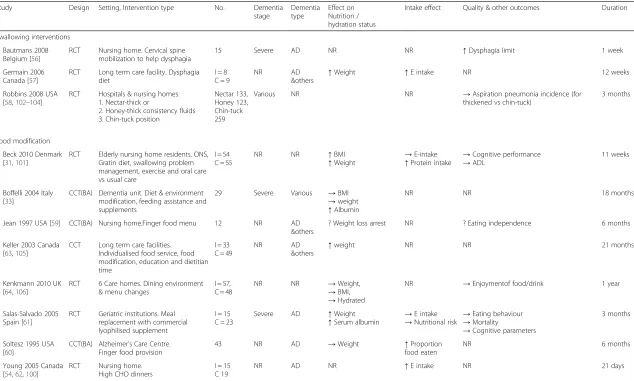
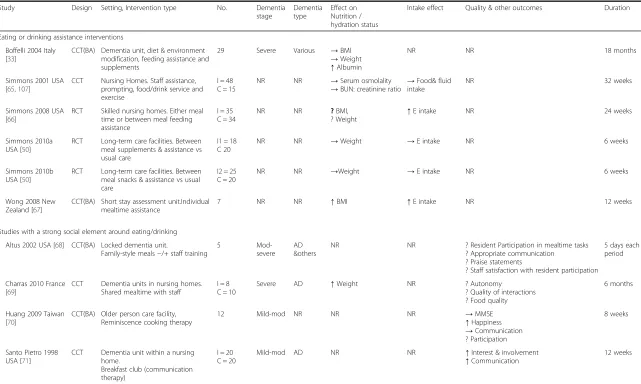
Direct interventions were categorised into: oral supple-ments, food/drink modification, swallowing problems man-agement, eating assistance and social support. Findings are presented under these headings below. Study characteristics and results are summarised in Tables 2 and 3, for full details of included studies see Additional file 2.
Oral nutrition supplement (ONS) interventions Effects of ONS
Twenty seven interventions (including approximately
1300 participants) [30–55] investigated effects of ONS.
We defined these as studies where any oral food or drink was offered in addition to standard provision (in-cluding commercial ONS preparations and additional snacks/drinks). In 19 interventions the supplement was the only intervention and compared to usual care or pla-cebo, whilst in two it was part of a multicomponent inter-vention [31, 33] and in four was compared to another intervention [48, 50, 54, 55]. Twenty studies were RCTs and six, CCTs. Study duration was from three to 80 weeks.
Few studies demonstrated low risk of selection bias, performance bias, detection bias or funding bias, and no studies were at low risk of bias overall (Additional file 3: Figure S3.1). Risk of attrition bias was low in over half of
Table 1Specific review questions formulated by members of the lay stakeholders, and the evidence found to address these questions
Area Questions from lay stakeholders Review findings
Type of dementia For people with different types of dementia (Alzheimer’s, vascular, dementia with Lewy bodies, other types or mixed types), what interventions can help to maintain or improve food intake or nutritional status and fluid intake or hydration status?
Less than half of studies indicated type of dementia of participants, but most that did enrolled people with AD. Results of 8 ONS studies including AD patients were not consistent - some studies reported improvement in nutritional status or intake, others no effect. Studies of other interventions were too few to compare or inform conclusions.
Stage of dementia What interventions can help to maintain or improve food intake or nutritional status and fluid intake or hydration status in people with mild cognitive impairment, mild/moderate/severe dementia?
Less than half of the studies had any data on stage of dementia of participants. Potential interventions are shown in Table4, but in studies of people with mild, moderate and/or severe dementia oral nutritional supplements (ONS) improved one or more markers of nutritional status (though usually not all markers, and only over short periods of time). Three studies of fruit juice supplements in people with mild cognitive impairment showed little effect. Shared mealtimes with staff and a commercial lyophilised food also appeared to improve some markers of nutritional status in people with severe dementia, while social interventions (supporting social interactions around food and drink) appeared to improve measures of participation, interactions, happiness, autonomy and involvement in people with mild, moderate and severe dementia.
Setting 1. For people with dementia living in residential care or residing in a medical setting, what interventions can help to maintain or improve food intake or nutritional status and fluid intake or hydration status?
2. For people with dementia living in their own homes with or without a carer (full-time or occasional; close relative or paid carer), what interventions can help to maintain or improve food intake or nutritional status and fluid intake or hydration status?
Most of the studies were conducted in various residential or nursing settings, and very few in participants own homes. Generally, effectiveness of interventions related to the effectiveness of interventions in residential settings.
Emotional and social issues For people with dementia, does emotional closeness of the carer (e.g. close relative vs paid carer) affect the outcomes?
Emotional closeness to the carer was not ever reported in studies, and carers generally appeared to be professional rather than family carers.
Meaningful Activity 1. For people with dementia, what interventions aimed at improving or maintaining food and/or fluid intake, nutrition or hydration status, support meaningful activity (activity around food or drink that is personally fulfilling, that people enjoy, look forward to or find important)?
2. For people with dementia, are there any interventions that decrease food or fluid intake, diminish enjoyment or quality of life, or diminish meaningful activity or social inclusion?
Few studies measured quality of life or happiness using a validated scale. However, some studies especially those with a strong social element (see main review) reported improved autonomy, involvement and interest of participants. Few interventions reported diminished intake or any poorer outcomes, except for a study that gave supplemental yogurt at breakfast, which resulted in reduced weight (possibly as the result of replacing rather than supplementing usual food)
Individualised interventions Do individualised interventions appear more effective than those that are not individualised, in helping people with dementia to maintain or improve food and/or drink intake, nutrition or hydration status (or related outcomes)?
Studies of ONS did not offer individualised interventions (based on needs and preferences of participants) beyond a choice of flavours, but the one study of individualised snacks did not suggest they were helpful. Multicomponent individualised interventions were more positive, suggesting useful effects on some nutritional outcomes. Individualised dysphagia diet and a multicomponent food modification diet appeared to improve weight, and individualised eating assistance was not clearly helpful.
Interventions around swallowing and oral hygiene
1. Do interventions to assess swallowing (and where necessary treat swallowing problems) have any effect on food or drink intake, nutrition
Studies assessing interventions for swallowing problems were generally inconclusive except that individual and multicomponent interventions
included studies. Due to lack of pre-registered proto-cols and details, most studies were judged at unclear risk of reporting and/or selection bias. Comparability of participants at baseline, suitability of outcomes mea-sured and dementia diagnosis appeared to be satisfac-tory in most studies.
Effects of interventions for swallowing problems Supplementary fruit juice
These studies assessed the effects of providing additional energy and protein using ONS. Of 17 RCTs included, 11 assessed the effects of ONS plus usual food vs usual food alone on weight or body mass index (BMI), and reported
Fig. 1EDWINA systematic review PRISMA flow diagram for studies of direct interventions*. *The number of interventions by category adds up to more than 43 (the total number of interventions in this paper) as several interventions were multicomponent, and so represented in several categories Table 1Specific review questions formulated by members of the lay stakeholders, and the evidence found to address these questions
(Continued)
or hydration status (or related outcomes)? 2. Do interventions to improve oral hygiene have any effect on food or drink intake, nutrition or hydration status (or related outcomes)?
including food modification appeared helpful in supporting nutritional status in several studies. No interventions aimed to improve oral hygiene.
Interventions in acute illness
Are there any interventions that are particularly effective in helping people with dementia to maintain or improve food and/or drink intake, nutrition or hydration status (or related outcomes) during periods of acute illness?
Only one study included people with acute illness. It provided ONS during acute illness and reported no change in nutritional status [52].
What are the most effective ways to encourage people with dementia to eat, drink and maintain nutritional intake? Information provided here is supplemental to the main findings of this review, and overall evidence is weak or lacking–the review does not definitively show that any intervention is either useful or not useful
Table 2Characteristics and results of included oral nutrition supplementation (ONS) interventions
Study Design Setting, supplement type Number completed
Dementia stage
Dementia type
Effect on nutrition or hydration status
Effect on intake of nutrients or fluid
Quality and Other outcomes
Duration
ONS (including energy, protein and often other nutrients) plus usual food vs. usual food (with or without placebo ONS)
Abalan 1992 France [30] RCT Geriatric inpatients. Proprietary ONS (‘Tonexis’) vs usual food
I = 15 C = 14
NR AD N/A →E intake ↑Cognitive function 15 weeks
Beck 2002 Denmark [32] RCT Nursing home (risk of malnourishment). Home-made ONS vs usual food
I = 8 C = 8
NR NR →Weight →E intake N/A 2 months
Carlsson 2009 Sweden [34] CCT (BA)
Group-living facilities for people with dementia. Drinkable yogurt
13 NR Mixed ↓Weight →E intake →Fluid intake
→Functional status 6 months
Carver 1995 UK [36] RCT Psychiatric hospital/elderly ward (under-weight).Proprietary ONS (‘Fortisip’) vs placebo
I = 20 C = 20
NR NR ↑Weight ↑* BMI →TSF ↑MAMC
N/A N/A 12 weeks
de Sousa 2012 Portugal [37] RCT Psychiatric hospital, geriatric unit, mild dementia patients (malnourished). ONS vs usual care & advice
I = 20 C = 15
Mild AD ↑Weight
↑BMI ↓
Nutritional risk →Functional status →Cognitive function
3 weeks
Faxen-Irving 2002 Sweden [38] CCT Group-living for people with dementia. ONS & diet advice vs usual care
I = 21 C = 12
Mixed Mixed ↑aWeight ↑a
BMI ↑‡TSF →AMC
N/A →ADL
↓Cognitive function
5 months
FICSIT Fiatarone Singh 2000 USA [39,
86–88]
RCT Nursing home (long term rehabilitation centre).
ONS vs placebo
I = 24 C = 26
NR NR ↑Weight
↑BMI →MAMA →TBW
→E intake →Fluid intake
→Functional status 10 weeks
FOPANU Carlsson 2011 Sweden [35,89,90]
RCT Residential care facilities.Protein-enriched drink (+/−exercise) vs placebo drink (+/−exercise)
I = 96 C = 95
NR NR →Weight →ICW
N/A →Balance →Gait
→Lower limb strength
3 months
Gregorio 2003 Spain [40] RCT Nursing home residents with AD. Proprietary ONS (‘Nutrison’) vs usual food
IG = 24 C = 74
Mod AD ↑*BMI ↓*Nutritional risk
N/A 12 months
Lauque 2000 France [44] RCT Nursing homes (risk of malnourishment). Proprietary ONS (Clinutren, Nestle) vs usual food
I = 19 C = 22
NR NR →Weight
→BMI ↑
E intake ↑Protein intake →
Grip strength 2 months
Lauque 2004 France [45] RCT Geriatric wards & day centres (risk of malnourishment). Proprietary ONS (Clinutren) vs usual food
I = 37 C = 43
Mod NR ↑Weight↑BMI ↑E intake
↓Nutritional risk →ADL
→Cognitive function →Eating behaviour
3 months
Manders 2009 Netherlands [46] RCT Nursing homes.ONS vs placebo I = 78 C = 33
NR NR ↑Weight ↑Calf circumference
N/A →Functional status →Grip strength →Cognitive status
24 weeks
Navrátilová 2007 Czech Republic [47] RCT Institutionalised residents with AD (type of institution unclear).Proprietary ONS (‘Nutridrink’) vs usual food
I = 50 C = 50
NR AD →Weight →BMI
↑†E intake
↑†Protein intake ↑Cognitive function 1 year
Pivi 2011 Brazil [55] RCT Setting unclear. Proprietary supplement (Ensure with FOS®) vs usual care
I = 26 C = 27
Mild-severe
AD ↑*Weight
↑*BMI
↑*AMC
↑*AC→TSF
N/A N/A 6 months
Planas 2004 Spain [48] CCT (BA)♣
Dementia care day centre.ONS +/−
micronutrients
I = 23 C = 21
Mild AD →BMI ↑MAMC ↑TSF
↑E intake →Cognitive function 6 months
Table 2Characteristics and results of included oral nutrition supplementation (ONS) interventions(Continued)
Study Design Setting, supplement type Number completed
Dementia stage
Dementia type
Effect on nutrition or hydration status
Effect on intake of nutrients or fluid
Quality and Other outcomes
Duration
Simmons 2010a USA [50] RCT Long-term care facilities, type unclear. Between meal nutritional supplements vs. usual care
I = 18 C = 20
NR NR →Weight →E intake ↑Costs & staff time 6 weeks
Souvenir I Scheltens 2010 USA & Europe [49,91–96]
CCT
(BA)♣ AD Treatment Centres.Proprietary ONS(Souvenaid) vs isocaloric placebo
I = 98 C = 97
Mild AD →BMI N/A →Cognitive function →QoL
12 & 24 weeks
Stange 2013 Germany [51,97–99]
RCT Nursing home (risk of malnutrition).ONS vs usual care
I = 45 C = 42
Mod-severe
NR ↑Weight →BMI ↑UAC
↑Calf circumference
→E intake →Protein intake →Nutritional risk
→Cognitive function →ADL
12 weeks
Wouters-Wesseling 2002 Netherlands [53]
RCT Nursing homes, residents with dementia.ONS vs placebo
I = 19 C = 16
NR Mixed ↑Weight →BMI
N/A →Functional status 12 weeks
Wouters-Wesseling 2006 Netherlands [52]
RCT Psychogeriatric nursing homes (with acute infection).ONS vs usual care
I = 18 C = 16
NR NR →Weight →TST →AMC
→E intake →Functional status 5 weeks
Young 2004 Canada [54,62,100]
RCT Dementia units within a nursing home. ONS vs high carbohydrate meals
I = 15 C = 19
NR AD ↑Weight ↑E intake ↑Protein intake
N/A 3 weeks
Fruit juice plus normal food vs control drink plus normal food
Krikorian 2010a USA [42] RCT Community-dwelling.Grape juice vs placebo I = 5 C = 7
MCI N/A →* Weight →* Waist
N/A ↑Learning, →Spatial awareness, →Recall
12 weeks
Krikorian 2010b USA [43] CCT Community-dwelling.Blueberry juice vs placebo
I = 9 C = 7
MCI N/A →* Weight →* Waist
N/A ? Cognition, ? Spatial awareness
12 weeks
Krikorian 2012 USA [41] RCT Community-dwelling.Grape juice vs placebo I = 10 C = 11
MCI N/A →Weight →Waist
N/A NR 16 weeks
Additional snacks between meals plus usual food vs usual food
Simmons 2010b USA [50] RCT Long-term care facilities.Between meal snacks & assistance vs usual care
I = 25 C = 20
NR NR →Weight →E intake ↑Costs ↑Staff time
6 weeks
Multicomponent interventions including ONS
Beck 2010 Denmark [31,101] RCT Elderly nursing home residents.ONS, Gratin diet, exercise, oral care vs usual care
I = 54 C = 55
NR NR ↑Weight ↑BMI
→E intake ↑Protein intake
→Cognitive performance →ADL
11 weeks
Boffelli 2004 Italy [33] CCT (BA)
Malnourished residents of dementia unit. Individualised diet including mealtime assistance, environmental modification and ONS if required
19 Severe Mixed →Weight →BMI ↑Serum albumin
N/A N/A 18 months
*Variance NR;†significance stated but nopvalues presented;‡Reported for females only;a
statistical significance reported in paper but change data not provided so significance does not appear in meta-analysis,
♣these were RCTs, but we used their data as before-after comparisons, so they are reported here as BA.
↑indicates statistically significant increase;↓indicates statistically significant reduction;→indicates no statistically significant effect; statistical significance of all effects were checked by reviewers where data were available, and reviewers results used when they differed from the original paper.
ADAlzheimer’s disease,ACArm Circumference,ADLactivities of daily living,AMCarm muscle circumference,BAbefore-after or pre-post,BMIbody mass index,Ccontrol group,CCTcontrolled clinical trial (with a concurrent control arm unless indicated as BA),CDRClinical Dementia Rating Scale,Ccontrol group,Eenergy,GDSGlobal Deterioration Scale,Iintervention group,ICWintracellular water,MAMAmid-arm muscle area, MAMCmid-arm muscle circumference,MCImild cognitive impairment,modmoderate,N/Anot applicable,NRnot reported,ONSoral nutritional supplement,QoLquality of life,RCTrandomised controlled trial,suppl supplement,TSFtriceps skin fold,TSTtriceps skin fold thickness,TBWtotal body water,UACupper arm circumference,vsversus
Abdelham
id
et
al.
BMC
Geriatrics
(2016) 16:26
Page
7
of
Table 3Characteristics and results of included food and drink modification, swallowing intervention, eating or drinking assistance and social support interventions Study Design Setting, Intervention type No. Dementia
stage
Dementia type
Effect on Nutrition / hydration status
Intake effect Quality & other outcomes Duration
Swallowing interventions
Bautmans 2008 Belgium [56]
RCT Nursing home. Cervical spine mobilization to help dysphagia
15 Severe AD NR NR ↑Dysphagia limit 1 week
Germain 2006 Canada [57]
RCT Long term care facility. Dysphagia diet
I = 8 C = 9
NR AD
&others
↑Weight ↑E intake NR 12 weeks
Robbins 2008 USA [58,102–104]
RCT Hospitals & nursing homes. 1. Nectar-thick or
2. Honey-thick consistency fluids 3. Chin-tuck position
Nectar 133, Honey 123, Chin-tuck 259
Various NR NR →Aspiration pneumonia incidence (for thickened vs chin-tuck)
3 months
Food modification
Beck 2010 Denmark [31,101]
RCT Elderly nursing home residents. ONS, Gratin diet, swallowing problem management, exercise and oral care vs usual care
I = 54 C = 55
NR NR ↑BMI
↑Weight
→E-intake
↑Protein intake
→Cognitive performance
→ADL
11 weeks
Boffelli 2004 Italy [33]
CCT(BA) Dementia unit. Diet & environment modification, feeding assistance and supplements
29 Severe Various →BMI
→weight
↑Albumin
NR NR 18 months
Jean 1997 USA [59] CCT(BA) Nursing home.Finger food menu 12 NR AD &others
? Weight loss arrest NR ? Eating independence 6 months
Keller 2003 Canada [63,105]
CCT Long term care facilities. Individualised food service, food modification, education and dietitian time
I = 33 C = 49
NR AD
&others
↑weight NR NR 21 months
Kenkmann 2010 UK [64,106]
RCT 6 Care homes. Dining environment & menu changes
I = 57, C = 48
NR NR →Weight,
→BMI,
→Hydrated
NR →Enjoymentof food/drink 1 year
Salas-Salvado 2005 Spain [61]
RCT Geriatric institutions. Meal replacement with commercial lyophilised supplement
I = 15 C = 23
Severe AD ↑Weight
↑Serum albumin
→E intake
→Nutritional risk
→Eating behaviour
→Mortality
→Cognitive parameters
3 months
Soltesz 1995 USA [60]
CCT(BA) Alzheimer’s Care Centre. Finger food provision
43 NR AD →Weight ↑Proportion food eaten
NR 6 months
Young 2005 Canada [54,62,100]
RCT Nursing home. High CHO dinners
I = 15 C 19
NR AD NR ↑E intake NR 21 days
Abdelham
id
et
al.
BMC
Geriatrics
(2016) 16:26
Page
8
of
Table 3Characteristics and results of included food and drink modification, swallowing intervention, eating or drinking assistance and social support interventions(Continued)
Study Design Setting, Intervention type No. Dementia stage
Dementia type
Effect on Nutrition / hydration status
Intake effect Quality & other outcomes Duration
Eating or drinking assistance interventions
Boffelli 2004 Italy [33]
CCT(BA) Dementia unit, diet & environment modification, feeding assistance and supplements
29 Severe Various →BMI
→Weight
↑Albumin
NR NR 18 months
Simmons 2001 USA [65,107]
CCT Nursing Homes. Staff assistance, prompting, food/drink service and exercise
I = 48 C = 15
NR NR →Serum osmolality
→BUN: creatinine ratio
→Food& fluid intake
NR 32 weeks
Simmons 2008 USA [66]
RCT Skilled nursing homes. Either meal time or between meal feeding assistance
I = 35 C = 34
NR NR ?BMI, ? Weight
↑E intake NR 24 weeks
Simmons 2010a USA [50]
RCT Long-term care facilities. Between meal supplements & assistance vs usual care
I1 = 18 C 20
NR NR →Weight →E intake NR 6 weeks
Simmons 2010b USA [50]
RCT Long-term care facilities. Between meal snacks & assistance vs usual care
I2 = 25 C = 20
NR NR →Weight →E intake NR 6 weeks
Wong 2008 New Zealand [67]
CCT(BA) Short stay assessment unit.Individual mealtime assistance
7 NR NR ↑BMI ↑E intake NR 12 weeks
Studies with a strong social element around eating/drinking
Altus 2002 USA [68] CCT(BA) Locked dementia unit.
Family-style meals−/+ staff training
5
Mod-severe AD &others
NR NR ? Resident Participation in mealtime tasks ? Appropriate communication ? Praise statements
? Staff satisfaction with resident participation
5 days each period
Charras 2010 France [69]
CCT Dementia units in nursing homes. Shared mealtime with staff
I = 8 C = 10
Severe AD ↑Weight NR ? Autonomy ? Quality of interactions ? Food quality
6 months
Huang 2009 Taiwan [70]
CCT(BA) Older person care facility, Reminiscence cooking therapy
12 Mild-mod NR NR NR →MMSE
↑Happiness
→Communication ? Participation
8 weeks
Santo Pietro 1998 USA [71]
CCT Dementia unit within a nursing home.
Breakfast club (communication therapy)
I = 20 C = 20
Mild-mod AD NR NR ↑Interest & involvement
↑Communication
12 weeks
↑indicates statistically significant increase;↓indicates statistically significant reduction;→indicates no statistically significant effect; ? indicates unclear whether effect was statistically significant. Statistical significance of all effects were checked by reviewers where data were available, and reviewers results used when they differed from the original paper.
ADAlzheimer’s disease,ADLactivities of daily living,BAbefore-after,BMIbody mass index,CCTcontrolled clinical trial,CGcontrol group,CHOCarbohydrate,Eenergy,IGintervention group,NRnot reported,ONSoral nutritional supplement,RCTrandomised controlled trial,vsversus
Abdelham
id
et
al.
BMC
Geriatrics
(2016) 16:26
Page
9
of
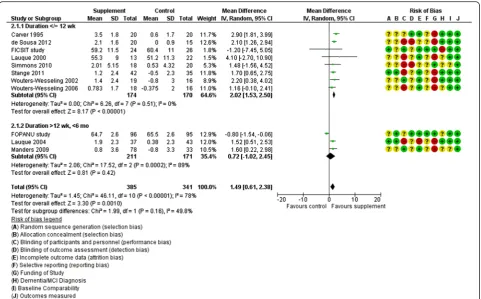
results that could be incorporated into meta-analysis. Duration of three was >12 weeks and meta-analysis sug-gested no statistically significant effect on weight (mean
difference [MD] 0.72 kg, 95 % CI−1.02-2.45, 382
partici-pants) but with high heterogeneity (I2 89 %) (Fig. 2).
One study [45] also assessed effects on BMI, suggesting
a small, statistically significant, increase of 0.64 kg/m2
(95 % CI 0.22-1.06, 80 participants) (Fig. 3).
Eight RCTs assessed effects over 3–12 weeks.
Meta-analysis suggested small, statistically significant, effects of supplementation on weight (2.02 kg, 95 % CI 1.53-2.50, 344
participants, I20 %, Fig. 2) and BMI (0.91 kg/m2, 95 % CI
0.56-1.25, I20 %, 221 participants, Fig. 3). Six RCTs either did not report weight or BMI [30], suggested no effect [32, 40, 47], or reported improvements but presented data in a form that could not be included in meta-analysis [48, 54]. We did not include CCT results in meta-analyses as they provide less valid data on effects. One CCT [38] reported significant weight gain (3.5 kg) compared to control after 5 months ONS (p = 0.003) while two RCTs [48, 49] (ana-lysed as before-after [BA] assessing effects of ONS compared to baseline) suggested no effect at six months on BMI.
Effects on other anthropometric measures were mixed: One RCT [36] reported positive effect on Mid-upper Arm Muscle Circumference but not on Triceps Skinfold Thick-ness; in three RCTs [46, 51, 55] Arm Muscle Circumfer-ence and/or calf circumferCircumfer-ence improved significantly; in a small Dutch RCT [52] there was no effect on Triceps Skinfold Thickness or Arm Muscle Circumference. One CCT [48] reported significantly increased Triceps Skinfold Thickness and Mid-Upper Arm Circumference.
Two RCTs [37, 45] assessed effects on Mini-Nutrition Assessment (MNA), and meta-analysis suggested signifi-cant improvement with supplementation (1.41 points, 95 % CI 1.06-1.75, I20 %, 115 participants, see Additional file 3:
Figure S3.2). Meta-analysis of six RCTs [39, 44, 45, 50–52]
suggested small statistically significant increases in energy
intake with ONS of 132 kcal/day (95 % CI 41–223, 279
par-ticipants, I214 %, Additional file 3: Figure S3.3).
Quality of life was measured in one RCT [51] with no significant effect on any of nine sub-scales for quality of
life, except ‘positive self-perception’ (p= 0.011), and no
effect on quality of life was found in the single CCT [49]. Functional status was assessed in several RCTs and CCTs but none found any effect (Table 2). Cognitive status was assessed in five RCTs and three CCTs. Three RCTs and all the CCTs found no effect [37, 38, 45, 48, 49, 51], while one RCT [30] reported an improvement of 6 points
in the MMSE score (p< 0.001, a surprising finding) and
another [47] reported slowing the rate of cognitive decline
(−1.3 vs. -3.7, p= 0.024). Hydration status was measured
in one RCT [39] which reported no effect.
Five RCTs [35, 37, 39, 40, 53] reported 40 deaths in 419 participants, but meta-analysis did not suggest any
effect of supplementation on mortality (RR 0.83, 95 % CI 0.43-1.61, Additional file 3: Figure S3.4).
Effects of food and drink modification Additional snacks between meals
Three studies assessed effects of fruit juice plus normal food vs control drink plus normal food. Two small RCTs [41, 42] examined effects of daily grape juice vs placebo for 12 or 16 weeks in community dwelling older adults with MCI, finding no significant effect on weight or waist circumference. One CCT [43] found no effect of 12 weeks of blueberry juice vs placebo in nine adults with MCI on weight, but suggested improvement of some memory tests (no clear numerical data presented, and control data utilised from another study) [42].
Effects of eating and drinking assistance Multicomponent interventions including ONS
A US RCT investigating energy intake and cost effective-ness of between-meal nutritious snacks in 45 nursing home residents [50] found no significant effect at five
weeks on weight (p= 0.66), or energy intake (p= 0.20).
Staff time increased (by 1.7 minutes/resident/offer), as
did product and staff costs (p< 0.01). A CCT [34] on 15
people living in Swedish dementia facilities reported
sig-nificant weight loss after six months drinkable probiotic
yogurt (−3.9 kg, SD 3.9, range−9.2-3), but no change in
energy or fluid intake.
Effects of interventions with a strong social element around eating and drinking
One RCT [31] tested effects of 11 weeks of ONS, man-agement of swallowing problems with soft pureed gratin diet, oral care and exercise vs usual care in 121 Danish dementia nursing home residents, finding improved weight
(1.3 % vs. -0.6 %, p = 0.005) and BMI (0.4 % vs. -0.2 %,p=
0.003). Energy intake (0.7 vs.-0.3 MJ/day, p= 0.084),
func-tional and cognitive status did not alter. A CCT [35] evalu-ated diet and environmental modification, increased nurse time and assistance at meals in 19 malnourished Italian dementia unit residents, finding increased serum albu-min (3.0 to 3.4 g/dL at 18 months) but no changes in weight or BMI.
Effects of interventions for swallowing problems
Swallowing interventions included interventions aiming to assess, treat or manage swallowing problems. Three
RCTs [56–58] assessed effectiveness of interventions to
support people with swallowing problems, two had low risk of selection bias [57, 58], all three had high or un-clear risk of performance bias and one [56] was at low risk of detection bias (Additional file 3: Figure S3.5). None was at low risk of bias overall, and meta-analysis was not possible due to differences in interventions.
One RCT [57] examined effectiveness of a dysphagia diet (reformed minced/pureéd foods and thickened fluids) vs standard diet in 17 cognitively impaired residents with weight loss and swallowing problems (their stage of de-mentia was not defined). Weight (+3.9 kg vs. -0.79 kg,
p= 0.02) and energy intake increased (p= 0.03). The
second RCT [58] compared thickened liquids vs chin-down drinking in aspirating patients (nutritional status and dementia stage were not defined) finding no differ-ences in aspiration pneumonia incidence or death (with no control group, it is unclear whether interventions were effective overall).
The third RCT [56] assessed one week cervical-spine mobilization vs therapist socialising visits in 15 people with severe AD and dysphagia. Dysphagia limit (maximal bolus of water swallowed in a single movement) increased from 3 to 10 ml (median), significantly greater than
con-trol (p= 0.03), but fluid intake and hydration status were
not measured.
Effects of food and drink modification
Food and drink modification included any modification to the food/drink itself, including nutritional or textural alterations and finger foods (except specifically for those with swallowing problems). All eight interventions were at high or unclear risk of selection, performance and de-tection biases, so none were at low risk of bias overall (Additional file 3: Figure S3.6. Meta-analyses were not possible due to differing interventions and outcomes.
Finger foods
Two CCTs [59, 60] assessed use of finger foods. One [59] evaluated six months of finger food menu for 12 cogni-tively impaired residents with poor intake and limited use of cutlery, finding weight-loss arrested in 10/12 partici-pants and eating independence improved (though no numbers or statistical analysis were provided). The other [60] assessed effects of increased finger food provision on weight and food consumption of 43 US AD care centre residents. The intervention, though aiming to increase numbers of finger foods provided, had implementation problems in that numbers of finger foods provided in-creased minimally (2.57 to 2.71 [breakfast]; 2.19 to 2.38 [lunch] and 2.0 to 3.8 [dinner]) over the six month study period. Body weight did not increase, though the propor-tion of food eaten increased by 3 % (p< 0.05).
Other food modification
Two RCTs [61, 62] assessed effects of food modification. Three months meal replacement with lyophilised (freeze-dried) foods and advice to residents and carers vs advice alone was investigated in 53 people with severe cognitive impairment [61], reporting improved weight
(+2.06 kg vs +0.32 kg, p< 0.05) and serum albumin
(3.76 mg/dl vs 1.13 mg/dl,p< 0.05), but no differences
in MNA, eating behaviour, cognition or mortality. A crossover RCT [62] assessed 21 days high-carbohydrate dinners compared to usual intake in 34 nursing home residents with AD. Energy intake increased, but weight was not presented for the first part of the crossover, so could not be assessed.
Food modification as part of multi-component interventions
One RCT [31] (discussed under multicomponent ONS interventions) and three CCTs [33, 63, 64] assessed food modification as part of multi-component interventions: One CCT [33] found increased serum albumin (3.0 to 3.4 g/dL) at 18 months in malnourished people with se-vere dementia living on a dementia unit, without effects on weight or BMI; the second [63] reported significant weight gain after nine months of enhanced dietetic time, high-energy snacks, high-energy/protein mashed pota-toes, high-protein milk and blended enhanced breakfasts
(4.8 % vs. -4.5 %, p< 0.001) in orally fed people with
dementia (dementia stage not stated); and the third [64] found that increased choice, ability to self-serve, improved atmosphere and readily available drinks and snacks had no effect on nutritional status, hydration or enjoyment of food in care home residents with low mean MMSE (not selected for cognitive or nutritional status).
Effects of eating and drinking assistance
Eating and drinking assistance was defined as direct physical assistance provided by carers, staff or volunteers to enable eating and/or drinking including use of aids and extra staff, but not verbal prompting. Six
interven-tions [33, 50, 65–67] assessed effects of eating or
drink-ing assistance, of which all were judged at high or unclear risk of selection and performance bias, while one was at low risk of detection bias, and none were at low risk of bias overall (Additional file 3: Figure S3.7). Meta-analysis was not possible due to differing interven-tions and outcomes. One RCT and one CCT investigated effects of eating assistance on nutritional status of people with dementia [66, 67]. A US study [66] randomised nursing home residents to individual assistance at mealtimes or between-meals vs usual care. Energy
in-take was higher with assistance (p= 0.03), but BMI and
weight (though measured) were not reported at 24 weeks. Staff time at 48 weeks was >42 minutes/meal/resident, and 14 minutes/snack/resident, and was <10 minutes/ meal/resident in the control group at 24 weeks. A CCT [67] (period 3) used volunteers to assist patients during mealtimes, reporting increased BMI (+0.4 kg/m2,p< 0.04)
and energy intake (+44Kcal, p< 0.001) after 12 weeks
(though it is surprising that such small changes were sta-tistically significant in seven participants).
Fig. 2Forest plot of the effect of RCTs of ONS plus usual food vs usual food alone on weight (in kg). * de Sousa 2012 [37], Simmons 2010 [50], Stange 2011 [51], Wouter-Wesseling 2002 [53] and 2006 [52] provided change data
Fig. 3Forest plot of the effect of RCTs of ONS plus usual food vs usual food alone on body mass index (in kg/m2)
Four interventions [33, 50, 65] had eating assistance as part of a multicomponent intervention: A CCT [33] (discussed above) included mealtime assistance, finding increased serum albumin at 18 months, without effects on weight or BMI; a complex 32-week CCT (including exercise, toileting and drinking prompts) [65] found no change in meal-time food or fluid intake, or hydration status; an RCT [50] provided assistance to enhance eat-ing intake and independence alongside between-meal nutritional supplements or nutritious snacks compared to usual care, finding no effect on weight or energy intake at five weeks, but with increased staff time and costs.
Effects of interventions with a strong social element around eating and drinking
Of four CCTs [68–71] which studied the promotion of
eating and/or drinking alongside a social activity or within a social context, all were at high or unclear risk of selection and performance bias, and one was at low risk of detection bias (Additional file 3: Figure S3.8). None was at low risk of bias overall.
Family-style meals in five US moderate-severe demen-tia unit residents were associated with increased resident participation in mealtime tasks, appropriate communi-cation, frequency of praise and carer satisfaction with residents’participation levels, but statistical significance was unclear [68]. Another study of family-style meals taken with staff [69] reported increased weight (+3.4 kg
vs−2.2 kg,p= 0.02) in18 patients with severe AD, while
comments and observations suggested improvements in autonomy, quality of interactions and other aspects of enjoyment of meals by patients. A study of reminis-cence cooking therapy in 12 Taiwanese mild-moderate dementia nursing home residents improved most per-sonal interaction scale items including feeling of
happi-ness (p= 0.01) and positive communication (p= 0.05)
[70]. A facilitated breakfast club compared to discussion with coffee in 40 people with mild-moderate AD in a de-mentia unit [71] reported significantly higher scores for interest, involvement and procedural memory, signifi-cantly better functional and cognition status.
Answers to questions from lay stakeholders
We found limited data to answer the questions formu-lated through public involvement (Table 1).
Discussion
To our knowledge, this is the first systematic review to assess the effectiveness of a full range of direct interven-tions aiming to improve, maintain or facilitate eating and drinking in adults with dementia of any type, any degree and in any setting. The 43 interventions investi-gated the effect of oral supplements, food/drink modifi-cation (including their use for people with swallowing
problems), eating assistance and social support. Most in-terventions occurred within residential institutions of vari-ous types, but three interventions on people with MCI
were in the community [41–43], one a treatment centre
(assumed to be an outpatient setting [72]), one in day cen-tres [48] and one unclear [55]. Included studies were mostly small (from five to 515 participants, with only
seven having≥100 participants [31, 35, 46, 47, 58, 64, 73]
and none were at low risk of bias.
Meta-analysis of RCTs of ONS suggest small, short term, statistically significant effects (of ONS with usual food compared to usual food alone) on weight, BMI, MNA and energy intake, but effects were too small to be clinically useful, and it is unclear whether these effects were sustained in the longer term (Figs. 2 and 3). There were no clear effects on the relevant and important out-comes quality of life, functional or cognitive status, hy-dration status or mortality, nor on fluid intake, and data on more useful nutritional outcomes (such as albumin or iron status markers) were rare. There was insufficient evidence to assess effects of fruit juice supplements, nu-trients without additional energy and protein or snacks between meals.
We found limited evidence that, for those with swal-lowing problems, dysphagia diets improved some nutri-tional markers [57]. Evidence for the utility of cervical spine mobilisation [56], different consistencies of thick-ened drinks, and chin-down drinking [58], were less clear. Effects of food modification were also mixed. In those unable to use cutlery, there was little evidence of finger food utility, with one study showing problems in implementation [60] and the other suggesting positive effects but with no numerical data provided [59]. In those with severe dementia there was some evidence that liquid or semi-liquid foods improved weight a little over 3 months (but not eating behaviour) [61]. Multi-component interventions including food modification increased weight and BMI in some cases [31, 63] but not others [33, 64].
Studies assessing effects of assistance with eating and drinking suggested little effect on nutritional outcomes. Studies assessing social interventions were small but consistently suggested the possibility of improving im-portant aspects of quality of life including autonomy, communication, mood, involvement and participation in meaningful activity in the context of food and drink [68–71].
As this systematic review did not find sufficient high quality evidence to state that any particular intervention was clearly effective, or clearly ineffective, we suggest that these interventions require further research. High quality, well designed randomised trials should be tai-lored specifically for people with dementia at different stages of the disease and in different settings. They
should include robust outcomes such as weight change to clarify nutritional status, serum osmolality to inform on hydration status and health outcomes (several studies re-ported improvements in intake, without accompanying improvements in nutritional status indicating that intake measures should be interpreted cautiously). Trials will ideally include input from people with dementia, and their formal and informal carers in study design. Trials should be powered to produce useful data and consider longer term effects (over at least 6 months) of interventions.
Despite no clear evidence of effectiveness, people with dementia and their carers regularly have to deal with problems around eating and drinking, including needing to be fed, food refusal, and swallowing difficulties [7]. For this reason, they may like to read about the different interventions that have been tested, and choose one or more of the interventions to help solve their own prob-lems. The possible interventions are detailed in Table 4.
While previous systematic reviews have assessed po-tential nutritional causes and prevention of dementia
[74–76], literature examining the effectiveness of
inter-ventions to support people with dementia to eat and drink well is more limited. Systematic reviews exploring effectiveness of interventions to support eating and drinking in people with dementia were either limited to residential care settings [23–25], focused on limited inter-ventions or outcomes [26], or carried out using limited or ill-described searches [27, 28], hence leaving evidence gaps.
Strengths and limitations
A strength of this systematic review is that after an exten-sive search we found a comprehenexten-sive set of interventions aiming to improve, maintain or facilitate eating and drink-ing in people with dementia and MCI. All study selection and data extraction was conducted in duplicate and we carried out meta-analyses where studies were appropri-ately similar in intervention, comparison and outcome, but this was only feasible for RCTs of ONS. The scope was enhanced by lay stakeholder input to ensure we inves-tigated relevant objectives. A limitation of our review may be that despite the extensive search, some studies might have been missed due to poor indexing and abstracts omit-ting to identify participants as having dementia or cognitive impairment. To overcome this, we included studies where cognitive scores suggested that most participants were cog-nitively impaired even when dementia was not mentioned or formally diagnosed.
We assessed interventions for swallowing problems in people with cognitive limitations, and found very limited evidence of the utility of interventions. However, whilst swallowing problems are common in people with de-mentia it is likely that results of research on interven-tions for people with swallowing problems but without dementia are transferrable to people with dementia, so the evidence base is much larger. Recent systematic re-views on interventions for people with swallowing prob-lems provide a fuller data set [77, 78].
Table 4Promising interventions that are presently unproven, but that warrant early reassessment in high quality and well powered RCTsa
Aim Potential interventions (presently unproven) which warrant early reassessment
Increase weight and/or BMI oOral Nutrition Supplements (ONS) (Figs.2and3)
oONS, gratin diet for those with swallowing problems, plus exercise and oral care (Beck) [31]
oDysphagia diet (reformed minced and pureed foods and thickened fluids) for those with swallowing problems (Germain) [57]
oMeal replacement with commercial lyophilised supplement (Salas-Salvado) [61]
oMultifactorial intervention including enhanced menu, individualised food service, more dietetic time, increased nutritional awareness and communication (Keller) [63]
oIndividual mealtime assistance (Wong) [67]
oShared mealtime with staff (Charras) [69]
Improve hydration oNo particularly useful interventions were noted, but cervical spine manipulation appeared to increase dysphagia limit for those with swallowing problems (Bautmans) [56]
Support meaningful engagement with food
and/or drink o
Eating with carers (Charras) [69]
oFamily style meals for people with dementia, enhanced further by staff training (Altus) [68]
oFacilitated breakfast club with supported involvement
in preparing, conversing, eating and clearing up (Santo Pietro) [71]
Improve quality of life oReminiscence cooking sessions (Huang 2009) [70]
Support eating independence oNo particularly useful interventions assessed
Improve quantity, quality or adequacy of food
or fluid intake o
Combination of ONS, gratin diet, exercise and oral care (Beck) [32]oFinger food provision (Soltesz) [60]
oHigh carbohydrate dinners (Young) [62]
oMeal time or between meal feeding
assistance, or individual mealtime assistance (Simmons 2008, Wong 2008) [66,67]
oDysphagia diet (reformed minced and pureed foods and thickened fluids) for those with swallowing problems (Germain) [57]
a
If you or someone you care for is experiencing difficulties with eating or drinking ALWAYS discuss these eating and drinking problems with your/their doctor, and ask to be referred to a dietitian and/or Speech and Language Therapist
As included studies often lacked details of dementia diagnosis, type and/or staging it was difficult to assess what interventions may be useful in different types and stages of dementia. There is also a lack of clear data on nutritional and hydration status of participants, and studies not choosing people with specific nutritional defi-cits may limit our ability to see effects of interventions on nutritional outcomes [79]. Eating and drinking problems differ at different dementia stages, so it is likely that inter-ventions will be stage- or problem-specific. Positive effects of nutritional supplements have been reported by other reviews [80, 81] but these reviews did not consider dur-ation. Previous reviews have not considered meaningful activity or quality of life as primary outcomes, despite sig-nificantly positive relationships between psychological
wellbeing and nutritional status in dementia [80–82].
Out-comes such as satisfaction, autonomy and quality of life have been highlighted in an expert-led research agenda as important determinants of interventions to improve food and fluid intake for older people, but were reported in few included studies [83]. The wide range of interventions and variable outcome measures reported make it difficult to compare results between studies.
Although we could not report definitive evidence on effectiveness of one or more interventions, by reviewing all available studies we have presented evidence on po-tentially useful interventions that could (and should) be considered for further research. We present a list of po-tentially useful interventions that need to be assessed in high quality and well powered RCTs to properly assess their efficacy (Table 4), and this may be a useful source of inspiration for people with dementia and their carers as suggestions to try out in dealing with specific eating and drinking problems, even though they have not been shown to be clearly effective. However, it should be noted that potentially effective interventions may not have appeared effective in this systematic review because many of the studies were underpowered, and so unable to suggest statistically significant benefits or harms.
Our finding that strong social support around food and drink are positive for quality of life is supported by
qualitative research in people with dementia that“eating
together reveals the essence of what it is to be human”
and mealtimes reflect identity and connections [84] and anthropological research suggesting that eating together is a core human activity important to building social groups [85]. This is a priority for the research agenda.
Conclusions
While we found no definitive evidence on effectiveness, or lack of effectiveness, of specific interventions, studies were small and short term. As people with cognitive im-pairment and their carers have to tackle eating problems despite this lack of evidence, promising interventions
have been listed and include: Oral nutrition supple-ments; pureed and reformed foods; thickened fluids; in-dividual mealtime or between-meal assistance; family style meals and meals shared with staff or carers; meals with a facilitated social element; reminiscence cooking; finger food provision. The need remains for high quality trials tailored for people with progressive cognitive im-pairment and their carers assessing robust and relevant outcomes.
Additional files
Additional file 1:Full systematic review methodology for EDWINA (Eating and Drinking Well IN dementiA) systematic review.
(DOCX 31 kb)
Additional file 2:Detailed characteristics of direct intervention EDWINA (Eating and Drinking Well IN dementiA) included studies.
(DOCX 125 kb)
Additional file 3:Summary of study validity and further meta-analysis results of direct interventions.(DOCX 136 kb)
Abbreviations
CCT:non-randomised controlled trial; EDWINA: Eating and Drinking Well IN dementiA study; MCI: mild cognitive impairment; ONS: oral nutrition supplements; RCT: randomised controlled trial.
Competing interests
No authors declare a conflict of interest, except that one of the review authors is an author of one of the included studies in this systematic review. This study was assessed for inclusion, data extracted and assessed for validity by other reviewers, without reference to the paper’s author.
Authors’contributions
The review idea was conceived by LH, FP and CF. AA managed the review. AA and LH drafted the protocol with expert and stakeholder input from MC, VC, AD, AH, AK, JP, KR, DS and CF. AA and LH designed the searches and AA ran the searches. AA and LH screened studies for inclusion/exclusion. AA extracted data and assessed study quality. DB, AD, CF, LG, AK, FL, JL, KR, and LH duplicated the data extraction and quality assessment. AA, DB and LH conducted the analysis and drafted the review. All authors commented on and approved the final draft.
Acknowledgments
We are grateful to all our lay stakeholders who contributed questions, thoughts and ideas to the systematic review protocol. We are also grateful to authors Dr Mary Coyne and Dr Patricia Heyn for providing further data/ publications on their studies. This article summarises independent research funded in part by the National Institute for Health Research (NIHR), Collaboration for Leadership in Applied Health Research & Care, East of England (CLAHRC EoE), and in part by the National Institute of Health Research Fellowship programme (NIHR-CDF-2011-04-025). The views expressed are those of the authors and not necessarily those of the NHS, the NIHR or the Department of Health. The funders had no part in the collection, analysis or interpretation of data; in the writing of the report; and in the decision to submit the article for publication.
Author details
1Norwich Medical School, University of East Anglia, Norwich Research Park,
Norfolk NR4 7TJ, UK.2Age UK Norfolk, 300 St Faith’s Road, Old Catton, Norwich NR6 7BJ, UK.3NorseCare, Lancaster House 16 Central Avenue St
Andrew’s Business Park, Norwich NR7 0HR, UK.4School of Health and Social
Work, University of Hertfordshire, Hatfield, Hertfordshire AL10 9AB, UK.
5
School of Health Sciences, University of East Anglia, Norwich Research Park, Norfolk NR4 7TJ, UK.6Norfolk and Norwich University Hospital, Colney Lane,
Norwich NR4 7UY, UK.7King’s College Hospital NHS Foundation Trust,
Denmark Hill, London SE5 9RS, UK.8Norfolk and Suffolk NHS Foundation
Trust, Hellesdon Hospital, Drayton High Road, Norwich NR6 5BE, UK.9Present
address: Royal College of Paediatrics and Child Health, 5-11 Theobalds Road, London WC1X 8SH, UK.
Received: 27 September 2015 Accepted: 12 January 2016 Published: 22 January 2016
References
1. Abdelhamid A, Bunn D, Dickinson A, Killett A, Poland F, Potter J et al.: Effectiveness of interventions to improve, maintain or faciltate oral food and/or drink intake in people with dementia.PROSPERO2014, CRD42014007611: http://www.crd.york.ac.uk/PROSPERO/display_record. asp?ID=CRD42014007611 .
2. World Health Organization: Dementia: Fact sheet N°362. accessed 25 08 2015: http://www.who.int/mediacentre/factsheets/fs362/en/; 2015. 3. Alzheimer’s Disease International: World Alzheimer Report 2009: The Global
Prevalence of Dementia. accessed 25 08 2015: http://www.alz.co.uk/ research/world-report-2009; 2015.
4. Prince M, Bryce R, Albanese E, Wimo A, Ribeiro W, Ferri CP. The global prevalence of dementia: a systematic review and metaanalysis. Alzheimers Dement. 2013;9:63–75.
5. Corrada MM, Brookmeyer R, Paganini AM, Berlau D, Kawas CH. Dementia Incidence Continues to Increase with Age in the Oldest Old The 90+ Study. Ann Neurol. 2010;67:114–21.
6. Matthews FE, Arthur A, Barnes LE, Bond J, Jagger C, Robinson L, et al. A two-decade comparison of prevalence of dementia in individuals aged 65 years and older from three geographical areas of England: results of the Cognitive Function and Ageing Study I and II. Lancet. 2013;302:105–12. 7. Volicer L, Seltzer B, Rheaume Y, Karner J, Glennon M, Riley ME, et al. Eating
Difficulties in Patients With Probable Dementia of the Alzheimer Type. J Geriatr Psychiatry Neurol. 1989;2:188–95.
8. Alzheimer’s Society, James Lind Alliance. Outcomes of the James Lind Alliance Dementia priority setting partnership. 2013. http://alzheimers.org.uk/site/scripts/ documents_info.php?documentID=1804, accessed 25 08 2015, Alzheimer’s Society.
9. Morley JE, Caplan G, Cesari M, Dong B, Flaherty JH, Grossberg GT, et al. International survey of nursing home research priorities. J Am Med Dir Assoc. 2014;15:309–12.
10. Camina Martin MA, Barrera Ortega S, Dominguez Rodriguez L, Couceiro Muino C, de Mateo SB, del Rio MP R. Presence of malnutrition and risk of malnutrition in institutionalized elderly with dementia according to the type and deterioration stage. Nutr Hosp. 2012;27:434–40.
11. Haveman-Nies A, de Groot LC, Van Staveren WA. Fluid intake of elderly Europeans. The Journal of Nutrition, Health and Aging. 1997;1:151–5. 12. Jesus P, Desport JC, Massoulard A, Villemonteix C, Baptiste A, Gindre-Poulvelarie L,
et al. Nutritional assessment and follow-up of residents with and without dementia in nursing homes in the Limousin region of France: a health network initiative. J Nutr Health Aging. 2012;16:504–8.
13. Siervo M, Bunn D, Prado C, Hooper L. Accuracy of prediction equations for serum osmolarity in frail older people with and without diabetes. Am J Clin Nutr. 2014;100:867–76.
14. Natalwala A, Potluri R, Uppal H, Heun R. Reasons for hospital admissions in dementia patients in Birmingham, UK, during 2002–2007. Dement Geriatr Cogn Disord. 2008;26:499–505.
15. Hooper L, Bunn D, Jimoh FO, Fairweather-Tait SJ. Water-loss dehydration and aging. Mech Ageing Dev. 2014;136–7:50–8.
16. Feehally J, Khosravi M. Effects of acute and chronic hypohydration on kidney health and function. Nutr Rev. 2015;73:110–9.
17. Elmadfa I, Meyer AL. Patterns of drinking and eating across the European Union: implications for hydration status. Nutr Rev. 2015;73:141–7. 18. Abdelhamid A, Bunn DK, Copley M, Cowap V, Dickinson A, Howe A, et al.
Indirect interventions to for improving, maintaining or facilitating oral food and/or drink intake in people with dementia: a systematic review. Submitted. 2015.
19. Alzheimer’s Disease International: World Alzheimer Report 2013: An analysis of long-term care for dementia. accessed 25 08 2015: http://www.alz.co.uk/ research/world-report-2013; 2013.
20. Higgins JPT, Green S. Cochrane Handbook for Systematic Reviews of Interventions Version 5.1.0 [updated March 2011]. http://handbook. cochrane.org/. 2011. The Cochrane Collaboration. 25-8-2015.
21. Moher D, Liberati A, Tetzlaff J, Altman DG, The PRISMA Group. Preferred Reporting Items for Systematic Reviews and Meta-Analyses: The PRISMA Statement. PLoS Med. 2009;6, e1000097.
22. Hooper L, Abdelhamid A, Atreed NJ, Campbell WW, Chassagne P, Channell AM, et al. Clinical symptoms, signs and tests for identification of impending and current water-loss dehydration in older people. Cochrane Database Syst Rev. 2015;2015, CD009647.
23. Hines S, McCrow J, Abbey J, Gledhill S. Thickened fluids for people with dementia in residential aged care facilities: a comprehensive systematic review. JBI Database of Systematic Reviews and Implementation Reports. 2009;7:761–824.
24. Hines S, Wilson J, McCrow J, Abbey J, Sacre S. Oral liquid nutritional supplements for people with dementia in residential aged care facilities: a systematic review. JBI Database of Systematic Reviews and Implementation Reports. 2010;8:1–52.
25. Jackson J, Currie K, Graham C, Robb Y. The effectiveness of interventions to reduce undernutrition and promote eating in older adults with dementia: A systematic review. JBI Database of Systematic Reviews and Implementation Reports. 2011;9:1509–50.
26. Whear R, Abbott R, Thompson-Coon J, Bethel A, Rogers M, Hemsley A, et al. Effectiveness of mealtime interventions on behavior symptoms of people with dementia living in care homes: a systematic review. J Am Med Dir Assoc. 2014;15:185–93.
27. Alagiakrishnan K, Bhanji RA, Kurian M. Evaluation and management of oropharyngeal dysphagia in different types of dementia: a systematic review. Arch Gerontol Geriatr. 2013;56:1–9.
28. Hanson LC, Ersek M, Gilliam R, Carey TS. Oral feeding options for people with dementia: a systematic review. J Am Geriatr Soc. 2011;59:463–72. 29. Higgins JPT, Altman DG, Gotzsche PC, Juni P, Moher D, Oxman AD, et al.
The Cochrane Collaboration's tool for assessing risk of bias in randomised trials. Br Med J. 2011;343:d5928.
30. Abalan F, Manciet G, Dartigues JF, Decamps A, Zapata E, Saumtally B, et al. Nutrition and SDAT. Biol Psychiatry. 1992;31:103–5.
31. Beck AM, Damkjaer K, Sørbye LW. Physical and social functional abilities seem to be maintained by a multifaceted randomized controlled nutritional intervention among old (>65 years) Danish nursing home residents. Arch Gerontol Geriatr. 2010;50:351–5.
32. Beck AM, Ovesen L, Schroll M. Home-made oral supplement as nutritional support of old nursing home residents, who are undernourished or at risk of undernutrition based on the MNA. A pilot trial. Aging Clin Exp Res. 2002;14:212–5.
33. Boffelli S, Rozzini R, Trabucci M. Nutritional Intervention in Special Care Units for Dementia. J Am Geriatr Soc. 2004;52:1216–7.
34. Carlsson M, Gustafson Y, Haglin L, Eriksson S. The feasibility of serving liquid yoghurt supplemented with probiotic bacteria, Lactobacillus rhamnosus LB 21, and Lactococcus lactis L1A - A pilot study among old people with dementia in a residential care facility. J Nutr Health Aging. 2009;13:813–9. 35. Carlsson M, Littbrand H, Gustafson Y, Lundin-Olsson L, Lindelof N, Rosendahl E,
et al. Effects of high-intensity exercise and protein supplement on muscle mass in ADL dependent older people with and without malnutrition: a randomized controlled trial. J Nutr Health Aging. 2011;15:554–60.
36. Carver AD, Dobson AM. Effects of dietary supplementation of elderly demented hospital residents. J Hum Nutr Diet. 1995;8:389–94.
37. de Sousa OL, Amaral TF. Three-week nutritional supplementation effect on long-term nutritional status of patients with mild Alzheimer Disease. Alzheimer Dis Assoc Disord. 2012;26:119–23.
38. Faxen-Irving G, Andren-Olsson B, af Geijerstam A, Basun H, Cederholm T. The effect of nutritional intervention in elderly subjects residing in group-living for the demented. Eur J Clin Nutr. 2002;56:221–7.
39. Fiatarone Singh MA, Bernstein MA, Ryan AD, O'Neill EF, Clements KM, Evans WJ. The effect of oral nutritional supplements on habitual dietary quality and quantity in frail elders. J Nutr Health Aging. 2000;4:5–12.
40. Gregorio PG, Diaz SPR, Casado JMR. Dementia and Nutrition. Intervention study in institutionalized patients with Alzheimer Disease. J Nutr Health Aging. 2003;7:304–8.
41. Krikorian R, Boespflug EL, Fleck DE, Stein AL, Wightman JD, Shidler MD, et al. Concord grape juice supplementation and neurocognitive function in human aging. J Agric Food Chem. 2012;60:5736–42.
42. Krikorian R, Nash TA, Shidler MD, Shukitt-Hale B, Joseph JA. Concord grape juice supplementation improves memory function in older adults with mild cognitive impairment. Br J Nutr. 2010;103:730–4.