R E S E A R C H A R T I C L E
Open Access
Assessing pre- and postoperative activity
levels with an accelerometer: a proof of
concept study
Eva van der Meij
1,2*, Hidde P. van der Ploeg
1, Baukje van den Heuvel
3, Boudewijn J. Dwars
4,
W. J. H. Jeroen Meijerink
5, H. Jaap Bonjer
5, Judith A. F. Huirne
1,2and Johannes R. Anema
1*Abstract
Background:Postoperative recovery after abdominal surgery is measured mostly based on subjective or self-reported data. In this article we aim to evaluate whether recovery of daily physical activity levels can be measured
postoperatively with the use of an accelerometer.
Methods:In this multicenter, observational pilot study, 30 patients undergoing laparoscopic abdominal surgery (hysterectomy, adnexal surgery, cholecystectomy and hernia inguinal surgery) were included. Patients were instructed to wear an Actigraph wGT3X-BT accelerometer during one week before surgery (baseline) and during the first, third and fifth week after surgery. Wear time, steps taken and physical activity intensity levels (sedentary, light, moderate and vigorous) were measured. Patients were blinded for the accelerometer outcomes. Additionally, an activity diary comprising patients’ self-reported time of being recovered and a list of 18 activities, in which the dates of resumption of these 18 activities were recorded after surgery, was completed by the patient.
Results:Five patients were excluded from analyses because of technical problems with the accelerometer (n= 1) and protocol non-adherence (n= 4). Light, moderate, vigorous, combined moderate and vigorous intensity physical activity (MVPA), and step counts showed a clear recovery curve after surgery. Patients who underwent minor surgery reached their baseline step count and MVPA three weeks after surgery. Patients who underwent intermediate surgery had not yet reached their baseline step count during the last measuring week (five weeks after surgery). The results of the activity diaries showed a fair agreement with the accelerometer results (Cohens Kappa range: 0.273-0.391). Wearing the accelerometer was well tolerated and not regarded as being burdensome by the patients.
Conclusions:The accelerometer appeared to be a feasible way to measure recovery of postoperative physical activity levels in this study and was well tolerated by the patients. The agreement with self-reported physical recovery times was fair.
Keywords:Accelerometer, Physical activities, Postoperative recovery, Abdominal surgery, Inguinal hernia surgery, Cholecystectomy, Hysterectomy, Adnexal surgery
* Correspondence:[email protected];[email protected]
1Department of Public and Occupational Health, EMGO+ Institute for Health
and Care Research, VU University Medical Center, van der Boechorsstraat 7, 1081 BT Amsterdam, The Netherlands
Full list of author information is available at the end of the article
Background
Postoperative recovery is an essential component of surgical therapy. Innovation of surgical techniques and the development of interventions aiming to enhance the recovery process, necessitate tools to measure recovery [1–5]. A frequently used standard to measure postoperative recovery is length of hospital stay, because it provides us with a well-defined and objective definition [6]. However, an increasing number of operations are performed as day surgeries and hospital stay has decreased generally over the last decade [7]. Patients are not fully recovered at time of discharge and subsequently, hospital stay does not correlate with postoperative recovery. Currently, a wide variation of instruments and outcomes are used to determine postoperative recovery, such as quality of life, satisfaction, pain, recovery indices and return to normal activities [1, 8–10]. Unfortunately, all of these measuring instruments are subjective and self-reported and therefore prone to measurement bias [1].
In physical activity research, accelerometers are used as an objective measure of physical activity and sedentary behaviors [11, 12]. Furthermore, activity monitors such as pedometers and the now widely commercially available wearables are used to promote physical activity, for example as behavior change tool in trying to prevent and manage obesity [13, 14]. Promoting physical activity is an important element in medical care as well, for example in the prevention of postoperative complications such as pneumonia, decubitus and deep venous thrombosis [15–17]. The use of accelerometers in postoperative care seems therefore logical, not only to measure postoperative physical activity levels, but also as a tool to stimulate physical activities after surgery.
Some earlier research has been carried out with accel-erometers in perioperative care, but these studies have focused on a relatively short postoperative period or used the accelerometer as an intervention to stimulate physical activities [18–20]. Therefore, data representing the normal recovery process measured with an accele-rometer are lacking. In this observational pilot study we will measure physical activities during four moments of one week each in the postoperative period. We aim to evaluate:
1) Whether recovery of physical activity levels can be measured postoperatively with the use of an accelerometer.
2) Whether the physical activity results measured with the accelerometer correspond with self-reported re-covery of physical activity levels.
3) Whether the use of an accelerometer in the postoperative course is feasible and accepted by patients.
Methods Study design
A multicenter, observational pilot study was conducted including 30 patients. Two teaching hospitals in Amsterdam, the Netherlands participated in the study. All patients waiting for surgery, who met the inclusion criteria, were approached for participation and signed informed consent. Patients received a gift card of 50 euros after completing the study. The study was con-ducted in accordance with the STROBE statement [21]. The study was approved by the local medical ethics committee of the VU medical center with registration number 2014.364.
Population
Patients between 18 and 75 years old, who were on the waiting list for the following type of surgeries were in-cluded: laparoscopic hysterectomy, laparoscopic adnexal surgery, laparoscopic cholecystectomy and laparoscopic inguinal hernia repair. These procedures were selected since we aimed to include a various sample of procedures because of the proof of concept design of the study and these are commonly applied surgical and gynecological procedures in the Netherlands. Laparoscopic hysterec-tomy was defined as intermediate surgery and laparo-scopic adnexal surgery, laparolaparo-scopic cholecystectomy and laparoscopic inguinal hernia repair as minor surgery. This subdivision is based on a classification which has been used previously in gynecologic surgery [22, 23]. The general surgical procedures were classified in line with these classifications. We based the latter on Delphi based recommendations among experts for resumption of normal activities after various surgical procedures in gynecology and general surgery [24, 25]. Exclusion criteria were: (suspicion of ) malignancy, deep infiltrating endo-metriosis, less than one week of waiting between identifi-cation and surgery, lack of understanding of the study information or insufficient Dutch language proficiency.
Outcome measures
Physical activities–Accelerometer
converts accelerations into activity counts based on a company algorithm. Activity counts are summed up and stored over a set time period (epoch). Accelerometer data was cleaned in 60 second epochs in order to capture health enhancing physical activities in line with the protocol used in NHANES [26]. Non-wear time was defined as≥60 minutes of no activity (consecutive zeroes, allowing for two interruptions of <100 counts). A valid day was defined as having a minimum of 10 h per day wear time, with the exception for the first week after surgery when a valid day was defined as six hours of wear time per day. This was done as patients were more bedridden in this week and often did not wear the acce-lerometer when in bed. Participants needed a minimum of four valid days per measuring week, to be included in the analyses. Steps taken and time spent in different intensity levels were used as outcomes. Existing cut-off points were used for the vertical axis of the accelero-meter, in order to determine time spent in sedentary time (<100 counts/min), and light- (100–2019 counts/ min), moderate- (2020–5998 counts/min) and vigorous intensity physical activity (≥5999 counts/min) [26].
Physical activities–Activity diary
Patients completed an activity diary after surgery, in which they recorded the first date they were able to perform a specific activity. This comprises a newly developed list of 18 activities (Additional file 1). Patients were instructed to fill in the dates on which they felt they had returned to their normal activity level for each of the 18 activities on the list. Patients were provided with the option to fill in
‘not applicable’ where appropriate. In addition the list contained two questions‘when did you feel physically re-covered’and‘when did you feel fully recovered (physically and mentally)’. After five weeks patients were asked to return the list. When patients had not returned to their normal activity level regarding an activity, the date was censored on five weeks after surgery. The list was based on an earlier study of our research group in which patients could make their own reco-very advice based on recommendations which were developed in a Delphi study [24, 25].
Feasibility - Feasibility questionnaire
We evaluated the feasibility of the accelerometer with a number of questions five weeks after surgery (Additional file 2). These questions concerned compliance, burden and usability of the accelerometer.
Statistical analyses
Mean step count and physical activity intensity level were calculated per measuring day and per measuring week, using only valid days. The definition for recovery of physical activity levels was that the mean activity level
was at 90% or above of the mean baseline activity level, a definition which is commonly used in similar type of research [19]. This was calculated for both step count and mean moderate physical activity intensity (MVPA). Comparing normally distributed scale variables between two subgroups was performed using the independent-SamplesT test. When a scale variable was not normally distributed, the Mann-Whitney U test was used. Com-paring nominal variables between two subgroups was done using the X2 test. Repeated-measures ANOVA were used to compare the mean counts of the accele-rometers between the different time points. A signifi-cance level of p< 0.05 was considered. Agreement between the accelerometer and the activity diary was quantified using Cohens kappa. A Cohen kappa of≤0 was considered as no agreement, 0.01–0.20 as none to slight agreement, 0.21–0.40 as fair agreement, 0.41–0.60 as moderate agreement, 0.61–0.80 as substantial agree-ment, and 0.81–1.00 as perfect agreement [27].
Results Participants
Between September 2014 and July 2015 we identified 106 patients from the surgery waiting list. In 20 patients surgery had already been carried out (n= 11), surgery had been cancelled (n= 7), or we had not been able to reach them in time (n= 2). Of the 86 patients assessed for eligibility, 30 patients (34.9%) participated in the study. The main reason for non-participation was that patients were not interested in study participation (Fig. 1). Comparison between the patients who participated and those who did not, revealed no statistically significant dif-ferences regarding demographic characteristics (gender, age, social economic status) and health related characteris-tics (type of surgery, American Society of Anesthesiolo-gists (ASA) classification and body mass index (BMI)).
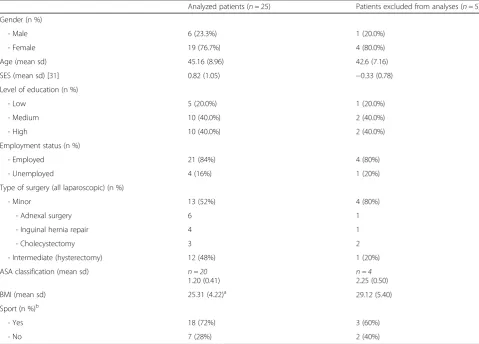
All 30 included patients completed the study. Data of 25 patients were used for analyses (Table 1). Data of five pa-tients were not used for analyses due to an accelerometer error (n= 1) or not meeting the accelerometer wearing criteria (n= 4). Most patients were female (76.7%), the mean age was 44.3 years old and most patients were employed (83.3%). Seventeen patients underwent minor surgery and 13 patients underwent intermediate surgery. There were no major differences in baseline characteristics between patients who were analyzed and those whose data were not used for the analyses, except for BMI which was higher in the group of patients excluded from analyses.
Results of the accelerometer
comparison to the value of T0 (baseline measure-ment). The mean number of valid days per week was similar for each measuring week. The mean wear time per day differed significantly between the different measuring weeks (p< 0.001) with the longest wear time during T0. Of the different physical activity in-tensity levels, light, moderate, vigorous, combined moderate and vigorous activities (MVPA) and step count differed significantly per measuring week, thus
representing the clearest recovery curves after surgery. Mean min/day moderate physical activity and MVPA on T3 were not significantly different from T0, indicating that baseline levels were reached at this moment.
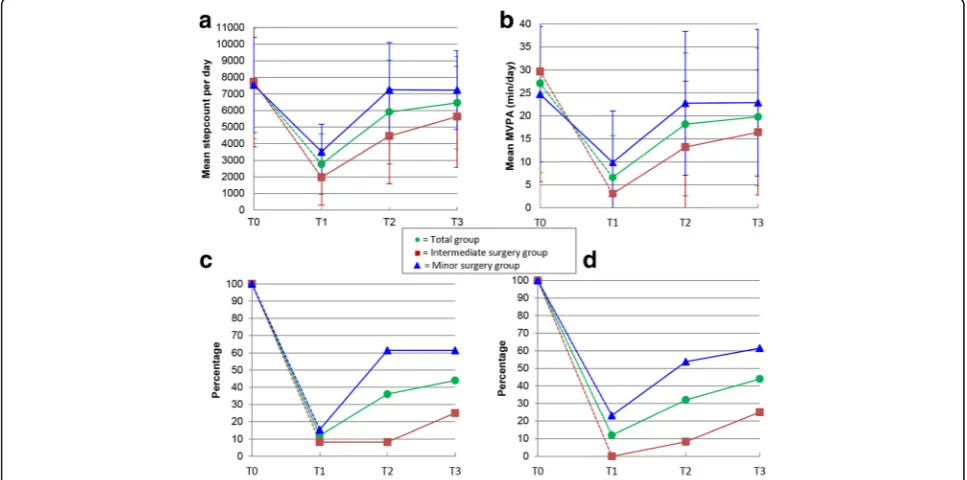
In Fig. 2 the mean step count (2A) and MVPA (2B) levels per measuring week are graphically displayed, for the total group and according to type of surgery. For the group of patients who underwent minor surgery, mean step count and MVPA differed significantly on T1
Fig. 1Flowchart
Table 1Characteristics of the analyzed patients
Analyzed patients (n= 25) Patients excluded from analyses (n= 5)
Gender (n %)
- Male 6 (23.3%) 1 (20.0%)
- Female 19 (76.7%) 4 (80.0%)
Age (mean sd) 45.16 (8.96) 42.6 (7.16)
SES (mean sd) [31] 0.82 (1.05) −0.33 (0.78)
Level of education (n %)
- Low 5 (20.0%) 1 (20.0%)
- Medium 10 (40.0%) 2 (40.0%)
- High 10 (40.0%) 2 (40.0%)
Employment status (n %)
- Employed 21 (84%) 4 (80%)
- Unemployed 4 (16%) 1 (20%)
Type of surgery (all laparoscopic) (n %)
- Minor 13 (52%) 4 (80%)
- Adnexal surgery 6 1
- Inguinal hernia repair 4 1
- Cholecystectomy 3 2
- Intermediate (hysterectomy) 12 (48%) 1 (20%)
ASA classification (mean sd) n = 20
1.20 (0.41) n = 42.25 (0.50)
BMI (mean sd) 25.31 (4.22)a 29.12 (5.40)
Sport (n %)b
- Yes 18 (72%) 3 (60%)
- No 7 (28%) 2 (40%)
SESSocial Economic Status. Scores are based on geographic location,ASAAmerican Society of Anesthesiologists classification,BMIBody Mass Index
a
Significantly lower in the analyzed patients compared to the patients whose data were not used for the analyses
b
compared to T0, but this was no longer the case on T2 (p= 0.650 and p= 0.543 respectively), indicating that these group of patients had achieved their mean baseline step count and MVPA three weeks after surgery. How-ever the group of patients who had undergone inter-mediate surgery had not even achieved their mean baseline step count and MVPA five weeks after surgery (difference between T3 and T0 p= 0.007 and p= 0.022 respectively). When determining whether or not each in-dividual patient has achieved his or her own baseline step count (2C) or MVPA (2D), the graph shows a different pattern. In contrast to what graph 2A and 2B
suggests, graphs 2C and 2D show that only 44% of the patients had reached their baseline step count and MVPA within five weeks after surgery (61.5% (8/13) of the patients who underwent minor surgery and 25% (3/ 12) for the intermediate surgery patients). This illus-trated the individual variations between patients, with some patients surpassing their baseline levels (n= 8), which increases the mean group levels. Patients who did not reach their baseline step count five weeks after surgery (n= 11) on average achieved 69.45% of their baseline step count (range 43.57–89.40%). For MVPA this was 50.7% with a range of 17.95–89.43%.
Table 2Mean accelerometer data (n= 25), based on valid days
One week before surgery (T0)
One week after surgery (T1)
Three weeks after surgery (T2)
Five weeks after surgery (T3) P
-value for time trend‡
Mean min/daywear timeper day (SD) 869 (64.18) 709 (109.71)* 815 (71.62)* 822 (71.72)* <0.001
Mean number ofvalid daysper week (SD)† 6.24 (1.10) 5.76 (1.16) 6.16 (1.03) 6.20 (0.96) 0.175
Mean min/daysedentary physical activity(SD) 548 (101.67) 554 (83.62) 549 (78.49) 534 (91.81) 0.674
Mean min/daylight physical activityintensity (SD) 294 (85.86) 148 (76.98)* 248 (94.89)* 268 (85.70)* <0.001
Mean min/daymoderate physical activityintensity (SD) 26.08 (19.23) 6.53 (8.93)* 17.76 (15.16)* 19.47 (14.94) <0.001
Mean min/dayvigorous physical activityintensity (SD) 1.02 (2.30) 0.08 (0.28) 0.41 (1.19) 0.31 (1.31) 0.089
Mean min/daymoderate and vigorous physical activity intensity (MVPA)(SD)
27.10 (19.46) 6.61* (9.08) 18.17* (15.53) 19.78 (14.94) <0.001
Meanstep countper day (SD) 7634 (3343.25) 2775*
(1815.71) 5912* (3134.72) 6464* (2781.38) <0.001
* significant different compared to T0 (Bonferroni correctedp-value < 0.05)
†A valid day was defined as having a minimum of 10 h per day wear time, except for the first week after surgery (T1) when a valid day was defined as 6 h of wear time per day
‡Thep-values indicate whether the values of each measuring week differ significantly from each other
Figure 3 presents the daily variation in mean step count for each assessment week. This clearly shows the expected within week variation of activity levels but also reveals a clear recovery curve in the first week after surgery.
Twenty-four patients returned their activity diary at the end of the study. Twenty five percent of the patients (6/24) resumed all the activities which were applicable to them five weeks after surgery. This showed a fair agreement with reaching baseline step count five weeks after surgery (Cohens kappa 0.391) and reaching MVPA five weeks after surgery (Cohens kappa 0.273). In addition patients were asked whether they felt physically recovered and fully mentally and physically recovered after five weeks. 45.8% (11/24) reported that they felt physically recovered after five weeks. This showed mod-erate agreement (Cohens kappa 0.497) with reaching baseline step count after five weeks and fair agreement with reaching MVPA after five weeks (Cohens kappa 0.239). 37.5% (9/24) reported that they felt fully mentally and physically recovered after five weeks. This matched fair with the accelerometer data. (Cohens kappa of 0.319 for reaching baseline step count and Cohens kappa of 0.391 for reaching MVPA after five weeks). A selection of the most relevant activities of the activity diary are presented in Fig. 4 (12 out of 20). The majority of the patients who underwent intermediate surgery did not re-sume the majority of the activities by the end of week 5. Therefore, the outcomes of the intermediate surgery group were not included in Fig. 4. In Fig. 4 the median recovery times for the selected activities of the patients who underwent minor surgery are plotted against the daily step count levels. Return to seven out of 12 activities had a median time between one and two weeks after surgery, the weeks in which the largest increase in step count was detected.
We evaluated the feasibility of the accelerometer with a number of questions among the participants at the
end of the study. One participant did not respond. Of the remaining 24 participants, 23 (95.8%) reported that it had been clear to them how to use the accelerometer. None of the patients found it burdensome to wear the accelerometer. Ten patients (41.7%) indicated that they had failed to wear the accelerometer for one or two days. Reasons were that they had forgotten it (n= 6), because they had stayed in bed the whole day (n= 3) and that it had been too painful to wear the accelerometer at these moments (n= 1).
Discussion
Results of this proof of concept study show that the ac-celerometer provides a feasible and objective method to measure recovery of physical activity levels after various forms of abdominal surgery. The group of patients who underwent minor surgery reached their mean baseline step count and MVPA three weeks after surgery. The group of patients who underwent intermediate surgery had not reached their mean baseline step count and MVPA five weeks after surgery. However, determining whether or not each individual patient has reached his or her own baseline step count, shows that only 61.5% (8/13) of the patients who underwent minor surgery and 25% (3/12) of the patients who underwent intermediate surgery, had reached their baseline step count or MVPA at the end of the study (five weeks after surgery). An ex-planation for this dissimilarity is that eight patients had surpassed their baseline levels five weeks after surgery, which increased the mean group levels. The outcomes of the accelerometer showed a fair agreement with the self-reported activity results recorded in the activity diary and a moderate agreement with patients’report of having the feeling of being physically recovered.
There are few other studies which use the accelerometer in the postoperative care. In a study by Bisgaard et al. [18], 24 patients undergoing laparoscopic cholecystectomy used
a wrist-worn mini-motion logger Actigraph accelerometer (Basic model, Ambulatory Monitoring, Inc, New York, NY) one week before surgery until one week after surgery [18]. Patients reached their baseline physical activity level two days after surgery. The difference in outcome might be explained by differences in study population. The pre-operative activity level in our study was lower than the pre-operative activity level in Bisgaards’ study (105.07 activity counts/minute vs around 200 activity counts/mi-nute), which suggests that the study population in Bisgaards’ study consisted of a more active group. However, we have to be careful comparing the activity levels from both studies, since different measuring instru-ments are used. Secondly, our group of patients who underwent minor surgery, comprised three different types of laparoscopic surgery, of which three out of 13 under-went a laparoscopic cholecystectomy. The heterogeneity of our group might result in different outcomes. Lastly, the study group of Bisgaard et al. followed a relatively intense study program which might have resulted in a difference of motivation.
Another study carried out with an accelerometer in postoperative care by Wasowicz-Kemps et al. including an intervention group (n= 36) and a control group (n= 28) which both wore an accelerometer (PAM Model AM101, PAM B.V., Doorwerth, The Netherlands), performed measurements one week before a laparoscopic cholecyst-ectomy until one week after surgery [19]. The control group received no feedback from their accelerometers as the display was turned off, while the intervention group did receive physical activity feedback from the display after surgery and also received personal advice regarding their physical activity. Activity scores were expressed in PAM scores based on accelerations in the vertical axis. In the control group 10/28 (36%) patients had reached their pre-operative value one week after surgery compared to 18/36 (50%) patients in the intervention group. Reaching base-line was defined as a PAM score exceeding 90% of the mean preoperative value. In our study only 2/13 patients (15.4%) who underwent minor surgery reached their baseline step count one week after surgery and 5/13 (23.1%) their baseline MVPA. In our
study the definition of reaching baseline was also set at 90% of the mean preoperative value. Again, the dif-ference in outcome might be due to the heterogeneity of our minor surgery group and the fact that patients from the intervention group of Wasowicz-Kemps’ study received extra advice regarding their physical activities and could not see their own activity results.
Until now, our pilot study has been the first study in which postoperative physical activity levels are measured for a period longer than one week after surgery with an accelerometer, without any additional interventions, resulting in a clear and objective view of the recovery process. Only in obesity surgery, studies have been performed measuring activity levels after bariatric surgery nine months and 12 months after surgery respectively [28, 29]. However, these studies are focusing on measuring physical behavior changes in-stead of measuring recovery of physical activities after surgery. Another strength of our study is that we also measured reported activity results, using a self-developed activity diary. We have chosen to do so since pre-existing questionnaires focusing on daily activities were not suitable to match to the accele-rometer results, because we were interested in a date of resumption after surgery and this is not what these kind of questionnaires focus on. We tried to develop a well-documented list, which has not yet been vali-dated in this population, by using a functional ability list which earlier had been used to develop the conva-lescence recommendations of the type of surgical proce-dures we included in our study [24, 25]. However, since the agreement between the accelerometer results and the activity diary was fair in this study, no assumptions can be made regarding the fact that this was because we have not used a validated questionnaire to measure activities or be-cause the correlation between self-report and objective measures was indeed low. This could be the case since the accelerometer only measures objective physical data and the self-report also contains subjective mental feelings re-garding the recovery process. The same applies to the moderate agreement between patients’self-report of being physically recovered and reaching baseline step count with the accelerometer. Future research in this field should therefore be performed using a validated physical activity instrument (such as the International Physical Activity Questionnaire [30]) alongside the accelerometer. Another limitation of our pilot study is the heterogeneity within the small study sample with regard to surgical procedures. Different surgical procedures might result in different pat-terns of recovery. However, the heterogeneity could also be regarded as an advantage, as using an accelerometer to objectively assess postoperative recovery levels might be applicable to a wide range of surgeries. We have tried to remedy this by dividing the surgical procedures into
minor and intermediate surgery. Although the subdivision is partly based on current literature, the subdivision re-mains controversial. Therefore, future studies should try to include more participants per surgical procedure in order to improve comparison between and within the dif-ferent patient groups. Another limitation is that the mean wear time per day differed significantly between the meas-uring weeks. Wear time dmeas-uring T1 was lower, which was due to the alternative definition that was used for this time point as many patients were bedridden and not always wearing the accelerometer in bed in this week. This may give an underestimation of physical activity in the first postoperative measuring week, especially in patients that might not have been bedridden and did not wear the ac-celerometer. However, wear time in the first week after surgery was considerably lower than in the other weeks mostly because participants did not wear the accelerom-eter in bed, and hence a correction for wear time would overestimate the physical activity levels in the first week considerably as non-wear time was mostly spent seden-tary. Overall the protocol adherence was good, which sug-gests that the underestimation will have been minimal. Wear time during T2 and T3 was also lower than during T0, however in our opinion this difference was clinically not relevant and possibly still due to extra sleep time. Lastly, there was a relatively low inclusion percentage. The non-response analysis showed no significant differ-ences in patient characteristics between included and non-included patients, but the included patients are likely to be a selection of the more motivated patients who are more willing to accept the additional burden of wearing an accelerometer.
device. Researchers can consider using a cheaper commercially available activity tracker which only measures steps in future research or clinical practice as opposed to our more expensive research based tool. Further, we think that the relatively low inclu-sion percentage was also because we could not offer the participants any benefit since they did not receive any feedback in the current study. However, when an intervention will be added, ie when patients can see their own activity results and get feedback, the added value might become obvious. The results of this study can help defining some standard values for giving feedback. In conclusion, an accelerometer can be use-ful in postoperative care to measure postoperative physical activity levels. Future research with a larger number of patients, also including open abdominal surgical procedures have to be performed to get more insight into the generalizability and clinical applicabi-lity of the results of this proof of concept study.
Conclusions
This observational proof of concept study showed that:
1) The accelerometer showed a clear recovery curve over time and a clear difference in recovery curve according to level of invasiveness of the surgical procedure, which makes it a promising tool to assess post-operative recovery of daily physical activity levels.
2) The agreement between accelerometer results and the self-reported recovery times was fair in this study. More research is necessary to explore this. 3) The accelerometer was a feasible measure for
objectively assessing post-operative recovery of daily physical activity levels, as it was well tolerated by the patients.
Additional files
Additional file 1:Activity diary. The activity diary in which was completed by the patients. (DOCX 21 kb)
Additional file 2:Feasibility questionnaire. The questionnaire in which the feasibility of the accelerometer was evaluated. (DOCX 14 kb)
Abbreviations
ASA:American society of anesthesiologists classification; BMI: Body mass index; MVPA: Moderate and vigorous intensity physical activity; SES: Social Economic Status. Scores are based on geographic location
Acknowledgements Not applicable.
Funding
This study was carried out with funding of ZonMw (project number 837002409), an organization for health research and development in the Netherlands.
Availability of data and materials
The datasets used and/or analyzed during the current study available from the corresponding author on reasonable request.
Authors’contributions
All authors made substantial contributions to this article. EM, HP, BH, BD, WM, HB, JH, JA conducted the study. EM and BD collected the data. EM and HP analysed the data and drafted the manuscript. BD, JH, JA, BH, WM and HB participated in the drafting and revising of this article. All approved the final manuscript and all agreed to be accountable for all aspects of the work in ensuring that questions related to the accuracy or integrity of any part of the work are appropriately investigated and resolved.
Competing interests
EM, HP, BH, BD and WM have no conflicts of interest. JH received grants from NWO, ZonMw and Samsung, during the conduct of the study and received a fee from Olympus, outside the submitted work. HB received personal fees from Olympus, Stryker, Medtronic and from Applied medical, outside the submitted work. JA holds a chair in Insurance Medicine paid by the Dutch Social Security Agency, he is stockholder of Evalua and received grants from ZonMw/NWO, Instituut Gak, UWV, SZW, VWS, Pfizer, Achmea, CVZ/Zorg Instituut outside the submitted work.
Consent for publication Not applicable
Ethics approval and consent to participate
The medical ethics committee of the VU medical center approved the protocol in 2014 (registration number 2014.364). Written informed consent was obtained from all study participants.
Publisher’s Note
Springer Nature remains neutral with regard to jurisdictional claims in published maps and institutional affiliations.
Author details 1
Department of Public and Occupational Health, EMGO+ Institute for Health and Care Research, VU University Medical Center, van der Boechorsstraat 7, 1081 BT Amsterdam, The Netherlands.2Department of Obstetrics and Gynaecology, VU University Medical Center, Amsterdam, The Netherlands. 3
Department of Surgery, Jeroen Bosch ziekenhuis, Den Bosch, The Netherlands.4Department of Surgery, Slotervaartziekenhuis, Amsterdam, The Netherlands.5Department of Surgery, VU University Medical Center, Amsterdam, The Netherlands.
Received: 3 November 2016 Accepted: 10 March 2017
References
1. Asti E, Sironi A, Lovece A, Bonitta G, Bonavina L. Open versus laparoscopic management of incisional abdominal hernia: cohort study comparing quality of life outcomes. J Laparoendosc Adv Surg Tech A. 2016;26(4):249–55. 2. Inoue Y, Kimura T, Noro H, Yoshikawa M, Nomura M, Yumiba T, et al. Is
laparoscopic colorectal surgery less invasive than classical open surgery? Quantitation of physical activity using an accelerometer to assess postoperative convalescence. Surg Endosc. 2003;17(8):1269–73. 3. Jensen KK, Brondum TL, Harling H, Kehlet H, Jorgensen LN. Enhanced
recovery after giant ventral hernia repair. Hernia. 2016;20(2):249–56. 4. Liang X, Ying H, Wang H, Xu H, Yu H, Cai L, et al. Enhanced recovery
program versus traditional care in laparoscopic hepatectomy. Medicine (Baltimore). 2016;95(8):e2835. doi:10.1097/MD.0000000000002835. 5. Mostafa G, Matthews BD, Sing RF, Kercher KW, Heniford BT. Mini-laparoscopic
versus laparoscopic approach to appendectomy. BMC Surg. 2001;1:4. 6. Ramirez JM, Blasco JA, Roig JV, Maeso-Martinez S, Casal JE, Esteban F,
et al. Enhanced recovery in colorectal surgery: a multicentre study. BMC Surg. 2011;11:9.
8. Kikuchi I, Takeuchi H, Shimanuki H, Kitade M, Kumakiri J, Kuroda K, et al. Questionnaire analysis of recovery of activities of daily living after laparoscopic surgery. J Minim Invasive Gynecol. 2008;15(1):16–9. 9. Kluivers KB, Hendriks JC, Mol BW, Bongers MY, Vierhout ME, Brolmann HA,
et al. Clinimetric properties of 3 instruments measuring postoperative recovery in a gynecologic surgical population. Surgery. 2008;144(1):12–21. 10. Tran TT, Kaneva P, Mayo NE, Fried GM, Feldman LS. Short-stay surgery: what
really happens after discharge? Surgery. 2014;156(1):20–7.
11. Belton S, O’Brien W, Issartel J, McGrane B, Powell D. Where does the time go? Patterns of physical activity in adolescent youth. J Sci Med Sport. 2016. doi:10.1016/j.jsams.2016.01.008.
12. Jansen FM, Prins RG, Etman A, van der Ploeg HP, de Vries SI, van Lenthe FJ, et al. Physical activity in non-frail and frail older adults. PLoS One. 2015;10(4): e0123168. doi:10.1371/journal.pone.0123168.
13. Washington WD, Banna KM, Gibson AL. Preliminary efficacy of prize-based contingency management to increase activity levels in healthy adults. J Appl Behav Anal. 2014;47(2):231–45.
14. Goode AP, Hall KS, Batch BC, Huffman KM, Hastings SN, Allen KD, et al. The impact of interventions that integrate accelerometers on physical activity and weight loss: a systematic review. Ann Behav Med. 2016. doi:10.1007/ s12160-016-9829-1.
15. Kreutzer L, Minami C, Yang A. JAMA PATIENT PAGE. Preventing venous thromboembolism after surgery. JAMA. 2016;315(19):2136.
16. Lassen K, Soop M, Nygren J, Cox PB, Hendry PO, Spies C, et al. Consensus review of optimal perioperative care in colorectal surgery: Enhanced Recovery After Surgery (ERAS) Group recommendations. Arch Surg. 2009;144(10):961–9.
17. Pellino G, Sciaudone G, Candilio G, De Fatico GS, Canonico S, Selvaggi F. Predictors of venous thromboembolism after colorectal surgery in a single unit. Acta Chir Belg. 2015;115(4):288–92.
18. Bisgaard T, Klarskov B, Kehlet H, Rosenberg J. Recovery after uncomplicated laparoscopic cholecystectomy. Surgery. 2002;132(5):817–25.
19. Wasowicz-Kemps DK, Slootmaker SM, Kemps HM, Borel-Rinkes IH, Biesma DH, van Ramshorst B. Resumption of daily physical activity after day-case laparoscopic cholecystectomy. Surg Endosc. 2009;23(9):2034–40. 20. Wiklund M, Sundqvist E, Fagevik OM. Physical activity in the immediate
postoperative phase in patients undergoing roux-en-Y gastric bypass-a randomized controlled trial. Obes Surg. 2015;25(12):2245–50.
21. von EE, Altman DG, Egger M, Pocock SJ, Gotzsche PC, Vandenbroucke JP. The Strengthening the Reporting of Observational Studies in Epidemiology (STROBE) statement: guidelines for reporting observational studies. PLoS Med. 2007;4(10). doi:10.1016/S0140-6736(07)61602-X.
22. Brolmann HA, Vonk Noordegraaf A, Bruinvels DJ, de Vet RH, Dirksz AA, Huirne JA. Can prolonged sick leave after gynecologic surgery be predicted? An observational study in The Netherlands. Surg Endosc. 2009;23(10):2237–41.
23. Vonk Noordegraaf A, Anema JR, Louwerse MD, Heymans MW, van Mechelen W, Brolmann HA, et al. Prediction of time to return to work after gynaecological surgery: a prospective cohort study in the Netherlands. BJOG. 2014;121(4):487–97.
24. van Vliet DC, van der Meij E, Bouwsma EV, Vonk NA, van den Heuvel B, Meijerink WJ, et al. A modified Delphi method toward multidisciplinary consensus on functional convalescence recommendations after abdominal surgery. Surg Endosc. 2016;30(12):5583–95.
25. Vonk NA, Huirne JA, Brolmann HA, van Mechelen W, Anema JR. Multidisciplinary convalescence recommendations after gynaecological surgery: a modified Delphi method among experts. BJOG. 2011;118(13):1557–67.
26. Troiano RP, Berrigan D, Dodd KW, Masse LC, Tilert T, McDowell M. Physical activity in the United States measured by accelerometer. Med Sci Sports Exerc. 2008;40(1):181–8.
27. Landis JR, Koch GG. The measurement of observer agreement for categorical data. Biometrics. 1977;33(1):159–74.
28. Berglind D, Willmer M, Tynelius P, Ghaderi A, Naslund E, Rasmussen F. Accelerometer-measured versus self-reported physical activity levels and sedentary behavior in women before and 9 months after roux-en-Y gastric bypass. Obes Surg. 2016;26(7):1463–70.
29. King WC, Hsu JY, Belle SH, Courcoulas AP, Eid GM, Flum DR, et al. Pre- to postoperative changes in physical activity: report from the longitudinal assessment of bariatric surgery-2 (LABS-2). Surg Obes Relat Dis. 2012;8(5):522–32.
30. Craig CL, Marshall AL, Sjostrom M, Bauman AE, Booth ML, Ainsworth BE, et al. International physical activity questionnaire: 12-country reliability and validity. Med Sci Sports Exerc. 2003;35(8):1381–95.
31. SCP Statusscores. 2016. http://www.scp.nl/Formulieren/Statusscores_ opvragen. Accessed Nov 2015.
• We accept pre-submission inquiries
• Our selector tool helps you to find the most relevant journal • We provide round the clock customer support
• Convenient online submission • Thorough peer review
• Inclusion in PubMed and all major indexing services • Maximum visibility for your research
Submit your manuscript at www.biomedcentral.com/submit