Volume 2008, Article ID 693427,15pages doi:10.1155/2008/693427
Research Article
Compression of Human Motion Animation Using
the Reduction of Interjoint Correlation
Shiyu Li, Masahiro Okuda, and Shin-ichi Takahashi
Department of Environmental Engineering, Faculty of Environmental Engineering, The University of Kitakyushu, Kitakyushu-shi 808-0135, Japan
Correspondence should be addressed to Shiyu Li,[email protected]
Received 1 February 2007; Revised 14 July 2007; Accepted 23 October 2007
Recommended by Nikos Nikolaidis
We propose two compression methods for the human motion in 3D space, based on the forward and inverse kinematics. In a motion chain, a movement of each joint is represented by a series of vector signals in 3D space. In general, specific types of joints such as end effectors often require higher precision than other general types of joints in, for example, CG animation and robot manipulation. The first method, which combines wavelet transform and forward kinematics, enables users to reconstruct the end effectors more precisely. Moreover, progressive decoding can be realized. The distortion of parent joint coming from quantization affects its child joint in turn and is accumulated to the end effector. To address this problem and to control the movement of the whole body, we propose a prediction method further based on the inverse kinematics. This method achieves efficient compression with a higher compression ratio and higher quality of the motion data. By comparing with some conventional methods, we demonstrate the advantage of ours with typical motions.
Copyright © 2008 Shiyu Li et al. This is an open access article distributed under the Creative Commons Attribution License, which permits unrestricted use, distribution, and reproduction in any medium, provided the original work is properly cited.
1. INTRODUCTION
3D motion capture systems have been widely used in CG amusement and human motion analysis such as games and athlete training. To use these human motion capture data to produce compelling animation, the users need a tion library to store the existing motion data. Large mo-tion databases do not accept the uncompressed forms, since the motion data are often huge. For example, the size of only a 3-second sample of the skeleton motion capture data with 200 frames, in a typical motion format, is about 200 KB. On the other hand, motion data transmission often requires compactly coded motion [1]. Studying these issues, we be-lieve the motion compression is essential for all these tasks.
In this paper, we propose two compression methods for the human motion in 3D space, based on the forward and in-verse kinematics. Analyzing the human motion signals, such as walking, dancing, and kicking, we find that these motions contain mainly low-frequency components and discarding some small wavelet coefficients will not bring great effects on the motion. Thus, in the first method, we propose a com-pression algorithm for motion data which combines wavelet
transform and forward kinematics (FK) to achieve a pro-gressive motion compression. Due to appearance of distor-tion caused by the quantizadistor-tion, the error is propagated from higher to lower levels in a motion chain hierarchy. To reduce this effect, we compensate the error by a forward kinemat-ics fashion. The method also gives a hierarchical description of the motion by virtue of the wavelet transform so that the progressive encoding/decoding is possible, which is efficient for motion editing and key framing [2–5].
The second method uses a prediction, based on the in-verse kinematics (IK). Although this is not a hierarchical cod-ing, more efficient compression in a sense of accuracy can be given. This method exploits two redundancies, the cor-relation between frames and the corcor-relation between joints. For motion compression, these two should be taken into ac-count simultaneously. However, few techniques specially ad-dress them. In our method, the correlation between the joints is efficiently reduced by the inverse kinematics.
of orientation for each joint, to be compressed instead of the three rotation angles. This approach brings the advantages as the first, to control thepositionmore precisely by assign-ing more bits thanorientationthat is less important than the positionin many cases; secondly, to save computation time and improve the compression efficiency, two angles of trans-formation are utilized to get a closed form expression of the Jacobian matrix.
The remainder of the paper is organized as follows. After a review of previous work inSection 2, we present the intro-duction about the transformation from the general motion format to the converted format inSection 3and give a brief description of wavelet-based compression algorithm and us-ing forward kinematics for data optimization inSection 4. In
Section 5, we explain the inverse kinematics-based
compres-sion algorithm in detail. The motion comprescompres-sion procedure with a predicting technique is also assigned in this section. Illustrative motion examples are given inSection 6to show the advantage of our approach. InSection 7, we conclude the method.
2. BACKGROUND
Many works in computer graphics address the problem of huge motion data and present compact expression of the mo-tion [1–3,6]. These previous methods focus on the reduc-tion of the number of moreduc-tion samples. Liu et al. introduced a system for analyzing and indexing motion databases [7]. Their method reduces the size of the database by selecting the principal markers and constructing simple models to de-scribe groups of similar poses. Furthermore, recently, the re-searchers in motion identification, extracting, analysis, and classification pay more attention to controlling the motion signals in low dimensionality [8–10]. Although the need for compressing the large motion database exists in many fields, their studies are only located in using key-poses to represent the action synopsis by a sequence of motions. For a mono-tone and periodic sample, the key-poses can synopsize the action well, while they are not sufficient to the complicated action. In this case, only the compressed representation of the whole motion fulfills the requirement of the users.
While the motion compression attempts to represent the whole motion by fewer amounts of data without subsam-pling, the conventional key framing methods subsample it and interpolate the key frames smoothly while rendering. The key framing realizes a compact representation as well. However, if one applies the key framing to the compression, some problems arise. First, essentially selected key frames should not be correlated. It is difficult to compress a lot even though the number of frames is smaller. Moreover, when the key frames are regularly sampled, it is difficult to compensate sudden changes by the interpolation and it often results in over- and under-shoots. When irregular key frame sampling is applied (which is much more common in CG), one needs to encode not only the data but also the time indexes, result-ing in increase of data. Lim and Thalmann achieve motion compression by the key-posture extraction of motion data using the motion curve simplification in [6]. Based on the method in [6], Etou et al. proposed the use of only five joints
as the important joints and applied the motion curve simpli-fication method in these selected joints to reduce the dimen-sionality [2]. Ahmed et al. utilized the wavelet technique to compress each sample [11]. In [12] Arikan introduced a lossy compression algorithm. They approximated the short clips of motion using Bezier curves and clustered principal com-ponent analysis. To avoid solving the nonlinear problem of the orientations, they represent the motion by 3 times more storage (3 virtual marker positions for each frame instead of 3 joint angles). Obviously, this representation introduces a problem of space complexity. To reduce the high dimen-sionality, they group the similar looking clips into clusters and use PCA in each cluster. This processing brings another problem of time complexity. For motion compression, one should take into account (1) the correlation between joints and (2) the correlation in time domain. In other words, the level of accuracy should be accordingly changed, depending on frames and joints such as end effectors which often re-quire higher precision than other general types of joints due to motion characters. Most of these conventional methods [2,6,11,12] focus on the correlation only in time domain.
To solve those two problems, we proposed a compression algorithm for motion data which combines wavelet trans-form and forward kinematics. To reduce the distortion in hi-erarchy chain, we compensate the error by a forward kine-matics fashion. The method also gives a hierarchical descrip-tion of the modescrip-tion by virtue of the wavelet so that progressive encoding/decoding is possible, which is efficient for motion editing and key-framing.
However, according to the forward kinematics, in a mo-tion chain, the distormo-tion of a joint that comes from the quantization introduces the warp of the position to its child joint. The distortion of this child joint affects its grand child joint in turn, and so on. The warp may be accumulated to the end effector which is usually treated as the most important joint for some motion feature. To reduce the propagation of the warp to the end effectors, we have to minimize the errors between the actual positions and the compressed results in the lower level of hierarchy. The forward kinematics cannot address this problem perfectly.
To control the movement of the whole body, it is com-mon to use the inverse kinematics [13]. It is presumed that the specified joints, called the end effectors are assigned in target positions from preceding positions. By position changes of the end effectors one may get variations of the motion of the entire body using the inverse kinematics algo-rithm. Therefore, for most joints, when recovering motion in a decoder, we only require a series of small modifications to the corresponding values. The author of [12] realizes the importance of the end effectors and compresses them sepa-rately by DCT. Unfortunately, in his paper we cannot find a solution for exploiting correlation between joints.
Root
Terminator Link
Left limb chain (thick curve)
End effector
Figure1: Human figure.
We further present an inverse kinematics based compres-sion method in this paper. In our work, we improve the cal-culation for the prediction of next frame by adding the con-straint of minimizing the acceleration of the motion instead of minimizing the velocity which is described in [14]. Be-cause the constraint of minimizing the velocity, which de-duces the Moore-Penrose pseudoinverse, relates a series of smallest changes of the rotation angles to a small displace-ment in the end effector, it is not adapted to the motion com-pression.
3. PRELIMINARY
3.1. General format
In CG application, a human figure is modeled by a hierar-chical chain, in which connections between two neighboring joints are rigid, for example, the joints of a shoulder and an elbow move, but the distance between them is not changed. In this framework, the motion data is expressed by a series of rotations instead of x,y,z coordinates. A motion chain, which is hierarchically constructed by some linked joints, has one end that is free to move, which is called an end effector. The other end of the chain is fixed and called a terminator
(seeFigure 1). InFigure 1, a joint defined as an origin of
co-ordinates is called a root. The root may have multiple trees and the several end effectors. Kinematics based motion data processing is to handle the motion chains, such as trunk, up-per limbs and lower limbs.
The motion capture data format, such as BVH format which is employed in our experiment, typically includes the position of the root and orientation of other joints [15]. For the orientation of the joints, the three Euler rotation angles are adopted rather than the quaternion.
In the motion chain, to calculate the position of a joint we need to create a rigid transformation matrix by local transla-tion and rotatransla-tion informatransla-tion. A rotatransla-tion matrixRis com-posed of three Euler rotation matrices with respect toX,Y,Z axes [16]. Suppose a rotation order isY XZ, by concatenat-ing the Euler rotation matrices, we can getR=RZ·RX·RY.
By applying a matrixTwhich is a homogeneous matrix to represent both the translation and the rotation by one com-mon equation, the position of a joint in global coordinatepG can be described by
pG=T·pL, (1)
wherepG=[1PXPYPZ]T,pLis the position of this joint in local coordinate, andpL=[1PxPyPz]T,
T=
⎡ ⎢ ⎢ ⎢ ⎣
1 ... 0 · · · · · ·
l ... R
⎤ ⎥ ⎥ ⎥
⎦, (2)
andlis a translation vector [1lxlylz]T. Once the local trans-formation of a joint is created, it will be concatenated with the transformation of its parent, then its grand parent, and so on. The position of this joint in world coordinate can be obtained by
pworld=Troot·Tgrandparent·Tparent·Tchild·pchild. (3)
3.2. Converted angle format
We assume the motion chains are expressed by the rigid transform except for the root joint with the position,x,y,z, in the world coordinate. We first convert the three Euler ro-tation angles to two roro-tations and one orienro-tation. The two rotations perfectly specify the position in 3D space, and the rest represents its orientation. Since in most applications the position is more important than the orientation, by assigning more bits during the compression one can have a degree of freedom to reconstruct the position more precisely than the orientation. This format also realizes the scalability of data. That is, if motions are described only by the positions (i.e., orientation is not included) like data captured from most of the motion capture equipments or a user in the decoder needs only the positions (i.e., orientation is not required), it is possible to transmit the twoφ andϕof the three an-gles, which saves much more information to send. Moreover, as we will explain later, this converted format gives a closed form expression of Jacobian matrix in the inverse kinemat-ics algorithm which is the partial derivative of the function about the position and the rotation angles of the joint with respect to a set of angles and saves computation time.
Suppose the length of a link connecting a child joint and a parent joint isr, and the two positions are related by a ro-tationRZXY:
pparent=RZXY·pchild, (4)
pparent=[pXparentpYparentpZparent]Tis represented by two
an-gles:
pXparent=r·sinφ·cosϕ,
pYparent=r·sinφ·sinϕ,
pZparent=r·cosφ,
Z
Y
X
r
pXparent
pZparent
pYparent ϕ
φ
Figure2: Direction of the spherical angles in a 3D coordinate sys-tem.
where φ andϕ can substitute for three Euler angles to be compressed in the IK algorithm inSection 3. The Figure 2
shows the direction of these spherical angles of a 3D coordi-nation system.
To represent the motion, the positions of the joints in world coordinate can be represented by two anglesφandϕ sufficiently in (5), and these positions can represent the skele-ton motion instead of the orientation of the joints. However, to apply our compression algorithm to more general CG an-imations, we further need a parameter, the orientation angle ψ, to retrieve the three Euler angle since a joint may present different orientation in a same position in the world coordi-nate. We can calculate the orientation angleψby a standard matrix of rotation around an arbitrary axis [17].SupposeA is the matrix that rotates by angleψabout the axisuis
A= ⎡ ⎢ ⎢ ⎢ ⎢ ⎣
tx2
r+c txryr+szr txrzr−syr 0 txryr−szr t y2
r+c t yrzr+sxr 0 txrzr+syr t yrzr−sxr tz2
r+c 0
0 0 0 1
⎤ ⎥ ⎥ ⎥ ⎥ ⎦, (6)
wherec=cos(ψ),s=sin(ψ),t=1−cos(ψ) andxr,yrand zr are the components of a unit vector on the axisuthough the origin and pparent. In our case,u = [pXparent, pYparent,
pZparent] holds. SupposeRcross is the rotation matrix which
is built by current position pchildand target positionpparent.
Combine (4), (5), and (6), then we can easily get
RZXY =A·Rcross. (7)
Note thatφ,ϕ, andψat each frame are data to be encoded. Since the variance ofψis usually small, this angle format of-ten improves compression efficiency in practice.
The three Euler angles may exhibit discontinuity when the angles are limited in [0, 2∗π]. This is easily addressed by the conventional phase unwrapping technique. We actually use “unwrap” in the MATLAB library. In the decoder, after reconstructing the rotation matrixRzxy, the orientation an-gle can be retrieved by limiting three Euler anan-gles in a quad-rant and the absolute value of them between [0, 2∗π].
4. WAVELET CODING ALGORITHM
4.1. General wavelet coding for motion
Analyzing the human motion signal, such as walking, danc-ing and kickdanc-ing, we find these motions contain mainly low frequency components and discarding some small wavelet coefficients will not introduce the large effects on the mo-tion. In [11], the author also gives a report about it. However, using a constant quantization for all motion signals may in-troduce visible error such that motion appears dithering or other unnatural manner. Thus, variable stepsizes in quan-tization are required to encode motion signals of different joints.
As applied in image compression and other computer graphics applications [18, 19], the general wavelet-based compression steps are given as follows. In an encoder phase, we decompose a signal into a sequence of wavelet coefficients W, then quantize them with multiple stepsizes to convertW to a sequenceQin quantization, finally apply entropy coding to compressQinto a sequenceE. In decoder phase, the con-trary operations are performed. Therefore, the motion data are quantized adaptively, so that the decoder receives a com-pressed data without visible artifacts.
In our compression algorithm, we perform the 9/7 tap wavelet transform, and our aim is to compress curves of all the joints represented by series of rotations in all frames.
4.2. ROI coding of motion
In motion compression, to keep some special characteristics, we have to consider two constraints which are also specified in motion editing [4,5]. The one is used to describe an artic-ulated figure [13], such as the elbow and knee joints should not bend backward, that is, the rotation angles about these types of joints should be in some ranges. The second con-straint is used to guarantee that the end effector is placed at a particular position in some frames. For example, consider-ing a motion in which a human puts a box on a desk, in last some frames, the box should be precisely put on the desk. In this paper, we call these frames “constraint frames.” The con-straint frames are derived automatically from the interaction between the figure and environment or specified by user. In the encoding steps, it is useful that the user can adaptively compress the joints. For example, smaller quantization step-size is used for important joints. The important joints, which are located more precisely than others, are called “constraint joints” in this paper. This can be done by region-of-interest (ROI) coding.
A B B
C
C
End effector
(a) Distortion ofBandC
A B B
C
CC
End effector
(b) RotateBCto find optimalC
Figure3
general signals. More accurate frames will be gained and hence the motion feature can be preserved.
4.3. Forward kinematics for data optimization
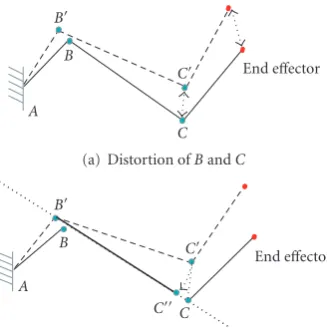
ROI-based approach preserves a large amount of features of the motion. However, the lossy compression for rotation an-gles produces some quantization error. In Figure 3(a), the position ofBis warped toBand in turnCis warped toC. Finally, the warp is accumulated to the end effector.
To reduce the propagation of the warp, we have to min-imize the error of position betweenC andC. Utilizing the quantized position of the root joint and a correct position of the child joint, we can obtain an optimal position of the child joint instead of its warped one (Figure 3(b)).
Since the length betweenBandCis fixed, suppose this link isl, rotate the linkBCwith respect toB to meet the lineBC, we get an intersectionC. In triangleΔBCC of
Figure 3(b),BC+CC > BC, we can easily educeCC >
CC. That meansCis closer toCthanC, that is,EC< EC,
whereEC denotes the error of distance betweenCandC, whileECdenotes the error of distance betweenCandC.C is clearly the optimal position. CalculateRnewcorresponding
toC.Rnewindicates the rotation ofCaboutBand can be
calculated by pCandpC. pCis original position ofCin its parent coordinate with originBandpC is optimal position ofCin its parent coordinate with originB.
Then in each motion chain, the optimal rotation angles of a child joint can be gotten by warped position of its parent sequentially and encoded instead of the original data [21].
A motion data compression algorithm is shown in
Fig-ure 4.
5. INVERSE KINEMATICS BASED ALGORITHM
5.1. Inverse kinematics
According to the forward kinematics, in a motion chain, the transformation of a parent joint causes a change of its child
Dequantization hierar-chically Max shift for constraint frames
(scale down) Max shift for
constraint frames (scale up) Hierarchical quantization
Entropy decoding
Input bits Output : jointi Input : jointi
Inverse wavelet transform: c0,w0,w1,. . .,wj−1,cj−1 Wavelet transform:
c0,w0,w1,. . .,wj−1,cj−1
Convert to Euler angle format Convert to two angle
format
Data com-pensation for
jointi+ 1
Inverse operation (decoder)
Entropy coding
Output bits
Encoder Decoder
Figure4: Adaptive algorithm for optimization-based motion data compression.
θ1 θ2
θ3 P End effector Terminator
Pend=f(θ) (a) Forward kinematics
θ1 θ2
θ3 P End effector Terminator
θ=f−1(P end) (b) Inverse kinematics
Figure5
joint position. The change of this child joint in turn affects its grand child joint, and so on. Finally the changes are ac-cumulated to the end effector. Motion is inherited down the hierarchy from the parents to the children (Figure 5(a)). For simplicity, we discuss two-dimensional case. In the framen, the position of the end effectorPnin two dimensional can be determined:
Pn= f(θn), (8)
where θn is composed of all angles (θ1,θ2,θ3,. . .,θN j) for
each joint in framen.
(1) The 3 Euler anglesθx,θy,θzof each
joint in each frame are inputted
(2) Convertθx,θy,θzintoφandϕby (4) and
(5) calculate theψusing (6) (3) Calculate the incrementΔpof the
position of the end effector by (16)
(4) Calculate the Jacobian marixJusing the angles φandϕof last frame by (19)
(5) Get the pseudoinverseJ∗ofJby (14) (6) Obtain the angle change ofφandϕby (15) (7) Calculate the angle change of theψby simply
finding the difference of the two connective frames
(8) Apply quantization in the data obtained in the step 3, 6 and 7 respectively using different stepsize
(9) Perform entropy coding for the data obtained in step 8
(10) Send the compressed data to the decoder
Algorithm1: IK Algorithm.
effector can reach the goal. To find the set of the changes of the angles which satisfy a given displacement of the positions of the end effectors, we need to solve
θn= f−1(Pn). (9)
However, this inverse is, in most cases, difficult to solve. Instead of this, Jacobian-based method is utilized [22–24]. Equation (8) is written in differential form:
˙
Pn=Jθ˙n, (10)
J is the Jacobian matrix of the displacement of the position of the end effector ˙Pnwith respect to the changes of the joint angles ˙θnand
J≡ ∂Pn
∂θn. (11)
To get the desire ˙θn, one has to solve
˙
θn=J−1Pn.˙ (12)
Since the natural human body motion typically is repre-sented over 30 degrees of freedom (DOF) which is larger than rank ofJ, the set of (12) are underdetermined. To solve this, some constraints are needed. Meanwhile for motion com-pression, the constraint used to make adjustments of the joint angles must be considered to match the motion char-acters. Traditionally, one minimizes the norm of the velocity of the joint anglθ˙nunder the constraintJθ˙n−Pn˙ = 0. Then, (12) is written by
˙
θn=J∗Pn˙ , (13)
where
J∗=JT(JJT)−1 (14)
Compressed angles of previous frame
Position calculation
Simple prediction
Entropy coding Entropy
coding
Quantization Decoding
Decoding Quantization
Converted format
End effectors General
other joints Prediction
by IK Orientation
calculation
Simple
prediction predictionCalculate error
Com-pressed position ˙p
θ0
D
Dψ ψ
δ
(a) Encoder
Entropy decoding Entropy
decoding
Position calculation Dequantization Dequantization
Angle conversion
Bits of end effectors Bits of
general other joints
Orientation angle retrieval
Convert all joints to original angle format Prediction
by IK
Converted two angles
Compressed angles of previous frame
δ
D
ψ
θ0
˙p
(b) Decoder
Figure6: IK algorithm-based compression flow chart.
constraint. In this paper, we employ the constraint of mini-mizing the norm of the differential accelerationθ˙n−θ˙n−12
and get the solution in our prediction algorithm:
˙
θn=θ0+J∗( ˙Pn−Jθ0), (15)
whereθ0 = kθ˙n−1,k is the parameter that determines the
weighting between the solution and the error. It is clear that this method leads to satisfying the natural motion charac-ter betcharac-ter than traditional minimizing the velocities of the joint angles. WhenΔPn, which is a displacement of end ef-fector from previous position to current position, is given, the change of each joint can be determined by (13).
Our IK algorithm consists of the following steps.
(1) Calculate the incrementΔpof the position of the end effector from the framei−1,pi−1to the framei,pi:
Δp=pi−pi−1. (16)
(2) Calculate Jacobian matrix J(φ1,ϕ1,φ2,ϕ2,φ3,ϕ3,. . ., φN j,ϕN j) using the angles of last frame (φ1,ϕ1,φ2,ϕ2, φ3,ϕ3,. . .,φN j,ϕN j), whereφjandϕjare the two an-gles in (5). Since
pi(x,y,z)= ⎡ ⎢ ⎣
f1(φ,ϕ)
f2(φ,ϕ)
f3(φ)
⎤ ⎥
⎦, (17)
where,
f1(φ,ϕ)=
n
j=1
Lj·sin(φj) cos(ϕj),
f2(φ,ϕ)=
n
j=1
Lj·sin(φj) sin(ϕj),
f3(φ)=
n
j=1
Lj·cos(φj)
(18)
by (5) andLjis the length of linkj, then by (10),Δp= J[ ˙φjϕ˙j] and
J=
∂ f
1(φ,ϕ)
∂φj
∂ f1(φ,ϕ)
∂ϕj
,∂ f2(φ,ϕ) ∂φj
∂ f2(φ,ϕ)
∂ϕj
,∂ f3(φ) ∂φj
0
,
(19)
where
∂ f1(φ,ϕ)
∂φj
=Ljcos(φj) cos(ϕj),
∂ f1(φ,ϕ)
∂ϕj = −Ljsin(φj) sin(ϕj),
∂ f2(φ,ϕ)
∂φj =Ljcos(φj) sin(ϕj),
∂ f2(φ,ϕ)
∂ϕj
=Ljsin(φj) cos(ϕj),
∂ f3(φ)
∂φj
= −Ljsin(φj).
(20)
(3) Get the pseudoinverse ofJby (14).
(4) In each motion chain, obtain the changes in framei forφ1,ϕ1,φ2,ϕ2,. . .,φN j,ϕN j by (15). ˙θiis the change of the angles in frameiand is given by ˙θi =kθ˙i−1 +
J∗(Δp −J∗kθ˙i−1). We obtain the good results with
k=2.
In step (2), if the general format, which is composed of ro-tation angles about X,Y,Zaxes, is applied to calculate the Jacobian matrix, each element of the Jacobian matrix almost involves all the related trigonometric functions of the corre-sponding angles in the motion chain. While in our converted format, sinceφandϕare calculated by the product of all the related rotation matrices from current joint to root joint, us-ing converted format, the JacobianJis given in a closed form. Although two angles format is sufficient to represent the po-sition of the joints in the world coordinate, the constraints on the joints generally controlled by the orientation of the joints. To apply our compression algorithm to more general CG animations, we further using the parameterψthat is the orientation angle and calculated by the standard matrix of rotation around an arbitrary axis introduced inSection 3.2. Therefore, initial orientation of the three Euler angles of the joint is retrieved perfectly.
Finally, the algorithm is stated inAlgorithm 1.
5.2. Compression with prediction technique
Considering motion characters, we have to assign more bits to some special joints such as the end effectors than other general types of joints. An adaptive quantization approach preserves features of the motion greatly. To achieve this, the hierarchical stepsize for different joints can be implemented in quantization step.
Meanwhile, since the amount of motion data is consider-able, high compression rate is needed. Prediction based tech-niques have been widely and successfully applied in compres-sion of series of data. If we can predict every next frame, we only have to save the first frame and the difference between real value and predicting result. The better the predictions, the more common corrections we can get and the more bits we can save.
The aforementioned two points characterize our IK com-pression approach properly when comparing with previous works. Actually, there are no conventional algorithms that specialize the constraints in joints, that is, precise reconstruc-tion of the end effectors, and achieve efficient compression rate simultaneously.
To predict every next frame, an intuitive method is to uti-lize the last frame directly. Taking the differenceDibetween the current frameiand last framesi−1 may be one of the simplest methods. By this method, we can decode current valueθiin decoder using the equation
θi=θi−1+Di. (21)
0.486 0.775 1.3835 2.2205 3.1083 4.086 Entropy Walk 0 5 10 15 20 25 30 35 Er ro r % in position of joints
0.7022 1.3503 2.1621 3.0897 4.0394 6.8813 Entropy Ballet 0 5 10 15 20 25 30 35 Er ro r % in position of joints
0.4022 0.6503 1.1621 1.5897 2.3964 3.4813 Entropy Throw 0 5 10 15 20 25 30 35 Er ro r % in position of joints
0.2436 0.3195 0.6589 0.9363 1.1237 1.4822 Entropy Kick 0 5 10 15 20 25 30 35 40 Er ro r % in position of joints IKBP SPBLF FKBC IBKF DWT
Figure 7: RD curve of the position of the walk, ballet, throw, and kick motions; IKBP—IK-based prediction method, FKBC— FK-based compression, SPBLF—simple prediction by last frame, IBKF—interpolation between the key frames, DWT—discrete wavelet transform.
0.5374 1.7881 1.921 3.017 3.6424 4.5173 Entropy Walk 0 1 2 3 4 5 6 7 8 9 Er ro r % in ang le o f joints
0.44369 1.0559 1.9509 3.1466 4.3812 5.3861 6.2248 Entropy Ballet 0 2 4 6 8 10 Er ro r % in ang le o f joints
0.3295 0.6305 1.3509 1.7183 2.4812 2.9869 Entropy Throw 0 1 2 3 4 5 6 7 Er ro r % in ang le o f joints
0.2436 0.5559 0.9565 1.2495 1.4428 1.6827 Entropy Kick 0 1 2 3 4 5 6 7 8 Er ro r % in ang le o f joints IKBP SPBLF FKBC IBKF DWT
Top: original motion frames
Bottom: compressed motion frames when entropy=0.6679 The index of the frames is
1 55 142 184 268 307 392 441 500 600 Walk motion
Top: original motion frames
Bottom: compressed motion frames when entropy=1.4227 The index of the frames is
1 121 139 166 220 238 254 313 332 388 Ballet motion
Top: original motion frames
Bottom: compressed motion frames when entropy=0.5891 The index of the frames is
1 20 25 33 39 44 48 62 76 179
Throw motion
Top: original motion frames
Bottom: compressed motion frames when entropy=0.5256 The index of the frames is
1 30 37 51 67 80 96 107 127 147 Kick motion
Figure9: Series of samplings of the motions.
The inverse kinematics gives a solution exactly. In our compression method, an encoder calculates the differences of position of end effectors between two sequential frames. More bits are assigned to them to keep the precision of the end effectors in quantization. Then these differences will be sent to decoder. Next, both in encoder and decoder, using these differences and the angles in previous frame we can cculate the change of the rotation angle in each joint by IK al-gorithm approximately. Suppose the difference between the
value predicted by IK and the value in the last frame isDi and
θipredict=θi−1+Di, (22)
Dican be calculated by (14) as the ˙θn. We need transferδ= Di−Dito the decoder which may reconstruct current value θiby
θi=θipredict+δ. (23)
We adopt a prediction for orientation angles of each joint. Our prediction method is simply done by subtracting the current frame by the last frame. The IK based compres-sion procedure with the prediction technique is shown in
Figure 6. In the encoder, the data of the rotation angles of
the end effectors and the other general joints are processed separately.
Firstly, for the general joints, the change of the rotation angle in each frameDican be predicted by the compressed anglesθ0of previous frames and the change of the position
˙p of the end effectors. Here we use the quantized versionθ0
instead ofθ0and˙p instead of˙p to get the same result in the
decoder. After calculating the prediction error δ, we adopt general quantization and entropy coding to the prediction error. Meanwhile, we adopt the simple prediction method by every last frame for the orientation angleψ of each joint to getD ψ.
For the end effectors, after the position calculation, we also adopt the simple prediction method by every last frame. The quantization and entropy coding are applied into the simple predicted sequence of the end effectors.
The bits of the end effectors and the other general joints are sent to the decoder, respectively.
For the bits of the general other joints, the entropy de-coding and dequantization are implemented as the opposite processing in the encoder. Using the IK algorithm, we pre-dict the rotation angles of a current frame by the last decoded frameθ0, then add the compressed prediction errorδand the
change of the position of the end effectors˙p using
θi=θi−1+D+δ. (24)
This process is the same as the prediction in the encoder. For the end effectors, after the entropy decoding and de-quantization of the bits, we retrieve the position of the end ef-fector of each frame. Finally, the angle conversion of the end effectors is added to convert the position of the end effectors to the rotation angles following the original data format.
6. EXPERIMENTAL RESULTS
Table1: Error of position of each joint in a limb chain for walking motion. This table records almost the same entropy of different methods for compression ratio and the error of the positions of several joints for the quality of the compressed motion correspondingly. In the walking motion, the left shoulder chain includes 4 joints (left shoulder, left humerus, left radius, and left hand).
Method Entropy Compression ratio%
Error of the position
Root joint Child joint Grand child joint End effector
left shoulder left humerus left radius left hand
IKBP 0.7144 4.81381 0.4985 0.6238 0.9506 2.1912
SPBLF 0.7269 4.89805 1.6457 2.7175 6.4688 6.3385
FKBC 0.7350 4.95263 3.2423 7.6778 16.009 12.066
IBKF 0.7233 4.87379 >100 >100 >100 >100
DWT 0.7296 4.91625 13.709 28.270 40.623 37.992
IKBP 1.3821 9.31297 0.3576 0.5779 0.7809 1.1068
SPBLF 1.3673 9.21325 0.8872 1.5062 4.8276 4.6992
FKBC 1.3834 9.32173 0.8286 1.3859 1.7912 3.2002
IBKF 1.4056 9.47132 24.459 20.725 26.814 31.092
DWT 1.3850 9.33251 1.1968 1.6492 2.8112 3.4743
IKBP 2.1971 14.8046 0.0613 0.1005 0.1048 0.1616
SPBLF 2.2147 14.9232 1.2701 1.8213 1.0853 1.4703
FKBC 2.2205 14.9623 0.1057 0.1396 0.1376 0.1808
IBKF 2.3724 15.9858 13.021 16.758 14.668 13.227
DWT 2.2181 14.9461 0.1658 0.2417 0.2814 0.3500
IKBP 3.0171 20.3300 0.0521 0.054 0.0649 0.0831
SPBLF 3.1294 21.0867 0.5823 0.8639 0.8143 0.9136
FKBC 3.1083 20.9446 0.0622 0.0653 0.0697 0.0851
IBKF 3.1114 20.9654 4.8487 6.3667 6.8840 7.1055
DWT 3.0573 20.6009 0.0654 0.0714 0.0698 0.0856
IKBP 4.0977 27.6114 0.0237 0.0441 0.0648 0.0726
SPBLF 4.0860 27.5326 0.5423 0.6663 0.6373 0.6093
FKBC 4.0860 27.5326 0.0612 0.0628 0.0662 0.0736
IBKF 4.4625 30.0695 1.5934 2.0052 2.1053 2.4268
DWT 4.1962 28.2751 0.0634 0.0697 0.0677 0.0741
all joints in each frame. In the BVH format, the motion is described by a series of the three orientation matrices with respect to y,x,zaxes. We convert them to the two anglesφ andϕby (5) to represent the position and the orientationψ, and then compress them using prediction method.
To evaluate the efficiency, we calculate the error of the position of jointiof the compressed motion comparing with the original one by
Eposition(i)=
1 Nf
Nf
j=1
Pi
o j−Pc ji
2
(25)
and the error of all joints in all frames by
Eposition=
1 Nj
Nj
i=1
Eposition(i), (26)
wherePio j andPc ji are the 3D positions of jointi in frame jof original and compressed motions, respectively in world coordinate. AndNf is the number of frames, whileNjis the number of total joints.
We also calculate the error of three orientation angles of jointiof the compressed motion comparing with the original one by
Eangle(i)=
1 Nf
Nf
j=1
Oi
o j−Oic j
2
(27)
and the error of all joints in all frames by:
Eangle=
1 Nj
Nj
i=1
Eangle (i), (28)
whereOio jandOic jare orientation angles of jointiin framej of original and compressed motions, respectively, andNf is the number of frames, whileNjis the number of total joints. Note that the three orientation angles of our method areφ,ϕ andψ, while the original format consists of three angles with respect toX,Y,Zaxes.
Table2: Error of angle of each joint in a limb chain for walking motion. This table records almost the same entropy of different methods for compression ratio and the error of the orientation angles of several joints for the quality of the compressed motion correspondingly. In the walking motion, the left shoulder chain includes 4 joints (left shoulder, left humerus, left radius, and left hand).
Method Entropy Compression ratio%
Error of the angle
Root joint Child joint Grand child joint End effector
left shoulder left humerus left radius left hand
IKBP 0.5374 3.62115 0.9531 1.1785 0.4022 1.3495
SPBLF 0.5421 3.65282 0.9572 1.1932 0.8255 2.0165
FKBC 0.5539 3.73233 0.9585 1.1967 1.4382 2.9845
IBKF 0.4862 3.27615 34.530 53.226 >100 >100
DWT 0.5336 3.59554 0.9550 1.1717 1.4839 2.2946
IKBP 1.7881 12.0487 0.9530 1.1780 0.4015 1.3490
SPBLF 1.7938 12.0871 0.9568 1.1931 0.5984 2.0154
FKBC 1.7653 11.8950 0.9539 1.1826 0.4606 2.0059
IBKF 1.7804 11.9968 9.557 10.620 19.830 30.80
DWT 1.7671 11.9072 0.9542 1.1792 0.4093 2.0041
IKBP 1.9210 12.9442 0.9530 1.1757 0.4015 1.3483
SPBLF 2.0423 13.7615 0.9557 1.1878 0.5832 2.0151
FKBC 1.9756 13.3121 0.9537 1.1785 0.4534 2.0012
IBKF 2.1027 14.1685 2.2900 10.211 7.8120 30.410
DWT 2.0167 13.5891 0.9539 1.1789 0.4049 1.9998
IKBP 3.6424 24.5435 0.9529 1.1679 0.4009 1.3480
SPBLF 3.6982 24.9195 0.9537 1.1821 0.4439 2.0085
FKBC 3.6733 24.7517 0.9532 1.1781 0.4217 2.0002
IBKF 3.6081 24.3123 1.9200 3.2180 2.0250 7.2390
DWT 3.6729 24.7490 0.9529 1.1778 0.4015 1.9902
IKBP 4.5173 30.4388 0.9528 1.1650 0.3145 1.3483
SPBLF 4.5628 30.7454 0.9529 1.1776 0.4013 1.9961
FKBC 4.6805 31.5385 0.9529 1.1779 0.4014 1.9839
IBKF 4.4625 30.0696 0.8800 1.4900 0.9800 4.2000
DWT 4.5819 30.8741 0.9529 1.1772 0.3978 1.9837
three methods, the simple prediction by last frame (SPBLF) based on (21) inSection 5, the interpolation between the key frames (IBKF) and the motion compression technique us-ing the discrete wavelet transform (DWT) appearus-ing in [11]. (The wavelet transform and interpolations are implemented by Matlab software which is trustworthy implementation.) In IBKF based compression method we apply the Piecewise Cu-bic Hermite (PCH) interpolation into the key frames which are obtained by curve simplification in [6], while in DWT method we adopt the 9/7 wavelet transform to compression the motion data. We give the RD curves of four motions
inFigure 7. Thex-axis represents the summation of the
en-tropies of the three angles obtained by those five methods, respectively.
The entropy coding is widely used to estimate the bit rate of the coded stream, which gives theoretically minimal bit rate. The entropy of a random variableX, which is defined asH(X) = −x∈AxfX(x) log2fX(x) can be interpreted as
the average amount of information conveyed by the outcome of the random variableX.Axis known as the alphabet ele-ments. fX(x) is the probability of the outcomeX=x. In our
experiment, since we use the same Arithmetic coding in all methods, the entropy values the compression ratio of each method.
InFigure 7, the results of the five methods including the
proposed methods are shown. The proposed algorithm IKBP can get the more common corrections and save more bits than the general algorithm. The variance of the error of the joint position calculated by IKBP method is smaller than the results by FKBC, SPBLF, and IBKF methods. It demonstrates that our proposed algorithm IKBP can get the more common corrections and save more bits than the general algorithm.
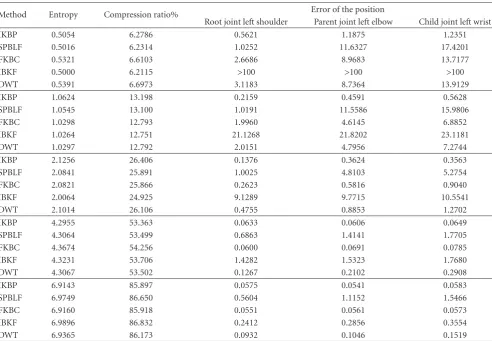
Table3: Error of position of each joint in a limb chain for ballet motion. This table records almost the same entropy of different methods for compression ratio and the error of the position of the joints for the quality of the compressed motion correspondingly. In the ballet motion, the left shoulder chain includes 3 joints (left shoulder, left elbow, and left wrist).
Method Entropy Compression ratio% Error of the position
Root joint left shoulder Parent joint left elbow Child joint left wrist
IKBP 0.5054 6.2786 0.5621 1.1875 1.2351
SPBLF 0.5016 6.2314 1.0252 11.6327 17.4201
FKBC 0.5321 6.6103 2.6686 8.9683 13.7177
IBKF 0.5000 6.2115 >100 >100 >100
DWT 0.5391 6.6973 3.1183 8.7364 13.9129
IKBP 1.0624 13.198 0.2159 0.4591 0.5628
SPBLF 1.0545 13.100 1.0191 11.5586 15.9806
FKBC 1.0298 12.793 1.9960 4.6145 6.8852
IBKF 1.0264 12.751 21.1268 21.8202 23.1181
DWT 1.0297 12.792 2.0151 4.7956 7.2744
IKBP 2.1256 26.406 0.1376 0.3624 0.3563
SPBLF 2.0841 25.891 1.0025 4.8103 5.2754
FKBC 2.0821 25.866 0.2623 0.5816 0.9040
IBKF 2.0064 24.925 9.1289 9.7715 10.5541
DWT 2.1014 26.106 0.4755 0.8853 1.2702
IKBP 4.2955 53.363 0.0633 0.0606 0.0649
SPBLF 4.3064 53.499 0.6863 1.4141 1.7705
FKBC 4.3674 54.256 0.0600 0.0691 0.0785
IBKF 4.3231 53.706 1.4282 1.5323 1.7680
DWT 4.3067 53.502 0.1267 0.2102 0.2908
IKBP 6.9143 85.897 0.0575 0.0541 0.0583
SPBLF 6.9749 86.650 0.5604 1.1152 1.5466
FKBC 6.9160 85.918 0.0551 0.0561 0.0573
IBKF 6.9896 86.832 0.2412 0.2856 0.3554
DWT 6.9365 86.173 0.0932 0.1046 0.1519
At low bit rates, FKBC is inferior to SPBLF, FKBC gains better compression in low compression rate. Note that FKBC is a hierarchical coding scheme and a progressive decoding is possible by virtue of the wavelet, while IKBP and SPBLF do not have this property.
Figure 8shows the RD curves about the error of the three
orientation angles. Thex-axis represents the summation of the entropies of three angles. For the curve generated by the IBKF method, since the error of the rotation angle of the walking motion by the IBKF is more than 100 when the en-tropy is smaller than 3, we also abridge the data of the large error by IBKF to give a comparison in the error range from 0 to 9.
We also present the error of positions and the orienta-tions of each joint in a limb chain corresponding to the dif-ferent entropy value of the walk motion in Tables1and2and the ballet motion in Tables3and4, respectively, to demon-strate the advantage of our approach. Since different motion has different hierarchy skeleton, in the walk motion the left shoulder chain includes 4 joints (left shoulder, left humerus, left radius, and left hand), while in the ballet motion, the same motion chain has 3 joints (left shoulder, left elbow and left wrist). When the entropy is smaller than 1, the error of
the positions of some joints by IBKF is larger than 100 and the recovered motion is totally distorted. In the same com-pressing ratio, the proposed algorithm IKBP produces small error of the positions in these joints than the general algo-rithms.
Figure 9 shows series of samples of the original
mo-tions and the decoded one by IKBP method correspondingly. These series of samplings present a period of the motion. In walk motion, when entropy is larger than 1.1206 it is diffi -cult to discovery the difference between the original motion and the decoded one. We also show the results of other three motions, “ballet,” “throw” and “kick.”Table 5gives the de-scription of these four motions.
Table4: Error of angle of each joint in a limb chain for ballet motion. This table records almost the same entropy of different methods for compression ratio and the error of the orientation angle of the joints for the quality of the compressed motion correspondingly. In the ballet motion, the left shoulder chain includes 3 joints (left shoulder, left elbow and left wrist).
Method Entropy Compression ratio% Error of the position
Root joint left shoulder Parent joint left elbow Child joint left wrist
IKBP 0.5054 6.2786 0.2648 0.6546 2.5389
SPBLF 0.5016 6.2314 1.4050 1.5067 6.4131
FKBC 0.5321 6.6103 0.6517 1.0528 2.3071
IBKF 0.5000 6.2115 45.4032 63.6985 66.9011
DWT 0.5391 6.6973 1.4340 1.7459 2.8383
IKBP 1.0624 13.198 0.2319 0.5896 1.5122
SPBLF 1.0545 13.100 1.3362 1.4687 5.5020
FKBC 1.0298 12.793 0.2685 0.6239 1.7313
IBKF 1.0264 12.751 30.2023 49.6792 66.2010
DWT 1.0297 12.792 0.2723 0.6732 1.9386
IKBP 2.1256 26.406 0.2302 0.5428 0.6538
SPBLF 2.0841 25.891 0.2816 0.9719 1.5518
FKBC 2.0821 25.866 0.2307 0.5430 0.6586
IBKF 2.0064 24.925 10.8476 33.8133 49.7030
DWT 2.1014 26.106 0.2391 0.5847 0.7053
IKBP 4.2955 53.363 0.2259 0.5378 0.3868
SPBLF 4.3064 53.499 0.2296 0.5620 0.4168
FKBC 4.3674 54.256 0.2267 0.5371 0.3483
IBKF 4.3231 53.706 3.4238 8.8972 20.4645
DWT 4.3067 53.502 0.2271 0.5384 0.3831
IKBP 6.9143 85.897 0.2257 0.5372 0.3504
SPBLF 6.9749 86.650 0.2257 0.5405 0.3483
FKBC 6.9160 85.918 0.2267 0.5371 0.3476
IBKF 6.9896 86.832 2.9320 4.1791 8.5528
DWT 6.9365 86.173 0.2265 0.5371 0.3479
Table5: Four original motion data.
Data size Number of joints Sampling rate Number of frames
Walk 324 k 23 0.00833 (s) 580
Ballet 183 k 20 0.0400 (s) 388
Throw 70 k 17 0.033333 (s) 179
Kick 56 k 19 0.033333 (s) 147
Table6: Compression and decompression times for one frame.
Encoding Decoding
IKBP 1.26 (ms) 1.32 (ms)
SPBLF 0.96 (ms) 1.09 (ms)
FKBC 1.12 (ms) 1.20 (ms)
IBKF 1.08 (ms) 1.20 (ms)
DWT 1.12 (ms) 1.15 (ms)
7. CONCLUSION
The compression of captured motion data is an impor-tant issue in motion storing, retrieval, editting and
Inverse kinematics is a common approach to control the movement of the whole body. The position of end effector can be specified in a target position from preceding position. By the changes of the position of the end effectors we may get variations of the motion of the entire body. The inverse kinematics, on the other hand, supports a prediction-based compression. To predict motion in decoder, we only save the first frame and a series of small differences between real value and prediction gotten by the variations of the positions of the end effectors. Therefore, it can solve the problems of specific joints and achieve efficient compression of the motion data.
We applied the FK based compression and IK based com-pression in our reduced two-angle format. Some experimen-tal results of example motions demonstrate the advantage of our methods compared with conventional methods.
ACKNOWLEDGMENTS
This work was partly supported by a Grant-in-Aid for Young Sciences (no. 14750305) of Japan Society for the Promotion of Science, fund from MEXT via Kitakyushu innovative clus-ter project, and Kitakyushu IT Open Laboratory of National Institute of Information and Communications Technology (NiCT).
REFERENCES
[1] A. Bruderlin and L. Williams, “Motion signal processing,” in
Proceedings of the 22nd Annual Conference on Computer Graph-ics and Interactive Techniques (SIGGRAPH ’95), pp. 97–104, Los Angeles, Calif, USA, August 1995.
[2] H. Etou, Y. Okada, and K. Niijima, “Feature preserving mo-tion compression based on hierarchical curve simplificamo-tion,” inProceedings of IEEE International Conference on Multimedia and Expo (ICME ’04), vol. 2, pp. 1435–1438, Taipei, Taiwan, June 2004.
[3] S. Li, M. Okuda, and S.-I. Takahashi, “Embedded key-frame extraction for CG animation by frame decimation,” in Pro-ceedings of IEEE International Conference on Multimedia and Expo (ICME ’05), pp. 1404–1407, Amsterdam, The Nether-lands, July 2005.
[4] J Lee and S. Y. Shin, “A hierarchical approach to interactive motion editing for human-like figures,” inProceedings of the 26th Annual Conference on Computer Graphics and Interac-tive techniques (SIGGRAPH ’99), pp. 39–48, Los Angeles, Calif, USA, August 1999.
[5] M. Gleicher, “Motion editing with spacetime constraints,” in
Proceedings of the Symposium on Interactive 3D Graphics, pp. 139–148, Providence, RI, USA, April 1997.
[6] I. S. Lim and D. Thalmann, “Key-posture extraction out of hu-man motion data by curve simplification,” inProceedings of the 23rd Annual International Conference of the IEEE Engineering in Medicine and Biology Society (EMBC ’01), vol. 2, pp. 1167– 1169, Istanbul, Turkey, October 2001.
[7] G. Liu, J. Zhang, W. Wang, and L. McMillan, “A system for an-alyzing and indexing human-motion databases,” in Proceed-ings of the ACM International Conference on Management of Data (SIGMOD ’05), pp. 924–926, Baltimore, Md, USA, June 2005.
[8] J. Assa, Y. Caspi, and D. Cohen-Or, “Action synopsis: pose selection and illustration,” ACM Transactions on Graphics, vol. 24, no. 3, pp. 667–676, 2005.
[9] A. Safonova, J. K. Hodgins, and N. S. Pollard, “Synthesiz-ing physically realistic human motion in low-dimensional, behavior-specific spaces,” ACM Transactions on Graphics, vol. 23, no. 3, pp. 514–521, 2004.
[10] J. Chai and J. K. Hodgins, “Performance animation from low-dimensional control signals,” inProceedings of International Conference on Computer Graphics and Interactive Techniques (SIGGRAPH ’05), pp. 686–696, Los Angeles, Calif, USA, July-August 2005.
[11] A. Ahmed, A. Hilton, and F. Mokhtarian, “Adaptive compres-sion of human animation data,” inProceedings of the Annual Conference of the European Association for Computer Graphics (Eurographics ’02), Saarbr¨ucken, Germany, September 2002. [12] O. Arikan, “Compression of motion capture databases,” in
Proceedings of the 33rd International Conference and Exhibi-tion on Computer Graphics and Interactive Techniques (SIG-GRAPH ’06), pp. 890–897, Boston, Mass, USA, July-August 2006.
[13] M. Naganand and F. Stuart, “Specialised constraints for an in-verse kinematics animation system applied to articulated fig-ures,” inProceedings of the Annual Conference of the European Association for Computer Graphics (Eurographics ’98), pp. 215– 223, Leeds, UK, 1998.
[14] S. Li, M. Okuda, and S. Takahashi, “Kinematics based mo-tion compression for human figure animamo-tion,” in Proceed-ings of the 30th IEEE International Conference on Acoustics, Speech, and Signal Processing (ICASSP ’05), vol. 2, pp. 1077– 1080, Philadelphia, Pa, USA, March 2005.
[15] J. Lander, “Working with motion capture formats,” Darwin 3D, LLC, January 1998.
[16] M. Z. Vladimir,Kinematics of Human Motion, Human Kinet-ics, Champaign, Ill, USA, 1998.
[17] A. S. Glassner,Graphics Gems, Academic Press, Boston, Mass, USA, 1990.
[18] C. Christopoulos, J. Askelof, and M. Larsson, “Efficient region of interest coding techniques in the upcomingJPEG2000 still image coding standard,” inProceedings of IEEE International Conference on Image Processing (ICIP ’00), vol. 2, pp. 41–44, Vancouver, BC, Canada, September 2000.
[19] A. Secker and D. Taubman, “Motion-compensated highly scal-able video compression using anadaptive 3D wavelet trans-form based on lifting,” inProceedings of International Con-ference on Image Processing (ICIP ’01), vol. 2, pp. 1029–1032, Thessaloniki, Greece, October 2001.
[20] I. Ueno and W. A. Pearlman, “Region-of-interest coding in volumetric images with shape-adaptive wavelet transform,” in Image and Video Communications and Processing 2003, vol. 5022 ofProceedings of SPIE, pp. 1048–1055, Santa Clara, Calif, USA, January 2003.
[21] S. Li, M. Okuda, and S. Takahashi, “Hierarchical human mo-tion compression with constraints on frames,” inProceedings of the 47th Midwest Symposium on Circuits and Systems (MWS-CAS ’04), vol. 1, pp. 253–256, Hiroshima, Japan, July 2004. [22] S. R. Buss, “Introduction to inverse kinematics with jacobian
transpose, pseudoinverse and damped least squares methods,” April, 2004.