1
Title: Binge Drinking and Unplanned Sexual Behaviour: Deconstructing the Role of 1
Impulsivity 2
ABSTRACT 3
The co-occurrence of binge drinking and unplanned sexual behaviour (USB) is a physiological 4
and social concern; however, potential underlying mechanisms in this relationship remain 5
largely unexplored. The current study compared low and high-binge drinkers on impulsivity 6
variants and USB. Participants were 122 university students (71 females). Questionnaires 7
measured binge drinking, USB, reward sensitivity, and trait impulsivity (Barratt Impulsiveness 8
Scales). Cognitive-behavioural aspects of impulsivity were assessed using a Stop Signal Task 9
(response inhibition) and an Information Sampling Task (IST: reflection-impulsivity). ANOVAs 10
revealed that high-binge drinkers scored more impulsively than low-bingers on self-report 11
impulsivity, and the decreasing win condition of the IST. A positive relationship was found 12
between USB and self-report, but not cognitive-behavioural, impulsivity. In regression 13
analysis, both binge drinking and trait impulsivity were found to have a unique effect on the 14
proclivity to engage in USB. Findings provide an insight into demarcating impulsivity’s 15
relationship with both binge drinking and USB. 16
Keywords: Binge drinking, unplanned sexual behaviour, trait impulsivity, reflection-17
impulsivity, response inhibition, reward sensitivity 18
1. Introduction 19
Repeated episodes of binge-style drinking (approximately four or more drinks for females and 20
five or more drinks for males within a two-hour period [1]) has been posited to be particularly 21
2
for long-term health problems and addiction [2]. Often associated with young adult students 23
[3, 4], this pattern of episodic alcohol consumption has also been implicated in an array of 24
adverse consequences including poor academic performance, criminal involvement, drink-25
driving, perpetrating or being victims of physical or sexual assault, and unplanned and unsafe 26
sexual activity [5]. 27
Unplanned sexual behaviour (USB) refers to the act of engaging in a brief sexual encounter 28
with someone outside of a committed relationship. Sometimes referred to as casual sex or a 29
one-night stand, this category of sexual activity typically occurs with someone only once and 30
is usually devoid of commitment or emotional involvement [6]. Concernedly, some studies 31
have found that when binge drinking precedes unplanned sex, both males and females are 32
more inclined to participate in unprotected sexual activity, thereby increasing their risk of 33
adverse outcomes such as unplanned pregnancy, sexually transmitted infections (STIs), and 34
the Human Immunodeficiency Virus (HIV) [7]. 35
Previous research attempting to explore the underlying mechanisms in the relationship 36
between binge drinking and USB has focused on various theories including alcohol myopia [8] 37
and alcohol expectancies [9]. In addition, potential risk factors such as family background, 38
peer influence, and personality traits, including sensation seeking and impulsivity, have all 39
been considered [10]. Of interest here is the multi-dimensional construct of impulsivity, which 40
has previously been associated with both USB and binge drinking respectively [11, 12]. 41
Regarding sexual behaviour, both unplanned and unprotected sexual activity have been 42
associated with various facets of trait impulsivity including negative and positive urgency, (a 43
lack of) premeditation, sensation seeking, and impulsive decision-making [11,15]; although it 44
3
unplanned or ‘risky’ sexual behavior. In addition, studies examining neurocognitive 46
performance on inhibitory control have evidenced a positive relationship between impulsive 47
behavior and sexual risk-taking [16, 17, 18]. 48
In respect of binge drinking, varying dimensions of impulsivity have been implicated in both 49
the initiation and continuation of binge drinking. For example, an impulsive personality may 50
predispose an individual to drink to excess and from an early age and, in return, repeated 51
intoxication and withdrawal from ethanol can affect prefrontal neural systems responsible 52
for inhibitory control. This in turn can further exacerbate impulsive behaviour and a tendency 53
towards binge drinking creating a reciprocal effect [13, 14]. As such, the importance of testing 54
for both trait and behavioural measures of impulsivity is invaluable in exploring the 55
relationship with both binge drinking and USB. 56
To date, however, research integrating the three elements has been limited. Both Gullette 57
and Lyons [19] and Donohew et al. [20] discovered a positive relationship for impulsivity 58
variants, such as sensation seeking and impulsive decision-making, in co-occurring alcohol 59
and risky sexual behaviour. In a similar vein, a mediating role for both sensation seeking [21] 60
and excitement seeking [22] has been demonstrated in the relationship between alcohol use 61
and high-risk sexual behavior. Regarding behavioural impulsivity, a study by MacKillop et al. 62
[22] found a relationship between impulsive responding on a delay discounting task and 63
increased risky sexual behaviour during alcohol intoxication. 64
Nevertheless, a limitation of this research has been the utilization of single measures of 65
impulsivity and not accounting for the binge-style consumption of alcohol. A previous study 66
by Townshend, Kambouropoulos, Griffin, Hunt, and Milani [23] incorporated a cognitive-67
4
gather and evaluate information during decision making), as well as a single question to 69
measure self-reported impulsivity, and examined the relationship between binge drinking 70
and USB. Results revealed that the high-binge drinkers engaged in more unplanned sexual 71
encounters, rated themselves as more impulsive, and demonstrated aspects of reflection-72
impulsivity compared to the low-binge drinkers, although no comprehensive trait measure of 73
impulsivity was included in their study. 74
Taking into consideration the ubiquity of both binge drinking and unplanned sexual activity in 75
university students during emerging adulthood [24], a clearer understanding of potential 76
mediating factors, such as impulsivity, would be advantageous in efforts intended to reduce 77
unwanted pregnancy, STIs, and coerced sexual activity, as well as alcohol-related problems 78
and dependence. Thus, the overriding aim of the current study was to explore the relationship 79
between binge drinking, USB, and impulsivity using an extensive battery of behavioural and 80
self-report measures to examine the various dimensions of impulsivity. Accordingly, a sample 81
of low and high-binge drinkers, derived from the Alcohol Use Questionnaire [25], were 82
compared on different dimensions of impulsivity, as well as the tendency to engage in USB. 83
Specifically, based on previous findings in the literature, it is predicted that the high-binge 84
drinking group will score higher on self-report measures of impulsivity, display poorer 85
response inhibition, and show signs of less reflection and more impulsiveness compared to 86
the low-binge drinking group. In addition, it is predicted that the high-binge drinking group 87
will report more episodes of USB, compared to the low-binge drinking group. Furthermore, it 88
is predicted that more impulsive individuals will report more episodes of USB, compared to 89
less impulsive individuals. Finally, based on previous research [23], an interaction will be 90
5 2 Methods
92
2.1 Participants
93
Participants (N = 125) were recruited through in-class announcements and university website. 94
Criteria included being aged between 18 and 30 and describing oneself as a “social drinker” 95
(occasional through to heavy consumption) but excluded those with a history of drug or 96
alcohol dependence. Participants, all full-time Psychology students, provided relevant 97
demographics details, including age of first drink and age of first intoxication. Participants 98
consuming more than eight units of alcohol in the preceding 24 hours were excluded from 99
the study. This last criterion excluded three participants leaving a total of 122 participants 100
(Mage = 21.30, SDage = 3.54; 58% female).
101
2.2 Measures
102
All questionnaires used in the study are robust measures that have been employed in 103
numerous studies and are recognized as having high levels of reliability and validity. The one 104
exception is the Unplanned Sexual Behaviour Questionnaire (USBQ) that was utilized in the 105
previous study [see 23]. 106
2.2.1 Alcohol Use Questionnaire (AUQ [25]):
107
A revised version of the AUQ [26] was used to establish drinking behaviour. The AUQ provides 108
a binge score, as well as total alcohol units consumed per week. The binge score is calculated 109
from the number of times being drunk (previous six months), percentage of times getting 110
drunk when drinking (average), and speed of drinking (average drinks per hour). The median 111
6
below the median: high-binge drinkers (≥ 23; n = 61) and low-binge drinkers (≤ 22; n = 61) 113
respectively. 114
2.2.2 Unplanned Sexual Behaviour Questionnaire (USBQ [23]):
115
The 16-item USBQ asks questions relating to unplanned sexual behaviour, decision making, 116
impulsivity, and regret. The two questions of relevance to this paper included: Q1, 117
“Approximately how many times have you ever engaged in unplanned sexual activity with 118
non-partners or strangers?”. Possible answers are on a scale from “never”, “once”, “2-5 119
occasions”, “6-10 occasions”, to “11 or more occasions”. Secondly, Q13 asks: “Generally, 120
would you describe yourself as an impulsive person?”. Answers are on a 5-point Likert scale 121
(1 = “not at all impulsive” to 5 = “very impulsive”). 122
2.2.3 Barratt Impulsiveness Scale, Version 11 (BIS-11 [27]):
123
The 30-item BIS-11 assesses the personality (trait) dimensions of impulsivity. For example, “I 124
do things without thinking”. Answers are on a 4-point Likert scale ranging from “rarely/never” 125
to “almost always/always”. Several items are reverse scored and the greater the summed 126
score, the higher the self-reported level of impulsivity. In addition to the total score, the BIS-127
11 provides three subscales including attentional, motor, and non-planning facets of 128
impulsivity. Cronbach’s alphas for the current sample were .69 (attentional), .60 (motor), .69 129
(non-planning) and .82 (total score). 130
2.2.4 Sensitivity to Reward Questionnaire (SPSRQ-SR [28]):
131
This measure of reward sensitivity requires participants to tick “yes” or “no” to 17 items. For 132
example, “Do you often do things to be praised?”. A “yes” response is assigned a value of one 133
7
summed score, the higher the self-reported level of reward sensitivity. The Cronbach’s 135
reliability coefficient was .74 for the current sample. 136
2.2.5 Reflection Impulsivity: Information Sampling Task (IST; CANTAB Cambridge Cognition
137
Ltd.):
138
The IST assesses reflection-impulsivity on two sets of ten trials. Twenty-five grey boxes are 139
presented on a 5x5 matrix with two differently coloured squares displayed beneath. When 140
respondents touch any of the grey squares they turn to one of the two colours displayed 141
below and remain that colour for the duration of each individual trial, so there is no working 142
memory requirement to the task. Participants are asked to decide which colour is in the 143
majority, basing their decision on the boxes revealed. 144
The first set of ten trials is the Fixed Win (FW) condition with a win of 100 points for a correct 145
choice, and a deduction of 100 points for an incorrect choice. Participants are informed that 146
they can open as many boxes as they wish. The second trial is the Decreasing Win (DW) 147
condition in which participants start with 250 points; however, this time the score decreases 148
by ten points with every box opened, consequently the earlier a decision is made the more 149
points are awarded, providing the selection is correct. As before, one hundred points is 150
deducted for a wrong decision. Performance on the two tasks is measured by the number of 151
boxes opened per trial, proportion of correct choices [P(correct); the mean probability of 152
being correct at the point of decision], number of errors committed when selecting the 153
colour, and time taken to make a decision (opening latency). 154
2.2.6 Response inhibition: Stop Signal Task (SST;CANTAB Cambridge Cognition Ltd.):
8
The SST provides a measure of an individual’s ability to inhibit a prepotent response. 156
Participants are instructed to select the right or left-hand button on a press pad in accordance 157
with the right or left-pointing directional arrow presented on the screen in front of them. 158
Following this trial phase, the participant is then instructed to withhold their response if they 159
hear an auditory signal. The ‘stop signal’ (beep) is randomized and occurs on 25% of trials with 160
a variable ‘stop signal delay’ (SSD) between the onset of the arrow stimulus and the auditory 161
tone. The variation of the SSD is dependent on the participant’s performance, but adjusted 162
so that ‘stopping’ occurs approximately 50% of the time for all participants. Performance on 163
this task is measured by the number of directional errors (DE), median response time on GO 164
trials (GoRT), and the stop-signal reaction time (SSRT), which is an estimate of the time 165
between the go and stop stimuli that the participants has successfully inhibited their response 166
50% of the time (a higher SSRT score indicates poor inhibitory control). 167
2.3 Procedure
168
The study was approved by the university’s ethics sub-committee. Assurances were given 169
regarding anonymity, confidentiality and participants’ right to withdraw. Participants 170
provided informed consent and were awarded research participation pool points for their 171
time. Participants were instructed to work through a battery of questionnaires interspersed 172
with two computer tasks. These were presented in the order of: demographics, BIS-11, SST, 173
SPSRQ-SR, USBQ, IST, and AUQ, with the order of the IST and SST being reversed between 174
participants. All procedures took place in a dedicated research laboratory onsite and lasted 175
approximately 50 minutes. 176
3 Results 177
3.1 Demographics
9
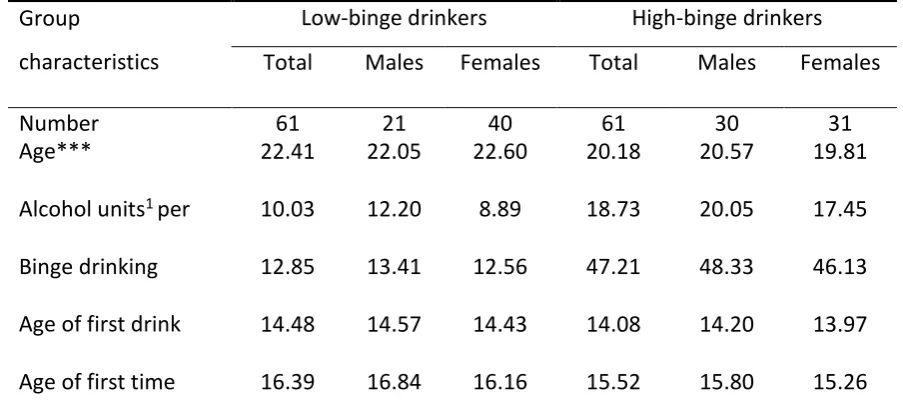
Table 1 shows the demographic data for the low and high-binge drinking groups, and 179
separately for males and females. The high-binge drinkers drank more units of alcohol per 180
week, t(87.06) = -4.14, p < .001, and first became drunk at a younger age, t(116) = 2.16, p = 181
.033. There was also a difference between the ages of the groups with the high-binge drinkers 182
being slightly younger compared to the low-binge drinkers, t(85.57) = 3.66, p < .001. Gender 183
was added to check for a potential confound effect; however, there were no significant 184
differences between males and females on the binge drinking score, t(120) = 1.56, p = .122, 185
and just a trend-level difference on alcohol units per week, t(120) = 1.87, p = .065, 186
demonstrating a slightly higher alcohol intake reported for males compared to females. 187
Table 1 188
Demographic and alcohol use data for low-binge and high-binge drinkers and for males and 189
females within each group. 190
Group
characteristics
Low-binge drinkers High-binge drinkers
Total Males Females Total Males Females
Number 61 21 40 61 30 31
Age*** 22.41
(4.31) 22.05 (3.63) 22.60 (4.66) 20.18 (2.04) 20.57 (2.34) 19.81 (1.64) Alcohol units1 per
week*** 10.03 (7.21) 12.20 (8.58) 8.89 (6.19) 18.73 (14.77) 20.05 (15.98) 17.45 (13.63) Binge drinking score*** 12.85 (5.66) 13.41 (5.53) 12.56 (5.78) 47.21 (22.32) 48.33 (25.09) 46.13 (19.64) Age of first drink 14.48
(3.17) 14.57 (3.67) 14.43 (2.92) 14.08 (2.69) 14.20 (2.67) 13.97 (2.75) Age of first time
being drunk* 16.39 (1.98) 16.84 (2.06) 16.16 (1.93) 15.52 (2.32) 15.80 (2.06) 15.26 (2.56)
Note. 1 One unit is 8g of alcohol. Data are presented as mean (SD). * p<0.05, *** p<0.001
191
differences between groups (low/high-binge drinkers). 192
3.2 Self-report impulsivity measures
10
A one-way MANOVA examined group differences on all self-report measures of impulsivity, 194
except for the BIS-11 total score, and demonstrated an overall main effect of binge drinking 195
group [Wilks’ Lambda=.81, F(5,116) = 5.30, p< .001, η2
p= .19].Univariate analyses revealed 196
differences between low and high-binge drinkers, using a Bonferroni adjusted alpha of .001, 197
on sensitivity to reward, F(1,120) = 13.15, p < .001, η2
p = .10, motor impulsivity, F(1,120) = 198
13.01, p < .001, η2
p = .10, and non-planning impulsivity, F(1,120) = 15.07, p < .001, η2p= .11. A 199
trend-level difference was revealed for the “how impulsive are you” question from the USBQ, 200
F(1,120) = 6.18, p = .014, η2
p = .05. There was no effect of binge drinking on attentional 201
impulsivity, F(1,120) = 3.79, p = .054, η2
p = .03.A separate univariate analysis was conducted 202
between the 11 total score and binge group due to the high correlation between the BIS-203
11 total score and the other BIS-11 subscales (r ≥ .75). Results revealed a significant difference 204
between binge drinking groups, F(1,120) = 16.29, p < .001, η2
p = .12. In all self-report 205
impulsivity measures the high-binge drinking group scored higher than the low-binge drinking 206
group. 207
3.3 Reflection-impulsivity: Information Sampling Task (IST)
208
The IST analysis was conducted in two parts: firstly, a trial by trial analysis involving a series 209
of one-way ANOVAs to examine potential binge group differences on number of boxes 210
opened, P(correct), total errors and latency, and secondly, a within-subjects analysis to 211
determine a potential effect of condition on performance across the FW and DW trials. 212
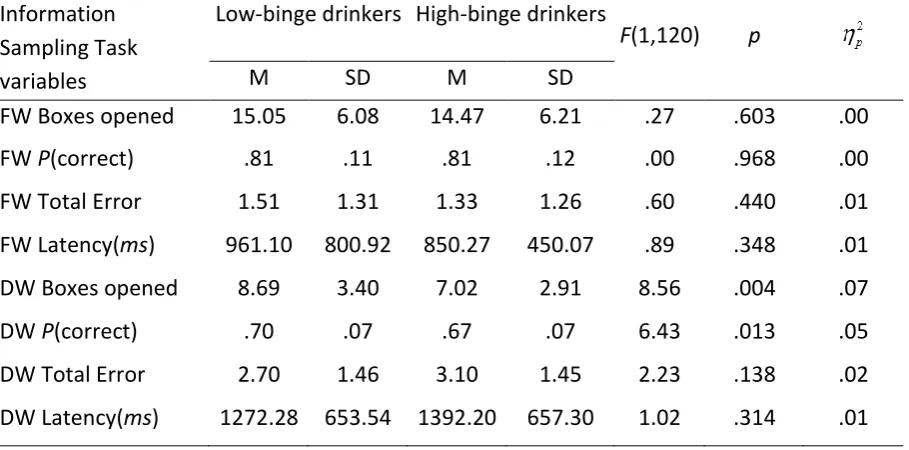
As Table 2 demonstrates, binge drinking groups were found to perform similarly on all IST 213
variables in the FW condition. In contrast, the DW condition revealed a significant difference 214
11
the means reveals that the high-binge drinkers opened fewer boxes than the low-binge 216
drinkers, and that their probability of being correct was lower than for the low-binge drinkers. 217
A series of mixed-model ANOVAs were then conducted to examine potential differences 218
across the FW and DW conditions (data not shown). There was a significant difference 219
between the FW and DW condition on all IST variables (ps < .001, η2
p > .42), demonstrating 220
that overall all participants altered their performance across the FW and DW conditions. This 221
finding suggests a sensitivity to the altered reward characteristics between the two conditions 222
and a desire to win more points. No differences were revealed between binge drinking groups 223
on any of the IST variables (ps > .05, η2
p < .03; combined FW and DW scores). 224
Table 2 225
Mean, standard deviation and group differences between low and high-binge drinkers on 226
the Information Sampling Task (N=122). 227
Information Sampling Task variables
Low-binge drinkers
(n=61)
High-binge drinkers
(n=61)
F(1,120) p
M SD M SD
FW Boxes opened 15.05 6.08 14.47 6.21 .27 .603 .00
FW P(correct) .81 .11 .81 .12 .00 .968 .00
FW Total Error 1.51 1.31 1.33 1.26 .60 .440 .01
FW Latency(ms) 961.10 800.92 850.27 450.07 .89 .348 .01
DW Boxes opened 8.69 3.40 7.02 2.91 8.56 .004 .07
DW P(correct) .70 .07 .67 .07 6.43 .013 .05
DW Total Error 2.70 1.46 3.10 1.45 2.23 .138 .02
DW Latency(ms) 1272.28 653.54 1392.20 657.30 1.02 .314 .01
Note. FW = Fixed Win condition; DW = Decreasing Win condition; = partial eta squared. 228
3.4 Response inhibition: Stop Signal Task (SST)
229
2
12
Independent t-tests were conducted to examine group differences on the SST variables 230
[direction errors (DE), median reaction time on Go trials (GoRT), and Stop-Signal Reaction 231
time (SSRT)]. Results revealed one group difference for DE (p = .028, Cohen’s d = .41) 232
demonstrating that the high-binge group committed more directional errors than the low-233
binge group (e.g., pressing the left button for a right arrow). There were no binge drinking 234
group differences for GoRT or SSRT (ps>.05). 235
3.5 Unplanned sexual behaviour questionnaire (USBQ)
236
A one-way ANOVA was conducted to examine group differences for times reported engaging 237
in unplanned sexual behaviour (USB). Results revealed a significant difference for binge 238
drinking group, F(1,120) = 4.76, p = .031, η2
p = .04, with the high-binge drinkers (M=2.70, 239
SD=1.36) reporting more episodes of USB than the low-binge drinkers (M=2.18, SD=1.30). In 240
further analysis, a bivariate correlation between all self-report measures of impulsivity and 241
the number of times engaged in USB revealed a positive association with all variables, except 242
the BIS-11 attentional scale (see Table 3). No relationship was revealed between the number 243
of times engaged in USB and either of the IST or SST outcomes. These findings suggest that a 244
proclivity to engage in USB is related to higher scores for reward sensitivity, motor and non-245
planning impulsivity, and the self-reported impulsivity question from the USBQ (Q13), but 246
that it is not associated with the dimensions of impulsivity elicited by behavioural and 247
cognitive measures. 248
Table 3 249
Pearsons’ correlation matrix between number of times engaged in unplanned sexual 250
13 Impulsivity measure
N = 122
Number of Times Reported USB
r p
BIS Attentional .17 .056
BIS Motor .38*** <.001
BIS Non-planning .30** .001
BIS Total Score .36*** <.001
SPSRQ-SR .27** .002
How impulsive are you? (USBQ) .41*** <.001
Note. ** p<0.01, ***p<0.001. BIS = Barratt Impulsiveness Scale, version 11; SPSRQ-SR - 252
Sensitivity to Reward Questionnaire; USBQ – Unplanned Sexual Behaviour Questionnaire. 253
3.6 Regression analysis
254
A final analysis (Table 4) was conducted to examine the predictive relationship between binge 255
drinking, impulsivity and USB. The selection of predictors was determined by the power of 256
the aforementioned results (i.e., largest η2
p). Preliminary analyses ensured no violations were 257
committed pertaining to assumptions of normality, linearity, and homoscedasticity. It was 258
anticipated that trait impulsivity may interact with binge drinking to influence engaging in 259
USB, therefore a product term was constructed from the binge score and the BIS-11 total 260
score prior to analysis. Both binge score and the BIS-11 total score were mean-centred prior 261
to analysis and the interaction term was constructed from the mean-centred variables to 262
minimise multicollinearity. Binge score and the BIS-11 total score were entered in Step 1 and 263
explained 18.3% of the variance in times engaged in USB. The product term of binge score 264
and BIS-11 total score was entered in Step 2 and explained an additional .35% of variance in 265
times engaged in USB. In the final model, both binge drinking and the BIS-11 total score were 266
significant predictors of times engaged in USB; however, the product term of trait impulsivity 267
14 Table 4
269
Hierarchical regression exploring interaction between impulsivity and binge drinking on 270
times reported engaging in unplanned sexual behaviour. 271
Step and predictor variable
B SE B β R2 R2 t p sr2
Step 1: .18 .17***
Binge scorea .02 .01 .26 2.83 .006 .05
BIS Totala .03 .01 .26 2.86 .005 .06
Step 2: .19 .00
Binge scorea .02 .01 .28 2.81 .006 .05
BIS Totala .03 .01 .25 2.79 .006 .05
BIS Total x Bingea .00 .00 -.06 -.60 .553 .00
Note. *** p<.001. a= variables centred to avoid multicollinearity.
272
4 Discussion 273
The results are generally in line with prediction and revealed that a sample of heavier binge 274
drinkers exhibited higher levels of trait impulsivity, reward sensitivity, and demonstrated 275
impairments on a cognitive-behavioural task designed to measure reflection-impulsivity. In 276
addition, the high-binge drinkers reported more episodes of unplanned sexual behaviour 277
(USB), in comparison to low-binge drinkers. Furthermore, more impulsive individuals were 278
found to report higher levels of USB, although interestingly, no interaction was demonstrated 279
between impulsivity and binge drinking scores on episodes of USB in a regression analysis. 280
Indeed, the results found here suggest that both binge drinking and an impulsive personality 281
may be uniquely related to the tendency to engage in USB. 282
There is a plethora of research finding a positive relationship between alcohol use and USB 283
15
been implicated in the relationship with risky sex [10]. However, there has been a paucity of 285
research incorporating binge drinking, USB and both trait and behavioural impulsivity in a 286
single study, and as such, these findings add to the existing literature; although further 287
replication of these findings is recommended. Nevertheless, the current study does 288
corroborate with the previous one by Townshend et al. [23], which found that high-binge 289
drinkers reported more episodes of USB and scored higher on a single self-report impulsivity 290
question, in comparison to the low-binge drinkers. 291
The discovery that the high-binge drinkers displayed higher levels of trait impulsivity and 292
reward sensitivity is congruent with previous research [29, 30]. Specifically, the high-binge 293
drinking group scored higher on non-planning and motor impulsiveness, suggesting a lack of 294
forethought and the tendency to act on the spur of the moment without regard for adverse 295
consequences. In addition, the high-binge drinkers reported higher levels on a reward 296
sensitivity measure suggestive of a heightened appetitive motivation towards binge drinking. 297
Indeed, these findings confirm previous factor analytic research proposing two distinct 298
components of impulsivity (i.e., rash-spontaneous impulsivity and reward sensitivity) that 299
appear to be positively associated with alcohol or substance use [31]. 300
Further evidence for the multi-dimensional construct of impulsivity was demonstrated by the 301
finding that the high-binge drinkers opened fewer boxes and thus, significantly lowered their 302
probability of being correct [P(correct)] in the Decreasing Win (DW) condition of the IST 303
(where points were deducted for each subsequent box opened). These findings partially 304
corroborate with previous studies; for example, the previous study by Townshend et al. [23] 305
demonstrated a similar difference between high and low binge drinkers, although this was 306
16
with some studies demonstrating a group difference between alcohol or cannabis users and 308
healthy controls on both conditions of the IST [32, 33], whereas others have failed to find a 309
difference on either condition [34, 29]. Nevertheless, the results found here are congruent 310
with a study by Bø, Aker, Billieux, and Landrø [35], who found that binge drinking was a 311
significant predictor of the probability of being correct [P(correct)] in the DW condition, and 312
not the FW. This outcome suggests that the high-binge drinkers may have played the task 313
more strategically than the low-binge drinkers, with a group difference only transpiring with 314
the opportunity to accrue more points. As Bø et al. [35] assert, this may suggest that the binge 315
drinkers are more sensitive to the positive consequences of the DW condition, rather than 316
impaired decision making and evaluating information per se (the central tenets of reflection-317
impulsivity). 318
An additional behavioural task, the SST, carried out to determine a difference between binge 319
drinking groups on response inhibition was not significant. This study failed to demonstrate a 320
group difference on either GoRT (the median response time on Go trials), or the key measure 321
of stop-signal reaction time (a higher SSRT is an index of impaired response inhibition). 322
However, the finding that high-binge drinkers committed more directional errors, in 323
comparison to low-binge drinkers, is in line with previous research demonstrating an impaired 324
performance on go accuracy errors from heavy drinkers [36]. Further research is warranted, 325
but these findings suggest that inaccuracy in performance on the SST may be indicative of a 326
difference in attention or cognitive impairment, which may be exacerbated in high-binge 327
drinkers. The lack of outcome on the SSRT variable may reflect the characteristics of this 328
sample (i.e., young adult social drinkers) as opposed to alcohol dependents, who have 329
17
A limitation of the current study is the cross-sectional design, thus prohibiting a causal 331
inference from the findings. Also, worthy to note is that the current sample was taken from a 332
single university in the UK and thus, findings may not generalise to other geographical or non-333
student populations. Inarguably, taking into consideration the cohort of young adult students, 334
the co-occurrence of binge drinking and USB may be high anyway. However, an important 335
contribution to the existing literature in this area was the demonstration that elevated levels 336
of trait impulsivity were positively related to both binge drinking and times reported to 337
engage in USB. Furthermore, the finding that either high levels of trait impulsivity or binge 338
drinking may be predictive of USB is worthy of further attention. 339
Previous research has suggested that heightened impulsivity from a young age may engender 340
an individual to engage in early experimentation of risky behaviours, such as binge drinking 341
and unplanned and unprotected sexual activity [37]. In addition, prolonged binge drinking has 342
been evidenced to effect neural systems responsible for inhibitory control, thus exacerbating 343
impulsive behaviour and potentially creating a reciprocal cycle [13, 14]. As such, early 344
identification of individuals high in impulsivity may be advantageous in efforts and treatment 345
programs intended to reduce risky-type behaviours. In sum, the current study’s findings 346
support the supposition that impulsivity is multi-dimensional and help to expand previous 347
research demonstrating that specific aspects of impulsivity may be influential in the 348
relationship with both binge drinking and USB. 349
Funding 350
This research did not receive any specific grant from funding agencies in the public, 351
commercial, or not-for-profit sectors. 352
18
19 References
355
[1] National Institute on Alcohol Abuse and Alcoholism, Binge drinking defined, NIAAA 356
Newsletter, 3 (2004). 357
[2] P. Maurage, F. Joassin, A. Speth, J. Modave, P. Philippot, and S. Campanell, Cerebral effects
358
of binge drinking: respective influences of global alcohol intake and consumption pattern, Clin 359
Neurophysiol, 123 (2012), 892-901. 360
[3] A. C. Carter, K. O. Brandon, and M. S. Goldman, The college and noncollege experience: a
361
review of the factors that influence drinking behavior in young adulthood, J Stud Alcohol 362
Drugs, 71 (2010), 742-750. 363
[4] M. P. Davoren, J. Demant, F. Shiely, and I. J. Perry, Alcohol consumption among university
364
students in Ireland and the United Kingdom from 2002 to 2014: a systematic review, BMC 365
Public Health, 16 (2016), 173-186. 366
[5] H. W. Perkins, Surveying the damage: a review of research on consequences of alcohol
367
misuse in college populations, J Stud Alcohol Supp, 14 (2002), 91-100. 368
[6] E. L. Paul, B. McManus, and A. Hayes, “Hookups”: Characteristics and correlates of college
369
students' spontaneous and anonymous sexual experiences, J Sex Res, 37 (2000), 76-88. 370
[7] K. M. Caldeira, A. M. Arria, K. E. O’Grady, E. M. Zarate, K. B. Vincent, and E. D. Wish, 371
Prospective associations between alcohol and drug consumption and risky sex among female
372
college students, J Alcohol Drug Educ, 53 (2009), 71-92. 373
[8] J. A. Griffin, M. R. Umstattd, and S. L. Usdan, Alcohol use and high-risk sexual behavior
374
among collegiate women: a review of research on alcohol myopia theory, J Am Coll Health, 58 375
(2010), 523-532. 376
[9] M. E. Patrick and J. L. Maggs, Does drinking lead to sex? Daily alcohol–sex behaviors and
377
expectancies among college students, Psychol Addict Behav, 23 (2009), 472-481. 378
[10] A. N. Justus, P. R. Finn, and J. E. Steinmetz, The influence of traits of disinhibition on the
379
association between alcohol use and risky sexual behavior, Alcohol Clin Exp Res, 24 (2000), 380
1028-1035. 381
[11] R. Bø, J. Billieux, and N. I. Landrø, Which facets of impulsivity predict binge drinking?, 382
Addict Behav Rep, 3 (2016), 43-47. 383
[12] A. Birthrong and R. D. Latzman, Aspects of impulsivity are differentially associated with
384
risky sexual behaviors, Pers Individ Dif, 57 (2014), 8-13. 385
[13] H. De Wit, Impulsivity as a determinant and consequence of drug use: a review of
386
20
[14] T. Duka, L. Trick, K. Nikolaou, M. A. Gray, M. J. Kempton, H. Williams, S. C. Williams, H. D. 388
Critchley, and D. N. Stephens, Unique brain areas associated with abstinence control are
389
damaged in multiply detoxified alcoholics, Biol Psychiatry, 70 (2011), 545-552. 390
[15] T. Deckman and C. N. DeWall, Negative urgency and risky sexual behaviors: A clarification
391
of the relationship between impulsivity and risky sexual behavior, Pers Individ Dif, 51 (2011), 392
674-678. 393
[16] A. C. Black, T. J. McMahon, M. N. Potenza, L. E. Fiellin, and M. I. Rosen, Gender moderates
394
the relationship between impulsivity and sexual risk-taking in a cocaine-using psychiatric
395
outpatient population, Pers Individ Dif, 75 (2015), 190-194. 396
[17] L. A. Nydegger, S. L. Ames, A. W. Stacy, and J. L. Grenard, Response inhibition moderates
397
the association between drug use and risky sexual behavior, Subst Use Misuse, 49 (2014), 398
1457-1464. 399
[18] R. M. Schuster, N. A. Crane, R. Mermelstein, and R. Gonzalez, The influence of inhibitory
400
control and episodic memory on the risky sexual behavior of young adult cannabis users, J Int 401
Neuropsycholl Soc, 18 (2012), 827-833. 402
[19] D. L. Gullette and M. A. Lyons, Sexual sensation seeking, compulsivity, and HIV risk
403
behaviors in college students, J Community Health Nurs, 22 (2005), 47-60. 404
[20] L. Donohew, R. Zimmerman, P. S. Cupp, S. Novak, S. Colon, and R. Abell, Sensation
405
seeking, impulsive decision-making, and risky sex: Implications for risk-taking and design of
406
interventions, Pers Individ Dif, 28 (2000), 1079-1091. 407
[21] J. A. Turchik, J. P. Garske, D. R. Probst, and C. R. Irvin, Personality, sexuality, and substance
408
use as predictors of sexual risk taking in college students, J Sex Res, 47 (2010), 411-419. 409
[22] J. MacKillop, M. A. Celio, N. R. Mastroleo, C. W. Kahler, D. Operario, S. M Colby, et al., 410
Behavioral economic decision making and alcohol-related sexual risk behavior, AIDS Behav, 411
19 (2015), 450-458. 412
[23] J. M. Townshend, N. Kambouropoulos, A. Griffin, F. J. Hunt, and R. M. Milani, Binge
413
drinking, reflection impulsivity, and unplanned sexual behaviour: impaired decision‐making in
414
young social drinkers, Alcohol Clin Exp Res, 38 (2014), 1143-1150. 415
[24] S. R. Carlson, S. C. Johnson, and P. C. Jacobs, Disinhibited characteristics and binge
416
drinking among university student drinkers, Addict Behav, 35, (2010), 242-251. 417
[25] A. Mehrabian and J. A. Russell, A questionnaire measure of habitual alcohol use, Psychol 418
Rep, 43 (1978), 803-806. 419
[26] J. M. Townshend and T. Duka, Patterns of alcohol drinking in a population of young social
420
drinkers: a comparison of questionnaire and diary measures, Alcohol Alcohol, 37 (2002), 187-421
192. 422
[27] J. H. Patton, M. S. Stanford, and E. S. Barratt, Factor structure of the Barratt Impulsiveness
423
21
[28] R. Torrubia, C. Avila, J. Moltó, and X. Caseras, The Sensitivity to Punishment and Sensitivity
425
to Reward Questionnaire (SPSRQ) as a measure of Gray's anxiety and impulsivity dimensions, 426
Pers Individ Dif, 31 (2001), 837-862. 427
[29] A. J. Caswell, M. A. Celio, M. J. Morgan, T. Duka, Impulsivity as a multifaceted construct
428
related to excessive drinking among UK students, Alcohol Alcohol, 51 (2015), 77-83. 429
[30] N. Kambouropoulos and P. K. Staiger, Personality, behavioural and affective
430
characteristics of hazardous drinkers, Pers Individ Dif, 42 (2007), 213-224. 431
[31] S. Dawe and N. J. Loxton, The role of impulsivity in the development of substance use and
432
eating disorders, Neurosci Biobehav Rev, 28 (2004), 343-351. 433
[32] L. Clark, J. P. Roiser, T. W. Robbins, and B. J. Sahakian, Disrupted `reflection' impulsivity in
434
cannabis users but not current or former ecstasy users, J Psychopharmacol, 23 (2009), 14-22. 435
[33] A. J. Lawrence, J. Luty, N. A. Bogdan, B. J. Sahakian, and L. Clark, Problem gamblers share
436
deficits in impulsive decision-making with alcohol-dependent individuals, Addiction, 104 437
(2009), 1006-1015. 438
[34] P. Banca, I. Lange, Y. Worbe, N. A. Howell, M. Irvine, N. A. Harrison, M. Moutoussis, and 439
V. Voon, Reflection impulsivity in binge drinking: behavioural and volumetric correlates, Addict 440
Biol, 21 (2016), 504-515. 441
[35] R. Bø, M. Aker, J. Billieux, and N. I. Landrø, Binge drinkers are fast, able to stop–but they
442
fail to adjust, J Int Neuropsychol Soc, 22 (2016), 38-46. 443
[36] C. Nederkoorn, M. Baltus, R. Guerrieri, and R. W. Wiers, Heavy drinking is associated with
444
deficient response inhibition in women but not in men, Pharmacol Biochem Behav, 93 (2009), 445
331-336. 446
[37] M. L. Cooper, P. K. Wood, H. K. Orcutt, and A. Albino, Personality and the predisposition
447
to engage in risky or problem behaviors during adolescence, J Pers Soc Psychol, 84 (2003), 448
390-410. 449