N O T E
A two-variable model for predicting the effects of moisture
content and density on compressive strength parallel to the grain
for moso bamboo
Hankun Wang•Wanju Li• Dan Ren•
Zixuan Yu•Yan Yu
Received: 24 April 2014 / Accepted: 13 June 2014 / Published online: 30 July 2014
ÓThe Japan Wood Research Society 2014
Abstract It is well known that mechanical performances of bamboos are significantly affected by moisture content (MC) and specific density. However, until now, no pub-lished studies have attempted to combine these two factors into one predictive model. In this paper, a two-variable model for predicting the combined effects of MC and specific density on compressive strength parallel to the grain (CSP) for moso bamboo was established and vali-dated. The results show that the two-variable model is capable of predicting the CSP for bamboos of variable density and MC with significantly higher accuracy than either of the single-variable models. It is envisioned that this model could play an important role in supporting non-destructive evaluations of bamboos mechanical properties, greatly enhancing the potential applications of bamboo-based engineered products in commercial fields.
Keywords Specific densityMoisture content Compressive strength parallel to gainMoso bamboo A two-variable model
Introduction
Bamboo is a typical natural fiber-reinforced composite with fibers as the reinforcement and parenchyma cells as the matrix [1–3]. The radial gradient distribution of fibers
further imparts bamboo with the characteristics of a natu-rally functional gradient material [4]. However, to promote the widespread application of bamboo in construction and other engineering fields, far more knowledge and under-standing of its mechanical properties is required. Many investigations have been undertaken to as certain how factors, such as structure, age, location along the culm, and density, as well as external factors, such as moisture con-tent (MC), temperature and biodegradation, affect the mechanical properties of bamboo and many other bioma-terials [5–11].
Density is known to be one of the most important factors affecting the mechanical performances of bamboo. Although correlation coefficients are not always very high for some species, generally, the mechanical properties of bamboo can be linearly fitted with specific density as the independent variable. MC is another important factor affecting the mechanical properties of bamboo. Zhou et al. [12] found that all the mechanical properties of bamboo decreased with rising MC until 30–40 % MC was reached. Compressive strength parallel to the grain (CSP) is a particularly important indicator for evaluating the suit-ability of bamboo in structural applications. Previous studies have demonstrated that both density and MC sig-nificantly affect the CSP of bamboo [5,6,8,13–15]. Jiang et al. found that CSP is most sensitive to MC variation among the several selected mechanical indicators. All of them only focused on one factor, either density or MC.
Given that both factors significantly contribute to the mechanical properties of bamboo, constructing a two-vari-able prediction model could greatly increase our under-standing of CSP, with potential practical applications in generating non-destructive predictive assessment techniques. In this paper, a two-variable model was proposed to predict the CSP of bamboo with varying density and MC.
H. WangW. LiD. RenZ. YuY. Yu (&)
Department of Biomaterials of International Center for Bamboo and Rattan, Key Laboratory of Bamboo and Rattan Science and Technology of State Forestry Administration, No.8, Futong Dong Dajie, Wangjing Area, Chaoyang District, Beijing 100102, People’s Republic of China
Using the model, the CSP of bamboo with any combination of MC and density could be predicted with improved accuracy, thus demonstrating that this approach may pro-vide a useful tool for guiding the production and design of bamboo-engineering products as well as expanding their use in commercial applications.
Experimental
Sample preparation
Moso bamboo (Phyllostachys pubescens Mazei ex H. de Lebaie) of four different ages, 0.5, 1.5, 2.5 and 4.5 years, was collected from a bamboo plantation located in Zhe-jiang Province, China. All the samples used for mechanical testing were prepared from the 15 to 25th internode of eight culms in accordance with GB/T 15780-1995, a Chinese national standard for performance testing of bamboo. The culms were split into bamboo strips with a width of 30 mm. These strips were then further processed into samples with a final size of length (20 mm)9width (thickness of the bamboo culm wall
-3 mm)9height (20 mm) to test CSP. All the samples were air-dried in environmental conditions (relative humidity 40–60 %) for more than four months before under taking the controlled conditioning.
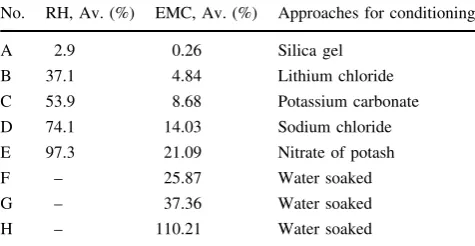
The measurement of MC, specific density and CSP The specific density of all of the samples was measured according to the Chinese national standard for bamboo (GB/T 15780-1995). The target MC levels for the com-pressive tests were 0, 5, 10, 15, 20, 25, 35 % and water saturation, respectively. The MC for the first 5 groups were achieved by placing these samples into desiccators containing different saturated salt solutions or a silica gel [10, 16–18] as listed in Table1. The relative humidity (RH) was measured with a hygrothermograph (TESTO 608-H1). The samples were conditioned over more than 40 days at a constant temperature of 23±1°C. The actual equilibrium moisture content (EMC) of each sam-ple was measured by weighing protocol after the condi-tioning, in accordance with the method used by Jiang et al. [15]. To achieve FSP, the bamboo samples were first soaked in water for a period of time until they had reached a target weight gain of approximately 25 %. The soaked samples were then sealed in plastic bags until they had reached an EMC of about 25 %, which was taken as the FSP for mature moso bamboo [16, 19]. The mechanical experiments were conducted using an electronic universal mechanical testing machine (Instron 5582, USA) in accordance with Chinese national standard GB/T
15780-1995. To minimize the loss of moisture, the spec-imens were tested immediately after being taken out of the desiccators.
Statistical analysis
A total of 640 samples were randomly selected from a larger batch of samples, which were cut from 100 moso bamboo culms. 63.9 % of the data generated from each group of samples was used to establish predictive models, with remaining specimens used to test the models’ pre-dictive validity. A statistical summary of the calibration and prediction sets is given in Table2.
Origin 8.0, a commercial statistics software package, was used to analyze the data. The standard error of fitting (SEF) (determined from the residuals of the fitting) and the coefficient of determination (R2) were used to assess the fitting performance. The standard error of prediction (SEP) was employed to evaluate the accuracy of the established model by predicting the parameter of interest for a set of unknown samples that are different from the calibration set. The predicting coefficient of determination (RP2) was
cal-culated as the proportion of variation in the independent prediction set.
Results and discussion
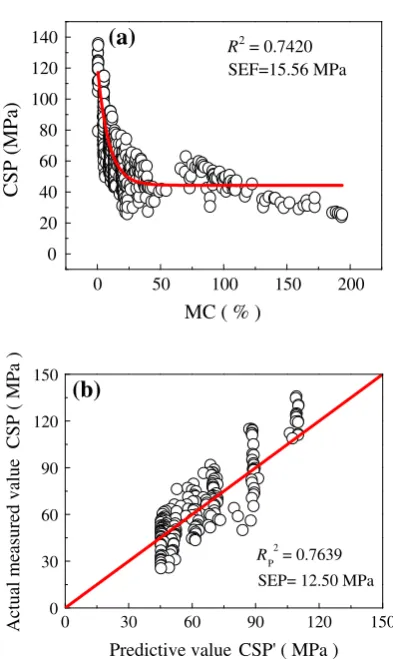
CSP prediction model based on MC as a single variable A total of 409 samples were tested and used to create the model. Figure1a shows the relationship between CSP and MC for all the tested samples with four ages. In the pre-vious studies, it was demonstrated that the FSP of mature Moso bamboo was approximately 23 % [15, 18]. There-fore, it is clearly observed that CSP decreased significantly with increasing MC levels until MC reaches roughly 23 %. This is followed by minimal variation, when MC rises above FSP. In order to better describe the correlation Table 1 Relative humidity (RH) levels in the experiments and the corresponding equilibrium moisture contents (EMC)
No. RH, Av. (%) EMC, Av. (%) Approaches for conditioning
A 2.9 0.26 Silica gel
B 37.1 4.84 Lithium chloride
C 53.9 8.68 Potassium carbonate
D 74.1 14.03 Sodium chloride
E 97.3 21.09 Nitrate of potash
F – 25.87 Water soaked
G – 37.36 Water soaked
between CSP and the whole MC range, a Boltzmann equation was selected to fit the experimental data, with the resultant regression equation presented as follows: CSP¼45:23þ180:7845:23
1þeðMC6þ:74870:1759Þ
ð1Þ
The correlation coefficientR2 of the predictive Eq. (1) was calculated to be 0.7420, which indicates that 74.20 %
of the variation in CSP could be explained by changes in MC. The SEF of 15.56 MPa indicates that this model not only gave a good relationship, but also had a relatively low calibration error.
CSP of samples used to validate the model was calcu-lated using Eq. (1). The experimental CSP and the pre-dicted one were plotted as shown in Fig.1b. The predicted value agreed well with the measured one withRP2of 0.7639
and standard error of prediction (SEP) of 12.50 MPa. The big data scatter shown in Fig.1b may be due to the exclusion of specific density in the model, which is well known to play an important role in CSP for bamboo [14].
CSP prediction model based on specific density as a single variable
The correlation between CSP and specific density for the samples with different MC was plotted and shown in Fig.2a. A huge variation of CSP could be clearly observed even if the density was the same, which was mainly attributed to the large variation of MC from nearly oven drying to about 110 %. A linear fit was adopted to describe the correlation between CSP and density, producing the following equation:
CSP¼151:23q33:37 ð2Þ
The correlation coefficient R2 was found to be only 0.4323, while the SEF was 19.08 MPa. These values were significantly lower and higher, respectively, than the cor-responding values given by Eq. (1). Similarly, the corre-lation between the predicted value based on Eq. (2), and the actual measured one was plotted and linearly fitted as shown in Fig.2b. The resultant correlation coefficient RP2
of 0.4109 and the SEP of 20.08 MPa indicated the accu-racy of the prediction model with specific density as the only independent variable was lower than that of the model with MC as the only independent variable. This can be explained by the significant effect of MC levels have on CSP for bamboo as shown in Fig.1a.
0 30 60 90 120 150
Actual measured value
CSP
( MPa )
Predictive value CSP' ( MPa )
RP2 = 0.7639
SEP= 12.50 MPa
0 30 60 90 120 150
0 50 100 150 200
0 20 40 60 80 100 120 140
MC ( % )
R2 = 0.7420
SEF=15.56 MPa
(a)
(b)
CSP (MPa)
Fig. 1 aThe relationship between compressive strength parallel to
the gain (CSP) and MC. b The relationship between predicted
compressive strength (CSP0) and experimental compressive strength
(CSP) based on MC Table 2 Statistical summary of the calibration and prediction sets
No. Calibration set (409) MPa Prediction set (231) MPa
Min. Max. Avg. SD Min. Max. Avg. SD
A 74.63 137.84 113.15 16.88 108.80 135.82 121.86 8.50
B 60.34 114.99 88.10 14.84 56.07 114.81 88.48 19.00
C 49.92 92.16 72.27 12.16 49.88 91.83 71.89 11.13
D 38.65 79.67 58.66 10.51 43.44 79.67 60.99 11.12
E 24.02 76.23 46.74 11.25 25.88 76.23 49.07 10.99
F 33.43 68.74 54.00 8.73 31.26 65.43 51.09 9.58
G 33.86 64.19 48.81 7.92 25.47 60.28 44.12 9.75
CSP prediction model based on both MC and specific density as independent variables
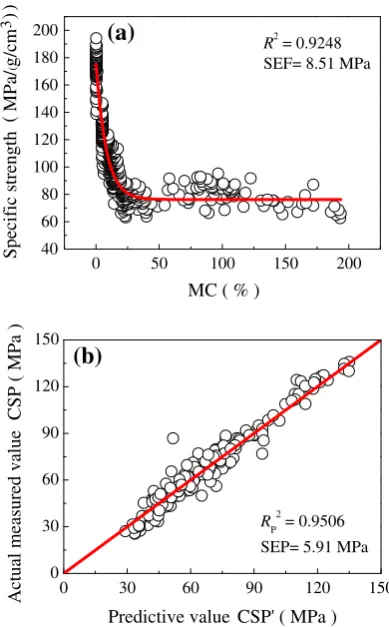
The previous analysis showed the prediction models with single variable, either MC or specific density, will not be always satisfying under complex conditions. Therefore, investigation on the combined influence of these two fac-tors is necessary. Since the CSP of bamboo linearly increased with rising density, the specific CSP (the ratio between CSP and specific density, i.e., CSP/q) was pro-posed as a dependent variable while MC was incorporated as an independent variable (Fig.3a). The Boltzmann function is selected to fit the data, and the regression model is shown in Eq. (3).
CSP
q ¼76:62þ
738:9076:62 1þeðMC7:þ629613:46Þ
ð3Þ
The correlation coefficient R2 of the improved predic-tion model reached as high as 0.9248, which is much higher than those of the regression Eqs. (1) and (2). Fur-thermore, the SEF is only 8.51 MPa. Figure3b shows the correlation between the experimental CSP and the
calculated CSP based on the Eq. (3). Excellent agreement between the predicated CSP and the experimental value demonstrates the accuracy of the improved predictive model. Finally, the SEP is only 5.91 MPa, much lower than those produced by the single-variable prediction models. The results demonstrate that to a large extent, specific density and moisture content together determine the CSP of bamboo.
Conclusion
In this study, three experimental models for predicting the CSP of bamboo with variable MC and specific density were established and compared. A two-variable model containing both MC and specific density as independent variables was developed, which was capable of accurately predicting longitudinal CSP of Moso bamboo with any combination of specific density and MC, delivering much higher predictive accuracy than that of corresponding sin-gle-variable models. The route and method presented in the present study could be extended to the non-destructive
40 60 80 100 120 140 160 180
200
(a)
Specific strength
( MPa/
(
g/cm
3))
MC ( % )
R2 = 0.9248
SEF= 8.51 MPa
0 50 100 150 200
0 30 60 90 120 150
0 30 60 90 120 150
Predictive value CSP' ( MPa )
Actual measured value
CSP ( MPa )
R
P 2
= 0.9506 SEP= 5.91 MPa
(b)
Fig. 3 aThe relationship between specific strength and MC.bThe
relationship between predicted compressive strength (CSP0) and
experimental compressive strength (CSP) based on MC and density
(q)
0 30 60 90 120 150
Actual measured value
CSP
( MPa )
Predictive value CSP' ( MPa ) RP2 = 0.4109 SEP= 20.08 MPa
0 30 60 90 120 150
0.3 0.4 0.5 0.6 0.7 0.8 0.9
20 40 60 80 100 120 140
Basic density ( g/cm3)
R2 = 0.4323
SEF= 19.08 MPa
(a)
(b)
CSP (MPa)
R
Fig. 2 aThe correction of compressive strength parallel to the gain
(CSP) and density (q) for all bamboo samples.b The relationship
between predicted compressive strength (CSP0) and experimental
prediction of other mechanical properties of bamboo, greatly enhancing potential applications of bamboo-based engineered products in commercial fields.
Acknowledgments The authors are grateful to the National Natural and Science Foundation of China (31070491) for their financial support for this research.
References
1. Fung YC (1993) Biomechanics: mechanical properties of living tissues. Springer, New York
2. Ashby MF, Gibson LJ, Wegst U (1995) The mechanical prop-erties of nature materials I: msterial property charts. Proc Math Phys Sci 450:123–140
3. Smith LB (1999) Molecular mechanisitic origin of the toughness of natural adhesives, fibres and composites. Nature 399:761–763 4. Parameswaran N, Liese W (1976) On the fine structure of
bam-boo fibres. Wood Sci Technol 10:231–246
5. Huang S, Ma L, Shao Z, Zhou X (2005) Relationship between microstructure characteristics and mechanical properties of moso bamboo. J Anhui Agric Univ 32:203–206
6. Yu H, Fei B, Ren H, Jiang Z, Liu X (2006) Variation in tensile properties and relationship between tensile properties and air-dried density for Moso bamboo. Scientia silvae Sinicae 42:72–76 7. Zhang X, Cheng X, Zhu Y (2006) Variation of bending perfor-mance with different location of bamboo. J Nanjing For Univ 30:44–46 (natural science edition)
8. Ji W, Yao W, Ma L (2007) Analysis on gradual mechanical
properties by the depth of bamboo wall of Dendrocalamus
gi-ganteus and Dendrocalamopsis oldhami. J Zhejiang For Coll 24:125–129
9. Oltean L, Teischinger A, Hansmann C (2007) Influence of tem-perature on cracking and mechanical properties of wood during wood drying: a review. Bioresoures 2:789–811
10. Wang H, Wang H, Li W, Ren D, Yu Y (2013) Effects of moisture content on mechanical properties at macroscopic and cellular levels for Moso bamboo. Bioresources 8:5475–5484
11. Sologubik CA, Campanone LA, Pagano AM, Gely MC (2007) Effect of moisture content on some physical properties of barley. Ind Crops Prod 43:762–767
12. Zhou FC (1998) Bamboo cultivation. Chinese Forestry Publish-ing House, BeijPublish-ing
13. Wang H, Yu Y, Yu Y, Tian G (2010) Measurement of saturation point of bamboo fiber from different age. J Nanjing For Univ 32:91–94 (natural science edition)
14. Wang H, Jiang Z, Yu Y, Tian G, Sun F (2010) Comparative on four mechanical properties of bamboo under air-dried and satu-rated state. Scientia Silvae Sinicae 46:119–123
15. Jiang Z, Wang H, Tian G, Liu X, Yu Y (2012) Sensitivity of several selected mechanical properties of Moso bamboo to moisture content change under the fibre saturation point. Biore-sources 7:5048–5058
16. Wang H, Jiang Z, Yu Y, Sun F (2010) Variation of the fiber saturation point of bamboo with age. J Cent South Univ For Technol 32:112–115
17. Wang H (2010) Study the mechanism of moisture affecting the bamboo fibre cell walls and macroscopic mechanical behavior. Cent South Univ For Technol, Changsha, pp 1–39
18. Choudhury D, Sahu JK, Sharma GD (2011) Moisture sorption isotherms, heat of sorption and properties of sorbed water of raw
bamboo (Dendrocalamus longispathus) shoots. Ind Crops Prod
33:211–216