NOMA based Resource Allocation and Mobility
Enhacement Framework for IoT in Next Generation
Cellular Networks
Raouf Abozariba,
Member, IEEE
, Muhammad Kamran Naeem,
Member, IEEE
, Mohammad
Patwary,
Senoir Member, IEEE
, Mir Seyedebrahimi, Adel Aneiba, and Peter Bull,
Member, IEEE
Abstract—With the unprecedented technological advances wit-nessed in the last two decades, more devices are connected to the internet, forming what is called internet of things (IoT). IoT devices with heterogeneous characteristics and quality of experience (QoE) requirements may engage in spectrum market due to scarcity of radio resources. We propose a framework to efficiently quantify and supply radio resources to the IoT devices by developing intelligent systems. The primary goal of the paper is to study the effect of the next cellular generation wireless connectivity characteristics with non-orthogonal multiple access technique (NOMA) on providing connection to clustered IoT de-vices. We first demonstrate analytically how the distribution and QoE requirements of IoT devices impacts the required number of radio resources. We then show that in a standard auction algorithm extended to allow for implementation of incentive and other complementary processes in clustered approach, bids informed by our proposed system enhance the radio resource utilization efficiency of the IoT service providers. Our results suggest substantial reduction in the number of sub-carriers required when compared to conventional orthogonal multiple access (OMA) model. The results also show our intelligent clustering is scalable and adaptable to the cellular environment. Ability to move spectrum usages from one cluster to other clusters after borrowing when a cluster has less user or move out of the boundary is another soft feature that contributes to the reported radio resource utilization efficiency. Moreover, the proposed framework provides IoT service providers cost estimation to control their spectrum acquisition to achieve QoE with guaranteed bit rate (GBR) and non-guaranteed bit rate (Non-GBR).
Index Terms—Resource allocation, IoT, 5G networks, NOMA, optimization, clustering
Raouf Abozariba, School of Computing and Communications, Lancaster University, Lancaster LA1 4WA, United Kingdom. Tel: +447429234875, Email: [email protected].
Muhammad Kamran Naeem, Research Innovation and Enterprice,
Southampton Solent University, Southampton SO14 0YN, United Kingdom. Tel: +447917192562, Email: [email protected].
Mohammad Patwary, Centre for Cloud Computing (CCC), School of Computing and Digital Technologies, Birmingham City University, Birm-ingham B4 7BD, United Kingdom. Tel: +447803495434, Email: [email protected].
Mir Seyedebrahimi, Centre for Cloud Computing (CCC), School
of Computing and Digital Technologies, Birmingham City University, Birmingham B4 7BD, United Kingdom. Tel: +441213317545, Email: [email protected].
Adel Aneiba, Centre for Cloud Computing (CCC), School of Computing and Digital Technologies, Birmingham City University, Birmingham B4 7BD, United Kingdom. Tel: +441213317494, Email: [email protected].
Peter Bull, Centre for Cloud Computing (CCC), School of Computing and Digital Technologies, Birmingham City University, Birmingham B4 7BD, United Kingdom. Tel: , Email: [email protected].
I. INTRODUCTION
The Internet of Things (IoT) refers to the interconnection of uniquely-identifiable embedded devices within the Internet infrastructure. It is forecast that in the next few years we will witness a deployment of billions more connected devices, en-abling new, wide-ranging use cases, including energy and util-ity monitoring, health-care, process automation and mission-critical services [1]–[3]. This will generate significant amount of traffic, transmitted over the radio frequency spectrum [4].
Typically wireless IoT traffic is transmitted over unli-censed spectrum such as the instrument, scientific and medical (ISM) bands. For future sustainability of the IoT technology, however, the question is whether the ISM bands, used by the underlying Internet architecture, such as LoRa, Sigfox, Weightless and many other platforms will be flexible enough to stretch to the potential of IoT. For example, low-latency and high-throughput requirements are expected to be necessary to support use cases such as health monitoring and V2X communications. Currently these applications are beyond the capability of current IoT platforms. One solution to provide connectivity and to address the spectrum demands of the IoT devices is cellular networks, enabling a wide range of data rates with high availability and reliability. Other advantages of cellular networks such as 5G-NR over traditional IoT wireless access technologies include; improvement of global coverage, long-term availability and technological advantages with respect to spectral efficiency, latency and data throughput. Non-orthogonal multiple access (NOMA) has been consid-ered as a promising candidate to increase the connectivity in future cellular networks. The use of NOMA not only ensures the user with poor channel conditions is served but also users with better channel conditions can concurrently utilize the same bandwidth resources. In addition to the spectral effi-ciency gain of NOMA, research in this area has demonstrated that NOMA can effectively support massive connectivity, an important characteristic to ensuring the forthcoming 5G network support the IoT industry [5].
performance of the proposed framework followed by conclu-sion in section VII.
II. RELATED WORK
5G cellular systems, with its promised reliability, scalability, and efficiency in terms of cost and spectrum utilization, is expected to be a key enabler for IoT technology [6]. Therefore, IoT provision in 5G wireless communication systems has been addressed in the literature to provide wireless connectivity to IoT devices and to meet the requirements of heterogeneous use cases. For example, a low-cost and low-complexity operation of IoT communications in 5G networks to support massive connection density of low-rate and low-power devices has been proposed in [7]. Low latency IoT applications and their requirements in the context of 5G networks are discussed in [8]. Palattella et al. have characterized the potential of 5G for the IoT in [9], considering both the technological aspects and their implications on business models and strategies. The authors in [10] proposed a scheme that is expected to achieve the uplink data rate for critical tasks in cellular based IoT networks.
In order to maximize the spectral efficiency and to support machine-type communications (MTC) within 5G networks, power-domain NOMA has been considered by the research community as a promising approach. Liu et. al. in [11] have investigated the simultaneous wireless information and power transfer using NOMA within 5G. Recently, several research studies have identified the potential benefits of NOMA in both the downlink and uplink to support IoT services within 5G cel-lular networks [12]. For example, the authors in [13] proposed an edge computing aware NOMA technique which leverages uplink NOMA in reducing users’ uplink energy consumption. To overcome the challenge of providing connectivity to a large number of IoT devices, the authors in [14] proposed a power-domain uplink NOMA scheme for narrow band IoT systems. A review study, surveyed recent advancements in NOMA for IoT communications and describes its benefits and challenges, can be found in [15].
NOMA serves multiple users simultaneously using the same sub-carrier, at the cost of increased intra-cell interference. To mitigate intra-cell interference, efficient NOMA design (e.g., user clustering and resource allocation) along with successive interference cancellation techniques/schemes has been consid-ered in the literature to manage large number of devices as discussed in [16]. Clustering technique in NOMA is paramount as it provides a way to allocate resources efficiently with minimum interference. A NOMA based clustering scheme is proposed by Ali et al. in [17] and considers the channel gain difference among users to form clusters and optimize their respective power allocations to increase throughput. A NOMA based optimization framework is proposed by Kiani et al. in [13] that minimizes the energy consumption of the users by optimizing the user clustering and transmit power. An interference aware NOMA framework is presented in [18] that is expected to perform for both intra-cell and inter-cell interference. The authors in [19] proposed a multi-cluster uplink NOMA system and analyze its performance considering
successive interference cancellation (SIC), where users are arranged based on the distance of their serving base station.
Bandwidth allocation challenges for IoT devices by consid-ering spectrum sharing is discussed in [20]. Spectrum leasing scheme, aimed at providing licensed spectrum to new emerg-ing technologies includemerg-ing IoT applications is investigated in [21]. The authors modeled a monopoly market where femto holders bid for spectrum, owned by mobile network operators to increase utility.
One challenge faced by IoT-SPs when acquiring radio resources is the determination of number of resource blocks required and the efficiency of outcomes. In this context, an auction market approach to maintain the QoS of IoT mobile nodes by purchasing bandwidth from the service provider is proposed by [22]. Based on service delay constrain, the aggregated bandwidth requirement is calculated. The authors consider an OMA modulation scheme to obtain the spectral efficiency. However, the problem of calculating the bandwidth requirements to support GBR, in NOMA, has not been ad-dressed. Predictive techniques to estimate the IoT bandwidth requirements carry a degree of uncertainty between expecta-tions and real-world experiences. Therefore, we compute the amount of spectrum required and provide an on-demand based service which runs in small time windows. Furthermore, we characterize the bandwidth demands of the entire IoT devices in a region. Under IoT-SPs strict demands over throughput and transmit power we focus on mechanisms to cluster IoT devices based on their location in reference to the base stations of the CSPs. The main contributions of this paper can be summarized as follows:
1) The focus of the paper revolves around NOMA enabled devices, with asynchronous data rate requests, served by IoT-SPs. In this context, NOMA scheme to provide guar-anteed bit rate (GBR), required by IoT-SPs, is proposed to optimize the spectrum utilization. This is followed by a spectrum trading market, formulated between IoT service providers and cellular service providers. 2) An algorithm to associate IoT devices with BSs, which
collectively can provide GBR is presented. This involves finding an appropriate combinations of BSs, leasing radio resources to IoT-SP under transmit power and distance restrictions. An advantage of the proposed algorithm is maximizing the average data rate of IoT devices. Thereafter, a solution developed to find the re-quired number of sub-carrier and minimizes the effect of interference is presented with an emphasis on clustering problems.
3) To expedite spectrum utility transfer between operators, a second price auction (SPA) algorithm which matches the requirement of IoT-SPs with CSPs’ spectrum avail-ability, in a form of radio slices is provided.
A. IoT future spectrum requirements
Radio spectrum is an essential part of the IoT infrastructure. As IoT networks develop towards maturity, diverse bands may seem more attractive to IoT operations. It is expected that the spectrum bands which could be most appropriate for the IoT services would have a wide range of properties, and thus frequencies, to suit different types of IoT applications are increasingly associated with IoT services. Traditionally, most of the existing IoT services rely on unlicensed spectrum to facilitate wireless links between the IoT devices and their associated access point. However, as the technology evolve to demand more spectrum and the unlicensed spectrum be-comes overloaded, an alternative to the unlicensed spectrum is required. A solution which manifest itself as a core part of the future IoT radio architecture is the well studied spectrum sharing. In this paper the attention is focused on the 5G candidate frequencies to support the IoT spectrum demands. It has been noted that IoT traffic is uplink dominant and therefore in this paper we have focused on [23]. In addition the periodic update traffic which occurs when a device transmits status updates to a server on a regular basis and the content data size is usually small and it is therefore neglected. A summary of IoT communication platforms and their features are presented in Table I.
III. SYSTEM MODEL
A. Network Description
The horizontal location of IoT device k is denoted as
wk ∈ R2×1, k ∈ {1,2, . . . ,K}, where R is a set of real
numbers. We also consider a set of B base stations (BSs) arbitrarily located in a given region ⊆R2. The coverage area
of BS b is denoted as Rb. The locations of IoT devices
are modeled as homogeneous Poisson point processes (PPPs) with densities λ, with the intensity is sufficiently large to ensure that each BS is active and to capture the notion of large number of IoT devices predicted in 5G networks. Users generate independent requests ofuk,tpossible data rate at time
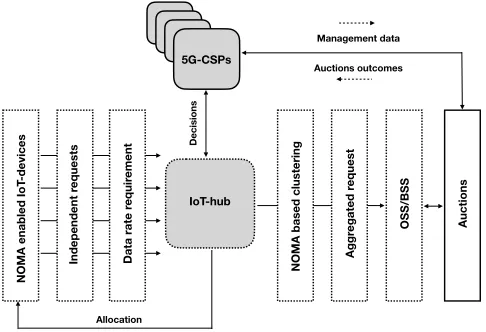
window t when it has pending data to be sent. The data rate requests by the IoT devices are transmitted wirelessly over reliable local communication channels to an IoT-Hub (e.g. by sending a SERVICE REQUEST message to the IoT-Hub for radio bearer establishment) to initiate access. We use the IoT-Hub to simplify the interaction between the IoT devices and CSPs. This approach allows overhead communication to be established between IoT-devices and IoT-hub over other unlicensed communication channels using platforms such as LoRa and Lightweight. IoT-Hub imposes a set of rules to select between one or more base stations (under strongest cell association). The rules are based on cost associated with providing IoT devices with sub-carriers and to provide connectivity. The rules are periodically updated on the IoT-Hub to reflect changes in established agreements between the CSPs. To generalize the system model, the density of IoT devices is considered to be variable over the BSs coverage area and some cells overlap each other. Furthermore, assume the time is slotted into discrete time slots, during which, the location of IoTs devices are fixed. The analysis provided in
this paper can also be extended to a more complex model, taking into account the mobility of IoT devices as will be shown in Section V. An overview of the network model is illustrated in Figure 1.
To set the stage for the system model, we denote withN =
{1,2, . . . ,N}as the set of IoT-Hubs in a macro-cell. IoT-Hubs
do not own spectrum bandwidth by default, which implies that in order for the IoT devices to transmit data to their respective servers, they have to rely on CSPs. In addition, letMn be the
set of IoTs devices which belong to thenth IoT-SP, then we have Ñ
n∈NMn = M. Let S = {1,2, . . . ,S} be the set of
CSPs in the region and Sm denote the set of CSPs who can
cover themth IoTs device, where m∈ M, which means that CSPs ∈ Sm can provide connectivity to themth IoT device. The number of CSP which can cover the mth IoT device is represented by
Data rate r
equir
ement
NOMA enabled IoT
-devices
IoT-hub 5G-CSPs
Independent r
equests
Allocation
Aggr
egated r
equest
Auctions
NOMA based clustering
OSS/BSS
Decisions
Management data Auctions outcomes
Fig. 1: Block diagram summarizing the methodological steps of the proposed resource allocation and spectrum sharing framework.
|Sm|={sm:|Sm| ≤S ≥0} (1)
where S is the total number of CSPs and |Sm| denotes the
cardinality ofSm.|Sm|=0describes the case where the IoT
device k is outside of the coverage area of all CSPs. In this case this IoT device is excluded from further consideration by the IoT-Hub. The matrix that defines each IoT-SP devices and their coverage provider is written as
Mn={vm,s}Mn×S,wherevm,s∈ {0,1} and (2)
∀n=1,2, . . . ,N.
B. Formulation of resource allocation problem
We posit that the BSs are equipped with successive in-terference cancellers (SIC), which exploit interfering signals structure to mitigate interference. We denote the frequency band of the CSP as Ws Hertz which are divided into Nf
TABLE I: IoT wireless access technologies.
Parameters
Technology
LoRa, SigFox & Weightless etc. eMTC & NB-IoT 5G-NR
Accessing spectrum Unlicensed (ISM bands) Licensed Licensed
Modulation scheme (Uplink) OMA OMA OMA & NOMA
Operating frequency (min-max) 7.8-500 (KHz) 180-1080 (KHz) Sub-1GHz, 1-6 GHz
Channel bandwidth 15 (KHz) 200 (KHz) variable (5 - 400 MHz)
Range (max) 50 (km) 25 (km) 2000 (m)
Throughput 600 (bps) 1 (Mbps) >100 Mbps
Transmit power (max) 20 (dBm) 23 (dBm) 30 (dBm)
fi,j =
(
1, if channel is available
0, otherwise. (3)
The subset of a matrix which contain the available channels for lease is defined asF = {fi,j ∈F|fi,j ,0}. Next, we derive the formulae to determine the number of sub-carriers required by the IoT-SPs, using NOMA technique. It is assumed that each sub-carrier can be allocated to Ji IoT devices, wherei
represents the index for sub-carriers such asi={1,2, . . . ,Nf}.
The signal received by the sth CSP fromith sub-carrier can be represented as yi
s and defined as:
ysi =
q
pi1%1g1ix i 1+
q
pi2%2g2ix i 2+. . .+
q
piJ
i%Jig
i Jix
i Ji+z
i
(4)
where the variable xij denotes the symbols transmitted from
jth IoT device to sth CSP, j={1,2, . . . ,J}.pi
j is the transmit
power of the signal transmitted by jth IoT device on ith sub-carrier. %j represents the joint effect of path loss and
shadowing between the jth IoT device andsth CSP. gij is the small scale fading coefficients for the link between jth IoT device and sth CSP. zi is the additive white Gaussian noise (AWGN) for the ith sub-carrier. Consider Y represents the symbols received from all Nf sub-carriers, which is defined
as Y = {y1,y2, . . . ,yNf}. NOMA is a technique to realize multiple access by utilising power domain in a spectrally efficient way and can serve multiple IoT devices in the same sub-carrier. This can be achieved by allocating different power levels to different IoT devices [24]–[27]. Consider Ji IoT
devices are expected to transmit data on theith sub-carrier.
Consider that Gj denotes the channel coefficient vector
of jth IoT device at sub-carrier i, which includes distance dependent loss, shadowing loss, and instantaneous fading coefficients and assume |G1| ≤ |G2| ≤ . . . ≤ |GJi| for Ji IoT devices [28]. The CSP superimposes the IoT devices data by allocating the corresponding power levels, pj, where
it represents the power level for jth IoT device. Moreover, the CSP is expected to allocate more power to the IoT-devices which are experiencing poor channel conditions i.e,
p1 ≥ p2 ≥ . . . ≥ pJi and p
2 1 + p
2
2 +. . . +p 2
Ji = 1 if
|G1| ≤ |G2| ≤ . . . ≤ |GJi|. The optimal order for decoding is in the order of the increasing channel gain, normalized by the noise and inter-cell interference power. Based on this order, the CSP decodes the signals from any of the Ji IoT
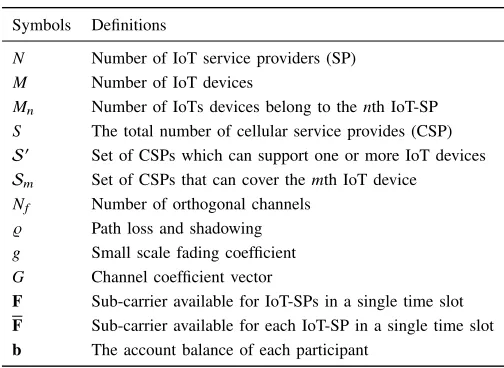
TABLE II: Key symbols and definitions
Symbols Definitions
N Number of IoT service providers (SP)
M Number of IoT devices
Mn Number of IoTs devices belong to thenth IoT-SP
S The total number of cellular service provides (CSP)
S0 Set of CSPs which can support one or more IoT devices
Sm Set of CSPs that can cover themth IoT device
Nf Number of orthogonal channels
% Path loss and shadowing
g Small scale fading coefficient
G Channel coefficient vector
F Sub-carrier available for IoT-SPs in a single time slot
F Sub-carrier available for each IoT-SP in a single time slot
b The account balance of each participant
devices. The throughput that is expected to be achieved on sub-carrieri denoted asUi
j(p)and expressed in equation (5).
Wherep∈R(Nf·J)×1 represents the transmission power. µ
J is
a non-negative constant that represents the priorities of theJth IoT device in resource allocation i.e. 0 ≤ µJ ≤ 1. Consider
for jth IoT device Gij = %j|g
i j|
σ2 , then the equation in (5) can
be written as equation (6).
The total achievable throughput from Nf sub-carriers can
be denoted as Uand defined as
U= Nf Õ
i=1 Ji Õ
j=1
Uij(p) (7)
Lets assume the required throughput by the nth IoT-SP is Un
r eq. Based on equation (7), each IoT-SP computes the
required number of sub-carriers to achieve a desired QoS in a form of throughput using Algorithm 1. The steps the CSPs takes to provide connectivity to IoT devices and to find the combination of CSPs that can accommodate all IoT devices with minimum power or cost are described as follow.
Firstly, the IoT-Hub quantifies all the CSPs which could provide access to one or more IoT devices to form the vector
S0⊆ S subject to constraints of the form
(C1):dms ≤dn0, dms ∈R+ (8)
Uij(p)=µ1log2©
«
1+
%1|gi1|
σ2 p
i 1
ÍJ
k=k+1
%k|gik|
σ2 pik+σ2
ª ®
¬
+µ2log2©
«
1+
%2|gi2|
σ2 p
i 2
ÍJ
k=k+2
%k|gik|
σ2 pik +σ2
ª ®
¬
+. . .
+µJ−1log2©
«
1+
%J−1|giJ−1|
σ2 piJ−1
ÍJ k=J−1
%k|gik|
σ2 p
i k +σ2
ª ®
¬
+ µJlog2©
«
1+
%J|gJi|
σ2 piJ
σ2
ª ®
¬
, ∀j =1,2, . . . ,J. (5)
Uij(p)=µ1log2 1+
Gi1pi1
ÍJ
k=k+1Gikpik +σ2
!
+µ2log2 1+
Gi2pi2
ÍJ
k=k+2Gikpik+σ2
!
+. . .
+µJ−1log2 1+
GiJ−1piJ−1
ÍJ
k=J−1Gikp i k+σ2
!
+ µJlog2 1+ GiJpiJ
σ2
!
, ∀j =1,2, . . . ,J. (6)
wheredms represents the distance between themth IoT device
and thesth CSP anddn0 is the distance threshold set by thenth IoT-SP. pms0 is the sth maximum allowed power for mth IoT device, imposed by the CSPs and p0n is the IoT-SP maximum supported power, this is important in 5G networks, supporting a wide range of radio frequencies, operating under various power restrictions to mitigate interference. Next, we find the combinations of CSPs which can accommodate all the IoT devices in the coverage area, enabling the IoT-SPs to identify the CSPs which will be used to provide connectivity. Let
hS×Mn ∈ {0,1}, where the value 1 represents the coverage provided by the sth CSP to the mˆ ∈ Mn IoT device and 0
otherwise. Mathematically the set is given by
l, if
Mn Î
ˆ m=1
hl,mˆ ,0
{l,k},where we letl,mˆ, if
Mn Î
ˆ m=1
Í
l,k h,0,
∀l,k ∈ S0
..
. ...
{l,k, . . . ,S0} if
Mn Î
ˆ m=1
Í
l,k,...,S0
h,0,
∀l,k, . . . ,S0∈ S0
φ, otherwise
(10)
where{l,k, . . . ,S0} ⊆ S0represents the CSPs that can provide coverage to IoT devices ofnth IoT-SP, andφis an empty set.
To derive the optimal allocation strategy, we formulate an optimization problem, which minimizes the cost of radio resources, expressed as
(P): min
C
Õ
k=1
S0(k) (11)
subject to
(C1):dmsˆ =min{dmsˆ },∀mˆ ={1,2, . . . ,Mn}, (12)
s={1,2, . . . ,S}
(C2):pmˆ,n≤p0n,∀n={1,2, . . . ,N}, (13)
(IoT-SP maximum supported power)
The constraint C2 in (P) enforces the IoT-Hub to consider
spectrum resources with allowable transmit power, as set by the CSP.
Algorithm 1 illustrates the steps to compute the required number of sub-carriers for one IoT-SP. It calculates the achiev-able throughput Uachn , using Equation (7), considering IoT devices with data to transmit, and in contrast with the required throughput. If the required throughput is not achievable with the available resources, additional sub-carriers are added to fulfill the throughput demand. This is to eliminate packet loss due to interference and fading, requiring retransmission of data and additional time and power which is impractical in real-world deployments. The algorithm starts with measuring the distance between each IoT device and the BSs, updating the vector Mn (Algorithm 1: Line 1–5). Clustering of IoT devices based on distance, taking into account the maximum number of devices in a cluster,V, is performed to obtain C, using k-means clustering (Algorithm 1: Line 6–12). Based on the number of devices and required QoS, we compute the required number of sub-carrier for each cluster, given inS(k)
(Algorithm 1: Line 14–24). The total number of required sub-carrier is then given byDs=ÍCk=1S(k), whereC is the total
number of clusters (Algorithm 1: Output).
IV. DYNAMIC SPECTRUM ALLOCATION
A. Charging scheme
Algorithm 1:Pseudocode for NOMA based IoT device clustering and calculation of the required number of sub-carriers.
Input: N:The number of IoT devices,
¯
F:available channels,
Ur eqn :total required throughput,
Un
ach :achieved throughput,Rˆn ∈ {φ}.
Mn∈ {1,2, . . . ,Mn},Rn ∈ {r1,r2, . . . ,rn}.
Output: Ds =ÍCk=1S(k) %
total number of required sub-carrier 1 foralli←1 :Mn do
2 ri =min{Rn} 3 Rˆn ←ri
4 Based onRˆn, sort all the IoT devices in Mn
5 return Mn
6 forall j ←1 :V do
7 l =j×C
8 if l≤Mn then
9 Cji={(C×(j−1))+1,(C×(j−1))+2, . . . ,C×v}
assigning IoT devices to the clusters
{1,2, . . . ,C}.
10 else
11 Cji={(C×(j−1))+1,(C×(j−1))+2, . . . ,Mn}
assigning IoT devices to the clusters
{1,2, . . . ,Mn− (C× (j−1))}.
12 return C
13 Ur eq ={Ur eq(1),Ur eq(2), . . . ,Ur eq(C)} 14 forall k←1 :C do
15 remaining IoT devices = C(k) 16 while remaining IoT devices>0 do 17 while Uach(k) ≤ Ur eq(k) do
18 calculate Uach(k) using equation (7) where
N ≤λN andU≤λu.
19 remaining IoT devices = Remaining IoT
Devices - 1
20 Ur eq(k)= Ur eq(k)-Uach(k)
21 required number of sub-carrier = required number of sub-carrier + 1
22 if remaining IoT devices>0 then
23 remaining IoT devices = remaining IoT
devices + 1
24 return S(k)= required number of sub-carrier for cluster k
second-highest bid. In the following section we provide rules of entering auctions.
B. Entering an auction problem
Definition 1. Network slicing is an end-to-end realization, covering all network segments including radio networks, wire access, core, transport and edge networks. In this paper we address the radio segment of the network slices – radio resource slicing – where radio resources are represented in a set of slices N={Slice1,Slice2,Slice3}
The IoT-Hub selects the appropriate set of radio resource slices for allocation to clusters in the BS’s coverage.
CSPs announce information related to auction opening and details on the available resources for lease. The minimum asking pricePmwhich is set so that bids must exceed the value
of Pm, is announced at the beginning of the jth trade window
where j ∈ {1,2, . . . ,I} and I denotes the total number of trading windows. Based on distributions of IoT-SP valuations, the total expected revenue of the CSP is maximized by a SPA with minimum asking price. The prior distributions of IoT-SP valuations come from past empirical data. The discussion on how much data is necessary and sufficient to guarantee near-optimal expected revenue to the CSPs or IoT-SPs is beyond the scope of this paper.
Next, we present a decision rule the IoT-SPs use to establish whether entering the auction is required. Suppose zi,j denote
the state of a ith IoT-SP at the beginning of the jth trading window;zi,j =0or1refers to the IoT-SP with data to transfer
or not, respectively. Let ai,j =0 refers to the case where the
required resources by theith IoT-SP (which is computed using Algorithm 1) is smaller than the resources announced by the CSPs at the jth trade window andai,j =1otherwise. Suppose ti,j denote the decision to enter an auction, i.e.ti,j =1means
the the ith IoT-SP decides to enter an auction and ti,j = 0
represents the decision not entering an auction. The binary rule can be written as
ti,j =
1, if
"
1−ÎI
j=1
zi,j 1− I
Î
j=1 ai,j
=1 #
andP(i)>Pm
0, otherwise.
(14) From the above formulation, it can be found that if the IoT-SP valuation of the spectrum resources, P(i), of the sub-carriers being auctioned is less than the minimum asking price, Pm,
then not entering the bidding is the optimum decision.
C. Rules of entering an auction
An IoT-SP may enter the bidding round once the auction has started within the time duration tx. Once the time is elapsed,
new IoT-SP are not allowed to place bids. Furthermore, the owner of the sub-carriers, the incumbent CSP, my decide to limit the number of bidders to minimize the time spent on deciding the winner of the auction and to avoid crashing or entering infinite loops. This is achieved by setting a threshold value, Nns, which represent the maximum number of bidders
allowed in one auction. To guarantee efficient usage of spec-trum, a minimum number of participant in an auction is not considered.
IoT-SPs who want to place a bid, submit their requests to the auction handler, where requests are registered and all the available RBs from one or more CSPs are found. If a request has not been received earlier in the round, before the timetxis
up, then the request is added giving that the maximum number of bids is not exceeded. IoT-SP violating the rules of bidding are charged and blocked from subsequent auctions.
resources traded in the auction. The case where two or more IoT-SPs submit equal winning bids is resolved by a random selection from the set of winners. Here, the winner pays the full value of the bid, Pb, since in the event of a tie the
first-place and second-first-place bids are equal. Algorithm 2 determines an optimal real-time allocation and pricing of sub-carriers to the winning IoT-SP. SPA is a standard auction, however, the novelty of the algorithm is that the bids of each IoT-SP are based on their exact required number of sub-carriers, which are computed using Algorithm 1.
Once an auction is complete, the winner is allowed to use the auctioned sub-carriers for the specified time and within the area boundaries. This approach simplifies the mechanisms within the spectrum market, allowing supply and demand between CSP and IoT-SPs and facilitating transactions.
D. IoT-SP account balance and modeling of incentives
To limit IoT-SP from breaching the rules or abandoning the auction, the CSP is modeled to hold a monetary account of each IoT-SP participant. We denote the account balance of each IoT-SP as b = {b1,b2, . . . ,bN}. Also, IoT-SPs whose
account value are below a certain threshold (e.g., bi < bm),
their bids are blocked from entering the auction. The IoT-SPs may withdraw money from their respective accounts at anytime but not during an auction they entered. Modeling the account balance in the auction is important, since it captures and removes the IoT-SP which are considered high risk. This process has advantages over, for example, making a payment on ad-hoc basis using bank transactions where it can be time consuming because every transaction must be approved through processor before IoT devices are able to transmit data over the radio spectrum. Advanced transactions between the IoT-SP to the CSP could be processed off-line to expedite payments between them, and provide cover against aborting IoT-SPs. In addition, the system offers the advantage of requiring a single transaction for one sum, used for multiple purchases, depending on the size of the account balance. Similar systems exists, such as prepaid cards.
Moreover, we present an incentive scheme for rewarding (positive incentive) or penalizing (negative incentive) IoT-SPs for cooperating with CIoT-SPs (such as giving access to available leased spectrum in peak hours) or violating oper-ational rules (such as out-of-band spectrum and interference violation [29]) respectively. We assume that the CSP define a set of rules, prior to auction commencement, rules can be defined as {zi|i = 1,2, . . . ,Υ}. If the CSP has identified a
particular cooperation or violation for a rule zi, it rewards or
penalizes based on the magnitude of the perceived cooperation or violation. Cooperation or violation of a particular rule by the IoT-SP will result in activation of rewards or penalties γi ∈ (−1,0,1), which are credited to IoT-SPs by the CSP or
payable by the IoT-SPs to the CSP at the end of the lease period. γi can be defined by the rule
γi =
1, when IoT-SP cooperate
−1, when rules are violated 0, otherwise
(15)
Algorithm 2: Matching the requirement of RBs/Network slices, which are available from the CSPs and defining second price auction.
Input:N0:number of bidders,
Pm:minimum asking price,
b∈ {b1,b2, . . . ,bN0}:account balance for each bidder,
tx:time duration of the auction.
Define:Ps:second-best price, Pb:best price, P(i):price paid byith bidder,
Nns:number of network slices. 1 fork =1←Nns do
2 Cns = n!
k!(n−k)!,n={1,2, . . . ,Nns}
3 defineCx fromswith respect to the combinations inCns
4 ci=
J
Õ
j
Ci jx, i=1,2, . . . ,number of rows ofCns
5 vi =ci− Ds
6 ifÍvi ≥0(% all values invi are +ive)then 7 Dˆs=min{vi}+Ds
8 else ifÍvi <0 (% all values invi are -ive) then
9 Dˆs=max{vi}+Ds
10 else if (%vi consists of +ive and -ive values) then
11 forl=1:J do
12 ifvi(l)>0 then
13 ˆvi(l)=vi(l)
14 Dˆs=min{ˆvi}+Ds
15 D=Ds+Dˆs
16 next we model the auction mechanism according to the second best price auction with incentives and privacy 17 bi =bi−Γ
18 whiletx ,0do 19 fori =1←N0do
20 Pb =Pm
21 if bi ≥bm (% check account balance)then 22 if(P(i)> Pb)and(P(i) ≥ Pm)then
23 Ps=Pb
24 Pb =P(i)
25 winner=i
26 else if P(i)> Ps then
27 Ps=P(i)
28 if privacy=1then 29 bi =bi− (Ps+Pp)
30 else
31 bi =bi−Ps
32 calculateΓ using equation (15) and (16)
where i ∈ {1,2, . . . ,N0} and N0 is the number of CSPs participating in auction. The reward of cooperation and cost of violating the rules are defined as the set {ζi+|i=1,2, . . . , υ+}
and {ζi−|i =1,2, . . . , υ−} respectively. Hence, when the CSP
detects a cooperation or violation, it measures the total incen-tives, Γ, and assigns these incentives to the IoT-SP. The total incentives can be calculated as
Γ= X
Õ
i=1
(ζi+γi + ζi−γi). (16)
As the incentives added is proportional to the number of rules cooperated or violated by the IoT-SP, the total incentives for an IoT-SP will be proportional to number of rules cooperated or violated. The incentives assigned to a particular IoT-SP are credited or deducted from their respective account as discussed in the previous section. However, if the total negative incentive is higher than the positive incentive plus the balance of the IoT-SP (i.e. an inequality Γ− >(bi+Γ+)), the IoT-SP is not
allowed to enter subsequent auctions unless the full negative incentives are cleared.
In this formalization the total payment, (Ps+Γ), is paid to
the CSP, depending on whether a violation has occurred. After each time window, the balance of all involved IoT-SPs are updated in two steps, subtracting incentivesΓfrom the balance
bi and storing the updated balance in association with the
IoT-SP. The new balance can be computed as [bi =bi−Γ]. bi is
the open inventory of the ith IoT-SP which is the monetary balance of the account that the ith IoT-SP has on hand at the beginning of a trade window or prior to entering an auction.
There is a possibility that CSPs may violate the rules by applying excessive charges that do not reflect the true cost of spectrum utility and/or by favoring particular IoT-SPs over others unfairly. In infrastructure-based networks, this can be halted by trusted monitoring governmental organization or by assigning a third-party to observe the process and to guarantee fair charging, preventing abuse of service provisioning.
E. Privacy
Prior to placing bids the only information available to the IoT-SPs is details of sub-carriers being offered for lease along with the lease time and the maximum number of bidders allowed. The latter can provide an indication to the IoT-SPs on the probability of winning an auction to determine whether to enter an auction. In addition, the proposed scheme achieves a degree of privacy by limiting access to information on the IoT-SPs involved. Although it is pivotal to inform auction participants of the outcome, privacy can still be protected by keeping the participant and the winner anonymous. The IoT-SPs is informed of the auction outcome, but without information linking to the identity of the IoT-SP. This can be achieved by assigning a new random identity code to each IoT-SP to keep them from being identified.
Remark 1. While we do not explicitly model communication, sending and receiving control data including bidding, updat-ing account balance and all other related communications between the IoT-SP and CSP can be made using wired commu-nications via internet, which can provide higher stability and
security to the system. Even though, the proposed dynamic scheme requires careful implementation, especially for large-scale networks, supporting massive MTC, it remains practical on the grounds of computational and cost efficiency.
V. ALLOCATION ANDMOBILITY MANAGEMENT
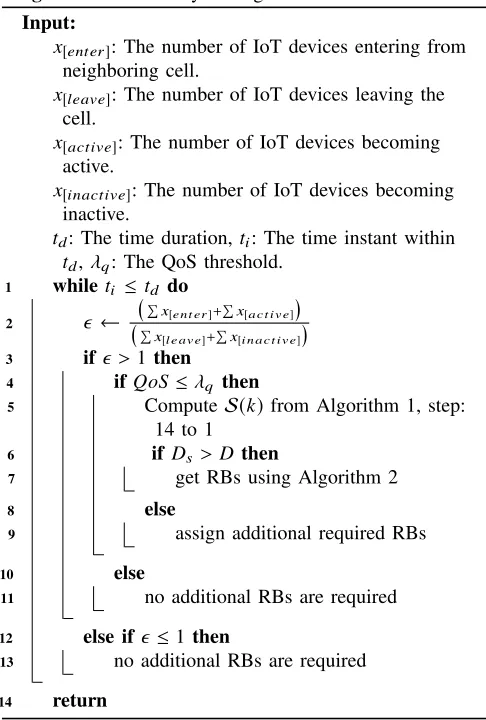
The CSPs allocates channels to IoT devices and assigns a QoS Flow ID (QFI) to each IoT-device. The QFI and session establishment remains fixed throughout the lifetime of the trade window, assuming connection stays active and without failure or detachment from the BS. Thereafter, for every event in the cell, such as when IoT devices join or leave a cell, a set of procedure should be executed. Events in the network may or may not induce the need for deploying additional resources. Resources are only required when the number of active users in the cell increases or decrease. When the number of users entering the cell equals the number of users leaving at a given time, then the existing resources will only be redistributed according to the new distribution of the IoT devices in the cell. And in the case where the modulation scheme NOMA is considered, the BS rearranges the clusters to ensure devices are supported with the resources sufficient to provide their required data rate. For some events, however, it is not necessary that all clusters need to be rearranged to accommodate the changes in the cell. For example, if an IoT device enters the cell in a location which can be added to a cluster, without significantly degrading the data rate to the existing IoT devices in the same cluster, then adjustments are only required in that cluster, leaving other clusters unchanged. Due to the large number of cells in 5G networks in contrast with earlier cellular networks, to improve mobility and handover, Secondary Cells (SCells) can be configured to form together with the Primary Cell (PCell) a set of serving cells. The configured set of serving cells for a an IoT device therefore should always consists of one PCell and one or more SCells [30]. As such, when an IoT device enters the cell from a neighboring one in which the IoT device is pre-configured to a new cell as its SCell, the IoT device should have been considered in previous allocation and does not have an impact on the clustering.
Events such as connection failure and users moving from inactive (disconnected) state to active (connected) (or from active/connected to inactive/disconnected state) should also be treated as part of the mobility. Modification procedures to other IoT devices in the associated cluster will also take place when an event of this nature occurs. Such events need to be handled autonomously and with minimum interruption to the network resource allocation. Algorithm 3 is developed to accommodate IoT device mobility challenges in NOMA.
We denote byλqthe maximum data rate that can be handled
by a cluster. And if this threshold is exceeded then the BS could deploy additional channels to that cluster following the procedure in Algorithm 3.
VI. RESULTS AND ANALYSIS
Algorithm 3: Mobility Management.
Input:
x[enter]: The number of IoT devices entering from
neighboring cell.
x[leave]: The number of IoT devices leaving the
cell.
x[active]: The number of IoT devices becoming
active.
x[inactive]: The number of IoT devices becoming
inactive.
td: The time duration, ti: The time instant within td,λq: The QoS threshold.
1 while ti ≤td do
2 ←
Í
x[e nt er]+Í x[a c t i v e]
Íx[l e a v e]+Íx
[i n a c t i v e]
3 if >1 then
4 if QoS≤λq then
5 ComputeS(k)from Algorithm 1, step:
14 to 1
6 if Ds>Dthen
7 get RBs using Algorithm 2
8 else
9 assign additional required RBs
10 else
11 no additional RBs are required
12 else if ≤1then
13 no additional RBs are required
14 return
is expected to facilitate the IoT-SP to calculate the required number of resource blocks that can meet their throughput demand and seamless acquisition of resource blocks from CSPs through proposed second-price auction. Moreover, we investigate the performance of the proposed solution and outline the merits of our framework compared to related work from the literature.
A. Scenario
Consider a cellular network covered by nBS BSs, where
each BS belong to one CSP. The devices which belong to N
IoT-SPs seek to transmit data to their designated servers/cloud. However, the devices need to have access to the BSs to enable uplink data transmission. To transmit the data to BSs, the IoT provider pays the CSPs in a form of monetary according to the amount of spectrum required to transmit the data and the time this spectrum is occupied by the IoT devices as discussed in Section IV-D.
B. Performance Analysis
To demonstrate the effectiveness of the proposed frame-work, an IoT network model is simulated. The proposed framework is analyzed in terms of average system throughput, required number of resource blocks and incurred cost of resource allocations.
TABLE III: Simulation parameters and their values
Parameter Value
Max Transmit Power (T xmax) 30 dBm
Bandwidth (B) 1 Hz
Path Loss and Shadowing (%) 4
Small Scale Fading Coefficient (g) 1
σ2 0.5 dBm/Hz
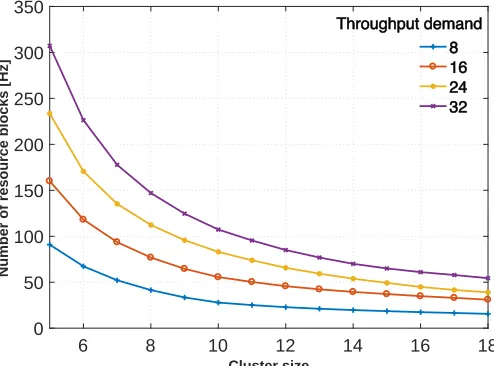
1) Impact of clustering on IoT devices data rate demand and sub-carrier requirements: The performance of the pro-posed framework is analyzed with average system throughput and different cluster sizes. The average system throughput is calculated using equation (6), where it is assumed that one resource block is assigned to each cluster. It is observed that reducing cluster sizes using NOMA gains significant average system throughput as shown in Fig. 2 and 3, but it will require additional resource blocks to achieve the targeted throughput demand as shown in Fig. 4 and 5. It can be found from Fig. 2 that providing services to 100 devices with 10 devices in each cluster, the maximum achievable average throughput is 46.33 bits/s/Hz. However reducing the cluster size to 5, 4, 3 and 2 will increase the average achievable throughput by 69%, 100%, 154% and 250% but with additional resource block of 100%, 150%, 230% and 500% respectively. Similarly, it is shown in Fig. 3 that with maximum allowable transmit power of 30dBm and providing services to 100 devices with cluster size 10, the maximum achievable average throughput is 61 bits/s/Hz. Reducing the cluster size to 5, 4, 3 and 2 will increase the average achievable throughput by 73%, 106%, 160% and 259% but with additional resource block of 100%, 150%, 230% and 500% respectively.
0 20 40 60 80 100
Number of IoT devices 0
20 40 60 80 100 120 140 160
Average
s
ystem
t
hroughput [bits/s/Hz]
2 3 4 5 10 20
Cluster size
Fig. 2: Average cell throughput with varied cluster size using NOMA for maximum transmit power=27 dBm.
0 20 40 60 80 100 Number of IoT devices
0 50 100 150 200
Average
s
ystem
t
hroughput [bits/s/Hz]
2 3 4 5 10 20
Cluster size
Fig. 3: Average cell throughput with varied cluster size using NOMA for maximum transmit power=30dBm.
reduces the number of sub-carrier requirements, however, power management at such scale is difficult and could result in higher bit error rate (BER). It is found that to serve high number of IoT devices, it is not always cost effective to have smaller cluster size. As shown in Fig. 4, to achieve 8 bits/s/Hz of average throughput with cluster size 5, 10, 12 and 14 will require 91, 28, 22 and 20 resource blocks. Similarly it is observed in Fig. 5, to achieve 8 bits/s/Hz of average throughput with cluster size 5, 10, 12 and 14 will require 66, 26, 23 and 20 resource blocks. However, as discussed earlier, higher number of devices in one cluster will result in higher BER and complex power management which will result in poor quality of experience (QoE). Hence, selection of cluster size is important in NOMA to maintain QoE and cost, this will be addressed in the future work.
6 8 10 12 14 16 18
Cluster size 0
50 100 150 200 250 300 350
Number of resource blocks [Hz]
8 16 24 32 Throughput demand
Fig. 4: Required number of resource blocks with varied cluster sizes to guarantee throughput demand [bits/s/Hz] using NOMA for maximum transmit power=27dBm.
2) NOMA vs OMA: A comparison between the efficiency of NOMA and OMA in respect to sub-carrier demand is
6 8 10 12 14 16 18
Cluster size 0
50 100 150 200 250
Number of resource blocks [Hz]
8 16 24 32 Throughput demand
Fig. 5: Required number of resource blocks with varied cluster sizes to guarantee throughput demand [bits/s/Hz] using NOMA for maximum transmit power=30 dBm.
provided in Fig. 6. Clearly, at lower demands the difference between the two techniques is small, however, as demand grows, NOMA requires less sub-carriers to deliver the same QoS. It is observed from simulation result that to achieve average system throughput of 20 bits/s/Hz, OMA requires 22% and 27% more resource blocks than NOMA requires for cluster size 2 and 3 respectively. Moreover, for achievable average system throughput of 40 bits/s/Hz, OMA requires 23.5% and 16% additional resource blocks for cluster size 2 and 3 respectively.
20 40 60 80 100 120 140
Average throughput demand [bit/s/Hz]
101 102
Required
n
umber of
r
esource
b
locks [Hz]
OMA NOMA 3-IoT-Devices case
2-IoT-Devices case
Fig. 6: The number of resource blocks required for NOMA and OMA to guarantee throughput demand
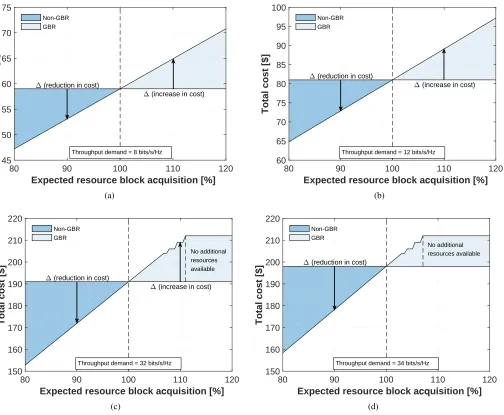
The Fig. 8 illustrates how IoT service providers may control their spectrum acquisition. For example, for applications where the users required GBR, the IoT-SP may chose to acquire additional resource blocks to facilitate the users with QoE requirements. Similarly, an IoT-SP may acquire less than the required number of resource block for Non-GBR users. The 100% on the X-Axis of Fig. 8 means the IoT-SP gets all the channels it theoretically required to fulfil the throughput demand. 80% means 20% less resource blocks provided for its IoT devices, however in some applications, this can be tolerated and the IoT-SP may save money. We provide a quantification of all these values to improve IoT-SP decisions on channel acquisition strategies. As discussed earlier, the throughput demand may increase due to GBR demand or providing services in an active user area where QoE is also very important and IoT-SP may acquire additional resource blocks to guarantee the QoE. The results in Fig. 8 provides a cost estimation to help the IoT-SP to take decision of resource block acquisition. In Fig. 8c and 8d, the area with “no additional resources available” presents a scenario where no additional resource blocks are available form CSPs.
60 70 80 90 100
Resource block acquisition [%] 0
50 100 150 200 250
Total
c
ost [$]
Throughput demand [bits/s/Hz]
8 12
16 32
34 36
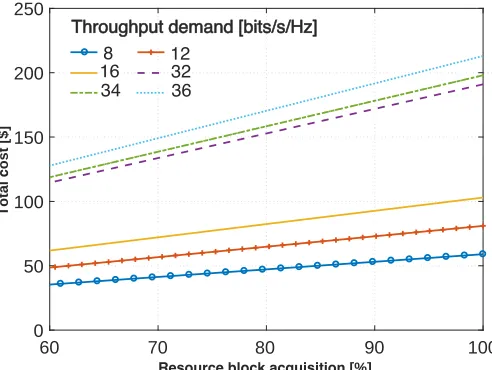
Fig. 7: Cost estimate to acquire required resource blocks to achieve throughput demand.
VII. CONCLUDINGREMARKS
We have investigated multi-layer multi-modal radio resource demand and availability anticipation for next generation of cellular networks. In response to anticipated scarcity model, we have proposed a cluster based joint allocation of radio resources to IoT devices active with NOMA. The proposed resource framework has considered a co-operative approach among the CSPs. To enhance the revenue from spectral resource, we have also designed an efficient auction algo-rithm for subcarriers trading between the IoT-SP and CSP. In addition, performance, through robustness, demand-supply co-ordination as well as cost modeling have been evaluated. The effectiveness of the proposed NOMA scheme and its role to facilitate spectrum borrowing strategies have also been quantified. The proposed framework has a number of advan-tages from both CSP and IoT-SPs’ perspective. From CSPs’
perspective, the proposed framework provides with a more robust strategies in participating auction enhance revenue as well as allocated radio resources; at the securing payments are controlled by the account balance of the IoT-SPs. Centralized control and implementation of incentive functions (positive and negative incentives) limits IoT-SPs from violating the rules set by the CSPs in having access to radio resources. At the same time, from IoT-SPs perspective, flexibility on the selection of cluster size in NOMA allows to maintain QoE and cost effectiveness of radio resources. For next generation cellular networks’ context, where network slicing will play crucial role to have access to radio resource – the proposed framework offers robust allocation, revenue generation and regulation strategies for both CSP and IoT-SP. In our future work, we are aiming at considering diversity and dynamic behaviour of throughput requirement, user density and link cost affordability measures into consideration to unify multi-layered allocation approach.
REFERENCES
[1] F. Chiti, D. Di Giacomo, R. Fantacci, L. Pierucci, and C. Carlini, “Optimized narrow-band M2M systems for massive cellular IoT com-munications,” in Global Communications Conference (GLOBECOM). IEEE, 2016, pp. 1–6.
[2] J. Britt and S. Zimmerman, “System and method for flow control in an internet of things (IoT) system,” Jun. 15 2017, US Patent App. 14/967,870.
[3] I. Farris, A. Orsino, L. Militano, M. Nitti, G. Araniti, L. Atzori, and A. Iera, “Federations of connected things for delay-sensitive IoT services in 5G environments,” in International Conference on Communications
(ICC). IEEE, 2017, pp. 1–6.
[4] S. Buzzi, I. Chih-Lin, T. E. Klein, H. V. Poor, C. Yang, and A. Zappone, “A survey of energy-efficient techniques for 5G networks and challenges ahead,” IEEE Journal on Selected Areas in Communications, vol. 34, no. 4, pp. 697–709, 2016.
[5] Z. Ding, X. Lei, G. K. Karagiannidis, R. Schober, J. Yuan, and V. K. Bhargava, “A survey on non-orthogonal multiple access for 5G networks: Research challenges and future trends,”IEEE Journal on Selected Areas
in Communications, vol. 35, no. 10, pp. 2181–2195, 2017.
[6] J. G. Andrews, S. Buzzi, W. Choi, S. V. Hanly, A. Lozano, A. C. Soong, and J. C. Zhang, “What will 5G be?”IEEE Journal on selected areas
in communications, vol. 32, no. 6, pp. 1065–1082, 2014.
[7] A. Ijaz, L. Zhang, M. Grau, A. Mohamed, S. Vural, A. U. Quddus, M. A. Imran, C. H. Foh, and R. Tafazolli, “Enabling massive IoT in 5G and beyond systems: Phy radio frame design considerations,”IEEE
Access, vol. 4, pp. 3322–3339, 2016.
[8] P. Schulz, M. Matthe, H. Klessig, M. Simsek, G. Fettweis, J. Ansari, S. A. Ashraf, B. Almeroth, J. Voigt, I. Riedelet al., “Latency critical IoT applications in 5G: Perspective on the design of radio interface and network architecture,”IEEE Communications Magazine, vol. 55, no. 2, pp. 70–78, 2017.
[9] M. R. Palattella, M. Dohler, A. Grieco, G. Rizzo, J. Torsner, T. Engel, and L. Ladid, “Internet of things in the 5G era: Enablers, architecture, and business models,”IEEE Journal on Selected Areas in
Communica-tions, vol. 34, no. 3, pp. 510–527, 2016.
[10] S.-H. Hsu, C.-H. Lin, C.-Y. Wang, and W.-T. Chen, “Minimizing upload latency for critical tasks in cellular-based IoT networks using multiple relays,” inInternational Conference on Communications (ICC). IEEE, 2017, pp. 1–7.
[11] Y. Liu, Z. Ding, M. Elkashlan, and H. V. Poor, “Cooperative non-orthogonal multiple access with simultaneous wireless information and power transfer,” IEEE Journal on Selected Areas in Communications, vol. 34, no. 4, pp. 938–953, 2016.
[12] L. Ericsson, “More than 50 billion connected devices,”White Paper, vol. 14, p. 124, 2011.
80 90 100 110 120
Expected resource block acquisition [%]
45 50 55 60 65 70 75
Total cost [$]
Non-GBR
GBR
Throughput demand = 8 bits/s/Hz (reduction in cost)
(increase in cost)
(a)
80 90 100 110 120
Expected resource block acquisition [%]
60 65 70 75 80 85 90 95 100
Total cost [$]
Non-GBR
GBR
Throughput demand = 12 bits/s/Hz (reduction in cost)
(increase in cost)
(b)
No additional resources available
80 90 100 110 120
Expected resource block acquisition [%]
150 160 170 180 190 200 210 220
Total cost [$]
Non-GBR GBR
Throughput demand = 32 bits/s/Hz (reduction in cost)
(increase in cost)
(c)
No additional resources available
80 90 100 110 120
Expected resource block acquisition [%]
150 160 170 180 190 200 210 220
Total cost [$]
Non-GBR GBR
Throughput demand = 34 bits/s/Hz (reduction in cost)
(d)
Fig. 8: Cost estimation for expected resource block acquisition to achieve throughput demand (a) 8 bits/s/Hz, (b) 12 bits/s/Hz, (c) 32 bits/s/Hz and (d) 34 bits/s/Hz with guaranteed bit rate (GBR) and non-guaranteed bit rate (Non-GBR)
[14] A. E. Mostafa, Y. Zhou, and V. W. Wong, “Connectivity maximization for narrowband IoT systems with NOMA,” inInternational Conference
on Communications (ICC). IEEE, 2017, pp. 1–6.
[15] M. Shirvanimoghaddam, M. Dohler, and S. J. Johnson, “Massive non-orthogonal multiple access for cellular IoT: Potentials and limitations,”
IEEE Communications Magazine, vol. 55, no. 9, pp. 55–61, 2017.
[16] S. R. Islam, N. Avazov, O. A. Dobre, and K.-S. Kwak, “Power-domain non-orthogonal multiple access (NOMA) in 5G systems: Potentials and challenges,”IEEE Communications Surveys & Tutorials, vol. 19, no. 2, pp. 721–742, 2017.
[17] M. S. Ali, H. Tabassum, and E. Hossain, “Dynamic user clustering and power allocation for uplink and downlink non-orthogonal multiple access (NOMA) systems,”IEEE Access, vol. 4, pp. 6325–6343, 2016. [18] K. S. Ali, H. Elsawy, A. Chaaban, and M.-S. Alouini, “Non-orthogonal
multiple access for large-scale 5G networks: Interference aware design,”
IEEE Access, vol. 5, pp. 21 204–21 216, 2017.
[19] H. Tabassum, E. Hossain, and J. Hossain, “Modeling and analysis of uplink non-orthogonal multiple access in large-scale cellular networks using poisson cluster processes,” IEEE Transactions on
Communica-tions, vol. 65, no. 8, pp. 3555–3570, 2017.
[20] N. C. Luong, P. Wang, D. Niyato, Y. Wen, and Z. Han, “Resource management in cloud networking using economic analysis and pricing models: A survey,”IEEE Communications Surveys & Tutorials, vol. 19, no. 2, pp. 954–1001, 2017.
[21] X. Chen, L. Xing, T. Qiu, and Z. Li, “An auction-based spectrum leasing
mechanism for mobile macro-femtocell networks of IoT,” Sensors, vol. 17, no. 2, p. 380, 2017.
[22] S. Misra, S. Das, M. Khatua, and M. S. Obaidat, “QoS-guaranteed bandwidth shifting and redistribution in mobile cloud environment,”
IEEE Transactions on Cloud Computing, vol. 2, no. 2, pp. 181–193,
2014.
[23] X. Wang, M.-J. Sheng, Y.-Y. Lou, Y.-Y. Shih, and M. Chiang, “Internet of things session management over LTE?balancing signal load, power, and delay,”IEEE Internet of Things Journal, vol. 3, no. 3, pp. 339–353, 2016.
[24] Z. Ding, Z. Yang, P. Fan, and H. V. Poor, “On the performance of non-orthogonal multiple access in 5G systems with randomly deployed users,”IEEE Signal Processing Letters, vol. 21, no. 12, pp. 1501–1505, 2014.
[25] J. Choi, “Non-orthogonal multiple access in downlink coordinated two-point systems,”IEEE Communications Letters, vol. 18, no. 2, pp. 313– 316, 2014.
[26] S. Timotheou and I. Krikidis, “Fairness for non-orthogonal multiple access in 5G systems,”IEEE Signal Processing Letters, vol. 22, no. 10, pp. 1647–1651, 2015.
[27] J. Choi, “Power allocation for max-sum rate and max-min rate pro-portional fairness in NOMA,” IEEE Communications Letters, vol. 20, no. 10, pp. 2055–2058, 2016.
resource allocation,” in international symposium on Wireless
commu-nication systems (ISWCS). IEEE, 2012, pp. 476–480.
[29] W.-Y. Lee and I. F. Akyildiz, “Joint spectrum and power allocation for inter-cell spectrum sharing in cognitive radio networks,” in3rd IEEE
Symposium on New Frontiers in Dynamic Spectrum Access Networks.
IEEE, 2008, pp. 1–12.