Final Report
Prepared by John Guenther
February 2019
Final Report
Prepared by John Guenther
February 2019
Funding acknowledgment (Ben will provide this)
Copyright statement , which I think belongs to First Nations Media Association
Publisher (BIITE)
A suggested citation:
Guenther, J (2019) Evaluation of inDigiMOB, final report. Batchelor: Batchelor Institute of Indigenous Tertiary Education.
Batchelor Institute also acknowledge the contribution of Ms Mack to the evaluation.
Partner logos for Tangentyere, PAW and ARDS
CONTENTS
Abbreviations 7
Executive summary
8Evaluation 8
Key findings 9
Recommendations 11
Introduction
12Evaluation team 13
Literature review
14Context and background 14
Definitions of digital inclusion and digital literacy 16
Evaluation methodology
17Evaluation questions 18
Instruments and tools 18
Ethical clearance 18
Data collection 18
Data analysis 19
Findings
21Reported outcomes 24
Mechanisms 25
Addressing challenges 26
Case studies
28Tangentyere Council Alice Springs Town Camps 28
PAW Media at Yuendumu 29
ARDS at Ramingining 30
Response to evaluation questions
31How and to what extent are inDigiMOB’s program objectives being met? 31
Addressing critical barriers 31
Meeting local needs 32
Benefits of Digital Mentors 32
Employment model for Digital Mentors 32
Under what circumstances (contexts and mechanisms) is inDigiMOB likely to work best to achieve
desirable outcomes for whom? 33
The significance of context 37
The inDigiMOB App
38What is currently available 38
How effective is the App? 39
What does digital inclusion mean?
40Limitations
42Recommendations
44Conclusions
46References
47Appendix 1
49Additional tables 49
Appendix 2
54FIGURES
Figure 1. Map of inDigiMOB sites, July 2007 to June 2008 13
Figure 2. Telstra coverage map, (LH pane) Northern Territory and (RH pane) detail for
Alice Springs (Telstra, 2018) 15
Figure 3. NBN coverage map for Alice Springs region (NBN, 2018), LH pane showing Town
Camps south of the Gap, and RH pane showing Town Camps near Sadadeen. 15
Figure 4. Data analysis schema 19
Figure 5. TOC conceptualisation 20
Figure 6. Skill focus of activities, all sites (n=191 activities) 22
Figure 8. Digital Mentor involvement in activities 23
Figure 7. Male and female participation, all sites 23
Figure 9 Digital mentor employment 24
Figure 10. Town Camps of Alice Springs (Foster et al., 2005, p. 7). 29
Figure 11. Linkages between mechanisms and outcomes 34
Figure 12. Revised Theory of Change 36
Figure 13. inDigiMOB App content 38
Figure 14. How digital inclusion is perceived by respondents 41
TABLE
Table 1. Household internet access Australia (ABS, 2018) 14
Table 2. Participation events by month and partner (See Figure 1 for locations) 22 Table 3. Summary of activities by partner, July 2017 to June 2018 49
Table 4. Participation by site and gender 49
Table 5. References to outcomes by site 50
Table 6. References to mechanisms for achieving outcomes, by site 51
Table 7. Perceived challenges for delivery by site 52
Table 8. Future directions in response to barriers, by site 53
Table 9. Survey results: Demographic data 54
Table 10. Activity involvement summary 55
Table 11. How well did the activities meet your needs? 55
Table 12. Who helped you? 56
Table 13. What did you get from your involvement? 56
Table 14. What would you like to see that wasn’t available, or you want more of 57
Abbreviations
ARDS Aboriginal Resource and Development Service or ARDS Aboriginal Corporation DAW Digital Access Worker
FNMA First Nations Media Australia
ICT Information and Communication Technology IRCA Indigenous Remote Communications Association NBN National Broadband Network
NT Northern Territory
This report presents findings from the year 2 evaluation of the inDigiMOB program, funded by Telstra. The program was designed to improve digital inclusion, particularly for people living in remote parts of the Northern Territory. The intent of the program is reflected in its four main objectives, to: 1) Address critical barriers to the take up and use of information and communications technologies (ICTs), tools and online services, 2) Apply the use of ICTs to address local and community needs and projects; 3) Establish and demonstrate benefits of local Aboriginal and Torres Strait Islander digital mentors; and 4) Establish employment models for Aboriginal and Torres Strait Islander digital mentor jobs.
The program commenced in 2016 with a pilot in four Alice Springs town camps through Tangentyere Council’s Community Centres and at Batchelor’s Arlparra Learning Centre. In the second year, between July 2017 and June 2018, the program continued at Arlparra for five months, expanded to work in five Alice Springs town camps, at Yuendumu and Yuelamu through PAW Media, and in five Arnhem Land communities through ARDS. Some activities were also carried out at Ntaria and development work of the inDigiMOB App culminated in its launch in June 2018. Activities of the program were a mix of peer to peer
training activities, non-formal and informal learning in learning/community centres, language projects, family history projects, community-based video and photography projects and animation projects. The inDigiMOB model emphasises an employment model where Digital Access Workers employed by partner organisations work alongside community-based Digital Mentors who are employed—mostly on a casual or part time basis—through partner or other community organisations.
Evaluation
The evaluation was designed to respond to two questions: 1) How and to what extent are inDigiMOB’s program objectives being met? And 2) Under what circumstances (contexts and mechanisms) is inDigiMOB likely to work best to achieve desirable outcomes for whom?
The evaluation drew data from 37 interviews with stakeholders, 13 participant surveys, observations of activities in Alice Springs, Yuendumu and Ramingining, regular reports prepared by, and statistics collected from Digital Access Workers at each site.
The evaluation was led by Dr John Guenther from Batchelor Institute of Indigenous Tertiary Education and supported by community researcher, Shiree Mack.
Key findings
A total of 3608 participation events were recorded during the 12 months across all the sites. Of these, 58 per cent were for females and 92 per cent of activities were recorded in learning/community centres at Arlparra and Alice Springs town camps. The most frequently reported activities were related to general use of devices, multimedia use, and basic computer skills. A total of 42 different Digital Mentors were employed in 12 sites.
In response to the evaluation questions: we found that inDigiMOB provided participants with access to a range of digital technology tools. These tools included computers and mobile devices, digital video, photography and audio recording equipment, free wifi and internet access, drones, and software applications designed for community-based projects such as family histories. Several activities were focused on learning and skill development. Respondents did not talk often talk about this access in response to or overcoming barriers, except in town camps where an advocacy project was designed around the problems associated with mobile phone and internet access in some locations around Alice Springs. The projects that emerged
The evaluation shows that the nature of and success of activities is dependent to a large extent on the strength of the partnership between the partner organisations and the community. Strong relationships between Digital Access Workers and community organisations facilitated positive outcomes. In each site we visited, the Digital Access Workers’ enthusiasm, relationships with communities, their relationship with the Digital Mentors and the mix of skills they brought were critical to development of employability skills and the key outcome of knowledge sharing. Elements of the inDigiMOB model—learning, training and community/learner engagement—were also integral in producing strong outcomes of increased confidence, digital literacy skills and enjoyment. A strong cultural maintenance outcome was also achieved through ground-up activities reflecting community aspirations, and through story-telling and intergenerational activities. The organisational context of the program played a significant role in the shaping outcomes. For example where learning/community centres were the vehicle for activities, much of the focus was on learning activities, while in the top end sites, where ARDS has a history of working with communities through media, this promoted activities that were more about
story-telling and digital content creation. Of all the program elements used by inDigiMOB we found the App to be least successful.
Recommendations
Eight recommendations emerge from the findings. These are presented below.
We recommend that inDigiMOB develops a short to medium term
strategic plan as a platform for future development.
We recommend that inDigiMOB pursues alternative funding sources
to extend the sustainability of the program.
Coupled with Recommendation 1, we recommend that inDigiMOB
explore additional partnerships opportunities within and outside the
Northern Territory.
We recommend that inDigiMOB increases its exposure in mainstream
and social media in order to maximise its visibility and recognition.
We recommend that further development of the inDigiMOB App be
put on hold pending review.
We recommend further exploration of innovative and potentially risky
approaches to increase the reach and impact of inDigiMOB into the
future.
We recommend that for the Phase 3 evaluation, data be collected
from participants while they are involved in activities, as well as
during the evaluation period.
We recommend that inDigiMOB use the evaluation as a means
of promoting the findings and as a way of engaging with other
audiences through conference presentations and journal articles.
01 /
02 /
03 /
04 /
05 /
06 /
07 /
In 2016 Telstra partnered with the Indigenous Remote Communications Association to launch inDigiMOB, a program to address barriers to the take up and use of digital technology in remote communities in the Northern Territory. This follows Telstra and the Northern Territory Government signing an infrastructure co-investment agreement to expand telecommunications infrastructure across Northern Territory remote communities. Commencing in 2016 as a pilot, inDigiMOB was envisaged as a platform for digital inclusion:
inDigiMOB is about improving digital inclusion for Aboriginal and Torres Strait Islander people in the Northern Territory. It does this by making available a flexible suite of resources that communities and organisations can take advantage of, according to their diverse needs and contexts. These resources include technical, training and
infrastructure support. They aim to establish local Digital Mentors; improve digital literacy through workshops and training; support connectivity solutions; provide technical advice; and develop appropriate and relevant learning tools.
(Indigenous Remote Communications Association, 2017)
The intent of the program is reflected in its four main objectives, to:
1.
Address critical barriers to the take up and use of information and communications technologies (ICTs), tools and online services2.
Apply the use of ICTs to address local and community needs and projects3.
Establish and demonstrate benefits of local Aboriginal and Torres Strait Islander digital mentors4.
Establish employment models for Aboriginal and Torres Strait Islander digital mentor jobs (Voerman et al., 2016)The barriers referred to above are explicitly described as:
[ Affordability of internet services including
limited information on data packages and costs management in relation to excessive bandwidth usage costs
[ Availability of internet services including
knowledge of internet services available in remote communities and black spot issues
inDigiMOB emphasises
informal, peer-to-peer
learning that values the
experiences and knowledge
of Aboriginal and Torres
Strait Islander people.
Learning is project based,
inclusive, responsive to
community wishes and
respects age, gender and
cultural protocols.
In 2016 Telstra partnered with the Indigenous Remote Communications Association to launch inDigiMOB, a program to address barriers to the take up and use of digital technology in remote communities in the Northern Territory. This follows Telstra and the Northern Territory Government signing an infrastructure co-investment agreement to expand telecommunications infrastructure across Northern Territory remote communities. Commencing in 2016 as a pilot, inDigiMOB was envisaged as a platform for digital inclusion:
inDigiMOB is about improving digital inclusion for Aboriginal and Torres Strait Islander people in the Northern Territory. It does this by making available a flexible suite of resources that communities and organisations can take advantage of, according to their diverse needs and contexts. These resources include technical, training and
infrastructure support. They aim to establish local Digital Mentors; improve digital literacy through workshops and training; support connectivity solutions; provide technical advice; and develop appropriate and relevant learning tools.
(Indigenous Remote Communications Association, 2017)
inDigiMOB emphasises
informal, peer-to-peer
learning that values the
experiences and knowledge
of Aboriginal and Torres
Strait Islander people.
Learning is project based,
inclusive, responsive to
community wishes and
respects age, gender and
cultural protocols.
[ Awareness among community members of
the potential of the internet and/or managing potential issues, including limited digital training, on-ground support and mentors, and cyber safety issues
[ Appropriateness of internet awareness
programs including lack of language-based training, lack of culturally appropriate training spaces and delivery modes.
The Batchelor Institute of Indigenous Tertiary
Education was contracted to conduct an evaluation of Year 2 of the inDigiMOB program—the period from July 2017 to June 2018. inDigiMOB currently operates in
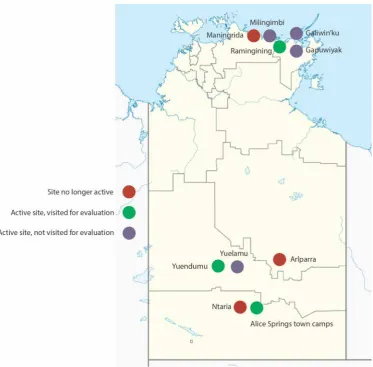
Alice Springs town camp learning centres (supported by Tangentyere Council), at Yuendumu through PAW Media and in four top end communities through ARDS. However, during the 2017/18 period, there was activity at Batchelor’s Arlparra Learning Centre (between July and November 2017), at Bawinanga Aboriginal Corporation’s Maningrida Arts and Culture Centre (between February and March 2018), at Ntaria led by Dave Nixon (between July 2017 and May 2018) and at Karnte Camp led by Jeremy Conlon (between November 2017 and December 2017). Data from all the above sites were collated for this review. However, the focus of interviews was on currently active programs. See Figure 1 for a map of locations.
Figure 1. Map of inDigiMOB sites, July 2007 to June 2008
A proposal for an evaluative research project was offered by Batchelor Institute of Indigenous Tertiary Education. The project was designed as two separate phases, spread over 16 months. Phase 1 focuses on Year 2 of the program and is more formative than summative and informs the program into Year 3. Phase 1 is now complete and Phase 2 will be completed by July 2019.
Evaluation team
LITERATURE REVIEW
Context and background
Across Australia, internet access has increased steadily, from about 55 per cent of households in 2004-05 to 86 per cent of households in 2016-17 (ABS, 2018). Yet, as Table 1 demonstrates, while less than one in eight households in major cities are without internet access, almost one in four households are without access in remote and very remote locations. The combination of remote and very remote disguises much lower levels of access in many remote communities, especially those without mobile phone coverage.
Table 1. Household internet access Australia (ABS, 2018)
Remoteness area Households with internet
access (per cent) Households without internet access (per cent)
Major Cities 87.9 12.0
Inner Regional 82.7 17.3
Outer Regional 80.7 19.2
Remote or Very Remote 77.1 22.9
Almost
1 in 4
remote and very
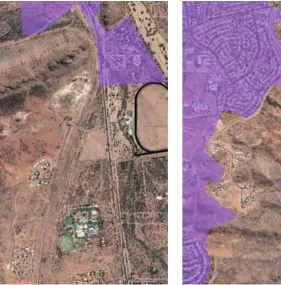
The Telstra coverage map (Figure 2) shows that access to mobile service in the Northern Territory is well established in all regional centres and extends to several larger remote communities. However, for most small communities with populations less than 200 mobile phone coverage does not exist. In Alice Springs however, the coverage map suggests that all the town is covered with 4GX service. While the NT Government and Telstra’s co-investment program has connected 39 communities since 2009, the recent Digital Territory Strategy suggests that one-third of Territorians can only access broadband internet by satellite (Northern Territory Government, 2018a, p. 16).
Figure 2. Telstra coverage map, (LH pane) Northern Territory and (RH pane) detail for Alice Springs (Telstra, 2018)
Fast access via NBN connections in most Northern Territory urban centres is a reality. However, in Alice Springs, the notable exceptions are some Town Camps, where coverage maps show NBN access stopping just short of Town Camps (see Figure 3).
Definitions of digital inclusion and
digital literacy
In the foregoing discussion, we have presented a picture of ‘digital access’ in remote Australia and the Northern Territory. Digital inclusion is somewhat different. The NT Government’s Discussion Paper Towards a digital strategy for the Northern Territory (Northern Territory Government, 2018b) does not refer to digital inclusion, and while the Strategy itself (Northern Territory Government, 2018a) talks about inclusion, it does not define it. However, it is clear that digital inclusion is not the same as digital access. Thompson et al. (2014, p. 9) define digital inclusion as ‘outreach as a means to empower underserved and marginalized populations’. More specifically, Ragnedda and Mustsvairo (2018) point to digital inclusion as a combination of access, availability and training for digital literacy skills. Similarly, Thomas et al. (2016) suggest that digital inclusion has three components: access, affordability and ability. They argue that:
The goal of digital inclusion is to enable everyone to access and use digital technologies effectively. It goes beyond simply owning a computer or smartphone. At heart, digital inclusion is about social and economic participation: using online and mobile technologies to improve skills, enhance quality of life, educate, and promote wellbeing across the whole of society (Thomas et al., 2016, p. 6)
Featherstone (2015, pp. 239-242), discussing a framework for evaluating ICT projects in remote parts of Australia suggests four principles of digital inclusion that relate to accessibility, awareness, appropriateness and affordability. Ganley (2014) adds ‘propensity’—the ability or desire of individuals to take up and use digital services—to this list, while Rigney (2014) defines digital inclusion as empowerment facilitated by sustainable access and training.
Park (2017b, p. 400) adds benefit to the definition: ‘Digital inclusion …includes not only the provision of infrastructure but user adoption and uses, and the resulting beneficial outcomes’. Who benefits and how these benefits are perceived will of course differ depending on context. At the heart of inDigiMOB is a principle that communities should decide how technologies should be best used and applied to their particular context. The success of the program is then dependent not on some externally imagined all-encompassing definition of digital inclusion, but rather a highly nuanced, place-based determination of what is good for that community.
‘Digital literacy’ is sometimes used in conjunction with ‘digital inclusion’, for example: ‘digital literacy skills are required to function in digitally inclusive communities’ (Thompson et al., 2014, p. 43). However,
the terms are distinct. Sharma et al. (2016, p. 630) define digital literacy ‘as the ability to use the internet and new media in order to access and critically evaluate different formats and types of digital information to participate in the socio-economic activities of a community through digital content creation, communication and exchange’. They go on to argue that: ‘taken together, they form the basis of a society that is able to learn and apply knowledge for economic benefit’ (p. 630). UNESCO’s Global Framework of Reference on Digital Literacy Skills for Indicator 4.4.2 emphasises skills and competence in five key areas: information and data literacy, communication and collaboration, digital content creation, safety, and problem solving (Law et al., 2018). Park (2017a) describes a framework of digital media literacy in terms of accessing, understanding and creating. The latter is described as the ‘Ability to produce, reproduce, and create content using digital technology’ (p. 131).
In summary, based on the literature, we see digital inclusion as an issue of equity, access and rights while digital literacy is more about the functional application of knowledge and skills for understanding and socio-economic participation. The two terms go hand in hand with each other and are mutually supportive.
Digital literacy:
The functional application of digital
knowledge and skills
Digital inclusion:
In brief, the evaluation methodology is built around realist informed formative approaches designed to inform ongoing development, decision-making and future evaluative processes. In essence the approach to be employed is a decision and accountability-oriented approach:
The decision- and accountability-oriented approach is based on the premise that program evaluation should be used proactively to help improve a program as well as retrospectively to judge its value (Stufflebeam & Coryn, 2014 Kindle Locations 5541-5542).
The realist informed focus recognises the complexity of causal mechanisms from inputs, processes through to outputs and outcomes or impact, noting the significance of context and the multiple potential mechanisms that either enhance or detract from intended outcomes, echoing the realist manifesto of ‘what works for whom in what circumstances … and why’ (Pawson, 2013, p. 15). Mechanisms are in effect the drivers for change or the triggers that cause processes to turn into outcomes. Mechanisms in this methodology are a mixture of observable
and unobservable actions, events and phenomena that demonstrate a causal connection between the activities and the outcomes (Patton, 2015, pp. 585-586). In using some of these ideas we are not suggesting this is a ‘realist evaluation’, rather it is informed with an understanding that for the purposes of the evaluation of inDigiMOB, theory, context
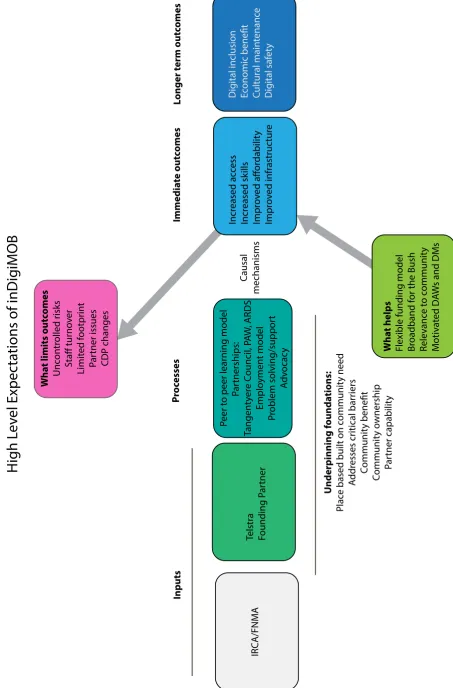
and mechanisms are all important and should be considered. It is why we started with a hypothesised theory of change model (Figure 5), using it as a foundation to test whether changes happen as expected, how they happened (causation) and under what circumstances (context). The data we collected then allowed us to test the assumptions of the model and show how change actually occurs.
EVALUATION METHODOLOGY
Evaluation questions
Evaluation questions define and describe what it is that we want to know from the research that is undertaken: ‘Evaluation questions are considered by many evaluation theorists to provide an essential means to focus and structure program evaluations, and program evaluation is fundamentally about answering these questions’ (Markiewicz & Patrick, 2015, p. 94). The questions that the evaluation responds to are:
1.
How and to what extent are inDigiMOB’s program objectives being met?We explore this in terms of the stated objectives (outlined on page 8) drawing on a combination of end-user, mentor and other organisational stakeholder experiences and perceptions. We also draw on secondary reports to examine quantitative output and uptake data.
2.
Under what circumstances (contexts and mechanisms) is inDigiMOB likely to work best to achieve desirable outcomes for whom?This question brings a realist informed perspective on the program, with a focus on the causal mechanisms that contribute to and detract from expected outcomes including resourcing and partner relationships. Responses to the question are underpinned by a retrospective and forward-looking theory of change.
Instruments and tools
Four data gathering tools were used in the evaluation.
1.
A paper-based survey instrument designedto assess participant experiences of the program;
2.
A semi-structured interview designed for use with Digital Mentors, Digital Access Workers, inDigiMOB staff, partners and other stakeholders;3.
Site based activity data collection spreadsheets; and4.
Partner reports, mostly prepared by Digital Access Workers.Ethical clearance
As this study involved an assessment of the
experiences and perceptions of Aboriginal people, it was necessary to ensure that ethical processes were followed, consistent with ethical practice demanded by higher education institutions and professional
evaluation societies (Australasian Evaluation Society Inc., 2013; Australian Institute of Aboriginal and Torres Strait Islander Studies, 2012) .
The project gained ethical clearance from the
Central Australian Human Research Ethics Committee (CAHREC) and the Department of Health and Menzies School of Health Research (Top End HREC).
Ethical clearance was obtained through CAHREC in late August 2018 and through the Top End HREC in mid-September 2018.
Data collection
Data collection proceeded as follows:
September 10-14 Alice Springs surveys and interviews (Tangentyere Town Camps)
September 18-20 Ramingining interviews (ARDS) September 24-28 Yuendumu and Alice Springs surveys and interviews (PAW and Tangentyere Town Camps)
October 2-12 Alice Springs surveys and interviews (Tangentyere town camps)
A total of 37 people were interviewed and 13 survey instruments were completed. Interviews were conducted with 11 people from town camps, eight from ARDS sites, seven from PAW Media at Yuendumu and 11 people with an overarching interest in the program (multi-site stakeholders). Two surveys were conducted in Yuendumu and 11 in town camps. The original plan was to interview up to 20 people and survey 60. The survey instrument itself was not problematic and generally took no more than 10 minutes to administer. However, for several reasons
it was difficult to find participants who were either available or willing to engage in a survey. In several cases, when asked if they would like to complete a survey, participants indicated a preference to discuss their views in a formal interview. The evaluation team visited Hidden Valley, Charles Creek, Larapinta Valley and Trucking Yards Community Centres. We attempted to visit Karnte Community Centre, but due to illnesses and staff changes, the Centre there was not open during the data collection period. Surveys were not attempted in Ramingining because the ARDS program there was still only working directly with Digital Mentors, not ‘participants’.
4
High Level Outcomes Expected:
- Digital Inclusion
Data analysis
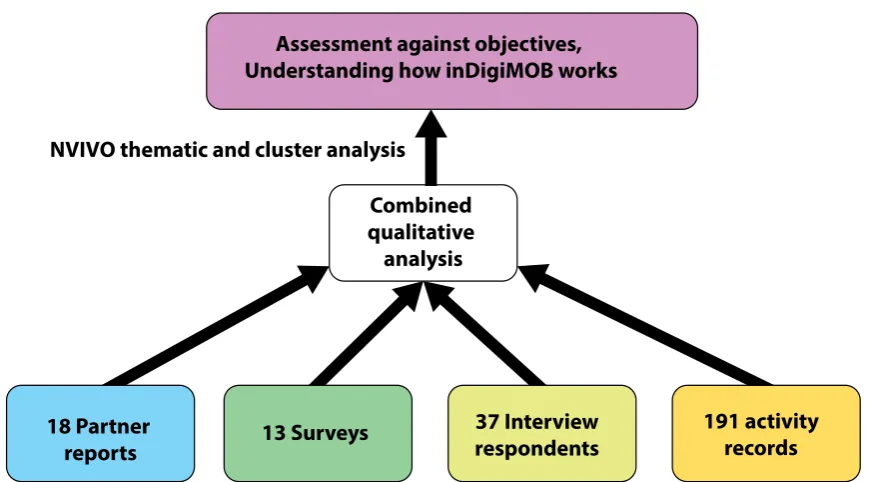
Interviews were transcribed and data from surveys were added to a single spreadsheet. Data from partner activity reports were collated into another spreadsheet. All data sets were combined into a single NVivo (qualitative analysis software) database for analysis. This facilitated a thematic analysis based on key areas of investigation including barriers, mechanisms for change, outcomes and future directions. Figure 4 shows a schema of the various data sources leading to an assessment of the program against its objectives and an understanding of how it works, for who and under what circumstances.
Figure 4. Data analysis schema
A quantitative assessment of outcomes derived from partner activity spreadsheets and surveys was carried out separately in two Excel spreadsheets.
Hypothesised theory of change
An important element of the evaluation design is establishment of an hypothesised Theory of Change (TOC). The reason for this TOC is to establish the pre-conceived assumptions about how and why the program works (Funnell & Rogers, 2011). Prior to data collection, a TOC workshop was conducted with inDigiMOB staff to establish what this might look like (see TOC conceptualisation, Figure 5). The Theory of Change represents the inputs and processes thatshould lead to immediate and longer term outcomes.
Inputs in this model include the financial resourcing through Telstra, the infrastructure provided through First Nations Media Australia (FNMA), and the human resourcing which provides the means for the program. Processes shown here are embedded in the various activities of the program. Specifically,
we identified partnerships, peer to peer learning, the employment model, support provided by inDigiMOB, and advocacy.
In this initial model we did not try to predict the causal mechanisms that support change from processes to outcomes. We did however consider what some of the external enablers (‘what helps’) and inhibitors (‘what limits outcomes’) could be. These enablers and inhibitors were perceived to be to some extent outside the control of inDigiMOB program (and program staff). Outcomes envisaged in the model are based on the conceptualisation of the program in terms of: 1) Digital Inclusion, 2) Economic Benefit; 3) Cultural Maintenance; and 4) Digital Safety.
Following data collection and analysis a
reconstructed Theory of Change was developed in the light of empirical evidence collected during the evaluation (Figure 12). The reason for this second TOC is to understand how and why the program actually works, based on the evidence gained through evaluation.
Combined
qualitative
analysis
NVIVO thematic and cluster analysis
Assessment against objectives,
Understanding how inDigiMOB works
13 Surveys
37 Interview
respondents
191 activity
records
18 Partner
Figure 5. TOC conceptualisation
H
igh L
ev
el Expec
ta
tions of inDig
iMOB
Telstr
a
Founding P
ar
tner
Peer t
o peer lear
ning model
Par
tnerships:
Tangen
ty
er
e C
ouncil
, P
AW
, ARDS
Emplo
ymen
t model
Pr
oblem solving/suppor
t
Adv
ocac
y
Incr
eased ac
cess
Incr
eased sk
ills
Impr
ov
ed aff
or
dabilit
y
Impr
ov
ed infr
astruc
tur
e
W
ha
t limits out
comes
Unc
on
tr
olled r
isks
Staff tur
no
ver
Limit
ed f
ootpr
in
t
Par
tner issues
CDP changes
W
ha
t helps
Fle
xible funding model
Br
oadband f
or the Bush
Relev
anc
e t
o c
ommunit
y
M
otiv
at
ed D
AW
s and DMs
Underpinning f
ounda
tions:
Plac
e based built on c
The findings are presented here first as activity participation, based on data collected by the
program itself and then on qualitative data collected and analysed by the evaluators. Where quotes are provided, at times they are adjusted either to ensure confidentiality and to smooth out the conversational nature of responses with their pauses, corrections and interruptions. Beyond the qualitative data collected through the survey, which is reported here, the survey results are not shown because of the small sample size. The results are however shown at Appendix 2, from Table 9 through to Table 15.
Activity participation
A total of 191 activity reports recorded onspreadsheets were analysed to assess 1) how many participants engaged in activities, 2) the gender mix of participants, 3) the skills focus of each activity, and 4) digital mentor involvement. Age comparisons are not possible due to differing age groupings over the course of the year.
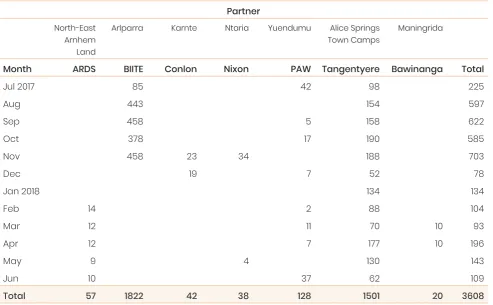
Table 2 summarises participation by month for each partner. Month to month fluctuations are the result of the nature of activities led by Digital Access Workers and the availability of staff. A total of 3608 participant events were recorded doing inDigiMOB activities during that period, 92 per cent of who were involved in Arlparra and town camp learning/ community centre activities. Note that many people may have participated in several different activities and on different occasions at the same site—hence the description of these as ‘participant events’, not participants. The nature of activities differed at each site, and the larger numbers of participants in town camps is largely due to activities such as family photo events, family history projects and
3608
Participant events in
191
Activity reports
collaborative multimedia activities which attracted large numbers. The small number of participants in the top end communities again is largely due to the nature of activities, often being small group skill development activities. Additionally, the top end sites began in January 2018.
Table 2. Participation events by month and partner (See Figure 1 for locations)
Partner North-East
Arnhem Land
Arlparra Karnte Ntaria Yuendumu Alice Springs
Town Camps
Maningrida
Month ARDS BIITE Conlon Nixon PAW Tangentyere Bawinanga Total
Jul 2017 85 42 98 225
Aug 443 154 597
Sep 458 5 158 622
Oct 378 17 190 585
Nov 458 23 34 188 703
Dec 19 7 52 78
Jan 2018 134 134
Feb 14 2 88 104
Mar 12 11 70 10 93
Apr 12 7 177 10 196
May 9 4 130 143
Jun 10 37 62 109
Total 57 1822 42 38 128 1501 20 3608
The 191 activity reports asked DAWs to identify up to three skill focus areas. Figure 6 summarises the findings for all sites where skill focus areas were recorded. The most commonly reported skill area was described as ‘general use of computer devices’ (146 activities). This was followed by ‘multimedia’ (142 activities) and basics of computing (89 activities). A breakdown of this data by site is provided in Appendix 1, Table 3.
Overall, female participation was higher than male participation as shown in Figure 7—58 percent of all
participation came from females. There was considerable variation across sites, but the skew towards females is largely due to higher levels of female participation in town camps. See Appendix 1, Table 4 for details of participation by site.
Figure 7. Male and female participation, all sites
Figure 8 summarises the number of occasions that Digital Mentors are reported to be involved in activities. In all, Digital Mentors were involved on 149 occasions.
Figure 8. Digital Mentor involvement in activities
Digital Mentors
involved on
149
Reported outcomes
Reported outcomes were identified through interviews, Digital Access Worker reports, surveys and activity spreadsheets, as outlined earlier in Figure 4. It is important to note here that outcomes are differentiated from mechanisms. Outcomes are here defined as products of the program while mechanisms (discussed later) are the means by which those outcomes are achieved. There is some overlap in a few of these, however; for example, community engagement could be considered an outcome, though we have taken the view that it is a means to a larger end—access and participation. A list of all outcomes identified by site is provided at Appendix 1, Table 5.
The strongest outcomes emerging from the evaluation are skills, increased confidence,
knowledge sharing, and access and equity.
Just over half of all outcomes reported as a result of inDigiMOB were described under these themes.
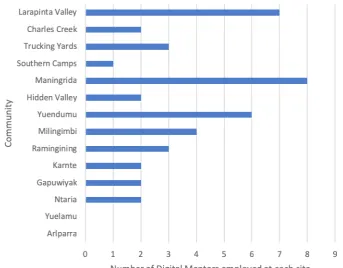
Figure 9 summarises Digital Mentor employment for each site. Note that for both charts, Karnte refers to the work done by Jeremy Conlon. Note too that for Yuelamu, Digital Mentors were involved, but they were brought in from Yuendumu. The Arlparra Learning Centre did not employ any Digital Mentors. Note also that depending on detail provided in reports, some numbers may not be accurate. Where this is the case, we have erred on the side of caution to show the minimum numbers. A total of 42 individuals were employed as Digital Mentors for varying lengths of time.
The data shows some distinct differences in the types of outcomes that emerged from each site. At the Tangentyere sites the most frequently reported outcomes were ‘access and equity’, ‘skills’ and ‘access to online services’. For example, one community centre participant pointed to accessing the internet and being able to do online reporting with Centrelink.
That proper internet access, eh. On the
computers and phones. A lot of them like to go on Centrelink and do their reporting and things. They can do that here. Some of them bush mob come here and they can do it on their phone.
At the PAW sites the top three outcomes reported were ‘skills’, ‘confidence’ and ‘knowledge sharing’. For example, a representative from one of PAW’s partners commented on increasing confidence of a mentor.
So it was really good, one fella … working with the older fellas gave him the confidence to do voice overs in Warlpiri so now—and this is an indicator that it works well—when he is in here being a mentor, he now has heaps of confidence helping people with banking, he has gone from not speaking Warlpiri, not talking on the phone to now doing the whole thing without me asking.
At the ARDS sites, the top three outcomes were ‘skills’, ‘knowledge sharing’ and ‘recording country’. Many of the Ramingining Mentors interviewed talked specifically about the skills they had learnt through the program, for example taking photos and video, and editing.
Yo, editing, sometimes I have got to know how to do editing. Like in this computer here, we always go take photo, and when we come back we download straight away. I was following the instructions there. Yo.
Stakeholders with interests in all sites identified ‘confidence’, ‘skills’ and ‘knowledge sharing’ as the main outcomes from inDigiMOB activities. Knowledge sharing was particularly important for the ARDS sites, where for the work in art centres, the important element of the work was sharing intergenerational knowledge and for the ranger groups, it was about translating knowledge gained on country to share with funder and Traditional Owners. For example:
The work is important so that rangers can take better photos, helping them to film, make small movies, record on computers, and reporting back to Traditional Owners.
Mechanisms
In the context of our methodology, mechanisms should be seen as the triggers that connect the activities to the outcomes—they are in effect the causal drivers for change that turn processes into outcomes. The strongest mechanisms were described in terms of ‘learning and training’, ‘community engagement’, ‘relationships’ and ‘resource creation’—40 per cent of all mechanisms were described under one of these headings. More detail on mechanisms by site is shown in Appendix 1, Table 6.
As was the case for outcomes, there are differences for each site, reflecting the different priorities and activities at each location. However, overall, ‘learning and training’ was the most frequently reported mechanism. For example, at Ramingining:
The women are so engaged with the training, they enjoy learning, I get busy with other things, but they like having someone spend time with them.
And at Yuendumu:
I thought it was exciting and a terrific opportunity for the community, fills a niche that we weren’t able to do before. We hadn’t had funding for grassroots work, if someone wants to be on staff, we give them technical training, but that’s not like the basics of training offered by inDigiMOB.
And in Alice Springs:
We had workshops here, with inDigiMOB, learning how to use a drone. It was really good because we were all excited, we were scared at first, because we might break this thing, and they just helped us through—the mentors, the teachers, the facilitators—and they talked us through and gave
40%
Of all mechanisms reported were
described as:
- Learning or training
- Community engagement
- Relationships
- Or resource creation
51%
Of all outcomes reported were
described as:
- Skills
- Confidence
us encouragement to use it for yourselves and at the end we all had a go at using the drone, we could see what the drone saw, it was really good because straight away I thought it would help us on our homeland, and we could map out our traditional map, really exciting for us, everyone was feeling the same way, locating waterholes in different areas, putting Indigenous names to it, marking out areas, really exciting.
Note that in all these examples learning is seen as a vehicle for something bigger, whether it was about being a better-skilled ranger, a pathway to employment, or a vehicle for use with traditional knowledge.
‘Community engagement’ was reported next most often among multi-site stakeholders. For example, the importance of community engagement is reflected here in contrast to perceived disengagement from education.
We see much greater engagement with people who haven’t been engaged in mainstream education.
Another multi-site stakeholder described the importance of engagement:
We've tried to develop a model where we are able to get some deeper engagement with communities and perhaps some quality engagement, better quality results but also having a balance where we are outreaching to get better coverage of engagement. Using the partners is the way we think you can get that deeper engagement, with activities run on a weekly basis on town camps, communities.
Engagement was also particularly important for respondents at the PAW site. For example, one respondent, asked about achievements, pointed first to engagement, then to confidence.
I can say it’s created positive engagement with young people. It has given people a better understanding of the possibilities that digital technology has. More confidence, definitely. I have seen people become more confident through engaging in inDigiMOB workshops.
‘Relationships’ came up as a theme most often at the PAW site, perhaps not surprisingly given the focus on engagement there. In this response, the interviewee was asked about challenges:
The workshops ongoing, it is really relational, the work, you can't do anything without good relationships with people, to maintain those relationships in remote contexts you have to be flexible… a workshop that’s not dependent on one space, one place, [if] something has
happened, if there is a sorry, or someone is not comfortable in the room, you have to be aware of what's going on culturally, you have to be flexible.
‘Resource creation’ was also particularly strong at PAW as well, as demonstrated by these observations from the same respondent.
I think [in] the multimedia workshops, people’s devices—[they] are realising it’s not just a phone, like a Facebook it is a multi-use tool, I can transfer money, have music on it, make content, creating content, sharing with each other, [it’s] not
something out of our control.
Beyond the top four themes, some sites had a particular emphasis on other mechanisms. Intergenerational activities, such as family history projects in the town camps were seen to be
important vehicles for change. And in the ARDS sites, intergenerational activities were coupled with telling stories. These stories were being captured with audio and video by Digital Mentors. One respondent at Ramingining spoke of his passion to see a museum established for just this purpose:
Old people can tell stories, young people don’t have the stories. I think better way [is a] museum, people can sit, listen, look, tell em to kids, we ran out of old people, some people here, when people tell stories, no learning, you better with museum.
Addressing challenges
In interviews, we asked specifically about the barriers that inDigiMOB was trying to address. In the survey we asked what else people needed help with. The
greatest needs were identified as ‘language projects’ which was followed by ‘making and editing digital videos’. In the interviews, few people spoke about key barriers to digital inclusion. There was limited
discussion about affordability, awareness and skills and a few comments about passwords and privacy.
38%
OF ALL CHALLENGES
REPORTED WERE
DESCRIBED AS:
INFRASTRUCTURE
LIMITATIONS
LIMITED CAPACITY TO
RESPOND
AVAILABILITY OF
RESOURCES
OR
FUNDING ISSUES
38%
Of all challenges reported were described
as:
- Infrastructure limitations
- Limited capacity to respond
happened, if there is a sorry, or someone is not comfortable in the room, you have to be aware of what's going on culturally, you have to be flexible.
‘Resource creation’ was also particularly strong at PAW as well, as demonstrated by these observations from the same respondent.
I think [in] the multimedia workshops, people’s devices—[they] are realising it’s not just a phone, like a Facebook it is a multi-use tool, I can transfer money, have music on it, make content, creating content, sharing with each other, [it’s] not
something out of our control.
Beyond the top four themes, some sites had a particular emphasis on other mechanisms. Intergenerational activities, such as family history projects in the town camps were seen to be
important vehicles for change. And in the ARDS sites, intergenerational activities were coupled with telling stories. These stories were being captured with audio and video by Digital Mentors. One respondent at Ramingining spoke of his passion to see a museum established for just this purpose:
Old people can tell stories, young people don’t have the stories. I think better way [is a] museum, people can sit, listen, look, tell em to kids, we ran out of old people, some people here, when people tell stories, no learning, you better with museum.
Addressing challenges
In interviews, we asked specifically about the barriers that inDigiMOB was trying to address. In the survey we asked what else people needed help with. The
greatest needs were identified as ‘language projects’ which was followed by ‘making and editing digital videos’. In the interviews, few people spoke about key barriers to digital inclusion. There was limited
discussion about affordability, awareness and skills and a few comments about passwords and privacy.
38%
OF ALL CHALLENGES
REPORTED WERE
DESCRIBED AS:
INFRASTRUCTURE
LIMITATIONS
LIMITED CAPACITY TO
RESPOND
AVAILABILITY OF
RESOURCES
OR
FUNDING ISSUES
However, the conversation about barriers generally turned quite quickly to what the challenges for inDigiMOB delivery were. These are summarised in Table 7 (See Appendix 1). Of all the responses about challenges to delivery, four key themes emerged—38 per cent of all challenges were described in terms of ‘infrastructure limitations, limited capacity to respond’, ‘availability of resources and equipment’ and ‘funding or sustainability issues’.
For the Tangentyere sites, the major challenges related to ‘infrastructure limitations’, a ‘limited capacity to respond’ and availability of ‘resources and equipment’. One organisational respondent commented:
First, the job is made difficult by things outside the program, e.g. infrastructure. We have finally got NBN at Larapinta. Having internet access at the centres. inDigiMOB could do more in the way of advocacy on this.
Another Alice Springs organisational respondent described the program as ‘stretched’:
I think it’s far too stretched. There needs to be way more people doing the work or the scope has to be brought back in. Seeing one person for three hours once a week doesn’t allow people to engage consistently.
A Digital Mentor described her frustration:
We’d like to see that internet thing fixed up properly [so not having to use a dongle]. Printer would be good, even just a land line for the Centre.
The funding issues raised varied. For example, one respondent, building a case for the resourcing for her organisation commented that:
It is also about equipment, it costs money, you need to look after it and you need electricity and those three things are also challenging for people.
In response to the barriers listed above, and also following consideration of the strengths and challenges of the program, respondents discussed four key future directions: ‘building sustainability’, ‘capacity building’, ‘Digital Mentor leadership’ and ‘specialised skill development’—56 per cent of all responses fell under one of these themes.
The first, identified mostly by multi-site stakeholders, relates to sustainability. There was some concern expressed that the program’s future funding should be prioritised. One particular concern was:
about being not too reliant on Telstra to keep [inDigiMOB] going.
More specifically, other stakeholders talked about potential partnerships with other corporate bodies and governments.
The second major theme relates to capacity building—that is, ensuring the capacity of the partner organisations into the future. One multi-site respondent expressed some caution about expansion unless future resourcing was also assured:
In terms of expanding when there are resources, for sure, people and people power. If that's there sure! Without that, if that's not there, I think its important to stick with something, things often happen slowly [here], it’s often the gradual steps, the baby steps.
Another organisational respondent described the challenge she had with limited resourcing:
it would be better if we had more staff, more of a team, resources and infrastructure and so inDigiMOB has been helping with staffing, but without the resourcing it’s a struggle. I have just been on my own running this program, I have the coordinators I talk to at each centre, but it would be good to work together to coordinate and deliver skills.
The third priority was described in terms of building the leadership capabilities of Digital Mentors. For example, one community member described how he saw the role of Digital Mentors in his community:
They are amazing people. The thing I saw, I couldn't believe my eyes… when we see those people, giving it to us, teaching us it’s just amazing.
The fourth major theme is about specialised skill development. For some this means having more consistent, structured training, rather than the limited access to less formal learning that is available through community centres. For example one Digital Mentor commented:
I think it’s beneficial to the community regarding access to new technology and computers, we need that structured format for training and teaching to go with it, that consistency, not just the four hour thing.
56%
OF ALL RESPONSES TO
The case studies here are offered as a representation of inDigiMOB’s activities among its three current partners. They are based on a combination of evaluator observations and evidence obtained in interviews and through a reading of partner reports.
Tangentyere Council Alice Springs
Town Camps
inDigiMOB operates in five community centres across Alice Springs town camps: Hidden Valley, Trucking Yards, Karnte, Charles Creek and Larapinta Valley. The centres are community spaces where a variety of activities occur. They are vibrant intergenerational spaces for socialization, cultural maintenance, creative work and learning. They are also sites for
activism and advocacy. For the most part they are located on the fringes of ‘town’ but have an appearance of suburbia. inDigiMOB works alongside all these functions. According to the 2016 Census, 1024 people live across the 18 locations as shown in Figure 10. The population fluctuates as visitors come and go (Foster et al., 2005).
CASE STUDIES
1500
participant events:
Figure 10. Town Camps of Alice Springs (Foster et al., 2005, p. 7).
What came through strongly in interviews was a passion for engagement. In part this is represented in the number of participants engaging in inDigiMOB activities over the course of a year: more than 1500 records of activity across the Town Camps. At Trucking Yards we saw the product of a family history project which mapped family trees using specialized software. The sense of excitement and discovery that emerged from this project was infectious—indeed other sites have taken this up too. At Hidden Valley, we heard of the powerful advocacy work done through inDigiMOB, as residents came together to campaign for equitable access to the NBN and mobile. In one interview, a participant described his frustration:
Once [DAW] was here; she showed me the map of the network [coverage] for Alice Springs areas and [how it] doesn’t go to Town Camps for Alice Springs. We can’t understand why [it’s like this]… [DAW and inDigiMOB] try and help people so we can all connect, for things we can use for our community, things like the rest of Alice Springs and NT get.
At Larapinta, a Digital Mentor shared with us the passion and excitement she had for learning using computers and applying it to cultural maintenance through digital archiving:
Archiving [the stories]... because we found out that there is 25 years left... to keep your archives, to keep your information in a state that can be obtainable in the future. We need to take steps now to inform and to get our young people to access this [material]and acknowledge this has to be done.
At Charles Creek we saw movies participants made, where children and families came together to share with each other. Many of these activities brought the whole community together.
All of these observations left us with a sense of the tangible benefit of digital inclusion in this context.
PAW Media at Yuendumu
Yuendumu and Yuelamu are communities with a combined population of nearly 1000 people. PAW has a 30 year history as a media organization servicing the Pintubi, Anmatjere and Warlpiri communities with community radio, community video production and language resources. At PAW, inDigiMOB works to support two main areas of activity: development of a digital archive, and provision of digital literacy workshops in partnership with the Warlpiri Youth Development Aboriginal Corporation (WYDAC). Our observations and interviews at Yuendumu were punctuated with repeated references to the importance of relationships and the cultivation of safe spaces for two-way learning, knowledge sharing, confidence and empowerment. The multi-layered outcomes that have emerged from inDigiMOB are in part represented by an account from a partner representative:
It has given people a better understanding of the possibilities that digital technology has. More confidence, definitely. I have seen people become more confident through engaging in inDigiMOB workshops.
Meanwhile a participant discussed the challenges he saw, and related these to what he saw as potential for inDigiMOB:
For our children to see the good and the bad, to access white society, Yapa way, here we are learning things about digital technology. This is not Yapa way, it is Kardiya way. The challenge for us is to make it our way… We want to be proud so we can own it and we can say to them it is ours. We want to see more Yapa and Kardiya teaching us so we can see it, different skills. I see more Yapa getting hold of it and driving it.
The insights reflected in the comment above, are evidence for the strong focus on learning as a vehicle for greater access to digital literacies and inclusion, adding to confidence and a set of skills that the whole community can build on. We also saw evidence of creativity in the production of animations and enthusiastic Mentors who were embracing their skills and sharing them with others.
ARDS at Ramingining
inDigiMOB works in four East Arnhem Land communities: Gapuwiyak, Galiwin’ku, Milingimbi and Ramingining. The model is somewhat different than in the other two sites as the Digital Access Worker rotates through each community, working with selected Digital Mentors for one to two weeks at a time. The Mentors are aligned to jobs in ranger programs and at art centres. For this evaluation we joined with the Digital Access Worker at Ramingining.
Much of what we observed here was about capturing and sharing the stories of country and people. With the rangers, it was about country, and with the art centre workers it was about elders and artists. For the Mentors there was clearly a personal interest in their work, and they were all enjoying learning from the Digital Access Worker. However, for most there was a bigger picture in their minds—maintaining culture. Asked why this was important one Mentor commented:
[It is for] young people. Kids from school, they are finished from school, no jobs, no Yolngu culture, they... my main [idea is] just put [in a] museum so people can come and see and look and listen. Try to encourage kids for the future.
Knowledge sharing was also at the heart of the ranger work where rangers had responsibility for monitoring and evaluation work and for reporting back to Traditional Owners. Their emerging skills were clearly contributing to the sustainability of their work and the demonstration of both traditional knowledge and western ecological knowledge.
How and to what extent are
inDigiMOB’s program objectives
being met?
Before responding to this question, we return to the stated objectives of inDigiMOB which are to:
1.
Address critical barriers to the take up and use of ICTs, tools and online services2.
Apply the use of ICTs to address local and community needs and projects3.
Establish and demonstrate benefits of local Aboriginal and Torres Strait Islander digital mentors4.
Establish employment models for Aboriginal and Torres Strait Islander digital mentor jobsWe address each objective in turn, below.
Addressing critical barriers
The critical barriers articulated by inDigiMOB focus on awareness, appropriateness, availability and affordability (Voerman et al., 2016, p. 5). While noting that these barriers identified by respondents were not described in these terms (see Addressing challenges, page 16), when we consider outcomes shown in Table 5 (see Appendix 1) there is strong evidence for the program’s role in increasing awareness and skills—36 per cent of all references to outcomes in the data, referred directly to skills, knowledge sharing and increased awareness. Similarly, as a vehicle for achieving outcomes, ‘learning and training’ accounted for 18 per cent of all references to mechanisms. Appropriateness is also reflected strongly in outcomes such as cultural maintenance, recording country, enjoyment and empowerment—
RESPONSE TO EVALUATION
QUESTIONS
of outcome reports are
about raising awareness
and improving skills
accounting for 18 per cent of all outcomes—and through community engagement mechanisms driven by culturally appropriate community aspirations, which accounted for 16 per cent of all references to mechanisms. There is less support for propositions that inDigiMOB improves availability
and affordability. For example, affordability as an outcome is only mentioned twice in the data on outcomes, and while there are hints in the data about increased availability (such as increased participation, mentioned twice also), they are not strong. The reasons for this lack of support is probably determined by the experience of what is currently available (as opposed to what may have once been available) and by free access available in learning/ community centres and through community-based free wifi. Stakeholders may have seen this availability and affordability as a given rather than as a benefit derived from inDigiMOB.
Meeting local needs
There is strong evidence from all sites that the program is meeting local needs. This is reflected in the nature of activities driven by community demand, including family history projects, archiving projects, story-telling and recording country projects. The outcomes we have described in Table 5 (see Appendix 1) as ‘access and equity’, ‘cultural maintenance’, ‘recording country’, ‘creative activities’ and enjoyment are all about meeting local community needs. These outcomes comprise 23 per cent of all outcomes identified in the data.
They are also reflected in ground-up, culturally appropriate mechanisms that support community aspirations and help communities to advocate for themselves. Many of the activities are
intergenerational built around knowledge sharing and the creation of resources and content. Of all mechanisms described in the data (see Table 6, Appendix 1), 44 per cent were related to meeting local needs.
One stakeholder commented:
The important thing is that something grows from the ground up because it's stronger.
And a community member offered this insight:
When I first heard it… I first thought it looks good, very new and special…, but when I saw it, people coming in and finding lots of things, I was thinking wow, that’s the sort of thing we want!
Benefits of Digital Mentors
Three main benefits of Digital Mentors emerge from the data. Note that these benefits are as much about the value of the program to the individuals as what the role does for their community or
workplace. These are broadly about skills, knowledge
sharing and confidence. Confidence is most often
directly attributed to Digital Mentors, accounting for 12 per cent of all outcomes identified, though all three outcomes sometimes come together, as demonstrated in this report from a Digital Access Worker,
One very proud moment was when [Digital Mentor] shared with me a short video she had cut together on her phone using the phones and videos she had taken with her phone throughout the workshops in both Alice Springs and [home community]. This was great as it displayed [Digital Mentor’s] digital skill development as well as her pride and purpose in the project.
For Digital Mentors, the significance of their
experience is at times quite profound. For some it has given them a unique opportunity to teach and learn, as this excerpt from an interview with a Digital Mentor demonstrates:
I taught [Digital Access Worker] through Aboriginal law how to respect Aboriginal people. She was teaching me. I knew a little bit but she made me more experienced.
Some stakeholders working with partner
organisations also recognised the importance of this learning within their paid employment roles. For example, this comment from a ranger organisation in Arnhem Land shows the benefit in terms of independence.
[inDigiMOB] helps the rangers become
independent, sharing their work for the monitoring and evaluation, using for reporting back to
funders, it allows them to be independent rather than relying on the non-Indigenous workers.
Employment model for Digital Mentors
A total of 42 Digital Mentors were employed in activities over the 12 month period to June 2018 (see Figure 9)—though at any one time only 10 of these would be active in their roles. Some mentors get“The impact on the active group of Digital
Mentors is potentially profound and their
ability to impart skills and knowledge,
inspire others and contribute to their
communities is also highly significant.”
of mechanisms were about
meeting community needs
involved in activities that they are interested in and then move on. Some are taken away from their work due to cultural obligations. Some activities only had a short duration (for example at Bawinanga and Ntaria) and only the Tangentyere and PAW sites operated for the whole year. The Digital Mentor model is generally perceived as being effective, though it is highly dependent on the Digital Access Worker, and to a large extent the Digital Access Worker role is dependent on the effectiveness of the Digital Mentor. In Alice Springs the Digital Access Worker attends each community centre once per week. In Arnhem Land, the Digital Access Worker spends a week in each community on a six-week rotation. The working relationships between the Digital Access Workers and Digital Mentors are seen to be a key to making the roles work well. Time and trust figure strongly as themes brought out in these three quotes from Digital Access Worker interviews.
It’s taken a long time for me to have relationships I have now. Five different places, It’s hectic. It takes time to get to know people.
Relationships take time. It’s only through having a solid foundation of relationships that you get trust and there is a supportive environment to help them in directions they want to go.
…some of the best points have been when we have run into challenges together and being able to reflect on it together, one time we went out to [community] to do our first workshop… we couldn’t do the workshop there, … no one's fault, it was bad timing, it was two hours’ drive back, a lot of time, we discussed a lot of things that went wrong, what we could do better next time, having the time and space, talking it through together, we were honest with each other…
Coupled with this mutual dependence is a corresponding reliance on a pre-existing
employment model with the partner organisations. As such, the employment creation intent of the model is somewhat limited, but the model’s ability to build organisational sustainability and capacity is significant. There is also significant vulnerability in the model. As Digital Mentors gain confidence and skills, their employability increases, and there is evidence of positive Digital Mentor attrition from inDigiMOB to other organisations. There is vulnerability in the model because it is so highly dependent on the relationship with the Digital Access Worker—changes in personnel for either role will likely result in less favourable program outcomes.
In summary, most of inDigiMOB’s objectives are being met in several ways. The extent to which these objectives are met is limited to a relatively small operational base in three regions, though the 3608 participation events (see Table 3) demonstrates considerable activity and community involvement. The impact on the active group of Digital Mentors is potentially profound and their ability to impart skills and knowledge, inspire others and contribute to their communities is also highly significant.
Under what circumstances (contexts
and mechanisms) is inDigiMOB likely
to work best to achieve desirable
outcomes for whom?
In terms of contexts, there are clear differences for each of the sites that affect the kind of outcomes achieved as shown in Table 5 (Appendix 1) and the mechanisms used to achieve the outcomes as shown in Table 6 (Appendix 1). While the Tangentyere sites were particularly concerned about advocacy and intergenerational community engagement as a vehicle to achieve access and equity outcomes, this was not the focus of the other two sites. At PAW sites, learning and training coupled with relationships were the key mechanisms to achieving more confident, better skilled people. At the ARDS sites storytelling and learning were the key mechanisms used to achieve skill and knowledge sharing outcomes. This diversity reflects the diversity of the sites.
42
Digital Mentors
Figure 11. Linkages between mechanisms and outcomes
Digital literacy skills Confidence
Knowledge sharing
Cultural maintenance
Community and learner engagement
Access and equity Employment
Awareness raising Enjoyment
Employability skills
Empowerent and opportunity
Learning and training
Advocacy
Community aspirations Intergenerational activities Digital Mentor model
Access Worker model
People helping people Resource and content creation
Relationships Partnerships Allowing time
Story-telling Culturally relevant
Ground up
Outcomes Mechanisms
External inhibitors over which the program has little control
Infrastructure limitations Funding issues
Resources and equipment