http://www.sciencepublishinggroup.com/j/jpmt doi: 10.11648/j.jmpt.20180402.11
ISSN: 2469-8423 (Print); ISSN: 2469-8431 (Online)
Application of Mathematical Modeling in Optimization of
Synthesis Process Parameters of Methylchlorosilane
Zhang Shuwen
Tangshan Sanyou Silicone Industry Co., Ltd. Tangshan, China
Email address:
To cite this article:
Zhang Shuwen. Application of Mathematical Modeling in Optimization of Synthesis Process Parameters of Methylchlorosilane. Journal of Photonic Materials and Technology. Vol. 4, No. 2, 2018, pp. 49-54. doi: 10.11648/j.jmpt.20180402.11
Received: August 15, 2018; Accepted: December 4, 2018; Published: January 3, 2019
Abstract: Methylchlorosilane is an important chemical raw material. It has been matured since the direct synthesis technology
has been applied for many years. However, due to the characteristics of gas-solid two-phase catalytic reaction, it still faces many problems in industrial production. The use of systems engineering methods to solve production problems has become an important task for organic chlorosilane monomer manufacturers. This paper introduces the application of mathematical modeling in the optimization of methylchlorosilane synthesis process parameters as an example to illustrate the important role of system engineering ideas in the production practice process, to achieve digitization of the fluidized bed reactor control process, parameter optimization. Through the research and analysis of the production control process, the mathematical model of superficial gas velocity and catalyst feed coefficient control was established to optimize the methylchlorosilane synthesis process. The results show that the apparent gas velocity should be controlled in stages during the direct synthesis of methylchlorosilane. The induction period is 0.10~0.12 m/s, and the stable period is 0.25~0.28 m/s. After the catalyst is added to the reactor, it will undergo three stages of induction period, stable period and aging period. After the catalyst reaction performance, the catalyst will gradually lose its catalytic ability due to various physical and chemical factors. Catalyst stability and life-span in industrial production are related to its own performance and mixing ratio, the ternary copper catalyst life-span is generally 50-60 hours, the suitable mixing ratio is 2.0-2.5%.Keywords: Mathematical Model, Methylchlorosilane, Superficial Gas Velocity, Catalyzer, Mixing Ratio
1. Introduction
The direct synthesis of methylchlorsilane monomer belongs to gas-solid multiphase catalysis reaction, which has many characteristics, such as difficult production control, complex mechanism, many side reaction, high energy consumption and higher dangerous degree. Therefore, the scientific use of mathematical methods to optimize the production process parameters of methylchlorsilane monomer, in order to solve the production and control problems, reduce costs, has become an important task of the organic silane monomer manufacturers. This experiment is closely combined with production practice, through the detailed and systematic research and analysis of production control process, the mathematical model of superficial gas velocity and catalyst feeding coefficient control is established to optimize the process.
2. Control of Superficial Gas Velocity
industry, the control of superficial gas velocity in the fluidized bed is realized by adjusting the flow rate of the raw chlorine methane. The control of superficial gas velocity can be optimized by mathematical modeling.
2.1. The Control Range of Superficial Gas Velocity
The superficial gas velocity affects not only the concentration and the diffusion rate of gas phase reaction, but also the macroscopic reaction rate, and the fluidization state of
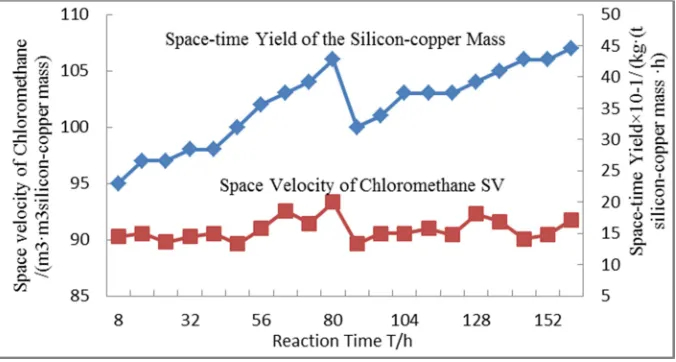
the reactor, which results in the change of mass transfer and heat transmission rate. The practice shows that the change of superficial gas velocity in the reactor is different from that of other reactors, and the effect of simply increasing the space velocity of chloromethane on space-time yield is negligible. Figure 1 is a time-dependent curve diagram of the space velocity and the space-time yield of chloromethane in the reactor during the initial stage of 160h.
Figure 1. Methylchloride space velocity and space-time yield curve.
Under certain working conditions, increasing the chloromethane flow rate in the reactor can increase the chloromethane space velocity, and the partial pressure and superficial gas velocity of the chloromethane in the reactor are increased. As can be seen from figure 1, there is no specific function relation between the superficial gas velocity of the chloromethane and the macroscopic reaction rate, which is because of the reaction of the industrial synthesis of methyl chlorosilane is mainly due to chemical kinetic control, and the influence of chloromethane diffusion rate on the macro reaction rate is limited. Therefore, The control of superficial gas velocity should satisfy the basic principles of fluidization and proper discharge of powders, and the theoretical analysis and production practice indicate that the superficial gas velocity (u) should satisfy the equation 1.
< < (1)
In the formula 1, uc for the average initial turbulent velocity
of the particle, m /s; ut for the fine particle the terminal
veloeity in the enlarged section, m /s.
According to the Geldart solid particle classification method, the silicon-copper contact particles belong to the B-type particles. [1], and the median particle diameter of the contact in the reactor is d50=90±10 µm. The theoretical
calculation can obtain the initial turbulent velocity umin =uc =
0.10~0.12 m /s. Maintaining a proper take-up speed ut is
important for reducing harmful impurities in the reactor, renewing the contact, maintaining high activity and selectivity of the contact, and extending system uptime.
In the early stage, the big data analysis method was used to
statistically analyze the production data for 3 years, and it was found that the particles with d≤45µm in the production can be taken out normally to achieve good results. Under this condition, the particle circulation amount Q=0.2~0.5 kg/(m2•s), the particle take-out speed ut=0.15~0.18 m/s, and
the reactor radial and axial temperature gradient are reduced to 0.5℃ under the same production load, the bed pressure
pulsation amplitude also reaches a minimum. Considering that the area ratio of the enlarged section of the reactor to the reaction section is generally 1.2 to 1.5, the superficial gas velocity umax of the reaction section is 0.25 to 0.28 m/s. Table 1
shows the appropriate range of superficial gas velocity at different stages of the methylchlorosilane synthesis reaction calculated in this experiment.
Table 1. Appropriate superficial gas velocity range at different stages of the reaction section1).
stages gas velocity u/m·s-1
the induction period 0.10~0.12
the stable period 0.25~0.28
Note: 1) There are differences in the mass flow rate and density of the top and bottom gas in the fluidized bed reactor. The theoretical calculation shows that the superficial gas velocity change caused by this cause is ≤4%. Considering the influence of gas backmixing, the superficial gas velocity along the reaction section and the axial direction can be ignored in actual production.
2.2. Mathematical Model of Superficial Gas Velocity Control
effective cross-sectional area, syngas flow, and chloromethane single pass conversion, etc. Mathematical modeling of superficial gas velocity is the process of determining the functional relationship between decision variables (operational parameters) and state variables (control parameters).
2.2.1. Determination of Process Variables
Because the superficial gas velocity is not a direct control parameter, in order to facilitate the control and combine the production practice, this experiment takes the liquid phase chloromethane flow rate VL entering the reactor as the
decision variable, the reactor outlet synthesis gas flow rate VG
as the state variable, and other parameters as the constraint. Condition, establish a mathematical model of superficial gas velocity control, and calculate the superficial gas velocity u under the corresponding working conditions according to equation 2.
= /A (2)
In the formula 2, VG for the corresponding gas flow of
reactor outlet under working conditions, m3/h; A for the cross-sectional area of the fluidized bed reaction segment, m2.
2.2.2. Establishment of Objective Function
Refer to Table 1 to determine the control range of the superficial gas velocity at different stages, set the flow rate of the synthesis gas at the outlet of the reactor in the corresponding period and consider the change of the inlet and outlet volume of the reactor. Under the specific conditions, the relationship between the liquid phase methylchloride flow rate VL and the synthesis gas flow rate VG can be established by
equation 3.
= ( + )/ , (3)
In the formula 3, VL is the mass flow rate of liquid
methylchloride in the reactor inlet, t/h; VG for the preset value
of the control syngas flow at different stages, calculated according to Table 1 and calculated according to equation 2, m3/h; δ for the variability factor, That is, the amount of change in the volume of the reaction mixture when producing 1 t of crude monomer, m3/t; q for the average yield per hour of crude monomer, t/h; KL,G for the equivalent volume, that is, 1 t liquid
Phase methylchloride is converted into the volume of gas at the corresponding operating conditions, m3/t.
In the actual production, the reactor temperature and product composition change little, and the statistical analysis shows that the variation range of δ, KL, V is also small, and can
be treated as a constant. If δ=100 m3/t, KL, V=230 m3/t, the
resulting relative error < 3%, can obtain the equation 4.
= ( + 100 )/230 (4)
3. Control of the Catalyst Feeding
Coefficient
Copper-based catalysts are the classic catalysts for industrial synthesis of methylchlorosilanes (currently using ternary copper Cu-CuO-Cu2O catalysts, the catalysts
mentioned in this paper are all in this series), which have the advantages of high activity, good selectivity and low consumption. Due to the backmixing of the solids during the fluidization process, the effect of the difference in catalyst concentration in the reactor on the reaction rate and the selectivity of the contact is negligible. However, it is sensitive to poisons, inactivated by poisoning, and has poor thermal stability. It will gradually lose its catalytic ability due to various physical and chemical factors and the number of cycles, and there are losses in operation, so it must be continuous or A certain amount of new catalyst is periodically added to achieve renewal of the active component of the catalyst. Therefore, the amount of catalyst addition m in a certain period of time is related to the total amount of reactor contact G, the stability and life of the catalyst T, the appropriate ratio of ingredients R, and the increment of the contact masses ∆L, and Equation 5 can be obtained according to the law of conservation of mass.
= = 1000 ( +∆ ) (5)
In the formula 5, K for the feed coefficient, ie the ratio of the catalyst addition amount m to the total mass G of the reactor in the t period; G for the total mass of the reactor contact, t; R for the suitable mixing ratio, ie silicon The optimal ratio of the mass of active catalyst to the total mass of the contact in the copper contact; T for the average life of the silicon-copper contact in the reactor, h; ∆L for the change of the mass of the reactor in the t period, and it is positive when slag is discharged from the reactor, and vice versa, t; wherein, the stability of the catalyst and the life T, the appropriate ratio of the contact masses R is the most important factor affecting the feed coefficient K.
3.1. Catalyst Stability and Life
Figure 2. Constant Temperature Stirred Bed Reactor ReactionTime and Space Time Yield Curve.
Figure 3. Constant temperature ttirred bed reactor reaction time and M2 selectivity curve.
It can be seen from Figure 3 that the change of catalyst activity with time has gone through three stages of induction period, stable period and senescence period. [2]. The induction period is generally 8~12 h, and the boundary between the stable period and the senescence period is difficult to distinguish. According to the production experience, the space-time yield under normal reaction conditions is generally reduced to 40% of the maximum value as a sign of catalyst deactivation. It can be seen that the lifetime of the four batches of catalysts in this experiment is 30~40 h, and the dimethyldichlorosilane selectivity in the stable period remains basically unchanged (Figure 4). It is worth noting that the industrial reactor is different from the laboratory equipment. The activity of the same batch of catalyst in industrial production is about 7 times that of the laboratory. The induction period is only 1/3~2/3 of the laboratory result, and the life is increased about 1/3. Therefore, the activity of the ternary copper series catalyst which can meet the production demand in industrial synthesis is 0.12~0.15t monomer/(t-contact•h)-1, and the service life is about 50-60 hours.
3.2. Contact Masses Mixing Ratio R
In a fluidized bed production system with continuous and stable operation, when other reaction conditions are constant, the suitable mixing ratio R (the mass ratio of copper to silicon in the contact, the same below) is mainly affected by the properties of the catalyst. In this experiment, the multi-index
orthogonal method was used to optimize the experimental process. [3], trying to determine the optimal ratio of silicon-copper contacts. Under the same reaction conditions, six groups of different silicon-copper ratios (3%~10%) of the contact bodies were arranged, and repeated experiments were carried out by the same experimental apparatus. After data processing, Figure 4 and Figure 5 were obtained.
60% of the laboratory result, it can satisfy Production requirements are also tested by production practices. Therefore, in industrial synthesis, the optimum ratio of
ingredients is from 2.0% to 2.5%, and must not be less than 1.5%.
Figure 4. Effect of contact masses mixing ratio on space-time yield in stirred bed reactor.
Figure 5. Effect of contact masses mixing ratio on the selectivity of M2 in stirred bed reactor.
4. Conclusions
The direct chemical synthesis of methylchloromethane is controlled by chemical kinetics. The control of superficial gas velocity should be based on the basic principle of normal fluidization and proper outflow of powder. It should be controlled in stages, The induction period is 0.10~0.12 m. The stable period is preferably 0.25~0.28 m/s. Catalyst stability and life in industrial production are related to its own performance and mixing ratio. The ternary copper (Cu-CuO-Cu2O) catalyst used in industrial synthesis of
methylchloride is generally 50-60 hours, and the mixing ratio is 2.0-2.5%.
References
[1] Zhu Bingchen. Chemical Reaction Engineering [M]. Beijing: Chemical Industry Press, 2007, pp. 250-253.
[2] Huang Zhongtao, Geng Jianming. Industrial Catalysis [M].
Beijing: Chemical Industry Press, 2006: 267-269. 271-313. [3] Zheng Mingdong, Liu Lianjie, Yu Liang, etc. Chemical Data
Modeling and Experimental Optimization Design [M]. Hefei: China University of Science and Technology Press, 2001: 93-142.
[4] Yang Hu Zhang Chenghong, ShiI Yan Fu Sichuan. Effect of Superficial Velocity of Methyl Chloride on Direct. Synthesizing Methylchlorosilane in Fluidized Beds [J]. Institute of Light Ind. & Chem. Tech., Zigong 643033, China, 2007 (13): 58-61.
[5] Kunii D, Levenspiel O J. Fluidization Engineering [M]. New York John Wiley & Sons. Inc, 1969.
[6] WANG Chao, WANG Guang-run, WANG Jin-fu. Process Characteristics of Cu-based Catalyst in Direct Synthesis of Methylchlorosilanes [J]. The Chinese Journal of Process Engineering, 2011, 11 (4): 639-643.
[8] HAN LU, WANG Guang-run, Liang Wei-hua, LUO Wu-xi, WANG Jin-fu. Experimental Study of Direct Synthesis Process of Methyl Chlorosilane in Fluidized Bed Reactor [J]. Journal of Chemical Engineering of Chinese Universities, 2002, 16 (3): 287-292.
[9] LUO WUXI, ZHANG GUOLIANG, WANG GUANGRUN, WANG JINFU. Effect of Copper Content on the Direct Process of Organosilane Synthesis from Silicon and Methyl Chloride [J]. Tsinghua Science & Technology, 2006, 11 (2): 252-258.
[10] MIKKO HEIKKINEN, TERI HILTUNEN, MIKA LIUKKONEN, et al. A modelling and optimization system for fluidized bed power plants [D]. 2009.