RESEARCH
Impact of furosemide on mortality
and the requirement for renal replacement
therapy in acute kidney injury: a systematic
review and meta-analysis of randomised trials
Łukasz J. Krzych and Piotr F. Czempik
*Abstract
Objective: To examine the impact of furosemide on mortality and the need for renal replacement therapy (RRT) in adult patients with acute kidney injury (AKI) based on current evidence.
Data sources: PubMed (Medline) and Embase were searched from 1998 to October 2018.
Study selection: We retrieved data from randomised controlled trials comparing prevention/treatment with furo-semide at any stage of AKI with alternative treatment/standard of care/placebo. The outcome was short-term mortal-ity and the requirement for RRT, when applicable.
Data extraction: Two reviewers independently extracted appropriate data. PRISMA guidelines were followed for data preparation and reporting.
Data synthesis: We identified 20 relevant studies (2608 patients: 1330 in the treatment arm and 1278 in the control arm). Heterogeneity between studies was deemed acceptable, and the publication bias was low. Furosemide had nei-ther an impact on mortality (OR = 1.015; 95% CI 0.825–1.339) nor the need for RRT (OR = 0.947; 95% CI 0.521–1.721). Furosemide had also no effect on the outcomes in strata defined by intervention strategy (prevention/treatment), AKI origin (cardio-renal syndrome, post-cardiopulmonary bypass, critical illness), control arm comparator (RRT, saline/ placebo/standard of care) and its dose (< 160/≥ 160 mg) (p > 0.05 for all). Subjects who received furosemide with matched hydration in prevention of contrast-induced nephropathy (CIN) had a less frequent need for RRT (OR = 0.218; 95% CI 0.05–1.04; p= 0.055).
Conclusions: Furosemide administration has neither an impact on mortality nor the requirement for RRT. Patients at risk of CIN may benefit from furosemide administration. Further well-designed RCTs are needed to verify these findings.
Keywords: Furosemide, Mortality, Renal replacement therapy, Acute kidney injury, Acute renal failure
© The Author(s) 2019. This article is distributed under the terms of the Creative Commons Attribution 4.0 International License (http://creat iveco mmons .org/licen ses/by/4.0/), which permits unrestricted use, distribution, and reproduction in any medium, provided you give appropriate credit to the original author(s) and the source, provide a link to the Creative Commons license, and indicate if changes were made.
Open Access
*Correspondence: [email protected]
Introduction
Acute kidney injury (AKI) constitutes a serious clini-cal hazard in criticlini-cally ill patients. There are multiple acknowledged risk factors for AKI which can be found in the intensive care unit (ICU) setting, including sepsis, circulatory shock, trauma, and use of nephrotoxic drugs [1]. Therefore, it is not surprising that AKI develops quite frequently, affecting one in five of all hospitalised patients [2], and more than half of all patients admitted to the ICU [3]. AKI has serious sequelae: progression to chronic renal failure; increased risk and progression of multiple organ failure; increased risk of cardiovascular disease; and, finally, increased in-hospital mortality [4].
Pharmacological and non-pharmacological interven-tions are made for AKI treatment, including metabolic and haemodynamic stabilisation, growth factor and adenosine receptor antagonist’s administration. Unfortu-nately, some of these were found to have unsatisfactory results. According to KDIGO guidelines [1], diuretics should not be used for the treatment of AKI, except for fluid overload. However, this is based on low evidence (II C recommendation). RRT is the only treatment option for severe AKI.
Previously, several investigators were concerned with increased mortality in patients with AKI treated with furosemide [5, 6]. These findings were rejected by many others [7, 8]. Due to the discrepancy mentioned earlier, the impact of furosemide on mortality in AKI patients has become a subject of several systematic reviews and meta-analyses [9–13]. As all of these meta-analyses included papers published over 20 years ago, their results should be cautiously extrapolated to current clinical practice due to evident changes in the treatment of the patients at risk of AKI (e.g. those with cardio-renal syn-drome, sepsis, in the perioperative period, in the ICU setting). Therefore, we attempted to verify this interest-ing relationship takinterest-ing into account the most recent data. We also sought to investigate the possible impact of furo-semide on the requirement for renal replacement therapy (RRT).
Materials and methods
In this systematic review, we conducted a comprehensive literature search for studies published in English from 1998 up to October 2018. We searched the electronic databases PubMed (Medline) and Embase using a pre-specified strategy (Additional file 1: Table S1). The MeSH (Medical Subject Headings) terms and key words were: furosemide, mortality, renal replacement therapy, acute kidney injury, acute renal failure and renal insufficiency. We searched for all related randomised controlled tri-als (RCTs) that compared prevention or treatment with furosemide, to a placebo, standard of care or RRT in adult
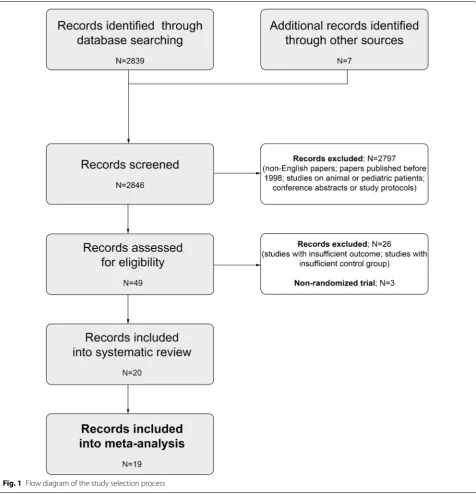
patients with AKI, or at risk of AKI (or acute renal fail-ure). Moreover, additional relevant studies were searched manually by checking the reference lists of identified studies or reviews. We excluded unpublished reports and conference abstracts. Two independent investigators (LJK and PFCz) screened the abstracts and/or manuscripts and extracted appropriate data. Short-term mortality was considered a primary outcome while the requirement for RRT was a secondary outcome. If the outcomes (i.e. OR; 95% CI) for individual RCTs were not revealed in the index publications, we calculated them based on raw data. Subgroup analyses defined by intervention strategy (prevention/treatment), AKI origin (cardio-renal syn-drome, contrast-induced nephropathy, post-cardiopul-monary bypass, critical illness), control arm comparator (RRT, saline/placebo/standard of care) and furosemide dose (< 160/≥ 160 mg) were also performed. PRISMA guidelines were followed for appropriate data prepara-tion and reporting [14]. A review protocol regarding this study has not been published before. Flow diagram of the study selection process is presented in Fig. 1. The quality of the trials was verified using the RoB 2.0 tool for assess-ing the risk of bias in randomised trials (Table 1) [15]. No disagreements occurred between the investigators on the quality of data extracted.
Statistical analysis
Statistical analysis was performed using licensed Med-Calc Statistical Software version 17.7 (MedMed-Calc Software bvba, Ostend, Belgium; http://www.medca lc.org; 2017). We applied random and fixed effect models to verify the association between furosemide treatment and the out-comes. Odds ratios (OR) with 95% confidence intervals (95% CI) were calculated. Forest plots were drawn. We used I2 test to evaluate the magnitude of heterogeneity
between studies, with values more than 50% defined as significant heterogeneity. Funnel plots were drawn to vis-ually evaluate the potential publication bias. P < 0.05 was considered significant.
Results
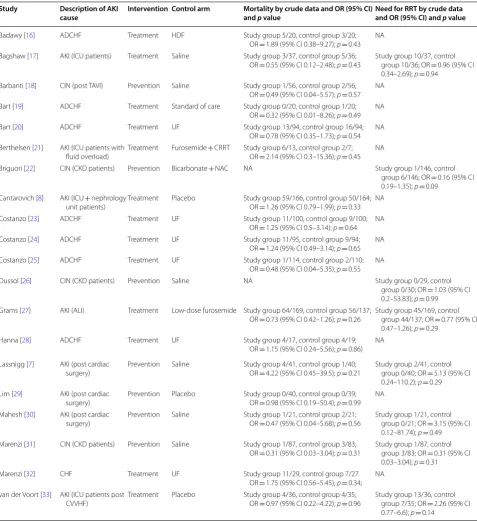
across them (Table 1). Nineteen were included in the meta-analysis (i.e. except from the study of Lim [29]). It was possible to calculate the daily furosemide dose in 17 studies (i.e. apart from the studies of Barbanti [18], Hanna [28] and van der Voort [33]), based on mean or median values given by the authors, or based on the infu-sion rate and body weight of the participants. This ranged from 20 to 2500 mg, with a median value of 160 mg. A detailed description of all reviewed and included trials is presented in Supplemental Digital Content.
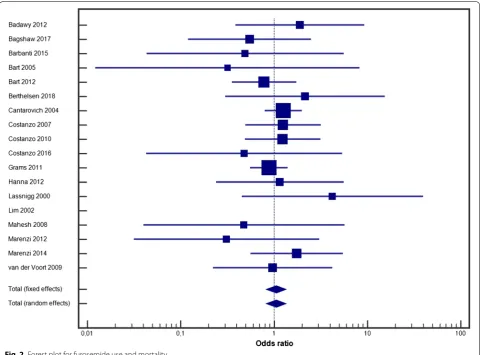
Furosemide had no impact on mortality (random effect model OR = 1.051, 95% CI 0.825–1.339, p= 0.4; fixed effect model OR = 1.051, 95% CI 0.827–1.334,
p= 0.4) (Fig. 2). Heterogeneity between studies was low (I2= 0%, 95% CI 0–10.4%, p= 0.9), and publication bias
0–69.29%, p= 0.2), and publication bias was low (Addi-tional file 4: Figure S1B).
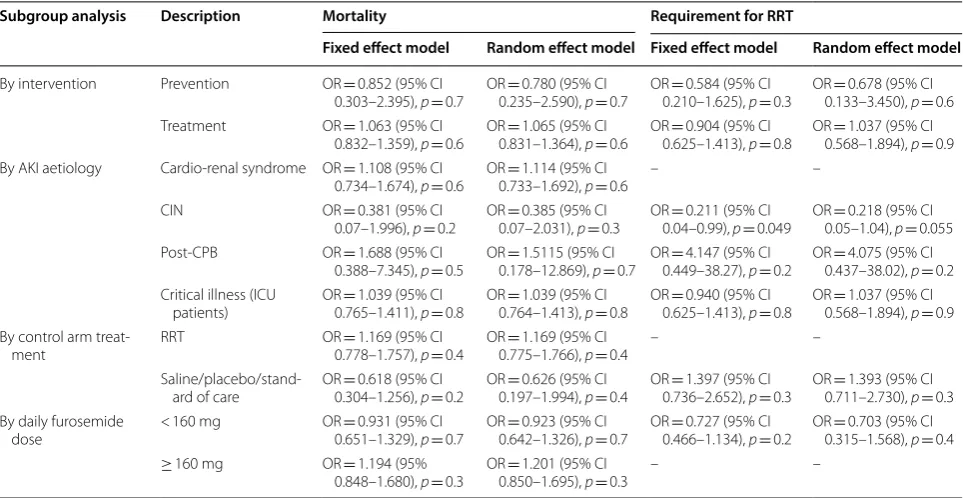
The results of additional analyses are shown in Table 3. Irrespective of intervention strategy (prevention/treat-ment), AKI origin (cardio-renal syndrome, post-car-diopulmonary bypass, critical illness), control arm comparator (RRT, saline/placebo/standard of care) and furosemide dose (< 160/≥ 160 mg), there was no effect of furosemide either on mortality or the need for RRT. How-ever, subjects who received furosemide with matched hydration in the prevention of CIN had a less frequent need for RRT (by 79%, with borderline significance).
Discussion
In this systematic review of 20 RCTs covering over 2600 patients with AKI, or at risk of AKI, we found that furo-semide had an impact neither on mortality nor on the requirement for RRT. Furosemide had no effect on the outcomes regardless of intervention strategy, AKI ori-gin, control arm comparator and furosemide dose. Only patients at risk of CIN may benefit from furosemide administration.
These observations are comparable with the avail-able data. In the most recent meta-analysis, Bove et al. [13] revealed no association between furosemide and
mortality, the need for RRT, length of hospital stay and worsening of AKI. The authors found significant improvement in survival of patients receiving furo-semide as a preventive measure (OR = 0.62; 95% CI 0.41–0.94). It needs to be underlined that they included 8 studies published over 20 years ago and compared intermittent furosemide administration (only) with any comparator (including continuous furosemide infu-sion) in subjects with or at risk of AKI. In their meta-analysis published in 2006, Ho and Sheridan [9] also found no impact of furosemide, either on mortality or on the need for RRT, regardless of the fact whether it was used to prevent acute deterioration of renal func-tion or treat acute renal failure. However, they included only 9 RCTs describing ARF patients, while only 3 of them investigated the requirement dialysis. Moreover, Bagshaw et al. [10] in 2007 described no effect of furo-semide on mortality and renal recovery. In their study, loop diuretics were associated with a shorter dura-tion of RRT (by 1.4 days), a shorter time to spontane-ous decline in serum creatinine level (by 2.1 days) and a greater increase in urine output from the baseline (OR = 2.56; 95% CI 1.35–4.85). However, they analysed 5 RCTs only, 4 of which were published over 20 years ago, and all of which were of very low quality. Last but
Table 1 Quality assessment of the included studies
H high, L low, U unknown
Study Selection bias Performance bias Detection bias Attrition bias Reporting bias Other bias Random
sequence generation
Allocation
concealment Blinding of participants and personnel
Blinding of outcome assessment
Incomplete outcome bias
Selective reporting
Badawy [16] U U H L U L H
Bagshaw [17] L L L L H L H
Barbanti [18] L H L L L L H
Bart [19] U U H L H H H
Bart [20] L L H L L L H
Berthelsen [21] L L H L H H H
Briguori [22] U U H L H L H
Cantarovich [8] U U L L L L H
Costanzo [23] U U H L U H H
Costanzo [24] U U H L U H H
Costanzo [25] L L H L H H H
Dussol [26] L L H L U H H
Grams [27] L L H L U L H
Hanna [28] U U H L H H H
Lassnigg [7] L H L L H L H
Lim [29] L U L L H H H
Mahesh [30] U U L L H H H
Marenzi [31] L U L L H H H
Marenzi [32] L L H L L H H
Table 2 Systematic review of studies on furosemide and the outcome Study Description of AKI
cause Intervention Control arm Mortality by crude data and OR (95% CI) and p value Need for RRT by crude data and OR (95% CI) and p value
Badawy [16] ADCHF Treatment HDF Study group 5/20, control group 3/20;
OR = 1.89 (95% CI 0.38–9.27); p = 0.43 NA
Bagshaw [17] AKI (ICU patients) Treatment Saline Study group 3/37, control group 5/36;
OR = 0.55 (95% CI 0.12–2.48); p = 0.43 Study group 10/37, control group 10/36; OR = 0.96 (95% CI 0.34–2.69); p = 0.94
Barbanti [18] CIN (post TAVI) Prevention Saline Study group 1/56, control group 2/56;
OR = 0.49 (95% CI 0.04–5.57); p = 0.57 NA
Bart [19] ADCHF Treatment Standard of care Study group 0/20, control group 1/20;
OR = 0.32 (95% CI 0.01–8.26); p = 0.49 NA
Bart [20] ADCHF Treatment UF Study group 13/94, control group 16/94;
OR = 0.78 (95% CI 0.35–1.73); p = 0.54 NA
Berthelsen [21] AKI (ICU patients with
fluid overload) Treatment Furosemide + CRRT Study group 6/13, control group 2/7; OR = 2.14 (95% CI 0.3–15.36); p = 0.45 NA
Briguori [22] CIN (CKD patients) Prevention Bicarbonate + NAC NA Study group 1/146, control
group 6/146; OR = 0.16 (95% CI 0.19–1.35); p = 0.09
Cantarovich [8] AKI (ICU + nephrology unit patients)
Treatment Placebo Study group 59/166, control group 50/164;
OR = 1.26 (95% CI 0.79–1.99); p = 0.33 NA
Costanzo [23] ADCHF Treatment UF Study group 11/100, control group 9/100;
OR = 1.25 (95% CI 0.5–3.14); p = 0.64 NA
Costanzo [24] ADCHF Treatment UF Study group 11/95, control group 9/94;
OR = 1.24 (95% CI 0.49–3.14); p = 0.65 NA
Costanzo [25] ADCHF Treatment UF Study group 1/114, control group 2/110;
OR = 0.48 (95% CI 0.04–5.35); p = 0.55 NA
Dussol [26] CIN (CKD patients) Prevention Saline NA Study group 0/29, control
group 0/30; OR = 1.03 (95% CI 0.2–53.83); p = 0.99 Grams [27] AKI (ALI) Treatment Low-dose furosemide Study group 64/169, control group 56/137;
OR = 0.73 (95% CI 0.42–1.26); p = 0.26
Study group 45/169, control group 44/137; OR = 0.77 (95% CI 0.47–1.26); p = 0.29
Hanna [28] ADCHF Treatment UF Study group 4/17, control group 4/19;
OR = 1.15 (95% CI 0.24–5.56); p = 0.86) NA
Lassnigg [7] AKI (post cardiac
surgery) Prevention Saline Study group 4/41, control group 1/40; OR = 4.22 (95% CI 0.45–39.5); p = 0.21 Study group 2/41, control group 0/40; OR = 5.13 (95% CI 0.24–110.2); p = 0.29 Lim [29] AKI (post cardiac
surgery) Prevention Placebo Study group 0/40, control group 0/39; OR = 0.98 (95% CI 0.19–50.4); p = 0.99 NA Mahesh [30] AKI (post cardiac
surgery) Prevention Saline Study group 1/21, control group 2/21; OR = 0.47 (95% CI 0.04–5.68); p = 0.56 Study group 1/21, control group 0/21; OR = 3.15 (95% CI 0.12–81.74); p = 0.49 Marenzi [31] CIN (CKD patients) Prevention Saline Study group 1/87, control group 3/83;
OR = 0.31 (95% CI 0.03–3.04); p = 0.31
Study group 1/87, control group 3/83; OR = 0.31 (95% CI 0.03–3.04); p = 0.31
Marenzi [32] CHF Treatment UF Study group 11/29, control group 7/27
OR = 1.75 (95% CI 0.56–5.45); p = 0.34; NA van der Voort [33] AKI (ICU patients post
CVVHF) Treatment Placebo Study group 4/36, control group 4/35; OR = 0.97 (95% CI 0.22–4.22); p = 0.96 Study group 13/36, control group 7/35; OR = 2.26 (95% CI 0.77–6.6); p = 0.14
ADCHF acute decompensated chronic heart failure, AHF acute heart failure, AKI acute kidney injury, ALI acute lung injury, ARF acute renal failure, CHF chronic heart failure, CIN contrast-induced nephropathy, CKD chronic kidney disease, CVVHF continuous venovenous hemofiltration, CRRT continuous renal replacement therapy,
HDF hemodiafiltration, ICU intensive care unit, NA non-applicable, NAC N-acetylcysteine, OR odds ratio, RCT randomised controlled trial, TAVI transcatheter aortic valve implantation, UF ultrafiltration
not least, Cheng et al. [34] in their meta-analysis of 7 RCTs, revealed comparable mortality between patients with decompensated heart failure receiving heamofil-tration or diuretics (OR = 0.95; 95% CI 0.58–1.55).
CIN. Based on 4 trials, they found the beneficial impact of furosemide use on CIN occurrence (OR = 0.31; 95% CI 0.19–0.50), as well as the need for RRT (OR = 0.19; 95% CI 0.05–0.79).
From a clinical point of view, our observations are of particular importance to practitioners as, based on experimental data, furosemide may have some detri-mental effects in patients with or at risk of AKI [5, 6, 36]. This observation plays also a key role in determin-ing the necessity of early initiation of RRT in critically ill subjects with deterioration of renal function and/or fluid overload. This is in line with the above-mentioned observations of Cheng et al. [34].
Fluid overload is frequently found in AKI patients in the ICU setting. Fluid excess of at least 10% is asso-ciated with increased mortality and morbidity, includ-ing pulmonary oedema, cardiac failure, delayed wound healing, tissue breakdown and impaired bowel function [37, 38]. Although there are several methods of evaluat-ing fluid status, most of them are fairly inaccurate [39, 40]. Moreover, the optimisation and management of
fluid therapy remains difficult [41–43]. Diuretics are considered a reasonable first-line treatment but only in responsive subjects [1]. When selecting a diuretic, clini-cians should consider evidence-based indications, possi-ble adverse effects, compatibility, pharmacokinetics and other issues of particular diuretics [36]. Diuretics are not recommended to treat AKI per se but are suggested to treat volume overload [37]. According to current data, it is still difficult to predict which patients will respond to diuretics and which patients will benefit from early initia-tion of RRT.
The severity of AKI alters both the pharmacokinet-ics and pharmacodynampharmacokinet-ics of furosemide [40], making appropriate dosing of this agent difficult. The requirement for increased dosing of loop diuretics is associated with worse AKI prognosis in patients with congestive heart failure [44] and in other groups of critically ill subjects [45]. The use of high-dose furosemide to convert oliguric to non-oliguric AKI may exacerbate injury to the kidneys (increased markers of oxidative stress), especially in hypo-volaemic patients with reduced renal perfusion [46].
Based on our results, implementation of RRT should be considered at an early stage of critical illness in patients with fluid overload, as well as those with AKI and con-comitant indications for immediate extracorporeal treat-ment [47]. The effect of RRT modality seems to be of lower importance [48, 49].
Study limitations
Firstly, we focused on trials published only in the last 20 years. All previous meta-analyses took into account data published before 1998. Although this subjec-tive decision may cause publication bias, one ought to remember that clinical practice has improved markedly: currently we do not use such high doses of furosemide due to its side effects, while the pharmacological and non-pharmacological treatment of many co-existing acute conditions in critically ill patients has changed (acute heart failure treatment, antimicrobial treatment, perioperative care, fluid therapy, etc.). In addition, an understanding of the role of RRT in critical illness has led to its earlier implementation. Secondly, almost all
data from the ICU setting compared furosemide with alternative pharmacological treatment (usually a pla-cebo). So far, no single randomised trial has reported a comparison between furosemide and any modality of RRT in this heterogeneous group of critically ill patients. We can only extrapolate data from patients with isolated AKI due to acute decompensated heart failure to cur-rent ICU practice. Thirdly, as there are newer intravenous diuretics available on the market, including torasemide and aldactone, further research is needed to investigate their effect (on its own or in combination with furosem-ide) on mortality in AKI. Finally, our observations need further investigations. In the era of numerous non-renal indications for RRT, which are usually considered in the mixed population of ICU subjects, our results may be inadequate. Moreover, the quality of previously published RCTs remains suboptimal, while the heterogeneity of the populations recruited in earlier trials constitutes an important limitation in generalising results.
Conclusions
Based on our meta-analysis of RCTs, furosemide admin-istration has no impact either on mortality or on the requirement for RRT, regardless of intervention strat-egy, AKI origin, control arm comparator and furosemide dose. However, patients at risk of CIN may benefit from furosemide treatment, if proper hydration is guaranteed beforehand. Further well-designed RCTs are needed in order to verify these findings.
Additional files
Additional file 1: Table S1. Search strategy.
Additional file 2: Table S2. Detailed characteristics of included studies. Additional file 3: Figure S1A. Funnel plot for studies on mortality. Additional file 4: Figure S1B. Funnel plot for studies on the requirement for renal replacement therapy.
Acknowledgements Not applicable.
Authors’ contributions
LJK and PFCz screened the abstracts and/or manuscripts and extracted appro-priate data. LJK performed statistical analysis. LJK and PFCz read and approved the final manuscript. All authors read and approved the final manuscript.
Funding Not applicable.
Availability of data and materials
All data generated or analysed during this study are included in this published article [and its supplementary information files].
Ethics approval and consent to participate Not applicable.
Consent for publication Not applicable.
Competing interests
The authors declare that they have no competing interests.
Received: 8 May 2019 Accepted: 12 July 2019
References
1. Kidney Disease: Improving Global Outcomes (KDIGO) Acute Kidney Injury Work Group. KDIGO clinical practice guideline for acute kidney injury. Kidney Int Suppl. 2012;2:1–138.
2. Uchino S, Bellomo R, Goldsmith D, et al. An assessment of the RIFLE criteria for acute renal failure in hospitalized patients. Crit Care Med. 2006;34:1913–7.
3. Hoste EA, Clermont G, Kersten A, et al. RIFLE criteria for acute kidney injury are associated with hospital mortality in critically ill patients: a cohort analysis. Crit Care. 2006;10:R73.
4. Hoste EA, Kellum JA. Acute renal failure in the critically ill: impact on morbidity and mortality. Contrib Nephrol. 2004;144:1–11.
5. Minuth AN, Terrell JB Jr, Suki WN. Acute renal failure: a study of the course and prognosis of 104 patients and of the role of furosemide. Am J Med Sci. 1976;271(3):317–24.
6. Mehta RL, Pascual MT, Soroko S, et al. Diuretics, mortality, and nonrecov-ery of renal function in acute renal failure. JAMA. 2002;288(20):2547–53. 7. Lassnigg A, Donner E, Grubhofer G, et al. Lack of renoprotective effects of dopamine and furosemide during cardiac surgery. J Am Soc Nephrol. 2000;11(1):97–104.
Table 3 Subgroup analyses
AKI acute kidney injury, CI confidence interval, CIN contrast-induced nephropathy, CPB cardiopulmonary bypass, ICU intensive care unit, OR odds ratio, RRT renal replacement therapy
Subgroup analysis Description Mortality Requirement for RRT
Fixed effect model Random effect model Fixed effect model Random effect model
By intervention Prevention OR = 0.852 (95% CI
0.303–2.395), p= 0.7 OR 0.235–2.590), = 0.780 (95% CI p= 0.7 OR 0.210–1.625), = 0.584 (95% CI p= 0.3 OR 0.133–3.450), = 0.678 (95% CI p= 0.6
Treatment OR = 1.063 (95% CI
0.832–1.359), p= 0.6 OR 0.831–1.364), = 1.065 (95% CI p= 0.6 OR 0.625–1.413), = 0.904 (95% CI p= 0.8 OR 0.568–1.894), = 1.037 (95% CI p= 0.9 By AKI aetiology Cardio-renal syndrome OR = 1.108 (95% CI
0.734–1.674), p= 0.6 OR 0.733–1.692), = 1.114 (95% CI p= 0.6 – –
CIN OR = 0.381 (95% CI
0.07–1.996), p= 0.2 OR 0.07–2.031), = 0.385 (95% CI p= 0.3 OR 0.04–0.99),= 0.211 (95% CI p= 0.049 OR 0.05–1.04),= 0.218 (95% CI p= 0.055
Post-CPB OR = 1.688 (95% CI
0.388–7.345), p= 0.5 OR 0.178–12.869), = 1.5115 (95% CI p= 0.7 OR 0.449–38.27), = 4.147 (95% CI p= 0.2 OR 0.437–38.02), = 4.075 (95% CI p= 0.2 Critical illness (ICU
patients) OR 0.765–1.411), = 1.039 (95% CI p= 0.8 OR 0.764–1.413), = 1.039 (95% CI p= 0.8 OR 0.625–1.413), = 0.940 (95% CI p= 0.8 OR 0.568–1.894), = 1.037 (95% CI p= 0.9 By control arm
treat-ment RRT OR 0.778–1.757), = 1.169 (95% CI p= 0.4 OR 0.775–1.766), = 1.169 (95% CI p= 0.4 – –
Saline/placebo/stand-ard of care OR 0.304–1.256), = 0.618 (95% CI p= 0.2 OR 0.197–1.994), = 0.626 (95% CI p= 0.4 OR 0.736–2.652), = 1.397 (95% CI p= 0.3 OR 0.711–2.730), = 1.393 (95% CI p= 0.3 By daily furosemide
dose < 160 mg OR 0.651–1.329), = 0.931 (95% CI p= 0.7 OR 0.642–1.326), = 0.923 (95% CI p= 0.7 OR 0.466–1.134), = 0.727 (95% CI p= 0.2 OR 0.315–1.568), = 0.703 (95% CI p= 0.4
≥ 160 mg OR = 1.194 (95%
8. Cantarovich F, Rangoonwala B, Lorenz H, et al. High-dose furosemide for established ARF: a prospective, randomized, double-blind, placebo-controlled, multicenter trial. Am J Kidney Dis. 2004;44(3):402–9. 9. Ho KM, Sheridan DJ. Meta-analysis of frusemide to prevent or treat acute
renal failure. BMJ. 2006;333:420–5.
10. Bagshaw SM, Delaney A, Haase M, et al. Loop diuretics in the manage-ment of acute renal failure: a systematic review and meta-analysis. Crit Care Resusc. 2007;9:60–8.
11. Karajala V, Mansour W, Kellum JA. Diuretics in acute kidney injury. Minerva Anestesiol. 2009;75(5):251–7.
12. Landoni G, Bove T, Székely A, et al. Reducing mortality in acute kidney injury patients: systematic review and international web-based survey. J Cardiothorac Vasc Anesth. 2013;27(6):1384–98.
13. Bove T, Belletti A, Putzu A, et al. Intermittent furosemide administration in patients with or at risk for acute kidney injury: meta-analysis of rand-omized trials. PLoS One. 2018;13(4):1–18.
14. PRISMA (Preferred Reporting Items for Systematic Reviews and Meta-Analyses) guidelines. www.prism a-state ment.org.
15. Higgins JP, Altman DG, Gøtzsche PC, et al. The Cochrane Collaboration’s tool for assessing risk of bias in randomised trials. BMJ. 2011;343:d5928. 16. Badawy SI, Fahmy A. Efficacy and cardiovascular tolerability of continuous
veno-venous hemodiafiltration in acute decompensated heart failure: a randomized comparative study. J Crit Care. 2012;27(1):7–13.
17. Bagshaw SM, Gibney RTN, Kruger P, et al. The effect of low-dose furosemide in critically ill patients with early acute kidney injury: a pilot randomized blinded controlled trial (the SPARK study). J Crit Care. 2017;42:138–46.
18. Barbanti M, Gulino S, Capranzano P, et al. Acute kidney injury with the RenalGuard System in patients undergoing transcatheter aortic valve replacement: the PROTECT-TAVI Trial (PROphylactic effecT of furosEm-ide-induCed diuresis with matched isotonic intravenous hydraTion in Transcatheter Aortic Valve Implantation). JACC Cardiovasc Interv. 2015;8(12):1595–604.
19. Bart BA, Boyle A, Bank AJ, et al. Ultrafiltration versus usual care for hospi-talized patients with heart failure: the Relief for Acutely Fluid-Overloaded Patients With Decompensated Congestive Heart Failure (RAPID-CHF) trial. J Am Coll Cardiol. 2005;46(11):2043–6.
20. Bart BA, Goldsmith SR, Lee KL, et al. Ultrafiltration in decompen-sated heart failure with cardiorenal syndrome. N Engl J Med. 2012;367(24):2296–304.
21. Berthelsen RE, Perner A, Jensen AK, et al. Forced fluid removal in intensive care patients with acute kidney injury: the randomised FFAKI feasibility trial. Acta Anaesthesiol Scand. 2018;62(7):936–44.
22. Briguori C, Visconti G, Focaccio A, et al. Renal Insufficiency After Contrast Media Administration Trial II (REMEDIAL II): renalGuard System in high-risk patients for contrast-induced acute kidney injury. Circulation. 2011;124(11):1260–9.
23. Costanzo MR, Johannes RS, Pine M, et al. The safety of intravenous diuretics alone versus diuretics plus parenteral vasoactive therapies in hospitalized patients with acutely decompensated heart failure: a propensity score and instrumental variable analysis using the Acutely Decompensated Heart Failure National Registry (ADHERE) database. Am Heart J. 2007;154(2):267–77.
24. Costanzo MR, Saltzberg MT, Jessup M, et al. Ultrafiltration is associ-ated with fewer rehospitalizations than continuous diuretic infusion in patients with decompensated heart failure: results from UNLOAD. J Card Fail. 2010;16(4):277–84.
25. Costanzo MR, Negoianu D, Jaski BE, et al. Aquapheresis versus intra-venous diuretics and hospitalizations for heart failure. JACC Heart Fail. 2016;4(2):95–105.
26. Dussol B, Morange S, Loundoun A, et al. A randomized trial of saline hydration to prevent contrast nephropathy in chronic renal failure patients. Nephrol Dial Transplant. 2006;21(8):2120–6.
27. Grams ME, Estrella MM, Coresh J, et al. Fluid balance, diuretic use, and mortality in acute kidney injury. Clin J Am Soc Nephrol. 2011;6(5):966–73. 28. Hanna MA, Tang WH, Teo BW, et al. Extracorporeal ultrafiltration vs.
conventional diuretic therapy in advanced decompensated heart failure. Congest Heart Fail. 2012;18(1):54–63.
29. Lim E, Ali ZA, Attaran R, et al. Evaluating routine diuretics after coronary surgery: a prospective randomized controlled trial. Ann Thorac Surg. 2002;73(1):153–5.
30. Mahesh B, Yim B, Robson D, et al. Does furosemide prevent renal dysfunc-tion in high-risk cardiac surgical patients? Results of a double-blinded prospective randomised trial. Eur J Cardiothorac Surg. 2008;33(3):370–6. 31. Marenzi G, Ferrari C, Marana I, et al. Prevention of contrast
nephropa-thy by furosemide with matched hydration: the MYTHOS (induced diuresis with matched hydration compared to standard hydration for contrast induced nephropathy prevention) trial. JACC Cardiovasc Interv. 2012;5(1):90–7.
32. Marenzi G, Muratori M, Cosentino ER, et al. Continuous ultrafiltration for congestive heart failure: the CUORE trial. J Card Fail. 2014;20(5):1–9. 33. van der Voort PH, Boerma EC, Koopmans M, et al. Furosemide does not
improve renal recovery after hemofiltration for acute renal failure in critically ill patients: a double blind randomized controlled trial. Crit Care Med. 2009;37(2):533–8.
34. Cheng Z, Wang L, Hu S. Efficacy and safety of ultrafiltration in decom-pensated heart failure patients with renal insufficiency. Int Heart J. 2015;56:319–23.
35. Putzu A, Boscolo Berto M, Belletti A, et al. Prevention of contrast-induced acute kidney injury by furosemide with matched hydration in patients undergoing interventional procedures: a systematic review and meta-analysis of randomized trials. JACC Cardiovasc Interv. 2017;10(4):355–63. 36. Krzych Ł, Czempik P. Loop diuretics and mortality in patients with acute
kidney injury. In: Landoni G, Pisano A, Zangrillo A, Bellomo R, editors. Reducing mortality in acute kidney injury. Bern: Springer; 2016. p. 175–84. 37. Joannidis M, Druml W, Forni LG, et al. Prevention of acute kidney injury
and protection of renal function in the intensive care unit: update 2017: expert opinion of the Working Group on Prevention, AKI section, European Society of Intensive Care Medicine. Intensive Care Med. 2017;43(6):730–49.
38. Malbrain ML, Marik PE, Witters I, et al. Fluid overload, de-resuscitation, and outcomes in critically ill or injured patients: a systematic review with suggestions for clinical practice. Anaesthesiol Intensive Ther. 2014;46(5):361–80.
39. Claure-Del Granado R, Mehta RL. Fluid overload in the ICU: evaluation and management. BMC Nephrol. 2016;17(1):109.
40. Silbert BI, Ho KM, Lipman J, et al. Determinants of urinary output response to IV furosemide in acute kidney injury: a pharmacokinetic/ pharmacodynamic study. Crit Care Med. 2016;44(10):923–9. 41. Malbrain ML, Van Regenmortel N, Owczuk R. The debate on fluid
management and haemodynamic monitoring continues: between Scylla and Charybdis, or faith and evidence. Anaesthesiol Intensive Ther. 2014;46(5):313–8.
42. Hahn RG, He R, Li Y. Central venous pressure as an adjunct to flow-guided volume optimisation after induction of general anaesthesia. Anaesthesiol Intensive Ther. 2016;48(2):110–5.
43. van der Mullen J, Wise R, Vermeulen G, et al. Assessment of hypovolaemia in the critically ill. Anaesthesiol Intensive Ther. 2018;50(2):141–9. 44. Ricci F, Ramírez T, Marmorato R, et al. Predisposing factors for acute
kid-ney injury in Hispanic patients treated with diuretics for decompensated heart failure. P R Health Sci J. 2013;32(2):63–7.
45. de Louw EJ, Sun PO, Lee J, et al. Increased incidence of diuretic use in critically ill obese patients. J Crit Care. 2015;30(3):619–23.
46. Silbert BI, Ho KM, Lipman J, et al. Does furosemide increase oxidative stress in acute kidney injury? Antioxid Redox Signal. 2017;26(5):221–6. 47. Shiao CC, Huang TM, Spapen HD, et al. Optimal timing of renal
replace-ment therapy initiation in acute kidney injury: the elephant felt by the blindmen? Crit Care. 2017;21(1):146.
48. Czempik P, Cieśla D, Knapik P, et al. Outcomes of patients with acute kidney injury with regard to time of initiation and modality of renal replacement therapy—first data from the Silesian Registry of Intensive Care Units. Kardiochir Torakochirurgia Pol. 2016;13(2):122–9.
49. Nash DM, Przech S, Wald R, et al. Systematic review and meta-analysis of renal replacement therapy modalities for acute kidney injury in the intensive care unit. J Crit Care. 2017;41:138–44.
Publisher’s Note