Original Research Article.
459 | P a g e Int J Med Res Prof.2018 Jan; 4(1); 459-64. www.ijmrp.com
Assessment of Knowledge and Awareness of Ocular Allergy
Among Undergraduate Students, University of Tabuk,
Tabuk City, Saudi Arabia
Reema Saleh Al-Ghofaili
1, Wareef Abdullah Al-Lahim
1, Hani ALBalawi
21Medical Intern, College of Medicine, University of Tabuk, Tabuk, Saudi Arabia. 2Assistant Professor of Ophthalmology, University of Tabuk, Tabuk, Saudi Arabia.
ABSTRACT
Background: Proper knowledge and awareness of university students about ocular allergy may help in decreasing the illness duration or even prevent it.
Objectives: To assess the knowledge and awareness among
University of Tabuk students.
Material and Method: This descriptive cross-sectional study was conducted at the University of Tabuk, Tabuk city, Saudi Arabia among a random sample of undergraduate students from all faculties. Data were collected using self-administered online questionnaire established electronically on Google documents.
Results: The study included 382 students. Their age ranged between 18 and 48 years with a mean ±SD of 21.2±2.5 years. They were distributed between Medical/paramedical colleges (28%), scientific colleges (33.5%) and theoretical colleges (38.5%). History of ocular allergy was reported by 20.2% of them. One hundred fifteen students (30.1%) have heard about ocular allergy. The main source of their information regarding ocular allergy was the internet (50.4%). About two-thirds of the students knew correctly the eye structures involved in ocular allergy (67.8%) and that the best way to prevent ocular allergy is to avoid the source of trigger (61%). On the other hand, minority of them (11.3%) knew the medications used for treating ocular allergy. Overall, sufficient knowledge regarding
ocular allergy was observed among 19.1% of the participants. Older students and those of sixth academic level were more knowledgeable about ocular allergy compared to their counterparts.
Conclusion: The level of awareness and knowledge of ocular allergy was insufficient among Tabuk University students in the Kingdom of Saudi Arabia. Therefore, great effort should be made by authorized persons in improving awareness and knowledge regarding this relatively common community problem in order to reduce its impact on the quality of life and academic achievement of students.
Keywords: Ocular, Allergy, University, Students, Knowledge.
*Correspondence to:
Reema Saleh Al-Ghofaili,
Medical Intern, College of Medicine, University of Tabuk, Tabuk, Saudi Arabia. Article History:
Received: 11-12-2017, Revised: 02-01-2018, Accepted: 29-01-2018 Access this article online
Website: www.ijmrp.com
Quick Response code
DOI:
10.21276/ijmrp.2018.4.1.095
INTRODUCTION
Ocular allergy (Allergic Conjunctivitis AC) is a spectrum of disorders that involve abnormal inflammatory response of the conjunctiva to ordinarily harmless antigens.1 Major types of AC include seasonal allergic conjunctivitis (SAC), perennial allergic conjunctivitis (PAC) and giant papillary conjunctivitis (GPC) which considered to be non-sight threatening. Less common but more severe types are vernal keratoconjunctivitis (VKC) and atopic keratoconjunctivitis (AKC) as they may jeopardize the vision by causing corneal ulcers and scarring.1 Watery eyes and itching correspond for the most frequent complaints of AC (88%), followed by redness (78%), soreness (75%), swelling (72%) and stinging (65%).1 Globally several studies have estimated the prevalence of ocular allergies to be 5% to 40% of the overall population.1,2 However, AC prevalence is believed to be higher as Amir A et al. reported that only 10% of sufferers seek medical
MATERIALS AND METHODS
This study was conducted at the University of Tabuk, Tabuk city, Saudi Arabia. A random sample of undergraduate students from all faculties was invited to participate in the study. It was carried out as a descriptive cross-sectional, questionnaire-based study. A validated self-administered online questionnaire was distributed among undergraduate students. Multiple choice and true-false
questions were framed to obtain information about respondents’
knowledge and awareness about ocular allergy along with their demographic characteristics such as age and gender, year of study, and college major.
Based on a previous study the prevalence of ocular allergy has reached up to 40%4, and at 95% level of confidence with an assumed precession of 5%, the minimum sample size required is 369 Subjects.
Data were collected using self-administered online questionnaire established electronically on Google documents.6 The questionnaire was anonymous targeting currently enrolled students from the various colleges of the university. The link was distributed with the help of the representative of each college on social networks. The script was presented in Arabic for easy understanding and convenience of the study participants. It took about 4 to 6 minutes.
Coding book was prepared for entering the data. Variables such as gender were scaled using the binary options zero and one. The continuous values such as age were identified as a number and unit. Variables that are impossible, incorrect, irrelevant or outlier (e.g., an age of 250) were identified and corrected prior to initiation of statistical analysis.
Respondents were identified and demographic data such as (age, gender, year of study, college major) and health history including chronic illnesses, eye diseases, personal or family history of allergy will be gathered in the first part.
The second part consisted of 22 items aiming to measure the awareness and knowledge of ocular allergy. Having heard of
ocular allergy was defined as “awareness” and having some
understanding of ocular allergy were defined as knowledge. Right
answers were assigned a score of “1” whereas wrong or missed
answered were assigned a score of “0”. The total knowledge
score was computed by adding scores. The knowledge percentage score was estimated. Students scored below 60%
were considered having “insufficient knowledge” whereas those
scored 60% and more were considered having “sufficient
knowledge. Continuous variables such as age were summarized in terms of the mean and standard deviation. While the categorical variables such as gender, college major were summarized and reported regarding the frequency distribution. Chi-square test was utilized to test for the association between categorical level of knowledge and possible associated factors. Statistical Package for Social Sciences software (SPSS), version 22 was used for data entry and statistical analysis and a p-value less than 0.05 was considered for statistical significance level.
RESULTS
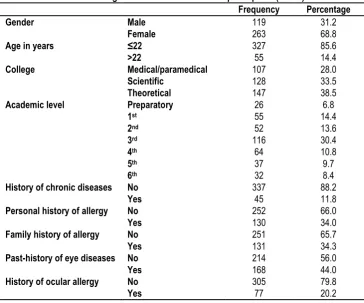
The study included 382 students. Their age ranged between 18 and 48 years with a mean ±SD of 21.2±2.5 years. Their background characteristics are summarized in table 1. Almost two-thirds (68.8%) were females. They were distributed between Medical/paramedical colleges (28%), scientific colleges (33.5%) and theoretical colleges (38.5%). About one-third of them (30.4%) were recruited from 4th academic level. Only 11.8% had a history of chronic diseases. Approaching one-third of them had a personal history (34%) and/or family history (34.3%) of allergy. Past-history of eye diseases was reported by 44% of the participants whereas a history of ocular allergy was reported by 20.2% of them.
Table 1: Background characteristics of the participants (n=382)
Frequency Percentage
Gender Male
Female
119 263
31.2 68.8
Age in years ≤22
>22 327 55 85.6 14.4
College Medical/paramedical
Scientific Theoretical
107 128 147
28.0 33.5 38.5
Academic level Preparatory
1st
2nd
3rd
4th
5th
6th
26 55 52 116
64 37 32
6.8 14.4 13.6 30.4 10.8 9.7 8.4
History of chronic diseases No
Yes
337 45
88.2 11.8
Personal history of allergy No
Yes
252 130
66.0 34.0
Family history of allergy No
Yes
251 131
65.7 34.3
Past-history of eye diseases No
Yes 214 168 56.0 44.0
History of ocular allergy No
Yes
305 77
Table 2: Responses of the participants to knowledge questions about ocular allergy (n=382)
Questions Right answer
No. %
▪ Does ocular allergy affect millions of people worldwide each year?YES 176 46.1
▪ Could ocular allergy lead to visual loss?YES 184 48.2
▪ Ocular allergy is one of the most common eye conditions encountered by General Practitioners as well as eye care practitioners TRUE
125 32.7
▪ Majority of people who have ocular allergy experience itching as the primary source of
discomfortTRUE 268 70.2
▪ What is your understanding of ocular allergy?Inflammation of the eye in response to harmless foreign substance/Discomfort and pains within the eye
294 77.0
▪ Eye structures involved in ocular allergy includeConjunctiva, cornea, limbus, eyelid 259 67.8
▪ Are ocular allergies transmitted from person to person?NO 147 38.5
▪ What is the best way to prevent ocular allergy? Avoid the source of triggers 233 61.0
▪ Do you know substances that trigger allergies in the eye?YES 119 31.2
▪ Do you know of medications used for treating ocular allergy?YES 43 11.3
▪ Some eye allergies are inheritedTRUE 141 36.9
▪ Smoking is a risk factor for ocular allergyTRUE 116 30.4
▪ Knowledge of signs and symptoms of ocular allergy Redness, itching, discharge, blurred vision, photophobia and tearing
≤3 >3 204 178 53.4 46.6 ▪ Knowledge of the forms of ocular allergySeasonal, vernal, perennial and atopic
conjunctivitis ≤2 >2 317 65 83.0 17.0
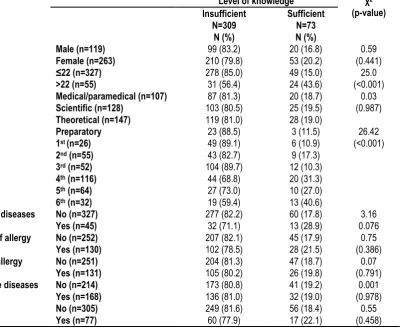
Table 3: Factors associated with knowledge of Tabuk University students regarding ocular allergy.
Level of knowledge χ2
(p-value) Insufficient N=309 N (%) Sufficient N=73 N (%)
Gender Male (n=119)
Female (n=263) 99 (83.2) 210 (79.8) 20 (16.8) 53 (20.2) 0.59 (0.441)
Age in years ≤22 (n=327)
>22 (n=55) 278 (85.0) 31 (56.4) 49 (15.0) 24 (43.6) (<0.001) 25.0
College Medical/paramedical (n=107)
Scientific (n=128) Theoretical (n=147) 87 (81.3) 103 (80.5) 119 (81.0) 20 (18.7) 25 (19.5) 28 (19.0) 0.03 (0.987)
Academic level Preparatory
1st (n=26)
2nd (n=55)
3rd (n=52)
4th (n=116)
5th (n=64)
6th (n=32)
23 (88.5) 49 (89.1) 43 (82.7) 104 (89.7) 44 (68.8) 27 (73.0) 19 (59.4) 3 (11.5) 6 (10.9) 9 (17.3) 12 (10.3) 20 (31.3) 10 (27.0) 13 (40.6) 26.42 (<0.001)
History of chronic diseases No (n=327)
Yes (n=45) 277 (82.2) 32 (71.1) 60 (17.8) 13 (28.9) 3.16 0.076
Personal history of allergy No (n=252)
Yes (n=130) 207 (82.1) 102 (78.5) 45 (17.9) 28 (21.5) (0.386) 0.75
Family history of allergy No (n=251)
Yes (n=131) 204 (81.3) 105 (80.2) 47 (18.7) 26 (19.8) 0.07 (0.791)
Past-history of eye diseases No (n=214)
Yes (n=168) 173 (80.8) 136 (81.0) 41 (19.2) 32 (19.0) 0.001 (0.978) History of allergic
conjunctivitis No (n=305) Yes (n=77) 249 (81.6) 60 (77.9) 56 (18.4) 17 (22.1) 0.55 (0.458)
One hundred fifteen students (30.1%) have heard about ocular allergy as illustrated in figure 1. The main source of their information regarding ocular allergy was the internet (50.4%), followed by friends/relatives (42.6%), mass media (22.6%), school curriculum (18.3%) and ophthalmologist (17.4%). (Figure 2)
ocular allergy (67.8%) and that the best way to prevent ocular allergy is to avoid the source of trigger (61%). On the other hand, minority of them (11.3%) knew the medications used for treating ocular allergy.
More than half of the participants (53.4%) knew three or less of the main signs and symptoms of ocular allergy and only 17% knew more than two of the forms of ocular allergy. Overall, sufficient knowledge regarding ocular allergy was observed among 19.1% of the participants as displayed in figure 3.
From table 3, it is seen that older students (aged over 22 years) were more knowledgeable about ocular allergy compared to younger students (43.6% versus 15%) had sufficient knowledge. This difference was statistically significant, p<0.001. Similarly, students of the sixth academic level were more knowledgeable about ocular allergy compared to those of preparatory or 1st year level (40.6% versus 11.5% and 10.9%) had sufficient knowledge, respectively, p<0.001. Other studied factors were not significantly associated with students` knowledge regarding ocular allergy.
Figure 1: Hearing about ocular allergy among Tabuk University students, Saudi Arabia
Figure 2: Source of information about ocular allergy among Tabuk University students, Saudi Arabia
Figure 3: Overall knowledge of the Tabuk University students regarding ocular allergy. 115, 30.1%
267, 69.9%
Yes No
0 10 20 30 40 50 60
73
309
SufficientDISCUSSION
In the last few decades, there is an apparent increase in allergic
diseases with a considerable percentage of the world’s population
suffering ocular allergies.2 Sufficient knowledge and awareness of the public about ocular allergy may help in reducing the illness burden. Therefore, this study was carried out to assess the knowledge and awareness among University of Tabuk students, who can disseminate the knowledge to the whole community. This study included students from different colleges in the university; medical, scientific and theoretical colleges. However, there was no difference between them regarding knowledge of different aspects of ocular allergy, although it was hypothesized that students of medical colleges would be more knowledgeable.5 This could be attributed to the fact that ocular allergy is not considered a top priority eye problem and therefore has not received sufficient attention as glaucoma and cataract, even among medical students despite its adverse symptoms and complications.7
In the present study, 77% of the students could correctly define ocular allergy as inflammation of the eye in response to harmless foreign substance/ with discomfort and pains within the eye. In a similar study carried out in Ghana among public university students, 55.9 % of students knew the correct definition of ocular allergy.5
Regarding main signs and symptoms of ocular allergy such as redness, itching, discharge, photophobia, blurred vision and tearing, less than half of the students (46.6%) could recognize more than three of them. Most of the students in this study (70.2%) recognized that majority of people who have ocular allergy experienced itching as the primary source of discomfort. In a study conducted in Ghana5, itching was the most recognized symptom whereas photophobia was the least recognized one. It has been documented that itching is typical of ocular allergy and diagnosis without the ocular itching is always problematic.8-10 In the present study, less than one-third (31.2%) of the students knew the agents which trigger the allergic reaction. In a study carried out in Ghana5, a higher percentage was reported (42.1%). This finding indicates that the knowledge of the students is suboptimal as knowledge of allergy triggers is the key element in prevention and control of ocular allergy.11,12 However, 61% of them knew that the best way to prevent ocular allergy is avoiding the source of allergy triggers. A close figure has been reported from Ghana (55.9%).5
It has been reported that the ideal non-pharmacological approach to prevention of allergic of eye disease is the avoidance of allergens, despite the challenges it causes due to the lack of consistence on the distributions and density of these triggers among the population.13
In the present study, a minority of the participants (11.3%) could identify drugs used in the treatment of ocular allergy and were mainly from medical colleges. Slightly higher figure (21.3%) has been reported in a study carried out in Ghana among University students.5
In this study, the main source of the students` information regarding ocular allergy was the internet (50.4%), followed by friends/relatives (42.6%), mass media (22.6%), school curriculum (18.3%) and ophthalmologist (17.4%). In a study conducted in Ghana5, media and the Internet were the main sources of information about ocular allergy, followed by information from eye
care providers, and finally family and friends. There is a need to create a formal educational program at both the University and the primary care levels to increase awareness and knowledge of the university students and the general public about the ocular allergy. It has been reported from a study carried out in Ghana that people who obtain their information from media and internet expressed a lower level of knowledge regarding ocular allergy compared to those obtained their information from the ophthalmologist.5 In the present study, since a great majority of the study subjects reported multiple sources of information, we could not compare individual sources of information.
This study has some limitations. Among them is the utilization of a self-administered questionnaire which subjected to bias. Second, a collection of data through an online approach which could affect the generalizability of results. The third is the cross-sectional design of the study which proves only association and not causality. However, the study has some strength such as the sufficient sample size and the inclusion of students from different colleges.
From the present study, it can be concluded that the level of awareness and knowledge of ocular allergy was insufficient among Tabuk University students in the Kingdom of Saudi Arabia, with no significant difference between medical and non-medical colleges. Therefore, great effort should be made by authorized persons in improving awareness and knowledge regarding this relatively common community problem in order to reduce its impact on the quality of life and academic achievement of students.
ACKNOWLEDGEMENT
We gratefully acknowledge the cooperation of University of Tabuk students, whose help in answering the questionnaire aided in the completion of the paper.
REFERENCES
1. Katelaris CH. Ocular allergy in the Asia Pacific region. Asia Pacific Allergy. 2011;1(3):108-114.
doi:10.5415/apallergy.2011.1.3.108.
2. Azari AA, Barney NP. Conjunctivitis: A Systematic Review of Diagnosis and Treatment. JAMA : the journal of the American Medical Association. 2013;310(16):1721-1729.
doi:10.1001/jama.2013.280318.
3. Petricek, I. Prost, M. Popova, A. The differential diagnosis of red eye: a survey of medical practitioners from Eastern Europe and the Middle East. Ophthalmologica. 2006;220(4): 229-37. doi: 10.1159/2006.06.21 doi: 10.1159/2006.06.21
4. Carr W, Schaeffer J, Donnenfeld E. Treating allergic conjunctivitis: A once-daily medication that provides 24-hour symptom relief. Allergy & Rhinology. 2016;7(2):e107-e114. doi:10.2500/ar.2016.7.0158. doi:10.2500/ar.2016.7.0158. 5. Kyei S, Tettey B, Asiedu K, Awuah A. Knowledge and awareness of ocular allergy among undergraduate students of public universities in Ghana. BMC Ophthalmology. 2016;16:190. doi:10.1186/s12886-016-0366-2.
6. Questionnaire: Available at: https://docs.google.com/forms/d/e/ 1FAIpQLSdzc9zUOgewo7XGs11Wanbi1bMzbJauQInMeEMpadZ GpC-VQg/viewform
8. Abokyi S, Koffuor GA, Ntodie M, Kyei S, Gyanfosu L. Epidemiological profile and pharmacological management of allergic conjunctivitis: A study in Ghana. Int J Pharm Biomed Res. 2012;3:195–201.
9. Rosario N, Bielory L. Epidemiology of allergic conjunctivitis. Curr Opin Allergy Clin Immunol. 2011;11:471–6.
10. Bielory L, Dinowitz M, Rescigno R. Ocular allergic diseases: Differential diagnosis, examination techniques and testing. J Cutan Ocular Toxicol. 2002;21:329–51.
11. Foster A, Resnikoff S. The impact of Vision 2020 on global blindness. Eye. 2005;19:1133–5.
12. Amoah AS, Obeng BB, Larbi IA, Versteeg SA, Aryeetey Y, Akkerdaas JH, et al. Peanut-specific IgE antibodies in asymptomatic Ghanaian children possibly caused by carbohydrate determinant cross-reactivity. J Allergy Clin Immunol. 2013;132:639–47.
13. Bielory L. Ocular allergy overview. Immunol Allergy Clin North Am. 2008;28:1–23.
Source of Support: Nil.
Conflict of Interest: None Declared.
Copyright: © the author(s) and publisher. IJMRP is an official publication of Ibn Sina Academy of Medieval Medicine & Sciences, registered in 2001 under Indian Trusts Act, 1882. This is an open access article distributed under the terms of the Creative Commons Attribution Non-commercial License, which permits unrestricted non-commercial use, distribution, and reproduction in any medium, provided the original work is properly cited.