Margin Adaptive Resource Allocation for
Multi–user OFDM Systems by Particle Swarm
Optimization and Differential Evolution
Imran Ahmed
†, Sonia Sadeque
††, and Suraiya Pervin
††††Northern University Bangladesh, Dhaka, Bangladesh††Simon Fraser University, Burnaby, Canada †††University of Dhaka, Dhaka, Bangladesh
E-mail: [email protected], [email protected]
Abstract— Like many wireless systems, Orthogonal Frequency Division Multiplexing (OFDM) needs proper allocation of limited resources such as total transmit power and available frequency bandwidth among the users to meet their service requirements. In this paper, different versions of two evolutionary approaches, Differential Evolution (DE) and Particle Swarm Optimization (PSO) have been applied for adaptive sub–carrier and bit allocations to minimize the overall transmit power of a multi– user OFDM system. Each user will be assigned a number of sub–carriers with at least one minimum sub–carrier even at the worst case. Then the number of bits and the transmit power level for each user are calculated to obtain the optimum requirements. Simulation results show that both the approaches outperform the conventional static and many other dynamic resource allocation schemes in multi–user scenario. The results also reveal that the employed two different schemes of DE show better performances than the original and modified versions of PSO.
I. INTRODUCTION
Being very efficient in combating Inter Symbol Interference (ISI) and in the use of available bandwidth, Orthogonal Fre-quency Division Multiplexing (OFDM) is considered as one of the most promising transmission techniques in wideband wireless systems [1], [2]. Multi–user OFDM allows multiple users to share the sub–carriers in each OFDM frame [3]. Allo-cation of sub–carriers to the users with the best signal–to–noise ratio (SNR) improves the performance of the system. The system performance can be further enhanced by employing resource allocation techniques including number of bits and sub–carrier allocation for each user in response to the channel state information (CSI). Two classes of resource allocation schemes exist in OFDM systems: fixed resource allocation [3] and dynamic resource allocation [4],[5],[6],[7]. Fixed resource allocation schemes, such as time division multiple access (TDMA) and frequency division multiple access (FDMA), as-sign an independent dimension, e.g. time slot or sub–channel, to each user. A fixed resource allocation scheme is not optimal since the scheme is fixed regardless of the current channel condition. On the other hand, dynamic resource allocation allocates a dimension adaptively to the users based on their channel gains. Due to the time–varying nature of the wireless channel, dynamic resource allocation makes full use of multi– user diversity to achieve higher performance. Two classes of optimization techniques have been proposed in the dynamic multi–user OFDM literature: margin adaptive (MA) [7] and rate adaptive (RA) [6]. The objective of MA technique is to achieve the minimum overall transmit power given the constraints on the users’ data rate and bit error rate (BER). On the other hand, the objective of RA technique is to maximize total throughput, where total transmit power and BER are
assumed to be constant. These optimization problems are nonlinear and hence computationally intensive to solve. In this paper, although we confine ourselves within MA resource allocation, it can be easily extended for RA schmes.
In [7], Wong et. al. proposed an iterative searching algorithm that applies Lagrangian relaxation for optimum multi–user sub–carrier, bit and power allocation. The algorithm is close to the lower bound of power requirement with high and complex computation. The algorithm proposed in [8], however, over–simplifies the sub–carrier allocation but could not fully utilize the multi–user diversity. In [5], an iterated water-filling algorithm is proposed; the algorithm can acquire similar per-formance as Wong’s algorithm and avoids the computational complexity. Y. B. Reddy et. al. introduced Genetic Algorithm (GA) in resource allocation with significant improvements [9]. [10] applies Particle Swarm Optimization (PSO) in allocating multi–user OFDM resources with some improvements. Q. Feng et. al. worked on differential evolution (DE) algorithm for resource allocation of OFDM system and showed some significant improvements [11].
In this paper, PSO [12], [13], [14] has been modified and applied to minimize the total transmit power to allocate sub– carriers and number of bits for multi–user OFDM systems. The modifications are done in such a way, so that it overcomes the shortcomings of original PSO. In addition, two versions of DE [15], [16] have been deployed as optimizers, so that they can search over diversified spaces more efficiently and quickly. The functions of the considered two types of DE have been compared with those of the original and modified versions of PSO. The overall performances of modified PSO (MPSO) and DE methods are further compared with some of the existing fixed and dynamic sub–carrier and bit allocation schemes. We show that, the performance and convergence of the conventional PSO have been improved by introducing dynamic inertia weight and by inserting generation index in position update equation, respectively. Simulation results show that, for higher number of users, two types of DE algorithm outperform the considered existing algorithms and even the MPSO, but take longer time for convergence.
II. SYSTEMMODEL
In this paper, we consider a multi–user OFDM system havingKusers with(k= 1,2, ..., K)andN sub–carriers with
(n= 1,2, ..., N). The resource allocator at base station allots
a subset of N sub–carriers to each user and determines the number of bits per each assigned sub–carrier on downlink transmission. bn,k ∈ {0,1,2, ..., BM} signifies the number of bits fornth sub–carrier andkth user, whereBM denotes the maximum number of information bits that can be transmitted associated with each sub–carrier for a particular modulation scheme. The allocator is assumed to have perfect instantaneous CSI. The channel is modeled as slow–varying Rayleigh faded and its components have independent identically distributed (i.i.d) complex values with zero–mean and unit variance. Let hn,k represents the magnitude of instantaneous channel gain of nth sub–carrier and kth user. Additive white Gaussian noise (AWGN) is considered in the system with elements of complex–value, zero–mean and unit variance. The required transmission power of nth sub–carrier and kth user at a specified BER, Pb forbn,k bits is given by [4],
pn,k=
f(bn,k)
h2
n,k
(1)
where
f(bn,k) =
N0
3
Q−1
P
b 4
2
2bn,k−1. (2)
Here N0 denotes the noise power spectral density and Q−1
denotes the inverseQfunction whereQ(x) = √1
2π
∞ R
x
e−t2
2dt.
In multi–user scenario, not more than one user is considered to share a particular sub–carrier. Mathematically it is expressed as
λn,k=
1, bn,k6= 0
0, bn,k= 0 (3)
The required total transmission power, P can be written as follows [4]
P =
N
X
n=1 K
X
k=1
f(bn,k)
h2
n,k
× λn,k. (4)
The sub–carrier and bit allocation problem for minimizing the total transmit power at a constant Pb can be formulated as
arg min bn,k,hn,k
N
X
n=1 K
X
k=1
f(bn,k)
h2
n,k
× λn,k (5)
subject to N
P
n=1 K
P
k=1
λn,k=N forbn,k ∈ {0,1,2, ..., BM}and
Rk =
N
P
n=1
bn,k for k = 1,2, ..., K.Rk >0 needs to satisfy
for practical realization of allocation. Moreover, it should be noted that, while satisfying (5), transmit power of each user,pk can also be allocated along other resources (which is termed as power allocation in the literature). Although we confine ourselves within sub–carrier and bit allocations in this paper, it can easily be extended for power allocation by satisfying MA optimization.
III. APPLICATION OFMPSOANDDEAS OPTIMIZERS A. MPSO
Like other evolutionary computation techniques, PSO is a population–based search algorithm and is initialized with a population of random solutions, called particles [12]. Each particle in PSO is also associated with a velocity. Particles fly through the search space with velocities which are dynamically adjusted according to their historical behaviors. Therefore, the particles have a tendency to fly towards the better and better search area over the course of search process [13], [14]. The original PSO algorithm is discovered through simplified social model simulation. The PSO algorithm works on the social behavior of particles in the swarm. Therefore, it finds the global best solution by simply adjusting the trajectory of each individual towards its own best location and towards the best particle of the entire swarm at each time step (generation).
Optimization by MPSO requires position and velocity val-ues as initial population (swarm) set [12]. For defining the problem of multi–user OFDM systems, we need to obtain position and velocity matrices as initial population (swarm) sets. To this end, we form a channel matrix, H of K rows andN columns where each of the elements denotes channel gain for a definite user using a definite sub–carrier. From the channel gains, we form a bit matrix, B of same size of H
according to water–filling algorithm [4]. According toH and
B, we form velocity and position matrices withM rows andN columns each, whereM denotes the size of initial population (swarm) for each sub–carrier. The position matrix consists of user indices. The original PSO updates the components of position and velocity matrices (xp,q and vp,q, respectively) from ith generation to (i+ 1)th generation according to the following [12]
vi+1
p,q =wv i
p,q+c1r1i ζp,qi −x i p,q
+c2ri2 ψqi−x i p,q
(6)
xi+1
p,q =xip,q+vp,qi . (7)
for p ∈ {1,2,· · ·, M}, q ∈ {1,2,· · ·, N}. Here, w is the inertia weight,c1 andc2are positive constants, r1i andr2i are
two random variables within the range [0 : 1]. ζi
p,q and ψiq are the local and global optimum values, respectively for a specific iteration index,i. For every generation, we verify (5). After a number of generations, we obtain the optimum result for a definite arrangement of user index from which we can obtain sub–carrier and bit arrangements.
It was observed from [10] that, in comparison to GA, PSO needs more iterations to converge to the optimum value. In (7), we see that the previous position has been added with the newly obtained velocity to get the new position which reveals the mismatch of dimensions. To give an idea of timing information to the update equations, we introduced the generation index in the position update equation, which gives the following expression
xip,q+1 =x
i p,q+i′v
i
p,q. (8)
change of inertia weight helps towards better results [14]. The inertia weight, w in (6), is replaced by the dynamic inertia weightwi, which can be defined as follows
wi=w
h−i′ws (9)
where ws = (wh−wl)/wr. Here wh, wl and wr define maximum, minimum and incremental rate of inertia weight.
B. DE
The DE algorithm is a population based algorithm like GA using the similar operations like crossover, mutation and selection. The main difference in constructing better solutions is that GA relies on crossover while DE relies on mutation operation. This main operation is based on the differences of randomly sampled pairs of solutions in the population and it is defined as mutation. Based on the mutation, we define two different schemes of DE algorithm as DE–1 (DE/rand/1) and DE–2 (DE/rand/1 with per-vector-dither)[17]. Both of the schemes require three control parameters: weight factor
(F), crossover rate (CR), and population size (NP). The initially generated populations are moved towards the optimum solution by carrying out mutation, crossover and selection operation for each generation.
Optimization by DE–1 and DE–2 requires 3 random matri-ces as initial populations. These matrimatri-ces consist user indimatri-ces and each of the matrices are of NP rows and N columns. In every generation, we shuffle the three matrices by using a rotate matrix which is also randomly generated. However, for a definite generationi, we then perform the mutation operation by differential variation and form a mutant matrix,mXi. This operation depends on the type of DE and for DE–1 and DE–2, the operations for each of the elements of mXi are
mxip,q=r i
(3)p,q+F
ri
(1)p,q−r i (2)p,q
(10)
and
mxip,q =r(3)i p,q+
ri
(1)p,q −r i (2)p,q
((1−F)r+F), (11)
respectively for p∈ {1,2,· · ·, NR} and q ∈ {1,2,· · ·, N}.
ri
(1)p,q, r i
(2)p,q and r i
(3)p,q denote the (p, q) elements of 3 random matrices at generation, i. The mutant matrix, mXi of ith generation is then compared with the solution matrix,
Xi−1 of (i −1)th generation according to the H and B
by satisfying (5). Crossover operator CR is used to increase the diversity of mutant matrix. This constant represents the probability of trial vector inherits parameter values from the mutant matrix. Mutant individual and target individual are subjected to crossover to generate the trial individual according to CR. After crossover, selection operation is performed to obtain the new solution matrix,Xiforith generation. After a definite number of generations, the convergence is achieved and we get the sub–carrier and number of bits from the converged user indices.
IV. NUMERICALRESULTS
In this section we discuss on the simulations and their results under different conditions.
TABLE I SPECIFICATIONS OFMPSO
Parameter Value
Initial Swarm Size 25
Generations 1 to 100
c1 1.5
c2 1.5
wh 1.2
wl 0.1
TABLE II SPECIFICATIONS OFDE
Parameter Value
Initial Population Size 25
Generations 1 to 100
F 0.85
CR 0.9
A. Specifications
In the simulations, slow–varying Rayleigh fading channel has been used and it has been assumed to be known to the resource allocator at base–station. The total transmitted power and bandwidth have been taken as 0.1W and 1MHz. The overall bit error rate (BER) is taken as 10−3. The total
bandwidth is divided into 64 sub–carriers for different number of users whereas the user locations are assumed to be equally distributed. 2, 4, 6 and 8 users have been considered in different aspects. We take bn,k ∈ {0,2,4,6} which specify no modulation, 4PSK, 16QAM and 64QAM, respectively. The parameters of MPSO and DE follow the specifications of Table I and II.
B. Results
Fig. 1 shows minimization of total transmit power vs. number of generations which actually shows the nature of convergence curves of different optimization schemes. First, we see that, the rate of convergence has been improved by modifying the PSO which was the shortcoming of original PSO in comparison to other evolutionary approaches like GA [10]. The introduction of generation index in the position update equation of MPSO helps to achieve the faster conver-gence. Moreover, the final optimum result is also improved by using MPSO over the original version of it. By using dynamic inertia weight, the searching operation has become more efficient for MPSO. The high initial value of inertia weight helps to achieve global optimum search space first. Then the gradual decrease of inertia weight facilitates the local search. The rates of convergence and final converged values of DE–1 and DE–2 are also comparable to MPSO. It should be noted that, the number of generations does not explicitly indicate the amount of time required by the optimization schemes. For instance, it can be shown that, the time required by DE–1 amd DE–2 for each generation takes more time than that by MPSO.
10 20 30 40 50 60 70 80 90 100 0
2 4 6 8 10 12 14 16 18
Generation Index
Minimum transmit power (in dBm)
MPSO PSO DE−1 DE−2
Fig. 1. Convergence curves of different algorithms for allocating sub–carrier and bits of 4 user OFDM systems.
TABLE III
MINIMUM TRANSMIT POWER(INdBm)USING DIFFERENT ALGORITHMS FOR4–USEROFDMSYSTEM WITH DIFFERENT RUN–TIMES. ALL THE
SIMULATIONS HAVE BEEN CARRIED OUT ON APC (PROCESSOR: INTEL(R), CORE(TM) 2 CPU, 1.73 GHZ, RAM: 2048 MB)
Run Index MPSO DE–1 DE–2
1 4.2484 4.1827 3.7364
2 4.2679 4.0899 3.6887
3 4.2602 4.0505 3.6373
4 4.2298 4.0942 3.6708
5 4.2629 4.0831 3.7207
6 4.2292 4.1385 3.7142
7 4.2668 4.1904 3.6748
8 4.2229 4.1110 3.7354
9 4.2941 4.1209 3.6879
10 4.2310 4.0923 3.6678
11 4.2441 4.1001 3.6320
12 4.2661 4.0881 3.7012
13 4.2212 4.0909 3.6551
14 4.2701 4.1091 3.6912
15 4.2801 4.0221 3.6789
Mean 4.2529 4.1043 3.6862
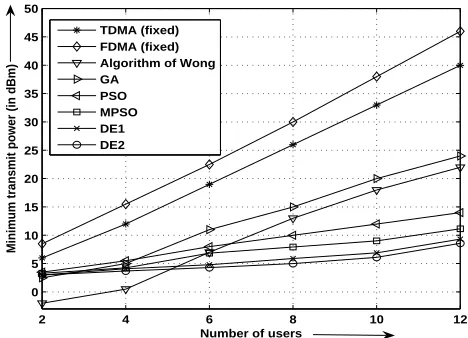
nearly same results for all the trial–runs. This result is more highlighted with respect to different number of users in Fig. 2. Here, we show minimization of total transmit power vs. number of users with different algorithms1. We see that all the dynamic allocation algorithms outperform fixed TDMA and FDMA schemes. Although Wong’s [7] algorithm2 shows an excellent performance for lower number of users, its per-formance declines for high number of users. On the contrary, MPSO and DE algorithms do not provide good performance for lower number of users at all. But their performances improve for high number of users. This is mainly due to the fact that, in comparison to other methods, evolutionary
1The specifications of GA follows [18]
2The specifications of Wong’s algorithm follows [7]
2 4 6 8 10 12
0 5 10 15 20 25 30 35 40 45 50
Number of users
Minimum transmit power (in dBm)
TDMA (fixed) FDMA (fixed) Algorithm of Wong GA
PSO MPSO DE1 DE2
Fig. 2. Minimum total transmit power vs. number of users for different algorithms for multi–user OFDM systems.
TABLE IV
EXECUTION TIME(IN SECOND)REQUIRED TO REACH A TARGET VALUE OF 3.45dBmFOR4–USEROFDMSYSTEM IN DIFFERENT TRIAL–RUN WITH DIFFERENT ALGORITHMS. ALL THE SIMULATIONS HAVE BEEN CARRIED
OUT ON APC (PROCESSOR: INTEL(R), CORE(TM) 2 CPU, 1.73 GHZ, RAM: 2048 MB)
Run Index PSO MPSO DE-1 DE-2 [7]
1 1.983 1.323 4.001 3.092 1.341
2 1.892 1.342 4.012 3.178 1.351
3 1.971 1.674 4.101 3.156 1.376
4 1.879 1.410 3.986 3.102 1.356
5 1.957 1.567 4.093 3.103 1.358
6 1.900 1.521 4.209 2.990 1.301
7 1.912 1.410 4.022 3.121 1.398
8 1.904 1.615 4.286 3.112 1.387
9 1.901 1.311 3.945 2.807 1.391
10 1.892 1.402 3.831 2.904 1.384
algorithms can handle efficiently with large number of data in terms of performance and complexity [10]. Moreover, among the considered evolutionary approaches, DE–2 is found to be the best in minimizing the total transmit power. Because, relatively higher value ofCR(0.90) is chosen for simulations, which means 90 percent of the elements of the trial vector were identical to those of the mutant vector and it implies a high density. It seems that, due to the high crossover constant, the path length is increased without a significant higher speed to approach the minimum. With each generation, the individuals got closer to each other and converged before they reach the minimum. On the other hand, ifCR is chosen too small then more generations are likely to be needed to find the minimum or it might even not find the global minimum value [15].
execution time of MPSO is also comparable to that of [7] for all the considered trial–runs which makes MPSO as practically feasible to implement. Although it is evident from Fig. 2 that both the versions of DE outperform MPSO for higher number of users, their time requirements are relatively higher than MPSO. As greedy selection scheme is used in DE, the trial vector yields a better cost function value compared to the parameter vector. As a result, DE shows the significant improvement in the overall performance, although its execu-tion time is relatively higher than the other ones. However, DE-2 needs less time to converge than DE-1 because of the variation in calculating the differential variation. DE-2 uses some randomly generated value with F to calculate the difference vector which emerges to minimize the total execution time in reaching the optimum value [16].
TABLE V
NUMBER OF FUNCTIONS EVALUATED(RUN–TIME FUNCTIONS OF THE ALGORITHMS)OF DIFFERENT TRIAL–RUN FORMAOPTIMIZATION FOR4
USEROFDMSYSTEM FOR A TARGET VALUE OF3.45dBm. ALL THE SIMULATIONS WERE CARRIED OUT ON APC (PROCESSOR: INTEL(R),
CORE(TM) 2 CPU, 2.00 GHZ, RAM: 4 GB).
Run Index MPSO DE-1 DE-2
1 1690 4152 3822
2 1700 4160 3961
3 1742 4214 3953
4 1722 4140 3914
5 1732 4172 3914
6 1730 4428 3803
7 1722 4164 3934
8 1738 4438 3923
9 1678 4132 3789
10 1716 4086 3796
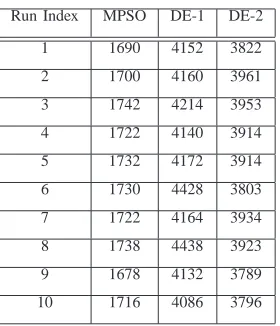
Table V represents the number of functions evaluated by MPSO, DE-1 and DE-2 to reach a target value of 3.45 dBm. 10 different trials have been made for evaluating the results for each of the algorithms. It should be noted that, for MPSO, we counted the number of position and velocity update equations used for total generations, and for DE algorithms, we counted the number of equations for selection, cross–over and mutation operations for total generations. Like previous case, MPSO evaluates less functions than DE-1 and DE-2 to reach a specified target value. However, DE-2 requires less number of functions to be evaluated than DE-1. So, in terms of usage of functions, MPSO is more efficient than DE algorithms although DE algorithms perform relatively better than MPSO.
V. CONCLUSION
In this paper, we allocated sub–carrier and number of bits for multi–user OFDM systems by minimizing total transmit power using MPSO and DE algorithms. Both the algorithms outperform other existing considered algorithms for higher number of users. However, DE performs relatively better than MPSO but takes more time to converge. Moreover, the time requirement for the convergence of MPSO is comparable to other real–time existing algorithm.
REFERENCES
[1] R. Chang. Orthogonal frequency division multiplexing. US. Patent-3,
488445, January 1970.
[2] Y. Wu and W. Y. Zou. Orthogonal Frequency Division Multiplexing: A Multi- Carrier Modulation Scheme. IEEE Trans. Consumer Electronics, 41:392–399, August 1995.
[3] E. Lawrey. Multiuser OFDM. Proc. International Symposium on Signal
Processing and its Applications, August 1999.
[4] J. Jang and K. B. Lee. Transmit power adaptation for multiuser OFDM systems. IEEE J. Select. Areas Commun., 21:171–178, February 2003. [5] I. Kim, H. L. Lee, B. Kim, and Y. H. Lee. On the use of linear programming for dynamic subchannel and bit allocation in multiuser OFDM. Proc. IEEE Global Communications Conf., 6:3648–3652,
November 2001.
[6] W. Rhee and J. M. Cioffi. Increasing in capacity of multiuser OFDM system using dynamic subchannel allocation. Proc. IEEE VTC, May 2000.
[7] C. Wong, R. S. Cheng, K. B. Letaief, and R. D. Murch. Multicarrier OFDM with adaptive subcarrier, bit, and power allocation. IEEE J. Select. Areas Commun., 17:1747–1758, October 1999.
[8] E. Bakhtiari and B. H. Khalaj. A new joint power and subcarrier allocation scheme for multiuser OFDM systems. Proc. of IEEE PIMRC, 2:1959–1963, September 2003.
[9] Y. B. Reddy and N. Gajendar. Evolutionary approach for efficient resource allocation in multi-user OFDM systems. Journal of
Communi-cations, 2:42–48, August 2007.
[10] I. Ahmed and S. P. Majumder. Adaptive Resource Allocation Based on Modified Genetic Algorithm and Particle Swarm Optimization for Multiuser OFDM Systems. Proc. of ICECE, December 2008. [11] QIAO. Feng and LIN. Ping. A differential evolutionary based algorithm
for multiuser OFDMA system adaptive resource allocation. Journal of
Communication and Computer, ISSN1548-7709, USA, 5:44–48,
Decem-ber 2008.
[12] R. C. Eberhart and J. Kennedy. A new optimizer using particle swarm theory. Proc. Sixth International Symposium on Micro Machine and
Human Science, pages 39–43, 1995.
[13] Y. Shi and R. C. Eberhart. Parameter selection in particle swarm optimization. Proc. Annual Conference on Evolutionary Computation, March 1998.
[14] R. C. Eberhart and Y. Shi. Particle swarm optimization: developments, applications and resources. Proc. Congress on Evolutionary
Computa-tion, South Korea, 2001.
[15] J. Ronkkonen, S. KUKKONEN and K.V. Price. Real-Parameter Op-timization with Differential Evolution. IEEE Xplore, pages 506–513, 2005.
[16] R. Gamperle, S. Muller and P. Koumoutsakos. A Parameter Study for Differential Evolution. WSEAS Int. Conf. on Advances in Intelligent
Systems, Fuzzy Systems, Evolutionary Computation, 2002.
[17] U.K. Chakraborty, S. Das and A. Konar. De with local neighborhood.
Pro-ceedings of Congress on Evolutionary Computation, 2006.