A Challenge-based Social Network: The LEGIO
Mobile Application
1
Ramin Asgharian; 2Mohammad Ghezelbash; 3ArashRabani
1 The International Informatics Institute Mashhad, Iran
2 Montazeri Technical College Mashhad, Iran
3 Iranian Management University Mashhad, Iran
Abstract -In this paper, we present the design, implementation and evaluation of the LEGIO application, which presents a challenge-based social network. This intends that in this network all of the activities of the users are linked up with the challenges. The social network in which a person or a company or association can produce and publish a challenge and then users participate in it. In the past, and today we witness the challenges were launched separately like the ice bucket challenge and the mannequin Etc. Only on that point was no social network to concentrate on these challenges to accompany help from the start to the close. This means that users can easily discover the challenges and become aware of their goals. But there are problems such as the lack of clear targets and rules, Failure to observe the rules by users or The lack of an integrated network for participants.So we started the idea of the design and implementation of a challenge-based social network structure with the aim of covering all the weaknesses of the past and current challenges and more special features. For implementation was needed to design a special challenge-based social network structure that finally we brought into a coherent structure with a survey of social network users. In the following, review the structure of a social network based on the challenge. We studied the different significances of the word challenge as well as a survey of 372 users, will achieve the different concepts of the word challenge. Then we started by designing a separate structure in the shape of a social network, with the intention of tracking all the concepts focused challenge for with amenities and features necessary to put through. The idea will be inaugurated in two phases: the first phase is the presentation of coherent structure proposed and the second phase is about the LEGIO application design.
Keywords – Challenge; Mobile Social Networking; Social media; Application
1. Introduction
echnical advances of the Internet and mobile technologies have promoted new forms of social communication (Rheingold, 2002), allowing the maintenance of large distributed networks of contacts. Such tools can either complement or replace face–to–face meetings. Social software, such as e– mail and instant messaging (IM), already provide full support to interpersonal or group communication. Nevertheless, social networks remain often either invisible (e–mail) or private (buddy list) [5]. They are often referred as online tools and network technologies for social interaction, connecting friends, family and even strangers from all corners of the world by allowing people to share content, opinions, knowledge or information in the form of
message, picture and video[6]. Today, online social networks became a global phenomenon with enormous social as well as economic impact within a few years. According to Forrester Research, 75% of Internet surfers used ‘‘Social Media’’ in the second quarter of 2008 by joining social networks, reading blogs, or contributing reviews to shopping sites[2]. Social networking has become a public reception from a small phenomenon. Recently, the concept of social networks has been used in the context of information and communication technologies to provide efficient data exchange, sharing, and delivery services [1].
In today’s world, social media such as Facebook, Twitter and YouTube are available for anyone accessing to the internet. Alone, the most popular online social network, Facebook, counts currently more than 850 million users worldwide[7].Social networking sites are applications that
enable users to connect by creating personal information profiles, inviting friends and colleagues to have access to those profiles, and sending e-mails and instant messages between each other[2] and also provides the possibility to express ideas and opinions freely and simultaneously interact with your thoughts, tastes and opinions of others and disappears boundary between the audience and the media.
One of the significant characteristics of social networking is the emergence of collective wisdom. The collective wisdom refers to the flow of fluid and dynamic imagination and mind of users in such environmentsthat such a massive processor process the information. Social media encourage active participation from people by allowing them to voice out their thoughts through posting messages, pictures or even videos on their own social media page; allowing exchange of information or knowledge; providing a platform for users to communicate and interact; connecting people with common interests, forming a community and interconnecting with other social media outlets[4].
After the advent of social networking sites and its problems,Design and was released mobile version of the networksthat there is no spatial and temporal dependence and they are always accessible.
The mobile social network (MSN) combines techniquesin social science and wireless communications for mobile networking. The MSN can be considered as a system whichprovides a variety of data delivery services involving the socialrelationship among mobile users[8].
The whim of social network and its application has recently gained much attention from the researchers in many subject areas. The understanding is that all entities (e.g., People, devices, or systems) in this world are related to each other in one way or another [9]. In a broader sense, a mobile social network is a mobile communications system which involves the social Relationship of the users. In such a network, mobile users can access, share, and distribute data in a mobile environment by exploiting the social relations[8].
Due to the ubiquitous availability of mobile devices (such as smart phones), a mobile social network can fully take advantage of human interaction and physical mobility to achieve efficient and effective data delivery services[8]. Participation in social networks increases the likelihood of participation and social interaction with them. So as individuals and members of the network links more will further the possibility of cooperation, interaction, intimacy views and moving along. In this digital era, anything
catchy and amusing can turn into a trend or viral Phenomenon with the help of social media, reaching out and impacting a large number of people. One of the most interesting topics is diffusion—the phenomena that certain viral “objects” can spread among individuals in a social Networker [3].
The viral growth of online social networking applications in the past few years has facilitated, like never before, forming new friends online and keeping in touch with old friends and past colleagues. These sites typically make it easy to declare friends, or add like-minded people as friends, and then follow their activities or posts online. While these declared networks appear large and thriving, it has been recently shown [15] [5] that much of the activity in these networks is driven by a more intimate group of users. Socially viral phenomena include videos that are made popular by sharing on the internet, and a video is said to have gone viral if it spreads rapidly as a result of frequent sharing[17][10].
As you may know, one of the most entertaining leisure activities that is gaining a great deal of popularity among Internet and social network users is "challenge". These days, challenge, which is frequently mixed with some other word, indicates an extensive event that quite often arises from the social media. A reason why a challenge deviates from its objectives is the deficiency of a platform or an application that is specifically planned for this use. Such means can make it possible to preserve the archive of challenges, protect the spiritual and property rights of theorists, unify the content produced by the users and provides easy access and raise awareness about current challenges, their goals and regulations. For example, Harlem Shake meme, Gangnam Style song by Psy, The Fox song by Ylvis and ALS Ice Bucket Challenge[4].
buckets of ice water on their heads. Consequently, over the 30-day period of summer, the ALS Association reported that they had obtained donations which exceeded $100 million[12]. The Harlem Shake is an Internet meme in the form of a video in which a group of people perform a comedy sketch accompanied by a short excerpt from the song "Harlem Shake". On February 10, 2013, the upload rate of Harlem Shake videos reached 4,000 per day, or one every 21.6 seconds[13]. However, a challenge cannot be considered merely as entertainment since it has various meanings with different implications. Therefore, we set out to categorize different concepts of challenge by initially examining its definitions as well as using data obtained from a field survey among people and Internet users; next, an attempt was made to discover and analyze the strengths and weaknesses of those challenges that received the highest rate of feedback on social networking websites.
Thus, looking at the current problems, shortages and a greater leaning toward this type of net, we decided to carry out an independent plan in a physique of a social network, seeking to cover all concepts of challenge in a concentrated manner using the necessary means and features.
The weakness of today's challenges: (From the challenge organizer point of view)
• Inability to control the spread of challenge and
dispersion videos.
• Lack of control on the content shared by participants. • Noncompliance with intellectual property rights and
property rights held major challenge.
• Noncompliance with the objectives and rules of a
challenge.
• Lack of proper understanding of the challenges.
The weakness of today's challenges: (From the participant point of view)
• Lack of awareness of the current challenges. • Lack of awareness of the rules and objectives of a
challenge.
• The impossibility of having a private challenge (for
celebrities or specific groups).
Eventually, after meditating and a study of 372 users and also examine theories, views and needs of users, we resolved to make a coherent structure to handle all these degrees of views. Our primary priority for creating this network is designing an application that is compatible with the operating systems on smartphones. Apart from the secondary features, which are not necessitated to be explicated here, this application has 5 primary divisions, with the most important being the challenge section, which shapes and holds the base of the application's
structure.
2. Structure
By studying the different meanings and concepts challenge as well as the strengths and failings of the challenges that had outstanding feedback on social networks, finally we came to create a structure to handle all these points of scenes and resolving more or less of these troubles.
In general, any challenge is comprised of two key components: goal and rule, which help to expand the challenge. The way the content is presented and shared by users in the application varies based on the type of challenge (content, supportive, competitive).
2.1 The Challenge
2.1.1 Content Challenge
As for the content section of the structure of the application, the features of the question along with multimedia answers help to find a solution and come up with appropriate ideas interactively; In this type of challenge, the aim of the organizers is finding solutions for solving a situation or phenomenon that may be necessary to struggle in the face with it. For example: water scarcity, air contamination, and so on Participants post their own content Compliance with relevant laws organizer (Referenced in the license Challenge) and Preferred Format (video, photos, audio, and text) that the organizer has set it.
2.1.2 Supportive Challenge
In the support section, features of running a campaign, supportive aids, etc. are presented through multimedia and direct interaction with the users, which can spread among them like a virus. The purpose of this Challenge is Support of an issue or problem that needs integrity and solidarity users or Specific groups. In this case, users and companies design a challenge and determine the laws and its objectives and then they invited users. For example: Ice Bucket challenge, cycling challenge, reading challenge, etc.
2.1.3 CompetitiveChallenge
challenge and then users send post themselves after reading the rules of the challenge. This type of challenge is the ability to work in all respects (Hobbies, sports, ethnic, educational, political, and so on) Such as black and white photo challenge, Lip Sync Battle, best picture, singing, acting, art, sports, magic, poetry, etc. In a survey conducted among users, asked“Which of the following are more willing to be held? (Entertainment-social-political-economic-educational) “.
2.2 Goal
The goal is the main part of a challenge. Each challenge must have a purpose, then the challenge can be placed in their category based on that. When an issue becomes a challenge it must have goals and also participants should be aware of the goals. For Example: Ice Bucket Challenge. The aim of the challenge was to increase public awareness of the disease and support for cancer patients ALS.
It may be forgotten the goals of the challenge or be away its route due to the lack of structure or a lack of awareness of the rules and objectives. But in a specific structure,each challenge has its own unique identity where in a fully referenced the objectives, rules and other information of the organizer. An obvious example is the "Ice Bucket Challenge" Which was supposed to bring benefits to help patients, ALS that in a very short time the significant number of usersturned into a tool for showing off and joke and even sometimes dangerous movements and the purpose for which it was intended completely away. The query was asked in the survey among users if we engage the word challenge as dealing with issues how much you get involved in the challenge to accomplish a specific end. Among the 372 participants, 66.1% were quite positive. This indicates two things, first users believe that there is a purpose behind their challenges and users are more inclined to participate in the challenge because they feel participation in problem solving and increasing social capital. For example: Florists challenges for the protection of children.
2.3 Rules
The rules are a set of things that users need to do to participate in a challenge. In fact, the rule prevents the diversion of challenges and moves toward the goal. As mentioned before, one of the weaknesses of today's challenges is the lack of exact information or non-compliance by users. Of course, with non-non-compliance, the challenge does not proceed in its direction. Thus, by having a structure and application an organizer canpartly force users to adhere to the principles and rules of the
challenge. In fact, the challenge organizer determines the required rules and then enters the challenge certificate designed within the app and participants are required to follow it. Now how determined these rules? In the first place, depends on the purpose of the challenge is launched and second depending on the organizer's opinion. According to the survey,65.45% users who are aware of the rules of the challenge are willing to follow itand lack of awareness and knowledge of the laws may affect its upward movement. For example: see the Ice Bucket Challenge, the objective of the challenge is the help and support of cancer patients, ALS and there are rules and tasks that users require to do to take part in it. In this way, simultaneously with a record of the video, you can empty the bucket of ice water over your head and invite three of your friends or colleagues or family to the challenge and share on social networks. If they do within 24 hours after the challenge, then just a viral spread. But if someone does not domust pay hundreds of dollars for one of the charities that operate in the area of the disease.
2.4 Challenge organizer
The person who invented a challenge and formed in his mind the idea of making a challengeand goes up to the implementation? The organizer must first determine the purpose of the challenge in this structure and then determine its categoryand then define a set of rules which can closer to viral spread and its purpose.
We have looked at options for personal organizer in this construction:
• Design Challenge in private or public
• Invite friends and users to participate in the challenge or as a viewer
• Ability to determine the content format of the challenge (video, photo, audio, text)
2.5 Participant
Refers to a user who is invited to a challenge. The participant can read the license of the challenge which provided by the organizer. The Challenge certificate, including: category; objectives, rules, the name of the Organizer; created time, etc. Then a user can participate in the challenge compliance with rules.
2.6 Viewer
3.
LEGIO Implementation
These days,the challenge usually combined with another wordrepresents a massive event that usually comes from the social networks. So that challenges often arise and repeated so that users tired of seeing them and soon forgotten. Again, when a new challengecomes with ability to globalization and grows similar to previous challenges and repeated the process continues without a centralized archive. One of the reasons for the deviation from the target is the absence of a specific application challenges.
The app allows archive storage challenges; protection of intellectual property rights thinker's challenge; integration of user-generated content; easy access and awareness of the current challenges and objectives them. Smart phones are devices that people tend to use them and has been significant progress and evolution from past till now. We see that many of the major social network, their main focus is just on smartphones. So our main priority to implement this type of social network is an app on a smartphone platform. Based on the above, now it’s time to design an app for the structure as a system and as a standalone application on the social network with a focus on challenges with the necessary features and functionalities. Following an overview of the features of the application and implementation phases of it. The LEGIO, apart from subsections and registration pages and the login which is common in most applications, There are five main sections:
3.1 Challenge
From here begins the formation of challenges .This section includes two subsections: Construction and Facilities.
3.1.1 The process of making a challenge (Construction)
To build a challenge you must first choose the type of challenge that you want to create. Like the content, competition or supportive challenge. By selecting one of these three types,displays a form with various features to create specific challenges. Features that are identical in all three types to create a challenge and is set by the organizers: such as Challenge type (content, supportive, completive); the goal of the challenge; Rule of the challenge; Invite members; Challenge certificate (including public / private of the challenge; expiration date; label for quick view content challenge).
3.1.2 Facilities
Invited to participate in private challenge:In this case the creator of the challenge invites users Or users sending requests to participate in the challenge and the creator confirms it.
• Participate in Public challenge: In public
challenges like not private proceedings and users can participate in a challenge without requiring the approval of the creator.
• Challenge link: Link is automatically created for
challengesso it can be sent to users in other social networksto join in the challenge.
• Category: to identify the type of challenge
(optional).
• Content format: Determine the type of content
format sent to participants (video, photos, audio and text).
• Access List: To determine user access levels to
manage the challenges.
• Post on challenges. • Watch user's posts
• Send Report for content a challenge • Comments, Favorite
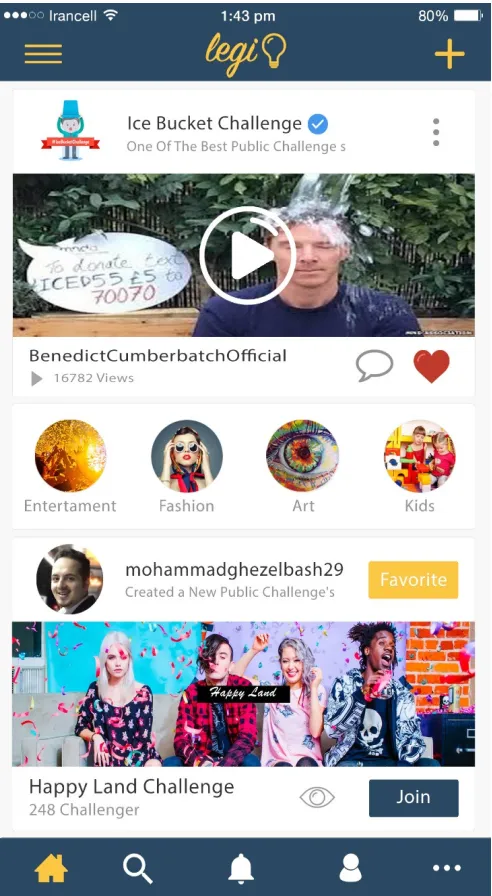
The following shows a view of the appearance of the proposed LEGIO application (see figure 1, 2).
Fig. 2 Application view
In this application the creator can change the settings if to have members only as a viewer, so the challengeViewers will see the participants' posts. Some users may not have the possibility of participating in some challenges, but they want to follow and support challenges. T-here are differencesin how content view and share it with the type of challenge application (content, supportive, competitive).
a. Timeline: A list of user activity from the moment
of joining the social network first up to now that shows in chronological order. In addition, the Friends will also be able to view this option.
b. Search: In this section, you can search by the title,
type or name of the organization.
c. Notification: In this part, shows user messages,
challenges and posts of the participants.
d. Profile: Including account information and
settings associated with it as well as user-submitted posts in challenges that are involved.
4.
Use Case Diagram
A use case diagram at its simplest is a representation of a user's interaction with the system that shows the relationship between the user and the different use cases in which the user is involved. A use case diagram can identify the different types of users of a system and the different use cases and will often be accompanied by other types of diagrams as well[18]. The following figure shows the user's interaction with the system (see Figure 3).
Fig. 3 use case diagram
5.
Business Plan
5.1 Plans
5.1.1 Making specific challenges and advertising
Companies can increase their sales efficiency with the launch of unique challenges with a focus on products or services. In addition to the attractive design the brand is strengthened with the release of viral videos.
5.1.2 Analysis of users' interests, challenges and offer special promotions
6.
Implementation Process
After introducing the structure and components of the application, will now pay the phasing of the project's implementation:
• Preliminary design review • Find resources and infrastructure
• Database design and manufacturing process applications
• Interface design
• Beta version
• Construction of the first version of the project in
context
• Support
• Research and Development
7.
Conclusion
In this paper, we present the design, implementation and evaluation of the LEGIO application, which represents an independent social network for creating and managing challenges. We first looked shortages and problems of today's challenges. The study was conducted surveys among users, we have designed a coherent structure to better manage the challenges that I mentioned. The proposed structure has been provided by our team of evaluation and assessment of all cases and may be the first project in this area with objections that can be discovered and solved in the next article. In the following became the structure of the phase-to-phase theory, practical and introduced some of the main components of the application.
References
[1] F. Nazir and A. Seneviratne, “Time Critical Content Delivery using Predictable Patterns in Mobile Social Networks,” pp. 1066–1073, 2009.
[2] A. M. Kaplan and M. Haenlein, “Users of the world,
unite! The challenges and opportunities of Social Media,” Bus. Horiz., vol. 53, no. 1, pp. 59–68, 2010. [3] S. Wang, T. Yang, Q. Zhang, and K. Zhao,
“Concurrent diffusion of information and behaviors in online social networks - a case study of the Ice Bucket Challenge,” CoRR, vol. abs/1508.0, pp. 1–15, 2015. [4] A. N. M. Phing and R. Yazdanifard, “How Does ALS
Ice Bucket Challenge Achieve its Viral Outcome Through Marketing Via Social Media,” Glob. J. Manag. Bus. Res., vol. 14, no. 7, pp. 57–63, 2014. [5] Lugano and Giuseppe, “Mobile social networking in
theory and practice,” First Monday 13.11, 2008. [6] & M. Papasolomou, I., Social media: Marketing public
relations’ new best friend. 2012.
[7] J. Heidemann, M. Klier, and F. Probst, “Online social networks: A survey of a global phenomenon,” Comput. Networks, vol. 56, no. 18, pp. 3866–3878, 2012. [8] N. Kayastha, D. Niyato, P. Wang, and E. Hossain,
“Applications, Architectures,and Protocol Design Issues for Mobile Social Networks:A Survey,” vol. 639798, no. 12, 2011.
[9] S. Wasserman and F. Katherine, Social network analysis: Methods and applications, Vol. 8. Cambridge university press, 1994.
[10] L. Jiang, Y. Miao, Y. Yang, Z. Lan, and A. G. Hauptmann, “Viral Video Style: A Closer Look at Viral Videos on YouTube,” Proc. Int. Conf. Multimed. Retr. - ICMR ’14, pp. 193–200, 2014.
[11] F. 2014 S. 7, “Facebook newsroom. The Ice Bucket Challenge on Facebook,” 2014. [Online]. Available: http://newsroom.fb.com/news/2014/08/the-ice-bucket-challenge-on-facebook/.
[12] P. Song, “The Ice Bucket Challenge : The public sector should get ready to promptly promote the sustained development of a system of medical care for and research into rare diseases,” vol. 3, no. 3, pp. 94–96, 2014.
[13] Wikipedia, “Harlem Shake (meme).” [Online]. Available:
https://en.wikipedia.org/wiki/Harlem_Shake_(meme). [14] Wikipedia, “Mannequin Challenge.” [Online].
Available:
https://en.wikipedia.org/wiki/Mannequin_Challenge. [15] B. A. Huberman, D. M. Romero, and F. Wu, “Social
networks that matter Twitter under the microscope,”
First Monday, vol. 14, no. 1, pp. 1–9, 2009.
[16] B. T. Harford, “Ice bucket challenge : the cold facts,”
Financial Times 2014 Sep12, 2014.
[17] W. M. Broxton T, Interian Y, Vaver J, “Catching a viral video,” J Intell Inf Syst, vol. 40, pp. 241–59, 2013.
[18] Wikipedia, “Use case diagram.” [Online]. Available: https://en.wikipedia.org/wiki/Use_case_diagram.
1
Ramin Asgharian graduated from JNTU university of Hyderabad India with master of technology degrees in computer networks and information. He is currently working as a data center technician. He is also