Integration of Deductive Reasoning with the
Subsets of Artificial Intelligence
1
Mradul Mourya,
2Divyansh Goud
1,2Delhi International School, Indore, Madhya Pradesh, India
Abstract
The betterment of life is what the central theme of all the researches that are happening around us. Many psychologists came up with the theories like cognitive development, social learning, psychoanalysis, self-actualization etc. The thesis of all these researches is based somehow on human brains, behaviors, actions, etc. Similarly, in this Psychological scientific paper, we present an idea for withdrawing logical decisions with the assistance of Artificial Intelligence. Logical reasoning or deduction is one’s capability of giving conclusion (as per the circumstances). Think of amelioration of this capacity to a level where one can never get stuck in the real-world situations. In this Paper, our purpose is to reach a logical or definite conclusion. We outline the structure of logical agent who tends to do work with rationality under various environments.
Keywords
Logical Decisions, Artificial Intelligence, Logical Reasoning, Deduction, Definite Conclusion, Logical Agent, Rationality, Environments.
I. Introduction
Deductive reasoning is a logical capability of human intelligence where premises are taken into consideration in order to reach a specific conclusion. Reasoning accounts for perceptions, opinions, thoughts and formal knowledge. Psychologists define plausible deduction as one whose conclusion is true in all possible environments given that all premises are true. The reasoning is an integral part of intelligence as our business of life depends on it. Many researchers came up with the theories of intellectual disciplines that underlie deductive reasoning and various coping strategies that lead to a balanced life.
All of a sudden, does human intelligence recounts for premises and yields a certain conclusion?
The answer to this question is- “yes” but not for all the times. Some deductions are crucial but on the other hand are difficult as they rely on too old and complex percept sequences which are complicated to draw certain conclusions.
To deduce the certain conclusions we can use three laws (or rules of inference) that govern deductive reasoning.
Modus Ponens ( the law of detachment) •
Syllogism •
Modus Tollens (the law of contrapositive) [1] •
Consider the following example:
If a light is continuously emitting from the projector, then the •
picture displayed is perfect. (conditional statement) The picture displayed is not perfect enough. (antecedent) •
The light is not continuous. (consequent and its negation) •
In the above example, we have two premises i.e, conditional statement and antecedent basis on which we can deduce the conclusion.
According to Modus ponens, first premise (A → B) is a conditional statement, A → antecedent of that conditional statement and B → conclusion deduced is consequent.
If a light is continuously emitting from the projector, then •
the picture displayed is perfect. (A → B). The picture displayed is not perfect enough. (A) •
Therefore, the light is not continuous. (B) •
Theorem of propositional logic: ((A → C)˄A) → C
According to Modus Tollens, first premise (A → B) is a conditional statement, (˾B) is the negation of the consequent and conclusion deduced is a negation of the antecedent. (˾A).
If a light is continuously emitting from the projector, then •
the picture displayed is perfect. (A → B). The light is not continuous. (˾B)
•
Therefore, the picture displayed is not perfect enough. (˾A) •
Theorem of propositional logic: ((A → B) ˄ ˾B) → ˾A
According to the law of syllogism, conclusions made by combining two conditional statements, A → B and B → C and conclusion deduced is A → C.
If a light is continuously emitting from the projector, then •
the picture displayed is perfect. (A → B)
If a picture is displayed perfectly, then only it will create an •
optical Illusion. ( B → C)
Therefore, if a light is continuously emitting from the projector, •
then only it will create an optical illusion. ( A → C)
Deductive reasoning is paradoxical to those who have less intellectual capabilities than those who have high. (this is measured by intelligence tests) So, we need intellectual capabilities that should always give the conclusions more appropriate and unbiased. For achieving this purpose, we need to put the agents in more complex environments as everything comes up is not always non-ambiguous. Hence, the goals of this interdisciplinary paper are to integrate science and psychology in order to answer the question – “Does artificial intelligence accounts for better reasoning in terms of more accurate information when there is uncertainty while giving decisions?”
II. The Idea of Rationality
world within the agent. Each representation is called a sentence. The sentences conveyed in a language known as knowledge representation language. Knowledge representation is a substitute of its own, used to entitle the reality to determine the results by thinking instead of acting i.e. irrefutable reasoning process. It’s a method of practically efficient computing [3].
With the help of the knowledge representation language, one can integrate procedural knowledge with a broad base of declarative forms. These forms give useful ways to express logical knowledge. Likewise the other agents, it takes input as a percept and returns an action given that agent initially contains some Background knowledge (BR). The program always does two things. TELLS and ASKS the knowledge base what it perceives and what action it should perform. To answer this question, logical reasoning is used to demonstrate which action is best amongst all, given its Background knowledge and goals. The agent then performs the selected action [4].
Fig. 1: A generic Knowledge Based Agent
What shall we do if the agent won’t be able to give the precise and more appropriate decisions when there is uncertainty (which we’ll discuss later)?
Now, the idea of rationality comes into existence. We require the ability to portray the knowledge as well as logic. This will allow us to reach a certain conclusion with the diversity of environments. We require the insight of how the world works for achieving perfect rationality i.e. always doing the right thing. To deduce what action is most rational, one has to make key presumptions and based on those, logical formulations. The logic of the agent is the knowledge representation language and ways of executing reasoning in that language. A knowledge-based agent should acquire the knowledge about the world—Present state, how to deduct hidden properties from percepts, how it’s progressing over time, what actions it’s taking in several circumstances, what are its goals—to infer conclusions about it. A knowledge-based agent should have knowledge, logic and by then, it can implement them. However, the choice of implementation is very crucial and it’s also possible for the designer to give inputs to the agent [5]. We can elaborate knowledge-based agents on three levels.
A. Knowledge Level
We can identify the agent by what it knows and what its goals are. For example, river rafters suppose to know that Nile River flows through Kenya, South Sudan, and Egypt.
B. Logical Level
level in which knowledge in inscribed into sentences. For example, river rafters may be identified by the logical sentence such as the Nile Flows through (Kenya, SS, Egypt) in its knowledge base.
C. Implementation Level
This level depends upon the construction of the agent. Pragmatically usage of the sentence at a logical level. Sentences like the Nile Flows through (Kenya, SS, Egypt) can be portrayed on KB (Knowledge Base) by string Nile Flows through (Kenya, SS, Egypt) contained in the record of strings.
The main objective of knowledge representation is to exhibit knowledge that can easily understand by the computers such that, agents can excel in their performance. Knowledge representation language can be defined in two ways: Syntax and Semantics [6].
The syntax is related with formulas or rules used for building and shaping the symbols and words that used in a language, in contrast to semantics which is related to sense or interpretation of language. Let’s consider the following formula, F=MA (Force=Mass*acceleration) the Syntax of the language of scientific expression says M and A denoting numbers, then “Force applied on a body is zero” is the sentence that constitutes M and A. The Semantics of that language says that the sentence “Force applied on a body is zero” is true whenever either mass or acceleration (or both) is zero, and else false. Representation of language by usage of syntax and semantics in a way that can be comprehensible for the agent, called Logic [7].
Furthermore, which language is considered best for representation of knowledge? Natural language, obviously not, as it is more often used in communication instead of knowledge representation. However, the advantages of natural language combined with the formal language give the agent what it wants for making certain inferences. As a result, the language is eloquent and concise such that we can say what we want to say epigrammatically. In the following paper, we’re going to focus on First-Order Logic as our representation language.
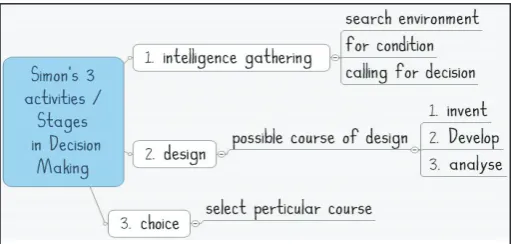
Rationality as defined earlier——always doing the right thing— —is not always achievable as there is one barrier i.e. Bounded Rationality. Herbert Simon, a pioneer in the field of Artificial Intelligence, stated “To completely achieve your goal, always select an alternative percept” He created the Logic Theory Machine (1956) and the General Problem Solver (1957) programs. Simon drew a contrast between procedural rationality and substantive rationality. Simon defines rationality, in his book Administrative Behavior (1916-2001), as to choose the alternative that gives the most preferable set of all possible decisions. Simon discussed three stages in decision making that are: intelligence gathering, design, and choice. He explained all these stages profoundly. Therefore, Herbert Simon was able to solve this query of bounded rationality
and provided various ways to reach a certain conclusion [8].
Fig. 2: Simon’s 3 Stages in Decision Making
III. Inferences: Logical Reasoning
The inference has its deep roots in cognitive psychology. The term “Inference” is coincided by the Ancient Greeks. Strictly speaking, Inference is the steps in reasoning to reach a logical conclusion. After all, our focus of this paper is to reach the ideal conclusion. Therefore, the study of a path to reach the goal is a integral process. Human inference, Statistical inference, and logical inference (or deductions) are the types of Inference. Our purpose is for humanity but by using the scientific approach. First of all, we need to build sentences by using the premises. After then, we need to implement the entailment of the sentences by means of logical deduction. But, entailment of sentences can be done if and only if a sentence is valid under all clarification of all environments. For example, “there is a blackboard at distance of 5.2 meters or there is not a blackboard at distance of 5.2 meters” this sentence is valid because it is true under all environments as there can be or cannot be a blackboard at distance of 5.2 meters. In contrast to the sentence” there is a yellow stain on my t-shirt or a red stain on my white t-shirt” this sentence can’t be considered as valid as t-shirt which contains yellow stain maybe white. So, entailment is not possible in this kind of sentences.
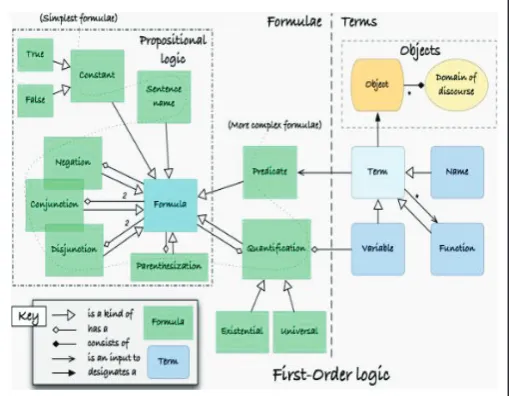
Furthermore, to make the system of sentences easier we can transform it into the form of variables. For this, we use the First-Order Logic. In contrast to Prepositional logic, which studies the methods of joining the whole sentences, statements or propositions to make more complex sentences, statements or propositions, first-Order Logic deals with quantifiers and predicates. Entities in the universe (discourse of domain) used as input for a predicate and it gives either True or False as output [9]. To understand First-Order logic more deeply, let’s consider the first-order formula, “If X is intelligent, then X is a problem solver” this sentence is a conditional statement as “if X is intelligent” is hypothesis and “X is a problem solver” is the conclusion. First-Order logic applied to the sentence as follows:
∀x INTELLIGENT(x)→PROBLEM SOLVER(x)
Universal Quantification (∀) “for all” holds for all alternatives
of X “for all X, if X is intelligent, then X is problem solver” and
Existential Quantification (∃)“there exists” holds for some
alternatives of X “there exists X such that X is intelligent and X is not a problem solver” is equivalent but substitution of “for all X, if X is intelligent, then X is problem solver”. First, we will talk about the Syntax of the First-Order logic. As defined earlier, the syntax is related with formulas or rules used for building and shaping the symbols and words that used in a language. Expressions used in First-Order logic are of two types: Terms, which instinctively portray objects and Formulas, which instinctively express predicates either True or False. Terms and Formulas of First-Order language are the subsets of Symbols. Terms and Formulas are connected with strings to Symbols in the language in order to give the legal expression. Symbols are categorized into two types: Logical Symbol (meaning has always same) like Universal Quantification (∀) and Existential Quantification (∃). Logical
connections: ∧ = conjunction, ∨ = disjunction, → = implication,
↔ = biconditional, ¬ = negation; Brackets, Parentheses and other punctuation symbols; the infinite set of variables (a,b,c,……….); an equality symbol.
Non-Logical Symbol (meaning differs by clarification). For example, Signature (identity of personnel changes by the choice i.e. clarification).
For defining terms and formulas of First-Order logic we use Formation rules. By applying rules of terms one can obtain the Atomic Formula. For example: ∀x∀y(P(f(x)) → ¬(P(x) → Q(f(y),x,z)))
Here, f = unary function symbol, P = unary predicate symbol and Q = ternary predicate symbol.
Now, we know how to express concepts of First-Order logic as language. To prove that concepts as valid or non-valid i.e. their truth value we use Semantics. As defined earlier, Semantics is related to sense or interpretation of the language. It assigns the meaning of the logical sentences by a theory known as Model Theory. This theory is achieved by the means of Interpretation, the process of linking truth-valued statements to a sentence in a chosen domain of discourse [10]. This domain of discourse can be any set of our own chosen choice. Let’s say, a set of variables. Consider the statement, “A |= (B = 2)”. The truth value of the sentence depends on the value of B. Some values of B might make the statement true or some values of B might make the statement false. Hence, we need to qualify our statement by giving the certain statement that provides value for B and such statements are known as “Binding Statements” For example,
∀x(likes(cars, B)) |= likes(cars, truffle).
The Binding statement after “|=” provides the value of B which satisfy the statement before “|=”.
Given below the figure explains the First-Order logic in logical Programming.
Fig. 3: Logical Programming: First-Order Logic
A. Applying the First-Order Logic
Previously we discussed the approaches and various tools to the logical consequences. Presently, we turn to evidence carrying on these theories. Usage of First-Order logic in various domains is what we’re going to discuss. Firstly, consider the example of the domain of family relationships (as it can be easily comprehensible). It includes the facts like, “Henry is Father of Mike and Mike is Father of Charles” and rules like “ x is Father of y and y is a father of z, then x is a grandfather of z. Here, we have two unary bases: Male and Female and bulk of binary base: Child, Daughter, Parent, Grandparent, Sibling, Spouse, Wife, Brother, Sister, etc. We take functions as Mother or Father (unary base) as each one of them has the entire binary base (according to the domain of discourse). For Example, one’s Father is one’s Male Parent”:
One’s wife is one’s female spouse:
∀ m,g Wife (g,m) = f <=> Female (g) A Spouse (g,m)
Child and parent are inverse relationship:
∀ h,k Child (h,k) = f <=>Parent (k,h)
To receive an affirmative answer we need to transform the sentence to KB, we would call:
TELL (KB, (∀ f,x Father (x) = f <=> Male (x) A Parent (f,x))).
Now if we tell:
TELL (KB, (Male (Garden) A Parent (Garden, Shirt) A Parent (Shirt, Rose))). Then we get:
ASK (KB, Grandparent (Garden, Rose))
B. Inference in First-Order Logic
As discussed earlier our purpose is sound and absolute inference. But we will need something to deal with First-Order logic with Quantifiers. So, we will introduce the three complex rules which alternate the explicit individuals for the variables. We will use the notion ALTER (θ, x) to denote the result of applying alternation to the sentence x. For example: ALTER ({a/John, b/Sam}, Likes (a,b)) = Likes (John, Sam). Three rules of inference
are:-1. Universal Elimination
For any sentence x, constant symbol k that does not appear anywhere else in the knowledge base, and variable v:
For example, from ∀ a Likes (a, chocolate), we can use alteration
{a/Samuel} and infer Likes (Samuel, Chocolate).
2. Existential Elimination
For any sentence x, constant symbol k that does not appear anywhere else in KB, and variable v:
For example, from ∃x Rabit (x, Carrots). If Eats does not appear anywhere in the sentence then we can infer that x is Eats.
3. Existential Introduction
For any sentence m, ground term g that occurs a, and variable v that does not occurs in a:
For example, Precautions (Samuel, Takes), we can infer 3a Precautions (a, Takes).
The application of these Inference rules is a question of matching the premises of the sentences or statements logically to its KB [11].
We will understand this with the help of an example as proof:
According to the law in India, the business of selling drugs (cocaine, LSD, cannabis, etc) illegally, is a criminal offense. Punjab, a city in India, has a high number of drug addicts; most of the drugs to Punjab were sold by Simon D. Cornell.
Our intention is to prove that Simon D. Cornell is a criminal “….. India, the business of selling drugs (cocaine, LSD, cannabis, etc) illegally is a criminal offense.”
A a,b,c India (a), drugs (b), criminal offense (c) A Sells (b,a) => Criminal (a)
“Punjab….has high number of drug addicts”
∃ a Owns ( Punjab, a)∧drug addicts (a)
“most of the drugs to Punjab were sold by Simon D. Cornell”
∀a Owns (Punjab, a) A drugs (a) => Sells (Cornell, Punjab, a)
We suppose to know that drugs are harmful:
∀a Drugs (a) => Harmful (a)
And that Cornell who is enemy for India is hostile:
∀a Enemy (a, India) => Hostile (a)
“Cornell, who is Indian”
Indian (Cornell)
“Punjab is a city”
City (Punjab)
“Business of drugs is a criminal offense”
Offense (BOD)
Progressions of applications of inference rules which satisfies the proof are Existential elimination, AND – elimination, Universal elimination, Modus Ponens, and AND – Introduction. By applying all the applications we can deduce:
Criminal (Cornell)
Thus, this satisfactorily proves the rules of Inference.
IV. Acting under Uncertainty
Agents do not always think of achieving rationality. According to the programs present in them, they more think of giving conclusion rather giving definite conclusion i.e. more appropriate or useful than non- definite conclusion. Agents can never acquire the complete facts of their environment. Knowledge of characteristics of the environment acquired by present and previous percepts and Sentences of environments ascertained by the agent’s percept. Nevertheless, the agents are unable to interpret the absoluteness of characteristics of the environment (due to laziness and ignorance). As a result, an agent is working under Uncertainty. John McCarthy (1959), proposed a program with “Common sense” that would make sentences of environments ascertained by agent’s own percept. From there a new term introduced, “The Qualification
Problem”. It says in order to completely depict the conditions required for successfully perform an action; an unfeasible and improbable number of qualifications should be included in the sentences expressing them [12]. For example:
an agent is not completely depicting the conditions that required for successfully performing an action. An agent is not considering the facts such as:
“Delivery bike can run out of petrol”. 1.
“It can get into an accident”. 2.
“It can get stuck into the traffic”. 3.
“It can get stuck in abnormal weather conditions like heavy 4.
rain, earthquake etc.”
Our goal is to make logical agents which will always provide a definite conclusion. Hence, for a logical agent, the scenario X15 is not so strong conclusion. Now, if we consider X25 as our conclusion, then it will increase the likelihood of a long wait. So, for achieving the rationality, doing the right thing, we want a strong degree of belief that should increase the likelihood of achieving rationality. For making this possible, the agent should reason according to Probability theory.
A. Reasoning with Probability
Two most important things in reasoning are Action and Communication. Probability theory is a solution to study these two things. Probability theory comprises of two theories: Decision Theory, combination of Probability theory and Utility theory and Information theory, logarithm of Probability theory. Firstly, we will discuss about probability spaces which deals with the uncertainty about an experiment. It has two parts: Sample Space
(Ω), which is a set of outcome and Probabilitymeasure P, which is subset of real function of Ω. A set of outcomes A ⊆ Ω is called
an event [13]
Fig. 4:
If our experiment is to situate weather forecaster, then there can be four outcomes:
Ω={(rain, earthquake),(no rain, earthquake),(rain, no earthquake),(no rain, no earthquake)}
These outcomes are mutually exclusive. And we can choose,
P({(fire, smoke),(no fire, smoke)}) = 0.08 •
P({(fire, smoke),(fire, no smoke)}) = 0.06 •
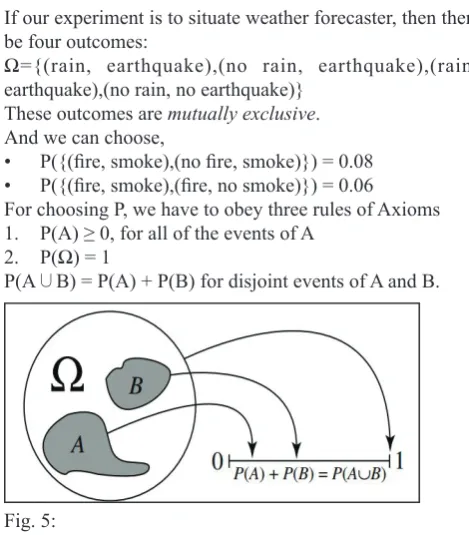
For choosing P, we have to obey three rules of Axioms P(A) ≥ 0, for all of the events of A
1.
P(Ω) = 1 2.
P(A∪B) = P(A) + P(B) for disjoint events of A and B.
Fig. 5:
Now for defining P we can assign a value to each one of the outcome ω ∈ Ω:
Rain No Rain
Earthquake 0.01 0.05
No Earthquake 0.02 0.92
Probabilities of all other events can be evaluated by the axioms: = P({(rain, earthquake)}) + P({(no rain, earthquake)})
= 0.01 + 0.05 = 0.06
We will use notation P(A) for saying A is true under all possible conditions and that’s called Prior probability.
P (event) = 0.5, then the agent allocate the event with probability of 50% of happening of that event. It is also important to remember that agent allocates the probability of 50% if and only if there is not any other information. But, if there is another information as B then, we will use Conditional Probability with notation P (A | B).
Example of Conditional Probability:-P is defined
by:-Rain No Rain
Earthquake 0.01 0.05
No Earthquake 0.02 0.92
Then, P ({(rain, earthquake)} | {(rain, earthquake), (no rain, earthquake)})
= P ({(rain, earthquake)} ∩ {(rain, earthquake), (no rain, earthquake)}) P ({(rain, earthquake), (no rain, earthquake)}) = P ({(rain, earthquake)}) P ({(rain, earthquake), (no rain, earthquake)})
=
By the definition of conditional probability we can infer three
rules:-1. Product rule, multiply by P (A) in the formula of conditional probability. We get,
P(A ∩ B) = P(A)P(B | A)
The chance that A and B each happen is that the chance that A happens times the chance that B happens, given A has occurred. 2. Chain Rule: By Applying the product rule multiple times we
get:
P ∩ki=1Ai = P(A1)P(A2 | A1)P(A3 | A1 ∩ A2)· · ·P Ak | ∩k−1 i=1 A
3. Bayes’ Rule: By dividing product rule by P (B) we get:
P(A | B) =
) ( A)P(A)
| P(B
B P
having strep throat is 1/30. Let B is showing happening of bacterial disease and S is showing happening of strep throat.
P(S\B) = 0.5 P(B) = 1/8000 P(S) =1/30
P(B/S) =
P(S)
B)P(B)
\ P(S
= 0.5 x 1/301/8000
= 0.003
Hence, by using probability theory we can withdraw degree of belief and accordingly we can infer our conclusions.
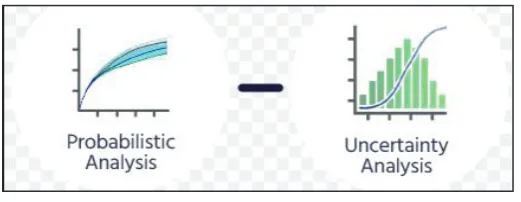
Fig. 6:
V. Conclusions
Many philosophers came into existence much longer before than computers, technology, AI, etc. All those studied the human mind and raised multiple questions regarding the logical working of brains. Dennett, in 1984, said that Philosophers may give the answer of questions of “How…?” but unable to give the answers of questions of “Why…?” [15] This follows to AI, which can solve this query. In this Paper, we talked about the same approach as agents working in complex environments. First, we discussed the complete rationality and making rational agents with KB (knowledge base), their language i.e. knowledge representation language. Further, the components of KRL are syntax and semantic. We choose our language as First-order logic for making sentence comprehensible by changing it into variables and show the programming of the First-Order Logic. Now, we have sentences and the next step is inference (which is very important to give conclusions). We show three laws (Universal Elimination, Existential Elimination, and Existential Introduction) that can be used for withdrawing inferences. Furthermore, we present definite conclusion which is our purpose as the conclusion is more of use. Definite conclusion (choosing the more appropriate conclusion) bears Degree of Belief which is measured by Probability theory more often by using Bayes’ Law. In conclusion, the question posed in the introduction section of this paper — “Does artificial intelligence accounts for better reasoning in terms of more accurate information when there is uncertainty while giving decisions?” Logically “Yes” than human intelligence. However, more researches yet to be done in this Psychological scientific area to find out whether machines can depict the same (or better) functioning than the human brain.
VI. References
[1] Herbert B. Enderton,"A Mathematical Introduction to Logic Second Edition", Harcourt Academic Press, Burlington MA, 2001.
[2] Davis, Randall; Howard Shrobe; Peter Szolovits,“What Is a Knowledge Representation?”. AI Magazine. 14 (1): pp. 17–33, 1993.
[3] Schwitter, Rolf,“Controlled natural languages for knowledge representation”, Proceedings of the 23rd International Conference on Computational Linguistics: Posters. Association for Computational Linguistics, 2010.
[4] Krishna, S,"Introduction to Database and Knowledge-base Systems", Singapore: World Scientific Publishing, 1992. [5] Stan Franklin, Art Graesser,"Is it an Agent, or just a Program?:
A Taxonomy for Autonomous Agents", Proceedings of the Third International Workshop on Agent Theories, Architectures, and Languages, Springer-Verlag, 1996. [6] Michael Sipser,"Introduction to the Theory of Computation",
PWS Publishing, 1997.
[7] Russell, Stuart J.; Norvig, Peter,"Artificial Intelligence: A Modern Approach (2nd ed.), 2003.
[8] Simon, Herbert,“Bounded Rationality and Organizational Learning”, 1991.
[9] Goertzel, B., Geisweiller, N., Coelho, L., Janičić, P., Pennachin, C.,"Real-World Reasoning: Toward Scalable, Uncertain Spatiotemporal, Contextual and Causal Inference (Amsterdam & Paris: Atlantis Press, 2011), pp. 29
[10] Herbert Enderton,“A Mathematical Introduction to Logic”, (2nd Edition). Academic Press, pp. 296-299, 2001.
[11] Copi, Irving M.,"Symbolic Logic", 5th edition, Prentice Hall, Upper Saddle River, NJ, 1979.
[12] McCarthy, J. (1959). “Programs with Common Sense” at the Wayback Machine (archived October 4, 2013). In Proceedings of the Teddington Conference on the Mechanization of Thought Processes, 756-91. London: Her Majesty’s Stationery Office.
[13] William Feller,“An Introduction to Probability Theory and Its Applications”, (Vol. 1), 3rd Ed, (1968), Wiley.
[14] William Feller,“An Introduction to Probability Theory and Its Applications”, (Vol . 1), 3rd Ed, (1968), Wiley.
[15] Dennett, D. C. (1978),"Brainstorms: Philosophical Essays on Mind and Psychology (MIT Press 1981)".
Mradul Mourya received his high school graduation from Delhi International School, Indore, Madhya Pradesh, India, in May 2016. His primary subjects at the high school included Physics, Chemistry, Mathematics, English and Physical Education. His research interests include Artificial Intelligence and cognitive science. At present, he is researching on Improvements in deductive reasoning.