An Efficient Multipath Routing Protocol with
Replication for On-demand Video Streaming in
MANETs
1
R. Raja Sekhar 2 Dr. P. Chennareddy
1
Assistant Professor in CSE, JNTUA College of Engineering, Anantapuramu, Andhra Pradesh-515002, India
2
Professor in CSE, Jawaharlal Nehru Technological University Anantapuramu Anantapuramu, Andhra Pradesh-515002, India
Abstract – Mobile Ad hoc Networks (MANETs) are becoming more essential to wireless communications due to growing popularity of mobile devices. On-demand video streaming over wireless networks is an increasingly important and attractive service to the mobile users. However, MANETs do not seem to effectively support multimedia applications and especially video transmission due to certain limitations like rapidly changing connectivity, network partitions, high error rates, collisions, limited bandwidth and power constraints. In this paper, we proposed and implemented EMRP_R (an Efficient Multipath Routing Protocol with Replication) based on the forecasting of parameters of nodes or routes that effect the performance for on-demand video streaming in MANETs. The main objective of the proposed work is to provide a smooth on-demand video streaming with minimum packet loss. Simulation was carried out in NS2 and the results obtained show that the proposed approach will improve the quality of on-demand video streaming when compared to the other existing approaches.
Keywords – MANETs; Multimedia Applications, On-Demand Video Streaming, Multipath Routing, Replication.
1. Introduction
1.1.Streaming in MANETs
Networks in which nodes are moving and communicating with each other via wireless medium with no infrastructure are said to be Mobile Ad-Hoc Networks (MANETs). These networks can be formed on fly with no prior establishment of any type of network supporting devices. The nodes in the network can be any type of mobile devices/wireless devices that can support LAN configurations. The nodes can move at ease and
communicate with each other without any dedicated routers. Each node is capable of acting as router for the traffic, source or destination depending on the requirement. The nodes cooperate themselves to cope up with the mobility of the nodes and configures themselves from time to time. This makes them very useful in situations like disaster recovery, establishment of networks temporarily or in emergency situations in which there is no pre-established infrastructure or lack of it. But the downside of these networks is their mobility due to which there is continuous change in network topology, interference in wireless access media, intermittent connectivity, frequent changes in routing path, limited energy and resources of the mobile nodes etc. These constraints make them challenging to use in real time applications like sensor networks, video streaming etc.
Video transmissions generally fall into two categories. One is downloading the entire video and then playing the video, which is not preferred by most of the users as the downloading of a video takes more time due to its large size in general. The other category is playing the video while the downloading is in progress, which commonly referred as on demand video streaming [3, 4]. Normally the playing of the video starts as soon as the sufficient number of frames are available to play the video. To continue the playing of the videos without any interruption, it should be ensured that there is a continuous feeding of the frames (streaming of the remaining frames) in a fixed time without fail. This makes the streaming most challenging task in networks like MANETs which are highly dynamic in nature [5, 6].
1.2 Role of Routing in MANETs for Video Streaming
Routing is the major concept that affects the transmission of packets from source to destination. MANETs employ a different kind of routing protocols when compared to those of wired networks due to their special characteristics. The conventional routing protocols for MANETs normally establish a single path between the source and destination with route establishment, maintenance and repair in case of failures. Single routing introduces delay in packet delivery in case of route failure, as it takes time to either repair the route or establish a new route. This causes the delay in delivering packets and makes it unsuitable for video streaming, in which the delay is not tolerated. A better solution is to establish multiple paths between source and destination and lead to the reduced probability of packet loss bursts. This may also indirectly reduce congestion in the network by balancing the load among multiple routes. For video streaming to work better, the multiple paths should be selected such that they match to the requirements of video transmission. The characteristics such as stability of the path, load distribution in the intermediate nodes, the energy levels of the participating nodes in the routes strongly affect the effectiveness of the routes selected. The multipath routing provides the advantages like load balancing, speed recovery from failures, more available bandwidth and are preferred to the single routes [7]:
This suggests us to use a good multipath routing algorithm for video streaming in MANETs. Many research works are going on this topic. Till now, there are no guidelines to fix the optimum number of routes for streaming. This is due to the reason that this factor always depends on the network configuration(s) under consideration such as the number of nodes, speed and movements of the nodes, frequency of topology change, stability of the nodes, energy of the nodes and many more.
In this paper, we proposed and implemented a dynamic multipath routing technique with replication for on-demand video streaming in MANETs. The main objective of the proposed work is to provide a smooth on-demand video streaming with minimum packet loss.
2. Literature Survey
A few researches have been done in this area. In this section we review some of the previous works done on video streaming in MANETs.
NDMP-AODV [8] is node disjoint multipath routing protocol that establishes multiple paths between source and destination. It takes the help of conventional AODV protocol to find the routes. The data transmission begins immediately as soon as the first route is formed. Then protocol proceeds to find a backup route concurrently. When the primary route fails to deliver the packets, the secondary route is selected immediately to transfer the packets. Meanwhile the source finds a new route to the destination. The protocol also requires that the intermediate nodes should also store multiple paths to the destination to avoid paths with common nodes or links. It is shown by simulation that the protocol provides better performance over conventional single path routing methods in terms of route availability, control overhead, average end to end delay and packet delivery ratio.
As the data is transmitted immediately after the first route is detected and do not wait for the new route discovery in case of a route failure, NDMP-AODV provides low end to end delay. The authors suggest improvements in the route selection process to match to the user or application requirements. This protocol is well suited to the applications like on demand video streaming, real time systems which need high data transmissions and less end to end delay.
In [10], a multipath routing algorithm is proposed which considers the best energy level route. The link failures due to the nodes mobility are also handled. As multiple paths are available, the average end to end delay is reduced and provides the better video streaming. The source uses alternate paths in case of the transmitting route failure. The algorithm lacks of a best energy management and also security concerns.
In [11], the authors have proposed a multipath routing specific to MPEG-2 videos. They concluded that the optimal number of paths for streaming MPEG-2 video is three. The three paths are used to stream the three different frames, namely I, P and B frames. Based on the priority of the packets, the routes are selected. This ensures that the video can be played during streaming without any disturbance.
Jiazi YI et al[12] have proposed a protocol to improve the delivery of H.264/SVC video streams in MANETs. The protocol considers to improve the Quality of Experience (QoE) measurements like PSNR and the protected data with higher priority over the packet loss networks. The underlying protocol used is MP-OLSR (Multipath Optimized Link State Routing) [12]. The MP-OLSR is used with Unequal Error Protection (UEP) scheme to achieve this. They have also developed a framework for H.264/SVC video transmission.
The traditional dynamic source routing has been modified to multiple paths by Monica et al. [13, 14]. The Multipath Multimedia Dynamic Source Routing, MMDSR, uses the Probe Messages to establish the routes. This protocol is used to meet the QoS requirements for video streaming in MANETs. Initially the DSR is used to find multiple paths. The protocol then tries to grade the routes found by using the probe message packets. The source sends a Probe Message (PM) packet, to the destination in each of the routes. The destination, after receiving the first PM packet, starts a timer. It keeps on receiving the PM packets from multiple routes until the timer expires. It discards the remaining PM packets received after this time, since they are received through paths which are having higher delays due to many reasons. The destination then generates a Probe Message Reply, PMR, packet for each of the PM packets received by each route. The destination fills the PMR with QoS parameters calculated by the destination from the samples available in each of the PM packets, which are filled by the nodes in each path. Now the paths are graded by the source and the video packets are sent through three best paths to the destination as per the priority of the packets.
Another such protocol which finds the multiple routes and labels the routes with different qualities is AODV with
multiple alternative paths (AODV-MAP) proposed by Vaidya et al. [15]. The highest priority packets of the video such as base layer are sent through a path labeled as primary path and the other layers are sent through the paths labeled as node disjoint path and fail safe path. Another protocol that improves the video streaming in MANETs is proposed by George Adam et al. [16] which makes use of the MAC layer information and feeds it to the transport layer protocol, TCP Friendly Rate Control (TFRC) and the network layer. In this design, the reason for packet is expected beforehand by sensing the Signal to Noise Ratio (SNR) from MAC layer. Based on this, the reason for packet loss is estimated by using a threshold value. If the packet loss is due to congestion, the TFRC acts, else the networking layer searches for alternate route and continues the streaming in the alternate path. Simulations show that the protocol performs better compared to the TFRC protocol alone.
3. Multipath Routing with Replication
Unlike the other protocols discussed so far, our proposed protocol uses the replication concept along with the multiple routes from source to destination to compensate for the packet losses due to various reasons.
Initially to find the route, the protocol uses two types of control messages: i) Route Request Messages (RREQ) and ii) Route Reply Messages (RREP). The source node starts the route discovery by flooding the RREQ messages into the network. Every intermediate node that is receiving the RREQ forwards the message to its neighbors only once by avoiding any duplicate broadcasting of the RREQ. The duplicate RREQ messages are prevented from broadcasting to the neighbors by maintaining a table, namely RReqRecd Table. AnRReqRecd table is maintained in each intermediate node to check the duplication of RREQs that are transmitted by it to its neighbors. RReqRecd table stores two values of each RREQ in the corresponding record: i) Source IP address and ii) Flooding ID of RREQ (f_id). Upon receiving RREQ, every intermediate node checks it with the available entries and discards the RREQ if it is a duplicate; otherwise it forwards the RREQ and updates the Seen Table.
(b_id) to it. Then the destination waits for at least two duplicate RREQ messages to be received from the same source, in given threshold time. The destination node reply to at least two RREQ messages. The maximum number can be decided by the application and user requirements. The threshold by which the destination waits for duplicate RREQ may be decided by the nature of the network configuration.
When the destination sends the RREPs, each node in the path including the destination node adds its node efficiency NE(n) value. After all the RREP’s are received by the source node, for every RREP received by the source node, it adds its node efficiency NE(n) value and calculates the route efficiency (RE) value for each route, which is the measure of the efficiency of the route.
3.1 Route Efficiency Estimation, Selection and Video Transmission
In order to find more efficient routes for video transmission in MANETs, we find efficient routes by using a new value calledroute efficiency (RE) value, which is a measure of the efficiency of the route.
The route efficiency RE(p) of a route is equal to the lowest node efficiency value NE(n) of the node in a path and is greater than a threshold value ω. RE(p) is given in Eq(1):
RE(p) = MIN (NE(SourceNode),...N E(IntermediateNode), …NE (DestinationNode)) (1)
where RE(p) > ω, the selecting value for route efficiency.
3.1.1 Node Efficiency Estimation
In the proposed approach, the estimation of the node efficiency NE(n), of a node n, is considered to be based on three different parameters e.g. Energy Forecast(EF), Stability Forecast(SF)and Traffic Load Forecast(TLF). The proposed simple linear equation for node efficiency NE(n)of a node n is given in Eq.(2).
NE(n)= a*EF(n) + b*MF(n) + c*TLF(n) (2)
where a, b, c, are weighing factors for the corresponding parameters. All three parameters, with values ranging from 0 to 1, are chosen so that a + b + c = 1. These values are kept flexible so that they can be changed as per the network scenario.
In the computation of NE(n) above, EFis the forecasting of energy level of node. When energy of each intermediate node is empty, it is impossible to communicate and link break occur. MFis the mobility forecasting of node that indicates the stability of a node.MN implies node stability
and hence the stability of route. TLFis traffic load forecasting of a node. Less the traffic load, more the successful delivery of packets.
a. Energy Forecasting of a node
In energy estimation, the Energy Level EL of a node n depends on the available energy EA of a noden which depends on total initial energy and consumed energy [17]. Available energy of node n is given in Eq. (3).
EA(n)= TE(n) – EC(n) (3)
TE(n) is the total initial energy of node n and EC(n) is the consumed energy of node n. The energy consumed EC(n) depends on transmitting (E_transmit) and receiving (E_received) one packet is given in Eq. (4).
EC(n) = E_transmit (n) + E_received (n) (4)
In our model, we use the available energy of a node EA(n) to forecast the node capacity to sustain in future for routing. This is done by using the weighted move average method. If Et-2, Et-1, and Etare the consumed energy in the
last three time periods, then the energy for the next time period is forecasted by using the Eq. (5).
EForecastn= 0.2*Et-2 + 0.3* Et-2 + 0.5*Et-1 (5)
The EForecastn is normalized to a value of 1, as given in
Eq. (6).
EF (n) = 1 if EForecastn / RTT >= 6
= 6 / (EForecastn / RTT) otherwise (6)
where RTT is the RoundTripTime of the route for which node n is acting as intermediate node (including destination).
b. Node Mobility Factor Deciding Model
We forecast the node n’s moving average using the weighted moving average, as given below.
The mobility forecast of a node n, MForecast (n), iscomputed by using the Eq. (7).
MForecast(n) = 0.2 * Dt-2 (n) +0.3 * Dt-1 (n)+0.5 * Dt (n)
(7) Dt (n) is the distance covered by node n in time slot t, from position Pt-1(x, y) to Pt(x, y),which is
calculated using Euclidian Distance formula as given in Eq. (8).
ܦ௧ሺ݊ሻ = ඥሺݔሺ݊ሻ௧− ݔሺ݊ሻ௧ିଵሻଶ+ ሺݕሺ݊ሻ௧− ݕሺ݊ሻ௧ିଵሻଶ
(8)
The MForecast (n) value is now used to calculate the chance of the node moving away from the route or near neighbors in next 6 time units using Eq. (9).
MF (n) = 1 if TR (n) / MForecast (n) >= 6 = 6 / (TR (n) / MForecst (n)) otherwise. (9)
where TR(n) is the transmission range of the node n.
c. Traffic Load Forecast
Traffic Load Forecast for a node is defined as the normalized value of traffic load that is estimated by using the weighted moving average over the past three normalized traffic load values in the past three time slots or periods. Usually the one time slot is chosen to be the RTT value. The traffic load forecasting of a node n is given by the Eq. (10).
TLF(n) = 0.2 *NTLt-2(n) + 0.3 *NTLt-1(n) + 0.5 *NTLt
(n)
(11) where NTLt(n) is the normalized traffic load of node n at
time slot t and is computed by Eq. (12).
NTLt (n) = 1 if the (routing) queue of the node
was full at any moment in the time period t
= MQL / CQ (12) Where MQL is the maximum occupied queue length in the last three time slots and CQ is capacity of the queue.
d. The Routing Process
In the present work, we have assumed that in the network, each mobile node sends messages to any other node with a
uniform rate.The proposed scheme estimates the RE(p) of each route formed. After finding the RE(p) for each path, the path with minimum RE(p) is selected as a primary path and the path with next minimum value is selected as the secondary path.
After the primary and the secondary paths are discovered, the source node starts transferring actual video data packets to destination through the primary route and the redundant copy of the video data packets through the secondary path to the one-hop neighbor of the destination node and periodically checks the efficiency of both the primary and the secondary routes. All the other node-disjoint routes that are discovered will be stored in the routing table as back up for route maintenance process. After storing the primary route and a specified number of secondary routes in the routing table (the number routes that are to be stored or cached can be chosen depending on the network characteristics), all the other routes (if any) are discarded. During the transmission if any of the primary or secondary routes efficiency falls under the given threshold (a route’s RE(p) value less than a predefined threshold value) at some instance of time and/or a link/route breakage is detected along the route, the source node then initiates a maintenance process in order to continue smooth video transmission.
3.2 Route Maintenance Process
To recover from the route failure either from link breakage and falling less than the threshold the Source node initiates a maintenance scheme. In this scheme, the Source node periodically calculates the REs of all the routes from source to destination. If primary route fails; destination node sends request to all its one-hope neighbors for the missed video packet. The one-hope neighbor which stored the missed redundant segment responds to the request and sends it to the destination and the secondary route which included this neighbor is extended up to destination and this route becomes the primary path. Mean while Source S finds another secondary route to transmit redundant video segments. Source continues its transmission by this new primary route and redundant segments through another new secondary route. If the secondary route falls under the threshold or breaks, S routes the redundant packets through another route and considers it as the new secondary route.
The overall conceptual algorithm of the proposed approach is as follows.
1. Node D REQUEST a video transmission from S.
3. Source S FINDsNode Disjoint Multiple Routes to D using AODV-Multipath algorithm.
4. One route which is having the high rank (based on three parameters i.e. residual energy of the nodes, stability of the nodes and traffic load of the nodes in the route) is SELECTed as the Primary route and the route with next low rank is selected as Secondary route.
5. Source S STARTs TRANSMITtingfirst segment to D through the primary route and redundant segment through the secondary route up to the one hope neighbor of D.
6. This process continues until the primary route or the secondary fails or the rank of primary or the secondary routes falls under a given threshold. (S periodically MONITORs the strength of the primary route and secondary routes).
7. If primary route fails; node D GETs the Dropped Segment from its one hope neighbor which stored the redundant segment by making a request.
8. Mean while S now makes the secondary route as the primary route and finds another secondary route.
9. S continues its transmission by this new primary route and redundant segments through another new secondary route.
10. If the secondary route falls under the threshold or it breaks S routes the redundant packets through another route and considers it as the new secondary route.
11. If the one hop-neighbor which is storing the redundant segments is moving far from its location, then it relocates its redundant segments in to another node which is nearer, stable and having high residual energy and updates the route.
4. Simulation and Performance Evaluation
In this section, we illustrate the feasibility and effectiveness of the proposed video streaming approach in the NS-2 simulator and compare it with NDMO-AODV and Cross-layer design with TFRC approaches based on various performance metrics like packet delivery ration (PDR) and quality of video etc.
The detailed simulation parameters are listed in Table 1.
TABLE 1. Simulation parameters
Parameter Values
Simulator NS2
Simulation time 700sec
Simulation area 1200x1200 sq.meter Number of nodes 50
Transport protocol UDP
Routing protocols PROPOSED, NDMP-AODV, AODV
Mobility model Random way-point Pause Time 0 to 250 sec
Video One segment of the India's Biggest Motion Picture Baahubali
Video Codification H.264SVC Number of Primary
Routes
01
Number of
Secondary Routes
01
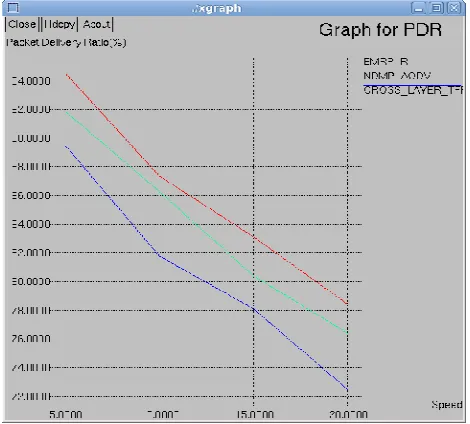
Figures 1a and 1bshows the packet delivery ratio (PDR) of the proposed approach compared with NDMO-AODV and Cross-layer design with TFRC approaches. The PDR (Number of video packets delivered) obtained with the proposed approach is high when compared to existing methods. The PDR is better than the other approaches because of using multiple paths to send the data from source to destination.
Fig. 1b. Packet Delivery Ratio
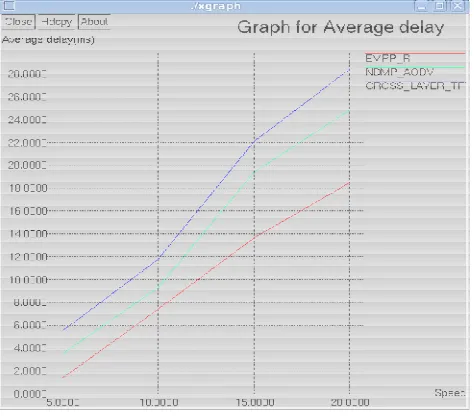
In Figures 2a and 2b the average delay is displayed for the three simulated scenarios. Since the proposed approach maintains replicas at the nearest neighbor of the receiver, delay will be minimized at the receiver side.
Fig. 2a. Average Delay
Fig. 2b. Average Delay
In figure 3a and 3b the average throughput is displayed for the three simulated scenarios. Since the proposed approach maintains a replica of the packets,throughput i.e., the rate of successful message delivery is high.
Fig. 3b. Average Throughput
In figure 4a and 4b the average PSNR is displayed for the three simulated scenarios. We can observe that the use of multiple paths leads to the improvement of average PSNR. This means that the proposed method greatly reduces the video frame losses, and thus allows for a better video display quality at the receiver side.
Fig. 4a. Average PSNR
Fig. 4b. Average PSNR
5. Conclusion
In this paper, we proposed a dynamic node disjoint multipath routing with replication scheme for on-demand video streaming inMANETs based on AODV protocol. The proposed approach takes three vital parameters, namely node’s residual energy, stability and traffic load, into account for constructing node disjoint multipath routes. This approach uses a primary and a secondary route to deliver video data packets, so that it avoids packet losses which are caused by using only one route. Due to multiple routes available in routing video data, video data is always made available for the receiver node even though one of the routes is broken. The replication scheme is used to store the replica of the packets at the one hop neighbor to the destination in the secondary route. Simulation results show that the proposed approach is able to provide high packet delivery ratio and good video quality by keeping packets available all the time to the receiver. The approach may be extended to improve the availability of the video data packets more even in the situation where the nodes storing the replicas are moved away from the receiver.
References
[1] H. Tafazolli, “A Survey of QoS Routing Solutions for Mobile Ad Hoc Networks”, IEEE Communications Surveys & Tutorials, Vol. 9, No. 2, pp. 50–70, 2007. [2] Janio M. Monteiro, Carlos T. Calafate, and Mario S.
Transactions on Broadcasting, Vol. 54, No. 3, September 2008, pp. 652–659.
[3] D. Wu, Y. T. Hou, W. Zhu, Y-Q. Zhang, and J. M. Peha, “Streaming Video over the Internet: Approaches and Directions, ” IEEE Transactions on Circuits and Systems for Video Technology, Special Issue on Streaming Video, Vol. 11, No. 3, pp. 282-300, 2001. [4] D. N. Sujatha, K. Girish, and K. V. Rajesh, K. R.
Venugopal, L. M. Patnaik, “Preemption-Based Buffer Allocation in Video-on-Demand System,” International Conference on Advanced Computing and Communications, ADCOM ‟06, pp. 523- 528, 2006. [5] X. Zhu, and B. Girod, “Video Streaming over Wireless
Networks,” In Proceedings of European Signal Processing Conference, EUSIPCO`07, pp. 1462-1466, 2007.
[6] V. Vassiliou, A. Pavlos, G. Iraklis, P. Andreas, “Requirements for the Transmission of Streaming Video in Mobile Wireless Networks,” International Conference on Artificial Neural Networks, ICANN‟06, pp.528-537, 2006.
[7] Stephen Mueller, Rose P Tsang, and DipakGhosal. Multipath routing in mobile ad hoc networks: Issues and challenges. In Performance Tools and Applications to Networked Systems, pp.209-234. Springer, 2004. [8] C. Lal ,V.Laxmi, M.S.Gaur, “A Node-Disjoint
Multipath Routing Method Based On Aodv Protocol For Manets”, 26th IEEE International Conference On Advanced Information Networking And Applications, 2012.
[9] Utkarsh, Mukesh Mishra And SuchismitaChinara ,” ESAR: An Energy Saving Ad Hoc Routing Algorithm For MANET” , Advanced Computing (Icoac), 2012 Fourth International Conference On IEEE 2012. [10] Smail Omar, MekkakiaZoulikha, Bernard Cousin
“Energy Efficiency In Ad Hoc Wireless Networks With Node-Disjoint Path Routing”Systems, Signal Processing And Their Applications (WOSSPA), 2011. [11] Frias, V.C., Delgado, G.D., Igartua, M.A.: Multipath
routing with layered coded video to provide QoS for video-streaming over manets. In: 14th IEEE International Conference on Networks, 2006. ICON ’06, vol. 1, pp. 1–6 (2006).
[12] Jiazi Yi, AsmaaAdnane, Sylvain David, and BenoˆıtParrein, ―Multipath optimized link state routing for mobile ad hoc networks,ǁ Ad Hoc Networks, vol. 9, no. 1, pp. 28–47, 2011.
[13] Monica A. Igartua, Victor .C. Frias, “Self configured multipath routing using path lifetime for video streaming services over Ad Hoc networks,” Computer Communications , pp. 1-32, 2010.
[14] S.J. Lee and M. Gerla, “Split multipath routing with maximally disjoint paths in ad hoc networks,” IEEE ICC, Helsinki, Finland, pp. 3201–3205, June 2001.
[15] Vaidya, B., Ko, N.Y., Jarng, S.S., Han, S “Investigating voice communication over multipath wireless mobile ad hoc network.” ICUIMC ’08: Proceedings of the 2nd International Conference on Ubiquitous Information Management and Communication, New York, NY, USA, pp. 528–532. ACM (2008).
[16] George Adam et.al, “A Cross-layer Design for Video Transmission with TFRC in MANETs”, Proceedings of the DCNET 2012 - International Conference on Data Communication Networking, pp. 5-12.
[17] Sumit Kumar Singh, Shiva Prakash and Kapil Kumar. (2011). Energy Aware Dynamic MANET Ondemand (EA-DYMO). International Journal of Computer Applications, 25(11), pp12-16.
[18] Shiva Prakash, S.C. Gupta, J. P. Saini, Sandip and Vijay. (2013). Design and Implementation of Variable Range Energy Aware Dynamic Source Routing Protocol for Mobile Ad Hoc Networks. International Journal of Computer Engineering and Technology. 4(1), pp105-123.
[19] SuchismitaChinara, and Santanu Kumar Rath. (2008). Energy Efficient Mobility Adaptive Distributed Clustering Algorithm for Mobile Ad Hoc Network. 16th IEEE International Conference on Advance Computing and Communication, pp265-272.
[20] MaysamHedayati, Hamid Reza Hoseiny, SeyedHosseinKamali and Reza Shakerian. (2010). Traffic Load Estimation And Load Balancing In Multipath Routing Mobile Ad-Hoc Networks. IEEE International Conference On Mechanical and Electrical Technology, pp117-221.
R. Raja Sekhar receivedB.Tech degree in Computer Science and Engineering in 1999 from S.V. University, Tirupati, M.Tech degree in Computer Science from JNTU, Hyderabad in the year 2006 and currently pursuing Ph.D. in JNTUA, Anantapuramu, A.P., India. He has been working Assistant Professor in JNTUA College of Engineering, Anantapuramu, India since 2006. His research interests include mobile adhoc networks, data structures and algorithms.