Capturing Streaming Data from Wireless Sensor Networks
Using Middleware and its Presentation in Real-Time
Dr. Kamlendu Kumar Pandey
Dept of Information and Communication Technology, VNSG University, Surat, Gujarat, India
Abstract
Wireless Sensor Networks are known for the sensor nodes sensing the data and disseminate the data into its network. The disseminated data finally reach the sink node. The huge volume of data needs a real time handling at the station where Sink node is installed. The paper shows the use of a middleware software required for handling and storing the data into a predefined format. This paper also shows how to show the data in real-time using its presentation in form of instantaneous graphs. A warning system is also presented in the paper if the the value of data goes above or below threshold level.
Keywords
Wireless Sensor Network, Sensor Middleware, Sensor Streaming Data, Virtual Sensors, Real-Time Sensor Data Capturing
I. Introduction
The use of Wireless Sensor Networks is now becoming more prevalent in various problem areas from environmental monitoring to surveillance and vehicle tracking. This technology is now coming out of labs to actual implementation in the fields. The biggest challenge of this network is the speed and quantity of data sensed and disseminated in the network. All the data is finally coming to Sink node. The data if not captured from sink node to some storage will simply be lost. So there has to be some good mechanism where all the packets which come to the sink node must be taken carefully. The packets should be read for the data as per the packet structure of sensors. The Middleware comes as a great help here. A Server based arrangements which can be configured for diverse time of sensing equipments must be used to deal with the data and store the data into the way the organisation wishes. The storage can very from a xml file to a sophisticated RDBMS. After being stored it is required to present the data to get its real utility and decision making based upon the nature and the trend of the data captured. This paper uses GSN a famous middleware developed by Ali Sulehi , describes all the steps from installation of middleware , custom code writing for storage of data. Finally the storage data is represented in instantaneous graphs with warning system.
II Related Work
After the aggregated data reaches the sink it is handled by application middleware sitting on the high-end servers and web based applications. The applications which deal with the sensed data are called Sensor Middleware. A lot of work is done in this category. Nader and Al-Jaroodi [1] have done an excellent survey on the middleware being used in the sensor networks. SstreamWare [2] is a sensor mediator SOM that provides a query service to access data issued by heterogeneous sensors. The main objective is to provide a hybrid solution focusing on sensor heterogeneity management, scalability, and complex query evaluation. Sensor Web 2.0 [3] is developed to support the Open Geospatial Consortium’s (OGC) efforts, the Cloud Computing and Distributed Systems (CLOUDS) Laboratory at the University of Melbourne, are working on the SensorWeb
project (NICTA Open Sensor Web Architecture (NOSA)). In this project, the team discusses an SOM to support data collection and manipulation across heterogeneous sensor networks. It provides the following sensor services: (1) sensor notification, collection, and observation; (2) data collection, aggregation, and archival; (3) sensor co-ordination and data processing; (4) faulty sensor data correction and management; and (5) sensor configuration and directory service. OASiS [4] is an object-centric, service-oriented, ambient-aware sensor network applications development model. It defines the logical elements necessary to support a wide variety of WSN data flow applications. It defines a programming framework that facilitates separation of concerns for application development through a multilayer development process. The core sensor network functionalities are bundled as middleware services including service discovery, service graph composition, failure detection, and node management. Global Sensor Networks , GSN [5] developed by Ali Sulehi is an excellent implementation of Sensor Middleware which works on Java classes representing Virtual Sensors, Wrapper Classes , Processing Modules with any popular databases. It has a web based interface to configure the middleware and generate data report of the server. Kobialka T et al [8] proposed a sensor middleware for heterogeneous conditions. Botts et al [7] describes how sensors can be integrated as part of Open GeoSpatial Consortium.
Looking to all the middleware GSN created by Ali Sulehi was considered to be the best due to its openness, scalability and scope to have modification in the current modules. The whole Middleware is in Java so it can be integrated very easily with any Java Integrated development environment like NetBeans or Eclipse. The GSN Middleware is configured for TinyOS 2.0 packet structure to get the data from SINK to the database server.
III. Working of Middleware
All the data packets in the network layer finally come to SINK or Gateway Node which attached to the High-end Machines like PC and Servers through a USB Port. The entire purpose of the data wireless sensor network will fail if the vast amount of important data generated by the network is not stored and analyzed at some point. Well, Middleware or the server based logic offer some solution here. These server based logic requires high end machines due to parse huge amount of packets and store the data into some relevant format or structure which can be used by the organization to classify, interpret, analyze and take relevant action for the problem concerned.
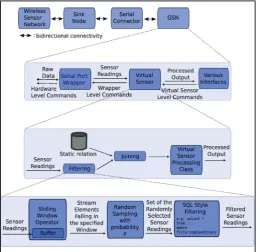
The sensed data after reaching the access point need to be gathered, stored and analyzed for the purpose of WSN deployment. After carefully studying various sensor Middleware described above in the literature survey, the global sensor network (GSN) developed by Ali Sulehi ET. Al. as project for World Geo-Spatial Consortium was considered to be the most accurate. This Middleware works as follows
from camera to sensor motes. In our case a Wrapper was written for motes with TinyOS and MIG message generated when the connected machines get the sensed data from access point. As this Middleware was tested for real crossbow motes a utility was developed in Java to sense the
Fig. 1: Working of GSN (Courtesy [5])
Incoming packets. Using the known packet format of tiny OS packets of MicaZ motes the data was converted into digital value. TinyOsWrapper written for this packet will push the data into XML. A virtual Sensor was developed to pull the data from database and populate the database from XML data.
A. Steps of Using GSN in Research
1. Installation
The GSN can be downloaded from source forge completely •
free of cost. It can be very easily installed with a machine having Java Development Kit in the PATH and CLASSPATH environment variable and MySQL
Fig. 2: GSN Home Page
Database server running on it. All we need to run an executable jar file with a configured ANT script to check dependency to
compile, build, package and run. The GSN Server runs on port no. 10000 by default and its user interface can be opened in the browser using http://localhost:22000 as URL
2. Writing a Wrapper for TinyOS 2.x
Two wrappers are written here to get the data from the Gateway or SINK node of Wireless Sensor Network.
DataWrapper for mig generated classes of tinyOS •
XMLDataWrapper to get the data from XML files produced •
by XSERVE and utility from memsic
(i). DataMessageWrapper
A MigMessageWrapper, reads MigMessage File generated by mig utility of tinyOS. The Mig File contains the complete packet structure of the sensors with their data type
A Java file generated from a mig utility of tinyOS using Mig looks like this
package gsn.wrappers.tinyos;
public class PayLoadMsg extends net.tinyos.message. Message {
/** The default size of this message type in bytes. */
public static final int DEFAULT_MESSAGE_SIZE =
26;
/** The Active Message type associated with this message.
*/
public static final int AM_TYPE = 128;
/** Create a new PayLoadMsg of size 26. */ public PayLoadMsg() {
super(DEFAULT_MESSAGE_SIZE); amTypeSet(AM_TYPE);
}
/** Create a new PayLoadMsg of the given data_length.
*/
public PayLoadMsg(int data_length) { super(data_length);
amTypeSet(AM_TYPE); } // ….... code continued....
The DataWrapper is written for the output produced by Mig Generated class.
MigMessageWrapper.java
public class DataMessageWrapper extends AbstractWrapper
implements net.tinyos.message.MessageListener {
/*Implements net.tinyos.message.MessageListener. messageReceived
public void messageReceived(int to, Message message) {
{
//code here…...
}}
(ii). XMLDataWrapper
Fig. 3: Running Xserve on Console
Fig 3 shows running of Xserve and it polls on port /dev/ttyS6 @57600. This is port of USB with a frequency of 57600 defaults for micaz
Xserve has much option to save the data we can show the data in verbose mode as well in a target XML file. The sample file is given as under.
<?xml version=”1.0” ?> <MotePacket><ParsedDataEle ment><Name>amtype</Name><ConvertedValue>11</ ConvertedValue></ParsedDataElement><ParsedDataEle ment><Name>nodeid</Name><ConvertedValue>1156</ ConvertedValue></ParsedDataElement><ParsedDataElement>< Name>parent</Name><ConvertedValue>0</ConvertedValue></ ParsedDataElement><ParsedDataElement><Name>gro up</Name><ConvertedValue>125</ConvertedValue></ ParsedDataElement><ParsedDataElement><Name>sock etid</Name><ConvertedValue>51</ConvertedValue></ ParsedDataElement><ParsedDataElement><Name>boa rd_id</Name><ConvertedValue>133</ConvertedValue></ ParsedDataElement><ParsedDataElement><Name>pack et_id</Name><ConvertedValue>134</ConvertedValue></ ParsedDataElement><ParsedDataElement><Name>volta ge</Name><ConvertedValue>3003</ConvertedValue></ ParsedDataElement><ParsedDataElement><Name>hum id</Name><ConvertedValue>45</ConvertedValue></P arsedDataElement><ParsedDataElement><Name>humt emp</Name><ConvertedValue>26</ConvertedValue></ ParsedDataElement></xml>
The XMLDataWrapper Simply parse the xml file and store the relevant data into a database with a predefined data structure which is created at the time of GSN installation. In our case the database is MySQL with database name “gsn”.
This wrapper writes the data of all the packets of all the motes into database if asked to do so. This is where Virtual Sensors come in picture.
(iii). Writing a Virtual Sensor
They are the final integrators and query processors to get the data from various motes and packets as per the requirement. They act a driving force for wrappers. The virtual sensors direct a wrapper to get the data as required by the system in the interval fixed by it. In our case two Virtual Sensors are written in Java
(a). DataSensorVS for sensing data and other weather parameters. This virtual Sensor uses MigMessageWrapper for getting the data. The piece of code below fetches the soil Data from the sensor.
public double getData(int rawValue) { if (rawValue >= 400) {
return (((rawValue * 2.5 * 1.7) / 4095.0) - 0.4) * 100.0;
} else {
return NO_VALUE; }
}
(ii). BridgeVirtualSensor (available in GSN) for getting the data from XML.
It uses XMLWrapper from getting the data.Both the virtual sensors need to implement AbstarctVirtualSensor Interface and override the initialize() and dataAvailableMethod(). Usually to make these virtual sensor more dynamic and configurable. We used from end XML configuration files
A sample XML for XML sensor is as follow. <virtual-sensor name=”DataSensor” priority=”11”> <processing-class>
<class-name>gsn.vsensor.BridgeVirtualSensor</class-name>
<output-structure>
<field name=”nodeid” type=”int”/> <field name=”voltage” type=”int”/> <field name=”humtemp” type=”int”/> <field name=”pressure” type=”int”/> <field name=”press” type=”double”/> </output-structure>
</processing-class>
<description>The VS demo the received sensor data from xBow sensor network.</description>
<life-cycle pool-size=”10”/> <addressing>
<predicate key=”geographical”>Room 106</predicate> </addressing>
<storage history-size=”1m” /> <streams>
<stream name=”input1” >
<source alias=”source1” storage-size=”1” sampling-rate=”1”>
<address wrapper=”sxml”>
<predicate key=”host”>192.168.0.110</predicate> <predicate key=”port”>9005</predicate>
<predicate key=”rate”>500</predicate> </address>
<query>select * from wrapper</query> </source>
<query>select * from source1</query> </stream> </ streams>
</virtual-sensor>
in this we can set the class of virtual Sensor, The Wrapper class, the interval of getting the data etc.
The combination of Xserve, Wrapper classes, Virtual Sensors and XML configuration files for virtual sensors are used to integrate the data from various motes in wireless Sensor Networks.
IV. Real-Time Data Presentation
The presentation service is build as a web application using following technologies
IDE : Netbeans and Eclipse •
Java Enterprise Edition : Using EJB, Web Services for getting •
the data on screen Java Server Pages •
JAX – Java API for XML •
JQuery •
JSGraph.js to have real time graphs •
Java Applets for warning system. •
MySQL data base server as data store. •
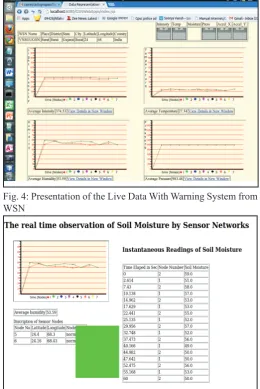
To get the data live on screen XSERVE and GSN both must be running along with Glassfish application server. This application will be a dashboard application to monitor the data and a warning system for all the sense entities. The facility exists to create the dashboard for individual parameters also. Not only graphs but the data can be seen in tabular for also. The data is refreshed at a user defined time interval.
Fig. 4: Presentation of the Live Data With Warning System from WSN
Fig. 5: Real Time Observation of Soil Data by Middleware Application
The graphs depicted the values of various physical parameters like temperature, pressure, humidity and soil Data. The application made it possible to configure the entire application with a web interface so that alarm settings and Geo-location Parameters can be set for the area and motes
The Fig. 5 shows a real time instantaneous observation of soil Data in the web application developed in search which interfaces the Global Sensor Networks, Middleware with the help of its Virtual Sensors and Wrapper classes and a TinyOS packet parser like Xserve or Serial Forwarder.
VI. Conclusion
The paper presents all the steps as how to deal with the fast streaming data coming from the sensor networks. As the sensors or sink node do not have the capability to store and process we require high-end machines. The use of open source Middleware called GSN is used to capture the data . The data is saved into XML and also in MySQL RDBMS. The utility Xserve (linux version) is used to capture the raw data and send it to the virtual sensors of GSN. Lastly all the data is processed to be represented graphically using programming platforms like Java, JQuery etc. The utility developed is also used for the warning system if the data goes below a predefined level. This way it will be very helpful for the new researchers to use WSN in the real systems.
References
[1] Mohamed, Nader, Jameela Al-Jaroodi,“A survey on service-oriented middleware for wireless sensor networks”, Service Oriented Computing and Applications 5.2 (2011), pp. 71-85.
[2] Levent G, Claudia R, Cyril L, Andre B, VincentO, "SstreaMWare: A service oriented middleware for heterogeneous sensor data management", In: Proceedings of ICPS, Sorrento, Italy, July 2008 pp. 121-130.
[3] Chu X, Kobialka T, Durnota B, Buyya R,"Open sensor web architecture: Core services", In: Proceedings of 4th international conference on intelligent sensing and information processing. Bangalore, India, pp. 98-103, 2006.
[4] Amundson I, Kushwaha M, Koutsoukos X, Neema S, Sztipanovits J (2006) OASiS: A service-oriented middleware for pervasive ambient-aware sensor networks", In: Pervasive and mobile computing journal on middleware for pervasive computing, October 2006.
[5] [Online] Available: http://folk.uio.no/paalee/referencing_ publications/ref-wsn-amundson_report2006.pdf
[6] K. Aberer, Ali Sulehi.,"The Global Sensor Networks, middleware for efficient and flexible deployment and interconnection of sensor networks”, Tech. Rep. LSIR-REPORT-2006-006, Ecole Polytechnique F´ed´erale de Lausanne, 2006.
[7] [Online] Available: http://lsirpeople.epfl.ch/hauswirth/ papers/LSIR-REPORT-2006-006.pdf
[8] Kobialka T, Buyya R, Leckie C, Kotagiri R,"A sensor web middleware with stateful services for heterogeneous sensor networks", In: Proceedings 3rd international conference on intelligent sensors, sensor networks and information processing (ISSNIP 2007). Melbourne, Australia, pp. 491-496, 2007.