Real Time Virtual Dressing Room
1
Nikita Deshmukh, 2 Ishani Patil, 3 Sudehi Patwari, 4 Aarati Deshmukh, 5 Pradnya Mehta
1, 2,3,4,5
Computer Department, SPPU, Pune, Maharashtra, India
Abstract -Real time virtual dressing room is used in shops, mall and any shopping center. Trying cloths in shopping center is actually a time consuming activity. Besides, it might not even be possible to try on clothes in such cases as online shopping. Our motivation is to increase time efficiency and improve the accessibility of clothes try on by creating virtual dressing room environment. Our aim is to build an interactive and highly realistic virtual machine on which the user can try cloths without wearing it actually.[8]
Keywords -Image Processing, Edge Feature, Face Detection, Skin Color Detection.
1. Introduction
Trying different cloths in store is very time consuming and tedious activity. It may also happens that after ordering the cloth from online shopping may not fit to the customer. So, Real time virtual dressing room is a concept where person buy clothes without wearing it actually. Recently, Virtual try-on of clothes from the given database has received too much attention due to its commercial potential. The detection of the user and the body parts is one of the main step in creation of real time virtual dressing room system. Suppose a person goes in the shop for buying the clothes. Then he selects the cloths from the database of clothes and he captures his photo. By using this virtual dressing room, the customer can see his picture with selected dress model. Then he decides whether to buy cloth or not. Face detection algorithm is used for determining the presence of person. Lower body detection algorithm is used for extracting the lower body of the customer by creating superimposed image with selected dress model and then it is displayed on the screen.[8]
There are various advantages of our system:
• It is used to make right choice for the size of
cloths without wearing it actually.
• It provides a platform for experimenting different
cloth styles.
• Main advantage is that the precious time of the
customer is saved by this virtual machine.
• It reduces the human effort for trying many
cloths
2. Literature Survey
In this paper, we mainly focus on designing the real time virtual dressing room. For implementing virtual dressing room, we need to recognize the user in the image and superimposed it with selected dress model. To identify the user, we are using face detection algorithm. Face detection is done by using haar classifier. Haar classifier is used for object detection. It is pre-trained classifier in OpenCV. It is very efficient and easy to use. But after face detection the unwanted faces also detected which are in the image. So, to identify the correct face, skin color detection algorithm is used. After face detection, we need to detect the lower body for superimpose the selected model on it. This can be done by lower body detection using haar classifier again. This algorithm is easy to implement. Euclidian distance technique is used to detect the distance between user and camera. By using this distance, the dress model is scaled. Hence, it is very easy to build real time virtual dressing room using suitable algorithms like skin color detection, face detection and lower body detection using haar classifier.
3. System Architecture
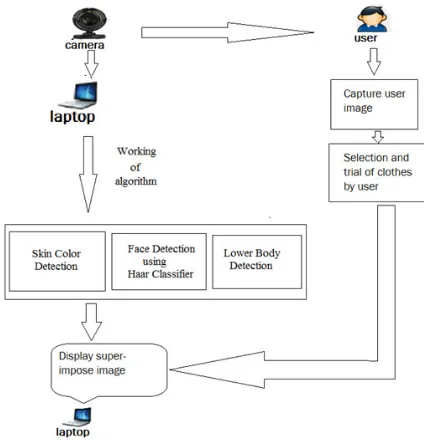
The camera continuously captures the image of the user and displayed on the desktop screen. Then user is extracted from that image by using haar cascade algorithm like skin color detection and face detection algorithm using haar classifier. Then user is allowed to select the cloth model from the given database.
of the user from camera. Then superimposition of the cloth model takes place on the user’s image. After that the superimposed image is displayed on the screen. If the user selects that model to buy, then remove that cloth model from the database and keep the user’s record. The system architecture of real time virtual dressing room is shown in the figure 3.1.
Fig. 3.1 System Architecture
Initially the user has to register his details with the application for the first time. The user has to enter the first name, last name, gender, etc. he also has to enter the userID and password for login purpose. So, registered user can login directly to use this application by using userID and password. Once the user registers, then he can use his userID and password to login in future. If the login is successful then home screen gets open.
The home screen contains the options like start app, update profile and view history, etc. The user will start the application. Then camera gets started. Then he captures the photo or video continuously and detects the face using haar classifier and rectangle is created around ROI. After detecting the face, in the same way lower body will be detected using haar classifier and rectangle is created around ROI. After detecting the face and lower body, the user will select the cloth for trying out virtually. After selecting the dress model, the superimposed image is displayed on the screen. It means that the selected dress model will get superimposed on the lower body of the user.
4. Algorithms and Formulae
4.1 Face Detection Algorithm
Face detection algorithm is used for checking whether the given input image contains any human face, and if face is present, returning the location of face in image. Face is an important thing for identifying presence of people. Here we are using face detection algorithm using haar classifier. Object detection for haar classifier is done by haar like feature. These features use the change in value of contrast between the adjacent rectangles. Here rectangle is a group of pixels. The haar like feature is formed using using two or more rectangles. The haar features can be easily scaled by maximizing and minimizing the size of the pixels. This haar feature is used for face detection. These haar feature is shown in figure 4.1, figure 4.2 and figure 4.3.[6]
Fig. 4.1 Edge Features
Fig. 4.2 Line Features
Fig. 4.3 Four Square Feature
Initially we need to load XML classifier in our system. The image of the user captured by the camera is loaded. Then we find the face. If face is detected, then it returns position of detected face as rect(x,y,w,h). After that we can create the region of the face as shown in figure 4.4. [7]
Fig. 4.4 Face Detection (ROI)
4.2 Skin Color Detection Algorithm
In skin color detection we are using YCbCr color space. It is widely used in image processing. Component Y is used for representing luminance information and color information is stored in two components, Cb and Cr. Cb is difference between the blue component and reference value. Cr is difference between red component and reference value. Cr and Cb are the red-difference and blue-difference chroma components respectively. The corresponding skin pixel is in the range which is specified below,
Y>80 85<Cb<135 135<Cr<180
Different people have different skin color. In this range any color of skin pixel like white skin pixel, black skin pixel is present. Skin color within the image can be segmented using histograms technique. The optimal threshold is determined by doing histogram analysis. First step is to transform the image from RGB to YCbCr color space. Then calculate the threshold using Cb and Cr from analysis of histogram. Filter stage or classifier is obtained from the threshold value. Skin Pixel Quantifier counts the pixel number with human skin. Then decision stage is used to classify the image according to the percentage of
the skin that present in the image. Figure 4.6 shows the proposed system for skin detection. [9]
Fig. 4.5 Proposed System of Skin Detection
4.3 Lower Body Detection Algorithm
Lower body detection is done by using Haar classifiers. Haar Classifier is used to detect the humans in a moving video; features like eye detection, face detection, upper body, lower body and full body detection. Haar classifier are instructed with the help of negative and positive samples of images and saved as .xml files. Haar cascades is Haar classifiers one of the function. Some cascades used in OpenCV to detect human are haar cascade_upperbody, haar cascade_lowerbody, haarcascade_fullbody, haarcascade_frontalface etc. Haar classifier uses Region of Interest (ROI) for detecting lower body. Figure 4.5 shows the flowchart for lower body detection using haar classifier.[5]
Fig. 4.6 Flowchart of lower body detection
separate window we apply the dresses on that window. So lower body detection algorithm using haar classifier is very efficient algorithm to use. [5]
4.4 Euclidian Distance Technique
The Euclidian distance formula is used to find the distance between camera and the customer. This Euclidian distance formula is used for scaling the cloth model on the customer’s image. If the distance between the customer and camera is large then scaling will be minimized and if the distance between customer and camera is small then scaling will be maximized. [10] Euclidian distance formula is given as
_____________
Distance ((x,y),(a,b))= √(x - a)² + (y - b)² (1)
Suppose x and y are the coordinates of camera. Similarly a and b are the coordinates of customer. [10]
5. Experimental Results
User needs to register before using the application. The registration can be done after filling the personal information. By using user name and password the user can login. The figure 5.1 shows the successful login of the user. After login, home screen page is opened which contains many options like start app, add product, view history, Update profile. The figure 5.2 shows the home screen. After starting an app, the camera will capture the photo of the user. Then face and lower body is detected as shown in the figure 5.3. After detecting the lower body, the user will select the dress model and that dress model is superimposed on the lower body as shown in the figure 5.4.
Fig. 5.1 Successful Login
Fig. 5.2 Home Screen
Fig. 5.3 Detection of face and lower body
Fig. 5.4 Superimposed Image
6. Conclusion and Future Scope
virtual machine is used by any non-technical person. It does not require much technical knowledge. So, it is user friendly. So it is an optimal addition for cloth store. Overall, the presented virtual dressing room seems to be good solution for quick and accurate try on of cloths virtually.
References
[1] Y. Gao. E. Petersson, and A.L. Brooks, “The Performance of Self in the Context of Shopping in a Virtual Dressing Room System,” “in press” HCI International 2014, 22-27 June, Creta Maris, Heraklion, Crete, Greece, 2014
[2] Kaoru Nakamura, “Basics.”, in The Kinect for Windows SDK Programming for C++, PlaS ONE, Volume 1, pp.34-103,(2012)
[3] Gary Btadski and Syouiti Madtuda,”Defined.” In Learn OpenCV, PloS ONE, Volume 1, pp.225-266,(2012)
[4] Toyobuki Tanisiri,”Kinect SDK Programming.” In Kinect Sensor image processing program. PloS ONE, Volume 1, pp.42-115,(2011)
[5] Masao Shimizu, “The detection of a pattern and the figure.” In Digital image Processing, PloS ONE, Volume 1, pp.202-219,(2011)
[6] P. Ian Wilson and Dr. J. Fernandez “Facial feature detection using Haar classifiers,” JCSC 21, 4(April 2006)
[7] J. Young Choi, Y. Man Ro and Konstantinos N. Plataniotis,” Color Local Texture Features for Color Face Recognition” in proceedings of IEEE Conference, 2011
[8] Volino P. Magnenat-Thalmann N. (2000) “Virtual Clothing-Theory and Practice”. Springer, Berlin Heidelberg.
[9] Yinghua Lu, Yuanhui Wangl, Xianliang Tong, Zebai Zhao 1, Hongru Jia, Jun Kong, “ Face Tracking in Video Sequences Using Practicle Filter based on the Skin Color Model and Facial Contour”, IEEE Tranas. Second International Symposium on Intelligent Information Technology Application, VOL. 29. No. 8, pp. 978-0-7695-3497-8. August 2007.