Exploring Science Curriculum Emphases
in Relation to the Alberta Physics
Program-of-Study
Man-Wai Chu
University of AlbertaUsing Roberts’ (1982, 1988, 1995, 1998, 2003) seven science curriculum emphases as its framework, this investigation into Alberta’s physics program-of-study found that pre-service and novice teachers reported focusing on four of the emphases—Structure of Science; Scientific Skill Development; Science, Technology, and Decisions; and Correct Explanation— while experienced teachers reported focusing on two of the emphases—Structure of Science and Everyday Coping. Other program-of-study aspects that were reported by teachers as being of high priority included holistic views of physics and student engagement, both of which fall beyond Roberts’ framework. Teacher participants focused on different aspects of the program-of-study as compared to a senior curriculum leader in Alberta (i.e., the program manager for secondary sciences in the Curriculum Branch of Alberta Education), suggesting a possible need for professional development for teachers to deliver the program-of-study as intended by Alberta Education. This research increases understanding of how teachers interpret a physics program-of-study with respect to science curriculum emphases.
Alberta programs-of-study, like subject syllabi in our education jurisdictions, are blueprints proposed to guide instruction in provincial/district classrooms. The philosophical foundations of such programs are embedded in attitude, knowledge, and skill outcomes and, in the case of the Alberta physics program-of-study, outcomes for science, technology, and society (Alberta Education, 2007). Teachers’ comprehension and interpretation of such programs-of-study directly impacts students’ experiences. Teachers’ interpretations of the programs-of-studies in science can be considered with reference to Roberts’ seven science curriculum emphases. These emphases are: "Everyday Coping; Structure of Science; Science, Technology, and Decisions; Scientific Skill Development; Correct Explanation; Self as Explainer; and Solid Foundation" (Roberts, 1982, 1988, 1995, 1998, 2003). Each curriculum emphasis represents a valuable and overt aspect of a science program-of-study that describes the goals and objectives of science education (Roberts, 1982). Roberts’ seven science curriculum emphases were chosen as a framework for investigating teachers’ interpretations of the program-of-study in physics on the basis that these emphases are answers to the question “Why are we teaching this?” Moreover, Roberts’ curriculum emphases are applicable to all disciplines of science education, as explained later in this paper.
This paper investigates the emphases on which teachers report that they focus on when planning and implementing the Alberta Education physics program-of-study. Physics was chosen as the subject of this research because the author taught physics and was interested in (a) understanding how teachers with different levels of classroom experience considered they delivered the program, and (b) exploring the beliefs that underpinned and guided their particular focus or foci. The findings from this study may be generalizable to other disciplines of science that tend to share similar characteristics.
Teachers’ decisions to focus on particular emphases are personal choices reflecting, sometimes tacitly, what they consider to be the most important aspects of science education (van Driel, Bulte, Verloop, 2008). Individual teacher’s perspectives of the goals and objectives influence the degree to which they address each of the seven curriculum emphases in their physics classes (Stock, 2010). Teachers may hold substantially different, yet valid perspectives of a program-of-study. These varying interpretations of a program may cause differences in the delivery of the subject from classroom to classroom and, thus, in students’ progress in attainment of the mandated learning outcomes. They also impact the implementation of the curricular expectations of Alberta Education. Researchers have speculated that aspects of the program-of-study that teachers consider most important are also dependent on their surroundings and the social trends that influence their thinking and teaching (Blades, 1997; Hodson, 1998; Roberts, 1982, 1988, 1995, 1998, 2003). This paper seeks to identify general trends in relation to pre-service teachers’, novice teachers’, experienced teachers’, and a curriculum leader’s perspectives of the Alberta physics program-of-study.
The paper is organized into four sections:
1. A review of Roberts’ seven science curriculum emphases and how these emphases are related to the Alberta physics program-of-study is presented.
2. The study’s research design and methodology is presented. 3. The results are outlined.
Purpose of the Study
The purpose of this study was twofold:
1. To examine whether there are differences between experienced, novice, and pre-service teachers, with respect to their self-reported prioritizing of select elements of the Alberta physics program-of-study.
2. To examine whether the reported priorities of those physics teachers match or otherwise those expressed by a member of the Curriculum Branch of Alberta Education who was responsible for writing and publishing the physics program-of-study.
Background
This section focuses on developments and changes that have occurred in Alberta’s physics programs-of-studies, and outlines Roberts’ seven curriculum emphases as the framework for this study. Previously, researchers have investigated teachers’ (a) curricular emphases (Roberts & Orpwood, 1982), (b) curricular intentions (Geddis & Roberts, 1998), (c) "what counts" in science education (Stock, 2010), (d) curricular components favored (Lin, Hu, & Changlai, 2005), and (e) curricular beliefs (van Driel, Bulte, & Verloop, 2008). However, no previous study has used Roberts’ seven science curriculum emphases to investigate teachers’ and a curriculum leader’s prioritizing of these emphases.
Physics Programs-of-Studies
Physics is distinguished from other sciences by its high levels of abstraction, and it seeks to answer "how" and "why" the universe works (Ackroyd et al., 2007; Duit, Niedderer, & Schecker, 2007). It follows that to increase the awareness and competency of all citizens in the area of understanding everyday life, a certain amount of physics education is required. Globally, physics education aims to educate all citizens for competency in physics (Smolin, 2006).
Physics Programs-of-Study in Alberta
A historical review of Alberta’s physics programs-of-studies from 1889-2007 reveals a trend toward decreasing content in the documents (Chu, 2009). For example, 14 of 27 topics, such as cloud chambers and thermodynamics, were omitted from the 1978 program. Further, increased attention is given to investigative laboratory work. Recent programs list scientific skills and scientific attitudes to be developed whereas the pre-1993 programs listed recipe-like laboratories to be performed. These changes suggest a movement towards attempting to have physics education replicate real world science (Hodson, 1988) where people are faced with everyday problems and a need to find a solution to those problems. Smolin (2006) suggests this form of problem-solving training encourages students to use physics principles and theories flexibly and in ways that promote creativity. Curiosity can guide students’ questions about the physical world and push the boundaries of the many inquiries that can be investigated.
laboratory skills, teachers delivering the program might not choose to emphasize inquiry or practical work. Hence, this study aimed to investigate aspects of the Alberta physics program-of-study that teachers identify as most important using Roberts’ seven science curriculum emphases as a framework for analyzing their views.
Seven Science Curriculum Emphases
The categorizations, as presented in Table 1, are curriculum emphases created by Roberts to explicitly describe the goals and objectives of science education. These seven science curriculum emphases, initially developed from Roberts’ examination of science textbooks, were created to discuss the mixture of curriculum content and intent, and were used to describe how select topics in physics could be taught in discrete ways to achieve different sets of goals and objectives (Roberts, 1982). Each emphasis, answers the question "Why are we learning this?" in a different way and represents an area of educational learning that has a counterpart in human affairs and academic studies. This study uses curriculum emphases as a framework to draw attention to individual teachers’ interpretation of "Why are we teaching this?" shifting from the original question of "Why are students learning this?"
The substance of Roberts’ curriculum emphases in science education draws attention to both the explicit and implicit messages of science education. Teachers should be aware simultaneously of “what is stated (about the subject matter) and what is not stated” (Roberts, 1982, p. 246). Although each of Roberts’ seven science curriculum emphases are represented in the Alberta physics program-of-studies, it is expected that teachers would address each emphasis to varying extents, both explicitly and implicitly. For example, the Structure of Science may not be explicitly discussed in physics classes, but students may be exposed to this emphasis implicitly through problem solving or inquiry laboratory activities. Roberts also states the “seven emphases do not necessarily constitute a set of mutually exclusive categories” (Roberts, 1982, p. 246), indicating that different aspects of the program could simultaneously have multiple emphases. Moreover, the seven emphases are not “exhaustive in terms of what is theoretically possible in science education” (Roberts, 1982, p. 246). They do, however, seem to be exhaustive in terms of what has been tried.
Roberts drew numerous examples from two dominant physics programs in North America in the 1980s—the Physical Sciences Study Committee and Harvard Project Physics courses—to highlight the different approaches to physics teaching. As a precursor to this study, a review, conducted by the author, of the (a) eight dimensions of scientific literacy (Gabel, 1976), (b) nine categories of chemistry (Ogden, 1975), and (c) seven categories of biology (Ogden & Jackson, 1978), confirmed Roberts’ seven science curriculum emphases as a plausible framework for interpreting what is valued in science curricula. Consequently, Roberts’ curriculum emphases were chosen as the framework for this study.
Table 1
Seven Scientific Curriculum Emphases (Roberts, 1982, 1988, 1995, 1998, 2003)
Curriculum emphasis Explanation of emphasis
Everyday Coping (Everyday Application)
Using science to understand both technology and everyday occurrences. For example, physics topics can be oriented to show how various common home devices, such as a lamp or a television set, function and can be maintained.
Structure of Science Understand how science functions as an intellectual enterprise in its growth and development. This emphasis stresses the importance of evidence and the role of "scientific method" as analogy, hypothesis, experiment, characteristics of scientific concepts, and to a certain extent, the historical evolution of scientific ideas. The ideas from the academic discipline, philosophy of science, are closely associated to this emphasis because it also investigates the relationship of evidence and theory, adequacy of a model to explain a phenomena, self-correcting features to promote growth of science, and matters relating to the way scientific knowledge is developed.
Science, Technology, and Decisions (STS; Science, Technology, and Society)
Brings out the interrelatedness of scientific explanation, technological planning, problem solving, and practical importance to society. For example, scientific knowledge and technical know-how should guide the decision on the route of an oil pipeline. Here socio-scientific decision making is seen as a process.
Scientific Skill Development
Developing sophisticated competence in conceptual and manipulative skills that are basic to all science, collectively labeled "scientific process," which are the keys to arriving at a reliable "product," or idea in science. This emphasis concentrates on the means of "science inquiry" including variations of inductive and deductive reasoning.
Correct Explanation Concentrates on the ends of scientific inquiry versus the means. Here science is seen as reliable, and valid knowledge from an authoritative group of experts is developed to give students the best explanations available for natural events and objects.
Self as Explainer (Personal Explanation)
Understanding one’s way of explaining events in terms of personal purpose, intellectual preoccupations, and cultural influences that form their context. Exposing the conceptual underpinnings that influence scientists when they were in the process of developing explanations; a personal animation of the history of science. A constructivist view of learning.
Methodology
A mixed methods approach was employed in this study. This approach incorporated strengths of both qualitative and quantitative methods, allowing them to complement each other (Creswell, 2008; Ercikan & Roth, 2006; Gage, 1989). Ethical protocols, as specified by the University of Alberta Research Ethics Board and one Alberta school district, were approved and adhered to.
Participants
Previous studies have explored differences between groupings of novice and experienced teachers (Hepburn & Gaskell, 1998; Jeans, 1998). Some have argued that there are no pre-set parameters to define groups of teachers using labels such as novice and experienced ( Hattie, 2003). For the purposes of the current study, experienced physics teachers were considered those with 10 or more years of physics teaching experience, and those who had been appointed as head markers by the Assessment Branch of Alberta Education. Novice physics teachers were considered to have less than 10 years of experience teaching physics and had not been head markers. Pre-service teachers were education students in their final year of field experience of their teacher education program. Participants were recruited from the June 2008 Diploma marking session, all physics teachers in one Alberta school district, and all the physical sciences pre-service teachers at the University of Alberta during Fall 2008.
The curriculum leader was, at the time of this study, the program manager for secondary sciences in the Curriculum Branch of Alberta Education. This individual had previously been a teacher, a science department head, and a science consultant for her school district. She was chosen to participate in the study due to her substantial leadership role in the creation of the physics program-of-study.
Creation of Science Emphases Survey
The survey used in this study consisted of three sets of seven statements. Each of the seven statements in a set represented one of Roberts’ seven science curriculum emphases. The current Alberta physics program-of-study (Alberta Education, 2007) includes statements that reflect all seven emphases in its "Rationale and Philosophy" section. However, there is no communication in the document as to which of these statements should be focused on more or less than others.
1. The first set of statements was directed at student learning outcomes with all the statements starting with "students are able to . . ." (e.g., “Students are able to recognize the subject matter of science, including the laws, theories, models, concepts, and principles that are essential to an understanding of each science area”).
2. The second set consisted of statements from the teacher’s perspective, with all the
statements beginning with "I provide opportunities . . ." (e.g., “I provide opportunities so that students recognize that the goal of science education is to construct knowledge about the natural world”).
Thus, although the emphases were used as an underlying framework throughout the survey, each set of statements approached the emphases from a different perspective. All statements in the survey were reviewed for content validity by Dr. Douglas A. Roberts, the developer of the seven science curriculum emphases (D. Roberts, personal communication, May 14, 2008). The complete survey is provided in the Appendix.
Survey Administration
The survey was distributed to 103 participants. The curriculum leader was approached by the author at her place of work, to complete the survey and participate in an interview. The survey was administered to most of the experienced and novice teachers on the last day of the June 2008 Diploma marking session, with the informed consent of the teachers and the Physics Diploma Exam Manager; the remainder were contacted through e-mail in the school district that granted research access. Surveys were administered to pre-service teachers during a Fall 2008 physical sciences curriculum class before their final practicum with permission of the instructor and the pre-service teachers. Participants were asked to sign a consent form agreeing to participate in the research. All participants were given the chance to return the survey directly to the author or mail it back to her office. Seventy-one surveys were returned on time for analysis, representing a return rate of 68.9%. Of the 71 respondents, 10 volunteered to be interviewed. Of those 10 voluntary participants, 5 were contacted for a 45-60 minute in-depth, face-to-face interview. Interview participants were 2 novice teachers, 2 experienced teachers, and the curriculum leader. Since this was a convenience sample, the views of interviewees may not necessarily be representative of the groups with which they were drawn from.
The teachers and curriculum leader were asked to rank the seven statements in each of the three sets in the survey. Participants were asked one open-ended written question at the end of the survey. The question was, “What part of the curriculum do you focus most on in your classroom and why?” Selected teachers who provided further information regarding their preferences also participated in an interview.
The semi-structured interviews contained several common questions designed to understand (a) the perspectives participants tended to prioritize in their physics classrooms, (b) why they did so, and (c) whether differences existed between the 2007 physics program-of-study and their views and practices. Examples of common questions included: “What would you say the things the program-of-studies is trying to achieve are?” and “What’s necessary or important to being a physics teacher or to a physics learner?” In addition, a number of questions were asked to allow participants the opportunity to elaborate on the perspectives they prioritized during the interview. Examples of these questions included: “Does that relate, what you just told me, to what you wrote on the questionnaire?” and “So, you basically repeated the idea that the bigger picture is more important for a student?” The interviews were audio-recorded, transcribed, and coded in relation to the seven science curriculum emphases and other common themes that fell outside of Roberts’ framework.
Reliability & Validity
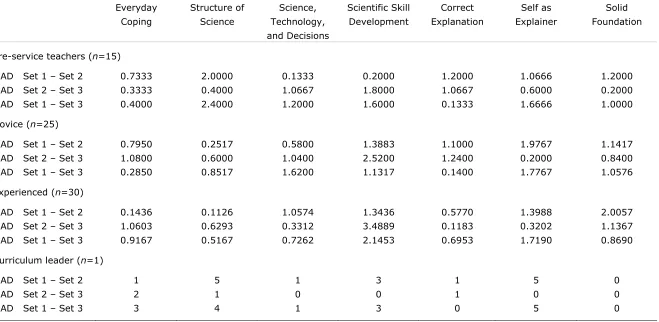
group and allows for comparisons between the sets of data (Gravetter & Wallnau, 2009). MAD is an alteration to the Mean Absolute Deviation (MADeviation) and Root Mean Square Deviation (RMSD), both of which compute the difference between the means of each set and the median of the compared sets. The values for MADeviation and RMSD were calculated and the results, along with the MAD values, all support relatively weak reliability between the three sets of statements in each group. For simplicity, only MAD values are reported in Table 2.
Credibility, Transferability, Dependability and Confirmability
The trustworthiness of qualitative research, which involves establishing credibility, transferability, dependability, and confirmability (Guba & Lincoln, 1989; Lincoln & Guba, 1985), are discussed in this section. Credibility was addressed through the triangulation and cross-checking of the rankings with open-ended responses of each participant (Mathison, 1988). Although this study was conducted in Alberta, Canada, the results may be relevant to other teachers in other locations because physics classrooms and teachers can share common characteristics allowing for transferability of the results (Duit, Niedderer, & Schecker, 2007). Dependability was addressed by having interview participants complete a curriculum survey rank-order and open-ended response question. Confirmability, performed by member checking, was done by each participant to ensure the transcription and interpretations of all interview data were done appropriately (Cohen & Crabtree, 2006).
Data Analysis Procedures Survey
The statistical survey data were processed with SPSS 17.0. The program calculated the means of the seven science curriculum emphases and ranked their importance based on the means. This was repeated for each of the three sets of statements as well as for each group of participants: pre-service teachers, novice teachers, experienced teachers, and the curriculum leader.
Open-Ended Question
Table 2
Mean Absolute Different (MAD) Values for Pre-Service, Novice, Experienced, and Curriculum Leader
Everyday Coping
Structure of Science
Science, Technology, and Decisions
Scientific Skill Development
Correct Explanation
Self as Explainer
Solid Foundation
Pre-service teachers (n=15)
MAD Set 1 – Set 2 0.7333 2.0000 0.1333 0.2000 1.2000 1.0666 1.2000
MAD Set 2 – Set 3 0.3333 0.4000 1.0667 1.8000 1.0667 0.6000 0.2000
MAD Set 1 – Set 3 0.4000 2.4000 1.2000 1.6000 0.1333 1.6666 1.0000
Novice (n=25)
MAD Set 1 – Set 2 0.7950 0.2517 0.5800 1.3883 1.1000 1.9767 1.1417
MAD Set 2 – Set 3 1.0800 0.6000 1.0400 2.5200 1.2400 0.2000 0.8400
MAD Set 1 – Set 3 0.2850 0.8517 1.6200 1.1317 0.1400 1.7767 1.0576
Experienced (n=30)
MAD Set 1 – Set 2 0.1436 0.1126 1.0574 1.3436 0.5770 1.3988 2.0057
MAD Set 2 – Set 3 1.0603 0.6293 0.3312 3.4889 0.1183 0.3202 1.1367
MAD Set 1 – Set 3 0.9167 0.5167 0.7262 2.1453 0.6953 1.7190 0.8690
Curriculum leader (n=1)
MAD Set 1 – Set 2 1 5 1 3 1 5 0
MAD Set 2 – Set 3 2 1 0 0 1 0 0
MAD Set 1 – Set 3 3 4 1 3 0 5 0
Results
Results from each data collection method (i.e., survey, open-ended question, and interview) are presented separately and then interpreted collectively to answer the research questions.
Survey Data
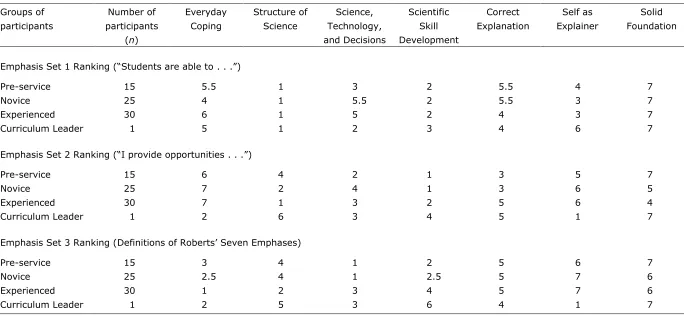
The means of each category were calculated for each group for the three sets of statements. These means were then used to rank each category with one being the most important and seven being the least important. The rankings for each group are provided in Table 3.
The correlation between the three sets of data was not high as indicated by the MAD values shown in Table 2. High MAD values indicated low reliability which resulted in the data from each set being analyzed separately for each group and comparisons being made between the four groups for each set.
1. The results from Set 1 (“Students are able to . . .”) show all participant groups ranked Structure of Science as their highest priority. Teacher participants ranked Scientific Skill Development as their second priority and Solid Foundation as their lowest priority, while the curriculum leader ranked Science, Technology, and Decisions and Self as Explainer as her second and third priorities.
2. The results from Set 2 (“I provide opportunities . . .”) show the highest priorities ranked by each participant group were: Scientific Skill Development by pre-service and novice
teachers, Structure of Science by experienced teachers, and Self as Explainer by the curriculum leader. The emphasis ranked least important by the pre-service teachers and curriculum leader was Solid Foundation. Novice and experienced teachers ranked Everyday Coping as least important.
3. The results from Set 3 (definitions of Roberts’ Emphases) showed pre-service and novice teachers prioritized Science, Technology, and Decisions, while experienced teachers ranked Everyday Coping as the most important emphasis. Similar to Set 2, the curriculum leader ranked Self as Explainer as the priority, and pre-service teachers and the curriculum leader again ranked Solid Foundation as the least important. Novice and experienced teachers ranked Self as Explainer as the least important emphases. For a complete ranking of the emphases by each group of participant refer to Table 3.
Table 3
Rankings of Set 1, Set 2, and Set 3 by Pre-Service, Novice, Experienced, and Curriculum Leader
Groups of participants
Number of participants
(n)
Everyday Coping
Structure of Science
Science, Technology, and Decisions
Scientific Skill Development
Correct Explanation
Self as Explainer
Solid Foundation
Emphasis Set 1 Ranking (“Students are able to . . .”)
Pre-service 15 5.5 1 3 2 5.5 4 7
Novice 25 4 1 5.5 2 5.5 3 7
Experienced 30 6 1 5 2 4 3 7
Curriculum Leader 1 5 1 2 3 4 6 7
Emphasis Set 2 Ranking (“I provide opportunities . . .”)
Pre-service 15 6 4 2 1 3 5 7
Novice 25 7 2 4 1 3 6 5
Experienced 30 7 1 3 2 5 6 4
Curriculum Leader 1 2 6 3 4 5 1 7
Emphasis Set 3 Ranking (Definitions of Roberts’ Seven Emphases)
Pre-service 15 3 4 1 2 5 6 7
Novice 25 2.5 4 1 2.5 5 7 6
Experienced 30 1 2 3 4 5 7 6
Curriculum Leader 1 2 5 3 6 4 1 7
Open-Ended Question Data
The open-ended question at the end of the survey provided participants with an opportunity to write responses regarding aspects of the program-of-study they believed to be the most important without the constraints of the pre-determined seven science curriculum emphases framework. The researcher interpreted statements such as placing a focus on “students to go through the scientific processes” (Participant 107) and need for students to “critically evaluate situations based on scientific principles” (Participant 40) as Structure of Science. However, these are the interpretations of the researcher and other interpretations are possible. For example, others might interpret the first quote as Scientific Skill Development and the second quote as Science, Technology, and Decisions which indicate the overlapping nature of Roberts’ emphases. Statements representing Structure of Science came from all three teacher groups indicating its importance to all the teacher groups. The ideas behind Correct Explanation were also highlighted as being important by pre-service and novice teachers through statements such as a need to focus on “knowledge outcomes [because teachers] feel the pressure to cover it” (Participant 104).
Two perspectives falling outside Roberts’ seven science curriculum emphases framework, which focus on the pedagogy of teaching, were mentioned in the open-ended survey question. Pre-service teachers mentioned the importance of student engagement during their interviews. At the time of the study, this term was widely used in education in Alberta because several initiatives, such as the Alberta Initiative for School Improvement: Student Engagement were funded by the government to seek to more fully engage students in their own learning (Dunleavy & Milton, 2009). This idea was present in comments highlighting the importance of teaching “fun and interesting topics that can be demonstrated” (Participant 106) and in performing “physics labs to help engage students” (Participant 112). Novice and experienced teachers mentioned the need to focus on creating a holistic view of physics with comments such as “linking concepts [studied] in one unit to the next so that students ‘see’ that there is a relationship between [information studied in] one unit to the next and begin to develop ‘big picture’ thinking” (Participant 39). Holistic education aims to utilize various aspects of students (social, biological, political, spiritual, etc.) and develop them simultaneously to create a more humanistic and philosophical type of education (Miller, 1990). This study uses the term holistic specifically to refer to the interconnection of many concepts as one larger picture. Some teachers reported a need to focus on “the components of diploma exam preparation” (Participant 31).
The teacher participants all focused on the Structure of Science while the curriculum leader focused on Science, Technology, and Decisions. This was interpreted from the curriculum leader’s response; “STS relevance to science, technology, and society are vital for all learners.” Discrepancy was noted between the teacher participants. Pre-service teachers focused on student engagement; both pre-service and novice teachers focused on Correct Explanation, while novice and experienced teachers focused on a holistic view of physics.
Interview Data
would be necessary to gain data representative of each group.
While the process of curriculum development in Alberta is a collaboration between teachers, government officials, university professors, and other stakeholders, only one curriculum leader was interviewed in this study. Her responses may be considered personal rather than representing the Curriculum Branch of Alberta Education. Nonetheless, the researcher refers to her comments as relevant to the intellectual climate of Alberta Education, as this was her place of employment at the time of the study.
An analysis of novice physics teachers’ priorities when teaching the program-of-study revealed “setting up proper investigation and [knowing] what kind of question you need to ask, and what variables you should be manipulating to get . . .[the answer] right” (Novice Teacher 1) as an important focus, which was interpreted as being Scientific Skills Development. An underlying theme amongst the novice teachers was to make the course fun and engaging for students because, “anytime you have a practical problem instead of a theoretical one, there’s a lot more room for engaging students” (Novice Teacher 2). Novice Teacher 2 further explained that when students were interested and engaged in a course, they would remember what they learned from the program and “perhaps transfer . . . [that knowledge] to other avenues of life”; this was interpreted as indicating a focus on the transferability of material. The two novice participants also mentioned placing less priority on Correct Explanation. Novice Teacher 1 pointed out, “in science . . . there’s a ton of material” that needs to be understood. This idea was furthered by referring to content knowledge as “stuff the kids . . . a year later wouldn’t remember from the program or rather not remember” (Novice Teacher 2) because it is associated with impersonal memorized content.
Experienced physics teachers identified a need to focus on
. . . organizational skills, the skill to be able to look at stuff, the skill to be able to take a problem and break it down and think about what’s going to occur and run it through a logical and correct process. (Experienced Teacher 1)
This was interpreted as a prioritization of Structure of Science. The experienced teachers defined this emphasis as the transferability of skills by focusing on “strategies they can use throughout their lives . . . teaching content is something that we do to teach those skills” (Experienced Teacher 1). The emphases was also defined through the intimation that,
We [a]re not here to memorize facts. We [a]re here to make connections, so we see this knowledge and skills and attitude, that we [a]re developing a course as an interconnected whole, so that we [a]re not putting all this information into little pigeon holes that are independent of each other, it [i]s one big mass and we [a]re trying to make it [sic] as many connections as we can (Experienced Teacher 2).
This was interpreted as a connectivist or holistic view of physics ideas because the passage talks about focusing on the big picture and the connections between the concepts instead of dwelling on specific pieces of information, independent of other physics concepts.
able to organize a classroom where students will have different opportunities for engagement. In other words, in different levels of learning or in different application[s] of the learning; so not everything will fit for all the students, but there will be a big enough buffet for them to give them those opportunities to really learn and engage in ways that are most meaningful for them. (Curriculum Leader)
In her mind, when students are engaged with a problem, they are more inclined to learn the scientific methods required to solve the problem and retain the information.
Summary
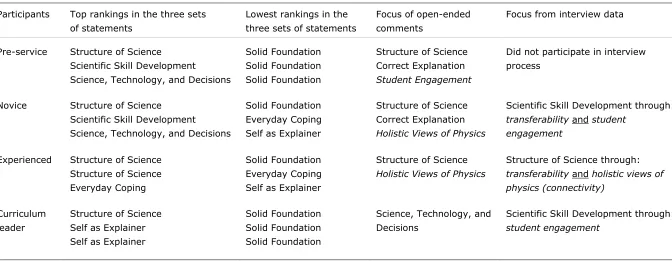
A summary of the results are presented in Table 4. The results indicate participants reported focusing on certain aspects from the program-of-study more than others. The emphases teachers prioritized were limited to the seven science curriculum emphases as represented in the program-of-study and responded to the question "Why are teachers teaching this?" while results that fell beyond Roberts’ framework, such as holistic views of physics, transferability, and
student engagement were matters of pedagogy and originate from the curriculum-as-lived or as
implemented in a classroom (Aoki, 1986/2005a).
Discussion
As reflected in the first research question, the study investigated the similarities and differences between the teacher participants in terms of their self-reported prioritizing of select elements from the physics program-of-study. From the survey, Structure of Science was ranked as most important by each participant group at least once. This is interesting as this emphasis matches the direction of change of the programs-of-study. A review of the programs-of-study indicates a shift towards the listing of specific scientific skills and attitudes, which suggests a trend towards Structure of Science and Scientific Skill Development (Chu, 2009).
The low reliability between the three sets of rankings could reflect participants’ varying familiarity level with each set of statements. Teacher participants may be more familiar with the statements directed at student learning outcomes (Set 1) and less familiar with definitions of Roberts’ seven science curriculum emphases (Set 3). Another reason for the low reliability between the sets of ranking could be the different perspectives used to create the three sets of statements in the survey (Harden, 2002). The different perspectives of each set of statements represent student outcomes, classroom teaching practices, and theoretical definitions of emphases. For example, the curriculum leader ranked Structure of Science to be the most important in terms of student outcomes, but ranked Self as Explainer as most important in terms of classroom practices and Robert’s curriculum emphases definitions.
Table 4
Summary of Emphases and Focuses of Participants
Participants Top rankings in the three sets of statements
Lowest rankings in the three sets of statements
Focus of open-ended comments
Focus from interview data
Pre-service Structure of Science
Scientific Skill Development
Science, Technology, and Decisions
Solid Foundation Solid Foundation Solid Foundation
Structure of Science Correct Explanation
Student Engagement
Did not participate in interview process
Novice Structure of Science
Scientific Skill Development
Science, Technology, and Decisions
Solid Foundation Everyday Coping Self as Explainer
Structure of Science Correct Explanation
Holistic Views of Physics
Scientific Skill Development through:
transferability and student engagement
Experienced Structure of Science Structure of Science Everyday Coping
Solid Foundation Everyday Coping Self as Explainer
Structure of Science
Holistic Views of Physics
Structure of Science through:
transferability and holistic views of physics (connectivity)
Curriculum leader
Structure of Science Self as Explainer Self as Explainer
Solid Foundation Solid Foundation Solid Foundation
Science, Technology, and Decisions
Scientific Skill Development through:
student engagement
Although novice and experienced teachers suggested transferability as an important theme, their definition of transferable skills differed slightly. Experienced teachers’ definition of these transferable skills involved scientific reasoning and analytical skills used to solve problems inside and outside of the classroom. Novice teachers’ definition of these skills was much broader than those of experienced teachers. They believed transferable skills included skills from manipulative mathematics and laboratory skills to practical problem solving skills that could be applied to situations out of the classroom. In this study, physics teachers tended to hold a general ideology of transferring skills outside of the classroom.
The study, as reflected in the second research question, explored similarities and differences between teacher participants and the curriculum leader. The curriculum leader differed from teacher participants as she focused on Self as Explainer (survey Sets 2 and 3) and Science, Technology, and Decisions (open-ended survey question). The points of commonalities between the curriculum leader and teacher participants were the ranking of Structure of Science as a top priority (survey Set 1), Solid Foundation as the least important emphasis (survey Set 1, 2, and 3), and focusing on Scientific Skill Development through student engagement (Interview Data). The curriculum leader focused on different emphases than teacher participants in survey Sets 2 and 3 indicating differences in priorities when faced with statements regarding classroom teaching practices and definitions of Roberts’ curriculum emphases respectively. Perhaps this difference in ranking between the curriculum leader and the teachers is due to different work environments, since the curriculum leader has been working out of the classroom for several years.
The most consistency seen from the data was from Set 1 of the survey rankings indicating all the teacher participants and the curriculum leader focused on Structure of Science most and Solid Foundation least, in terms of statements regarding students’ learning outcomes. Of the three groups of teacher participants, the curriculum leader’s selections were most similar to those of pre-service teachers. Perhaps, this reflects the collaboration between Alberta Education and teacher education programs and providers in the province. Another reason for such similarities could be pre-service teachers being regularly reinforced for finding the one correct answer, as perpetuated by textbook practice problems, hence they feel the need to conform to a correct way of thinking (Smolin, 2006). This correct mode of thought is often seen as the views of the officials, in this case the views of the curriculum leader who represents Alberta Education.
Significance of Findings
interpreted by each person differently and influenced by social factors (Blades, 1997; Hodson, 2001; Roberts & Orpwood, 1982).
While there were similarities to some extent between the self-reports of all groups of teacher participants, there were more similarities evident between the responses of pre-service and novice teachers. Both of these groups prioritized Structure of Science (Set 1), Scientific Skill Development (Set 2) and Science, Technology, and Decisions (Set 3) as their highest priorities on the survey, and also ranked Solid Foundation (Set 1) as their lowest priority. Similarities were also seen on open-ended comments showing both groups focused on Structure of Science and Correct Explanation. Interestingly, both groups ranked Correct Explanation, which tends to be associated with knowledge outcomes, identically with 5.5, 3, and 5 in the three sets respectively. Thus, the inconsistency between ranking this emphasis in the middle and highlighting it in the open-ended section might indicate tensionality between focusing on certain emphases versus the pressure to cover mandated outcomes (Aoki, 1986/2005b). This tensionality may be seen as conflation of curriculum emphases with the curriculum-as-planned and lived by teachers who are trying to achieve mandated learning outcomes for knowledge, skills, and attitudes. Pre-service teachers reported a priority in focusing on student engagement, through their open-ended survey question, that was echoed by the novice teachers during their interviews. These two groups of participants may have recently completed or are currently going through very similar education programs which may have caused the two groups to have more similarities than experienced teachers. Research also suggests pre-service and novice teachers have a tendency to be in survival mode, focusing on management and covering the program-of-study (Alberta Teachers’ Association, 2011).
The curriculum leader focused on different emphases to those of teacher participants. This difference of interpretation may be due to the need for the curriculum leader to create a program that will represent “a big enough buffet” (Curriculum Leader) for Alberta students. As an employee of Alberta Education, the curriculum leader works within the guidelines and philosophies set by the government whose views may be different than those of a classroom teacher (Alberta Education, 2011a). Teachers may be delivering the curriculum differently than intended and planned by the curriculum leader.
Implications
This investigation provides a snap-shot of a small group of teachers’ and curriculum leader’s prioritization of science curriculum emphases. The same participants may give different results at a later time as more experiences develop (Roberts, 1982). A longitudinal study following a group of teachers over several years would provide a more in-depth look at the trends of curriculum emphases and the basis for change over time.
An experienced teacher suggested, in his interview that, while some teachers self-report focusing on a specific emphasis, this may not be the case in practice. To truly find an answer to where an emphasis is ranked on each teacher’s priority list, an in-depth exploration of teachers’ lessons could be studied. Rather than surveying teachers, interviewing, videotaping and observing teacher’s lessons and classroom interactions would provide more complete pictures of what particular teachers emphasize in practice.
The findings presented here might act as a stimulus for pre-service, novice, and experienced teachers to reflect upon their teaching practices. The differences between the teacher participants and the curriculum leader suggest that the program-of-study is being addressed and implemented in ways that are different than what was intended by the curriculum leader. Perhaps, having a variety of teachers focus on different emphases is the intention of the Curriculum Branch of Alberta Education as this provides students with a variety of perspectives to learn physics. However, if this was not the intention of the Curriculum Branch then on-going professional development may help teachers deliver the program as intended.
It is well known that the ideologies and emphases teachers have of the physics program-of-study are a direct reflection of teachers’ personalities and experiences. Although different people will find certain emphases more desirable than others, there are no wrong or incorrect emphases for teachers to have in any classroom. Hence, instead of focusing on popular emphases, of the time, teachers could attend to emphasize what they deem most beneficial to their students, given their personal understanding and comfort level, and develop those aspects of the curriculum.
References
Ackroyd, J. E., Anderson, M., Berg, C., Martin, B. E., McGuire, B. L. S., Sosnowski, C., Szojka, M., & Wolfe, E. (2007). Physics. Toronto, ON: Pearson Education Canada.
Alberta Education. (2007). Physics 20-30. Alberta, Canada: Author. Retrieved May 2, 2012, from http://education.alberta.ca/media/654853/phy2030_07.pdf
Alberta Education. (2011a). Alberta’s higher quality curriculum: Development and implementation. Alberta, Canada: Author. Retrieved May 2, 2012, from
http://www.education.alberta.ca/media/824183/curric_dev.pdf
Alberta Education. (2011b). General information bulletin: Introduction to the diploma examinations program. Alberta, Canada: Author. Retrieved May 2, 2012, from
http://education.alberta.ca/media/6446502/02-dip-gib-2011-12_intro%20revisions.pdf
Alberta Teachers’ Association. (2011). The early years of practice: Interim report of a five-year study of beginning teachers in Alberta. Edmonton, AB: Author. Retrieved from
Aoki, T. T. (2005a). Legitimating lived curriculum: Toward a curricular landscape of multiplicity (1993). In W. F. Pinar & R. L. Irwin (Eds.), Curriculum in a new key: The collected works of Ted T. Aoki (pp. 199-215). Mahwah, NJ: Lawrence Erlbaum Associates.
Aoki, T. T. (2005b). Teaching as in-dwelling between two curriculum worlds (1986/1991). In W. F. Pinar & R. L. Irwin (Eds.), Curriculum in a new key: The collected works of Ted T. Aoki (pp. 159-166). Mahwah, NJ: Lawrence Erlbaum Associates.
Blades, D. W. (1997). Procedures of power and curriculum change: Foucault and the quest for possibilities in science education. New York, NY: Peter Lang Publishing.
Chu, M. (2009). Exploring science curriculum emphases in relation to the Alberta physics program-of-study. Unpublished master's thesis, University of Alberta, Edmonton, Alberta, Canada.
Cohen, D., & Crabtree, B. (2006). Qualitative research guidelines project. Retrieved from http://www.qualres.org/HomeLinc-3684.html
Creswell, J. W. (2008). Educational research: Planning, conducting, and evaluating quantitative and qualitative research (3rd ed.). Upper Saddle River, NJ: Pearson Education.
Duit, R., Niedderer, H., & Schecker, H. (2007). Teaching physics. In S. K. Abell & N. G. Lederman (Eds.), Handbook of research on science education (pp. 599-629). Mahwah, NJ: Lawrence Erlbaum
Associates.
Dunleavy, J., & Milton, P. (2009). What did you do in school today? Exploring the concept of student engagement and its implications for teaching and learning in Canada. Toronto, ON: Canadian Education Association. Retrieved from
http://barryanderson.wikispaces.com/file/view/Exploring+Engagement+1.pdf
Ercikan, K., & Roth, W.-M. (2006). What good is polarizing research into qualitative and quantitative? Educational Researcher, 35(5), 14-23.
Gabel, L. L. (1976). The development of a model to determine perceptions of scientific literacy. Unpublished doctoral dissertation, The Ohio State University, Columbus, Ohio. (ERIC Document Reproduction Service No. ED130915). Retrieved from the Education Resources Information Center (ERIC) Website: http://www.eric.ed.gov/PDFS/ED130915.pdf
Gage, N. L. (1989). The paradigm wars and their aftermath: A "historical" sketch of research on teaching since 1989. Educational Researcher, 18(7), 4-10.
Geddis, A. N., & Roberts, D. A. (1998). As science students become science teachers: A perspective on learning orientation. Journal of Science Teacher Education, 9(4), 271-292. Retrieved from
https://www.ntnu.no/wiki/download/attachments/11273030/Geddis+%281998%29As+science+stu dnets+becomes+teachers.pdf
Gravetter, F. J., & Wallnau, L. B. (2009). Statistics for the behavioural sciences (8th ed.). Belmont, CA: Wadsworth Cengage Learning.
Guba, E. G., & Lincoln, Y. S. (1989). Fourth generation evaluation. Newbury Park, CA: Sage Publications. Guba, E. G., & Lincoln, Y. S. (1997). Naturalistic and rationalistic inquiry. In J. P. Keeves (Ed.),
Educational research, methodology, and measurement: An international handbook (2nd ed., pp. 86-91). New York, NY: Pergamon.
Harden, R. M. (2002). Learning outcomes and instructional objectives: Is there a difference? Medical Teacher, 24(2), 151-155.
Hattie, J. (2003, October). Distinguishing expert teachers from novice and experienced teachers. Teachers make a difference: What is the research evidence? Paper presented at the meeting of the Australian Council for Educational Research. University of Auckland, Auckland, New Zealand. Retrieved from https://www.det.nsw.edu.au/proflearn/docs/pdf/qt_hattie.pdf
Hodson, D. (1988). Toward a philosophically more valid science curriculum. Science Education, 72(1), 19-40.
Hodson, D. (1998). Teaching and learning science : Towards a personalized approach. Buckingham, UK: Open University Press.
Hodson, D. (2001). What counts as good science education? Ontario Institute for Studies (OISE) Education Papers in Science, Technology, Society, and Environment (STSE) Education, 2, 7–22. Retrieved from http://sccao.oise.utoronto.ca/downloads/derek%20oisepapers.pdf
Jeans, S. L. (1998). Teacher images of the intent of science curriculum policy: Experienced and novice teachers at work. Paper presented at the XXVI annual conference of the Canadian Society for the Study of Education, Ottawa, Ontario, Canada.
Kapuscinski, B. P. (1982). Understanding the dynamics of initiating individualized science instruction. Journal of Research in Science Teaching, 19(8), 705-716.
Lin, C.-Y., Hu, R., & Changlai, M.-L. (2005). Science curriculum components favored by Taiwanese biology teachers. Research in Science Education, 35(2-3), 269-280.
Lincoln, Y. S., & Guba, E. G. (1985). Naturalistic inquiry. Beverly Hills, CA: Sage Publications. Mathison, S. (1988). Why triangulate? Educational Researcher, 17(2), 13-17. Retrieved from
http://blogs.ubc.ca/qualresearch/files/2008/01/why-tirangulate.pdf
Miller, R. (1990). What are schools for? Holistic education in American culture. Brandon, VT: Holistic Education Press.
Ogden, W. R. (1975). Secondary school chemistry teaching, 1918-1972: Objectives as stated in periodical literature. Journal of Research in Science Teaching, 12(3), 235-246.
Ogden, W. R., & Jackson, J. L. (1978). Secondary school biology teaching, 1918-1972: Objectives as stated in periodical literature. Science Education, 62(3), 291-302.
Peshkin, A. (2000). The nature of interpretation in qualitative research. Educational Researcher, 29(9) 5-9. Retrieved from
http://www.tc.umn.edu/~dillon/CI%208148%20Qual%20Research/Session%2011/Peshkin%20200 0%20Interpretation.pdf
Popham, W. J. (2001). Teaching to the test? Educational Leadership, 58(6), 16-20. Retrieved from http://olms.cte.jhu.edu/olms/data/resource/7749/TeachingtotheTest-Popham.pdf
Roberts, D. A. (1982). Developing the concept of “curriculum emphases” in science education. Science Education, 66(2), 243-260. Retrieved from
http://www.kcvs.ca/martin/EdCI/literature/literacy/roberts.pdf
Roberts, D. A. (1988). What counts as science education? In P. J. Fensham (Ed.), Development and dilemma in science education (pp. 27-55). Philadelphia, PA: The Falmer Press.
Roberts, D. A. (1995). Junior high school science transformed: Analysing a science curriculum policy change. International Journal of Science Education, 17(4), 493-504.
Roberts, D. A. (1998). Analyzing school science courses: The concept of companion meaning. In D. A. Roberts & L. Östman (Eds.), Problems of meaning in science curriculum (pp. 5-12). New York, NY: Teachers College Press.
Roberts, D. A. (2003). Analyzing science in the school curriculum: Deciding about it, formulating it, communicating about it, enacting it, living with the consequences. Unpublished manuscript, University of Alberta IONCMASTE presentation paper.
Roberts, D. A., & Orpwood, W. F. (1982). Classroom events and curricular intensions: A case study in science education. Canadian Journal of Education, 7(2), 1-15.
Smolin, L. (2006). The trouble with physics. New York, NY: Houghton Mifflin Company.
Van Driel, J. H., Bulte, A. M. W., & Verloop, N. (2008). Using the curriculum emphasis concept to investigate teachers’ curricular beliefs in the context of educational reform. Journal of Curriculum Studies, 4(1), 107-122.
Wang, J., Odell, S. J., & Schwille, S. A. (2008). Effects of teacher induction on beginning teachers’ teaching: A critical review of the literature. Journal of Teacher Education, 59(2), 132-152.
Zeichner, K. M. (1993). Traditions of practice in U.S. preservice teacher education programs. Teaching and Teacher Education, 9(1), 1-13.
Man-Wai Chu ([email protected]) is a Ph.D. student in the Department of Educational Psychology, University of Alberta. Her research interests include science curriculum studies, assessment, cognition, and measurement.
Appendix
Curriculum Emphasis Survey
1. Please provide the following demographic questions: a) Number of years teaching: _________
b) Number of years teaching physics: _________ c) Age: _________
d) Gender (Please circle): Male / Female e) Type of Education Degree (Please circle):
Two year after
degree
/
Four year
degree
/
Five year combined degree
/
Other:
Major: Minor:
f) Have you participated in any type of curriculum course or professional development? If yes, please specify.
2. Please rank from 1 (most important) to 7 (least important) the following statements
regarding students’ proposed learning outcomes from their physics course, in terms of their importance to you as a teacher.
a) Students are able to use scientific vocabulary and principles in everyday discussions.
b) Students are able to explore their environment, gather knowledge and develop ideas that help them interpret and explain what they see.
c) Students are able to use and recognize that science and technology are developed to meet societal needs and expand human capability.
d) Students are able to use the skills developed at each level of physics with increasing scope and complexity of application: initiating and planning, performing and recording, analyzing and interpreting, & communication and teamwork.
e) Students are able to recognize the subject matter of science, including the laws, theories, models, concepts, and principles that are essential to an understanding of each science area.
f) Students are able to show interest in science-related questions and issues and confidently pursue personal interests and career possibilities within science-related fields.
3. Please rank from 1(most important) to 7 (least important) the following statements about your classroom teaching practice, in terms of the importance of each practice to you as a teacher.
a) I provide opportunities to show how cultural and intellectual traditions have influenced the focus and methodologies of science, and that science has influenced the wider world of ideas.
b) I provide opportunities to show science provides an ordered way of learning about the nature of things, based on observation and evidence.
c) I provide opportunities for students to investigate how technological solutions have emerged from previous research, and how many of the new technologies have given rise to complex social and environmental issues.
d) I provide opportunities for students to develop skills that involve answering questions, solving problems and making decisions.
e) I provide opportunities so that students recognize that the goal of science education is to construct knowledge about the natural world.
f) I provide opportunities for students to explore their personal perspectives, attitudes and beliefs regarding scientific and technological advancements. g) I provide opportunities for students with a foundation in science to create
opportunities for them to pursue progressively higher levels of study, prepare them for science-related occupations, and engage them in science-related hobbies.
4. Please rank from 1(most important) to 7 (least important) the following objectives for students in terms of their importance to you as a teacher.
a) Students become able to use science to understand both technology and everyday occurrences.
b) Students become able to understand science as a growing intellectual
enterprise, stressing the importance of "scientific method" using hypotheses, experiments, scientific concepts, and historical evolution of scientific ideas. c) Students become able to understand the interrelatedness of scientific
explanations, technological planning, problem solving, and the practical importance of science to society.
d) Students become able to develop competence in conceptual and manipulative skills that are basic to science, collectively labeled "scientific process"; which are the keys to arriving at a reliable "product," or idea in science.
e) Students become able to concentrate on the ends of scientific inquiry, science is reliable and valid knowledge from an authoritative group of experts
developed to provide explanations to justify natural events and objects. f) Students become able to explain events in terms of their personal purpose,
their intellectual preoccupations, and their cultural influences that form their context.
5. What part of the curriculum do you focus most on in your classroom and why?
6. (OPTIONAL) If you are willing to provide more in-depth answers, through an interview, e-mails, etc., please leave your name and contact information.
Thank you for your participation.