Volume 12, Issue 9 (September 2016), PP.73-80
Studying of two choline chloride’s deep eutectic solvents in their
aqueous mixtures
Ghassan H. Abdullah
1,2, Mohammed A. Kadhom
1,3*Department of Chemical Engineering, University of Missouri-Columbia, Columbia, Missouri 65211, United States.
Department of Chemical Engineering, University of Tikrit, Saladin, Iraq. Department of Pathology, Al-Dour Technical Institute, Saladin, Iraq. Corresponding author: [email protected]
Abstract:-Deep Eutectic Solvents (DESs) are an interesting category of solvents that recently getting more
attention due to their unique properties. DESs proved their reliability in many applications which made them overcoming the traditional solvents. In this work, two deep eutectic solvents choline chloride: urea and choline chloride: glycerol having molar ratio of 1:2 respectively were prepared and characterized. Different water content, 0, 3, 5, 10, 25, 50 and 75 wt. %, were added and the effect was studied. Cyclic voltammetry, viscosity, density and thermogravimetric analysis have been investigated and reported in this research. The viscosity was studied as a function of temperature at normal and high temperatures and as a function of shear rate at low temperature. For our best awareness, the non-Newtonian behavior of the above two DESs is first reported in this work. The shear rate effected the viscosity of the mixtures at low temperatures; thereby, by increasing the applied shear rate, the viscosity of the mixtures decreased at a fixed temperature.I.
INTRODUCTION
Deep Eutectic Solvents (DESs) can be defined as a mixture of a hydrogen bond donor (HBD) and a hydrogen bond accepter (HBA) which can associate with each other to form a eutectic mixture. The final mixture melting point is lower than both of its raw materials separately.
In general, deep eutectic solvents have a very huge depression in their freezing points . They are liquids at temperatures below than 150 ̊C. Most of them are liquids under 70 ̊C, with some even at room temperature. In most cases, deep eutectic solvent can be prepared by mixing one of the quaternary ammonium salts as a hydrogen bond donor with a metal salt as a hydrogen bond acceptor [1].
Andrew Abbott and co-workers introduced the term of “Deep Eutectic solvent” in 2003. They got this name from the idea of synthesizing liquids from a mixture of two high melting point solid raw materials. Multiple researchers subsequently published papers using the term “Deep Eutectic Solvents” [2]. Figure 1 is showing the growth in publications’ number contained “Deep Eutectic Solvents” in their titles, key words, and/or abstracts. The data were obtained using Scopus database and they were updated up to the mid of July 2016.
A very common example of a DES is the mixture of choline chloride and urea. Choline chloride has a melting point of 302 ºC and urea’s melting point is 133 ºC. The mixture melting point is 12 ºC for a molar ratio 1:2, respectively [3].
DESs usually are synthesized by raising the temperature of two solid raw materials while mixing them together. The final high temperature attained depends on the nature of the raw materials, but commonly using higher temperatures and good mixing leads to faster melting [4].
Using Ionic Liquids, many researches have produced nanoparticles from gold, silver, platinum, copper, manganese, titanium, chrome, molybdenum, tungsten, iron, ruthenium, osmium, and their various components such as oxides, halides, etc. By choosing which different anions and cations make up the Ionic Liquids, specific products can be manufactured [5-14].
Deep eutectic solvents have the advantages over ionic liquids of being water-tolerant, biodegradable, less expensive, easer to make, and safer to use. Many deep eutectic solvents are non-toxic compared to ionic liquids [2].
the first paper reporting the non-Newtonian behavior for those two DESs at low temperature and study the shear rate effect on the viscosity.
II.
EXPERIMENTAL SECTION
2-1 Materials
Choline chloride (≥ 99%) was purchased from Chem-Impex Int´l Inc, USA. Urea (99.4%) and Glycerol (99.5%) were obtained by Fisher Scientific Company, USA. The commercial catalyst of Pt/C (19.7% Pt over Vulcan XC-72ETEK) was obtained by De Nora North America. Deionized water (DI) was obtained by Direct-Q3 UV Millipore device.
2-2 DESs’Preparation:
Choline chloride was dried at 65 °C and under vacuum for 24 hr to get rid of any possible moisture. The first DES mixture was prepared by mixing the dried choline chloride with urea in molar ratio of 1:2, respectively. But choline chloride with glycerol DES, 1:2 molar ratios, respectively, was prepared by heating glycerol first up to 80 °C and choline chloride was added later. The mixtures were heated at 80 °C and stirred until homogeneous colorless liquids were formed. Finally, DESs mixtures were dried at 80 °C and left under vacuum overnight in order to eliminate any possible moisture before starting characterizations.
2-3 Characterization
Cyclic Voltammetry (CV): The electrochemical test CV, for both dried mixtures, was performed at room temperature using electrochemical workstation model CHI651E. Three electrodes cell with glassy carbon (GC) electrode of 0.196 cm2 working electrode was used for this test. The reference electrode was Ag/AgCl and the counter electrode was platinum wire. Alumina slurry of 1µm size was used to polish the GC and it was washed ultrasonically by DI water. The test was occurred using commercial catalyst of ETEK Pt/C. 1mg of Pt/C catalyst was ultrasonically dispersed in 1ml of ethanol for one hour to prepare ink for the test. 10µl of this ink was dropped on the polished GC electrode and dried at room temperature. 10 µl of 0.05% Nafion solution was dropped on the dried catalyst to bind the catalyst on the electrode surface and was left it to dry at room temperature. The potential range of this test was -1V to 1V.
Viscosity: The viscosity was measured using Brook Field DV Ш Ultra Program Rheometer cone/ plate and the attached spindle was #42. The temperature range was from 10 to 80 °C. The viscosity was studied as a function of shear rate at low temperatures and the non-Newtonian behavior was reported. Different water contents, 0%, 3%, 5%, 10%, 25%, 50% and 75% weight ratio, were added to the prepared DESs and the viscosity was measured for the new mixtures. The temperature was controlled using external water circulator ISOTEMP.
Density: The density was measured using 2 ml Gay-Lussac vial at room temperature (22 °C) for the mentioned mixtures above.
Thermogravimetric analysis (TGA): TGA was tested using TA Instruments-Waters LLC device model Q500 and the analyzing temperature range was from10 to 800 °C. The temperature rising rate was 10 °C/min using a platinum pan of 0.379 gm. Nitrogen was used as balance and sample gas and purged in rate of 40 ml/min.
III.
RESULT AND DISCUSSION
3-1 Cyclic VoltammetryIn the present study, cyclic voltammetry was tested to figure out the electrochemical behavior for both mixtures as shown in fig2. The dashed curve represented chcl: glycerol DES while the solid one represented chcl: urea mixture. For chcl: urea DES, it can be observed from the forward scan that there are two oxidation
waves started at -500 mV and -400 mV. These waves could be attributed to low H+ ions concentrations in the
DES, H2O molecules dissociation, impurities which represented by protons, and/or the high hygroscopic of choline chloride. On the other side, no oxidation waves observed for chcl: glycerol DES. It can be seen that chcl: glycerol mixture started to oxidize sharply at potential higher than 700 mV and reached its maximum current density at 920 mV. Whereas, chcl: urea oxidation current increased slightly after the potential of 700 mV which could be attributed to evolution of chlorine gas [15] and reached its maximum current density at 1000 mV.
Couple of reduction peaks are clearly observed at potentials of 320 and -100 mV for chcl: glycerol mixture which could be attributed to water reduction [16]. No reduction peaks observed for chcl: urea DES and the reduction current started to increase sharply at potential lower than -500mV.
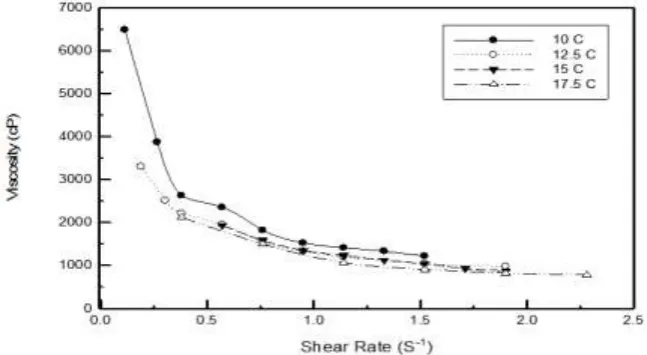
The viscosity was measured for both mixtures at different water content (0, 3, 5, 10, 25, 50 and 75 wt. %) and different temperatures (10 to 80 ºC). At temperatures below 20 ºC, these mixtures behaved as Non-Newtonian fluids and the viscosity depended on the shear rate values. That means the viscosity did not have a specific value at a certain temperature because it depended on the shear rate. While at temperatures (above 20 ºC) they behaved as Newtonian fluids.
Figure 3 shows the viscosity behavior of chcl: Glycerol of 0 % water content at 10, 12.5, 15 and 17.5 ºC. At 20 ºC and above, this DES started to behave as a Newtonian fluid. However, figure 4 shows the same phenomena for chcl: Urea of 0 % water content mixture at 10, 15 and 20 ºC. From the two figures, it can be noted that viscosity decreased with shear rate increasing. This difference was big at low shear rates for the same DES and it started to decrease with shear rate increasing.
From both figures, the shear rate effect decreased with temperature increasing and chcl: urea mixture was more viscous than chcl: glycerol mixture at the same temperature and shear rate. Higher than the mentioned temperatures, 17.5 ºC for chcl: glycerol and 20 ºC for chcl: urea, both DESs mixtures started to behave as Newtonian fluids.
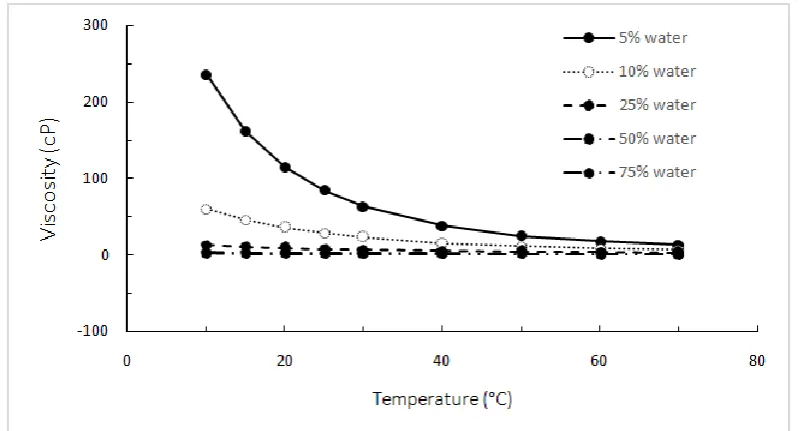
Figure 5 shows the temperature effect on viscosity when the two mixtures behave as Newtonian fluids. It is clear that the viscosity decreased with temperature increasing. Also, whenever the temperature increased, the changing in viscosity value decreased and the curve almost became linear.
3-3 Water content effect on viscosity
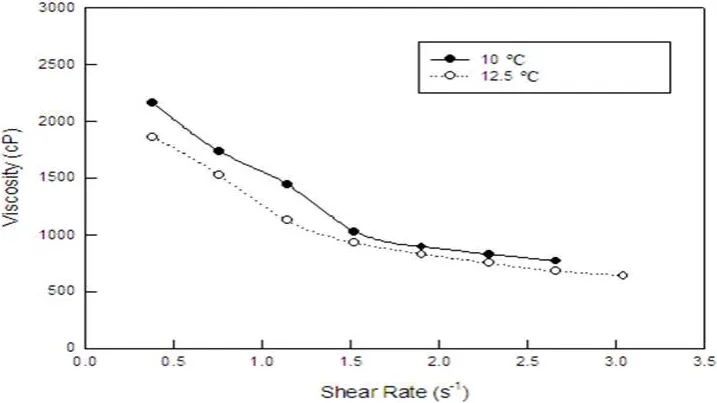
The effect of water content on the viscosity was studied in different percentages for the same range of temperatures above. For both mixtures, the water content percentages were 3, 5, 10, 25, 50, and 75 wt.%. For chcl: glycerol mixture, at 3% water content, figure 6 is showing the shear rate effect on viscosity at 10 and 12.5 ºC. While figure 7 is showing the shear rate effect at 10 ºC for 10 and 25 % water content. However, for higher temperatures and water contents, the mixture behaved as Newtonian fluid. Whereas, chcl: urea mixture behaved as a Newtonian fluid when water was added in whole temperatures range. So that, the water content effected chcl: urea mixture more than chcl: glycerol mixture.
Figures 8 and 9 show the effect of temperature on viscosity in different water content for both mixtures. Both of them show Newtonian behavior whenever the temperature increases.
The temperature dependence on viscosity was studied for both mixtures in different water content and the data was fitted to Arrhenius equation [17].
ln V = ln V˳ + Eᵥ
RT (1)
Where Vo is a constant, R is the universal gas constant, T is the temperature in (K), and Ev is the activation energy. Table 1 shows the results when equation 1 was applied. It can be noted that the activation energy decreased by increasing the water content for both mixtures, except when the water’s percentage exceeded the DES’s one for chcl: glycerol mixture.
3-4 Density
The density was studied at room temperature (22 ºC) as reported in table 2. It can be noted from that table whenever the water percent increased, the density decreased.
3-5 Thermogravimetric analysis
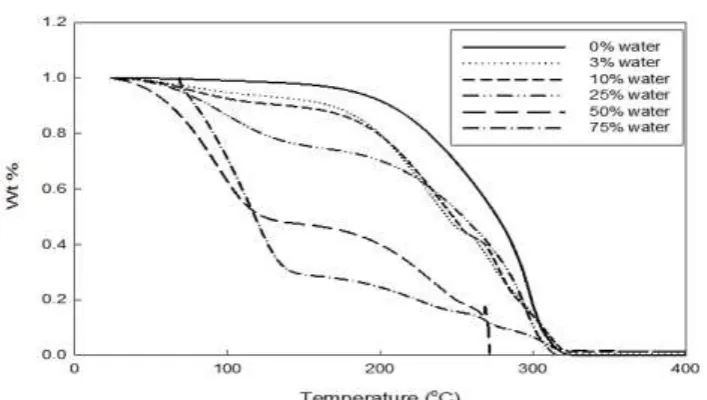
TGA was studied at range of Room temperature up to 800 ºC. The results show that whenever the water percentage increased, the decomposition rate increased as shown in figures 10 and 11. The reason is because the water started to evaporate before the deep eutectic solvent. Both DESs mixtures at 0% water content started to decompose around 200 ºC.
IV.
Conclusion
ACKNOWLEDGMENTS:
This work has been done in Dr. Sheila Baker lab, so we would like to thank her for giving us the access permission. The financial support was provided by Higher Committee of Education Development in Iraq (HCED Iraq), so we would like to acknowledge them as well.
REFERENCES
[1]. Francois Jerome, “Deep Eutectic Solvents: Syntheses, Properties and Applications”, Chem. Soc. Rev.,
2012, 41, 7108–7146
[2]. Maria Francisco, Adriaan van den Bruinhorst, and Maaike C. Kroon, Angew,
“Low-Transition-Temperature Mixtures (LTTMs): A New Generation of Designer Solvents”, Chem. Int. Ed. 2013, 52, 3074 – 3085
[3]. Andrew P. Abbott et.al., “Novel Solvent Properties of Choline Chloride/Urea Mixtures”, 2003, The Royal Society of Chemistry.
[4]. María Francisco, Adriaan van den Bruinhorst and Maaike C. Kroon, “New Natural and Renewable Low Transition Temperature Mixtures (LTTMs): Screening as Solvents for Lignocellulosic Biomass Processing”, Green Chem., 2012, 14, 2153.
[5]. A. SafaviandS. Zeinali, “Synthesis of Highly Stable Gold Nanoparticles Using Conventional and Germinal Ionic Liquids”, Colloids and Surfaces A: Physicochem. Eng. Aspects 362, 2010, 121–126.
[6]. Eva Rodil, Leigh Aldous, Christopher Hardacre, M Cristina Lagunas., “Preparation of AgX (X = Cl, I)
Nanoparticles Using Ionic Liquids”, Nanotechnology 19, 2008, doi:10.1088/0957-4484/19/10/105603.
[7]. Jer-Yeu Lee, Tung-Yuan Yung and Ling-Kang Liu, “The Microwave-Assisted Ionic Liquid
Nanocomposite Synthesis: Platinum Nanoparticles on Graphene and the Application on Hydrogenation of Styrene”, Nanoscale Research Letters 2013, 8:414.
[8]. Tarek Alammar, Alexander Birkner and Anja-Verena Mudring, “Ultrasound-Assisted Synthesis of
CuONanorods in a Neat Room-Temperature Ionic Liquid”, Eur. J. Inorg. Chem. 2009, 2765–2768.
[9]. Borja Rodrıguez-Cabo, Eva Rodil, Ana Soto, Alberto Arce, “Preparation of Metal Oxide Nanoparticles
in Ionic Liquid Medium”, J Nanopart Res, 2012, 14:939.
[10]. JairtonDupont et.al., “Controlled Synthesis of Mn3O4 Nanoparticles in Ionic Liquids”, Dalton Trans., 2013, 42, 14473.
[11]. Kristina Schadt, Benjamin Kerscher , Ralf Thomann, and Rolf Mü lhaupt, “Structured Semifluorinated
Polymer Ionic Liquids for Metal Nanoparticle Preparation and Dispersion in Fluorous Compartments”, Macromolecules 2013, 46, 4799−4804.
[12]. Wenjun Zheng, Xiaodi Liu, Zhiying Yan and Lianjie Zhu, “Ionic Liquid-Assisted Synthesis of
Large-Scale TiO2 Nanoparticles with Controllable Phase by Hydrolysis of TiCl4”, 2009, acnano, VOL. 3, NO. 1,115–122.
[13]. EngelbertRedel, Ralf Thomann and Christoph Janiak, “Use of Ionic Liquids (ILs) for the IL-anion
Size-Dependent Formation of Cr, Mo and W Nanoparticles from Metal Carbonyl M(CO)6 Precursors”,
Chem. Commun., 2008, 1789–1791.
[14]. Jerome Kramer, EngelbertRedel, Ralf Thomann, and Christoph Janiak, “Use of Ionic Liquids for the
Synthesis of Iron, Ruthenium, and Osmium Nanoparticles from Their Metal Carbonyl Precursors”, Organometallics 2008, 27, 1976–1978.
[15]. Ana-Maria Popescu1, Virgil Constantin1, AncaCojocaru, MirceaOlteanu. Electrochemical Behavior of
Copper (II) Chloride in Choline Chloride-urea Deep Eutectic Solvent REV. CHIM. (Bucharest) ,62, 2,2011.
[16]. Li Qb, Jiang Jy, Li Gf, Zhao Wc, Zhao Xh, Mu Tc. The electrochemical stability of ionic liquids and
deep eutectic solvents. Sci China Chem, Vol.59 No.5 (2016), 571–577.
[17]. P. Bonhote, A. Dias, N. Papageorgiou, K. Kalyanasundaran, M. Gratzel, Hydrophobic, highly
Fig.1. Number of Publications contained “Deep Eutectic Solvents” in their titles, keywords, and/or abstracts obtained by Scopus database.
Figure2: Cyclic voltammetry profiles obtained for chcl: urea and chcl: Glycerol DESs using Pt/C catalyst pasted on GC electrode at scan rate: 50 mV s-1.
Figure 4:viscosity as a function of shear rate for DES (1:2,chcl: urea) 0% water content.
Figure 5: viscosity as a function of temperature for choline chcl: glycerol and chcl: urea mixtures, 0% water content.
Figure 7: Viscosity as a function of shear rate for 10 and 25 % water content in 10 and ºC for chcl: glycerol mixture.
Figure 10: TGA analysis for Choline Chloride: Glycerol mixture in different water contents.
Figure 11: TGA analysis for Choline Chloride: Urea mixture in different water contents.
Table 1. activation energy relation with viscosity based on Arrhenius equation Choline Chloride: Glycerol Choline Chloride: Urea
No. Water % Ln (V˳) Ev/R R
2
Water % Ln (V˳) Ev/R R
2
1 0 -11.231 5007.527 0.996 0 -4.181 3034.059 0.902
2 3 -10.370 4637.397 0.991 5 -5.149 2951.180 0.945
3 10 -9.125 3986.981 0.991 10 -3.819 2204.248 0.944
4 25 -5.210 2371.106 0.976 25 -2.932 1531.608 0.943
5 50 -4.538 1759.520 0.951 50 -2.508 1035.300 0.952
6 75 -6.328 2051.627 0.995 75 -3.115 1032.754 0.918
Table 2. Densities of DESs at different water content
Choline Chloride: Glycerol Chlorine Chloride: Urea
No. Water % Density (gm/ml) Water % Density (gm/ml)
1 0 1.210 0 1.260
2 3 1.203 3 1.187
3 10 1.166 10 1.171
4 25 1.500 25 1.158
5 50 1.108 50 1.100
6 75 1.049 75 1.072