Exploring the Dimensions of Emotional
Intelligence and Personality of Teachers
Dr Sandhya Mehta
Dy Director, Guru Nanak institute of management and technology Model town,Ludhiana-141002
Abstract - Emotional intelligence is the ability to identify, regulate and manage your own emotions and the emotions of others. Teachers with different personalities have varied degrees of emotional intelligence. The present study attempted to explore the various dimensions emotional intelligence and personality of secondary school teachers of government and private schools of Ludhiana. Keirsey temperament sorter scale was used to determine the personality type of teachers and self designed instrument, EI (Pc -SC) Scale was used to measure emotional intelligence. The findings indicated that Government school teachers were more emotionally intelligent than private school teachers. The most dominant personality type among both the categories private and government school teachers was personality type ESTP. Dimensions of Emotional intelligence varied significantly with different personality types. The results of the study were found to be consistent with the findings of other researchers.
Key words: emotional intelligence, teachers, personality type
I. INTRODUCTION
Teachers’ personality contributes to overall effectiveness in classroom teaching. The teachers who are energetic, passionate and empathetic are able to bring the best in the students and are able to create a positive milieu in the classroom. A lot of people aspire to take teaching as a career hence it is imperative for a teacher to have insights into the emotional set up of the students. An emotionally intelligent teacher may be able to establish a better connect with the students.
II. REVIEW OF LITERATURE
2.1Emotional intelligence
significant in effective teacher- student communication, achieving a positive work atmosphere, academic success and in reducing stress and conflict. “An Individual’s success is not only related to his IQ , but is also linked to social and emotional skills whether in education, schools, or years later after the university. Those who have high emotional quality have more stable long-term relationships ,more social skills and more abilities to deal with conflicts”.(Akbarzade 2004)
2.2. Personality
Personality is the unique and relatively stable pattern of behavior, thoughts and emotions exhibited by individuals. Every individual is unique in personality from others. C.G. Jung way back in 1921 analysed the psychological types and provided a base for the concept of personality type. Large number of definitions with regard to personality have been given(Fred Luthans ,1989; Boudreau et al. 2001 b, Carmeli ,2003).
Based on Jung’s theory of persoanlity , Briggs and Myers Biggs developed an instrument to differentiate individuals on the basis of their personality type. On the other hand Keirsey (1998:20) opined that personality has two facets, one temperament and the other character. For him, temperament is a configuration of inclinations and is a disposition while character is a configuration of habits and is a pre-disposition. The Keirsey temperament theory describes the personality type and therefore the individuals can be categorised by their use of words and tools. In the last few decades , numerous studies has been undertaken on personality proving its importance and credibility in organisational settings. “Big – Five” or five factor model of personality is the widely used measure to analyse the personality type of different type of respondents.(Barrick and Mount, 2001; Goldberg, 1990; Rand,1997; and Sagoe 1999). Mehta(2011)in a study on understanding personality profiles and academic achievement of management students with the help personality testing through MBTI found maximum percentage of MBA students were ESTJs whereas maximum percentage of BBA students were ENTJs. Mehta & Kaur (2011) in their study on students found that 21 % students belonged to personality type ESTJ followed by personality type ISFJ and ESTP at 10 %. Personality type ENFP found no representation.
2.3Personality and Emotional intelligence
There is a close knit relationship between personality and emotional intelligence. Personality type influences how we develop our emotional quotient, on the other hand, Emotional Quotient influences how we apply and develop our personality type. Personality type is a preference and innate in nature while emotional quotient is a competence and is changeable in nature. Empirical studies indicated that there is significant relationship between personality and emotional intelligence( Besharat ,2010; Donald H. Saklofske ,2003; Higgs,2001). Caruso, Mayer and Salovey (2002) viewed Emotional intelligence as a construct independent from personality. The research used an ability measure of emotional intelligence and 16PF as personality measure to determine the relationship between the two variables. Joseph P. (1990) undertook research on the effects of personality and goal salience on Impulsive motor behavior and indicated that impulsive subjects were neurotic extraverts and anxious subjects were neurotic-introverts.
Khalatbari et al. (2011) reported a positive and significant relationship between intrapersonal skills dimension of emotional intelligence and flexibility and neurosis. Nawi and Redzuan (2011) predicted that emotional intelligence is moderately correlated with neuroticism, psychoticism, and extraversion.
2.4.Private and Government schools
A great deal of research has been conducted to compare private and public schools on a variety of measures such as, effectiveness, equity, student achievement, accountability, job satisfaction, and others (Bracey, 2002; Coleman, Hoffer, & Kilgore,1982; Lockheed & Jimenez, 1996). The analysis and understanding of teacher personality can provide insights to the teacher to identify his or her strengths and areas of improvement (Mehta, 2012).
The present was guided by a predisposition that there is a paucity of research on analyzing the association between emotional intelligence and personality in academic settings. Though a number of researches has been conducted on students in academic settings but a very few has been undertaken on teachers to compare the private and government school teachers on the basis of personality types and emotional intelligence.
1. To compare the emotional intelligence of private and government school teachers 2. To compare the emotional intelligence of male and female school teachers
3. To find out the impact of marriage and experience on emotional intelligence of the school teachers. 4. To identify the personality types of government and private school teachers.
5. To explore variance in dimensions of emotional intelligence in relation to experience of teachers.
6. To examine the variance between various dimensions of emotional intelligence and different personality types.
IV. RESEARCH METHODOLOGY
To analyze the extent to which there is association between personality type and emotional intelligence, a quantitative study method was used. The sampling frame consisted of secondary school teachers of private and government schools of Ludhiana, Punjab selected using random sampling. The total sample comprised of 300 secondary school teachers out of which 58.6 % were government teachers while 41.3 % were private teachers; again of total , 22.6 constituted male teachers while 77.3 % constituted female teachers. Since the study at hand was quantitative yet descriptive-analytic, a survey technique was chosen to collect the information. Questionnaires were delivered to the respondents having the biographical profile, aspects of emotional intelligence and personality. Data on biographical variables like age, gender, school type, marital status and experience was collected from the teachers. The questionnaire was developed in three sections: a) Biographical profile covering age, gender, experience, educational qualification, marital status and type of school etc. b) Personality type were determined using Keirsey Temperament sorter measure. c) Each of the six components of emotional intelligence scale - Self awareness, self motivation, emotion regulation, social awareness, social skills and emotional receptivity developed by Mehta and Singh (2013). A pilot testing of questionnaire was conducted to check the clarity and lack of ambiguity in the wording. Subsequently some modifications were done to make the questions simple in wording. The data was analyzed using independent t- test and one –way ANOVA and Two way ANOVA
4.1.Research hypothesis:
1) H1: There would be significant difference in emotional intelligence of government and private secondary school teachers.
2) H2: There would be significant difference in emotional intelligence of male and female secondary school teachers.
3) H3: There would be significant difference in emotional intelligence of married and unmarried secondary school teachers.
4) H4: There would be significant difference in emotional intelligence and experience of secondary school teachers. 5) H5: there would be significant difference between emotional intelligence and personality types of secondary school teachers.
4.2.Research instruments
4.2.1.keirsey temperament sorter
The Keirsey models make use of four dichotomous pairs of preferences as the basis of the four dominant temperament types (Keirsey.com, 2008). The temperament types are sensing / intuiting (S / N), thinking / feeling (T / F), judging / perceiving (J / P), and extroversion / introversion (E / I).Each of the dominant temperaments are anchored by two of the dichotomous traits which are listed in table 1.
4.2.2.EI (pc -sc) scale
Part B, it incorporates the SSE for social competence which is broadly classified as Social Awareness, Social skills and Emotional receptivity. For checking the reliability of EI (Pc -Sc) scale, coefficient of cronbach alpha was calculated. The reliability value was found to be 0.91. Since the reliability value more than 0.7 is considered good, the reliability of the emotional intelligence scale was found to be quite high.
Table 1 : Reliability Statistics
Cronbach’s Alpha N of Items
0.89 300
For checking the reliability of the questionnaire, Cron bach alpha was calculated as shown in table 1. The reliability value was found to be 0.89 for EI (Pc-Sc) scale .Since the reliability value more than 0.7 was considered good. Thus, the reliability of the Emotional Intelligence scale was found to be quite high.
V. RESEARCH FINDINGS
Out of 300 respondents surveyed, 26 % were males while 74 % were females..Further, 18 % of the respondents were unmarried while 82 % were married. The respondents with age band of below 25 years were 4 % ; between 25-30 were 20 % ; 30-35 were 23 % ; 35-40 were 20 % and in the age band of 40 and above were 33 % .Also the respondents with less than 5 yrs experience were 25%; 5-10 yrs experience were 28% and more than 10yrs experience were 47%.
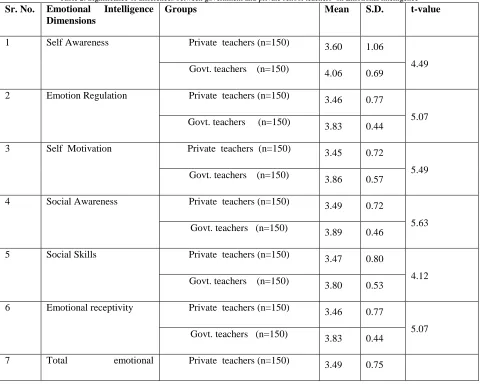
Table 2: Significance of differences between government and private school teachers on Emotional intelligence
Sr. No. Emotional Intelligence Dimensions
Groups Mean S.D. t-value
1 Self Awareness Private teachers (n=150) 3.60 1.06
4.49
Govt. teachers (n=150) 4.06 0.69
2 Emotion Regulation Private teachers (n=150) 3.46 0.77
5.07
Govt. teachers (n=150) 3.83 0.44
3 Self Motivation Private teachers (n=150) 3.45 0.72
5.49
Govt. teachers (n=150) 3.86 0.57
4 Social Awareness Private teachers (n=150) 3.49 0.72
5.63
Govt. teachers (n=150) 3.89 0.46
5 Social Skills Private teachers (n=150) 3.47 0.80
4.12
Govt. teachers (n=150) 3.80 0.53
6 Emotional receptivity Private teachers (n=150) 3.46 0.77
5.07
Govt. teachers (n=150) 3.83 0.44
Intelligence Govt. teachers (n=150) 3.88 0.44 5.42
Table 3 indicated significant differences between government and private school teachers on various sub scales of emotional intelligence . As for self awareness (t= 4.49, p<0.05); emotion regulation (t= 5.07, p<0.05), self motivation (t = 5.49, p<0.05). and social awareness ( t = 5.63, p<0.05),social skills(t= 4.12, p<0.05);emotional receptivity(t= 5.07, p<0.05)and total emotional intelligence(t= 5.42, p<0.05)
There was a significant difference between the two groups for all factors of emotional intelligence. It showed that govt. teachers who had higher mean scores with respect to all dimensions of emotional intelligence as well as with respect to total emotional intelligence were more emotionally intelligent than the private school teachers
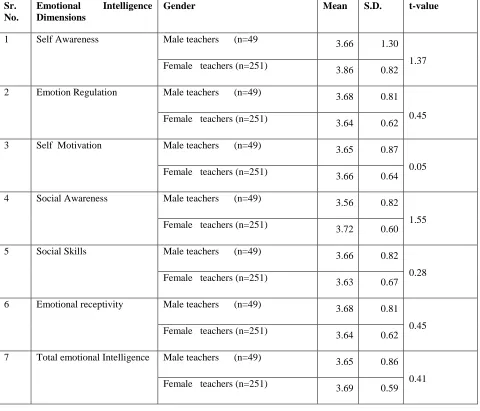
Table 3: Significance of difference between mean scores of various sub scales of emotional intelligence and gender of teachers
Sr. No.
Emotional Intelligence Dimensions
Gender Mean S.D. t-value
1 Self Awareness Male teachers (n=49 3.66 1.30
1.37
Female teachers (n=251) 3.86 0.82
2 Emotion Regulation Male teachers (n=49) 3.68 0.81
0.45
Female teachers (n=251) 3.64 0.62
3 Self Motivation Male teachers (n=49) 3.65 0.87
0.05
Female teachers (n=251) 3.66 0.64
4 Social Awareness Male teachers (n=49) 3.56 0.82
1.55
Female teachers (n=251) 3.72 0.60
5 Social Skills Male teachers (n=49) 3.66 0.82
0.28
Female teachers (n=251) 3.63 0.67
6 Emotional receptivity Male teachers (n=49) 3.68 0.81
0.45
Female teachers (n=251) 3.64 0.62
7 Total emotional Intelligence Male teachers (n=49) 3.65 0.86
0.41
Female teachers (n=251) 3.69 0.59
Table5: Significance of difference between mean scores of various dimensions of emotional intelligence and marital status of teachers
Sr. No.
Emotional Intelligence Dimensions
Gender Mean S.D. t-value
1 Self Awareness Married teachers (n=246) 3.83 0.95
0.17
Unmarried teachers (n=54) 3.81 0.78
2 Emotion Regulation Married teachers (n=246) 3.66 0.65
0.82
Unmarried teachers (n=54) 3.58 0.66
3 Self Motivation Married teachers (n=246 3.66 0.69
0.14
Unmarried teachers (n=54) 3.64 0.64
4 Social Awareness Married teachers (n=246) 3.69 0.64
0.00
Unmarried teachers (n=54) 3.69 0.64
5 Social Skills Married teachers (n=246) 3.63 0.67
0.03
Unmarried teachers (n=54) 3.64 0.78
6 Emotional receptivity Married teachers (n=246) 3.66 0.65
0.82
Unmarried teachers (n=54) 3.58 0.66
7 Total emotional Intelligence Married teachers (n=246) 3.69 0.65
0.35
Unmarried teachers (n=54) 3.66 0.62
*p>.05
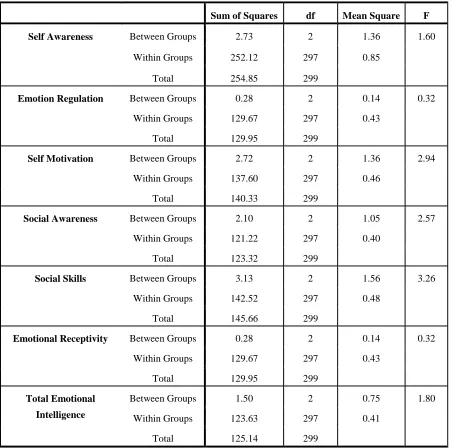
Table 6: Analysis of variance of Emotional Intelligence dimensions by Experience
Sum of Squares df Mean Square F Self Awareness Between Groups 2.73 2 1.36 1.60
Within Groups 252.12 297 0.85
Total 254.85 299
Emotion Regulation Between Groups 0.28 2 0.14 0.32
Within Groups 129.67 297 0.43
Total 129.95 299
Self Motivation Between Groups 2.72 2 1.36 2.94
Within Groups 137.60 297 0.46
Total 140.33 299
Social Awareness Between Groups 2.10 2 1.05 2.57
Within Groups 121.22 297 0.40
Total 123.32 299
Social Skills Between Groups 3.13 2 1.56 3.26
Within Groups 142.52 297 0.48
Total 145.66 299
Emotional Receptivity Between Groups 0.28 2 0.14 0.32
Within Groups 129.67 297 0.43
Total 129.95 299
Total Emotional Intelligence
Between Groups 1.50 2 0.75 1.80
Within Groups 123.63 297 0.41
Total 125.14 299
Table 7: Description of Personality Profile of teachers
Sr. No. Personality Type Government school teachers Private school teachers
N % N %
1. ESTP 44 30% 24 16%
2. ISTP 13 9% 11 7%
3. ESFP 27 18% 19 13%
4. ISFP 8 5% 24 16%
5. ESTJ 12 8% 6 4%
6. ISTJ 11 7% 2 1%
7 ESFJ 3 2% 3 2%
8. ISFJ 9 6% 5 3%
9. ENFJ 0 0% 7 5%
10. INFJ 7 5% 17 12%
11. ENFP 5 3% 3 2%
12. INFP 3 2% 11 7%
13. ENTJ 2 1% 7 5%
14. INTJ 6 4% 0 0%
15. ENTP 0 0% 6 4%
16. INTP 0 0% 5 3%
Total 150 150
Table 8: Analysis of variance for emotional intelligence and personality of teachers
Sources of Variation Sum of Squares
Degrees of
Freedom Mean Square F
Between Groups 36.40 15 2.42 7.74 Within Groups 88.73 283 0.31
Total 125.14 299
Table 8. showed the analysis of variance for emotional intelligence and personality. The table value of F between and within the samples (15 and 134) at 5% level of significance is 1.75. The calculated value of F is more than the table values hence the difference in the mean values of the sample is significant. Hence the hypothesis stating that there will be significant difference between emotional intelligence and personality types of secondary school teachers of Ludhiana is accepted.
The personality types which showed highest score on self awareness dimension were ESFJ and INFJ. Personality types ESFJ, ESTP and INFJ, ISTJ scored higher on emotion regulation and self motivation dimension of emotional intelligence. With respect to social awareness dimension, ISTJ and ESFJ were the most prominent personality types. On the other hand, INFJ and ESTP were the most significant personality types on emotional receptivity.INTP and ENTP scored least on self motivation, social awareness, emotion regulation and emotional receptivity dimension of emotional intelligence. The personality type ENFJ which represents ‘teacher ‘according to Keirsey temperament sorter found no representation.
VI. DISCUSSION AND CONCLUSION
The type of school had a bearing on the results of emotional intelligence of teachers. The results showed that govt. teachers had higher mean scores with respect to all dimensions of emotional intelligence as well as with respect to total emotional intelligence hence were more emotionally intelligent than the private school teachers (table 4). It was corroborated by the studies conducted by (Negi, 2011; Nasir & Masrur, 2010) but contradictory to the studies conducted by (Pande, 2010; Katyal & Awasthi, 2005; Singh, 2002; Chu, 2002;. Dunn, 2002; Hans, Mubeen &Al Rabani ,2013) who found no significant difference between gender and emotional intelligence.
The hypothesis stating there would be significant difference in emotional intelligence of male and female& married and unmarried secondary school teachers was not confirmed.
The analysis of variance for emotional intelligence by experience proved no variance in emotional intelligence w.r.t dimensions such as self awareness, emotion regulation, &emotional receptivity. There was significant variance with respect to dimensions such as self motivation, social awareness, social skills and total emotional intelligence. Hence the hypothesis stating that there would be significant difference in emotional intelligence and experience of secondary school teachers was selected with respect to some dimensions only.
Table 7 exhibited the description of personality profile of teachers. The most dominant personality type among both the categories private and government was personality type ESTP. As compared to other studies nearly 55 percent of the pre service teachers had a profile of ESTJ, ISTJ, or ESFJ. (Cano&Garton, 1994).Reid (1999) sampled elementary teachers and concluded that 57.7%favoured both S and J as preferences in their teaching .Lapenz ; Lester (1997)indicated in their study that ESTJ, ISTJ, ENTJ, and ENFJ – accounted for 69% of all technology professionals. Ian Ball (2000) found that amongst secondary school teachers the three most frequent types are all SJs: ISTJ, ESTJ and ISFJ..
government school teachers no teacher belonged to this category and among the private school teachers only 5% of the teachers belonged to this category.
The analysis of variance for emotional intelligence and personality of teachers proved the hypothesis that there will be significant difference between emotional intelligence and personality types of secondary school teachers of Ludhiana (table 9). Kappagoda(2013) too had concluded that emotional intelligence had strong influence on personality of teachers.
VII. IMPLICATIONS OF THE STUDY
The study would be very useful in an educational setting in terms of identifying teachers who are emotionally weak and give some interventions for enhancing their teaching effectiveness, psychological well being and managing intra-personal and inter-personal relationships. Since the pressures on teachers are very high in terms of handling students and classroom behaviors, teachers should learn to handle all kinds of situations effectively. And this can be possible only when the schools shall organize exercises and workshops to enhance their personal and social emotional competence since teachers are the main contributors in shaping the personality and character of youth. The study would also be useful for the teachers in determining their personality types. The analysis and understanding of teacher personality can provide insights to the teacher to identify his or her strengths and areas of improvement.(Mehta,2012).
REFERENCES
[1] Akbarzade, Nastaran. (2004).Emotional intelligence, Farabi publications, Feyz-al-Eslam Press.
[2] Alhashmei, E., Sushaila., & Hajee, R.. Zahra. (2013).The relationship between leadership, educational level and emotional intelligence : A case study in Bahrain. Prabhandan : Indian journal of management, 6, 24-32.
[3] Boorer, D., Preston, R. (1987). The maintenance of mysticism and ego-centricity: Constraints on teacher effectiveness in higher education in developing countries. International Journal of Educational Development, 7 (1), 13-20
[4] Bennett, N. (1988) .The effective primary school teacher: The search for a theory of pedagogy. Teaching and Teacher Education, 4 (1), 19-30
[5] Briggs Myers, I. & Myers, P.B. (1995). Gifts differing : Understanding personality type ( 2nd ed.). Palo Alto, CA : Davies-Black Publishing.
[6] Bar-On, R. (1997). Bar-One Emotional Quotient Inventory: Technical manual. Toronto:Multi-Health Systems. [7] Barrick, M.R.,Mount, M.K.,Judge, T.A. (2001). Personality and performance at the beginning behavior, 50,145-167.
[8] Birol, C., Atamtürk, H., Silman, F., Atamtürk, A. N., Şensoya, Ş. (2009). A comparative analysis of teachers’ perceptions of emotional intelligence and performance management in the secondary schools of the TRNC. Procedia Social and Behavioral Sciences, 1(1), 2600-2605
[9] Boudreau, J.W., Boswell, W.R., Judge, T.A., and Bretz, R.D. (2001).Personality and cognitive ability as predictors of job search among employed managers. Personnel Psychology, 54, 25-5
[10] Besharat, Muhammad Ali. (2010). The relationship between emotional intelligence and self-efficacy and academic success, Educational Renovations Journal, 3, 5.
[11] Bracey,G.(2002). The war against America’s public schools: Privatizing schools, commercializing education .Boston: Allyn & Bacon. [12] Cano, J., & Garton, B. L. (1994). The learning styles of agriculture preservice teachers as assessed by the MBTI. Journal of Agricultural
Education, 35(1), 8-12
[13] Coleman, J., Hoffer, T., & Kilgore, S. (1982). High school achievement: Public, Catholic and private schools compared. New York: Basic Books.
[14] Chu, J. (2002). Boys development. Reader’s Digest, 94-95.
[15] Carmeli, A. (2003). The relationship between emotional intelligence and work attitudes, behavior and outcomes : An examination among senior managers. Journal of managerial psychology, 18, 788-813
[16] Dunn, S. (2002). Emotional intelligence quotations from around the world. Retrieved from http://www.eqcoach.net/.
[17] Donald, Saklofske., Elizabeth, J.Austin., Paul, Minski. (2003). Factor structure and validity of a trait Emotional Intelligence measure.
Personality and Individual
Differences, 34(4), 707-721.
[18] Das, G.M., Archana. ( 2011). Emotional intelligence and personality in students pursuing professional and non- professional courses - The influence of personal correlates, Prabandhan : Indian journal of management, 4(1), 43-49.
[19] Goldberg, L.R.(1990). An alternative " description of personality " : The big-five factor structure. Journal of personality and social Psychology, 59, 1216-1229.
[20] Goleman, D. (1998b). Working with Emotional Intelligence. New York: Bantam
[21] Hans,Arvind.,Soofi,Asra.Mubeen.,Ruwaiya,Salim.Said.,Al ,Rabani.(2013).a study examined the level of Emotional Intelligence among teachers working in the private institutions in Muscat. International Journal of Application or Innovation in Engineering & Management 2( 7)
[22] Ian Ball. (2000) .Primary and secondary teachers – alike or different? AustralianPsychological Type Review. 2, 3 . [23] Jung, C.G. (1921). Psychological Types, Princeton : Princeton University Press, Reprinted in 1971.
[24] Joseph, P. (1990). Impulsive motor behavior: Effects of personality and goal salience .Journal of Personality and Social Psychology, 58(3), 512-518.
[26] Keirsey, D. (1998). Please understand me II : temperament, character, intelligence. Del Mar, CA: prometheus Nemesis Book Company. [27] Korthagen, F. A. J. (2004). In search of the essence of a good teacher: towards a more holistic approach in teacher education. Teaching and
Teacher Education, 20, 77–97
[28] Keirsey. (2008). The Keirsey temperament sorter (KTS-II). Retrieved March 10, 2013, from http://www.keirsey.com/aboutkts2.aspx
[29] Khalatbari, Javad., Hasani, Masoumeh., Rahmani, Mohammad Ali., Ghorbanshiroudi, Shohreh., Keikhayfarzaneh ., Mohammad, Mojtaba. (2011).The relationship between emotional intelligence and personality traits with the thrill- seeking and self- efficacy in students of TAU Tonekabon Branch in the academic year 2010-2011, International Journal of Scientific & Engineering Research 2 (10),. 1-10 [30] Kappagoda, Sampath.( 2013). The Relationship between Emotional Intelligence and Five Factor Model of Personality of English Teachers
in Sri Lanka (May 13. International Journal of Business, Economics and Law, Vol. 2, Issue 1.
[31] Luthans, F., and Thomas, L.T. (1989). The relationship between age and job satisfaction : Curvilinear results from an empirical study- A research note. Personnel Review 18 (1), 23-26.
[32] Lockheed, M., & Jimenez, E. (1996). Public and private schools overseas: Contrasts in organization and effectiveness. In B. Fuller, & R. Elmore (Eds.), Who chooses? Who loses? (pp. 138–153). New York: Teachers College Press.
[33] Lapenz ,SK.,& Lester, D. (2006). The relations between personality characteristics, work environment, and the professional well-being of music therapists. J Music Ther, 43(3):174-97
[34] Nasir, M., & Masrur, R. (2010). An exploration of emotional intelligence of the students of IIUI in relation to gender, age and academic achievement. Bulletin of Education and Research, 37–51.
[35] Negi, Sita.(2011). A Study of Emotional Intelligence of Teachers Working in Government and Private Senior Secondary Schools.Brics journal of educational research,1( 2)
[36] Malcolm,Higgs. (2001). "Is there a relationship between the Myers-Briggs type indicator and emotional intelligence?”.Journal of Managerial Psychology, 16( 7), 509 – 533.
[37] Mayer, J.D., Caruso, D.R., & Salovey, P. (2002). Relation of an ability measure of emotional intelligence to personality. Journal of Personality Assessment, 79(2), 306-320.
[38] Mehta,Sandhya. (2011). Understanding personality profiles and academic achievement of management students. Asia Pacific Journal of Research in Business Management,2(3)
[39] Mehta, Sandhya .,& Kaur, Sandeep. (2011). Interpersonal Orientation as Affected by Personality, International journal of research in commerce & management, 2(2),47-52
[40] Mehta, Sandhya. (2012). Personality of Teachers. International Journal of Business and Management Tomorrow, 2(2), 1-8 [41] Mehta,Sandhya.(2013).Teacher :personality & jobsatisfaction.
[42] New Delhi.Commonwealth Publishers,India
[43] Mehta, Sandhya., & Singh, Namrata.(2013a). A Review paper on emotional intelligence: Models and relationship with other constructs.
International Journal of Management & Information Technology, 4(3),342-353
[44] Mehta ,Sandhya .,& Singh, Namrata.(2013b). Development of emotional intelligence Scale.International Journal of Management & Information Technology,8(1),1251-1262.
[45] Mohsin Atta.,Muhammad Ather., Maher, Bano.(2013).Emotional Intelligence and Personality Traits among University Teachers:Relationship and Gender Differences.International Journal of Business and Social Science, 4 , 17
[46] Muncherji, Nina., & Pestonjee, D.M. (2013). A study of the relationship between emotional intelligence and organisational role stress amongst private sector bank employees, AIMS International journal of management, 7(1) ,25-39.
[47] Nawi, Nurul. Hudani Md., Redzuan, Ma'rof.(2011).Emotional Intelligence, Personality and Self Esteem: A Comparison of the Characteristics among Two Categories of Subjects, International Journal of Humanities and Social Science,. 1 (8), 238-247.
[48] Pande, H. S.( 2010). Evaluating characteristics and emotional intelligence among workers in organizations in the state of Rajasthan,
International Research Journal, 1( 10)
[49] Rand, McNally., Salgado, J.F. (1997). The five-factor model of personality and job performance in the European Community. Journal of applied Psychology, 82, 30-43.
[50] Reid, J. (1999). The relationship among personality type, coping strategies, and burnout in elementary teachers. Journal of Psychological Type, 51, 22–33.
[51] Rushton, S. Morgan, J., Richard, M. (2007). Teacher’s Myers-Briggs personality profiles: Identifying effective teacher personality traits.
Teaching and Teacher Education, 23, 432–441
[52] Sagoe, I.K.(1999). Personality and job satisfaction : A test of Myers- Briggs Type indicator in different management and reward systems, Doctoral Dissertation, Nova Southeastern University, Dissertation Abstracts International, 59 (10), 3886A.
[53] Schulte, D. P., Slate, J. R., Onwuegbuzie, A. J. (2008). Effective high school teachers: A mixed investigation. International Journal of Educational Research, 47 (6), 351-361
[54] Tolor, A. (1973). Evaluation of perceived teacher effectiveness.Journal of Educational Psychology, 64 (1), 98-104 [55] Tamblyn, P. (2000). Qualities of success: Lessons from a teacher career. Education Canada, 40 (1), 19–19
[56] Viin, Tiina., Juust, Liis., & Tooman, Heli. (2010). Emotional intelligence of teachers of tourism and hospitality students: the case of Estonia, University of Tartu. Retrieved from http://www.eurochrie2010.nl/publications/103.pdf