A JOINT COMPRESSION & WATERMARKING
ALGORITHM FOR COLOR IMAGES
PANKAJ SONI 1, VANDANA TRIPATHI2, RITESH PANDEY3
1. Dept of ECE, ME student, G.N.C.S.G.I., JABALPUR, M.P., INDIA, 2-Dept of ECE, Asst. Prof., G.N.C.S.G.I., JABALPUR, M.P., INDIA, 3-Dept of ECE, Asst. Prof., G.N.C.S.G.I., JABALPUR, M.P., INDIA,
ABSTRACT: Watermarking is highly demanding in recent times for the protection of multimedia data in network environment from illegal copying, violation of copyright,
authentication etc, while compression of multimedia signals is essential to save storage space and
transmission time. It is also well known the importance and effectiveness of compression
techniques to store transmit and retrieve visual information. However, the creation or
development of a joint compression and watermarking framework for images has yet to be
explored. Experiments are performed to verify the robustness of the proposed algorithm. The
results show that the proposed algorithm is superior to other algorithm in terms of providing a
high PSNR. It is also shown that the proposed algorithm is highly robust against different types
of attack.
KEYWORDS: Watermarking, Discrete wavelet transform, Discrete Cosine Transform, PSNR, MSE.
1. INTRODUCTION
DIGITAL image watermarking has become a necessity in many applications such as data
authentication, broadcast monitoring on the Internet and ownership identification. Various
watermarking schemes have been proposed to protect the copyright information. There are three
indispensable, yet contrasting requirements for a watermarking scheme: robustness, invisibility
and capacity. Therefore, a watermarking scheme should provide a trade-off between these
features [1].
The rapid growth of visual media based applications necessitates sophisticated
compression techniques in order to store, transmit and retrieve audio-visual information. The
manipulation of visual media. With the widespread use of the Internet and the rapid and massive
development of multimedia, there is an impending need for efficient and powerfully effective
copyright protection techniques. Digital watermarking schemes are typically classified into three
categories. (1) Private watermarking which requires the prior knowledge of the original
information and secret keys, at the receiver, (2) Semi-private or semi-blind watermarking where
the watermark information and secret keys may be available at the receiver, and (3) public or
blind watermarking where the receiver must only know the secret keys [2].
Uncompressed multimedia (Image, audio, signal) data requires considerable storage
capacity and transmission bandwidth despite rapid progress in mass storage density, processor
speeds and digital communication system performance, demand for data storage capacity and
data transmission bandwidth continues to outstrip the capabilities of available technologies. The
recent growth of data intensive multimedia-based web applications have not only the need for
more efficient ways to encode signals and images but have made compression of such signals
central to storage and communication technology. At the present state technology, the only
solution is to compress multimedia data before its storage and transmission, and decompress it at
the receiver for playback [4].
2.LITERATURE REVIEW
Hamidreza Sadreazami et.al: Author’s proposes “Multiplicative Watermark
Decoder in Contourlet Domain Using the Normal Inverse Gaussian Distribution” A novel watermark decoder in the contourlet domain. It is known that the contourlet coefficients of an
image are highly non-Gaussian and a proper distribution to model the statistics of the contourlet
coefficients is a heavy-tailed PDF. The proposed watermark extraction approach is developed
using the maximum likelihood method based on the NIG distribution. Closed-form expressions
are obtained for extracting the watermark bits in both clean and noisy environments.
Experiments are performed to verify the robustness of the proposed decoder. The results show
that the proposed decoder is superior to other decoders in terms of providing a lower bit error
rate. It is also shown that the proposed decoder is highly robust against various kinds of attacks
Zhao Jian et.al has proposed “A Watermark Technique Based On Extended Shearlet And Insertion Using The Largest Information Entropy On Horizontal Cone”.
Author’s proposed the algorithm in which firstly, 1-level extended discrete shearlet transform
decomposes the test image into directional components on horizontal cone; each directional
component reflects directional features and textured features differently. Next, the directional
component whose information entropy is the highest is selected to carry watermark. Compared
with related algorithms based on DWT and DCT, the proposed algorithm tends to obtain
preferable invisibility when it is robust against common attacks [3].
Koyi Lakshmi Prasad et.al has proposed “A Hybrid LWT-DWT Digital Image
Watermarking Scheme Using LSVR and QR-Factorization”. In this proposed article author’s
present an efficient and hybrid approach that integrates features of lifted wavelet transform
(LWT) and discrete wavelet transform (DWT) based on linear support vector regression (LSVR)
and QR-factorization for watermarking. Precisely the integrated hybrid approach produces less
distortion rate. The experimental results are analyzed with other models and offers high
reliability on watermark embedding and authenticity along with less computational cost [7].
3.WATERMARKING TECHNIQUE
In general digital watermarking involves two major operations: (i) watermark embedding,
and (ii) watermark extraction. For both operations a secret key is needed to secure the
watermark. The keys in watermarking algorithms can apply the cryptographic mechanisms to
provide more secure services. The secret message embedded as watermark can almost be
anything, for example, a bit string, serial number, plain text, image, etc. The most important
properties of any digital watermarking technique are: robustness, security, imperceptibility,
complexity, and verification. Watermarking techniques can be classified according to the nature
of data (text, image, audio or video), or according to the working domain (spatial or frequency),
or classified according to the human perception (robust or fragile). In images, the watermarking
techniques can broadly be classified into three types: (i) visible watermark, (ii) invisible fragile
watermark and (iii) invisible robust watermark, which has wider currency and use [5].
Watermarking compressed domain data will obviate the need for it to be decompressed
efficiently. Hence, there is an impending need for sophisticated joint watermarking and
compression techniques that could compress, protect and watermark data simultaneously. While
compression aims at concentrating data in the least possible information, watermarking aims at
distributing and hiding logos and parameters. Hence, compression and watermarking are
inversely related and they have to be treated on a trade-off manner. The amount of
extracted/retrieved watermarked data is affected by the compression degree of the host data,
while the efficiency of compression is affected by the amount of data that needs to be embedded
and extracted [2].
4.IMAGE COMPRESSION
Compression algorithms are methods that reduce the number of symbols used to represent source information, therefore reducing the amount of space needed to store the source
information or the amount of time necessary to transmit it for a given channel capacity. The
mapping from source symbols into fewer target symbols is referred to as compression. The transformation from the target symbols back into the source symbols representing a close
approximation form of the original information is called decompression. Compression system consists of two steps, sampling and quantization of a signal. The choice of compression
algorithm involves several conflicting considerations. These include degree of compression
required, and the speed of operation. Obviously if one is attempting to run programs direct from
their compressed state, decompression speed is paramount. The other consideration is size of
compressed file versus quality of decompressed image. Compression is also known as encoding
process and decompression is known as decoding process [6].
5.PERFORMANCE EVALUATION PARAMETER
The PSNR computes the peak signal-to-noise ratio, in decibels, between two images.
This ratio is often used as a quality measurement between the original and a compressed image.
The higher the PSNR, the better the quality of the compressed or reconstructed image.
The Mean Square Error (MSE) and the Peak Signal to Noise Ratio (PSNR) are the two
error metrics used to compare image compression quality. The MSE represents the cumulative
squared error between the compressed and the original image, whereas PSNR represents a
MSE is defined as:
Where,
X (i, j) = original image Xc (i, j) = compressed image
PSNR represents a measure of the peak error & is expressed in decibels. It is defined by:
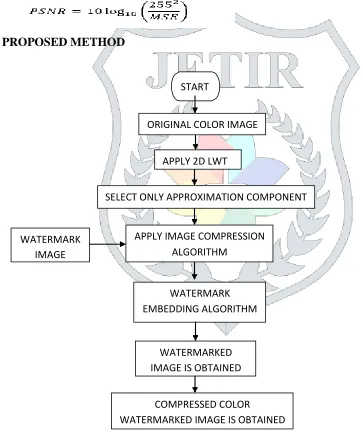
FIGURE 1: FLOW CHART OF WATERMARKING EMBEDDING ALGORITHM
6. PROPOSED METHOD
START
ORIGINAL COLOR IMAGE
APPLY 2D LWT
SELECT ONLY APPROXIMATION COMPONENT
APPLY IMAGE COMPRESSION ALGORITHM
WATERMARK IMAGE
WATERMARK EMBEDDING ALGORITHM
WATERMARKED IMAGE IS OBTAINED
COMPRESSED COLOR
An image is a two dimensional signal containing a multitude of frequencies both high and
low and is also represented as a two dimensional matrix. Therefore the most appropriate portion
to be taken into account for watermark embedding consists of high frequency components. So in
order to identify the significant portion of the image data for consideration of watermark, the
image I of size MXN is subjected to level 1 LWT thereby decomposed into four non overlapping
multi-resolution sub-bands viz. LL (Approximation sub-band), HL (Horizontal sub-band), LH
(vertical sub-band) and HH (diagonal sub-band), out of which LL is the low frequency
component and rest are high frequency (detail) components. Apply image compression algorithm
in Approximation sub-band & in watermark image so that compressed image is obtained. Apply
watermarking embedding algorithm in Approximation sub-band so that compressed with color
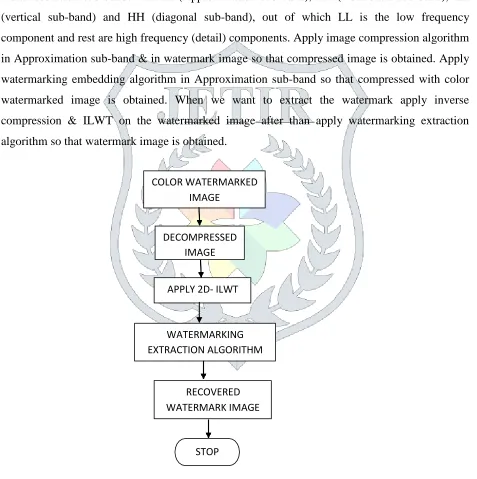
watermarked image is obtained. When we want to extract the watermark apply inverse
compression & ILWT on the watermarked image after than apply watermarking extraction
algorithm so that watermark image is obtained.
STOP
FIGURE 2: FLOW CHART OF WATERMARKING EXTRACTION ALGORITHM
COLOR WATERMARKED IMAGE
DECOMPRESSED IMAGE
APPLY 2D- ILWT
WATERMARKING EXTRACTION ALGORITHM
6.EXPERIMENTAL RESULTS:
Experiments are performed to evaluate the imperceptibility of the embedded watermark
as well as the robustness of the proposed watermarking scheme against various attacks. In our
experiments, we use color images of size 512X512.
INVISIBILITY OF WATERMARK: Invisibility is an evaluative measure of perceptual quality of the watermarked image. In a satisfactory image watermark algorithm, watermark should not
cause much degradation of perceptual quality of the watermarked image. In the proposed
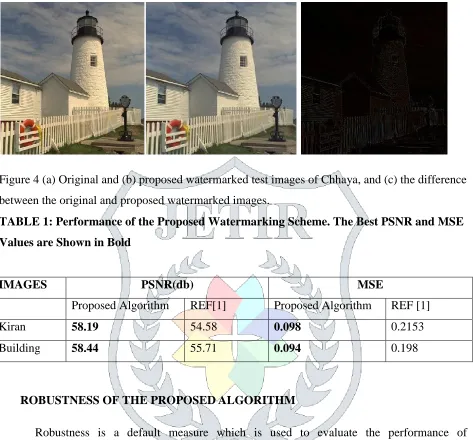
algorithm, a watermark image is embedded into different test images to test invisibility. As shown
in figure 3 & 4, there are not much visual differences between original test images and their
corresponding watermarked images. The extracted watermarks are all easily distinguishable.
Furthermore, by analyzing the absolute difference between the test image and the watermarked
image the images are indistinguishable, thus showing the effectiveness of the proposed
watermarking scheme in terms of the invisibility of the watermark.
Figure 3 (a) Original and (b) proposed watermarked test images of Lena and (c) the difference
Figure 4 (a) Original and (b) proposed watermarked test images of Chhaya, and (c) the difference
between the original and proposed watermarked images.
TABLE 1: Performance of the Proposed Watermarking Scheme. The Best PSNR and MSE Values are Shown in Bold
IMAGES PSNR(db) MSE
Proposed Algorithm REF[1] Proposed Algorithm REF [1]
Kiran 58.19 54.58 0.098 0.2153
Building 58.44 55.71 0.094 0.198
ROBUSTNESS OF THE PROPOSED ALGORITHM
Robustness is a default measure which is used to evaluate the performance of
watermarking algorithm resistance against attacks such as compression, salt & pepper noise,
filtering, cropping, and rotation. In a satisfactory algorithm for image watermark, the watermark
would not be easily removed from the watermarked image after common and deliberate attacks.
TABLE 2: PSNR and MSE comparisons of LENA test image between the proposed scheme and the algorithm in [1].
. WATERMARKED
IMAGE
EXTRACTED
WATERMARK
WATERMARKED
IMAGE
EXTRACTED
WATERMARK
ATTACK TYPE PSNR MSE PSNR MSE PSNR MSE PSNR MSE
1 NO ATTACK
58.19 0.098 58.40 0.094 54.58 0.2153 50.22 0.6229
3. SALT &
PEPPER
NOISE
52.56 0.3605 50.82 0.789 49.11 0.7975 48.19 0.886
4.
MEDIAN
FILTER
55.89 0.167 51.98 0.799 50.12 0.781 49.81 0.994
5. CROPPING
6. ROTATION
100
51.79 0.541 49.82 0.999 49.67 0.811 48.99 0.986
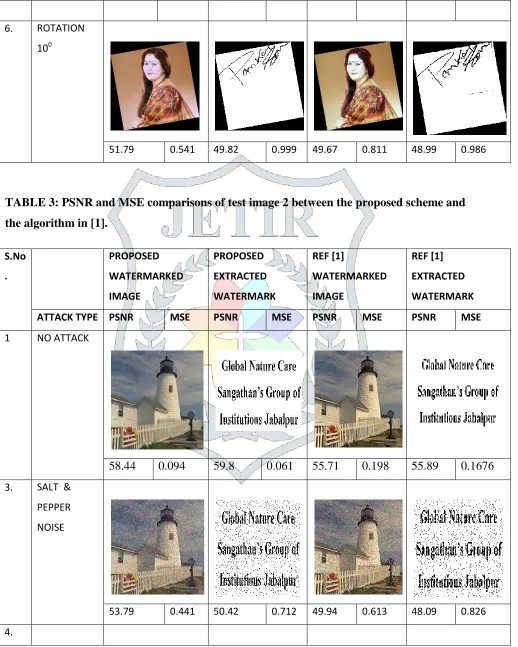
TABLE 3: PSNR and MSE comparisons of test image 2 between the proposed scheme and the algorithm in [1].
S.No
.
PROPOSED
WATERMARKED
IMAGE
PROPOSED
EXTRACTED
WATERMARK
REF [1]
WATERMARKED
IMAGE
REF [1]
EXTRACTED
WATERMARK
ATTACK TYPE PSNR MSE PSNR MSE PSNR MSE PSNR MSE
1 NO ATTACK
58.44 0.094 59.8 0.061 55.71 0.198 55.89 0.1676
3. SALT &
PEPPER
NOISE
53.79 0.441 50.42 0.712 49.94 0.613 48.09 0.826
MEDIAN
FILTER
55.95 0.165 50.28 0.531 50.82 0.681 49.81 0.994
5. CROPPING
54.12 0.623 49.11 0.797 44.23 2.451 47.56 0.7967
6. ROTATION
100
52.79 0.641 49.12 0.489 48.67 0.711 48.19 0.838
8.CONCLUSION
In this paper, a new method compression with watermarking algorithm has been
proposed. To investigate the robustness of proposed algorithm, different images with different
intentional and unintentional attacks were employed. PSNR values are estimated for all the
images. Comparing these PSNR values with that obtained by earlier conventional approach it can
be concluded that the fidelity of the watermarked image is improved with the proposed method.
It has been also shown that the performance of proposed algorithm is highly robust against
9.REFERENCES
1. Hamidreza Sadreazami et.al: “Multiplicative Watermark Decoder in Contourlet Domain
Using the Normal Inverse Gaussian Distribution” Ieee Transactions On Multimedia, Vol.
18, No. 2, February 2016.
2. Gamal Fahmy et.al : “ Joint Watermarking and Compression for Images in Transform
Domain” International Journal of Modern Engineering Research (IJMER) Vol.2, Issue.4,
July-Aug. 2012 pp-2341-2351.
3. Zhao Jian et.al: “Image Watermark Based on Extended Shearlet and Insertion Using the
Largest Information Entropy on Horizontal Cone”: Hindawi Publishing Corporation
Mathematical Problems in Engineering Volume 2015, Article ID 450819, 10 pages.
4. R.Sudhakar et.al : “Image Compression using Coding of Wavelet Coefficients – A
Survey” ICGST-GVIP Journal, Volume (5), Issue (6), June 2005.
5. Mustafa Osman Ali et.al : “ Invisible Digital Image Watermarking in Spatial Domain
with Random Localization” International Journal of Engineering and Innovative
Technology (IJEIT) Volume 2, Issue 5, November 2012.
6. Archana Deshlahra: “Analysis of Image Compression Methods Based On Transform and
Fractal Coding” thesis NIT Rourkela 2013.
7. Koyi Lakshmi Prasad et.al : “ A Hybrid LWT-DWT Digital Image Watermarking
Scheme using LSVR and QR-factorization” International Journal of Applied Engineering