Abstract—Free space optics (FSO) is a promising solution
for the need to very high data rate point-to point communication. It is one of the future technologies of wireless networks as it meets most of the quality parameters at low implementation cost. The main drawback in communicating via the FSO channel is the detrimental effect the atmosphere has on a propagating laser beam. This paper investigates the use of multiple lasers and multiple apertures to mitigate the effects of the atmospheric turbulence without and with low density parity check (LDPC) code. Here an analytical approach is presented to evaluate the bit error rate performance of a free space optical link using LDPC coded Q-ary optical PPM through atmospheric turbulence channel. The performance results are evaluated in terms of bit error rate (BER) and coding gain. It is found that LDPC coded system provides significant coding gain of 10 to 20dB over uncoded system can be evaluated at BER 10-12 for multiple source and photo-detector combinations. It is also found that LDPC code provides better performance under strong turbulence rather
than weak turbulence conditions.
Index Terms—bit interleaved coded modulation (BICM), Low density parity check (LDPC) code, multiple input/multiple output (MIMO) processing, pulse position modulation (PPM).
I. INTRODUCTION
Free-space optical (FSO) communications is a cost effective and high bandwidth access technique, which is receiving growing attention with recent commercialization successes [1]. FSO transmission is unlicensed, and only must subscribe to safety standards for potential eye damage. In this regard, use of infrared wavelengths, in particular 1.55 m, is advantageous, since eye hazards are less problematic, and a large technology base exists from the fiber-optic world. However, to exploit all potentials of FSO communication systems, the designers have to overcome some of the major challenges related to the optical wave propagation through the atmosphere. Namely, an optical wave propagating through the air experiences fluctuations in amplitude and phase due to atmospheric turbulence [1]– [7]. This intensity fluctuation, also known as scintillation, is one of the most important factors degrading the performance of an FSO communication link, even under the clear sky conditions.To enable the transmission under the
Manuscipt received March 9, 2011; revised May 21, 2011.
Bobby Barua is with the Department of EEE, Ahsanullah University of Science and Technology.
Dalia Barua is with the IICT, Bangladesh University of Engineering and Technology [email protected]
strong atmospheric turbulence the use of the multi-laser multi-detector (MLMD) concept has been reported in Ref. [4, 6]. In several publications, MLMD concept itself [6] and different coding techniques [4] are studied assuming an ideal photon-counting receiver. Low density parity check coded (LDPC) modulation is found to be more efficient rather than other coding technique [7].
To improve the performance of FSO systems with PPM, several number of coding techniques including convolutional codes, turbo codes (TC), and Reed-Solomon (RS) codes, have been proposed so far. The classical binary convolutional codes have been applied to QPPM in [10] and [11]. Convolutional coded interleaved QPPM has been proposed in [12]. More powerful codes such as turbo-codes have also been considered for QPPM [12], [13]. However, the main drawback of these schemes is that binary codes are not suitable for using with Q-ary symbols in the sense that they are not efficient for correcting demodulator output errors. Non-binary codes are more appropriate [13]. However, the problem with non-binary convolutional or turbo-codes is their decoding complexity that can be prohibitively large for a practical implementation in a Gbps-rate FSO system. RS codes are appropriate from this point of view: an (n, k) RS code is naturally matched to QPPM by choosing n = Q−1 [15], [16]. Coding gains of RS and convolutional codes are sufficient under the regime of weak turbulence and in the absence of fog. However, in the presence of strong turbulence or deep fog, coding gains of RS or convolutional codes are insufficient, as shown in [8], and more advanced FEC schemes, such as turbo [9] or low-density parity-check (LDPC) codes are needed.
In this paper, we propose an analytical approach to evaluate the performance of uncoded and power efficient coded-modulation scheme based on bit interleaved coded modulation (BICM) [2] with LDPC codes as component codes, suitable for the use in MIMO FSO systems with Q-ary PPM. The proposed coded modulation scheme allows aggregation of RF/microwave signals and a conversion to the optical domain in a very natural way and may be a good candidate for hybrid RF/microwave-FSO systems. The proposed coded modulation scheme allows aggregation of RF/microwave signals and a conversion to the optical domain in a very natural way and may be a good candidate for hybrid RF/microwave-FSO systems. The bit-error rate (BER) performance results are evaluated with and without LDPC code in the presence of background radiation. The bit-error rates are determined assuming that p.i.n. photodiodes are used, and the channel is modeled using both lognormal and Gamma-Gamma distribution.
Evaluate the Performance of a LDPC Coded
FSO System Employing Q-PPM as Modulation
Technique
(a)
(b)
(c)
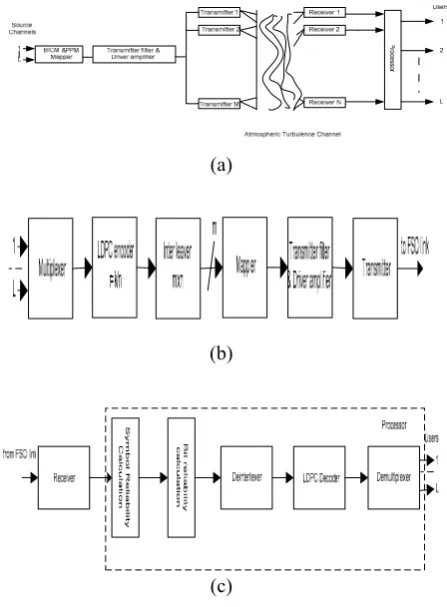
Fig. 1. (a) Atmospheric optical MIMO system with Q-ary PPM and BICM, (b) transmitter side and (c) processor configuration.
II. SYSTEM MODEL
Fig.1(a) shows the block diagram of LDPC coded FSO communication link with MIMO technology employing Q-ary PPM as modulation technique. The encoder and decoder configurations are shown in Fig. 1(b) and 1(c), respectively. From the overall diagrams it is clearly observed that a Q-ary PPM scheme transmits L=log2Q bits per symbol, providing high power efficiency. The source bit streams coming from L sources ui (i=1,2,….L) are encoded using L(n,ki) LDPC encoders of rate Ri=ki/n where n is the codeword length and ki is the dimension (information word length) of the ith component LDPC code. The mxn block-interleaver, collects m code-words written row-wise. The mapper accepts m bits at a time from the interleaver column-wise and determines the corresponding slot for Q-ary (Q=2m) PPM signaling using a Gray mapping rule. With this BICM scheme, the neighboring information bits from the same source are allocated into different PPM symbols. In each signaling interval Ts a pulse of light of duration T=Ts/Q is transmitted by a laser. The signaling interval Ts is subdivided into Q slots of duration T. The total transmitted power Ptot is fixed and independent of the number of lasers so that emitted power per laser is Ptot/M. This technique
improves the tolerance to atmospheric turbulence, because different Q-ary PPM symbols experience different atmospheric turbulence conditions The ith (i=1,2,…,M) laser
modulated beam is projected toward the jth (j=1,2,…,N)
receiver using the expanding telescope, and the receiver is implemented based on a p.i.n. photo detector in a
r t( )=
η
h t I( ) 0+n t( )(1)
where I0 =the average transmitted light intensity and I =hI0 =the corresponding received intensity in an ON PPM slot. h =the channel fading coefficient n =receiver noise.
The aggregate optical field is detected by each PD, assuming an ideal photon counting model with typical quantum efficiency. The use of only one LDPC code allows iterating between the a posteriori probability (APP) demapper and the LDPC decoder (we will call this step the outer iteration), further improving the BER performance.
III.CHANNEL MODELING
Though we assume an LOS path exists between the transmit and receive array, the transmitted field from a single laser will propagate through an atmosphere and may experience several effects. To characterize the FSO channel from a communication theory perspective, it is useful to give a statistical representation of the scintillation. The reliability of the communication link can be determined if we use a good probabilistic model for the turbulence. Several models exist for the aggregate amplitude distribution, though none is universally accepted, since the atmospheric conditions obviously matter. Most prominent among the models are the log-normal , Rayleigh and gamma-gamma model.
A. Log-normal and Rayleigh Model
For propagation distances less than a few kilometers, variations of the log-amplitude are typically much smaller than variations of the phase. Over longer propagation distances, where turbulence becomes more severe, the variation of the log amplitude can become comparable to that of the phase. Based on the atmosphere turbulence model adopted here and assuming weak turbulence, we can obtain the approximate analytic expression for the covariance of the log-amplitude fluctuation of plane and spherical waves which is also known as Rytov variance, given by[1],
σR2 =1.23C n 2 k7/6L11/6 (2)
where Cn2 is the wave number spectrum structure parameter and depends on the altitude. Due to the turbulence of the atmosphere, the field strength received at the detector becomes a random field. We adopt both log-normal and Rayleigh models - which are the most accurate among them. In the log-normal model, the amplitude of the random path gain A can be written as A=ex , where X is
normal with mean μx and variance σ2 x. By definition, the
logarithm of A follows a normal distribution. The pdf. of A is given by [9],
2
1 2
2 2
(log ) 1
( ) exp( ), 0
2 (2 )
e x
A
x x
a
f a a
a
μ σ πσ
−
= − > (3)
of the strength of atmospheric fading, known to information theorists as the “amount of fading”, is defined as
4
2 2
. . E A 1
S I E A ⎡ ⎤ ⎣ ⎦ = − ⎡ ⎤ ⎣ ⎦ (4)
which, for lognormal distribution, can be shown to equal
2
. . 4 x 1
S I= eσ − . Typical values appearing in the literature are S.I. in the range of 0.4–1.0.
Rayleigh fading emerges from a scattering model that views the composite field as produced by a large number of non dominating scatterers, each contributing random optical phase upon arrival at the detector. Furthermore, with Rayleigh fading, the diversity order which means the number of independently fading propagation paths - of the MIMO system becomes apparent by analyzing the slopes of the symbol error probability curves . The pdf of A under the Rayleigh distribution is
( ) 2 a2 , 0
A
f a = a e− a > (5) The central limit theorem then gives a complex Gaussian field, whose amplitude is Rayleigh.
B. Gamma-gamma Model
Under weak fluctuation conditions, the scintillation index [Eq. (3)] increases with increasing values of the Rytov variance [Eq. (2)]. The scintillation index continues to increase beyond the weak fluctuation regime and reaches a maximum value greater than unity (sometimes as large as 5 or 6) in the regime characterized by random focusing. With increasing path length or in homogeneity strength, the focusing effect is weakened by multiple self-interference and the fluctuations slowly begin to decrease, saturating at a level for which the scintillation index approaches unity from above.
The reliability of the communication link can be determined if we use a good probabilistic model for the turbulence. Several probability density functions (pdfs) have been proposed for the intensity variations at the receiver of an optical link. Al-Habash et al. [9] proposed a statistical model that factorizes the irradiance as the product of two independent random processes each with a Gamma pdf. The pdf of the intensity fluctuation is given by [9],
( ) ( )/2 1
2 ( )
2( )
( ) (2 ), 0
( ) ( )
f I I K I I
α β α β α β αβ αβ α β + + − − = >
Γ Γ
(6)
I is the signal intensity, Г(.) is the gamma function, and Kαβ is the modified Bessel function of the second kind and order αβ. α and β are pdf parameters describing the scintillation experienced by plane waves, and in the case of zero-inner scale are given by [9]
2 12 / 5 7 / 6
1 0.49
exp 1
(1 1.11 )
R R α σ σ = ⎡ ⎤ − ⎢ + ⎥ ⎣ ⎦ (7)
2 12 / 5 5 / 6 1 0.51
exp 1
(1 0.69 )
R R β σ σ = ⎡ ⎤− ⎢ + ⎥ ⎣ ⎦
(8)
IV.THEORETICAL ANALYSIS
C. Bit Error Rate (BER) of uncoded system
First, we assume the channel gain of every laser-detector pair is fixed over a symbol duration. Letting amn denote the amplitude fading on the path from laser m to photodetector n, we define the channel gain matrix as A with element [anm, n =1,……,N, m = 1, ……M]. The probability of symbol error conditioned on the fading variables is
2( ) |
1 0
( 1) ( , , ) s n mnm
w w i a i l
l M
s A i l
w i w
P t Q w i e
i i λ − + − = = − ⎛ ⎞ ⎛ ⎞ ∑ ∑ = − ⎜ ⎟⎜⎜ ⎟⎟ ⎝ ⎠⎝ ⎠
∑∑
(9)To extend the analysis of non-fading link and no background radiation case to the case of link fading, we can simply average the (conditional) symbol error probability of (3.3.20), with respect to the joint fading distribution of the Anm variables. We emphasize that this produces the symbol error probability averaged over fades. Formally, we find Ps by evaluating
PS =
∫
P f a das A A| ( ) (10) where the integral is interpreted as an MN-dimensionalintegral. Since the Anm variables are assumed independent, the above averaging leads to
2 ( ) 0 1 0
( 1) ( , , ) s ( )
MN
w w i i l a
l M
s A
i l
w i w
P t Q w i e f a da
i i λ − ∞ + − = = − ⎛ ⎞ ⎛ ⎞ ⎛ ⎞ = − ⎜ ⎟⎜⎜ ⎟⎟ ⎜ ⎟ ⎝ ⎠⎝ ⎠ ⎝ ⎠
∑∑
∫
(11)If the channel is under log-normal fading, the probability of zero count in slot 1 at detector n is given by [1],
[
]
1 12 rP
1 0 | 1,
M n s
nm m n T a Mhf Q n
P allZ slot A e
η = = ⎛ ⎞⎛ ⎞ − ⎜ ⎟⎜ ⎟ ⎝ ⎠⎝ ⎠ ∑ ∑
= = (12)
If the path gains are independently distributed and identical, the average symbol error is given by [4],
2 | 1 ( ) ( ) Es a M hf M N
s s A A A
Q
P P f a da e f a da Q η⎛⎜⎝ ⎞⎟⎠ − ⎧⎡ ⎤ ⎫ ⎪⎢ ⎥ ⎪ − ⎪ ⎪ = = ⎨⎢ ⎥ ⎬ ⎪⎢ ⎥ ⎪ ⎣ ⎦ ⎪ ⎪ ⎩ ⎭
∫
∫
(13)In case of gamma-gamma fading, the probability of zero count in slot 1 at detector n is
[
]
1 12 rP
1
0|
1,
M n s
nm m n T a Mhf Q n
P allZ
slot A e
η = = ⎛ ⎞⎛ ⎞ − ⎜ ⎟⎜ ⎟ ⎝ ⎠⎝ ⎠
∑ ∑
=
=
(14)If the path gains are independently distributed and identical, the average symbol error becomes
2 | 1 ( ) ( ) Es a M hf M N
s s A
Q
P P f I dI e f I dI
Q η⎛⎜ ⎞⎟ ⎝ ⎠ − ⎧⎡ ⎤ ⎫ ⎪⎢ ⎥ ⎪ − ⎪ ⎪ = = ⎨⎢ ⎥ ⎬ ⎪⎢ ⎥ ⎪ ⎣ ⎦ ⎪ ⎪ ⎩ ⎭
0 0.5 1 1.5 2 2.5 3 3.5 4 0
0.2 0.4 0.6 0.8 1 1.2 1.4
I
f(
I)
Rayleing Pdfs SI=0.4 SI=0.8
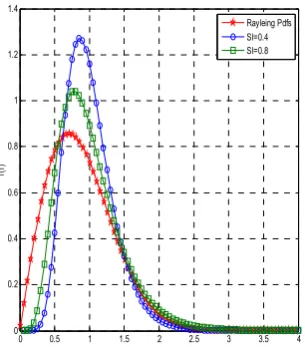
Fig2. Probability of Distribution Function for Lognormal pdfs.
0 0.5 1 1.5 2 2.5 3 3.5 4 0
0.1 0.2 0.3 0.4 0.5 0.6 0.7 0.8 0.9
I
f(
I)
SI=3 SI=6
Fig3. Probability of Distribution Function for Gamma-Gamm
D. Bit Error Rate (BER) of coded system
The outputs of the N receivers in response to symbol q, denoted as Zn,q (n=1,2,…,N; q=1,2,…,Q), are processed to
determine the symbol reliabilities ((q) (q=1,2,…,Q) given by[2]
2 , 1
1 1 1 ,
2 2
( )
N
M s
N Q
nq m n m
n n q n I
E
Z I
Z M
q
λ
σ σ
=
= = =/
⎛ ⎞
−
⎜ ⎟
⎜ ⎟
⎝ ⎠
= − −
∑
∑
∑ ∑
(16)
where Es is the symbol energy of uncoded symbol in
electrical domain (in the absence of scintillation), which is related to the bit energy Eb by Es=Eblog2Q. σ² is the variance of TA thermal noise (that is modeled as additive white Gaussian noise (AWGN)), and it is related to the double-side power spectral density N0 by σ²=N0/2. With Inm we denoted the intensity of the light incident to nth photo-detector (n=1,2,…,N), originated from mth (m=1,2,…,M) laser source, which is described by the Gamma-Gamma probability density function (pdf). The bit reliabilities L(cj), (j=1,2,…,m) (cj is the jth bit in observed symbol q binary representation c=(c1,c2,…,cm)) are determined from symbol reliabilities are given by[2],
( )
( )
( )
: 0exp
log
exp
j c c j
q L c
q
λ λ
= ⎡⎣ ⎤⎦
=
⎡ ⎤ ⎣ ⎦
∑
∑
(17)
We assumed equally probable transmission (Pr(q)=1/Q, q=1,..,Q), the averaging over different symbols will not affect the result. Notice that the ensemble averaging is to be done for different channel conditions (I n) and for different
thermal noise realizations (Z | I n). Under this condition the
pdf is given by P(Z n q| In) , is
2
2
( )
1
( | ) exp
2 2
n nq n
nq
Z I
P Z I
σ σ π
⎡ − ⎤
= ⎢− ⎥
⎢ ⎥
⎣ ⎦
(18)
V. RESULTS AND DISCUSSION
Following the analytical approach presented in section IV, we evaluate the bit error rate performance result of a MIMO FSO link with Q-ary PPM and direct detection scheme. The simulations are performed for up to 25 iterations in LDPC decoder, the influence of scintillation is modeled assuming both lognormal and gamma-gamma distribution and an ideal photon counting receiver is employed. The plots of the probability density function in Fig. 2 and Fig. 3 for lognormal and gamma-gamma cases with several typical values of scintillation index (S.I) and turbulence strength. In particular, notice the gamma-gamma model has a much higher density in the high amplitude region, leading to a more severe impact on system performance.
-185 -180 -175 -170 -165 -160 -155 -150 -145 10-12
10-10 10-8
10-6 10-4
10-2
Es(dBJ)
BE
R
MIMO M=2,N=4 Q=2 SI=.2 Uncoded MIMO M=2,N=4 Q=2 SI=.2 LDPC Coded
Fig4. Plots of BER vs. symbol energy of uncoded and bit-interleaved LDPC-coded modulation scheme for FSO (MIMO) communication with
lognormal channel.
Fig. 4 shows the BER performance under weak turbulence for MIMO system with Q-ary scheme. The BER performances are shown in Fig. 5 for multiple numbers of transmitter and receiver under strong turbulence condition.
-200 -195 -190 -185 -180 -175 -170 -165 10-12
10-10 10-8 10-6 10-4 10-2
Es(dBJ)
BER
MIMO M=2,N=4 Q=4 SI=3 Uncoded MIMO M=2,N=4 Q=4 SI=3 LDPC Coded
Fig5. Plots of BER vs. symbol energy of uncoded and bit-interleaved LDPC- coded modulation scheme for FSO (MIMO) communication with
gamma-gamma channel.
uncoded system. It is also noticed that, BER improves as the numbers of lasers and photodetectors are increased. The proposed LDPC coded scheme provides excellent coding gains for strong atmospheric turbulence conditions rather than weak turbulence. For example, under strong turbulence the BICM scheme itself (for M=2,N=4,Q=2) provides a coding gain of 19 dB at BER of 10-12 .whereas the FSO MIMO system with M=2, N=4 Q=2 supplemented with BICM provides the 7 dB improvement at BER of 10-12 under weak turbulence.
-200 -195 -190 -185 -180 -175 -170 -165 10-12
10-10 10-8 10-6 10-4 10-2
Es(dBJ)
BER
MIMO M=1,N=1 Q=2 SI=3 Uncoded MIMO M=4,N=2 Q=2 SI=3 Uncoded MIMO M=4,N=2 Q=4 SI=3 Uncoded MIMO M=4,N=2 Q=8 SI=3 LDPC Coded MIMO M=1,N=1 Q=2 SI=3 LDPC Coded MIMO M=4,N=2 Q=2 SI=3 LDPC Coded MIMO M=4,N=2 Q=4 SI=3 LDPC Coded MIMO M=4,N=2 Q=8 SI=3 Uncoded
Fig6. BER performance of bit-interleaved LDPC-coded modulation scheme for FSO (MIMO) communication for strong turbulence strength.
We also found from Fig.5 that, various combinations are performed to obtain maximum coding gain but the excellent coding gain will found with M=2, N=4 Q=4 under strong turbulence condition.
VI.CONCLUSIONS
We have analyzed an optical MIMO system employing
LDPC coded Q-ary optical PPM through atmospheric turbulence channel under strong and weak turbulence. To describe weak turbulence lognormal channel analysis is appropriate but moderate or heavy turbulence condition gamma-gamma channel is more appropriate to characterize the turbulence condition. It also showed that LDPC coded FSO communication link perform better under strong turbulence rather than weak turbulence condition. Finally BICM scheme proposed by I.B Djordjevic [2] provide excellent
performance and easier to implement, because it requires the use of only one LDPC encoder/decoder.
REFERENCES
[1] S.G. Wilson, M. Brands-Pearce, Q Cao., and J.J.H. Leveque,III, “Free Space optical MIMO transmission with Q-ary PPM,” IEEE Trans.Commun.53,1402-1412 (2005)
[2] I.B. Djordjevic, LDPC-coded MIMO optical communication over the atmospheric turbulence channel using Q-ary pulse position modulation. Opt. Express 16,10026-10032(2007)
[3] I.B. Djordjevic , S. Sankaranarayanan , S. K Chilappagari, and B. Vasic, “Low-density perity- check codes for 40 Gb/s optical transmission systems,” IEEE J. Sel. Top. Quantum Electron. 12, 555-562 (2006)
[4] I. B Djordjevic., B. Vasic, and M. A Niefeld., “ Multilevel coding in free-space optical MIMO transmission with Q-ary PPM over the atmospheric turbulence channel,” IEEE Photon Technology.Lett.18, 1491-1493 (2006)
[5] I.B. Djordjevic, B. Vasic, and M. A. Niefeld, “ Power efficient LDPC coded modulation for free-space optical communication over the atmospheric turbulence channel,” in Proc. OFC 2007, Paper on JthA46,March25-29, 2007, Anaheim, CA,USA.
[6] I.B. Djordjevic, B. Vasic, and M. A. Niefeld,., “LDPC coded OFDM over the atmospheric turbulance channel,”Opt Express 15, 6332-6346 (2007).
[7] Jilei Hou, Paul H. Siegel, LaurenzceB. Milstein, and Henry D. Pfister, “Multilelevel Coding with Low- Density Perity-Check Components Codes”, IEEE (2001).
[8] J. A. Anguita, I. B. Djordjevic, M. A. Neifeld, and B. V. Vasic, “Shannon capacities and error- correction codes for optical atmospheric turbulent channels,” OSA J. Opt. Networking, vol. 4, pp.586–601, Sep. 2005.
[9] M. A. Al-Habash, L. C. Andrews, and R. L. Phillips, “Mathematical model for the irradiance probability density function of a laser beam propagating through turbulent media,” Opt. Eng. 40, 1554–1562 (2001).
[10] J. L. Massey, “Capacity, cutoff rate, and coding for a directdetection optical channel,” IEEE Transactions on Communications, vol. COM-29, pp. 1651–1621, Nov. 1981.
[11] H. Park, “Convolutional coded pulse-position modulation on wireless optical communication,” in Proc. Vehicular Technology Conference, Spring, vol. 2, pp. 1293–1297, Apr. 2003.
[12] E. Forestieri, R. Gangopadhyay, and G. Prati, “Performance of convolutional codes in a direct-detection optical PPM channel,” IEEE Transactions on Communications, vol. 37, no. 12, pp. 1303– 1317, Dec. 1989.
[13] J. Hamkins, “Performance of binary turbo-coded 256-ary
pulseposition modulation,” TMO Progress Report, pp. 42–138, Aug. 1999.
[14] S. Sheikh Muhammad, T. Javornik, I. Jelovcan, E. Leitgeb, and Z. Ghassemlooy, “Comparison of hard-decision and soft-decision channel coded M-ary PPM performance over free space optical links,” European Transactions on Telecommunications (ETT), Nov. 2008, published online.
[15] R. M. Gagliardi and S. Karp, Optical Communications, 2nd ed. John Wiley & Sons, 1995.
[16] D. Divsalar, R. M. Gagliardi, and J. H. Yuen, “PPM performance for Reed-Solomon decoding over an Optical-RF relay link,” IEEE Transactions on Communications, vol. 32, pp. 302–305, Mar. 1984. [17] S. S. Muhammad, E. Leitgeb, and O. Koudelkat, “Multilevel