e-ISSN: 2278-7461, p-ISSN: 2319-6491
Volume 8, Issue 1 [January 2019] PP: 15-20
Soil stabilization with Flyash and YamWaste Ash –
Improvements in Engineering Characteristics
Robert M. Brooks, Ph.D., PE, F.ASCE
Associate Professor, Department of Civil and Environmental EngineeringTemple University, Philadelphia
19122
ABSTRACT:
Infrastructure plays an important role in a nation’s development. Clay soils play significant part
of the strength of any infrastructure built over them. The objective of this paper is to stabilize soil with the fly
ash and Yam Waste ash. For this purpose, a soil with high clay content was mixed with fly ash and Yam Waste
ash. Several engineering improvements were reported and discussed as a result of this study.
The result on UCS at 30 % flyash and 6 % YWA, for a 28 day curing period, is 680 kPa. When the YWA content
was increased from 0 to 12%, CBR improved from 1.5 to 5.5 % for 0% flyash. When the YWA content was
increased from 0 to 12%, CBR improved from 2.6 to 7.4 % for 25% flyash.At 15% flyash and 3 % YWA, for a 28
day curing period, the UCS is 521 kPa. At 15% flyash and 9 % YWA, for a 28 day curing period, the UCS is 627
kPa.
The impact on UCS at 15% flyash and 6 % YWA, for a 28 day curing period, is 588 kPa. At 15% flyash and
12% YWA, for a 28 day curing period, the UCS is 672 kPa. The influence on UCS at 15% flyash and 15% YWA,
for a 28 day curing period, is 658 kPa.
KEY WORDS
: Construction Materials, Clays, Yam Waste Ash, Flyash
---
Date of Submission: 21-02-2019 Date of acceptance:10-03-2019
---
---I.
INTRODUCTION
There are many engineering parameters that characterize the performance of soils. Shear failure is one
of them. There are many superstructures that serve the humanity. Dams are some of them. Subgrades provide
support for dams. Subgrades effect the performance of dams in many ways. An example of this effect is shear
failure. Clay content has direct negative effect on the shear failure characteristics ofsoils
1,2,3. The objective of
this paper is to stabilize soil with the fly ash and Yam Waste ash.
II.
MATERIALS
Soils
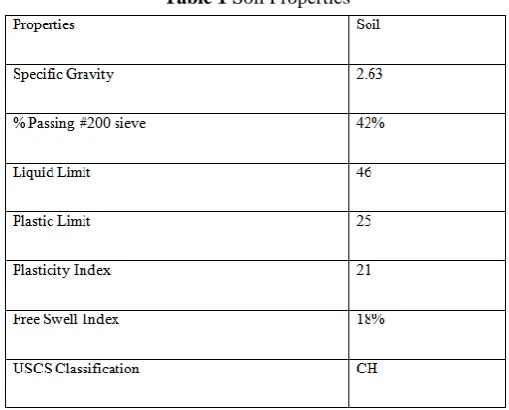
Table 1 shows the properties of the expansive clay used in this investigation. As per the USCS classification
system, the soil is a CH soil.
Flyash
Table 2 shows the constituents of Class C flyash used in this study.
Experiments
Several simple but valuable tests were conducted to support the importance of this paper. These include the
following tests: UCS, CBR, compaction and swell-shrinkage tests.
Compaction
The tests were performed in accordance with ASTM D 1557. The specimens were of 102mm diameter and
116mm height.
UCS
The UCS tests were performed in accordance with ASTM D 2166. The sample sizes were of 40mm diameter
and 80mm length.
CBR
Swelling
Consolidation test (ASTM D 2435) setup was used for determining the cyclic swell-shrink behavior of
the soil. The sample sizes were 76mm and 50mm in diameter and height respectively. The samples were
prepared at Proctor’s dry densities. The compacted admixture was cured for 14 days and placed over the
expansive soil. The efficacy of YWA as a cushioning layer between the foundation and subgrade was also tested
using the consolidation test.
III.
TEST RESULTS AND DISCUSSION
The Influence of flyash content on the UCS of YWA is presented in Figure 1. The influence of flyash
on the stress strain behavior of the clay specimens in UCS test is shown in Fig. 2. The flyash content varied
from 0 to 30%. When flyash was increased from 0 % to 25 %, the compressive strength increased from 300 to
486kPa at a strain of 6%. When flyash was increased from 0 % to 25 %, the compressive strength increased
from 239 to 610kPa at a strain of 9%.
The influence of YWA on CBR of clay-flyash mix is shown in Fig. 3. At any flyash content, addition
of YWA up to 12% led to increases in CBR. Further increase in YWA decreased CBR, indicating that 12% is
the optimum value of YWA. When the YWA content was increased from 0 to 12%, CBR improved from 1.5 to
5.5 for 0% flyash. When the YWA content was increased from 0 to 12%, CBR improved from 2.6 to 7.4 % for
25% flyash as shown in Figure 3.Low cohesion makes YWA a poor cushioning and construction material.
However, after stabilizing with flyash and curing for 28 days, YWA acquires better cushioning properties and
hence it can be used as a construction material between the subgrade and foundations.
Fig. 4 shows the influence of number of cycles on swell percent. Fig. 5 shows the influence of swell
reduction layer thickness ratio on percent swell for various surcharges.
At 15% flyash and 12% YWA, for a 28 day curing period, the UCS is 672kPa as shown in Figure 1. As
per Kate and Katti
4, this qualifies as a cushioning material at 15% flyash. Similar results were found by
Sivapulliahet al.
5for an YWA-lime mixture.
References 6 through 17 deal with more research studies on the behavior of clays and admixtures of
other waste materials. References 18 through 39 indicate the importance of this research study which is applied
in class room teachings for the benefit of engineering students.
IV.
CONCLUSIONS
The following are the conclusions.
1.
The result on UCS at 30 % flyash and 6 % YWA, for a 28 day curing period, is 680kPa
2.
When the YWA content was increased from 0 to 12%, CBR improved from 1.5 to 5.5% for 0%
flyash.When the YWA content was increased from 0 to 12%, CBR improved from 2.6 to 7.4 % for 25%
flyash.
3.
At 15% flyash and 3 % YWA, for a 28 day curing period, the UCS is 521kPa
4.
At 15% flyash and 9 % YWA, for a 28 day curing period, the UCS is 627kPa
5.
The impact on UCS at 15% flyash and 6 % YWA, for a 28 day curing period, is 588kPa
6.
At 15% flyash and 12% YWA, for a 28 day curing period, the UCS is 672kPa
7.
The influence on UCS at 15% flyash and 15% YWA, for a 28 day curing period, is 658kPa
Limitations of This Study
The results of this paper are limited to the materials tested in this study. More materials need to be tested to
increase the scope of this study.
ACKNOWLEDGEMENT
KeerthiTakkalapelli, a graduate student of the author conducted the experiments. His work is duly
acknowledged.
REFERENCES
[1]. Mitchell, J.K., “Practical Problems from surprising soil Behavior,” J. Geotech. Eng., 1986, Vol. 112, No. 3, 255-289.
[2]. Drumm, E.C., Reeves. J.S., Madgett, M.R., and Trolinger, W.D., “Subgrade Resilient Modulus Correction for Saturated Effects”. Journal of Geotechnical Geo-environmental engineering, 1997, Vol. 123, No. 7, pp. 663-670.
[3]. Liu, C., and Evett, J., “Soils and Foundations”, 2008, Pearson-Prentice Hall, Seventh Edition, Upper Saddle River, New Jersey. [4]. Kate, J.M. and Katti, R.K., “Effect of CNS layer on the behavior of underlying expansive soils media: an experimental study”,
1980, Indian Geotechnical Journal, 281-305.
[5]. Sivapulliah P.V., Subba Rao K.S., and Gurumurthy, J.V., “Stabilization of rice husk ash as cushion below foundations on expansive soils”, Ground Improvement, 2004, Vol. 8, No. 4, pp 137-14
[7]. R. M. Brooks (Corresponding author), F. Udoeyo, and K. V. Takkalapelli, “Compaction Delay Characteristics of Clay with Cement Kiln Dust”, UK Institute of Civil Engineers, Geotechnical Engineering Volume 162, issue 5, ISSN: 1353-2618, pp 283-286, Oct 2009.http://www.icevirtuallibrary.com/content/article/10.1680/geng.2009.162.5.283
[8]. Robert Brooks (Corresponding author), MozhganBahadory, Fernando Tovia and Hossein Rostami, “Properties of Alkali Activated Fly Ash: High Performance to Lightweight” , International Journal of Sustainable Engineering, Taylor and Francis V3, No.3, 211-218, September 2010,http://www.tandfonline.com/doi/abs/10.1080/19397038.2010.487162#preview
[9]. Khoury, N., Robert Brooks (Corresponding author), Musharraf M. Zaman, Charbel N. Khoury . “Variations of Resilient Modulus of Subgrade Soils with Postcompaction Moisture Contents”, Transportation Research Record: Journal of the Transportation Research Board, Transportation Research Board of the National Academies, issn 0361-1981, Volume 2101 / 2009, page 72-81. http://trb.metapress.com/content/j2h2j8841p067802/
[10]. Khoury, N., Brooks, R. (Corresponding author), Khoury, C., and Yada, D., “Modeling Resilient Modulus Hysteretic Behavior with Moisture Variation”. Int. J. Geomech, American Society of Civil Engineers ISSN 1943-5622, 2011. http:// ascelibrary.org/doi/abs/ 10.1061/%28ASCE%29GM.1943-5622.0000140
[11]. Khoury, N., Ph.D., Robert Brooks (Corresponding Author), Ph.D., P.E., ASCE Fellow, Charbel N. Khoury. Environmental influences on the engineering behavior of unsaturated undisturbed subgrade soils: effect of soil suctions on resilient modulus. International Journal of Geotechnical Engineering, J. Ross Publishing, Inc 1938-6362, Volume 3, Issue 2 / April 2009, page 303-311. http://jrosspub.metapress.com/content/p4310j7pt70707k0/
[12]. Hossein Rostami, Robert Brooks (Corresponding Author), Fernando Tovia, MozhganBahadory. Development of Lightweight Construction Material From Alkali Activated Fly Ash. The Journal of Solid Waste Technology and Management. Volume 35. Issue 3, August 2009. http://solid-waste.org/journal/abstracts-of-published-papers/volume-35-2009/
[13]. Brooks, R., Soil Stabilization with Lime and RHA, International Journal of Applied Engineering, IJAER, Volume 5, Number 7. pp. 1077-1086, 2010.http://www.ripublication.com/Volume/ijaerv5n7.htm
[14]. Brooks, R. M. Soil Stabilization with RHA and Flyash, International Journal of Research and Reviews in Applied Sciences V 1, Issue 3, pp.209-217, 2009. http://arpapress.com/Volumes/Vol1Issue3/IJRRAS_1_3_01.pdf
[15]. Kingsley Donaldson, Robert M. Brooks (Corresponding author), Felix F. Udoeyo, and Keerthi V. Takkalapelli. Effects of Fly Ash on Engineering Properties of Clays. International Journal of Applied Engineering Research. Volume 6, Number 1, pp. 43-52, 2011. http://www.ripublication.com/Volume/ijaerv6n1.htm
[16]. Khoury, N., Robert M Brooks (Corresponding Author), Santhoshini Yadav Boeni, and Damodar Yada “Variation of Resilient Modulus, Strength, and Modulus of Elasticity of Stabilized Soils with Postcompaction Moisture Contents”, Journal of Materials in Civil Engineering, American Society of Civil Engineers, Volume 25, Number 2, ISSN 0899-1561, pp.160-166, February 2013. [17]. http://ascelibrary.org/doi/abs/10.1061/(ASCE)MT.1943-5533.0000574
[18]. Robert M. Brooks and Mehmet Cetin. “Water Susceptible Properties of Silt Loam Soil in Subgrades in South West Pennsylvania”, International Journal of Modern Engineering Research. Vol.3, Issue 2, ISSN: 2249-6645, S. No: 57, March- April, 2013, pp. 994-948. http://www.ijmer.com/papers/Vol3_Issue2/CE32944994-948.pdf
[19]. Robert Brooks, S. Jahanian, A Pedagogical Strategy for Gradual Enhancement of Creative Performance of the Students, European Journal of Engineering Education Volume 24, No,1 1999.
[20]. S. Jahanian, and Robert Brooks (a/k/a James Matthews). Multidisciplinary Project-A tool for Learning the Subject Journal of American Society of Engineering Education, V 88, No.2, pp153-162, April 1999.
[21]. Robert Brooks, Keerthi V. Takkalapelli, BerkAyranci, Improvement of Graduate Students Performance In Design, Discovery, And Learning, 2009, AC 2009-2524 ,ASEE 2009 Annual Conference. http:// search.asee.org/ search/fetch?url= file%3A%2F%2 Flocalhost%2FE%3A%2Fsearch%2Fconference%2F19%2FAC%25202009Full2524.pdf&index=conference_papers&space=12974 6797203605791716676178&type=application%2Fpdf&charset=
[22]. Robert Brooks, Fernando Tovia, Tony Singh, AmithrajAmavasai, Hossein Rostami, Innovative Training Strategy (Its) for Teaching Assistants, AC 2010-264, ASEE 2010 Annual Conference. http:// search.asee.org/ search/ fetch? url= file%3A%2F%2Flocalhost%2FE%3A%2Fsearch%2Fconference%2F32%2FAC%25202010Full264.pdf&index=conference_papers & space=129746797203605791716676178&type=application%2Fpdf&charset=
[23]. Robert Brooks, Fernando Tovia, Keerthi V. Takkalapelli, AmithrajAmavasai, Hossein Rostami, NajiKhoury, Tony Singh,
Improving Creativity in A Graduate Course , AC 2010-72 , ASEE 2010 Annual Conference.
http://search.asee.org/search/fetch?url=file%3A%2F%2Flocalhost%2FE%3A%2Fsearch%2Fconference%2F32%2FAC%25202010 Full72.pdf&index=conference_papers&space=129746797203605791716676178&type=application%2Fpdf&charset=
[24]. Robert Brooks, Mr. AmithrajAmavasai, Rewarding Levels of Knowledge in Graduate Student Exams, AC 2011-143, ASEE 2011 Annual Conference, Ancouver, B. C. Canada, June 26-29 2011. http://www.asee.org/public/conferences/1/papers/143/view [25]. Robert Brooks, NajiKhoury, JyosthnaKavaturu, Mr. AmithrajAmavasai Correlation between “Ethical Issues” and “Grade”
Performance in a Graduate Class, AC 2011-147 , ASEE 2011 Annual Conference, Ancouver, B. C. Canada, June 26-29 2011. http://www.asee.org/public/conferences/1/papers/147/view
[26]. Robert Brooks, JyosthnaKavaturu, Mr. AmithrajAmavasai. Engineering and Technology for Non-Engineering and Non-Science Majors, AC 2011-140, ASEE 2011 Annual Conference, Ancouver, B. C. Canada, June 26-29 2011. http:// www.asee.org/public/ conferences/1/papers/140/view
[27]. Robert Brooks, JyosthnaKavaturu, Mr. AmithrajAmavasai Development of Best Practices for New Engineering and Math Educators, AC 2011-135, ASEE 2011 Annual Conference, Ancouver, B. C. Canada, June 26-29 2011. http://nee.asee.org/ConferencePapers/2011/135.pdf
[28]. Robert M. Brooks, Jyothsna K. S., Mehmet Cetin. AC 2012-2992: Creativity for Enhancing The Technological Literacy For Non-Science Majors, ASEE 2012 Annual Conference, San Antonio, June 10-13, 2012. http:// www.asee.org/ public/conferences/8/ papers/2992/view
[29]. Robert M. Brooks, Jyothsna K. S., Mehmet Cetin. AC 2012-2979: Critical Thinking: A Pedagogical Instrument For New Engineering And Science Educators. ASEE 2012. Annual Conference, San Antonio, June 10-13, 2012. http:// www.asee.org/ public/conferences/8/papers/2979/view
[30]. Robert M. Brooks, Jyothsna K. S., Mehmet Cetin. AC 2012-2977: Science for Non-Science Majors. ASEE 2012 Annual Conference, San Antonio, June 10-13, 2012. http://www.asee.org/public/conferences/8/papers/2977/view
[31]. Robert M. Brooks, Mehmet Cetin., and Jyothsna K. S., Application of Peer Reviewed Journal articles for Enhancing Technological Literacy. ASEE 2013 Annual Conference, Atlanta, June 23-26, 2013.
[33]. Robert Brooks, etc. Keeping the Civil Engineering Pipeline Filled- Attracting Young Talent ASEE Global Colloquium, Singapore, Oct 2010.
[34]. Robert M. Brooks (Corresponding author), Hamza Al-Ayaydah, “Soil Stabilization with Flyash and Sorghum Waste Ash – Improvements in Engineering Characteristics”, International journal of emerging technology and advanced engineering, Volume 9, Issue 2, 2019.
[35]. Robert Brooks, etc. Intellectual Dexterity and Strategy to Solutions for Multidisciplinary Problems-Tools for Attracting Students to Study Engineering ASEE Global Colloquium, Singapore, Oct 2010.
[36]. Robert Brooks, etc. A Strategy to Increase Shelf Life of Engineers ASEE Global Colloquium, Singapore, Oct 2010.
[37]. Robert Brooks, etc. Assessment of ABET Deliverables in a Senior Design Project Course for Effective Engagement of Our Future Engineers, ASEE Global Colloquium 2009.
[38]. Robert Brooks, etc. Case Studies - A Tool for Learning Environmental Science Course, ASEE Global Colloquium 2009. [39]. Robert Brooks, etc. Post-test- A Tool for an Effective Engagement of Our Future Engineers, ASEE Global Colloquium 2009. [40]. Robert M. Brooks, “Soil Stabilization with Flyash and Corn Waste Ash – Improvements in Engineering Characteristics”,
International Journal of Applied Engineering Research (IJAER), Volume 14, Issue 4, 2019