ROBUST IMAGE WATERMARKING USING
CRYPTOGRAPHIC ALGORITHM
Pankaj Gautam, Mahendra Kumar Pandey and Chetan Pathak
Dept. of Electronics and Communication Engineering, Rustamji Institute of Technology (RJIT), Tekanpur.
Abstract – In this paper, robust image watermarking technique using cryptographic algorithm has been proposed. By using Discrete Wavelet Transform (DWT) with SVD, a multi-bit watermark is embedded into the low frequency sub-band of a cover image by using variable scaling factor. The insertion and extraction of the watermark is protected using cryptographic algorithm. The experimental results indicate the effectiveness of the proposed work on the basis of MATLAB simulation work. Performance is evaluated on the basis of different fidelity parameter like as peak signal to noise ratio (PSNR), normalized correlation coefficient (NCC) etc.
Index Terms— Image watermarking, DWT, singular value decomposition (SVD), cryptographic algorithm, PSNR, NCC.
1. INTRODUCTION
Due to rapid delivery of digital multimedia data over
internet, demand of hiding techniques to secure digital data is
required. Data hiding is a very active research areas. Digital
watermarking is a branch of Data hiding which is used to hide
proprietary information in digital media like photographs,
digital music, or digital video [1-2]. Watermarking is the
process of embedding the watermark into cover image with the
help of embedding algorithm for security and other purposes.
Later on, this embedded image can be extracted with the help
of extraction algorithm. Generally, the image watermarking can
be done in spatial domain or in transform domain [3].
Compared to spatial domain techniques frequency-domain
watermarking techniques proved to be more effective with
respect to achieving the imperceptibility and robustness
requirements of digital watermarking algorithms [4].
Commonly used frequency-domain transforms include the
Discrete Wavelet Transform (DWT), the Discrete Cosine
Transform (DCT) and Discrete Fourier Transform (DFT) etc.
However, DWT has been used in digital image watermarking
more frequently due to its excellent spatial localization and
multi-resolution characteristics, which are similar to the
theoretical models of the human visual system.
2. METHODOLOGY
A. Discrete Wavelet transforms (DWT)
Discrete Wavelet transform (DWT) is a mathematical tool
for hierarchically decomposing an image. It is a
multi-resolution technique that can analyze different frequencies by
different resolutions. For 2-D images, filters divide the input
image into four no overlapping multi-resolution sub-bands.
Fig. 1. Decomposition Structure “Single level DWT
Fig. 1 illustrates the DWT decomposition structure for
Image, its produce the four different band of image such as LL1,
HL1, LH1 and HH1 known as approximation information,
horizontal detail information, vertical detail information and
diagonal detail information; In wavelet analysis, maximum
energy of function or image is centered at LL band means as
approximation coefficient. Due to its excellent
spatial-frequency localization properties, the DWT is very suitable to
identify the areas in the host image where a watermark can be
embedded effectively [5].
B. Overview of singular value decomposition (SVD)
SVD is an effective numerical analysis tool from linear algebra
to decompose a rectangular matrix “A” into an orthogonal
matrix U, diagonal matrix S, and the transpose of an orthogonal
matrix V . SVD decomposes a given image A of size M×N as
A =USVT (1)
U and V are orthogonal matrices of size MxM and NxN,
respectively. S is a diagonal matrix of size MxN having singular
values .The singular vectors of an image specify the image
“geometry” similarly left singular vectors represent horizontal
details and right singular vectors represent the vertical details
of an image, while the singular values specify the “luminance”
(energy) of the image. Slight variations in the singular values
do not affect the visual perception of the quality of the image
C. Cryptographic algorithm
Here we used Arnold transform as cryptographic algorithm for
the encryption of an images.
Arnold Transform
The Arnold transform was introduced by Arnold. For an image
C with N *N, the Arnold transform operation on the position (x,
y) pixel is given by
(2)
The Arnold transform, which changes the positions of the
pixels, can be repeated many times in order to obtain a
scrambled image. [6-7].
Anti-Arnold Transform
Use of the Arnold transform periodicity on a scrambled image
to recover the original image could be achieved at the expense
of possibly a large computational complexity depending on
how many iterations have already been used to obtain the
scrambled image. The anti-Arnold transform is given by
(3)
If a scrambled image is obtained by using n iterations of the
operation of the Arnold transform, it needs the same number of
iterations to recover the original image using the anti-Arnold
transform.
3. PROPOSED WORK
The proposed work is divided into two parts, watermark
embedding and watermark extraction.
A. Watermark Embedding
The watermark embedding process is described below:
Step.1: Load the cover image and watermark image.
Step.2: Decomposed both the image into four sub-bands
using DWT for cover and encrypted watermark images
respectively.
Step.3: after applying DWT, we decomposed both the
image using SVD.
Step.4: Compute new singular matrix using fusion of both singular matrix.
(3)
where, Swm ,Si and Sw and denote the singular values of
watermarked, host and water mark image, respectively.
Step.5: Using new computed singular matrix Snew, New LL
band is computed with inverse SVD.
Step.6: Finally, watermarked image is obtained by merging
LLnew band and remaining sub band of cover image.
B. Watermark Extraction
The watermark embedding process is described below:
Step.1: Load the cover image, watermark image and
watermarked image.
Step.2: Decomposed the images into sub-bands using DWT
respectively.
Step.3: after applying DWT, we decomposed images using
SVD.
Step.4: The new extracted singular matrix can be calculated by:
(4)
where, Sw_n denotes new singular value.
Step.5: Using new computed singular matrix, New LL band
is computed with inverse SVD.
Step.6: Finally, extracted watermark image obtained using
inverse DWT based on LLnew band and reaming sub band.
4. RESULTS AND DISCUSSION
In this section, performance analysis of proposed work has been
presented. The simulation work using MATLAB illustrate the
efficiency and performance of proposed work on the basis of
fidelity parameters.
A. Fidelity Parameters
The performance of watermarked images is determined by
using peak signal-to-noise ratio (PSNR) and Normalized
Correlation coefficient (NCC).
Peak signal-to-noise ratio (PSNR) :-
For measurement of imperceptibility, PSNR in dB is given
by:
1 1 1 , , N M c wm i jMSE f i j f i j NM
(5)
2 10 ,10log fc i j
PSNR
MSE
(6)
where, fc2 (i, j) indicates the peak brightness value of pixel
and fc, fwm represent the brightness of host and watermarked
images at different pixels values.
Normalized Cross Co-Relation (NCC):-
To check the robustness and image quality, the value of
normalized cross co-relation (NCC) is measured by:
'
1 1
2 2
1 1 1
, ,
, ,
N M
w w
i j
N M N M
w w
i j i
g i j g i j
NCC
g i j g i j
(7)wm i w
S S alpha S
_ ( ) /
w n Sw m c a lp h a
where, gw and gw’ are the brightness level of original and
extracted watermark at different value of pixel.
B. Simulated Results
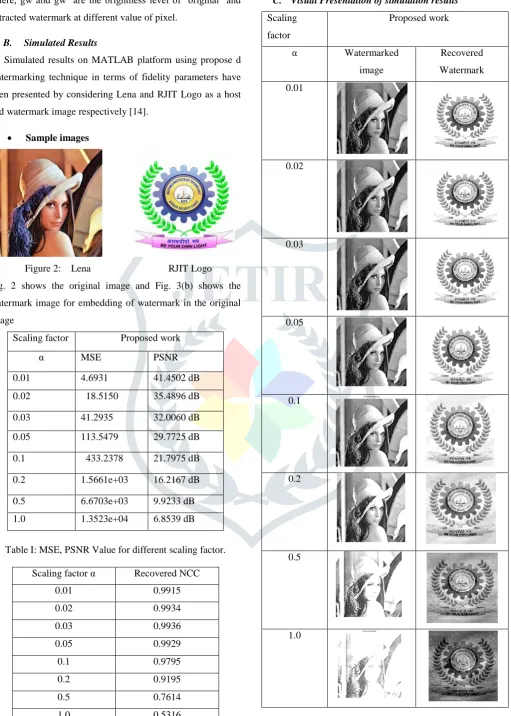
Simulated results on MATLAB platform using propose d
watermarking technique in terms of fidelity parameters have
been presented by considering Lena and RJIT Logo as a host
and watermark image respectively [14].
Sample images
Figure 2: Lena RJIT Logo
Fig. 2 shows the original image and Fig. 3(b) shows the
watermark image for embedding of watermark in the original
image
Scaling factor Proposed work
α MSE PSNR
0.01 4.6931 41.4502 dB
0.02 18.5150 35.4896 dB
0.03 41.2935 32.0060 dB
0.05 113.5479 29.7725 dB
0.1 433.2378 21.7975 dB
0.2 1.5661e+03 16.2167 dB
0.5 6.6703e+03 9.9233 dB
1.0 1.3523e+04 6.8539 dB
Table I: MSE, PSNR Value for different scaling factor.
Scaling factor α Recovered NCC
0.01 0.9915
0.02 0.9934
0.03 0.9936
0.05 0.9929
0.1 0.9795
0.2 0.9195
0.5 0.7614
1.0 0.5316
Table II: NCC Value for different scaling factor.
C. Visual Presentation of simulation results
Scaling
factor
Proposed work
α Watermarked
image
Recovered
Watermark
0.01
0.02
0.03
0.05
0.1
0.2
0.5
1.0
Fig.3 shows the visual representation of watermarked and
recovered watermark image at different value of SF. WatermarkedImage
WatermarkedImage
WatermarkedImage
WatermarkedImage
WatermarkedImage
WatermarkedImage
WatermarkedImage
5. ATTACKS
Resistance of the watermarked image under various attacks is
called robustness [10]. Robustness of presented work under
various attacks has been tested and presented with NCC values
in given below in fig4.
Attacks Attacked
Watermarked image
Recovered
Watermark
Salt &
Pepper
Noise
NCC 0.9978
Gaussian
Noise
NCC 0.9037
Speckle
Noise
NCC 0.9862
Poisson
Noise
NCC 0.7370
Resize
attack
50%
NCC 0.9930
Median
Filter
[3*3]
NCC 0.3838
Fig.4 shows the visual representation of Attacked watermarked
and recovered watermark image under various attacks.
As seen in simulated results shown in tables, it has been
concluded that the value of scaling factor is varied from 0.01 to
1. As the value of scaling factor decreases, the value of PSNR
increases but the same time the value of NCC decreases. The
simulated experimental results also evaluated with visual
representation of watermarked and extracted watermark image
for human vision system (HVS).Hence it can be concluded that
the proposed work provides robustness and perception
transparency to the watermarked image and original image
against different kind of attacks like noises, filtering and
scaling.
6. CONCLUSION
In this paper, an analysis of image watermarking technique
using cryptographic algorithm has been implemented. This
technique can embed the watermark into salient features of the
image using different scaling factor. Experiment results shows
that the quality of the watermarked image and the recovered
watermark are dependent only on the scaling factors. Results
are clearly seen that the proposed methodology is robust against
various attacks.
References
[1] W. Bender, D. Gruhl, N. Morimoto and A. Lu, "Techniques
for Data Hiding", IBM System Journal, Vol. 35, NOS 3&4,
pp. 313-336, 1996.
[2] P. H. W. Wong, O. C. Au and G. Y. M. Yeung, “A Novel
Blind Multiple Watermarking Technique for Images”,
IEEE Transactions on Circuits and Systems for Video
Technology: Special Issue on Authentication, Copyright
Protection and Information Hiding, Sept. 2003.
[3] E. T. Lin and E. J. Delp “A Review of Data Hiding in
Digital Images”, Proc. of the Image Processing, Image Quality, Image Capture Systems Conf. (PICS’ 99), pp.
274-278.1999.
[4] L. Hu, F. Wan, “Analysis on wavelet coefficient for image
watermarking”, Int. Conf. MINES’10, pp. 630-634, 2010
[5] CH.-Ch. Chang, K.-N. Chen, M.-H. Hsieh, “A robust
public watermarking scheme based on dwt”, 6th
IIH-MSP’10, pp. 21-26, 2010.
[6] L. Wu, J. Zhang, W. Deng and D. He, "Arnold
transformation Algorithm", Proc. Information Science and
Engineering Inter. Conf., Nanjing, China, Dec. 2009.
[7] Dr. J. Abdul Jaleel, Jisha Mary Thomas , “Guarding
Images Using A Symmetric Key Cryptographic
Technique: Blowfish Algorithm“, ISSN: 2277-3754 ISO
9001:2008 Certified International Journal of Engineering
and Innovative Technology (IJEIT) Volume 3, Issue 2,
August 2013.
[8] M. Ibrahim, M. M. Rahman, and M. Iqbal, “Digital
watermarking for image authentication based on combined
DCT, DWT and SVD transformation”, arXiv preprint
arXiv:1307.6328, 2013.
[9] Makbol, Nasrin, and B. E. Khoo, “A new robust and secure
digital image watermarking scheme based on the integer
wavelet transform and singular value decomposition”,
Digital Signal Processing 33, pp. 134-147, October, 2014.
[10] S. Agarwal, Priyanka, and U. Pal, “Different types of attack
in image watermarking including 2D, 3D images”,
International Journal of Scientific & Engineering
Research, Vol. 6, No. 1, January, 2015.
[11] N. Chawla and Mahendra Kumar Pandey, “Lifting scheme
based non-blind hybrid image watermarking technique
using low frequency band", 7th IEEE International
Conference on Communication Systems and Network
Technologies (CSNT), 2017.
[12] P. Gupta and G. Parmar, “Image watermarking using
IWT-SVD and its comparative analysis with DWT-IWT-SVD”, Proc.
IEEE International Conference on Computer,
Communications and Electronics (COMPTELIX-2017),
pp. 527-531, Manipal University, Jaipur, July, 2017.
[13] R.Tyagi and M. K. Pandey “An adaptive second level
hybrid image Watermarking Technique using DWT-SVD
in low frequency band’’ Published in IJARCCE, Vol. 6,
Issue 1, January 2017.
[14] USC-SIPI image database