DESIGN AND ANALYSIS OF BCH-RSC CONCATENATED
SYSTEM WITH QPSK MODULATION TECHNIQUE IN
WIRELESS COMMUNICATION
Uttambir Kaur1, Ms. Tanika Thakur2
1. INTRODUCTION
Forward Error Correction (FEC) or channel coding is a technique used for managing errors in data transmission over unreliable or noisy channels. In wireless, satellite, and space communication systems, the prime aim of channel coding is to maximize the reliability of communication within constraints of signal power, system bandwidth and complexity of the implementation. Since then communication engineers have been trying to design error-correcting codes that can achieve a small probability of error at a rate as close to the channel capacity as possible.
According to Shannon’s theorem, bit error rate (BER) performance is typically improved by choosing longer and more complex codes [1]. But with the increase in block length, decoding complexity increases exponentially. Since then efforts have been made for designing good codes that approach the near channel capacity limitation with moderate complexity. Forney in 1966 first introduced the idea of concatenated codes [2]. As per Forney, concatenation is a method of building long codes out of shorter ones in order to resolve the problem of decoding complexity by breaking the required computation into manageable segments according to the divide and conquer strategy. In 1989, concatenation of multiple convolutional codes was introduced [3], and was used with Soft Output Viterbi Algorithm (SOVA). A recent landmark development in channel coding is Turbo codes, in particularly Parallel Concatenated Convolutional Codes (PCCC), by Berrou, et.al. in 1993 with simple iterative decoding technique based on the Maximum A Posteriori (MAP) algorithm with Soft-In Soft-Out [4]. It was shown that the performance of Turbo code, in terms of Bit Error Rate (BER), is very close to Shannon’s limit. The concatenation of convolutional codes was examined further in which turbo code namely Serially Concatenated Convolutional Code (SCCC) was introduced & it was shown that SCCC has better performance than PCCC [5]. An iterative decoding approach to SCCC’s was introduced in [6]. The iterative decoding method provides a significant increase in performance over a single iteration and in some cases approaches the theoretical limit. Through iterative decoding scheme, performance in terms of BER is enhanced, but at the expense of complexity of the system. However, the convolutional codes suffered from the problem of burst errors [7] & Reed Solomon codes suffered from problem of random errors [8]. To compensate this problem, a new concatenated scheme was proposed in which a concatenation of a Reed-Solomon (RS) code and a Recursive systematic convolutional code (RSC) codes was used & it was shown that RS-RSC concatenated codes have good performance than RSC itself [9].
A low-latency decoder [10] was proposed for the shortened/punctured Reed-Solomon codes. Significant reduction in the decoding latency is possible, if the code length of the shortened/punctured codes is much smaller than the original mother codes. Communication engineers largely agree that for applications not requiring low latencies, long LDPC codes are the right method to achieve capacity-approaching performance [11].But there is currently no consensus regarding the right coding method to use for low required latencies.
In [12] it was shown that the performance of RSC-RSC concatenated code is better than RS-RSC concatenated code in terms of bit error rate (BER).
1
Department of Electronics and Communication Engineering, Swami Vivekananda Institute of Engineering & Technology Banur, India
2
Department of Electronics and Communication Engineering, Assistant Professor, Swami Vivekananda Institute of Engineering & Technology Banur, India
Abstract— In this paper, we conduct performance comparison of RS-RSC concatenated system with BCH-RSC concatenated system. Two models of serially concatenated codes are simulated and tested over AWGN channel using Matlab simulations. The first model uses Reed-Solomon (RS) code as outer encoder and Recursive convolution code (RSC) as inner one & decoding is performed by concatenation of Viterbi decoder & Berklelamp-Massey decoder. The second model uses Concatenation of BCH code as outer encoder and RSC code as inner encoder. We show that the performance of BCH-RSC concatenated code is better than RS-RSC concatenated code in terms of bit error rate (BER).
Keywords— Forward error correction; Serially concatenated convolutional codes; Recursive systematic convolutional codes; Viterbi decoding; Channel coding.
In [13] it was shown that RSC-RSC is to be a better code rather than RS-RSC; it has low latency. Hence RSC-RSC system is more suitable for low latency applications. Hence a trade off is always there between BER and Latency in wireless communication. This is further need to be explored in research.
In this paper, we provide modified encoder for BCH-RSC concatenated system. We have compared its performance with the Traditional Structure of RS-RSC concatenated system.
The rest of the paper is organized as follows. In section II, simulation setup of the proposed system is presented. The simulation results and its discussion are given in section III. Finally, the section IV concludes the paper.
2. SIMULATION SETUP
In this section simulation model & simulation parameters of the implemented systems are described.
2.1 RS-RSC concatenated codes
RS-RSC code is a concatenated code of RS code as the outer code and RSC code as the inner code. Since these two codes have different characteristic in terms of handling the errors, so they tend to give benefits in BER performance. More specifically, the RSC is good for correcting random errors that is caused due to a noisy channel and RS codes can combat burst errors.
2.2 Simulation Model:
In this setup, RS-RSC simulation model is designed as shown in Figure 1. For the outer encoder, It uses (255, 245) RS code in GF (28) that has 5 symbol error-correcting capability. For inner encoder, Recursive systematic convolutional code (1,171/133) with six memory element has been used. Their mother code rate is 1/2 each and punctured code rates are 2/3, 3/4. At the inner decoding stage, it is decoded by Viterbi decoding [11] & at the outer decoding stage, decoded by Berlekamp-Massey decoding. Simulation has been performed to investigate the effect of signal to noise ratio on bit error rate. The Simulation parameters of the system given in Table 1 [9].
Figure 1.Simulation Model of RS-RSC code system [9].
Table 1. Simulation Parameters of RS-RSC code system [9].
Outer encoder Inner encoder
Reed-Solomon (255, 245) over GF (28)
RSC ( 1,171/133) Constraint length (k) = 7
5-symbol error- correcting code Base code rate = 1/2 Punctured code rate = 2/3, 3/4
Berlekamp-Massey decoding Viterbi decoding (hard-decision)
2.3 BCH-RSC concatenated code
BCH-RSC code is a serial concatenation of recursive systematic convolutional encoder and BCH encoder.
2.4 Simulation Model:
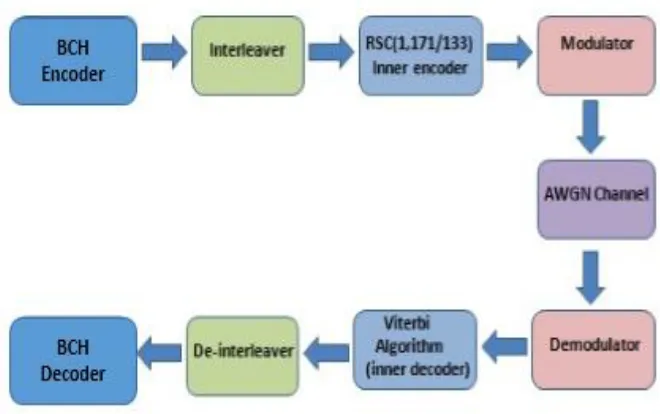
BCH-RSC concatenated system has been simulated as shown in Figure 2 & effect of signal to noise ratio on the bit error rate is observed. Table 2 describes the simulation parameters used.
Figure 2. Simualtion Model of BCH-RSC system
Table 2. Simulation Parameters of BCH-RSC system
Outer Encoder Inner Encoder
BCH Code RSC ( 1,171/133)
Constraint length = 5 Constraint length= 7 Base code rate = 1/2 Base code rate = 1/2
Punctured code rate = 2/3 Punctured code rate = 2/3, 3/4 BCH Decoder Viterbi Algorithm (hard-decision)
QPSK modulation AWGN channel
3. RESULTS & DISCUSSION
The two systems described in section II are implemented using MATLAB and BER is observed for different values of Eb/No (signal to noise ratio).
3.1 RS-RSC concatenated system:
The BER performance of RS-RSC system with QPSK modulation is done using the simulation parameters shown in Table 1. It shows that in RS- RSC system as signal to noise ratio increases, Bit Error Rate decreases. These values of BER are put in tabular form in table 3 and result is plotted in figure 3.
Table 3. BER Versus Signal To Noise Ratio For RS-RSC Systems. Coding
Scheme
Signal to Noise Ratio (Eb/No)
0 dB 1dB 2dB 3dB 4dB 5dB
RS-RSC1/2 0.064 0.027 0.027 0.006 0.0007 0
RS-RSC 2/3 0.114 0.071 0.041 0.019 0.010 0.003
RS-RSC 3/4 0.216 0.165 0.105 0.057 0.031 0.014
RS-RSC 5/6 0.237 0.195 0.153 0.103 0.066 0.38
3.2 BCH-RSC concatenated system:
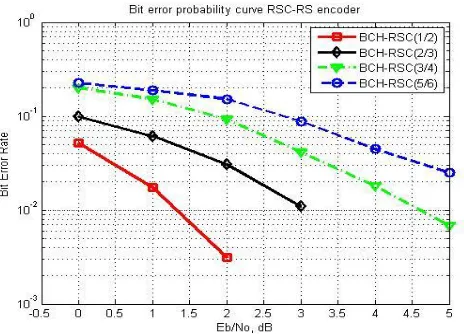
The BER performance of BCH-RSC system with QPSK modulation is done using the simulation parameters shown in Table 2. It shows that in BCH- RSC system as signal to noise ratio increases, Bit Error Rate decreases. These values of BER are put in tabular form in table 4 and result is plotted in figure 4.
Figure 4. BER probability analysis for BCH-RSC system
Table 4. BER versus Signal to noise ratio for BCH-RSC system Coding
Scheme
Signal to Noise Ratio (Eb/No)
0 dB 1dB 2dB 3dB 4dB 5dB
BCH-RSC 1/2 0.049 0.016 0.004 0 0 0
BCH-RSC 2/3 0.107 0.061 0.037 0.010 0.001 0
BCH-RSC 3/4 0.209 0.149 0.090 0.043 0.020 0.005
BCH-RSC 5/6 0.231 0.189 0.141 0.105 0.054 0.026
3.3 Comparison of RS-RSC & BCH-RSC system:
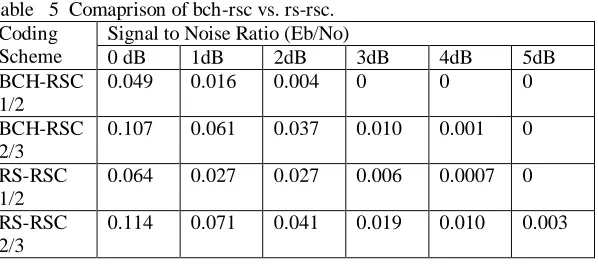
From the Performance comparison of BCH-RSC concatenated code system with RS-RSC code system, it is observed that in BCH-RSC system has less BER as compared to RS-RSC system as shown in figure 5
Table 5 Comaprison of bch-rsc vs. rs-rsc. Coding
Scheme
Signal to Noise Ratio (Eb/No)
0 dB 1dB 2dB 3dB 4dB 5dB
BCH-RSC 1/2
0.049 0.016 0.004 0 0 0
BCH-RSC 2/3
0.107 0.061 0.037 0.010 0.001 0
RS-RSC 1/2
0.064 0.027 0.027 0.006 0.0007 0
RS-RSC 2/3
0.114 0.071 0.041 0.019 0.010 0.003
4. CONCLUSION
This thesis work is dedicated to analysis and evaluation of low Bandwidth, less BER & high speed error correcting codes. In particular performance of serially concatenated codes has been investigated. In this thesis Bit Error rate performance analysis of RS-RSC concatenated code and BCH –RSC code has been performed. It is observed that in both the models the bit error rate decreases sharply as Eb/No increases. Finally, Performance comparison of BCH-RSC concatenated code system with RS-RSC code system has been implemented and it is researched that for a given data rate and a given channel condition, BCH-RSC system is better than RS-RSC in terms of error performance.
5. REFERENCES
[1] G Shannon, “A Mathematical Theory of Communication”, Bell Technical System 27,379-423, 1948
[2] G. D. Forney, “Concatenated Codes. Cambridge”, M.I.T. Press, 1966
[3] J. Hagenauer and P. Hoeher, “Concatenated Viterbi Decoding”, Proceedings of the International Workshop on Information Theory, 1989.
[4] C. Berrou, A. Glavieux, and P. Thitimajshima, “Near Shannon Limit Error-Correcting Coding and Decoding, Turbo-Codes”, Proceedings of ICC'93,
Geneva, Switzerland, May 1993
[5] S. Benedetto and G. Montorsi, “Serial concatenation of block and convolutional codes”, Electron. Lett. vol. 32, pp. 887-888, May 1996.
[6] S. Benedetto and G. Montorsi, “Iterative decoding of serially concatenated convolutional codes,” Electronics Letters, vol. 32, pp. 1186 – 1188, June
1996.
[7] P. Elias, “Coding for Noisy Channels”, IRE Conv. Rec.: 37-46, 1955.
[8] I. S. Reed and G. Solomon, “Polynomial codes over certain finite fields”, J. Soc. Industrial Appl. Math, vol. 8, pp. 300-304, 1960
[9] Byun, Sunghan, Dong Joon, and Jung Sun, “Performance comparison of RS-CC concatenated codes using NSC and RSC codes”, Network
Infrastructure and Digital Content, 2nd IEEE International Conference, Beijing,24-26 Sept. 2013
[10] Shin-Lin Shieh at.al ,”A Low-Latency Decoder for Punctured/Shortened Reed-Solomon Codes” IEEE 16th International Symposium on Personal,
Indoor and Mobile Radio Communications,2547-2551,2005
[11] M.Kaiser et al., “A Comparison of Decoding Latency for Block and Convolutional Codes” proceeding of ISCTA ’09,Ambleside U.K., 2009
[12] K. Manish., and S. Jyoti, “Performance Comparison of Latency for RSC-RSC and RS-RSC Concatenated Codes,” International Journal Of Scientific
Research In Network Security And Communication”, June 2013
[13] Manuscript published, “Performance Comparison of RSC-RSC Concatenated code and RS-RSC Concatenated code using Non-iterative
![Figure 1.Simulation Model of RS-RSC code system [9].](https://thumb-us.123doks.com/thumbv2/123dok_us/1414125.1654344/2.612.111.505.358.540/figure-simulation-model-of-rs-rsc-code-system.webp)