Effect of new generation herbicides on weed
dynamics and weed control efficiency in maize
J. Satheesh
1, *S. Ramesh
2, S. Manimaran
2and P. Sudhakar
2*Corresponding Author,
1PG scholar,
2Assistant professor,
Department of Agronomy, Faculty of Agriculture,
Annamalai University Annamalai Nagar,Tamil Nadu, India - 608002.
ABSTRACT
Field experiment was conducted at the Annamalai University, Experimental Farm, Department of Agronomy, Faculty of Agriculture, Annamalai Nagar to study the Effect of new generation herbicides on weed dynamics and weed control efficiency in maize during (Feb - June) 2015. The experiment was laid out in randomized block design with three replications and nine treatments. The treatment details are viz., Weedy check (T1), Lumax 440 ZC W/V @ 2.5 lit ha-1 on 3 DAS (T2), Lumax
440 ZC W/V @ 3 lit ha-1 on 3 DAS (T3), Lumax 440 ZC W/V @ 3.5 lit ha-1 on 3 DAS (T4), S-metolachlor
96% EC @ 1lit ha-1 on 3 DAS (T5), Mesotrione 48% SC @ 208 ml ha-1 on 3 DAS (T6), Atrazine 50 WP @
2 Kg ha-1 on 3 DAS (T
7), Paraquat dichloride 24% SL @ 2 lit ha-1 on 10 DAS (T8) and twice hand weeding
at 20 and 40 DAS (T9). All the treatments were found to be significantly influenced the weed biometrics,
and grain and stoves yields of maize. The result of the study clearly showed that pre-emergence application of Lumax 440 ZC W/V @ 3.5 lit ha-1 on 3 DAS (T4) significantly registered lesser weed population, higher
Weed Control Efficiency (WCE), grain and stover yields of maize. However, it was on par with twice hand weeding at 20 and 40 DAS (T9). Weedy check (T1) recorded the higher weed population resulting in lesser
values of grain and stover yields. From the study, it could be concluded that application of Lumax 440 ZC W/V) @ 3.5 lit ha-1 on 3 DAS was found to be a judicious recommendation to control of weeds and for augmenting higher productivity of maize in view of inadequate labour and higher weeding cost. Hence this can be recommended to the maize growing farmers of Tamil Nadu.
Introduction
Maize (Zea mays L.) is the third most important cereal crop in the world after wheat and rice with an area of 161.02 million ha, production of 822.7 million tonnes and a productivity of 5109 kg per ha (Anon., 2013). Maize is known as ‘Queen of cereals’ because of its high production potential and wider adaptability. In India, it is cultivated on an area of 8.17 million ha with a production of 19.73 million tonnes and the productivity of 2424 kg per ha contributing nearly eight per cent in national food basket (Jat et al., 2010). It is one of the important staple food crop for humans being and quality feed for animals, it serves as a basic raw material for production of starch, oil, protein, alcoholic beverages, food sweeteners and more recently bio-fuel. Being a potential crop in India, maize occupies important place as food (25 %), animal feed (12 %), poultry feed (49 %), industrial products mainly starch (12 %) and one per cent each in brewery and seed (Dass et al., 2008).
allows fast growth of a variety of weed species causing a considerable reduction in yield by affecting the growth and yield attributing components. Presence of weeds reduces the photosynthetic efficiency, dry matter production and distribution to economical parts and there by reduces sink capacity of crop resulting in poor grain yield. Thus, the extent of reduction in grain yield of maize has been reported to be in the range from 28 to 100 per cent (Teasdale and Mohler, 2000) depending on the type of weed species in standing crop and duration of crop-weed competition. It is well established that 30 to 60 days after sowing is the most critical period for crop-weed competition in maize. Manual weeding is a common practice, but it is less efficient, labour intensive, costly and often not done at proper stage. Mostly farmers adopt manual weeding only after sufficient weed growth. It is essential to remove the early flush of weeds at right time. Hence, there is a immense need to identify the new generation herbicides to controlling of weeds at right time in maize crop.Keeping these in view, field experiment was conducted during summer season (February to June-2015) at Annamalai University, Experimental Farm, Annamalainagar, to study Effect of new generation herbicides on weed dynamics and weed control efficiency in maize .
MATERIALS AND METHODS
Field Experiment was conducted at the Experimental farm, Annamalai University, Annamalainagar during (Febraury – June) 2015 to study the Effect of new generation herbicides on weed dynamics and weed control efficiency in maize. The experimental farm is geographically located at 1124’ North latitude and 7944’ East longitude with an altitude of 5.79 m above mean sea level. The weather at Annamalai nagar is moderately warm with hot summer months. During the cropping period received a rainfall of 162.9 mm with distribution over 10 rainy days. The soil of the experimental field is clay loam in texture. The fertility status of the soil was found to be low in available nitrogen (216 kg ha-1), medium in available
phosphorus (19 kg ha-1 ) and high in available potassium (315 kg ha-1). The maize hybrid Pioneer 30B07
was chosen for the study. The experiment was laid out in randomized block design with three replications and nine treatments. The treatment details are viz., Weedy check (Control)- (T 1), Lumax 440 ZC W/V @
2.5 lit ha-1 on 3 DAS - (T 2), Lumax 440 ZC W/V @ 3 lit ha-1 on 3 DAS - (T 3), Lumax 440 ZC W/V @ 3.5
lit ha-1 on 3 DAS - (T
4), S-metolachlor 96% EC @ 1 lit ha-1 on 3 DAS - (T 5), Mesotrione 48% SC @ 208
ml ha-1 on 3 DAS -(T
6), Atrazine 50 WP @ 2 Kg ha-1 on 3 DAS - (T 7), Paraquat dichloride 24% SL @ 2
lit ha-1 on 15 DAS - (T 8) and Hand weeding twice at 20 and 40 DAS - (T 9). The recommended seed rate
of 15 kg ha-1 was used for the trail. The seeds were sown by dibbling with a spacing of 60 X 20 cm. The fertilizers were applied to the experimental field as per the recommended manurial schedule of 135:62.5:50 kgs of N, P2O5 and K2O ha-1. The entire dose of phosphorus, potassium and half dose of nitrogen was
Weed count
Weed counts were recorded at 30 and 60 DAS from four quadrates each of area 0.25 m 0.25 m, fixed permanently in sampling area of each treatment and expressed in number of weeds m-2.
Weed control efficiency (WCE)
The weed control efficiencyfor each plot was calculated by using the formula suggested by Mishra and Tosh (1979) and recorded as percentage.
WCE =
Where,
WCE = Weed control efficiency
a = Weed population in control plot b = Weed population in treated plot
Five plants in each plot were selected at random in border rows and tagged. These plants were used for recording all biometric observation at different stages of crop growth. Harvesting was done in each plot separately from the net plot area leaving the border rows. Grains were separated, dried, cleaned and grain yield was recorded plot wise at 12 per cent moisture content. The grain and stover yields were computed to Kg ha-1
. The data on various characters studied during the course of investigation were statistically
analyzed as suggested by Gomez and Gomez (1984). For significant results, the critical difference was worked out at 5 per cent probability level and statistical conclusions were drawn.
Result and Discussion
Individual weeds species at 30 DAS (m-2)
The important weed floras observed in the experimental field were Cyperus rotundus, Trianthema portulacastrum, Cynodon dactylon, Echinochloa crusgalli, Commelina benghalensis, Phyllanthus niruri and Cleome viscosa. Among the weed species, recorded four weed species namely Cyperus rotundus, Trianthema portulacastrum, Cynodon dactylon and Echonochloa crusgalli were occurring in the major proportion and these were significantly influenced by the weed control treatments. The weed species like Phyllanthus niruri and Cleome viscosa occurred in negligible proportion and these weeds were not significantly influenced by the treatments. Among the treatments pre emergence application of Lumax 440 ZC W/V @ 3.5 lit ha-1 on 3 DAS (T4) recorded significantly the least weed count of 2.4 m-2 of Cyperus
rotundus, 2.2 m-2 of Trianthema portulacastrum, 1.5 m-2 of Echinochloa crusgalli and 3.3 m-2 of Cynodon
dactylon, gave better result over other weed control treatments and recorded the least individual weed count at 30 DAS. This next best treatment was on par with twice hand weeding (T9). The unweeded plot
(T1) recorded the highest weed count of 4.7 m-2 of Cyperus rotundus, 3.8 m-2 of Trianthema portulacastrum,
5.1 m-2 of Echinochloa crusgalli, 3.1 m-2 of Cynodon dactylon, 2.8 m-2 of Commelina benghalensis, 2.0 m-2 of Phyllanthus niruri and 1.2 m-2 of Cleome viscose respectively.
Individual weeds species at 60 DAS (m-2)
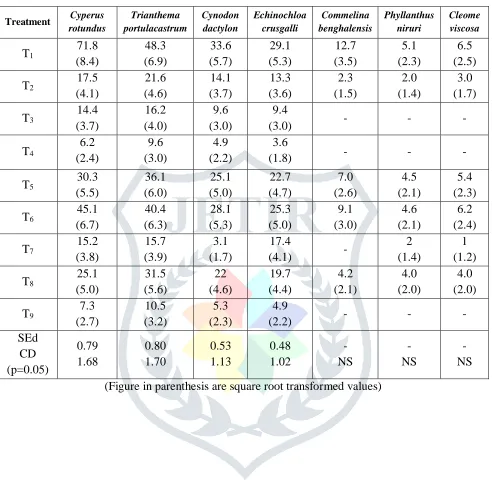
Among the weed species recorded, four weed species namely Cyperus rotundus Trianthema portulacastrum, Cynodon dactylon and Echinochloa crusgalli were occurring in the major proportion and these were significantly influenced by the weed control treatments. The weed species like Phyllanthus
100 a
b
niruri and Cleome viscosa occurred in negligible propotion and these weeds were not significantly influenced by the treatments. Among all the treatments, pre emergence application of Lumax 440 ZC W/V @ 3.5 lit ha-1 on 3 DAS (T4) recorded significantly the least weed count of 2.4 m-2 of Cyperus rotundus, 3.0
m-2 of Trianthema portulacastrum, 1.8 m-2 of Echinochloa crusgalli and 2.2 m-2 of Cynodon dactylon, gave better result over other weed control treatments and recorded the least individual weed count at 60 DAS. This next best treatment was on par with twice hand weeding (T9). The unweeded plot (T1) recorded the
highest weed count of 8.4 m-2 of Cyperus rotundus, 6.9 m-2 of Trianthema portulacastrum, 5.3 m-2 of Echinochloa crusgalli, 5.7 m-2 of Cynodon dactylon, 3.5 m-2 of Commelina benghalensis, 2.3 m-2 of Phyllanthus niruri and 2.5 m-2 of Cleome viscose respectively.
Total weed count at 30 and 60 DAS (m-2)
All the treatments attained significant influence on the weed population. Among different weed control measures, pre emergence application Lumax 440 ZC W/V @ 3.5 lit ha-1 on 3 DAS (T4) effectively control all
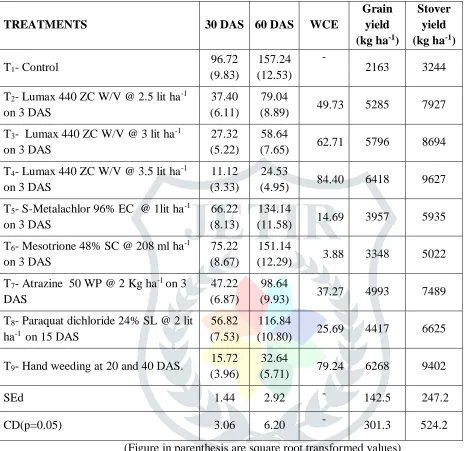
most all type of weeds, which is recorded the least weed count of 11.12 m-2 and 24.53 m-2 at 30 and 60 DAS, respectively. This might be due to the better efficacy of Lumax controlling early stage broad leaved weeds, sedges and grassy weeds. Lumax is a premixed and its contain herbicides viz., S-metalachlor + Mesotrione + Atrazine, which has high efficient, broad-spectrum and low toxic herbicide and thus it controls grasses, sedges and broads leaved weeds. Similar result was also reported by Saleem et al. (2015). However, it was on par with hand weeding twice on 20 and 40 DAS. This might be due to hand weeding twice completely removed all categories of weeds including sedges by Sandhya Rani et al. (2011) and Roman Kierzek et al. (2012) Higher weed population was noticed under weedy check with the total weed count of 96.72 m-2 and 157.24 m-2 at 30 and 60 DAS, respectively. This may be due to the weed competition throughout the crop duration and resulted in the highest weed count. Similar findings were reported by Pratik et al. (2013).
Weed control efficiency (WCE)
Among the weed control measures, pre emergence application Lumax 440 ZC W/V @ 3.5 lit ha-1 on 3 DAS (T4) excelled others by recording the higher weed control efficiency of 84.40 per cent. This can be
attributed to the better performance of premixed herbicides in reducing the weed infestation throughout the cropping period due its wide spectrum activity and its combination effect, as opined by Grzegorz et al. (2011) and Sonawane et al. (2014). It was followed by on par with twice hand weeding (T9) by recording the
weed control efficiency of 79.94 per cent. The weed control efficiency of 3.88 was found to be least in (T6)
Mesotrione 48% SC @ 208 ml ha-1 on 3 DAS. which may be due to more weed infestation than other weed control treatment plots during entire cropping period under this treatment .
Grain and Stover Yield
All the treatments significantly influenced the grain and stover yields. Among the treatments
Lumax 440 ZC W/V @ 3.5 lit ha-1on 3 DAS (T4) significantly registered the highest grain yield of 6418 kg
ha-1 and stover yield of 9627 kg ha-1. Efficient weed control during the critical period of crop weed competition, higher LAI and sustained availability of nutrients for uptake of the crop contributed to higher post flowering photosynthesis and assimilate portioning to sink, might be reason for higher grain and stover yield. Similar results have been discussed by Kamble et al. (2015). However, this treatment on par with twice hand weeding (T9), which was registered the grain yield of 6268 kg ha-1 and stover yield of 9402 kg
ha-1 . This might be due to better removal of weeds at early stage favoured the growth and yield components, which is reflected registering higher grain and stover yield of maize with this treatment (Haque et al. 2013). The next in order of ranking were T3 and T4. Among the herbicide application,
might be due to inadequacy of herbicide required to control weeds during cropping period. Similar finds have been reported by Patel et al. (2006). The lowest grain yield of 2163 kg ha-1 and stover yield of 3244
kg ha-1 were recorded in weedy check. This could be attributed to greater removal of nutrients by weeds and severe crop weed competition resulted in poor source and sink development with lesser yield components and yield of crop. This was conformity with the findings of Riaz et al. (2007).
CONCLUSION
Based on the results of the study, it can be concluded that efficient and economic weed management in maize could be achieved by application of pre emergence herbicide Lumax 440 ZC W/V @ 3.5 lit ha-1 on 3 DAS. It effectively reduced the infestation of weeds and resulting in higher grain yield of maize.
Table 1. Effect of new generation herbicides on Individual weed species (m-2) at 30 DAS
Treatment Cyperus
rotundus Trianthema portulacastrum Cynodon dactylon Echinochloa crusgalli Commelina benghalensis Phyllanthus niruri Cleome viscosa T1 22.5 (4.7) 15 (3.8) 9.4 (3.1) 26.4 (5.1) 8.4 (2.8) 4.1 (2.0) 1 (1.2) T2 12.5 (3.5) 7.3 (2.7) 3.03 (1.7) 13.6 (3.6) 3.4 (1.8) 1.6
(1.2) -
T3 6.6 (2.5) 5.2 (2.2) 5.4 (2.3) 5.8
(2.4) - - -
T4 5.8 (2.4) 5 (2.2) 11.0 (3.3) 2.3
(1.5) - - -
T5 19.6 (4.4) 8.7 (2.9) 8.3 (2.8) 22.9 (4.7) 4.2 (2.0) 3 (1.7) 1.5 (1.2) T6 21.2 (4.6) 21.8 (4.6) 9.7 (3.1) 24.8 (4.9) 4.5 (2.1) 3.1 (1.7) 2.1 (1.4) T7 15.2 (3.8) 15.7 (3.9) 3.1 (1.7) 17.4
(4.1) -
2 (1.4) 1 (1.2) T8 17.7 (4.2) 18.2 (4.3) 20.4 (4.5) 20.6 (4.5) 3.1 (1.7) 2.1 (1.4) 1 (1.2) T9 9.6 (3.0) 6.7 (2.6) 3.1 (1.7) 9.3
(3.0) -
2
(1.4) -
SEd CD (p=0.05) 0.43 0.90 0.34 0.73 0.11 0.23 0.47 1.01 - NS - NS - NS
Table 2. Effect of new generation herbicides on Individual weed species (m-2) at 60 DAS
Treatment Cyperus
rotundus Trianthema portulacastrum Cynodon dactylon Echinochloa crusgalli Commelina benghalensis Phyllanthus niruri Cleome viscosa T1 71.8 (8.4) 48.3 (6.9) 33.6 (5.7) 29.1 (5.3) 12.7 (3.5) 5.1 (2.3) 6.5 (2.5) T2 17.5 (4.1) 21.6 (4.6) 14.1 (3.7) 13.3 (3.6) 2.3 (1.5) 2.0 (1.4) 3.0 (1.7) T3 14.4 (3.7) 16.2 (4.0) 9.6 (3.0) 9.4
(3.0) - - -
T4 6.2 (2.4) 9.6 (3.0) 4.9 (2.2) 3.6
(1.8) - - -
T5 30.3 (5.5) 36.1 (6.0) 25.1 (5.0) 22.7 (4.7) 7.0 (2.6) 4.5 (2.1) 5.4 (2.3) T6 45.1 (6.7) 40.4 (6.3) 28.1 (5.3) 25.3 (5.0) 9.1 (3.0) 4.6 (2.1) 6.2 (2.4) T7 15.2 (3.8) 15.7 (3.9) 3.1 (1.7) 17.4
(4.1) -
2 (1.4) 1 (1.2) T8 25.1 (5.0) 31.5 (5.6) 22 (4.6) 19.7 (4.4) 4.2 (2.1) 4.0 (2.0) 4.0 (2.0) T9 7.3 (2.7) 10.5 (3.2) 5.3 (2.3) 4.9
(2.2) - - -
SEd CD (p=0.05) 0.79 1.68 0.80 1.70 0.53 1.13 0.48 1.02 - NS - NS - NS
Table 3. Effect of new generation herbicides on Total weed count (m-2), WCE (%) and Grain and stover yield of maize
TREATMENTS 30 DAS 60 DAS WCE
Grain yield (kg ha-1)
Stover yield (kg ha-1)
T1- Control
96.72 (9.83)
157.24 (12.53)
-
2163 3244
T2- Lumax 440 ZC W/V @ 2.5 lit ha-1
on 3 DAS
37.40 (6.11)
79.04
(8.89) 49.73 5285 7927
T3- Lumax 440 ZC W/V @ 3 lit ha-1
on 3 DAS
27.32 (5.22)
58.64
(7.65) 62.71 5796 8694
T4- Lumax 440 ZC W/V @ 3.5 lit ha-1
on 3 DAS
11.12 (3.33)
24.53
(4.95) 84.40 6418 9627
T5- S-Metalachlor 96% EC @ 1lit ha-1
on 3 DAS
66.22 (8.13)
134.14
(11.58) 14.69 3957 5935
T6- Mesotrione 48% SC @ 208 ml ha-1
on 3 DAS
75.22 (8.67)
151.14
(12.29) 3.88 3348 5022
T7- Atrazine 50 WP @ 2 Kg ha-1 on 3
DAS
47.22 (6.87)
98.64
(9.93) 37.27 4993 7489
T8- Paraquat dichloride 24% SL @ 2 lit
ha-1 on 15 DAS
56.82 (7.53)
116.84
(10.80) 25.69 4417 6625
T9- Hand weeding at 20 and 40 DAS.
15.72 (3.96)
32.64
(5.71) 79.24 6268 9402
SEd 1.44 2.92 - 142.5 247.2
CD(p=0.05) 3.06 6.20 - 301.3 524.2
(Figure in parenthesis are square root transformed values)
REFERENCES
Anonymous. 2013. Annual progress report kharif. Indian Institute of Maize Research p 10
Dass, S., Arora, P., Kumari, M. and Dharma, P., 2008, Morphological traits determining drought tolerance in maize (Zea mays L.). Indian J. Agric. Res., 35 (3): 59-63
Gill, G. S. and Vijay kumar, 1969, Weed index-a new method for reporting control trials. Indian J. Agron., 14: 96-98.
Gomez, K.A. and Gomez, A.A. 1984. Statistical procedures for agricultural research. A Willey Inter Science Publication, New York, pp.76-83.
Haque, H., Birendra Kumar, Suman Kalyani and Ranvir Kumar. 2013. Effect of maize based intercropping system on maize yield and associated weeds under rainfed upland ecosystem. Res. J. Agric. Sci., 4(3): 416-419.
Jat N K, Kumar A and Dhar S. 2010. Influence of Sesbania green manure with or without wheat residues and N fertilization on maize (Zea mays)–wheat (Triticum aestivum) cropping system. Indian Journal of Agronomy 55(4): 253–8.
Kamble, T.C., S.U. Kakade, S.U. Nemade, R.V. Pawar and V.A. Apotikar. 2005. An integrated weed management in hybrid maize. Crop Res., Hisar, 29(3):396 - 400.
Mishra. A and G. C. Tosh. 1979. Chemical weed control studies in dwarf wheat J. Res. Orissa Univ. Agric. and Tech., 10: 1-6.
Patel, V.J., P.N. Upadhyay, J.B. Patel and M.I. Meisuriya. 2006. Effect of herbicide mixture on weeds in kharif maize (Zea mays L.) under middle Gujarat conditions. Indian J. of Weed Science, 38(1&2):
54 - 57.
Pratik Sanodiya, A.K. Jha and Arti Shrivastava. 2013. Effect of integrated weed management on seed yield of fodder maize. Indian J. Weed Sci., 45(3): 214- 216.
Riaz, M., M. Jamil and T.Z. Mahmood. 2007. Yield and yield components of maize as affected by various weed control methods under rainfed conditions of Pakistan. Int. J. Agric. Biol., 9: 152-155.
Roman, Kierzek, Adam Paradowski, and Roman Krawczyk. 2011. "Effectiveness of weed control in maize (Zea mays L.) depending on the date and method of herbicide application." Acta Scientiarum Polonorum. Agricultura 10.2.
Saleem, A., Ali, S., Khan, M.A., Marwat, K.B., Jan, A.U., Jan, D. and Sattar, S., 2015. Performance and economics of growing maize under organic and inorganic fertilization and weed management. Pak. J. Bot, 48(1), pp.311-318.
Sandhya Rani, B., G. Karuna Sagar and P. Maheswara Reddy. 2011. Effect of integrated weed management with low volume herbicides in sweet corn (Zea mays). Indian J. Weed Sci., 43(1&2): 110 - 112.
Sonawane, R.K., Dandge, M.S., Kamble, A.S. and Shingrup, P.V., 2014. Effect of herbicides on nutrient uptake and yield of Kharif maize (Zea mays L.). BIOINFOLET-A Quarterly Journal of Life Sciences, 11(1a), pp.136-138.