ISSN: 2231-5381
http://www.ijettjournal.org
Page 770ECG Data Compression using Wavelet Transform
Suresh Patel1, Dr. Ashutosh Datar 2
1
PG Student Department of Electronics and Communication S.A.T.I. Vidisha (M.P.) INDIA 2
Head Department of Bio-Medical Engineering S.A.T.I. Vidisha (M.P.) INDIA
Abstract— ECG data compression has been one of the active
research areas in biomedical engineering. In this paper a compression method for electrocardiogram (ECG) signals using wavelet transform is proposed. Wavelet transform compact the energy of signal in fewer samples and has a good localization property in time and frequency domain. The MIT-BIH ECG signals are decomposed using discrete wavelet transform (DWT).The DWT provide powerful capability to remove frequency components at specific time in the data. The thresholding of the resulted DWT coefficients are done in a manner such that a predefined goal percent root mean square difference (GPRD) is achieved. The compression is achieved by the quantization technique, run-length encoding, Huffman and binary encoding methods. The proposed method, for fixed GPRD shows better performance with high compression ratios and good quality reconstructed signals.
Keywords—Compression, discrete wavelet transform
Electrocardiogram (ECG), PRD, quantization, thresholding.
I. INTRODUCTION
The electrocardiogram (ECG) is one of the simplest and oldest cardiac investigations available, yet it can provide a wealth of useful information and remains an essential part of the assessment of cardiac patients. An ECG is an indispensable physiological signal for diagnosis of heart diseases. The volume of ECG data produced by the monitoring systems grows as the sampling rate, sample resolution, observation time, and number of leads increases. To transmit and store enormous amount of digitized medical signals efficiently becomes one of the important issues in the biomedical signal processing community. A reliable, accurate, and more efficient data compression technique with improved feature performance requirements at lower cost is needed to solve this problem.
The data compression is the process of detecting and eliminating redundancies in a given data set [1]. The main objective of any compression technique is to remove redundancy and achieve maximum data volume reduction while preserving the necessary diagnosis features. Data compression methods have been extensively discussed and classified into following major categories [2].
1) Parameter extraction techniques: In the parameter extraction approach, particular characteristic or parameter features of ECG signals are extracted to
facilitate the compression process. The average beat subtraction method, cycle-pool-based compression method, linear prediction methods and neural network methods fall into this category.
2) Direct data compression techniques: In the direct method, ECG signals are processed directly to provide the compression. The differential pulse code modulation (DPCM), vector quantization (VQ), turning point (TP), Fan, scan along polygonal approximation-2 (SAPA-2), amplitude zone time epoch coding (AZTEC) and entropy coding are typical examples in this category [3]-[5].
3) Transformation methods: In the transform method, the original signal in time domain is converted into a transform domain where the actual compression is performed. The Walsh transform, Karhunen–Loeve transform, cosine transform, Fourier transform, and wavelet transform (WT) are typical transforms used in the transform approach [6]-[11].
All above proposed methods have different approaches but with common design ideology that is taking the quality of the reconstructed signals as a necessary design constraint in their compression methods. In recent years wavelet-based approaches provide the good signal reconstruction quality and the high compression ratios. A fundamental coding technique called the embedded zero tree wavelet or EZW [12] has attracted great research interest in the signal compression algorithm. Another such technique that have excellent coding performance is set partitioning in hierarchical trees (SPHITs) [13].The method in [14] is based on the SPHIT algorithm can attain exact bit rate and generates a bit stream progressive in quality. In the controlled wavelet based method [15], the measure to be prepense is a user specified PRD to be matched by searching for an appropriate rate. A synonymous ideas based on the energy packing efficiency (EPE) is conferred by authors of [16, 17] .Some of the authors focus on the study of wavelets, while others are oriented towards inventing the new coding scheme for wavelet coefficients.
II. WAVELET TRANSFORM (WT)
ISSN: 2231-5381
http://www.ijettjournal.org
Page 771( , ) = 1
√ ( )
∗ − (1)
( ) = ( , ) , ( ) (2)
where, ( ) is the signal to be analyzed / synthesized, <∗>
denote complex conjugation, ( , ) denote the wavelet
transform coefficients, and is a fundamental waveform
called a mother wavelet. A wide variety of functions can be chosen as mother wavelet provided that the admissibility and regularity conditions are satisfied [18]. This is one of the differences between the wavelet transform and the Fourier transform. In (2), , is obtained by a dilated and translated
version of the mother wavelet .
, ( ) =
1 √
−
(3)
The DWT removes the redundancy of the CWT by using discrete steps for scale and translation; thus, the time-scale space is sampled at discrete intervals
, ( ) =
1 −
, , (4)
In (4), and are the integers and > 1 is a fixed
dilation step. Setting = 2 provides a dyadic sampling of the
frequency axis and allows viewing the wavelet decomposition as a cascaded octave bandpass filter .Dyadic sampling of the
time axis can be achieved by setting = 2.
The energy packing capability and selectable coefficient disposal are the two major advantages for a transform coding to preserve signal energy and save bitrates simultaneously [2]. The WT is entrenched on basis functions formed by dilation and translation of a prototype wavelet function. These wavelet basis functions are short-duration, high-frequency and long-duration, low frequency functions. They are much better suited for representing short bursts of high-frequency signals or long-duration, slowly varying signals.
III. PERFORMANCE MEASURES
The ECG signals compression algorithms require an evaluating criterion to evaluate quality of reconstructed signals more accurately. Several measures criteria is presented [19, 21] and focused especially on the widely used popular criterion which is the percent root-mean-square difference (PRD).
= ∑ ( )− ( )
∑ ( ) × 100 (5)
1 = ∑ ( )− ( )
∑ ( ( )− ̅) × 100 (6)
2 = ∑ ( )− ( )
∑ ( ( )−1024) × 100 (7)
where ( ) is the original signal, ( ) is the reconstructed signal, ̅ the signal’s mean value and is the length of the window over which the PRD is calculated. Definition (6) is
independent of the dc level of the original signal. Definitions (5) and (6) are identical for a signal with zero mean.
If the PRD1 value is between 0 and 9%, the quality of the reconstructed signal is either “very good” or “good” [19]. If the value is greater than 9% its quality group cannot be determined. As we are interested in very good and good reconstruction, it is taken that the PRD1 value must be less than 9%.
The correlation coefficient (CC) is used as a measure to evaluate the similarity between the two signals and described by [21]:
=
1∑ ( ( )− ̅)( ( )− ̅)
1
∑ ( ( )− ̅) 1∑ ( ( )− ̅)
(8)
where, ̅ indicate the mean values of the reconstructed signal.
In this measure the instantaneous distortions may be undetectable.
Finally, weighted diagnostic difference (WDD) is a well adapted measure for ECG evaluation [19] and described as
, =∆ Λ
Λ∆ × 100 (9)
where, and represent two vectors of 18 diagnosis features concerning respectively the original beat and reconstructed
beat of an ECG signal. ∆ is the normalized difference
vector and Λis a diagonal matrix of weights. The WDD is a better measure for diagnosis features; its only drawback is its expensive cost in term of time calculation. However, PRD is easy to understand and calculate.
The compression ratio (CR) is the key parameter for every signal compression methods. Generally, such methods are designed to achieve highest CR with imperceptible or at least tolerable distortion in the reconstructed signal. In general CR is defined as the ratio of the number of bits representing the original signal to the number required for representing the compressed signal [17]
= ℎ
ℎ (10)
In the literature, there are some other error measures for comparing original and reconstructed ECG signals [20], such as the mean square error (MSE):
= ∑ ( )− ( ) (11)
The root mean square error (RMS) is [19]:
= ∑ ( )− ( ) (12)
The signal to noise ratio (SNR), which is expressed as [19]:
= 10 ∑ ( ( )− ̅)
∑ ( )− ( ) (13)
The relation between the SNR and the PRD is [19]:
=−20 (0.01 ) (14)
A maximum amplitude error (MAE) or peak error (PE) is also an error measure [19]:
ISSN: 2231-5381
http://www.ijettjournal.org
Page 772All these error measures have many disadvantages which all result in poor diagnostic relevance.
IV. PROPOSED METHODOLOGY
The block diagram describing the different operation of the proposed method is presented in Fig. 1. The proposed approach utilizes binary encoding in place of arithmetic encoding proposed by Benzid [21].
Fig.1. Flow chart of compression algorithm.
A. Wavelet Decomposition
The DWT allow us to remove frequency components at specific times in the data [16]. In decomposition signal is split into two parts using high pass and low pass filter [22]. For good quality reconstructed signal with high compression ratio it is desired that the mother wavelet will be compactly supported. The basis functions be orthonormal to minimizes
the inter scale correlation of the decomposed signal. Compact support makes the wavelet transform able to work on finite signals to discriminate signal features in both time and scale [23, 24].The ECG signal is decomposed by applying the pyramidal DWT using the Daubechies wavelet. Maximum energy of the decomposed wavelet coefficients is concentrated in the lower approximation subband. The amplitudes of the wavelet coefficients in the detail subbands (high frequency wavelets coefficients) are relatively small compared with those in the approximation subband (low frequency wavelets coefficients).The number of wavelet coefficients in the detail subbands is relatively large compared with that of the
approximation subband that is essential for signal
compression.
B. Thresholding of the DWT coefficients
A The optimal threshold level is determined such that the signal reconstructed from the threshold coefficients is close to the original one as possible, subjected to a target PRD. We
have selected a starting threshold level ( )given by [21].
=( + )
2 (16)
where, and are the lower and the upper limits
of the starting search interval. The , and
are updated according to the well known bisection algorithm [25]. The thresholding will set a substantial numbers of wavelet coefficients to zeros whose absolute value are lower than a certain threshold level. After thresholding the signal is reconstructed and the PRD is calculated. Then each coefficient after thresholding is quantized.
C. Quantization of non-zero threshold coefficients
A quantizer [26, 27] simply reduces the number of bits needed to store the transformed coefficients by reducing the precision of those values. A quantization method maps a large number of input values into a smaller set of output values. During the quantization process some information is lost. After quantization the exact original wavelet coefficients cannot be recovered. This introduces more distortion in the reconstructed signal. Quantization is done using 8, 10 and 12 bits for the index indicating the codeword. The quantized coefficients are then encoded.
D. Coding the wavelet coefficients
In signal compression we aim at describing a signal in compact form that consists of a small set of numbers representing the significant coefficient and a large amount of zeros symbols that can be efficiently encoded. Different coding schemes can be used to code the wavelet coefficients [16]. The coding in two stages: 1) coding the significance map, and coding the significant coefficients. A significance map is a representation of position of significant transform coefficients. A significance map (binary lookup table) that stores the significance information is generated by scanning the thresholded coefficients. The output is “1” if a significant
End
HUFFMAN Encoding Binary Encoding
Quantization of resulting non-zero coefficients
Lookup table RLE encoding YES
NO PRD calculation
Predefined PRD is reached? Signal reconstruction by inverse
digital wavelet transform Threshold of a new copy of the wavelet
coefficients
Threshold Update Wavelet Decomposition
ISSN: 2231-5381
http://www.ijettjournal.org
Page 773coefficient (non-zero coefficients) is scanned and a “0” if an in significant coefficient is scanned. The significance maps allow us to group the significant coefficients separately. We use the lossless encoding to code these two vectors. The significance map can be coded efficiently by using a variable-length code based on run-variable-length encoding. After this the Huffman coding is applied to enhance the compression. The significant coefficients after quantization are coded by binary coding. Run-length, Huffman and binary coding techniques [20] give better overall compression.
V. EXPERIMENTAL RESULTS
The proposed method was tested on the standard MIT-BIH arrhythmia database. All records were characterized by a resolution of 11 bits and a sampling frequency of 360 Hz. We have used the data set reported in [13]. The data set consists of record numbers: 100, 101, 102,103, 107, 109, 111, 115, 117, 118, and 119.The signal block size used are of 1024, 2048, 4096, 8192 and 16384 samples. The analysis is carried out on Matlab7 (R14) version. The PRD1, SNR, MSE, MAE and CR are used as quantitative performance measures.
The data set is tested for the fixed goal PRD (GPRD) of 8.9. The one dimensional signals have been decomposed by using the Daubechies (db4, db5, db6, db7 and db8) wavelet at 4, 5, 6 and 7 levels of decomposition. We have evaluated the effect of decomposition level, signal length, quantization bit and wavelets on the quality of reconstructed signal.
The first 16384 samples ECG signal extracted from record 100 are decomposed by applying Daubechies wavelet at different decomposition level and performance results are shown graphically. Fig.2 and 3 illustrates that the compression performance depends on the number of decomposition levels, signal length and the type of wavelet applied. For the ECG signal it has been noticed that the best performance can be obtained if the signal is decomposed up to the fifth level. For a desired compression ratio the best wavelet is the one that achieves the most retained energy. It has been observed that the db5 wavelet performs better than the others. The optimal signal length is that which yield maximum compression ratio. It can be deduced that the maximum compression ratios result at length 16384 samples.
Fig.4 shows that the effect of quantization bit on compression ratio. It is observed that the compression ratio decreases if the quantization bit increases for all wavelet. The error measures such as MSE, MAE is decreased and SNR increases. This indicates that the quality of reconstructed signal improves with increase in quantization bit at a cost of decreased compression ratio. Furthermore, it is clear that the maximum
compression ratio of 11.27 with a PRD1 of 8.81 can be
achieved by using db5 wavelet for fifth level decomposition and 8 bit quantization.
The efficiency of proposed algorithm is shown by the results of Table I. The first 16384 samples of data set ECG signals have been decomposed up to fifth decomposition level using different Daubechies wavelet at 8 bit quantization. It is noted that the performance of the compression algorithm depends on the record being compressed. As we have achieved the PRD1
value less than 9% for all ECG records, this shows the controllability efficiency our algorithm.
Fig.2. Effect of decomposition level on the compression ratio at 8 bit quantization.
Fig.3. Effect of block size on the compression ratio for fifth level decomposition and 8 bit quantization.
4 5 6 7
10.3 10.4 10.5 10.6 10.7 10.8 10.9 11 11.1 11.2 11.3
Decomposition Level
C
o
m
p
re
ss
io
n
R
at
io
(
C
R
)
db4 db5 db6 db7 db8
0 2000 4000 6000 8000 10000 12000 14000 16000 8
8.5 9 9.5 10 10.5 11 11.5
Block Size (samples)
C
o
m
p
re
ss
io
n
R
a
ti
o
(
C
R
)
ISSN: 2231-5381
http://www.ijettjournal.org
Page 774TABLE I
TEST RESULTS FOR COMPRESSING THE DATA SET FOR GPRD = 8.9 %
WAVELET FACTOR ECG RECORD
100 101 102 103 107 109 111 115 117 118 119
Db4 PRD1 8.85 8.89 8.95 8.91 8.82 8.81 8.90 8.88 8.98 8.98 8.91
SNR 20.82 20.93 20.78 20.89 20.98 20.96 20.87 20.85 20.69 20.62 20.73
MSE 2.48E-04 3.92E-04 2.67E-04 8.40E-04 5.6E-03 1.3E-03 3.18E-04 1.0E-03 4.53E-04 1.4E-03 2.7E-03
MAE 0.0730 0.1036 0.0987 0.1671 0.5117 0.1899 0.0779 0.2100 0.1078 0.1774 0.3690
CR 11.22 9.44 10.53 12.76 14.84 14.48 11.27 14.34 15.06 11.36 16.17
Db5 PRD1 8.81 8.87 8.84 8.93 8.89 8.87 8.85 8.85 8.82 8.88 8.98
SNR 20.86 20.84 20.87 20.88 20.89 20.91 20.88 20.90 20.84 20.71 20.69
MSE 2.46E-04 3.88E-04 2.61E-04 8.42E-04 5.7E-03 1.4E-03 3.17E-04 9.88E-04 4.38E-04 1.4E-03 2.7E-03
MAE 0.0958 0.0996 0.0920 0.1743 0.5329 0.1732 0.0833 0.2136 0.0904 0.1924 0.3141
CR 11.27 9.61 10.46 12.91 15.15 15.26 11.18 13.84 15.37 11.15 16.02
Db6 PRD1 8.87 8.91 8.94 8.91 8.96 8.86 8.97 8.97 8.92 8.92 8.81
SNR 20.82 20.82 20.79 20.89 20.83 20.92 20.76 20.76 20.77 20.68 20.81
MSE 2.49E-04 3.91E-04 2.66E-04 8.39E-04 5.8E-03 1.4E-03 3.27E-04 3.27E-04 4.45E-04 1.4E-03 2.7E-03
MAE 0.0861 0.0985 0.1320 0.1906 0.4822 0.1689 0.0952 0.0952 0.0969 0.1980 0.3018
CR 11.18 9.18 10.36 12.52 15.08 14.90 11.15 11.15 15.41 11.34 15.58
Db7 PRD1 8.93 8.83 8.92 8.98 8.84 8.86 8.81 8.81 8.88 8.95 8.87
SNR 20.79 20.87 20.81 20.82 20.95 20.93 20.93 20.93 20.81 20.65 20.78
MSE 2.50E-04 3.86E-04 2.65E-04 8.53E-04 5.7E-03 1.3E-03 3.14E-04 9.82E-04 4.41E-04 1.4E-03 2.7E-03
MAE 0.0759 0.1079 0.0942 0.2318 0.4728 0.2179 0.0942 0.1936 0.1094 0.1787 0.2562
CR 10.82 9.04 10..05 12.53 14.35 14.70 10.99 13.60 15.29 11.46 15.57
Db8 PRD1 8.88 8.96 8.90 8.92 8.92 8.94 8.84 8.89 8.81 8.88 8.97
SNR 20.83 20.75 20.79 20.90 20.87 20.85 20.90 20.85 20.83 20.68 20.69
MSE 2.48E-04 3.97E-04 2.66E-04 8.37E-04 5.8E-03 1.4E-03 3.16E-04 1.0E-03 4.39E-04 1.4E-03 2.7E-03
MAE 0.0714 0.1001 0.1012 0.1769 0.5625 0.2106 0.0791 0.1606 0.1130 0.1805 0.2625
CR 10.59 9.24 9.88 12.18 14.29 14.78 10.87 13.54 14.66 11.03 15.20
Fig.4. Effect of quantization bit on the compression ratio for fifth level decomposition.
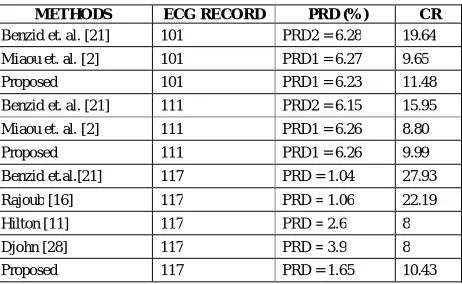
For comparison with other methods, the proposed algorithm was applied to records 101, 111 and 117. The wavelet decomposition of each 10 min length record up to level five using db5 wavelet at 8 bit quantization is carried out. The compression ratio and percentage root mean square error are
used as performance measures. In [11], Hilton presented a wavelet and wavelet – packet - based ECG codec and reported a PRD of 2.6% at compression ratio of 8:1for record 117. In [28], the discrete symmetric wavelet transform was used to compress ECG signals; a PRD of 3.9% was reported at a compression ratio of 8:1 for record 117.
The proposed algorithm was tested on record 117; a PRD of 1.65 was achieved at a compression ratio of 10.43 which is much better as compared with the above codec’s. Table II presents the summary of compression between the proposed method and the other wavelet based compression algorithm.
TABLE II
PERFORMANCE COMPARISON WITH OTHER METHODS
METHODS ECG RECORD PRD (%) CR
Benzid et. al. [21] 101 PRD2 = 6.28 19.64
Miaou et. al. [2] 101 PRD1 = 6.27 9.65
Proposed 101 PRD1 = 6.23 11.48
Benzid et. al. [21] 111 PRD2 = 6.15 15.95
Miaou et. al. [2] 111 PRD1 = 6.26 8.80
Proposed 111 PRD1 = 6.26 9.99
Benzid et.al.[21] 117 PRD = 1.04 27.93
Rajoub [16] 117 PRD = 1.06 22.19
Hilton [11] 117 PRD = 2.6 8
Djohn [28] 117 PRD = 3.9 8
Proposed 117 PRD = 1.65 10.43
8 10 12
7.5 8 8.5 9 9.5 10 10.5 11 11.5
Quantization Bits
C
o
m
p
re
ss
io
n
R
a
ti
o
(
C
R
)
ISSN: 2231-5381
http://www.ijettjournal.org
Page 775Finally, for the aim of visual inspection, we present visual results. Fig. 5 shows the first 512 samples of ECG record 100 which is extracted from block size of 1024 samples compressed using predefined PRD. Fig.6. shows the sample of
Fig.5.First 512 samples of Original ECG Signal of record 100.
Fig.6. Reconstructed ECG Signal of record 100.
Fig.7. Superimposed Original and Reconstructed signal for record 100.
Fig.8. Error signal for record100.
reconstructed ECG signal which is a smoothed version of the original signal as they do not suffer from the quantization noise introduced by the ECG recording unit. Furthermore, the error signal is almost uniformly distributed among the parts of the ECG signal.
VI. CONCLUSION
We have presented a closed loop compression scheme based on the wavelet transform using predefined goal PRD as a constraint. The technique is tested for compression of ECG signals extracted from the MIT-BIH database. The PRD1 value is less than 9%, quality of the reconstructed signals is either “very good” or “good”. The performance of the
50 100 150 200 250 300 350 400 450 500
-0.6 -0.4 -0.2 0 0.2 0.4 0.6 0.8 1
Sample Index
A
m
p
lit
u
d
e
(m
V
)
50 100 150 200 250 300 350 400 450 500
-0.6 -0.4 -0.2 0 0.2 0.4 0.6 0.8 1
Sample Index
A
m
p
lit
u
e
(m
V
)
50 100 150 200 250 300 350 400 450 500
-0.6 -0.4 -0.2 0 0.2 0.4 0.6 0.8 1
Sample Index
A
m
p
lit
u
d
e
(m
V
)
Original ECG Signal Reconstructed ECG Signal
50 100 150 200 250 300 350 400 450 500
-0.08 -0.06 -0.04 -0.02 0 0.02 0.04 0.06 0.08
Sample Index
A
m
p
it
u
d
e
(m
V
ISSN: 2231-5381
http://www.ijettjournal.org
Page 776compression algorithm depends on the record being compressed, decomposition level, quantization bit, signal length and the type of wavelet. The results demonstrate that the desired quality specification can be reached quickly and compression is superior to other method. All the clinical information is preserved after compression and this makes the algorithm safe for compression of ECG signals.
REFRENCES
[1] S. M. S. Jalaeddine, C. G. Hutchens, R. D. Strattan, and W. A. Coberly,
“ECG compression techniques —A unified approach,” IEEE Trans.
Biomed. Eng., vol. 37, pp. 329–343, Apr. 1990.
[2] S. G. Miaou and H. L. Yen, “Quality-driven gold washing adaptive vector quantization and its application to ECG data compression,”IEEE Trans. Biomed. Eng., vol. 47, pp. 209–218, Feb. 2000.
[3] J. R. Cox, F. M. Nolle, H. A. Fozzard, and G. C. Oliver, “AZTEC: A
preprocessing scheme for real time ECG rhythm analysis,” IEEE Trans.
Biomed. Eng., vol. BME-15, pp. 128–129, Apr. 1968.
[4] D. Stewart, G. E. Dower, and O. Suranyi, “An ECG compression
code,”J. Electrocardiol., vol. 6, no. 2, pp. 175–176, 1973.
[5] U.E. Ruttimann and H. V. Pipberger, “Compression of ECG by
prediction or interpolation and entropy encoding,” IEEE Trans. Biomed.
Eng.,vol. BME-26, pp. 613–623, Nov. 1979.
[6] B. R. S. Reddy and I. S. N. Murthy, “ECG data compression using
Fourier descriptors,” IEEE Trans. Biomed. Eng., vol. BME-33,
pp.428–434, Apr. 1986.
[7] W.S. Kuklinski, “Fast Walsh transform data-compression algorithm:
ECG applications,” Med. Biol. Eng. Comput., vol. 21, pp. 465–472, July 1983.
[8] S. Olmos, M. Millan, J. Garcia, and P. Laguna, “ECG data
compression with the Karhunen–Loeve transform,” in Comput. Cardiol.
Conf., 1996, pp. 253–256.
[9] B. Bradie, “Wavelet packet-based compression of single lead
ECG,”IEEE Trans. Biomed. Eng., vol. 43, pp. 493–501, May 1996.
[10] A. G. Ramakrishnan and S. Saha, “ECG coding by wavelet-based
linear prediction,” IEEE Trans. Biomed. Eng., vol. 44, pp. 1253–1261, Dec.1997.
[11] M. L. Hilton, “Wavelet and wavelet packet compression of
electrocardiograms,” IEEE Trans. Biomed. Eng., vol. 44, pp. 394–402, May 1997.
[12] J. M. Shapiro, “Embedded image coding using zerotrees of wavelet coefficients,” IEEE Trans. Signal Processing, vol. 41, pp. 3445–3462, Dec.1993.
[13] A. Said and W. A. Pearlman, “A new, fast and efficient image codec based on set partitioning in hierarchical trees,” IEEE Trans. Circuits Syst. Video Technol., vol. 6, pp. 243–250, June 1996.
[14] Z. Lu, D. Y. Kim, and W. A. Pearlman, “Wavelet compression of ECG
signals by the set partitioning in hierarchical trees algorithm,” IEEE Trans. Biomed. Eng., vol. 47, pp. 849–856, July 2000.
[15] S-G. Miaou, C-L. Lin, “A Quality-on-demand algorithm for wavelet-based compression of electrocardiogram Signals,” IEEE Trans. on Biomedical Engineering, vol. 49, pp. 233-239, 2002.
[16] B. A. Rajoub, “An efficient coding algorithm for the compression of
ECG signals using the wavelet transform,” IEEE Trans. on Biomedical
Engineering, vol. 49, pp. 355-362, 2002.
[17] M. Abo-Zahhad and B. A. Rajoub, “ An effective coding technique for
the compression of one-dimensional signals using wavelet transform,” Medical Engineering & Physics, vol. 24 pp. 185-199, 2002.
[18] S. G. Mallat, “A theory for multiresolution signal decomposition: The wavelet representation,” IEEE Trans. Patten Anal. Machine Intell., vol.11, pp. 674–693, 1989.
[19] Y. Zigel, A. Cohen, and A. Katz, “The weighted diagnostic distortion (WDD) measure for ECG signal compression,” IEEE Trans. Biomed. Eng., vol. 47, pp. 1422–1430, 2000.
[20] K. Sayood, Introduction to Data Compression. San Mateo, CA: Morgan Kaufmann, 1996.
[21] R. Benzid, F. Marrir and N. E. Bouguechal, “Quality-controlled
compression method using wavelet transform for electrocardiogram signals,” International Journal of Biological and Life Sciences, vol. 1. pp. 28-33, 2005.
[22] P. P. Vaidyanathan, Multirate Systems and Filter Banks. Englewood Cliffs, NJ: Prentice-Hall, 1993.
[23] I. Daubechies, “Orthonormal bases of compactly supported wavelets,” Commun. Pure Appl. Math., vol. 41, no. 7, pp. 909–996, November 1988.
[24] I. Daubechies, Ten Lectures on Wavelets. Philadelphia, PA: Soc. Ind. Appl. Math. (SIAM), 1992, SIAM CBMS-NSF Regional Conf.: Applied Mathematics.
[25] W. H. Press, B. P. Flannery, S. A. Teukolsky, and W. T. Vetterling, Numerical Recipes in C—The Art of Scientific Computing. Cambridge, U.K.: Cambridge Univ. Press, 1988.
[26] J. Max, "Quantizing for Minimum Distortion," IRE Transactions on Information Theory, Vol. 6, pp. 7-12. 1960.
[27] S. P. Lloyd, "Least Squares Quantization in PCM," IEEE Transactions on Information Theory, Vol. 28, pp. 129-137. 1982.
[28] A. Djohan, T. Q. Nguyen, and W.J. Tompkins, “ECG compression