Strategies For Enhancing The Contribution Of
Gemstone Mining In Developing Countries
Dr. S Kambani
University of Zambia, School of Mines [email protected]
Abstract: The principal objective of this study is to suggest strategies for enhancing the contribution of gemstone mining to economies of developing countries (DCs). There are three major reasons for the study, namely, (i) the sub-sector’s apparent significant economic potential, (ii) a conspicuous lack of scientific literature on aspects of mining, processing and marketing, and (iii) the unique position held by gemstone mining in the world’s mining industry. The study focusses on five principal areas. First, the interrelationship between minerals and economic development is discussed. The special role and potential held by small scale mining (SSM) in contributing to the development objectives of DCs, is emphasized.Second, a review of the international gemstone industry is conducted. The high unit value of gemstones, the elevated geological risk, special mining techniques and complex marketing mechanisms, places the industry in a unique position within the world’s mining sector. A strong positive correlation is found to exist between the consumption of gemstones and the GNP per capita. The consumption is also found to set in only above a certain level of GNP per capita which provides an indication of where gemstone markets are. Thirdly, a detailed evaluation of policies and sub-sector constraints is presented. It is established that the sub-sector’s constraints are largely a direct result of an unsupportive policy environment. While aiming at improving the total operational business environment of the economy, policies must emphasize the role of free markets systems, state ownership of mines and control of marketing must be limited to improve the sub-sector’s productivity and efficiency. Effective mineral resource policies as reflected by sound mineral legislation as well as high quality of institutional framework support, is also a pre-condition to the successful development of the sub-sector. Lastly. Resulting from the investigation of policies and sub-sector constraints, options for the removal of constraints are identified. The identified options are then combined into a general development strategy model for the sub-sector.
Keywords Small-scale mining; gemstone mining sub-sector; Economic development; mineral policies; institutional framework support.
Role of Small-scale Mining
A universal definition of what constitutes small-scale mining, has always been elusive(Barreto L.M, Hinton J and Hruschka F (2018). Generally, a typical small-scale mining operation in DCs is characterized by the following attributes:
Often seasonal production of limited quantities of minerals from small deposits with few known reserves;
Labor intensive with heavy reliance on manual labor; Lack of technical, financial and business management
skills;
With a few exceptions, the capital investment in plant and machinery is held to a minimum; and
May be owned and managed by the individual entrepreneur, a family, cooperative, limited company of the state.
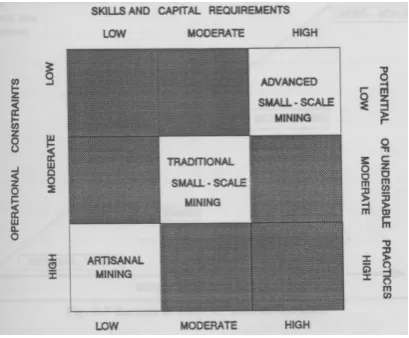
More specifically, based on organizational aspects, three basic types of small-scale mines with special characteristics can be distinguished as illustrated in Figure 1. The first type, artisanal mining (micro-scale mining) encompasses the smallest and simplest operations. It is characterized by the use of simple tools and the absence of a formal enterprise. Artisanal mining ranges from individuals to more commonly family or village groups, mining legally or illegally. The second group comprises the traditional SSM which includes registered and licensed non-mechanized or semi-mechanized mining operations run by organized society members of entrepreneurs with the use of hired labor. The third group is the legally constituted advanced SSM using highly mechanized techniques. The third group is the legally constituted advanced SSM using highly mechanized techniques.
Figure 1. Categories of Small-scale Mining
There are a number of clearly identifiable social and economic benefits associated with SSM in DCs with the following advantages:
Has high employment potential, especially for unskilled labor
Low investment requirements Short gestation periods
Does not require elaborate infrastructure It is an efficient user of scarce capital, and
Creates opportunities for indigenous entrepreneurial development
response to growing youth unemployment. Evidence from
these countries, however, confirms that SSM activities can generate quite conflicting effects. It is obvious that the sub-sector incorporates both an important positive and a serious destructive potential (Gavin, 2002). This is particularly the case with regard to the artisanal segment of the sub-sector. The constructive potential pertains to employment, income and foreign earnings effects. However, if conducted in an uncontrollable manner, SSM can also be associated with serious negative implications (Hrushka F, Hentschel T, et al., 2009) and (Mihaye, J, 2013). These include:
Neglect of safety and hygienic conditions
Vicious exploitation of labor, including child labor Non-adherence to environmental protection
regulations, and
Extensive illegal mining and marketing activities, notably in gemstones and precious metals.
Cultural and traditional conflicts with existing communities.
Introduction of new deseases and prostitution into local communities.
From a technical and structural perspective, SSM in DCs can be subdivided into artisanal operations on the one hand and small mining enterprises on the other. Small mining enterprises are formally registered legal entities, usually in the form of single proprietorship companies, cooperatives or limited liability companies. These enterprises generally have basic management structures, hired labor-force and a minimum degree of mechanization. By contrast, the main characteristics of artisanal mining is the absence of a formal legal enterprise, although mining activities as such are usually well organized. Artisanal mining is conducted both as an informal spontaneous activity without legal title to the property worked, and as a formal operation on registered claims. The most significant positive aspect of artisanal and SSM in DCs is the employment effect. Being a highly labor intensive activity, it provides substantial employment to people in rural areas where alternative job opportunities are scarce and low paying. As opposed to medium and large-scale mining, artisanal and small operations, moreover, primarily use inexpensive domestic inputs in the form of locally manufactured simple equipment and tools. Demand for local inputs not only promotes the evolution of a domestic manufacturing industry, it also contributes to save scarce foreign exchange. Equally important is the fact that the use of inexpensive local inputs instead of more costly foreign equipment results in a higher national value added per unit output. Considering all aspects, it is apparent that owing to the intimate linkages with the domestic market, small operations are an important force in regional development. Given that small miners primarily target high value minerals such as gold and gemstones for which there is no local market, SSM is an export oriented economic activity, contributing significantly to the foreign exchange earnings which are usually scare in most DCs. Apart from the significant beneficial effects of the sub-sector discussed, uncontrolled artisanal and SSM operations can, however, also have a serious negative impact. Of particular concern in this context is the poor health and safety record and the widespread use of hazardous mining and processing practices. Moreover, artisanal and SSM activities cause the destruction of vegetation and the degradation of large areas of land, as mined out prospects are usually abandoned
without post-mining reclamation. Much of the land worked by the miners is left with a pattern of waste piles and unsecured pits and trenches, which pose a grave safety hazard to people and livestock. The second serious negative aspect of the sub-sector relates to the extent of lawlessness, disruption of local communities way of life, illegal mining and marketing. Gold and gemstones, the main products of the sub-sector, can be easily traded due to their exceptionally high unit value. In addition, controlling the marketing of these commodities is practically impossible in view of the large numbers of miners involved, their frequently remote locations, their mobility and the small individual product quantities traded. The concurrence of these factors greatly facilitates the evolution of a black market. Available information indicates that in many DCs, more than 50 percent of the production of precious minerals is traded illegally. One of the principal economic consequences of illicit trading in the affected countries is the loss of tax revenues. The other effect is that the potential to increase the national value added through further downstream processing, cannot be utilized. While there may be a number of reasons for illicit mining and trading, it primarily results from inadequate government policies. Cumbersome access to mineral rights is one major cause of illegal mining. A black market usually develops, whenever official prices offered by the government buying agencies are fixed well below world market prices. An overvalued currency, together with high rate of inflation also has the effect of underpricing. The traditional strong ties established by illegal buyers through a mechanism of pre-financing the operations of small producers lacking working capital, frequently is another important factor. It is evident from economic theory that the greatest volume of production and sub-sector income, can only be achieved if the market is allowed to operate freely, offering prices close to the world market prices.
Review of the Sub-sector
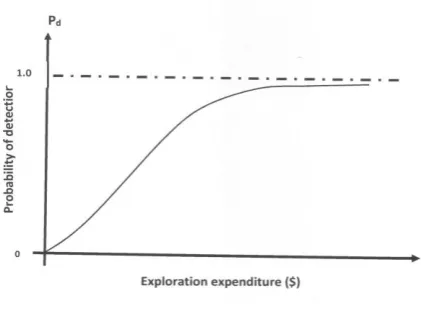
Figure 2. Probability of detection versus exploration expenditure
It can be observed that initially, the probability of detection rises rapidly with increments in exploration expenditures. However at some point, diminishing returns set in resulting in large expenditures with ever decreasing improvements in the probability of detection until it reaches its maximum value of unity. Given the nature of gemstone deposits, budgets for gemstone exploration to ensure a high probability of success can be expected to be considerably higher that with other minerals, a fact which renders detailed exploration of gemstones economically unjustified. Because of this factor, it is usually not possible to establish any significant amount of reserves with a reasonable level of confidence. This leads to inability to develop convincing bankable documents necessary for raising capital from traditional financial banking systems. Gemstone mining is largely concentrated in DCs. The estimation of actual gemstone production remains one of the most difficult areas in the study of the world gemstone sub-sector, since as previously mentioned, significant quantities are mined and traded illegally. Both open-pit and underground mining techniques are used. Where gemstone pockets are close to the surface, open-pit mining methods are used. This is the most commonly applied mode of operation in gemstone mining. In the case where deposits are deep-lying, simple underground mining methods are employed. Mining operations range from the very simple manual labor-intensive methods to highly mechanized methods. In the case of submerged placer deposits, the river may be diverted to drain the bottom. Otherwise dredging is commonly used. Following the mining operation, gemstones may undergo some downstream processing. The most important value added activity in downstream processing is lapidary work involving the cutting and polishing of gemstone materials and jewelry making. With the exception of a few countries such as India, Sri Lanka, Thailand and Brazil, most DCs do not have a developed lapidary sector and export rough stones. The major cutting centers of colored stones of high value are located in Germany, Israel, Thailand, Sri Lanka, USA, India, France and Russia. China and Japan are world reknown for cutting jade and other non-transparent materials. Marketing channels for colored gemstones are totally different from those of gem diamond or other minerals. Gem diamond has been synonymous with De Beers. For most of the twentieth century, the diamond market was entirely controlled by De Beers. The cartel controlled over 90 percent of world’s supply of diamonds
largely from its own sources. Once De Beers had control of global supply, it could keep prices stable by stockholding rough diamonds during a weak market and then releasing them once demand increased. This total control of the industry meant that De Beers set diamond prices. However, with the arrival of new but significant supplies of diamonds from Russia, Canada and others, the monopoly was destroyed (https://www.diamondspot.com). Today diamond prices are driven largely by supply and demand. Current De Beers market shares is estimated to have dropped to about 33 percent through its Diamond Trading Company (DTC). See figure 4.
Figure 4. Global supply of diamonds. Source Ziminsky P (2014)
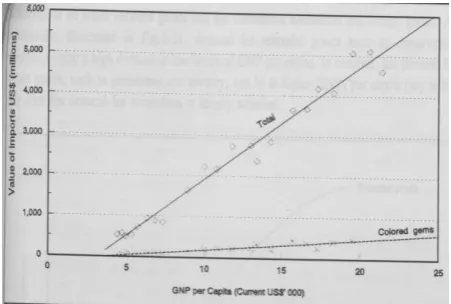
Figure 3. US imports for consumption of gemstones between 1970-1990.
In this figure, total value of US import for consumption includes diamonds (rough and cut but set), emeralds, (cut but set), coral (cut but unset and cameos suitable for use in jewellery), rubies and sapphires (cut but set), marcasites, pearls (natural, cultured, and imitation, synthetics (cut but set), imitations and other precious and semi-precious gems (rough, cut but unset). A strong positive correlation is also observed between the GNP per capita and gemstone consumption. From the same study of the USA market, it is further observed that the consumption of gemstones which are essentially luxury goods, sets in at elevated GNP per capita levels. These are important observations which can be used to predict future demand and new potential gemstone markets. Based on this investigation, it can be expected that the future economic performance of high income countries will be an important factor in determining the strength of future demand for gemstones. In addition, growth in demand can be expected in upper-middle income economies with high GNP per capita growth rates. Only in these countries will the GNP per capita reach levels that trigger the demand for gemstones in the medium term. With regard to the global supply pattern, no radical shifts are expected in the foreseeable future with most of production of natural gems coming from DCs.
Policies and Analysis of Constraints
The third element in the study, involved the analysis of policies and the identification of sub-sector constraints. Based on their origin, gemstone sub-sector constraints can be segmented into two categories, namely, (i) external constraints that influence the environment in which the sub-sector operates, comprising of economic and mineral resource policies, and (ii) structurally inherent constraints, such as high geological risks, financial, business management and technology constraints. Mineral resource policies (MRP) are part of the overall national economic policies. Constraints are essentially due to their poor design and promotional quality. If for instance, the national economic policy does not recognize the importance of promoting value addition, then significant social and economic benefits, are lost to foreign markets. Major issues associated with MRP are due to poor design and promotional capacity. Access to mineral rights most often are problematic. The major problems associated with mineral rights have included: (i) the difficulty in securing permits; (ii) rights have not been readily transferable; and (iii) licenses have been of unreasonable duration. Small
deposits that can be exploited profitably by small scale miners, have been neglected. This is evident from the sub-Saharan mining sector experience which comprises of large-scale mining operations on one end of the large-scale and numerous unregistered artisanal mining operations on the other. There is the “missing middle” comprising of formal small to medium-scale operations. The other important aspect of the MRP concerns the poor quality of institutional framework support due to lack of adequate operational budgets from the government. Therefore, the burgeoning small-scale mining sector is constrained from making meaningful economic contribution by the lack of appropriate mineral legislations and an inadequately resourced institutional support required to deal with the demanding task of supervising and monitoring many small miners.
Policy and Strategy Options
limited capabilities of small operators. With regard to the
overly sensitive area of gemstone marketing, the only economically efficient way to improve market access and eliminate illegal trading practices, lies in the establishment of a free and open market, accompanied by a market based foreign exchange rate policy. In countries where gemstone production and trading is significant, dealers must be encouraged to establish gemstone exchanges where all matters related to buying, valuation and export, can be conducted. Recognizing the high geological risk associated with gemstone mining, options that minimize investment risks are important. Equipment leasing is one of the most practical approaches. The concept behind this option is to make capital mobile and not tied to any one project. This can also be encouraged through the formation of cooperatives where scarce resources, risks and responsibilities can be shared. Drawing on the parallel experiences from specialized banks of other sectors of the economy, such as agriculture, gemstone trading banks can also be established. They would primarily offer facilities to gemstone dealers for the purchase and export of gemstones. The bank can also provide credit lines to less risky lapidary and jewelry industry for equipment and working capital. The technology constraint typical of the sub-sector is a combined result of two factors, i.e., the lack of finances and the lack of technical and business management skills. Some financing options have already been discussed. The obvious remedy for improving the operational skills of miners is through extensive and ongoing training programs in the form of regular short courses under the auspices of miners associations. Further, the grant of mineral rights should be made conditional upon providing proof of technical competence. In addition, field consultancy services could be provided at affordable rates by the authorities. One of the key factors in the successful implementation of a MRP is the quality of the institutional framework support. Improving the promotional capability of the mining authorities will require that (i) institutions must have adequate professional resources including the right composition of mining engineers, geologists and gemologists with operational experience, (ii) motivated staff with a competitive remuneration scheme be put in place, (iii) an adequate travel budget and transport vehicles for inspection visits be provided, (iv) a SSM unit to deal with specific problems of small miners be established in cases where the sub-sector is significant, and (v) the establishment of field offices in high density mining areas. The lack of finances is usually the major cause of poorly motivated and inadequately resourced institutions. Government, which is the source of finances must recognize that it is only through a high promotional quality of the mining authorities that the sub-sector will be strengthened, monitored and put in a better position to contribute to the treasury. The resulting enhanced contribution of SSM to economic development, will provide the justification for government commitment. Although the downstream processing of gemstones has not received much attention by most producers in DCs, manifested by exportation largely of rough materials, it is the most important factor for increasing economic benefits from the sub-sector in terms of a higher social surplus and creating employment. Already, there are a number of limited initiatives in Tanzania (Kenya and Zambia to develop their lapidary industries. However, given the lack of lapidary skills in
most DCs, it is apparent that strategies must focus on the massive training of nationals in this craft. This must be accompanied by the availability of financial assistance for the acquisition of processing equipment and working capital. In an effort to improve the provision of lapidary skills, the Zambian government in 2005 established the Gemstone Processing and Lapidary Training Center (GPLTC) under the Ministry of Science Technology and Vocational training in Ndola (. An assessment of its performance so far indicates declining standards due to poor government funding and lack of policy for value addition in the sector while both Tanzania (Branstrator, B, 2016) and Kenya (Njugunah M, 2017) have made announcements that within the next few years ban the export of gem-quality rough. Rather, the gemstones will be cut before leaving the country in an effort to add value to the stones and boost the economy. Kenya hopes to make Nairobi a gold and gemstones processing centre by offering tax incentives to importers of minerals from across East Africa.
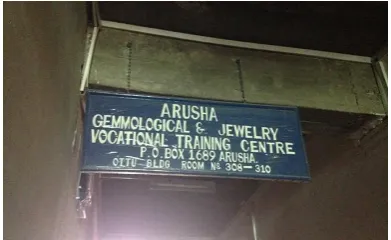
Figure 4. Gemmological and Jewelry Vocational Training Centre in Arusha, Tanzania
Figure 5. Students at Gemstone Processing and Lapidary Training Centre in Ndola, Zambia.
firms of partnerships must be encouraged to form
associations. This must extend to the usually small numbers of lapidary and jewellery companies that may exist. The main objectives of associations are to represent the sub-sector group interest vis-a-vis authorities and promote the interests of its members.
Conclusions
It is quite evident from the above discussion that the gemstone sub-sector has the potential to drive the economies of DCs once the inherent constraints are resolved. The proposed model suggests some of the general strategies that could assist in achieving this goal. Of course, individual countries may have unique problems that may require a refined approach.
References
[1]. Barreto L.M, Hinton J and Hruschka F (2018), “The Impact of Small-Scale Mining Operations on Economies and Livelihoods in Low- to Middle-Income Countries”. Publication by East Africa Research Fund (EARF), Pact Global UK.
[2]. Branstrator B (2018), T.I.A., Part 3: East Africa’s Changing Gemstone Market.
[3]. Gavin H (2002), “Small-scale mining and its socio-economic impact in developing countries”, Natural Resources Forum 26 (2002) 3–13
[4]. Hentschel T, Hruschka F, Priester M (2003), “Artisanal and Small-Scale Mining Challenges and Opportunities”, International Institute for Environment and Development and WBCSD, Russell Press Ltd, Nottingham, UK ISBN 1 84369 470 0
[5]. Hilson G (2002), “Small‐scale mining and its socio‐economic impact in developing countries”. Natural Resources Policy, Vol. 26, Issue 1, February 2002, pp3-13.
[6]. Kambani S., (2003), “Small-scale Mining in Zambia”. The Socio-economic Impacts of Artisanal and Small-scale Mining in Developing Countries. Edited by Gavin M. Hilson, ISBN: 90 580 9615 7, A.A.Balkema Publishers. A World Bank publication.
[7]. Krzemien K (2018), “De Beers – how did the diamond monopolist lose its position?”Jewellery and other products
[8]. Mihaye J, (2013), “Small-Scale Mining Operations and their Effects in the East Akim Municipal Assembly”. Thesis (MPHIL)-University of Ghana, 2013
[9]. Njugunah M (2017), “Kenya to export polished gemstones through new value addition centre”.
[10]. Ziminisky P (2018), The End of the De Beers Monopoly. https://www.diamondspot.com
[11]. Ziminsky P (2014), The Separation of Power (or lack thereof?) in the Rough Diamond Industry,