DOI: 10.14738/abr.81.7692.
Salvi, V. Z. (2020).Supermarket Global Supply Chain. Archives of Business Research, 8(1), 192-201.
Supermarket Global Supply Chain
Vinicius Zomkowski Salvi
EXECUTIVE SUMMARY
Successful business depends on successful internal and external Supply Chain. From company requirements to tier supplier relationship, companies want to gain and keep customers. This article studied Supermarket supply chains. It tried to find positive and negative attributes, it did a gap analysis of those attributes and it dedicated deeply in techniques of integration and synchronization such as VMI, ECR and CPRF to prove the importance of a successful supply chain management.
It was got 14 positive and negative attributes such as POS data, collaborative planning, collaborative and automatic replenishment, controlled inventory and developed logistics tools as cross docking, third parties, and RFID. Negative attributes can be, for instance, a complexed logistics operations and difficulties in implementing synchronization.
INTRODUCTION
A successful business depends on a successful internal and external Supply Chain Management. Every project or routine, for instance, starts with a good plan, better if it is an integrated plan (inside the company) or even better if it is a collaborative plan (done with tiers), and best practice if it is internal and external plan with collaborative information sharing- applying the finest Supply Chain techniques and avoiding the Bullwhip Effect, that last one treated for example in (Lu et al, 2016).
Therefore, successful business companies struggle for achieving sales and getting the wishing profit. To obtain that they utilize tiered supplier’s partnership, good company requirements for achieving and sustaining customers. It because tiered suppliers allow organizations to compete between supply chain networks, guaranteeing core competitive advantages such as low cost, sustainability, traceability, customer satisfaction and premium quality beyond company’s borders. Good company requirements permit assertively buying and to acquire correct is essential for delivering end-consumer value.
Supermarkets have been becoming more powerful than industries in a Supply Chain Network relationship (Marion, 1998). The private label is passing to retailers the possibility to communicate and interact with their customers, using POS (point of sale). The positioning of retail expresses itself in such a way that allows retailers to manage one of the most important information in a chain, the end-consumer demand profile. Requirements from supermarkets are turning into real time big data which can transform completely the way of doing business by supermarkets, together with tier virtual supplier relationship.
Then it shows improvement gaps between evaluation and implementation of attributes of supermarket supply chains. Finally, it brings an analyze of solving problems through multinational global issues and applied techniques (CPFR, VMI and ECR).
SUCCESSFUL AND UNSUCCESSFUL CHARACTERISTICS IN SUPERMARKETS
Supermarkets as Walmart, Carrefour, Aldi, Lidl, Tesco and Mercado have passed from competition to a great multinational battle, especially in Europe. International agreements have been created free trade zones since 1990’s. After NAFTA was signed, for instance, Walmart intensified its expansion to Mexico and Canada (Hunt, Watts and Bryant, 2018).
That battle generated developments, together with the introduction of high information technology. It turned point of sales knowledge one of the most important characteristics of a supermarket successful. Walmart, for example, sharing knowledge about local consumer preferences with Pfizer (Lee, 2000, cited in Zhang, Gunasekaran and Wang, 2015). It enables the supermarket to influence the whole chain by given the demand quantity through real time control at POS. However, the POS has not used all its potential. Alftan et al (2015) commented that many groceries do not know what to do with produced data. Therefore, POS has a positive and a negative attribute associated with.
Collaborative Planning, replenishment, and inventory control became important features used by a modern Supermarket Supply Chain, during that battle commented above. Vendor managed inventory – VMI, Collaborative Planning, Forecasting and Replenishment – CPFR, and Efficient Consumer Response – ECR give some examples of supply chain collaboration (Panahifar et al, 2018). Pramatari and Doukidis (2007) commented Vilapoulos, a Greek supermarket, utilizes ECR. The same authors introduced concept of PCSO (Process of Collaborative Store Ordering), characterizing it as CPFR, but for store levels.
However, especially national companies have had difficulties in implementing those tools. It is due to some points cited by Fliedner (2003) who was exemplifying CPFR complications, but those impediments are also valid to VMI and ECR: “Lack of trust on sharing sensitive information, fragmented information sharing standards, and fear of collusion”. There are more three points when it intends to advance to planning and forecast: “lack of internal forecast collaboration, aggregation concern (number of forecast and frequency of generation), and availability and cost of technology”. It can be affirmed that supply chain collaboration of planning, replenishment and inventory also have positive and negative attributes. Positive is the implementation of those techniques, and the negative is it can be hard to implement those.
Figure 1: Causes of Out-of-Stock (OOS) - Wordwide Averages.
Source: Grun et al (2002) cited in Pramatari and Doukidis (2007)
Traceability and trackability are important subjects to groceries, they are a positive attribute. Once retailers command the distribution chain, it is considerable essential to have information since the origin, also emitting data indeed to end consumer. Figure two demonstrates tracing and tracking in a retail supply chain. Reuters (2018) presented that Carrefour provides traceability to consumers using blockchain. “Consumers can use a smartphone to scan a code on the package” and see where “honey, eggs, cheese, milk, orange, tomatoes, salmon and hamburger” came from, also passing relevant information to final consumer. It is even more important now because Europe has passed, for instance, through a scandal about horse meat (Sarpong, 2014)
Figure2: Tracking and Tracing. Source: Sarpong, 2014
Some supermarkets such as Tesco have less private label (PL) SCR (share of category requirements) than others such as Aldi which have excess of, Dawes (2013). Private Label is classified as positive attribute, once it allows supermarkets to control and coordinate the supply chain, guaranteeing accurate requirements, incisive participation of tier suppliers and winning shopping from end consumer, especially in time of crisis. Hard discounters have almost 90% of its goods PL and soft discounter almost 50% (Lamey, 2014), in crisis both kind of grocery have been growing a lot.
Supermarket logistics has as bad point the transport from suppliers to supermarkets. It has long opportunities for being optimized by using retailer load, letting supplier produce Free on Board (FOB) – Fernie and McKinnon (2003). Cross-docking, Transport management system, warehouse management system, labor management system, outsourcing and 3PL are great tools in logistics (Lund and Wright, 2003). Logistics works well in a deeply complexity. “Rising number of products and parts, rising product variety, reducing product life cycle” (Sternberck and Kuhn, 2013).
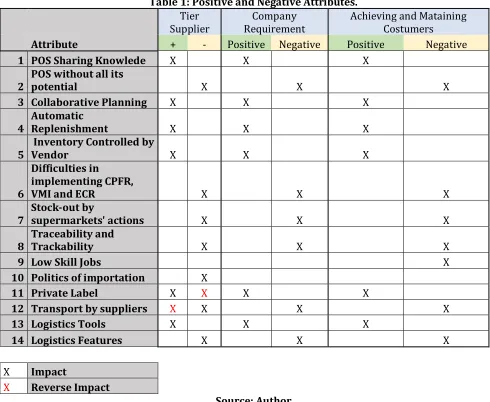
Table one resume the positive and negative attributes, showing where they affect the tier suppliers, the company requirements, achieving and sustaining costumers.
Table 1: Positive and Negative Attributes.
Supplier Tier Requirement Company Achieving and Mataining Costumers
Attribute + - Positive Negative Positive Negative
1 POS Sharing Knowlede X X X
2 POS without all its potential X X X
3 Collaborative Planning X X X
4 Automatic Replenishment X X X
5 Inventory Controlled by Vendor X X X
6
Difficulties in
implementing CPFR,
VMI and ECR X X X
7
Stock-out by
supermarkets' actions X X X
8 Traceability and Trackability X X X
9 Low Skill Jobs X
10 Politics of importation X
11 Private Label X X X X
12 Transport by suppliers X X X X
13 Logistics Tools X X X
14 Logistics Features X X X
X Impact
X Reverse Impact
GAPS BETWEEN EVALUATION AND IMPLEMENTATION
Gap Analysis was built from those above 14 attributes (see table 1). It was generated a graphic, using a systematic score from 0 – low importance to 10 – strong importance, and from 0 – bad performance to 10 - good performance of each attribute. Position one on graphic shows concentrates here, position two maintain performance, position three not important and position four Possible Overkill. (Martilla and James, 1977). See graphic one which shows results of each attribute.
Graphic 1: Importance X Performance - Gap Analysis.
Source: Martilla and James (1977)
It will be started critically commenting the Maintain Performance and the Concentrate here attributes. It is possible to conclude that if a supermarket has POS sharing, implemented well logistics tools, got an inventory controlled by vendor, a collaborative planning and an automatic replenishment, it sounds impossible it also has stock-out by supermarket`s actions, difficulties in implementing CPFR, VMI and ECR and do not lead satisfactorily complex logistics features. However, a supermarket has lots of categories. Whilst beverages, for instance, uses some of those positive attributes in leading supermarkets, chicken and pork let it be done emphasizing lots of negatives attribute (Salvi, 2014). Those facts are limitation of this research which indicates for further researches a Gap Analysis by categories.
If a Supermarket has categories with Maintain Performance characteristics, those categories should be readier for Corporative Social Responsibility (CSR), Sustainability, E-commerce and Retail 4.0, because they already use positive attributes. CSR and Sustainability of food supply chains have been studied by many scholar (Govidan, 2018), (Validi, Bhattacharya and Byrne, 2014) and (Sgarbossa and Russo, 2017), and now it is gaining power once costumers are becoming to accept paying more for sustainable or social responsible products. It means that supermarkets with cited characteristics can have as Concentrate Here, the CSR, Sustainability, E-commerce and Retail 4.0.
Other categories of supermarkets in maintain performance are shampoo, blade, dental cream, deodorant provided by P&G to Walmart. Swami and Shah (2011) helps with this example and the arguments used in last paragraph given P&G and Walmart a studied case of green supply chain due to size of package and shelf-space allocation optimization between them.
Beyond categories, performance is also different between countries. Corporate Social Responsibility in Lidl, for example, is diverse in each country. Whilst it is a Lidl’s public campaign in Croatia, it lacks evidences of use in UK by Lidl (Topic and Tench, 2016). It is another limitation of the gaps presented above. It used a general positive and negative attributes classification and it can be further researched, using countries gap analysis. Another example is done comparing Norway and France, France is concerned with plastic bags replacement while Norway sounds to be less committed with. (Loussaief et al, 2018).
Although there are two important limitations - analysis by category and analysis by country or at least regions of the globe, the gap analysis proposed has a good result once it can be seen some positive and negative attributes of supermarkets divided by squares of relevance and importance. It enables to think about evaluation and implementation, great supermarkets are starting to be compromised with CSR, sustainability and others, because most part of their categories have implemented integrated supply chain techniques, POS data used and others.
CPRF, VMI and ECR are tools that provide Collaborative Planning an Forecast (CPFR), auto replenishment (ECR, VMI and CPFR) and managed inventory by suppliers (VMI and CPFR). As I said above, those are positive attributes that must be maintained. Because of it, next topic will bring a deep analysis of those tools, giving examples of applications between countries around the globe and providing better knowledge about it.
SOLVING PROBLEMS THROUGH GLOBAL SUPERMARKETS AND APPLIED TECHNIQUES
As it was said above, this article shows CPFR, VMI and ECR utilization across globe to cite some applied techniques able to solve supermarkets’ problems. This article brought ECR in three countries Japan, Germany and Australia, three developed countries in the early 2000, it shows VMI developments in the food supply chain, and finally, it presents CPFR as an evolution of VMI and ECR. Those techniques are important to reduce inventory, create a integrate planning, generate a better and synchronized supply chain.
In Australia, Grocery was in the early stage of implementation of ECR until 2003. Six points was emphasized by a case study: “lack of understanding ECR, Retailers lead manufactures in ECR adoption, retailer and manufactures have different interests and perceptions, retailers experience more benefits than manufacturers, retailer are more powerful than manufactures, and lack of cooperation and trust” (Kurnia and Johnson, 2003). It is probable that the number of supermarkets and companies have risen with development of information technology.
It was a complete successful in Germany, 84,5% of big groceries implemented ECR until 2002. However, the same research also showed that this number dropped when it was Small and Medium (SME) size groceries to 51,2%, but it keeps being a good number compared to Australia and Japan. Reasons for not adopted ECR by big groceries and for SME groceries were showed in figure 3 bellow. (Borchert, 2002).
Figure3: The five most important Reasons.
Source: Borchert, 2002
Europe is considered the most mature market in the world. Maybe there is a correlation with the sophistication of retail and supplier relations, and the precision in the company’s requirement to be this most mature market. It is a theme for a new research. ECR is a technique able to reduce stock-outs, reduce costs of replenishment, implement category management, and continuous planning, helping with the bullwhip effect.
VMI is another technique which transfers to vendor the management of retailer’s stock with automatic replenishment, it is well-done with POS sharing data from supermarkets (Lee, Cho and Paik, 2018). It allows reduction in transaction costs, volume of stock, stock-out and others. Dorling, Scott and Deakings (2006) said that are three points determinants to successful of VMI “developing long-term relationships, investing in supply chain technology and adopting supply chain best practice are the means of achieving increased industry profitability”.
product/market. Danese (2007) also gave an example of integration of Walmart, P&G, Unilever, Henkel, Kraft, Sainsbury’s and others, using CPFR.
In the same way, CPFR can be considered an evolution of VMI too Kumar (2006). Panahifar et al (2015) showed “Collaborative replenishment spreads replenishment activities across the supply chain and facilitates collaborative inventory management in operations”. This article affirmed that CPFR is the most advanced technique of integration and synchronization. In the beginning of 2000’s, it sounds that the maturity of Europe continent allowed to spread quicker the ECR, it was opposite of Japan and Australia. But now, lots of companies such as Unilever, P&G, Heineken and Sunbury’s implemented CPFR in different operations across the globe, especially in developed markets. Those two affirmations, developed markets and mature markets must be further researched.
CONCLUSIONS
It was proved that successful supply chain management defines successful business once it was showed positive and negative attributes of supermarkets. Some of positive attributes were classified in Maintain Here square and allowed categories and countries with those characteristics try to reach sustainability, e-commerce, retail 4.0 and other decisions of this fourth industrial revolution.
Limitations were found in my research. It cannot guarantee that positive and negative attributes are equal to all categories and in all countries, an initial literature review appointed to differentiation in market/product. It was also a limitation of scope to define CPFR in developed and in developing countries. Preliminary information gives the feeling that developed countries spread quicker positive attributes.
In a business conclusion, tier suppliers and company requirements turn a supermarket more competitive. POS, VMI, ECR, CPFR and other are not only letters, they represent important global techniques that allows to reduce stock-out, reduce costs and improve relations with final costumer.
References
Alftan, A., Kaipia, R., Loikkanen, L. and Spens, K. (2015). Centralised grocery supply chain planning: improved exception management. International Journal of Physical Distribution & Logistics Management, 45(3), pp.237-259. Blackwell, C., Wasas, J., Flanagan, S., Norman, B. and Haight, J. (2016). Grocery shelf stocking tool: analysis of productivity and human factors. International Journal of Productivity and Performance Management, 65(4), pp.554-570.
Borchert, S. (2002). Implementation hurdles of ECR partnerships – the German food sector as an ECR case study. International Journal of Retail & Distribution Management, 30(7), pp.354-360.
Danese, P. (2007). Designing CPFR collaborations: insights from seven case studies. International Journal of Operations & Production Management, 27(2), pp.181-204.
Dawes, J. (2013). Reasons for variation in SCR for private label brands. European Journal of Marketing, 47(11/12), pp.1804-1824.
Dreamstime (2018). Supply Chain Management. Available at: https://www.dreamstime.com/stock-illustration-supply-chain-management-chart-keywords-icons-image49270619. Last Accessed: 26/08/2018
Dorling, K., Scott, J. and Deakins, E. (2006). Determinants of successful vendor managed inventory relationships in oligopoly industries. International Journal of Physical Distribution & Logistics Management, 36(3), pp.176-191. Fernie, J. and McKinnon, A. (2003). The grocery supply chain in the UK: improving efficiency in the logistics network. The International Review of Retail, Distribution and Consumer Research, 13(2), pp.161-174.
pp.14-Govindan, K. (2018). Sustainable consumption and production in the food supply chain: A conceptual framework. International Journal of Production Economics, 195, pp.419-431.
Hollmann, R., Scavarda, L. and Thomé, A. (2015). Collaborative planning, forecasting and replenishment: a literature review. International Journal of Productivity and Performance Management, 64(7), pp.971-993.
Hunt, I., Watts, A. and Bryant, S. (2018). Walmart’s international expansion: successes and miscalculations. Journal of Business Strategy, 39(2), pp.22-29.
Kumar, A. (2006). Implications Of Collaborative Planning, Forecasting, And Replenishment In Supply Chain Management. Paradigm, 10(1), pp.21-25.
Kurnia, S. and Johnston, R. (2003). Adoption of efficient consumer response: key issues and challenges in Australia. Supply Chain Management: An International Journal, 8(3), pp.251-262.
Lamey, L. (2014). Hard economic times: a dream for discounters. European Journal of Marketing, 48(3/4), pp.641-656.
Lee, J., Cho, R. and Paik, S. (2018). Supply chain coordination in vendor-managed inventory systems with stockout-cost sharing under limited storage capacity.
Lohtia, R., Xie, “. and Subramaniam, R. (2004). Efficient consumer response in Japan. Journal of Business Research, 57(3), pp.306-311.
López-González, A., Lois-González, R. and Fernández-Casal, R. (2013). Mercadona (Spain): a retail model in expansion. International Journal of Retail & Distribution Management, 41(1), pp.6-26.
Loussaïef, L., Cacho-Elizondo, S., Pettersen, I. and Tobiassen, A. (2018). Do CSR actions in retailing really matter for young consumers? A study in France and Norway.
Lu, J., Feng, G., Lai, K. and Wang, N. (2016). The bullwhip effect on inventory: a perspective on information quality. Applied Economics, 49(24), pp.2322-2338.
Mao, R. and Zhang, B. (2015). Export Destination and Export Market Penetration of the People's Republic of China—Past and Future. Asian Development Review, 32(1), pp.142-166.
Marion, B. (1998). Changing power relationships in US food industry: Brokerage arrangements for private label products. Agribusiness, 14(2), pp.85-93.
Martilla, J.A. and James, J.C., “Importance-Performance Analysis”, Journal of Marketing, January 1977 Panahifar, F., Byrne, P., Salam, M. and Heavey, C. (2018). Supply chain collaboration and firm’s performance. Journal of Enterprise Information Management, 31(3), pp.358-379.
Panahifar, F., Heavey, C., Byrne, P. and Fazlollahtabar, H. (2015). A framework for Collaborative Planning, Forecasting and Replenishment (CPFR). Journal of Enterprise Information Management, 28(6), pp.838-871. Pramatari, K. and Doukidis, G. (2007). New Forms of Collaboration and Information Sharing in Grocery Retailing. International Journal of Cases on Electronic Commerce, 3(4), pp.73-86.
Reuters (2018). Retailer Carrefour using blockchain to improve checks on food products. Available at:
https://www.reuters.com/article/carrefour-blockchain/retailer-carrefour-using-blockchain-to-improve-checks-on-food-products-idUSL5N1QO2YW. Last Accessed: 25/08/2018
Roos, G. and Shroff, Z. (2017). What will happen to the jobs? Technology-enabled productivity improvement – good for some, bad for others. Labour & Industry: a journal of the social and economic relations of work, 27(3), pp.165-192.
Salvi, V. Z. (2014). Analysis of Integration and Synchronization Between Supermarkets and Frozen Food Industry. Master’s Degree. Santa Catarina Federal University.
Sarpong, S. (2014). Traceability and supply chain complexity: confronting the issues and concerns. European Business Review, 26(3), pp.271-284.
Sgarbossa, F. and Russo, I. (2017). A proactive model in sustainable food supply chain: Insight from a case study. International Journal of Production Economics, 183, pp.596-606.
Swami, S. and Shah, J. (2011). Channel Coordination in Green Supply Chain Management: The Case of Package Size and Shelf-Space Allocation. Technology Operation Management, 2(1), pp.50-59.
G. Sternbeck, M. and Kuhn, H. (2014). Grocery retail operations and automotive logistics: a functional cross-industry comparison. Benchmarking: An International Journal, 21(5), pp.814-834.
Topić, M, & Tench, R. (2016). The corporate social responsibility in Lidl’s communication campaigns in Croatia and the UK. The Qualitative Report, 21(2), 351-376. Retrieved from http://nsuworks.nova.edu/tqr/vol21/iss2/11 Uusitalo, O. and Rökman, M. (2004). First foreign grocery retailer enters the Finnish market—a stakeholder model. Journal of Retailing and Consumer Services, 11(4), pp.195-206.
Validi, S., Bhattacharya, A. and Byrne, P. (2014). A case analysis of a sustainable food supply chain distribution system—A multi-objective approach. International Journal of Production Economics, 152, pp.71-87.
Zhang, C., Gunasekaran, A. and Wang, W. (2015). A comprehensive model for supply chain integration. Benchmarking: An International Journal, 22(6), pp.1141-1157.