Published online December 18, 2014 (http://www.sciencepublishinggroup.com/j/aff) doi: 10.11648/j.aff.20140306.13
ISSN: 2328-563X (Print); ISSN:2328-5648 (Online)
In vitro germination and direct shoot induction of Yeheb
(Cordeauxia edulis Hemsl.)
Yohannes Seyoum
1, Firew Mekbib
2, *1
Dry land Crop Research Department, Somali Region Pastoral and Agro-pastoral Research, Jijiga, Ethiopia
2
School of Plant sciences, Haramaya University (HU), Dire Dewa, Ethiopia
Email address:
[email protected] (Y. Seyoum), [email protected] (F. Mekbib)
To cite this article:
Yohannes Seyoum, Firew Mekbib. In Vitro Germination and Direct Shoot Induction of Yeheb (Cordeauxia Edulis Hemsl.). Agriculture,
Forestry and Fisheries. Vol. 3, No. 6, 2014, pp. 452-458. doi: 10.11648/j.aff.20140306.13
Abstract:
‘Yeheb’ (Cordeauxia edulis Hemsl) is a multipurpose and evergreen shrub and endemic to southeastern corner ofEthiopia and Somalia. It is adapted to low and irregular rainfall and survives a very long dry season. It has enormous economic and food security role to the pastoralist of Somali in Ethiopia. However, the plant is threatened with extinction due to overexploitation and its’ poor natural regeneration capacity. In addition, ‘yeheb’ is usually reported having limited reproductive capacities and often have very specific and limited conditions for seed germination, flowering and seed shelf life. Therefore, to overcome these propagation challenges, an experiment was conducted with the aim of developing a protocol for the in vitro regeneration of ‘yeheb’ from cotyledonary node. The result of these studies revealed that seed was washed by 5% sodium hypochlorite for ten min in aseptic condition found to be more effective in surface sterilization. The sterilized seed cultured on half strength of Gamborg (B5) medium was found to be the most suitable medium for germination (26.67%).The highest shoot initiation percentage (89 % of explants produces shoots), number of shoots per explant and number of leaf per shoot were obtained from cotyledonary node explants cultured on Murashige and Skoog (MS) media supplemented with 2.00 mg. l-1 N6-benzylaminopurine (BAP) within nine weeks. While, the highest shoot length and shoot fresh weight were recorded from control (free BAP) and 6.00 mg. l-1 BAP, respectively. The highest shoot multiplication (4.56 number of shoot induced) and elongation (2.97cm) were obtained from the induced shoot were cut and placed on MS media supplemented with 2.00 mg. l-1BAP+6.00 mg. l-1of gibberellic acid (GA3) and free BAP+6.00 mg. l-1 of GA3, respectively. The elongated shoots were
transferred to different media supplemented with various types and levels of hormones but none of them induced root. As a conclusion, this is the first attempt for direct in vitro regeneration of C. edulis and permissible result for cryopreservation.
Keywords:
BAP, Cotyledonary Node, Germination, In Vitro, GA3 Shoot Induction, Shoot Elongation1. Introduction
Cordeauxia edulis Hemsl, belongs to the family Leguminosae and the subfamily Caesalpinioideae and is
locally known as ‘Yeheb’ [1]. It is among the most important edible wild food plants in Ethiopia [2]. It is a multi-stemmed ever green shrub or small tree up to 2.5 m height, and is endemic to restricted localities in eastern Ethiopia and parts of central Somalia [1 and 3].
The shrub thrives well in frost-free climatic conditions with 28 ºC of mean annual temperature with two rainy seasons; one more reliable in March-May and another one in October–November, gives an annual rainfall of 85-400 mm [4]. The species has resistance to normal drought periods of 4-5 months, and up to 10-15 months in irregular drought
periods [5 and 6].
supplement in an area poor in protein supply [7]. It constitutes the staple food of the pastoralist of Somali region in Ethiopia. Moreover, the nut is sold on the market and even exported to the coastal cities of Somalia.
Another major use of the species is its contribution of up to half of the biomass in the area that makes it important dry season browse to camel and goat. The estimated average forage production is 325-450 kg ha-1 (1.4-2 kg/plant) [8]. Fodder value of the leaves is comparable to other tropical tree legumes but some mineral levels (P, Mg, Mn and partly Zn) would not satisfy the demands of animals if ‘yeheb’ were the only source of fodder [4]. Leaves have been used to dye cloths, calico and wool, since the cordeauxiaquinone forms vividly colored and insoluble combinations with many metals [9].
Even if the species has such and many other uses and has a potential to play a role in ensuring food security in the region, the plant is threatened with extinction due to overexploitation of the shrub by long term heavy grazing pressure, harvesting of seeds, cutting and fire. In addition, erosion, drought and war in the region has led to poor or none natural regeneration [9, 10, and 11].
Some Reference [5 and 12] reported the decline and progressive destruction of the stands of C. edulis due to over grazing, and recommended protection from use of the plant. Likewise [4] reported that C. edulis plant is in great danger of extinction and speedily narrowing distribution area because of the increase in population and their herds. Unlike many other plants, yeheb shrubs flowers just before the onset of rains and the seeds mature when the plant moisture content is at its peak [8]. Yeheb seeds have been reported not to retain viability for more than a few months, even if they are stored under ideal conditions and the recommendation has therefore been to sow them immediately [13 and 14].
Studies on C. edulis seed storage behavior and germination indicated characteristics of intermediate storage behavior and 70-84% of germination when seed moisture is above 24%, and achieved a germination percentage of 58% and 41% when seed moisture content was 12.3% and 9.6%, respectively [13]. Acid treatment (Gibberellic acid and Potassium nitrate) tests did not indicate a positive result for seed germination. The same author studied the desiccation tolerance of ‘Yeheb’. The results indicated that germination percentage was dependent on seed moisture content, i.e., there was a reduction in germination percentage from 70 to 57.5% when seed moisture content dropped from 24.4 to 12.3%. Further drying to 9.6% moisture content reduced germination percentage even less than 41.3%.Some pilot studies had been made regarding vegetative propagation but so far without greater success [14]. Due to poor germination and death of young seedlings under natural conditions, propagation through seeds, as with most leguminous trees, is unreliable. Hence, rapid in vitro propagation method is required for mass production of healthy and excellent C. edulis planting materials to rehabilitate the ecology of ‘Yeheb’ grown area and save the species from extinction. On the contrary, there is no cost effective in vitro regeneration protocol developed for C. edulis mass production anywhere. Therefore, it is imperative to develop and/or
optimize a tissue culture protocol for effectively and efficiently carryout in vitro regeneration and mass multiplication of C. edulis for regeneration of the species to maintain the ecology and enhance its economic importance. Thus, the objective of this study was to develop a protocol for the in vitro germination and shoot induction of C. edulis.
2. Materials and Methods
2.1. Description of the Experimental Area
The experiment was conducted at the Plant Biotechnology Laboratory of Holetta Agricultural Research Center (HARC). The center is located 29 km west of Addis Ababa at an altitude of 2400 meter above sea level, 90 00’N latitude, 380 30’E longitude.
2.2. Experimental Material
As the shrubs did not produced seed during the experimental period due to recurrent moisture stress in the region, the seeds that were full size and dried were collected from local market of ‘Boh’, Warder Zone of Somali regional state in June, 2011. Healthy seeds were selected carefully and used as explants for this study.
2.3. Explant Sterilization Experiment
The seeds used for this experiment were washed with 30g l-1 kocide under running tap water for different duration (thirty and sixty min) and used as treatment. This was followed by immersing 70% (v/v) ethanol for three min, and later rinsed three times (three min each) with sterile distilled water. After sterilization, seeds were soaked in sterile distilled water for twelve hours. The seed coats were then removed and subjected to surface disinfection with 5.00 % sodium hypochlorite for different duration (5, 8, 10 and 15 min) also used as treatment, and then rinsed three times (three min each ) with sterile distilled water.
2.4. Germination Induction Experiment
2.5. Direct Shoot Regeneration Experiment 2.5.1. Shoot Induction
Cotyledonary nodal explants of Cordeauxia edulis from twenty-one days old in vitro raised seedlings were planted on MS media, supplemented with BAP and kinetin (kin; K750, PhytoTechnology) at 0, 0.50 1.00, 2.00, 3.00, 4.00 and 6.00 mg. l-1 concentrations separately. The media contained 500 mg. l-1 of casein hydrolysate (C7290, Sigma), 3% sucrose and 100 mg. 1-1 of activate charcoal for prevention of browning of cultures and 0.7% agar. The media were adjusted to pH 5.7 after addition of the plant growth hormone, but prior to adding agar. Later the media were distributed to magenta before autoclaving at 1200C for 15 minutes. The culture was maintained at 25±20C with a 16 hour photoperiod at a light intensity of 2700 lux from cool white florescent 40 watt bulbs. Data on number of days to shoot initiation, number of shoots per explant, shoot length, number of leaves per explant and shoot fresh weight were recorded after 3 and 6 weeks of culture. The combined data were used for statistical analysis.
2.5.2. Shoot Multiplication and Elongation
After six weeks, those individual shoots (1 cm long) harvested from each explants were cultured in MS medium supplement 0.00, 1.00 and 2.00 mg. l-1 BAP + 2.00, 4.00 and 6.00 mg. l-1 gibberellic acid (GA3; G7645, Sigma) alone or in
combination for shoot multiplication and elongation. Media constituent and preparation were similar to shoot induction media, and also culture condition. After harvesting the shoots, the original explants were transferred to fresh treatment medium for further shoot proliferation and elongation. Data
on number of shoot and shoot length were recorded after three and six weeks of culture on shoot multiplication and elongation. The combined data were used for statistical analysis.
2.6. Experimental Design and Data Analysis
Treatments in all the experiments were arranged in a completely randomized design (CRD) with three replications. The data was subject for analysis of variance (ANOVA) using SAS (version 9.0) [17] and significant differences among mean values were compared using Duncan’s Multiple Range Test (DMRT) at p<0.05. Logarithmic transformation was used for percentages data to attain normality, before doing analysis of variance.
3. Results and Discussion
3.1. Optimizing Sterilization Technique
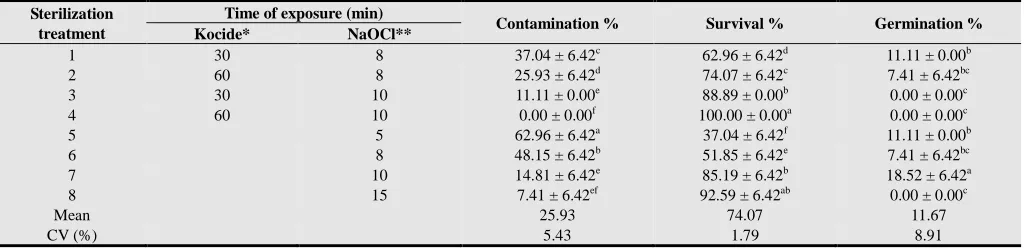
Analysis of variance (ANOVA) revealed that the sterilization treatment had highly significant effect on level of contamination, survival and germination percentage of yeheb seed in vitro culture. The highest contamination (62.96%) and lowest survival percentage (37.04 %) were recorded on treatment five: 5.00% sodium hypochlorite (NaOCl) solution for five min, while the lowest contamination (0.00%) and highest survival percentage (100.00 %) was recorded on treatment four: 30 g l-1 kocide for sixty min with 5.00% NaOCl solution for ten min (Table 1).
Table 1. Effect of disinfectants and time of exposure on contamination, survival and germination percentage.
Sterilization treatment
Time of exposure (min)
Contamination % Survival % Germination %
Kocide* NaOCl**
1 30 8 37.04 ± 6.42c 62.96 ± 6.42d 11.11 ± 0.00b
2 60 8 25.93 ± 6.42d 74.07 ± 6.42c 7.41 ± 6.42bc
3 30 10 11.11 ± 0.00e 88.89 ± 0.00b 0.00 ± 0.00c
4 60 10 0.00 ± 0.00f 100.00 ± 0.00a 0.00 ± 0.00c
5 5 62.96 ± 6.42a 37.04 ± 6.42f 11.11 ± 0.00b
6 8 48.15 ± 6.42b 51.85 ± 6.42e 7.41 ± 6.42bc
7 10 14.81 ± 6.42e 85.19 ± 6.42b 18.52 ± 6.42a
8 15 7.41 ± 6.42ef 92.59 ± 6.42ab 0.00 ± 0.00c
Mean 25.93 74.07 11.67
CV (%) 5.43 1.79 8.91
Means with same letter (s) in the same column are not significantly different at 1% according to Duncan’s Multiple Range Tests (DMRT). CV= coefficient of variation (%), *=30 g l-1 of kocide used before hood, **= 5% of NaOCl used after the seed coat removed, Three-min with 70% ethanol was used after Kocide and before NaOCl in aseptic condition, and in each steps the seed was rinsed three times for three min by double distilled sterilized water.
The highest seed germination percentage (18.52%) and the second lowest contamination percentage were recorded on treatment seven (5.00% NaOCl solution for ten min), while poor or no germination percentage was recorded on treatment three, four and eight. Treatments have lowest contamination and highest survival percentage. This indicated that the chemical and time used to sterilize or disinfect the seed from microbial affected the germination percentage. Specially, germination and contamination percentage were dramatically reduced when both disinfectant agents with long time exposure used together as one treatment, and the survival
percentage was increased (Table 1).
lower cost [20]. Similarly, our work have determined that 5% NaOCl for ten min is more effective to control contamination from C. edulis seed explants with minimum mortality effect. This sterilization technique is easy, locally available, less costly and less toxic compared to other sterilization agents (eg. HgCl2), i.e. does not require special handling and waste
disposal precaution [21]. Similar result was reported by [22] on Kinnow bud culture disinfection using 5% NaOCl for 10–15 minutes.
3.2. In Vitro Seed Germination of Yeheb (Cordeauxia Edulis)
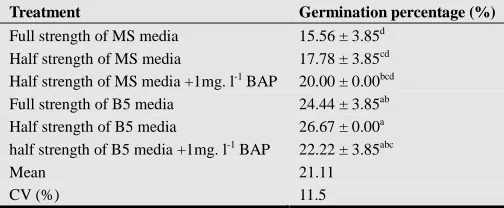
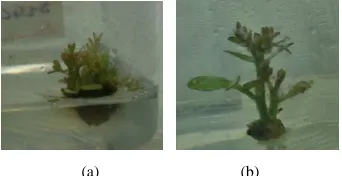
The seeds which were sterilized through optimized procedure were cultured on germination media. The half and full strength of MS and B5 media were tested for germination percentage. The analysis of variance revealed that different types of germination media had significant effect on germination percentage. Highest germination percentage (26.67%) was recorded on half strength of B5 media, while poor germination was recorded on full strength of MS media (Table 2; Fig. 1a and 1b, respectively). This result is similar with [23] who reported that B5 media gave 20% germination on Commiphora wightii.
Low C. edulis germination percentage (17%) was obtained from ex vitro experiment [14]. Several species of dry land plants have also been reported to exhibit similar low germination rates. For example, Temarindus indica, Acacia
auriculiformis and Chamaecytisus palmensis have been
reported to have a physical or chemical inhibitor for germination so that the seed will only germinate when conditions are favorable [24].
(a) (b)
Figure 1. In vitro germination C. edulis seed on various germination media (a) half strength of B5 media; and (b) full strength MS media.
Table 2. Effect of different media on germination of ‘yeheb’ seed
Treatment Germination percentage (%)
Full strength of MS media 15.56 ± 3.85d
Half strength of MS media 17.78 ± 3.85cd
Half strength of MS media +1mg. l-1 BAP 20.00 ± 0.00bcd
Full strength of B5 media 24.44 ± 3.85ab
Half strength of B5 media 26.67 ± 0.00a
half strength of B5 media +1mg. l-1 BAP 22.22 ± 3.85abc
Mean 21.11
CV (%) 11.5
Means with same letter (s) in the same column are not significantly different at 1% according to Duncan’s Multiple Range Tests (DMRT). CV= coefficient of variation (%).
The effect of BAP had no significant impact compared to other treatments on germination percentage, which contradicted with that reported by [23]. This might be due to the probable reduction of seed viability during the experiment period, since ‘yeheb’ seeds can be stored for only 3-4 month only [13].
Even if the mean germination percentage obtained from various media had not statistical difference for in vitro germination half strength of B5 media was found to be the permissible medium for in vitro germination (26.67%) for six month stored seed of C. edulis.
3.3. Direct Method of Regeneration
Induction media supplemented by different types and levels of concentrations of cytokinin were tested for shoot induction experiment on cotyledon node explant which was excised from 3 weeks old seedlings of C. edulis. Among tested cytokinin; BAP was able to induce considerable numbers of shoots compared to Kinetin. The superiority of BAP had also been reported on different Acacia species [25-27] and castor bean [28].
3.3.1. Effect of BAP Hormone on Shoot Induction
Results of the analysis of variance revealed that different level of BAP had a highly significant (p<0.01) effect on shoot initiation percentage, number of shoot, shoot length, number of leaf and shoot fresh weight. The higher mean shoot initiation percentage (89% of explant) was obtained on media supplemented by 2.00 mg. l-1 of BAP within six weeks cultured compared to control (Table 3, Fig. 2a ). On the other hand, poor shoot initiation percentage (22%) was recorded from BAP free and 6.00 mg. l-1 BAP (Table 3, Fig. 2b and 2c). This result indicated that the addition of BAP promoted the initiation of more shoots, i.e. the exogenous BAP for the shoot initiation is indispensable for cotyledonary nodal explant of C.
edulis. In consistent with this result, [29] had reported that
BAP induce more shoot on cotyledonary nodal explants of
Acacia sinuate.
The maximum mean number of shoots per explant (3.00±0.33) was obtained on media supplemented by 2.00 mg. l-1 BAP, followed by 1.78±0.19 and 1.55±0.19 shoots from 3.00 and 1.00 mg. l-1 BAP, respectively. While lower number of shoots of 0.78 ± 0.19 was obtained at 6.00 mg. l-1 BAP. In both low concentration of BAP (0.50 mg. l-1) and high concentration of BAP (6.00 mg. l-1) the shoot number was reduced. In addition, regenerated shoots exhibited slightly different morphology at high concentration of BAP (6.00 mg. l-1) and the explant gave dense clump of non-elongated new shoots (Fig. 2c). Reference [30] similarly reported that higher concentration of BAP reduce the number of shoots on Ricinus
communis L.
significantly. Reference [31] reported similar result on
Ceratonia siliqua. The reduction in shoot length at high
concentration of BAP might be due to the toxic effects of ethylene, produced at high cytokinin concentration. This result is in accordance with [32] Thomas and Blakesley reported that the production of ethylene by the excessive cytokinin application caused the inhibition of internodes elongation and number of regeneration of tobacco disc.
The maximum number of leaf and shoot fresh weight was recorded on media supplemented with 2.00 and 6.00 mg. l-1 BAP, respectively. Similarly, [33] reported that maximum number of leaf and shoot fresh weight was obtained from cotyledonary nodal explant of ‘korarima’ on medium supplemented with high concentration of BAP, respectively.
Generally, increasing BAP concentration up to certain
level (2.00 mg. l-1) increased shoot initiation percentage and shoot number. After maximum production, it starts declining with further increase in the BAP concentration. Therefore, selection of proper concentration of plant growth regulator is critical to shoot induction. To this end, we found that BAP at a concentration of 2.00 mg. l-1 the most suitable growing condition with regard to shoot initiation percentage (89 % of explant produces shoots within six weeks) and number of shoots per explant (three shoots per explant) with mean length of 0.97 cm. (Table 3).
3.3.2. Effect of Kinetin Hormone on Shoot Induction
None of the treatments induced shoot, rather large and green calli were observed after six weeks (Figure 2d). Similar results were observed on castor bean by [28].
Table 3. Effect of various level of concentration of BAP on different morphogenetic responses of C. edulis cotyledon node on MS medium after six week of cultured.
BAP (mg. l-1) Shoot initiation percentage (%)
Number of shoots per explant (n) (Mean ± SE)
Shoot length per explant (cm) (Mean ± SE)
Number of leaf per shoot (n) (Mean ± SE)
Shoot fresh weight per explant (g) (Mean ± SE)
0.00 22d 1.22 ± 0.19c 1.72 ± 0.15a 2.22 ± 0.19cd 0.266 ± 0.02f
0.50 33cd 1.33 ± 0.00c 1.52 ± 0.22a 2.44 ± 0.19bc 0.339 ± 0.03e
1.00 55bc 1.55 ± 0.19bc 1.07 ± 0.17b 2.56 ± 0.19b 0.402 ± 0.06d
2.00 89a 3.00 ± 0.33a 0.97 ± 0.23bc 3.22 ± 0.19a 0.446 ± 0.02d
3.00 67ab 1.78 ± 0.19b 0.77 ± 0.10cd 2.22 ± 0.19cd 0.517 ± 0.04c
4.00 33d 1.33 ± 0.00c 0.67 ± 0.10d 2.00 ± 0.00d 0.576 ± 0.00b
6.00 22d 0.78 ± 0.19d 0.32 ± 0.16e 1.67 ± 0.00e 0.642 ± 0.03a
Mean 50 1.62 1.10 2.33 0.46
CV (%) 1.25 8.95 2.48 6.97 7.14
Means with same letter (s) in the same column are not significantly different at 1% according to Duncan’s Multiple Range Tests (DMRT). CV= coefficient of variation (%)
(a) (b)
(c) (d)
Figure 2. Shoot induction of C. edulis from cotyledon node explants on shoot induction media supplement with different types and various level of cytokinin: a) 2.00 mg. l-1 BAP; b) free hormone; c) 6.00 mg. l-1 BAP.; and d) 2.00 mg. l-1
kin
3.3.3. Shoot Multiplication and Elongation
The analysis of variance revealed that BAP and GA3
hormones had highly significant (p<0.01) effects on shoot multiplication and elongation; and their interaction had also
significant (p<0.05) effect on shoot multiplication but not on shoot elongation. This interaction effect indicated that the two factors are dependent on each other for shoot multiplication but not for shoot elongation of C. edulis shoots.
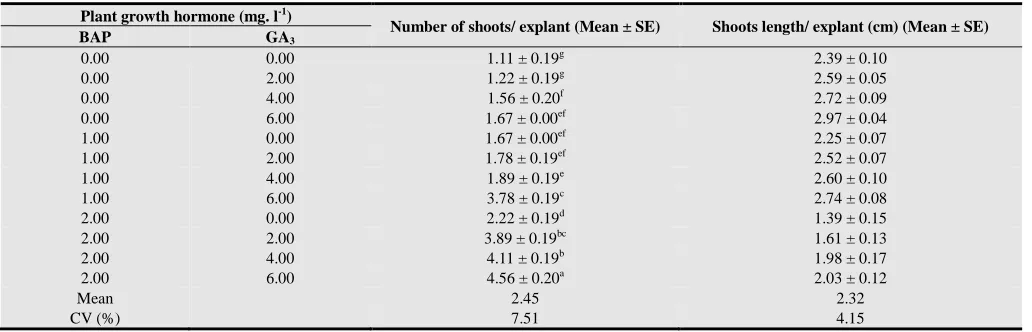
The maximum mean number of shoots (4.56 ± 0.20) was obtained on MS medium supplemented with 2.00 mg. l-1 BAP + 6.00 mg. l-1 GA3 (Table 4; Fig. 3a), while lower shoots (1.11
± 0.19 and 1.22 ± 0.19, respectively) were recorded from PGR free (control) and BAP free + 2.00 mg. l-1 GA3. Shoots number
increased when the BAP concentration increased along with increased of GA3 concentration in media.
(a) (b)
Figure 3. Shoot multiplication and elongation of C. edulis on media supplemented with: a) 2.00 mg. l-1 BAP + 6.00 mg. l-1 GA
3; and b) free BAP+6
mg. l-1 GA 3.
media supplemented with 6.00 mg. l-1 GA3 (Table 4; Fig. 3b),
while shortest shoot was recorded from PGR free (control). The shoot length increased with the increasing GA3
concentration but it decreased when BAP concentration increase in culture media. In addition dwarf shoots were observed on higher concentration of BAP. Similar result was obtained by [34] on Walnut trees.
Generally, these results showed that shoot proliferation was influenced by the combination of BAP with GA3 than
individually (Fig. 3a) This is due to the effect of GA3 on shoot
elongation which resulted in longer shoot having a potential to induce more number of bud than shorter shoot [35]. When the concentration GA3 increased within similar level of BAP in
the media, it increased shoot proliferation. However, increasing BAP concentration within similar level of GA3 in
the media decreased the shoot length (Table 4).This illustrated that the combination of BAP with GA3 enhanced shoot
proliferation but BAP alone had negative effect on shoot elongation. Similar result was reported by [36 and37].
Table 4. Effect of BAP and GA3 on number of shoots induces and shoots length during shoot multiplication
Plant growth hormone (mg. l-1)
Number of shoots/ explant (Mean ± SE) Shoots length/ explant (cm) (Mean ± SE)
BAP GA3
0.00 0.00 1.11 ± 0.19g 2.39 ± 0.10
0.00 2.00 1.22 ± 0.19g 2.59 ± 0.05
0.00 4.00 1.56 ± 0.20f 2.72 ± 0.09
0.00 6.00 1.67 ± 0.00ef 2.97 ± 0.04
1.00 0.00 1.67 ± 0.00ef 2.25 ± 0.07
1.00 2.00 1.78 ± 0.19ef 2.52 ± 0.07
1.00 4.00 1.89 ± 0.19e 2.60 ± 0.10
1.00 6.00 3.78 ± 0.19c 2.74 ± 0.08
2.00 0.00 2.22 ± 0.19d 1.39 ± 0.15
2.00 2.00 3.89 ± 0.19bc 1.61 ± 0.13
2.00 4.00 4.11 ± 0.19b 1.98 ± 0.17
2.00 6.00 4.56 ± 0.20a 2.03 ± 0.12
Mean 2.45 2.32
CV (%) 7.51 4.15
Means with same letter (s) in the same column are not significantly different at 1% according to Duncan’s Multiple Range Tests (DMRT). CV= coefficient of variation (%).
4. Conclusion
Yeheb (Cordeauxia edulis Hemsl.) is a multi-purpose plant where most parts of the plant are usable. Even if the species has multitude uses and has a potential to play a role in ensuring food security in the region, the plant is threatened with extinction due to overexploitation. This, in turn, has led to poor or none natural regeneration. Generally, this study found a permissible result to rescue rare, endemic, and endangered species through mass and continuous plantlet production within short period of time. In addition it may be used as a baseline point for ex situ conservation through cryopreservation. This is the first attempt in vitro regeneration of C. edulis. Hence, the aforementioned potential benefits of the outputs of this study can be reaped in the areas of future ‘Yeheb’ conservation, research, and development.
References
[1] Ali, H.M., 1988. Cordeauxia edulis: Production and Forage Quality in Central Somalia. Thesis for the degree of Master of Science in Rangeland Resources, National University of Somalia, Somalia.
[2] Teketay, D. and Eshete, A., 2004. Status of indigenous fruits in Ethiopia. In: Chikamai B, Eyog-Matig O, Mbogga M (eds.) Review and Appraisal on the Status of Indigenous Fruits in Eastern Africa: A Report Prepared for IPGRI-SAFORGEN in the Framework of AFRENA/FORENESSA, Kenya Forestry
Research Institute, Nairobi, Kenya, pp 3-35.
[3] Miège, J. and Miège, M.N., 1978. Cordeauxia edulis a Caesalpinaceae of Arid Zones of East Africa, Caryologic, blastogenic and biochemical features. Potential aspects for nutrition. Economic Botany, 32: 336-345.
[4] Drechsel, P. and Zech, W., 1988. Site conditions and nutrient status of Cordeauxia edulis (Caesalpiniaceae) in its natural habitat in central Somalia. Economic Botany, 42: 242–249.
[5] Hemming, C.F., 1972. The vegetation of the northern region of Somalia Republic. Proceeding of Linnaeus Social London, 177:173-250.
[6] Watson, R.M., Tippett, C.J., Becket, J.J. and Scholes, V., 1982. Somali Democratic Republic, Central Rangelands Survey, London. Resource Management and Research, 1:3–10
[7] N.A.S (National Academy of Science), 1979. Tropical legumes: Resource for the Future, Nat Acad. Sci. Washington DC, pp261.
[8] Brink, M., 2006.Cordeauxia edulis Hemsl Record from Protobase. PROTA (Plant resources of tropical Africa / Ressourcesvégétales de l’Afriquetropicale), Wageningen, Netherlands http://database.prota.org/search.htm (Accessed on September 14, 2011)
[9] Booth, F.E.M. and Wickens, G.E., 1988. Non-timber uses of selected arid zone trees and shrubs in Africa. FAO Conservation Guide 19, 52-58.
[11] Assefa, F., Bollini, R. and Kleiner, D., 1997. Agricultural potential of little used tropical legumes with special emphasis on Cordeauxia edulis (Ye-eb nut) and Sphenostylisstenocarpa (African yam bean). Giessener Beiträge zur Entwicklungsforschung, 24:237–242.
[12] Bally, P.R.O., 1966. Miscellaneous notes on the flora of Tropical East Africa, 29. Enquiry into the occurrence of the Yeheb nut (Cordeauxia edulis Hemsl.) in the Horn of Africa.Candollea 21 (1), 3-11.
[13] Liew, J., 2003. Desiccation tolerance of yeheb (Cordeauxia edulis Hemsl.) seeds.Thesis for the degree of Master of Science in Agriculture, SLU, Ultuna, Sweden.
[14] Mussa, M., 2010.Cordeauxia edulis (yeheb): resource status, utilization and management in Ethiopia. Thesis for the degree of Philosophiae Doctor, University of Wales.
[15] Murashige, T. and Skoog, F., 1962.A revised medium for rapid growth and bioassays with tobacco tissue cultures. Physiologia Plantarum, 15: 473-497.
[16] Gamborg, O.L., Murashige, T., Thorpe, T.A. and Vasil, I.K., 1976.Plant tissue culture media. In Vitro, 12:473-478.
[17] SAS Institute Inc., 2002. Statistical Analysis Software, Version 9.0. Cary, North Carolina, USA.
[18] Pierik, R.L.M., 1997. In vitro culture of higher plants. Kluwer Acadamic publishers. Wageningen Agricultural University, The Netherland, pp 1-72.
[19] Alvarez, V.M., Ferreira, A.G., and Nunes, V.F., 2006. Seed disinfestation methods for in vitro cultivation of epiphyte orchids from Southern Brazil. HorticulturaBrasileira 24: 217-220.
[20] Vujanovic, V., Arnaud, S.T.M. and Barabé, D., 2000.Viability testing of orchid seed and the promotion of coloration and germination.Annals of Botany, 86:79-86.
[21] George, E. F., Hall, M.A. and Klerk, G.D., 2008. Plant Propagation by Tissue Culture 3rd Edition, Publication by Springer, Netherlands.
[22] Altaf, N., 2006. In vitro bud culture of Kinnow tree, Pak. J. Bot. 38(3): 597-601.
[23] Kant, T., Prajapati S. and Parmar, A.K., 2010. Efficient micropropagation from cotyledonary node cultures of Commiphora wightii (Arn.)
[24] Roshetko, J.M., 1995. Albiziasaman: pasture improvement, shade, timber and more (NFTA 95-02). Winrock International, Morrilton, Arkansas. http://www.winrock.org/ forestry/factpub/factsh/a_saman.htm. (Accessed on September 14, 2011).
[25] Mittal, A., Agarwal, R., Gupta, S.C., 1989.In vitro development of plantlets from axillary buds of Acacia auriculiformis. Plant Cell, Tissue and Organ Culture, 19: 65–70.
[26] Dewan, A., Nanda, K., Gupta, S.C., 1992. In vitro micropropagation of Acacia nilotica sub sp. Indica Brenan via cotyledonary nodes. Plant Cell Reports, 12: 18–21.
[27] Singh, H. P., Singh, S., Saxena, R.P., Singh, R.K., 1993. In vitro bud break in axillary nodal segments of mature trees of Acacia nilotica. Indian Journal Plant Physiol. 36:21–24.
[28] Aha, Y.J., and Chen, G.Q., 2008. High frequency regeneration through adventitious shoot formation in caster bean (Riceinus communis L.). In Vitro Cellular and Developmental Biology -Planta, 43:9-15.
[29] Vengadesan, G. and Pijut, M.P., 2009. In vitro propagation of northern red oak (Quercusrubra L.)In Vitro Cellular and Developmental Biology – Planta, 45:474–482.
[30] Alam, I., Sharmin, S.A., Mondal, S.C., Alam, M., Khalekuzzaman, M. and Anisuzzaman, M., 2010. In vitro micropropagation through cotyledonary node culture of caster bean (Riceinus communis L.). Australian Journal of crop science, 4(2):81-84.
[31] Naghmouchi, S., Khouja, M.L., Rejib, M.N. and Boussaid, M., 2008. Effect of growth regulators and explant origin on in vitro propagation of Ceratonia siliqua L. via cuttings. Biotechnol. Agron. Soc. Environ.:12 (3):251-258.
[32] Thomas, T. and Blakesley, D. 1987 .Practical and potential uses of Cytokinin in agriculture and horticulture. In: Bonga, J. M., and Durzan, D.J.,(eds) Cell and tissue culture in trees, vol. 1 Amsterdam: Martinus Nijhoff Publishers.37p.
[33] Eyob, S., 2009.Promotion of seed germination, subsequent seedling growth and in vitro propagation of korarima Aframomum corrorima Braun. Journal of Medicinal Plants Research, 3(9):652-659.
[34] Payghamzadeh, K. and Kazemitabar, S.K, 2011. In vitro propagation of walnut. African Journal of Biotechnology, 10(3):290-311.
[35] Chitra D.S.V. and G., Padmaja, 1999. Clonal propagation of mulberry through invitroculture of nodal explants. Scientia Hort. 80: 289-298.
[36] Deore, A.J. and Johnson, A.T., 2008. High frequency plant regeneration from leaf-disc culture of Jatropha curcas L.: an important biodiesel crop. Plant Biotechnology Rep., 2:7-11.