INTERNATIONAL JOURNAL OF PHARMACEUTICAL, CHEMICAL AND BIOLOGICAL SCIENCES
Available online atwww.ijpcbs.com
METHOD DEVELOPMENT OF AN SIMULTANEOUS DETERMINATION OF
COMMON COUGH AND COLD INGREDIENTS BY HIGH PERFORMANCE
LIQUID CHROMATOGRAPHY (HLPC) IN MULTI COMPONENT COUGH
AND COLD ORAL DRUG PRODUCTS
Sakshi Sawant
1*and Nitin Borkar
21
Rusan Pharma Pvt. Ltd. 58 D, Government Industrial Estate, Charkop,
Kandivali west, Mumbai-400 067, India.
2
CEO ,Vergo Pharma Research Pvt. Ltd, 301/302 Opulence, 6 th Floor, TPS III,
Santacruz East, Mumbai-400 055, India.
1.0 INTRODUCTION
Cough and cold segment in the OTC is the major area of self medication. Aspirin drug combinations do not require a doctor's prescription as these analytes are previously approved prescription drugs now deemed safe enough for use without a medical practitioner's supervision like ibuprofen.
HPLC with ultraviolet, fluorimetry or mass spectroscopy (MS) is most widely used. 1 Other techniques include ultraviolet-visible spectroscopy, thin layer chromatography (TLC), gas chromatography (GC), GC/MS, capillary electrophoresis and multivariate spectrophotometric methods.2 There is no analytical method for simultaneous determination of most of the common ingredients for major analytes in the cough and cold category.
Dosage forms used for the treatment of cough and colds are complex mixtures containing several active analytes as decongestants, antihistamines, analgesics, antitussive, expectorants, preservatives, dyes and flavors available as syrup, suspension, powders, capsules and tablets. The active materials cover widely ranging polarities and include both acidic
and basic compounds. Analytical methodologies are reported for analgesic (eg acetaminophen), an antitussive (eg dextromethorphan), and antihistamine (eg chlorphenaramine Maleate) and a nasal decongestant (eg phenylephrine Hydrochloride). Guaifenesin was estimated simultaneously in the presence of acetaminophen, pseudoephedrine, folcodine.3 However this method was not stability indicating method. Acetaminophen has been analysed with salts of chlorphenaramine , dextromethorphan, phenylephrine in tablets using HPLC.4
Several methods use ion pairing reagents. They require use of hydrophobic additives either cationic such as triethylamine, hexalamine or anionic such as alkyl sulfonate. They tend to absorb very strongly on the stationary phase leading to difficulty in recovering initial column properties. Also use of ion pairing agents in mobile phase enhances the retention time of most components thereby increasing analysis time hence may not be preferred method of choice5.
Pharmacopoeial methods reported for each drug are generally not suitable for simultaneous determination due to interferences from other
Research Article
ABSTRACT
A common simultaneous HPLC method has been developed for the quantification of common analytes used in cough and cold products. The seven analytes acetaminophen, guafenesin, pheniramine maleate, phenylephrine hydrochloride, diphenhydramine, chlorpheniramine maleate, dextromethorphan are separated out. HPLC separation was achieved on a C18 column with a gradient system optimized for all seven analytes with different chemical structures.
analyte peaks. Using multiple methods of each analyte with different column, mobile phase, flow rates and sample preparations is uneconomical and time consuming in this low cost self medication market. Gradient method has been developed.
The goal of this article is to develop a potential, reliable fast and efficient chromatographic conditions for various dosage forms which can estimate all the major components of a cough and cold multi component formulation.
2.0MATERIALANDMETHODS
Individual standards of all seven analytes – acetaminophen (USP), guafenesin (USP), pheniramine maleate (IP), phenylephrine hydrochloride (USP), diphenhydramine (IP), chlorpheniramine maleate (IP), dextromethorphan (USP). Ammonium phosphate dibasic AR , Ammonium phosphate monobasic AR , 1- octane suphonic acid sodium salt monohydrate AR , Acetonitrile ( HPLC grade) and Milli Q water was used in all the work. Phosphoric acid AR for pH adjustment and triethylamine HPLC grade was used.
2.1 Buffer
was prepared by dissolving about 2.34 g of 1-Octane sulfonic acid sodium salt monohydrate AR in 1000 ml of water in a borosilcate glass container to obtain a concentration of about 0.01M . Adjusted the pH to 2.8 ± 0.1 with phosphoric acid, and filtered through a 0.45-µ nylon membrane filter. All solutions as well as the mobile phases were filtered through a 45-mm nylon membrane filter. Mobile phases were freshly prepared weekly and degassed prior the use.
2.2 Mobile phase A
Acetonitrile was used as mobile phase A
2.3 Mobile phase B
Buffer prepared above was used as mobile phase B
2.4 Diluent A
Dissolve 0.094 g of ammonium phosphate monobasic, and 0.108 g of ammonium phosphate dibasic, in 250 ml of water. Add 750 ml of acetonitrile and 3.0 ml of triethylamine. Mix and adjust to pH 6.8 ± 0.05 with phosphoric acid.
2.5 Diluent B
Prepare sufficient quantity by mixing buffer pH 2.8 and Acetonitrile 40:60 in a suitable container.
2.6 Preparation of the solutions
Standard solutions of acetaminophen, guaifenesin, pheniramine maleate, phenylephrine hydrochloride, diphenhydramine ,chlorpheniramine maleate, dextromethorphan were prepared as mentioned below.
2.7 Stock Standard Solution A
Accurately weigh and transfer about 50 mg of acetaminophen, guaifenesin, pheniramine maleate, phenylephrine hydrochloride, diphenhydramine, chlorpheniramine maleate, dextromethorphan standard into a 50 ml volumetric flask individually and add 60 ml of Diluent A, sonicate to dissolve and dilute to volume with Diluent A and mix well. (1000 ppm)
2.8 Stock Standard Solution B
Transfer 5.0 ml of Stock Standard Solution A individually into a separate 20 ml volumetric flasks, dilute to volume with Diluent A and mix well. (250 ppm)
2.9Combined Standard Preparation
1) Transfer 5.0 ml of Dextromethorphan hydrobromide and Diphenhydramine hydrochloride Stock Standard Solution A into a 50 ml volumetric flask, dilute to volume with Diluent B and mix well. (100 ppm).
2) Transfer 2.0 ml of paracetamol, guaiphenesin, pheniramine maleate, phenylephrine hydrochloride & chlorpheniramine maleate stock standard solution B (250 ppm) into same 50 ml volumetric flask, dilute to volume with Diluent B & mix well.(10 ppm)
2.10 Preparation of sample preparation
Prepare the sample stock solution into Diluent A. Further dilute the solution and get final concentration of acetaminophen (10 ppm), guaiphenesin (10 ppm), pheniramine maleate(10 ppm), phenylephrine hydrochloride(10 ppm), diphenhydramine (10ppm), chlorpheniramine maleate(10 ppm), dextromethorphan (100 ppm) with Diluent B.
3.0 METHOD DEVELOPMENT
appropriate method can be developed for the purpose. Method development can be based on sample and goal as well as available resources for chromatography but few basic steps for method development are discussed as below6.
3.1Steps in method development 7 • Sample information
• Define separation goals
• Sample pretreatment, need of special HPLC procedure
• Selection of detector and detector settings
• Selection of LC method; preliminary run; estimate best separation conditions
• Optimize separation conditions • Check for problems or requirement for
special procedure
3.2Sample information
1. Number of compounds present 2. Chemical structure of compounds 3. Chemical nature
4. Molecular weight of compounds 5. Ka Value(s) of compounds 6. Sample solubility
7. Sample stability and storage
8. Concentration range of compounds in sample
9. UV spectra of compounds or properties for detection of compounds.
3.3 Below mentioned are different analytes which were used for the separation by HPLC method
S.No Analyte pKa Acidic/Basic Category 1. Acetaminophen 9.0 Acidic Analgesic 2. Dextromethorphan 9.85 Basic Antitussive 3. Diphenhydramine 8.98 Basic Antihistaminic 4. Phenylephrine hydrochloride 8.97 Acidic Decongestant 5. Chlorpheniramine maleate 9.13 Acidic Anihistaminic 6. Pheniramine maleate 9.48 Basic Anithistaminic 7. Guaifenesin 13.42 Acidic Expectorant
3.4 Selection of various chromatographic
conditions
3.4.1 Mode of Separation
In case of HPLC the method of separation used is reverse phase mode of separation. In this case water will be one of the components of the mobile phase. The unmodified stationary phases include silica, cellulose, starch, polyamides and chitin.
Modified stationary phases include silicas
containing cyanodiol, amino, thiol groups. For HPLC the most frequently used stationary phase is silica8.
Hence reverse phase mode of separation was chosen for HPLC determination.
3.4.2 Selection of stationary phase
The introduction of a technique using alkyl chains covalently bonded to the solid support created a hydrophobic stationary phase, which has a stronger affinity for hydrophobic compounds. The use of a hydrophobic stationary phase can be considered the opposite, or "reverse", of normal phase chromatography - hence the term "reversed-phase chromatography".9 Reversed-phase chromatography employs a polar (aqueous) mobile phase. As a result, hydrophobic molecules in the polar mobile phase tend to adsorb to the hydrophobic stationary phase, and hydrophilic molecules in the mobile phase will pass through the column and are eluted first.
phases will lead to changes in selectivity.14 The sorbents have a pore size of 40 to 100 A°. Thus silica gel having pore diameter of 60 A° was chosen as a stationary phase material for the present research work.
Hence, Reverse phase HPLC was used for the research work.
3.4.3 Mobile phase optimization
Mixtures of water or aqueous buffers and organic solvents are used to elute analytes from a reversed-phase column. The solvents must be miscible with water, and the most common organic solvents used are acetonitrile, methanol, and tetrahydrofuran. Other solvents can be used such as ethanol or 2-propanol . Elution can be performed isocratically (the water-solvent composition does not change during the separation process) or by using a solution gradient (the water-solvent composition changes during the separation process, usually by decreasing the polarity). The pH of the mobile phase can have an important role on the retention of an analyte and can change the selectivity of certain analytes.15
Since most APIs have acidic and /or basic functionalities , their ionization state is controlled by both solution pH and acidic dissociation constants ( ie Ka values). These different chemical species (cationic, neutral or anionic) often have vastly different properties with respect to water solubility, volatility, UV absorption and reactivity with chemical oxidants. The ionized form is usually more water soluble while the neutral form is more lipophilic and has higher membrane permeability. From dissociation constants the major species of pharmaceuticals present in the environment can be estimated.
Consequently it is very important to know dissociation constants for environmentally relevant API’s in order to estimate their occurrence , fate and effects.
Knowledge of pka values as a function of solvent composition is also useful in applying liquid chromatography for the separation of ionizable compounds. The chromatographic retention of ionizable compounds strongly depends on the pKa of the compound and mobile phase pH. It is advisable to have the pH of mobile phase within approximately ± 2 units of pKa. Whenever acidic or basic samples are to be separated it is advisable to control mobile phase pH by adding a buffer solution. Reversed phase HPLC separations are generally carried out with C8 or C18 bonded phase silica based columns that are stable in pH ranges 2.0 and 8.0. Thus, buffers able to control pH between 2.0 to 8.0 are desirable. For reverse phase chromatography, a
buffer concentration of 10-50 mM is usually adequate.
The general strategy for optimizing the mobile phase in HPLC is to adjust the solvent strength by replacing a pure solvent by another, or by varying the proportions of the weak solvent and the strong solvent in a mixture so that the Rf values are in the range of 0.2 – 0.7. While keeping the optimized solvent strength constant, the solvent composition is then modified to obtain selectivity necessary to achieve the desired separation. But with complex multicomponent samples, it may not be possible to achieve the required separation with binary solvent system. In such cases ternary or quaternary mixtures provide more opportunities to fine-tune the selectivity while maintaining the solvent strength constant.16
The solvents should fulfil the following requirements
The solvent should be of adequate purity at reasonable cost.
The solvent should be unreactive with the sample and the stationary phase. The solvent should be miscible with the
other solvents of the mobile phase. The solvent should be stable in air and
should have low boiling point to facilitate easy removal after chromatographic development.
The solvent should be of suitable viscosity and surface tension.
The solvent should have linear partition isotherm.
The solvent should have vapour pressure that is neither very low nor very high.
The properties like flammability and toxicity are important due to their impact on safety and disposal.
the gradient manner. With this mobile phase, good resolution between all the three
components was seen with suitable Rf values.
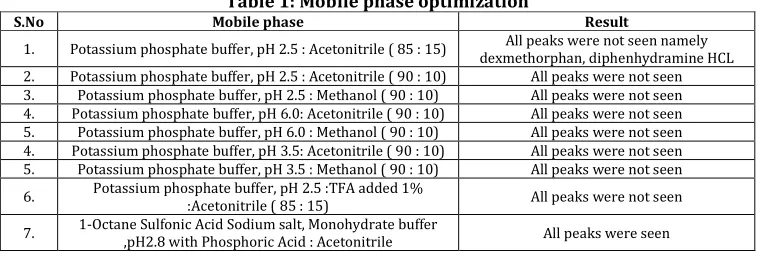
Table 1:Mobile phase optimization
S.No Mobile phase Result
1. Potassium phosphate buffer, pH 2.5 : Acetonitrile ( 85 : 15) All peaks were not seen namely dexmethorphan, diphenhydramine HCL 2. Potassium phosphate buffer, pH 2.5 : Acetonitrile ( 90 : 10) All peaks were not seen 3. Potassium phosphate buffer, pH 2.5 : Methanol ( 90 : 10) All peaks were not seen 4. Potassium phosphate buffer, pH 6.0: Acetonitrile ( 90 : 10) All peaks were not seen 5. Potassium phosphate buffer, pH 6.0 : Methanol ( 90 : 10) All peaks were not seen 4. Potassium phosphate buffer, pH 3.5: Acetonitrile ( 90 : 10) All peaks were not seen 5. Potassium phosphate buffer, pH 3.5 : Methanol ( 90 : 10) All peaks were not seen
6. Potassium phosphate buffer, pH 2.5 :TFA added 1%
:Acetonitrile ( 85 : 15) All peaks were not seen 7. 1-Octane Sulfonic Acid Sodium salt, Monohydrate buffer
,pH2.8 with Phosphoric Acid : Acetonitrile All peaks were seen
Thus optimized mobile phase used for separation was Solvent A: Acetonotrile Solvent B: Buffer Buffer: Dissolve about 2.34 g of 1-Octane Sulfonic Acid Sodium salt, Monohydrate AR grade in 1000 ml of Milli Q water in a suitable glass container to obtain a concentration of about 0.01M 1-Octane Sulfonic Acid Sodium salt solution. Adjust the pH to 2.8 ± 0.1 with Phosphoric Acid, and filter through a 0.45-µ nylon membrane filter. Degas the solution.
Gradient
3.4.5 Column Selection
Table 2: Various columns were used during method development to ensure all the components were eluted efficiently
S.No Column type Result
1. Zorbax SB_CN, 5 µ, 4.6 X 250 mm All peaks were not seen namely dexmethorphan, diphenhydramine HCL 2. Hypersil Gold, 5 µ, 4.6 X 250 mm All peaks were not seen 3. Thermoscientific, Hypersilgold , 4.6 X 250 mm All peaks were not seen 4. Zorbax C18, 5 µ, 4.6 X 250 mm All peaks were not seen 5. Zorbax C18, 5 µ, 4.6 X 150 mm All peaks were not seen 6. Thermoscientific, Hypersilgold , 4.6 X 150 mm All peaks were not seen 7. Zorbax NH2, 5 µ, 4.6 X 250 mm All peaks were not seen 8. Inertsil ODS 3V, 5 µ, 4.6 X 250 mm All peaks were not seen 9. Inertsil ODS 3V, 5 µ, 4.6 X 150 mm All peaks were not seen
10. Phenomenexluna, 5 µ, 4.6 X 150 mm
All peaks were not seen namely dexmethorphan, diphenhydramine HCL, split
3.4.6 Flow rate selection and injection volume selection
A lot of flow rates were tried out to get the best chromatogram eluted. Finally flow rate of 1ml/min was selected. Different volumes from 10µl - 100 µl was tried out. Finally injection volume of 25 µl was used .
Thus optimized flow rate of 1 ml/min and injection volume of 25µµµµl was selected.
3.4.7 Selection of the most suitable detector
Before the first sample is injected during the HPLC method development one must be sure that the detector selected will sense all sample components of interest. There are lot of detectors used like UV, photo diode array, mass spectroscopy, fluorescence, refractive index detector. Normally variable wavelength UV detector is the first choice of the chromatographers, because of their convenience
and applicability for most organic samples. UV spectra can be obtained by PDA detector. When the UV response of the sample is inadequate, other detector or derivative HPLC method can be used.18
Paracetamol, guaiphenesin, pheniramine Maleate, phenylephrine hydrochloride, dextromethorphan hydrobromide, diphenhydramine hydrochloride and chlorpheniramine maleate exhibit absorbance in the UV region of the electromagnetic spectrum. Hence detection and quantification was performed in absorbance mode using Ultra violet spectrophotometer.
In the present research work the most suitable wavelength was decided when a lambda max was found out for all the components. The wavelength chosen for further quantification was 264 nm.
Selection of the most suitable wavelength for UV
S.No Components λλλλmax1 λλλλmax2 λλλλmax3 λλλλmax4 1. Pheniramine maleate 262.0 223.6
2. Guafenesin 275.0 226.0 210.2
3. Diphenhydramine 264.6 258.8 253.0 215.6 4. Dextromethorphan 287.6 280.4 227.2 207.8 5. Chlorpheniramine maleate 269.8 262.6 220.0 207.8 6. Acetaminophen 259.2 211.6
7. Phenylephrine hydrochloride 276.0 218.2
Hence a wavelength of 264 nm was selected as all the components were detected at this wavelength.
3.5 Placebo interference
The specificity of the HPLC method was determined by injecting individual component, placebo preparation, where in no interference was observed for any of the components and no interference of any of the excipients is observed from the placebo preparation at the retention of Paracetamol, Guafenesin, Phenylephrine Hydrochloride, Dextromethorphan, Diphenhydramine Hydrochloride, Pheniramine Maleate, Chlorpheniramine maleate.
3.6 Information of sample
The important information concerning sample composition and properties like number of compounds present in the sample, concentration range of compounds in the sample preparation, the other properties like the chemical structure, molecular weight, pKa value, UV spectra, solution stability and solubility should be there.
Based on the composition of the sample, choice of the initial conditions for an HPLC was decided.
Sample comes in various forms such as solutions ready for injections, solutions that require dilution, addition of internal standard or other volumetric manipulation, solids must be dissolved or extracted from formulation matrix and sample that requires pretreatment to remove interferences and to protect the column from damage.
Sample preparation is an essential part of HPLC analysis to provide a reproducible and homogenous solution that is suitable for injection onto the column. Best results are obtained when the composition of the sample solvent is close to that of the mobile phase, since this minimizes baseline disturbance and does not affect the sample retention and resolution. Samples used were of syrups, tablets, powders in sachets. The sample preparation was designed in order to have all the ingredients in a common mixture so that it can analyzed in a single run.
Prepare the sample stock solution into Diluent A. Further dilute the solution equal concentration of standard preparation into a Diluent B.
Guaiphenesin, Pheniramine Maleate, Phenylephrine Hydrochloride and
Chlorpheniramine maleate 10ppm.
Samples Areas
Injection No: PCM GUI PM PEH DEX DPH CPM 1 470645 125673 246135 14830 89831 42722 222879 2 470648 125677 246132 14828 89833 42721 222880 3 470623 125680 246130 14827 89835 42728 222885 Average 470639 125677 246132 14828 89833 42724 222881 % 99.99 100.00 100.00 99.96 99.99 100.00 100.00
The order of elution of peak is as follows: Paracetamol, Guaiphenesin, Phenylephrine Hydrochloride, Pheniramine Maleate, Chlorpheniramine maleate, Dextromethorphan hydrobromide and Diphenhydramine hydrochloride.
Standard Areas
Assay for Paracetamol Guaiphenesin, Pheniramine Maleate, Phenylephrine Hydrochloride, Dextromethorphan hydrobromide, Diphenhydraminehydrochloride
and Chlorpheniramine maleate (Standard and Sample Areas)
Injection No: PCM GUI PM PEH DEX DPH CPM 1 470679 125685 246139 14834 89831 42726 222884 2 470675 125683 246136 14832 89833 42724 222885 3 470676 125682 246138 14836 89835 42724 222883 4 470679 125683 246140 14835 89839 42727 222883 5 470678 125681 2461437 14832 89837 42727 222886 6 470677 125682 246135 14836 89839 42725 222883 Average 470677 125683 246138 14834 89838 42726 222884 SD 1.63 1.37 1.87 1.83 1.17 1.38 1.26 RSD 0.0003 0.0011 0.0008 0.0124 0.0013 0.0032 0.0006
STANDARD
SAMPLE
Fig. 2: Assay for paracetamol, guafenesin, pheniramine maleate, phenylephrine hydrochloride, dextrometorphan hydrobromide, diphenhydramine hydrochloride and chlorphenimarine maleate (Sample)
4.0 CONCLUSION
Hence it was observed that paracetamol, guafenesin, phenylephrine hydrochloride, dextromethorphan, diphenhydramine hydrochloride, pheniramine maleate, chlorpheniramine maleate could be determined by HPLC. Thus, the research proposes HPLC
method development which can be successfully applied for the routine quality control analysis of paracetamol, guafenesin, phenylephrine hydrochloride, dextromethorphan, diphenhydramine hydrochloride, pheniramine maleate, chlorpheniramine maleate from their fixed dosage form.
Developed chromatographic conditions are as follows
SR No. PARAMETER DESCRIPTION 1. Instrument
Pump Gradient pump
Injector Autosampler
Column Phenomenex Luna C18, 25 cm x 4.6 mm i.d., 5µm. Detector UV- Visible detector
Wavelength 264nm
Recorder Empower -2 chromatography software
2. Mobile Phase
0.01M 1-octana sulphonic acid sodium salt monohydrate (pH adjusted to 2.80 with 0rthophosphoric acid): Acetonitrile in a gradient
ratio
3. Flow Rate 1.0 ml/ min
4. Injection Volume 25µl
5.0 ACKNOWLEDGEMENT
It is my first and foremost privilege to express my deep sense of gratitude to my guru, Dr. Nitin Borkar for his blessings, guidance and constant encouragement. He is a constant oasis of ideas and passion in this field which has inspired me and enriched my growth as student, a researcher and a scientist. Without him this paper would have not been possible.
I am grateful to the members of Novartis Healthcare for providing me every possible help related to my practical work in terms of reagents and material required for the work and
for their assistance, suggestions and invaluable advice.
I express my sincere thanks to Dr. Kunal Saxena (MD, Rusan Pharma) for his continuous support and inspiration and belief that I can excel.
6.0 AUTHOR CONTRIBUTION
I have been able to complete my research under the guidance of Dr. Nitin Borkar where my work started from collecting data for literature survey to completing the research.
research work and also helping me to write this paper methodologically with sufficient data. He has been the one to analyse all the data and finally structuring this paper.
REFERENCES
1. Alaa El-Gindy, Samy Emara, Mostafa K Mesbah and Ghada M Hadad: Liquid Chromatography and Chemometric- Assisted Spectrophotometric Methods for the Analysis of Two Multicomponent Mixtures Containing Cough Suppressant Drugs. Journal of AOAC International. 2005;88(4):1069-1080.
2. Ghanekar AG and Das Gupta V. Quantitative determinations of two decongestants and an antihistamine in combination using paired ion high pressure liquid chromatography. Journal of Pharmaceutical Sciences. 1978;67:873-874.
3. Shenoy KR, Krishnamurthy KS. Iyengar V and Harsha J. Simultaneous determination of phenylpropanolamine hydrochloride, dextromethorphan hydrobromide and chlorpheniramine maleate in formulations by reversed-phase liquid chromatography Indian Journal of Pharmaceutical Sciences. 2002;64(4):398-400.
4. Laura Carnevale. Simultaneous determination of Acetaminophen, Guafenesin, Pseudoephedrine, Pholcodine, and Paraben Preservatives in Cough Mixture by High- Performance Liquid Chromatography. Journal of Pharmaceutical Sciences. 1983;72(2): 196-198.
5. Caroll DI, Dzidic, Stillwell RN, Haegele KD and Horning EC. Analytical Chemistry. 1975;47:2369-2373. 6. Settle FA. Handbook of instrumental
techniques for analytical chemistry, ed: Pearson Education, Singapore. 2004. 7. Khopkar SM. Basic Concept of Analytical
Chemistry. Published by Wiley Eastern Limited, New Delhi, 1984.
8. Skoog DA, West DM, Holler FJ and Crouch SR. Analytical Chemistry – Introduction ,7th edition; Published by Saunders College Publishing; USA. 1999. 9. Tswett MS and Ber Disc Botb Ges. M-S Twestt & Chromatography. 1906;24: 316.
10. Tswett MS and Ber Disc Bot Ges. M-S Twestt & Chromatography. 1906;24:384.
11. Robards K, Haddad PR and Jackson PE. Priciples and Practice of Modern Chromatographic Methods, Published by Academic Press Limited. London. 1994;203.
12. Synder L, Kirkland J and Glajch J. Practical HPLC Method Development. In: Difficult Separations: The use of other separation variables and procedures. New York, Chichester, Brisbane, Toronto, Singapore. 1988; 125-137.
13. Synder L, Kirkland J and Glajch J. Practical HPLC Method Development. In: Difficult Separations: The use of other separation variables and procedures. New York, Chichester, Brisbane, Toronto, Singapore. 1988;61-64.
14. Synder L, Kirkland J and Glajch J. Practical HPLC Method Development. In: Difficult Separations: The use of other separation variables and procedures. New York, Chichester, Brisbane, Toronto, Singapore. 1988; 231-239.
15. Snyder L, Kirkland J and Glajch J. Practical HPLC Method Development. In: Getting started .Ed. Wiley -Interscience, New York, Chichester, Brisbane, Toronto, Singapore. 1988;5-6. 16. Snyder L, Kirkland J and Glajch J. Practical HPLC Method Development. In: Getting started .Ed. Wiley -Interscience, New York, Chichester, Brisbane, Toronto, Singapore. 1988;1-4. 17. Snyder L, Kirkland J and Glajch J. Practical HPLC Method Development, In: Systematic Method Development. Ed. Wiley- Interscience New York, Chichester, Brisbane, Toronto, Singapore. 1988;85-89.