A Review on Smart Bulb & Proposed a Real
Time Vision Based Smart Bulb using Image
Processing
Dashrath Mahto#1, Sreeja Nair*2 #
M. Tech. Scholar Computer Science & Engineering, Oriental Institute of Science & Technology, Bhopal, India
*
Associate Professor Computer Science & Engineering, Oriental Institute of Science & Technology, Bhopal, India
Abstract— In recent years, light bulb is getting smarter because of its smart behavior. It means that it can be controlled via smartphone through wireless connection and even you may control it when you are not at your home. Now a day’s market place has been occupied with the smart bulbs replacing CFLs and traditional LED. It is totally differ from the traditional bulb even much more expensive as compare to the traditional one. Smart bulb offers remote control feature along with schedule timer, it means that you have a smartphone as a remote and you can also set timer to turn off or on these bulbs. Even it can be control through GPS installed in your smartphone. It means that when you are bit far away from your home and you forget to turn off your bulbs then you can turn off it, your bulb is almost another smartphone that is why it is expensive as compare to the traditional bulb. Now it’s time to replace this smart bulb from new era with much smarter bulb which is going to be proposed i.e. Real Time Vision Based Smart Bulb Using Image Processing. It will work like a human vision, a bulb which does not require any manual control, it will be operated automatically. It means that it will automatically sense when it should be off and on. When no one is present in the room for 20 minutes, it will automatically off and when you come, it will automatically on. One more feature is very effective in it, is when you present in the room and there is no movement for one hour then it will automatically off, because it is practically demonstrated that no one can be totally stable for one hour when he is not sleeping or when he is conscious. He must have any kind of movement if he is conscious. He must be slept if he is not responding for one hour. It will consider that you are sleeping and bulb should be turned off. Even you may turn off or on this feature as per your desire. Definitely it will save your electricity when you are not in your home or even you are at home.
device is required. It will be the most intelligent light bulb till now.
Keywords— Smart Bulb, Image Processing, CFL, LED, MATLAB, GPS etc.
1. INTRODUCTION
1.1 Introduction of Present System
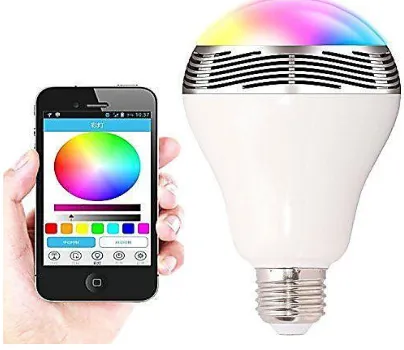
Playbulb Rainbow, Stack Down light Starter Kit and many more. Few of them can sense low light and able to turn it brighter in that case and few of them can emit multiple colors of light and rest all are able to connect to smartphone for remote control.
1.2 Introduction of Proposed System
1.2.1 Smart Light Bulb:
To replace present system, we have new promising concept which is intelligent enough for real time decision making. We proposed a new promising system which will be able to monitor real time activity. It is slightly differ from the present system, here we are not going to control it through your smartphone and we are going to develop a system which will be intelligent enough to take decisions on real time with practical sense i.e. when it should be turned off or on. Suppose you are working on living room and after some time you go to your bed room to sleep, but you forgot to turned off your bulb, in this case if we are using a traditional bulb then it will remain on until you turned it off and if we are using smart LED then it will also remain on because you will also have to turn off it manually through your smartphone, but if we talk about our system then it will check if you are not coming to your living room till 30 minutes then it will off light automatically. No need to turn it off manually, even when you come back to your living room it will on your bulb automatically. One more thing which is not possible for traditional bulb as well as present smart LED is that when you are working in your living room and after a while you got sleep there while working then if we talk about traditional system, the light bulb will remain on till your effort will not come, it is as similar with present smart LED but our system has a sense if you are stable for 1 hour or no movement with your body, definitely you are sleeping as well, because it is practically demonstrated that if someone has no movement till 1 hour then definitely he is not conscious. In this case our system will turn off the switch automatically and it will turn on when you show your palm as signal. It is totally incredible to observe and it will make your lifestyle easier.
Smart LED lighting system implementation using Human tracking US/IR sensor proposed by Daeho Kim1, Junghoon Lee1 and Yeongmin Jang2, Jaesang Cha1*in
978-1-4577-1268-5/11/$26.00 ©2011 IEEE. [1]
This paper was proposed in 2011 which was based on ultrasonic sensor (US) and infrared sensor (IR) to track human and by tracking human it operates the bulb automatically but these sensors are not enough intelligent to recognize human, these sensors are also very expensive to embedded. That is why there is no practical model proposed in market based on these sensors.
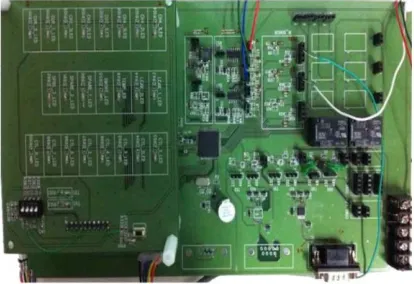
Fig. 1.2.1.1 The implemented MCU board for the control of sensor and LED
Smart Personal Sensor Network Control for Energy Saving in DC Grid Powered LED Lighting System proposed by Yen Kheng Tan in 2012 on IEEE. [2]
Fig. 1.2.1.2 Deployment of smart personal sensor network control for energy saving in dc grid
powered LED lighting system
Development of Smart LED Lighting System Using Multi–Sensor Module and Bluetooth Low Energy Technology proposed by Young Seek Cho,Jaerock Kwon ,Seyeong Choi and Dae-Hee Park in 2014 IEEE SECON Posters IEEE
International Conference on Sensing,
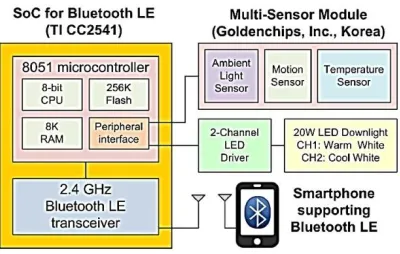
Communications and Networking (SECON). [3] This paper was proposed in 2014 which developed a smart bulb which can be controlled through communicate via Bluetooth to control the function of bulb. It has so many sensors like temperature measuring sensor, light intensity sensor and many more. But this system is depending on your instructions. This system does not operate automatically. Bluetooth is not a strong medium as compare to Wi-Fi or others.
Fig. 1.2.1.3 High level block diagram of the proposed LED lighting system
Fig. 1.2.1.4 A picture of the smart LED lighting system implemented
A low cost, highly scalable Wireless Sensor Network Solution to achieve smart LED light control for Green Buildings proposed by M. Magno, Member, IEEE, T. Polonelli, L. Benini Fellow, IEEE, E. Popovici , Senior Member, IEEE published in 2015. [4]
This paper was published in 2015 based on wireless sensor to control the light bulbs. They were using wireless sensors and control it manually to save electricity especially for offices. This system was not automatically controlled. The system combines motion sensors and light sensors in a low power wireless solution using Zigbee communication.
Fig. 1.2.1.5 Smart Lighting
A Smart LED Lighting with Multiple
Dimming and Temperature Automatic
Protection Capabilities proposed by Kai-Lun Chen a, Hao-Ping Chan b, Yu- Cherng Hung c, Shao-Hui Shieh d in 2016 International Symposium on Computer, Consumer and Control. [5]
That is why this system is not that much effective as our system is.
Fig. 1.2.1.6 LED lamp system
Fig. 1.2.1.7 The temperature distribution Even there so many companies like Philips and many more proposed a smart bulb which can be controlled through your smartphone using Wi-Fi and GPS. As per their implementation closure they didn’t published their idea of forming smart bulb.
3. PROBLEM STATEMENTS
Existing system is not intelligent enough to sense when is should be turn off or on. It is manually controlled through smartphone, it has convenience of remote access but when you are sleeping or when you are not at your house, you have to check whether it is on or not then you may turn off or on it, some kind of effort and concern are required in this system. That is why this system is lacking somewhere which is required to overcome.
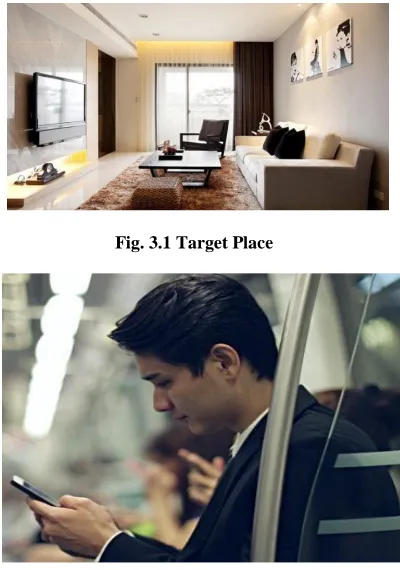
Fig. 3.1 Target Place
Fig. 3.2 Control via Smartphone
Fig. 3.3 Bulb Controlled via Smartphone
4. PROPOSED WORK
4.1Smart Light Bulb:
Fig. 4.1.1 Working on Living Room
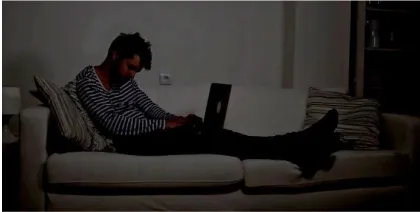
Suddenly you got sleep, then by present smart LED it is impossible to turn off light automatically, you will have to turn it off either by your smartphone or your switch.
Fig. 4.1.2 Sleep Detection
But the proposed system will sense your movement till 1 hour and accordingly it will turn off your bulb automatically as figure 4.1.3 given below.
Fig. 4.1.3 turned off after sleep detection
sense if you are not in your room for half an hour then it will turned off your bulb automatically, then whether you are sleeping in your bed room or you are not in your home or you forgot to switch off your bulb.
Fig. 4.1.4 Working on living room
Fig. 4.1.5 No one is detected in room Fig.
Fig. 4.1.6 turned off after detection
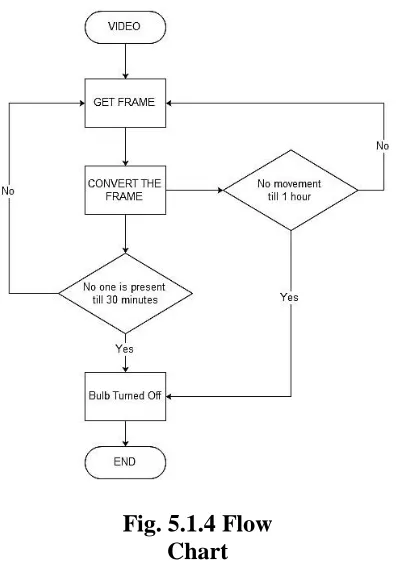
and compare it with the real time video for change detection, human motion detection and hand posture recognition signal.
Fig. 5.1.1 Presence Detection
Fig. 5.1.2 Sleep Detection
Fig. 5.1.3 Hand Recognition Signal
Fig. 5.1.4 Flow
Chart
6.CONCLUSION
Thus the real time vision based smart bulb avail you to save your electricity automatically and also save you and your house from electrical casualty. The present system has no potential to works or sense automatically but the proposed one will definitely avail you an intelligent bulb which turn your life easier as you think. Because we are going to the era of automation where everything will be operated automatically and intelligent enough to work accordingly and known for best decision making.
7. FUTURE SCOPE
The current proposed concept of real time vision based smart bulb definitely get enhanced in future because we can also develop a system which can control you home appliances automatically using intelligent approach like your fan, cooler, television and many more which will turn you stress less.
8.REFERENCES
[1] Smart LED lighting system implementation using Human tracking US/IR sensor proposed by Daeho Kim1, Junghoon Lee1 and Yeongmin Jang2, Jaesang Cha1*in 978-1-4577-1268-5/11/$26.00 ©2011 IEEE.
[2] Smart Personal Sensor Network Control for Energy Saving in DC Grid Powered LED Lighting System proposed by Yen Kheng Tan in 2012 on IEEE.
Technology proposed by Young Seek Cho, Jaerock Kwon , Seyeong Choi and Dae-Hee Park in 2014 IEEE SECON Posters -- IEEE International Conference on Sensing, Communications and Networking (SECON).
[4] A low cost, highly scalable Wireless Sensor Network Solution to achieve smart LED light control for Green Buildings proposed by M. Magno, Member, IEEE, T. Polonelli, L. Benini Fellow, IEEE, E. Popovici , Senior Member, IEEE published in 2015.