http://www.sciencepublishinggroup.com/j/ajme doi: 10.11648/j.ajme.20170304.12
Asymmetry Interactions of Electrons and Positrons in
Strong Pulsed Laser Fields
Stanislav Starodub
1, Sergei Roshchupkin
2, Viktor Dubov
21
Institute of Applied Physics, National Academy of Sciences of Ukraine, Sumy, Ukraine
2
Department of Theoretical Physics, Peter the Great St. Petersburg Polytechnic University, St-Petersburg, Russian Federation
Email address:
[email protected] (S. Starodub), [email protected] (S. Roshchupkin), [email protected] (V. Dubov)
To cite this article:
Stanislav Starodub, Sergei Roshchupkin, Viktor Dubov. Asymmetry Interactions of Electrons and Positrons in Strong Pulsed Laser Fields. American Journal of Modern Energy. Vol. 3, No. 4, 2017, pp. 65-72. doi: 10.11648/j.ajme.20170304.12
Received: May 15, 2017; Accepted: June 15, 2017; Published: July 21, 2017
Abstract:
The interaction of two electrons and two positrons in the field of two strong pulsed laser waves outside the framework of the dipole approximation (with an accuracy of relativistic corrections v/c) has been studied theoretically. The possibility of significant asymmetry in the interactions of particles and antiparticles in the external laser fields is shown. This asymmetry of interactions essentially depends on the magnitude and sign of the phase shifts of the waves relative to each other, and also on the intensities of the waves. The ranges of phase shifts and field intensities in which the interaction of electrons and positrons have qualitatively different character from anomalous repulsion to attraction are determined.Keywords:
Nonrelativistic Electrons and Positrons, Strong Femtosecond Laser Pulsed Fields, Effective Interaction, Phase Shift1. Introduction
There are many works devoted to research of interaction of electrons in the presence of an electromagnetic field (see, the works [1-9]). The possibility of electron attraction in the presence of a plane electromagnetic wave was firstly assumed by Oleinik [4]. However, the theoretical proof of the attraction possibility was given by Kazantsev and Sokolov for interaction of classical relativistic electrons in the field of a plane wave [5]. It is worth noting the work [6] also. It is very important to point out, that attraction of classical electrons in the field of a plane monochromatic electromagnetic wave is possible only for particles with relativistic energies. In the authors works (see, review [3], articles [7-9]) the possibility of attraction of nonrelativistic electrons (identically charged ions) in the pulsed laser field was shown. Thus, in the review [3] the following processes were discussed: interaction of electrons (light ions) in the pulsed field of a single laser wave; interaction of nonrelativistic electrons in the pulsed field of two counter-propagating laser waves moving perpendicularly to the initial direction of electrons motion; the interaction of nonrelativistic light ions moving almost parallel to each other in the propagation direction of the pulsed field of two
counter-propagating laser waves moving in parallel direction to ions; interaction of two nonrelativistic heavy nuclei (uranium 235), moving towards each other perpendicularly to the propagation direction of two counter-propagating laser waves. The effective force of interaction of two hydrogen atoms (after their ionization) in the pulsed field of two counter-propagating laser waves was considered in [7]. Influence of pulsed field of two co-propagating laser waves on the effective force of interaction of two electrons and two identically charged heavy nuclei was studied in [8]. The main attention is focused on the study of the influence of phase shifts of the pulse peak of thesecond wave relatively to the first on the effective force of particles interaction. The phase shift allows to increase duration of electron's confinement at a certain averaged effective distance by 1,5 time in comparison with the case of one and two counter-propagating pulsed laser waves. Interaction of two classical nonrelativistic electrons in the strong pulsed laser field of two light mutually perpendicular waves, when the maxima laser pulses coincide, was studied in [9]. It is shown that the effective force of electron interaction becoming the attraction force or anomalous repulsion force after approach of electrons to the minimum distance.
field of mutually perpendicular strong laser waves is studied with allowance for their phase shifts of the pulses. The ranges of intensities and phase shifts of waves are determined for which the effective interaction of two particles (electrons) and two antiparticles (positrons) is essentially asymmetric. The obtained results can be used for experiments in the framework of modern research projects, where the sources of pulsed laser radiation are used (SLAC, FAIR) [10-12].
2. Equations of Particles Interaction in
Pulsed Field of Two Laser Waves
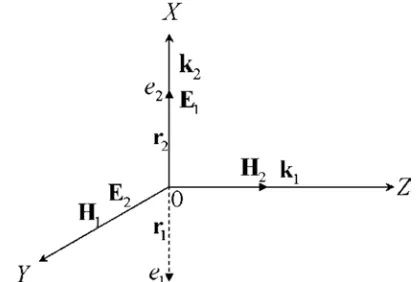
Consider the interaction of two nonrelativistic electrons (positrons) moving towards each other along the axisxin a field of two linearly polarized pulsed electromagnetic waves. Waves propagate perpendicularly to each other. The first wave propagates along the axis z , the second wave propagates along the axisx (see Figure 1).
Figure 1. Interaction kinematics of two classical electrons (positrons) in the field of two light mutually perpendicular waves.
The strengths of the electric and magnetic fields are given in the following form:
(
t z x, j, j) ( ) ( )
= 1 t z, j + 2 t x, j ,E E E (1)
( )
1 1 2(
)
1 01 1 1 1 1
1 1
, j exp j cos j x, j j ,
t z E t k z
t
ϕ δτ
ϕ ϕ ω
ω
−
= ⋅ − ⋅ = −
E e (2)
( )
2 2 2(
)
2 02 2 2 2 2
2 2
, j exp j cos j y, j j ,
t x E t k x
t
ϕ δτ
ϕ ϕ ω
ω
−
= ⋅ − ⋅ = −
E e (3)
(
t z x, j, j)
= 1( )
t z, j + 2( )
t x, j ,H H H (4)
( )
1 1 21 01 1
1 1
, j exp j cos j y,
t z H
t
ϕ δτ
ϕ ω
−
= ⋅ − ⋅
H e (5)
( )
2 2 22 02 2
2 2
, j exp j cos j z,
t x H
t
ϕ δτ
ϕ ω
−
= ⋅ − ⋅
H e (6)
where
ϕ
ij are the phases of corresponding wave (i=1, 2)and corresponding particle ( j=1, 2);
E
0i and H0i are the strength of electric and magnetic field in the pulse peak, respectively; δτiare the phase shifts of pulse peaks of the first and second waves; ti and ωi are the pulsedurations and frequency of the first and the second wave;
x
e , ey, ez are unit vectors directed along the
x
, y andz axes.
It is well-known fact that in a frame of the dipole approximation (k=0) and without taking into account terms of the order v c/ << 1 the particle interaction with plane-wave field does not affect on the particle relative motion in center-of-mass system. Thereby should consider the particle motion in the laser field beyond to the dipole approximation and an accuracy of quantities of order /v c<< 1(
v
is the relative velocity). Newton equations for motion of two identically charged particles with the mass m and charge e( e= =e1 e2 ) in the pulsed field of two mutually perpendicular laser waves (1) - (6) are determined by following expressions:
(
)
(
)
3(
)
2
( ) ( ) ( ) ( ) ( ) ( ) ( ) ( )
1 1 1 1 1 1 2 1
( ) ( )
2 1
1
, , , , e ,
m e t z x t z x
c
= − −
−
+ ×
r r r
r r
r H
E
∓ ∓ ∓ ∓ ∓ ∓ ∓ ∓
∓ ∓
ɺɺ ∓ ɺ (7)
(
)
(
)
3(
)
2
( ) ( ) ( ) ( ) ( ) ( ) ( ) ( )
2 2 2 2 2 2 2 1
( ) ( )
2 1
1
, , , , e ,
m e t z x t z x
c
= + −
−
+ ×
r r r
r r
E r H
∓ ∓ ∓ ∓ ∓ ∓ ∓ ∓
∓ ∓
ɺɺ ∓ ɺ (8)
where r1( )∓ and r2( )∓ are electrons (sign of the charge is “–”) or positrons (sign of the charge is “+”) radius-vectors.
Subsequent consideration should be carry out in the center-of-mass system:
( ) ( ) ( )
2 1 .
= −
r∓ r∓ r∓ (9)
There are following equations for particle relative motion in the center-of-mass system:
(
)
2 3 ( ) ( ) ( ) ( ) ( ) ( ) 2 ,x x y y z z
e
mr = e Μ + Μ + Μ
r
r e e e
∓ ∓ ∓ ∓ ∓
∓
ɺɺ ∓ (10)
( )
( )
( )
( )
( )
( )
( ) ( ) ( ) ( ) 1 2 ( ) ( ) ( ) 2 ( ) ( ) 1 1 12sin sin cos cos ,
2
1
2 sin sin cos , 2
1
cos ,
z
x z y
x
y x
z x
r
f t k r t f r t
c c
r
f t k r t
c
f r t
c ω ω ω ω ω ω ′ ′ Μ = − + ′ Μ = − ′ Μ = ∓ ∓ ∓ ∓ ∓ ∓ ∓ ∓ ∓ ɺ ɺ ɺ ɺ (11)
(
)
( )
(
( )
)
2 2 1 21 01 2 2 02 2
1 2
exp t , exp t .
f E f E
t t
ω δτ
ω δτ
ω
ω
− − ′= − ′= − (12)Note that equations for relative motion (10) -(12) are written beyond to the dipole approximation
(
k≠0)
and anaccuracy of term of order /v c<< 1. Note, small influence of external strong pulsed laser field on radius-vector of the center-of-mass motion was shown in the work [9]. Thereby, study of relative motion of electrons (positrons) makes sense
to be done only.
Equations (10) - (11) have to be written in the dimensionless form:
(
)
( ) ( ) ( ) ( ) ( ) 3 ( ), β Nx x Ny y Nz z ,
=F F= ⋅ ξ + +
ξ e e e
ξ ∓ ∓ ∓ ∓ ∓ ∓ ɺɺ ∓ (13)
( )
( )
( )
( )
( )
( )
( ) ( ) ( ) ( )1 1 2 2
( ) ( ) ( ) 2 2 ( ) ( ) 1 1
sin sin cos cos ,
2 2
sin sin cos ,
2 2 cos , 2 z z x y x x y x z
N f f
N f N f ξ ξ η τ τ η ξ τ ξ ξ η τ τ ξ η τ = − + = − = ∓ ∓ ∓ ∓ ∓ ∓ ∓ ∓ ∓ ɺ ɺ ɺ ɺ (14) where, ( ) ( ) ( ) 1,2 1,2 , , ,
k
τ ω τ
tω
t= = = =
ξ∓ r∓ r∓ Ż (15)
(
)
22 0
2 2
, ; 2, exp , 1, 2.
i i
i i
i
e E e
m f i
c c τ δτ η β µ µ ω µ τ − = = = = − = Ż (16)
Here, ξ( )∓ is the radius-vector of the relative distance between electrons (positrons) in units of the wavelength, the parameters
η
1,2 are numerically equal to ratio of an oscillation velocity of a particle in the peak of pulse of the first or second wave to the velocity of light c(hereinafter, should consider parametersη
1,2 as oscillation velocities); theparameter
β
is numerically equal to ratio of the energy of Coulomb interaction of particles with reduced mass µ at thewavelength to the particle rest energy. The pulse duration exceeds considerably the period of wave rapid oscillation (∼ω−1) for a majority of modern pulsed lasers:
1,2>> 1.
τ
(17)2
( ) ( )
0
1
.
2 d
π
ξ ξ τ
π
=
∫
⋅∓ ∓
(18)
It is worth emphasizing that in the expression for the effective force F (13) the first summand corresponds to the Coulomb repulsion of like-charged particles, and the second summand corresponds to the interaction of charged particles with the external laser field. It is important to note that for electrons and positrons this interaction has a different sign (see the sign before the second summand in expression (13)). Because of this, in the external laser field, the symmetry disappears in the interaction of particles of the same charge, but of different sign.
Note that expressions (13), (14), consider interaction with the Coulomb field and the pulsed-wave field strictly, and don't have the analytical solution. For subsequent analysis all equations will study numerically.
Electrons (positrons) initial relative coordinates and velocities are the following:
( ) ( ) ( )
0 0 0
( ) 3 ( ) ( )
0 0 0
2, 0, 0,
1.7 10 , 0, 0.
x y z
x y z
ξ ξ ξ
ξ − ξ ξ
= = =
= − ⋅ = =
∓ ∓ ∓
∓ ∓ ∓
ɺ ɺ ɺ (19) The interaction time is
τ
∈ −[
600 600÷]
and it was increased, if necessary for more clear results. Frequencies of waves areω ω
1= 2 =2 Ps−1 (Ż=0.15 mµ ), pulse durations are τ1=τ2 =600 ( t1= =t2 300 fs ). Field intensities (oscillations velocitiesη η1, 2) are varied. Phase shifts arevary within
δτ
1,2∈ −[
600 600÷]
and step ish=50. Initial conditions are the same as in [9]. That allows to estimate influence of phase shifts on relative motion of electrons and compare results. Note, in the work [9] the parameter of the phase shift of a pulse of a wave (δτ
1,2=0) was absent, andpulse peaks of both waves were in moment τ =0.Initial coordinates and velocities of electrons (positrons) are chosen so that at the point τ =0 particles were in maximum
approach (the Coulomb force was maximum). In this work the pulse peaks of waves can have maximum at given moment of time (
τ δτ
= 1,2 ) and it’s leads to significant change in the behavior of electron (positron) interaction. Numerical solving of equations for relative motion (13) results to several cases.3. Anomalous Repulsion
The case when the oscillation velocity of the first wave is greater than the initial velocity of particles (
η ξ
1> ɺ0∓), and oscillation velocity of the second wave considerably exceeds the initial velocity (η
2 ≫ξ
ɺ0∓ ). Let designate the final distance at which electrons and positrons scatter in the time moment τ( )( )C final∓ ≡τ( )C final =600: without an external fieldas ξ( )( )C final∓ ≡ξ( )C final =2 ; in the external field, when
1 0, 2 0
δτ = δτ = as ξ(0)( )−final for electrons and ξ(0)( )+final for positrons; in an external field, when δτ1≠0,δτ2≠0 as
( ) final
ξ − for electrons and ( ) final
ξ + for positrons.
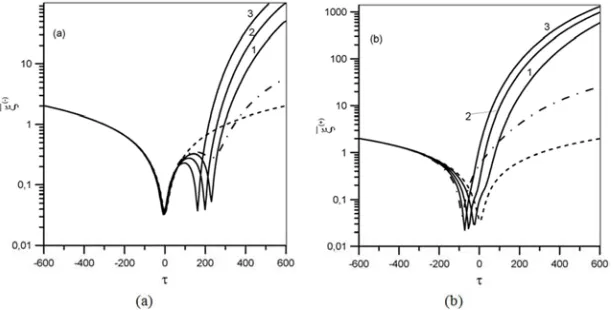
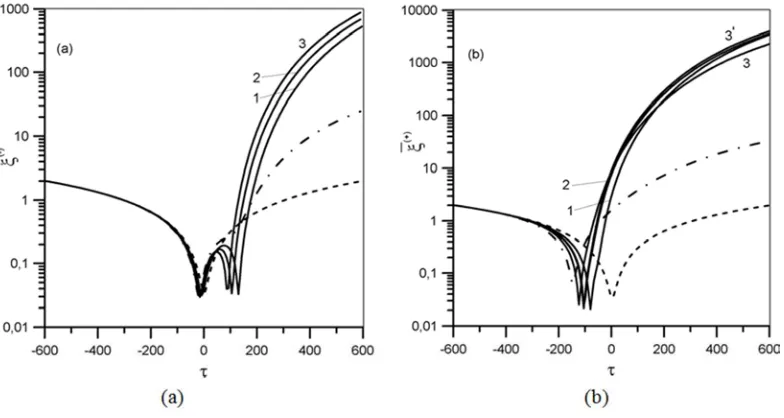
Figures 2 and 3 show the average relative distances (in logarithmic units) between electrons (a) and positrons (b) against the interaction time
τ
.Figure 2 shows the average relative distances between electrons (see Figure 2(a)) and positrons (see Figure 2(b))for the velocities of oscillations of two waves
η
1= ×3 10−3,2 2 6 10
η
= × − , and for different values of the phase shifts ofboth waves (curves 1, 2, 3 in Figure 2). For electrons and positrons, the same initial conditions, intensities, and phase shifts of the waves were chosen. It's seen from Figure 2 that for phase shifts of waves having different signs (for the first wave the phase shift is negative, and for the second wave - positive), electrons and positrons abnormally strongly repulse. Moreover, it is possible to select such phase shifts of waves (see curves 3 in Figure 2(a) and Figure 2(b)), when the anomalous repulsion becomes maximum.
Figure 2. The averaged relative distance ξ( )∓ of electrons (a) and positrons (b) against the interaction time
τ
. The dashed line corresponds to the case ofthe absence of the external field. The dashed-dot line and solid lines correspond to oscillation velocities: 3 1 3 10
η = × − , 2
2 6 10
η = × − (field intensities:
12 2
1 3 4 10. W cm
I = × , 15 2
2 1.3 10 W cm
I = × ), phase shifts of pulse peaks: 1- δτ1= −450,δτ2=450; 2- δτ1= −350,δτ2=300; 3- δτ1= −550,δτ2=250; the dashed-dot
Thus, for electrons at time τ =600 for phase shifts
1 450, 2 450
δτ = − δτ = , the ratio of the average relative distance in the laser field to the corresponding value without a field is ξfinal( )− ξ( )C final ≈24(see curve 1in Figure 2(a)). At
this, for positrons this ratio is ξfinal( )+ ξ( )C final≈293 (see
curve 1in Figure 2(b)), i.e. an order of magnitude greater than the corresponding distance for electrons (ξfinal( )+ ξfinal( )− ≈12).
By analogy, for phase shifts δτ1= −350,δτ2=300 for
electrons ξfinal( )− ξ( )C final≈48 (see curve 2 in Figure 2(a))
and for positrons ξfinal( )+ ξ( )C final ≈506(see curve 2 in Figure
2(b)). At this, the ratio of final positron and electron distances is ξfinal( )+ ξfinal( )− ≈10 . For phase shifts
1 550, 2 250
δτ = − δτ = for electronsξfinal( ) ξ( )C final 81
− ≈
(see
curve 3 in Figure 2(a)) and for positronsξfinal( )+ ξ( )C final ≈673
(see curve 3 in Figure 2(b)). The ratio of final positron and electron distances is ξfinal( )+ ξfinal( )− ≈8 . It is important to
emphasize that with zero phase shifts, the effective repulsive force becomes significantly smaller (the corresponding averaged distances for electrons and positrons are an order of magnitude smaller).
Figure 3. The averaged relative distance ξ( )∓ of electrons (a) and positrons (b) against the interaction time
τ
. The dashed line corresponds to case withoutexternal field. The dashed-dot line and solid lines correspond to oscillation velocities: η1= ×3 10−3, 1 2 10
η = − (the field intensities: 12 2
1 3 4 10 W cm.
I = × ,
15 2
2 3.8 10 W cm
I = × ), the phase shifts of pulse peaks: 1- δτ1= −300,δτ2=350; 2- δτ1= −400,δτ2=300 ; 3- δτ1= −450,δτ2=250 ; 3′-
1 450, 2 300
δτ = − δτ = ; the dashed-dot line - δτ1=0,δτ2=0.
An increase in the rate of oscillations velocity of the second wave to a maximum value
η
2 =10−1 leads to a significant increase in values of final distances, to which particles and antiparticles are scattered. In this case, for phase shifts δτ1= −300, δτ2 =350 and for electrons the ratio ofthe average relative distance in the laser field to the corresponding value without a field is ξfinal( ) ξ( )C final 263
− ≈
(see curve 1 in Figure 3(a)). For positrons, this ratio is
( )
( )C final 1670 final
ξ + ξ ≈ (see curve 1 in Figure 3(b)). For
phase shifts δτ1= −400, δτ2 =300 for electrons the ratio is ( )
( )C final 341 final
ξ − ξ ≈
(see curve 2 in Figure 3(a)) and for
positrons ξfinal( )+ ξ( )C final ≈1766 (see curve 2 in Figure 3(b)).
For phase shifts δτ1= −450,δτ2=250 for electrons the
ratio is ξfinal( ) ξ( )C final 437
− ≈
(see curve 3 in Figure 3(a)) and
for positrons ξfinal( )+ ξ( )C final ≈1110 (see curve 3 in Figure
3(b)). With not large increase in the phase shift of the second wave, the positrons scatter much further. So for phase shifts
1 450, 2 300
δτ = − δτ = for positrons the ratio is
( )
( )C final 1903 final
ξ + ξ ≈
(see curve 3' in Figure 3(b)).
4. The Effective Slowing-Down of
Particles
In contrast to the previous section, consider the case, when the oscillation velocity η1 has to be close to the initial
relative velocity
η ξ
1≈ ɺ0∓ and the oscillation velocity η2 is greater an order of magnitude. Let designate the time at which the averaged relative distance between electrons or positrons is equal to ξ( )C final =2: in the external field, when1 0, 2 0
δτ = δτ = - τ(0)( )∓ ; in the external field, when
1 0, 2 0
δτ ≠ δτ ≠ - τ( )∓ .
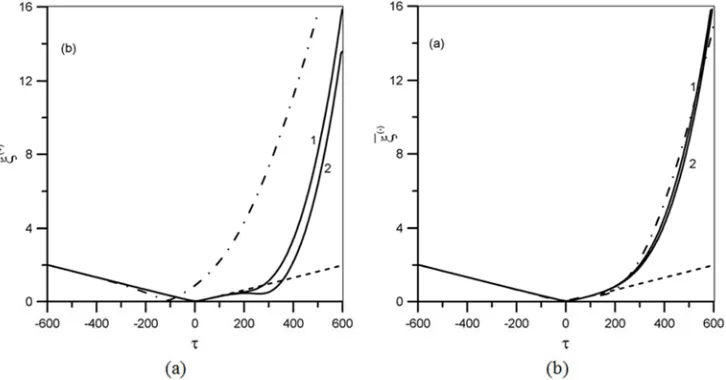
Figures 4 and 5 show the average relative distances between electrons (see Figures 4a and 5a) and positrons (see Figures 4b and 5b) for oscillations velocities of two waves
3
1 0 1.7 10
η ξ
= ɺ = × − , 22 3 10
η
= × − , and for different values ofphase shifts of both waves with same signs (for the first and second waves the phase shift is positive, see curves 1, 2 in Figure 4 and Figure 5).
For electrons and positrons, the same initial conditions, intensities, and phase shifts of the waves were chosen. It is seen from Figure 4 that in the selected range of phase shifts
δτ δτ
1, 2∈[
300 400÷]
, for electrons s, the attraction effect takes place (see Figure 4(a)), and for positrons the repulsion effect takes place (see Figure 4(b)).At the same time, it is seen from Figure 5 that for another set of valuesof phase shifts
δτ δτ
1, 2∈[
500 600÷]
the opposite Figure 4 picture is obtained: positrons are attracting, and electrons are repulsing. Let's analyze in more detail Figure 4 and Figure 5.Figure 4 shows that for phase shifts δτ1=350 ,
2 400
δτ = the time of electron scattering to the initial value of the distance ( ξfinal( )− =2 ) is increased in
comparison with the case without an external field to
( )
( )C final 13.5
τ − τ ≈ (see curve 1 and the dashed line in
Figure 4(a)). In the external field when δτ1 =0, δτ2=0
the time is increased to
τ
( )−τ
(0)( )− ≈4 (see curve 1 and thedashed-dot line in Figure 4(a)). The effect is a bit weaker for phase shifts δτ1=300 , δτ2 =300 (see curve 2 in
Figure 4(a)). Under the same conditions, positrons effectively repulse and scatter over longer distances than without an external field ξfinal( )+ ξ( )C final ≈2.3(see curve 1
and the dashed line in Figure 4(b)), but these distances are two times less than without the phase shifts
( ) ( )
(0)final 0.5 final
ξ + ξ + ≈
(see curve 1 and the dashed-dot line in Figure 4(b)). Note that for curve 2 in Figure 4(b)the similar results are obtained: ( )
( )C final 3.3 final
ξ + ξ ≈ (see curve 2
and the dashed line in Figure 4(b)) and
( ) ( )
(0)final 0.7 final
ξ + ξ + ≈ (see curve 2 and the dashed-dot line
in Figure 4(b)).
Figure 4. The averaged relative distance of electrons (a) and positrons (b) against the interaction time
τ
. The dashed line corresponds to case without external field. The dashed-dot line and solid lines correspond to the oscillation velocity: 31 0 1.7 10
η ξ= ɺ = × − , 2 2 3 10
η = × − (the field intensity:
12 2
1 1.1 10 W cm
I = × , 14 2
2 3.4 10 W cm
I = × ), phase shifts of pulse peaks: 1-δτ1=350,δτ2=400, 2-δτ1=300,δτ2=300; the dashed-dot line -
1 0, 2 0
δτ = δτ = .
Figure 5 shows that for phase shifts δτ1=550,δτ2=500 electrons repulse and scatter over longer distances than without an external field: ( )
( ) 1.8
final C final
ξ − ξ ≈ (see curve 1
and the dashed line in Figure 5(a)) and in an external field without phase shifts: ( ) ( )
(0) 4.3
final final
ξ − ξ − ≈ (see curve 1 and the dashed-dot line in Figure 5(а)). For phase shifts
1
550,
2600
δτ
=
δτ
=
the similar results are obtained:( )
( ) 1.7
final C final
ξ
−ξ
≈(see curve 2 and the dashed line in
Figure 5(a)) and in an external field without phase shifts:
( ) ( )
( 0) 4
final final
ξ
−ξ
− ≈(see curve 2 and the dashed-dot line in
initial distance in a longer time than without an external field: ( )
( )C final 1.3
τ
+τ
≈(see curve 1 and the dashed line in
Figure 5(b)) and even more slowly than in an external field without phase shifts: ( ) ( )
(0) 2.9
τ + τ+ ≈ (see curve 1 and the dashed-dot line in Figure 5(b)).
With increasing intensity of the second wave to maximum
values
η
2=
10
−1 and same phase shifts as in Figure 5(
δτ δτ
1,
2∈
[
500 600
÷
]
), the behavior of electrons andpositrons becomes similar (repulsion takes place) (see Figures 6(a), (b)).
Figure 5. The averaged relative distance ξ( )∓ of electrons (a) and positrons (b) against the interaction time
τ
. The dashed line corresponds to case without external field. The dashed-dot line and solid lines correspond to the oscillation velocity: 31 0 1.7 10
η ξ= =ɺ × − , 2
2 3 10
η = × − (the field intensity:
12 2
1 1.1 10 W cm
I = × , 14 2
2 3.4 10 W cm
I = × ), phase shifts of pulse peaks: 1-δτ1=550,δτ2=500, 2-δτ1=550,δτ2=600; the dashed-dot line - δτ1=0,δτ2=0.
Figure 6. The averaged relative distance ξ( )∓ of electrons (a) and positrons (b) against the interaction time τ. The dashed line corresponds to case without external field. The dashed-dot line and solid lines correspond to the oscillation velocity: 3
1 0 1.7 10
η ξ=ɺ = × −, 1 2 10
η = − (the field intensity: 12 2 1 1.1 10 W cm
I= × ,
15 2
2 3.8 10 W cm
I = × ), phase shifts of pulse peaks: 1-δτ1=550,δτ2=500, 2-δτ1=550,δτ2=600; the dashed-dot line - δτ1=0,δτ2=0.
5. Conclusion
The study of the interaction of two electrons and two positrons in strong laser fields has shown a significant asymmetry in the effective interaction of particles and antiparticles. This asymmetry essentially depends on the magnitude and sign of phase shifts of waves relative to each other and intensities of both waves.
If the phase shifts of the waves have different signs (for the
If the phase shifts of both waves have the same sign (for the first and second waves the phase shift is positive), then the interaction of the particles varies significantly. If the velocities of the wave oscillations do not differ much from
each other ( 3
1 0 1.7 10
η ξ
= ɺ = × − , 22
3 10
η
= ×
−) and the values
of phase shifts are in the range
δτ δτ
1, 2∈[
300 400÷]
, then for electrons there is an attractive effect (see Figure4(a)), and for positrons - the effect of repulsion (see Figure4(b)). In this case, for another set of values of phase shifts[
]
1, 2 500 600
δτ δτ
∈ ÷ the opposite situation is obtained:positrons are attracting, and electrons are repulsing (see Figure 5).
In the range of phase shifts
δτ δτ
1, 2∈[
500 600÷]
and at the maximum intensity of the second wave (η2=0.1) the effective interaction of electrons and positrons occurs in a similar form (see Figure 6).References
[1] F. Ehlotzky, K. Krajewska, J. Z. Kami´nski, “Fundamental processes of quantum electrodynamics in laser fields of relativistic power,” Rep. Prog. Phys., vol. 72, 046401, 2009. [2] S. P. Roshchupkin, A. A. Lebed’, E. A. Padusenko, A. I.
Voroshilo, “Quantum electrodynamics resonances in a pulsed laser field,” Laser Phys., vol. 22, pp. 1113–1144, 2012. [3] S. S. Starodub, S. P. Roshchupkin, “Interaction of classical
nonrelativistic identically charged particles in a strong pulsed light field,” Laser Phys.,vol. 22, pp. 1202–1219, 2012.
[4] V. P. Oleinik, “Resonance effects in the field of an intense laser beam,”J. Exptl. Theoret. Phys. (U.S.S.R.), vol. 52, pp. 1049–1067, 1967.
[5] A. P. Kazantsev, V. P. Sokolov, “Interaction between electrons in a light wave,” Zh. Eksp. Teor. Fiz., vol. 86, pp. 896–905, 1984.
[6] S. T. Zavtrak, “Radiatione interaction of charges,” Letter in Zh. Teor. Fiz., vol. 15, pp. 14–16, 1989.
[7] S. S. Starodub, S. P. Roshchupkin, “Non-linear effects at ionization of hydrogen atoms in the strong pulsed light field,” Problems Atom. Sci. Technol., vol. 1, pp. 153–156, 2012. [8] S. S. Starodub, S. P. Roshchupkin, “Interaction of identically
charged particles in a pulsed field of two laser waves propagating in the one direction,” Laser Phys., vol. 25, 076001 (8pp), 2015.
[9] S. S. Starodub, S. P. Roshchupkin, V.V. Dubov, “The anomalous interaction of electrons in strong pulsed light fields,” Laser Phys. Lett., vol. 13, 116001 (6pp), 2016. [10] C. Bula et al, “Observation of nonlinear effects in Compton
scattering,” Phys. Rev. Lett., vol. 76, pp. 3116–3119, 1996. [11] D. L. Burke et al, “Positron production in multiphoton
light-by-light scattering,” Phys. Rev. Lett., vol. 79, pp. 1626–1629, 1997.