4572
Development Of Geometric Creativity Of
Secondary School Students By Computer
Kuralov Yuldash Abdullaevich
Abstract : The search for ways to develop geometric creativity of students in the study of mathematics in secondary schools is traditionally carried out by researchers in the direction of the external activity of children in the lesson, characterized by the measure of their involvement in the implementation of educational tasks and related to the form of organization of educational classes, and in the direction of internal activity, characterized by the level of heuristic creativity and related to the implementation of creative tasks, resolution of problem situations. Without reducing the significance of each of these approaches individually, we note that both of them in a real educational process should be harmoniously synthesized. Moreover, an analysis of the features of the multifaceted process of creativity shows that a comprehensive development of all components of geometric creativity that characterize its essence is necessary. The hypothesis of the study is as follows: if you characterize the specifics of geometric activity, determine the component composition of geometric creativity and develop methodological support for the development of each of the selected components using constructive-dynamic, visualization, animation and other computer capabilities, this will allow you to purposefully develop the creative abilities of general education school’s students when studying geometric material. The methods, means and forms of the development of geometric creativity of schoolchildren are determined in the article, conclusions are developed.
Keywords: creative technologies, special tasks, geometric problems, problematic teaching, creative thinking in geometry, animation, computer technology.
—————————— ——————————
1
INTRODUCTION
Modern society cannot function effectively without finding new ways of developing the creative activity of people in all spheres of life. Its improvement involves the education and training of highly educated people who are prone to creative activity in various fields of science, culture and technology. In conditions of accelerating scientific, technical and social progress, the formation of a creative personality is one of the strategic goals of modern pedagogy and school. The most important is the task of developing the intellectual abilities of children, the ability to think, creatively solve problems that arise in the process of life. Simply assimilating the totality of knowledge by children is no longer enough; there is a need for the young generation to form a need for independent creative activity and to develop their mental abilities.
2. MATHERIALS
AND
METHODS
The object of research is the process of geometric education of students of secondary schools. The subject of the study is a methodological system for the development of geometric creativity of students in secondary schools using information technology training. The purpose of the study is to develop methodological foundations for the development of geometric creativity of students of secondary schools by means of information technology training. Studies of the ways of developing geometric creativity of students in the study of mathematics in secondary schools are traditionally conducted by researchers in the direction of the external activity of children in the lesson, characterized by the measure of their involvement in the implementation of educational tasks and related to the form of organization of educational classes, and in the direction of internal activity, characterized by the level of heuristic creativity and related to the implementation of creative tasks, resolution of problem situations.
Without reducing the significance of each of these approaches individually, we note that both of them in a real educational process should be harmoniously synthesized. Moreover, an analysis of the features of the multifaceted process of creativity shows that a comprehensive development of all components of geometric creativity that characterize its essence is necessary. The hypothesis of the study is as follows: if you characterize the specifics of geometric activity, determine the component composition of geometric creativity and develop methodological support for the development of each of the selected components using constructive-dynamic, visualization, animation and other computer capabilities, this will allow you to purposefully develop the creative abilities of general education students schools when studying geometric material. To achieve this goal and test the hypothesis formulated, it was necessary to solve the following main tasks: - based on the analysis of psychological, pedagogical and
methodological literature on the research problem, characterize the essence of geometric creativity and disclose approaches to the development of creative abilities of students of secondary schools in teaching geometry; - highlight the structural components of geometric creativity; - build a model for the development of geometric creativity of
students;
- develop methodological foundations for the development of each of the identified components of geometric creativity in the study of geometric material using information technology training;
- experimentally verify the effectiveness of the proposed
methodological tools in the practice of training.
Methodological foundations of the study:
- The concept of an active approach to the development of students' creative abilities in teaching geometry; the concept of a focused approach to the development of students' creative abilities in teaching geometry;
- psychological research on the problem of creativity (I. Torrens, J. Gilford, Ya.A. Ponomarev and others);
- research on the theory of teaching geometry in secondary schools. To solve the tasks, the following methods of pedagogical research were used: analysis of philosophical, psychological, pedagogical and methodical literature on the _________________________________________
research problem;
- the study of domestic and foreign experience in the development of creativity of students in mathematics; analysis of educational standards and curricula in geometry for a comprehensive school;
- system analysis of pedagogical objects;
- generalization of the existing experience of teachers in developing the creativity of students in secondary schools in teaching geometric material;
- experimental verification of the main provisions of the dissertation research using the developed teaching materials in a real educational process;
- statistical processing of data obtained during the experiment.
Literature Review. The need in modern conditions to rethink approaches to the development of creativity in the education system puts the focus of researchers on the problem of creativity and creativity. The problem of abilities, creativity and creative activity, the application of information technology in education was studied by many psychologists: B.G. Ananyev [2], V.L. Andreev [3], A.K. Artemev [4] V.V. Davydov [9], V.N. Druzhinin [11], V.A. Izvozchikov [12], Disterveg [10], Torrance [35], [36], C. Taulor [33], R. Sternberg [38], S.L.Rubinshteyn [27], N.F.Talyzina [29], E. Ogurcova [23 ], K.K.Platonov [25], Ja.A. Ponomarjov [26], M.N. Skatkin [28], O.V. Fyodrova [30], E.I. Mashbic [20] M.I. Mahmutov [19], E.V. Kuznecova [16], V.A. Kruteckij [15] and others. Scientists do not hold a single view on the concept of creative activity. Some stop at getting a certain C.JI product. Rubinstein and others), others focus on the procedural side of the matter (I.Ya. Lerner [17], P.I. Pidkasisty [24], etc.) Of particular relevance is the development of creative abilities and the formation of creative activity when learning geometry. The possibilities for the development of creative abilities and various aspects of the formation of creative activity during the training of geometry are reflected in the scientific and methodological works of many educators and mathematicians: S.Alikhonov [1], G.D. Glaser [6], A.Ya. Tsukar [32], V.A. Gusev [7], [8], M.V. Egupov [14], I.S. Bekesheva [5]. S.V. Maslova [18], A.K. Nasybulina [22], D.M. Makhmudova [21], A. Khamrakulov [31] and others. Theory and Discussion. The development of geometric creativity of students of secondary schools by means of information technology is due to several reasons. Firstly, a distinctive feature of the current stage of development of society is the rapid penetration of information technology in all areas of public life, which necessitates the assessment of existing approaches to learning, as well as the development of new ones. In this regard, the creation of a promising educational system that can prepare the world's population for life in the information society is one of the most important and urgent problems for the education sector. Secondly, at present, special attention is given in the secondary school to the developmental goals of instruction. Mathematics, like no other science, has great potential for the intellectual development of students. With the advent of computer technology, these capabilities have been further enhanced. So, it became possible to visualize the various stages of the geometric activity of students, to use the functions of a computer to develop spatial imagination, logical thinking, children's observation, flexibility and criticality of the mind. There was a need for a special study of the possibility of a purposeful and systematic use of information technology in order to develop in the process of teaching geometry the intellectual abilities of
4574 Example 1. Create a toric knot.
Questions:
1) What is a toric knot? 2) How can I draw a knot?
3) If we create multiple nodes in one image, how do you get a picture?
Example 2. A triangle is the simplest closed rectilinear figure, one of the first, the properties of which a person recognized in ancient times, since this figure has always been widely used in practical life. For centuries, the property of rigidity of the triangle has been used for centuries to strengthen various buildings and their details. The image of triangles and tasks on triangles are found in papyrus, in ancient Indian books and in other ancient documents. We examined the types of triangles, we know some of their properties, and today we will continue to study the properties of a triangle, regardless of its type.
Questions:
1) Remember what shape is called a triangle.
2) What can be the triangles depending on the size of the angles?
3) How many triangles can be placed in one triangle?
4) What do you think, if you fill a triangle with other triangles - what image can be obtained?
Example 3. Regular polyhedra (Platonic solids).
Questions:
1) What is a polyhedron?
2) How do you represent regular polyhedrons?
3) If you draw five regular polyhedra (Platonic solids), in rotation in each of the three dimensions, what will it look like?
Or, we can use Paint during class to paint a lot of geometric shapes.
The methodology for the formation of students' creativity in the process of teaching geometry is effective if it meets the following criteria:
• target - reflects the target vector of the formation of students' creativity in the process of learning geometry;
• informative - enriches the content of teaching geometry to students with creative-oriented geometric tasks at each stage of the model;
• organizational and procedural - it is a set of mutually dependent methods, forms and teaching aids adequate to the goals and content of the training (methods: heuristic methods, case study method, project method, game technologies, etc.; forms: various types of lectures, seminar, business game, independent work of students,
etc.; means: teaching aids, methodological
recommendations for studying a course at the students' choice, alternative forms of assignments, etc.);
• diagnostic - designed taking into account the specifics of the subject and provides reliable information about the dynamics of the level of geometric creativity of students in secondary schools.
1. EXPERIMENTALRESULTS The study was organized as follows:
- at the first stage, scientific, educational, psychological and pedagogical literature on the topic of dissertation research was studied and analyzed, the real state of the practice of the development of geometric creativity of students in secondary schools was analyzed, and a stating experiment was conducted;
- at the second stage, the conceptual provisions for the development of geometric creativity of students of
secondary schools using computer-based learning
technologies were determined, methodological materials were developed, and their initial testing was carried out; - at the third stage, a training experiment was conducted, the
results of the dissertation research were tested, an abstract and dissertation work were drawn up.
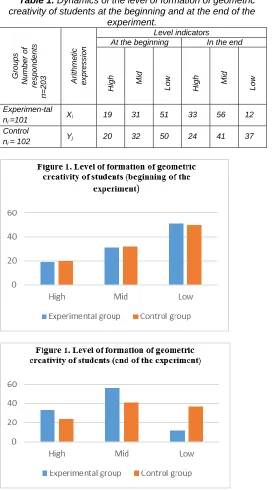
Table 1. Dynamics of the level of formation of geometric creativity of students at the beginning and at the end of the
experiment.
Gr
o
u
p
s
N
u
mbe
r
o
f
re
s
p
o
n
d
e
n
ts
n
=2
0
3 Arit
h
me
ti
c
e
x
p
re
s
s
ion
Level indicators At the beginning In the end
H
igh Mid
Low High Mid Low
Experimen-tal
ni =101 Xi 19 31 51 33 56 12 Control
ni = 102 Yj 20 32 50 24 41 37
The effectiveness of the developed methodology for the formation of geometric creativity of students in secondary schools has been experimentally confirmed.
4. CONCLUSION
1. Of particular importance in the development of geometric creativity of students of secondary schools are creative tasks selected in accordance with the model of geometric creativity, which can simultaneously influence the development of each of the three components of creativity: reproductive-variative, variably productive and creative-creative, that is. with the effect of complex effects.
2. The development of the reproductive-variable component of geometric creativity is advisable to carry out by completing tasks to determine the shape, size, location, relationships and transformations of geometric shapes.
3. The development of the variably productive component is realized through heuristic variation of geometric situations using dynamic, computational and other capabilities of information technologies.
4. The development of a creative-creative component is carried out by completing tasks for creating new geometric images, obtaining unusual geometric configurations, modeling the properties and dependencies of the elements of geometric shapes.
5. The conducted pedagogical experiment confirmed the effectiveness of the approach to the development of methodological foundations for the development of geometric creativity of students in secondary schools using the information technology of teaching described in the dissertation. The hypothesis of the study was confirmed.
5. REFERENCES
[1] Alikhonov S. «Matematika o‘qitish metodikasi»,
Tashkent, 1992, pp.146-200.
[2] Anan'ev, B.G. Psihologija chuvstvennogo
poznanija. -Moscow.: Nauka, 1960.- p. 486.
[3] Andreev, V.L. Dialektika vospitanija i
samovospitanija tvorcheskoj lichnosti. Kazan', 1988. – p. 240.
[4] Artemov, A.K. Priemy organizacii razvivajushhego
obuchenija. Nachal'naja shkola. 1995. - No.3. - pp. 35-39.
[5] Bekesheva (Egorova), I.S. Zadachnyj podhod k
formirovaniju kreativnoj kompetentnosti budushhih
uchitelej pri obuchenii matematike. Vestnik
Krasnojarskogo gosudarstvennogo
pedagogicheskogo universiteta im. V.P. Astaf'eva – Krasnojarsk: «Litera-print», 2017. – No.2
[6] Glejzer, G.D. Razvitie prostranstvennyh
predstavlenij shkol'nikov pri obuchenii geometrii. Moscow.: 1978. – p.103.
[7] Gusev, V.A. Geometrija 5-6 klassy: uchebnoe
posobie. M.JuOO TID «Russkoe slovo - RS», 2002. – p. 256.
[8] Gusev, V.A. Kak pomoch' ucheniku poljubit'
matematiku? Moscow.: Avangard, 1994. –pp.
142-168.
[9] Davydov, V.V. Teorija razvivajushhego obuchenija /
V.V. Davydov. -Moscow.: INTOR, 1996.- p. 544.
[10]Disterveg, F. Jelementarnaja geometrija dlja shkol i
voobshhe dlja nachinajushhih. F. Disterveg. SPb., 1870. – p. 109.
[11]Druzhinin, V.N. Psihologija obshhih sposobnostej.
Spb.: Izd-vo «Piter», 2000. – pp. 212-368.
[12]Izvozchikov, V. A. Infonoosfernaja jedukologija:
Novye informacionnye tehnologii obuchenija. SPb.: RGPU im. Gercena, 1991.- p. 120.
[13]Koljagin, Ju.M. Zadachi v obuchenii matematike.
Matematicheskie zadachi kak sredstvo obuchenija i razvitija uchashhihsja. Moscow.: Prosveshhenie, 1977. Ch. II. – p. 144.
[14]Egupova, M.V. Zadachi na prilozhenija matematiki
v metodicheskoj podgotovke uchitelja v pedvuze. Materialy XXXIV Mezhdunarodnogo nauchnogo seminara prepodavatelej matematiki i informatiki
universitetov i pedagogicheskih vuzov. – Kaluga.:
2015 – pp. 319-321
[15]Kruteckij, V.A. Psihologija matematicheskih
4576 Prosveshhenie, 1986. – pp. 145-416.
[16]Kuznecova, E.V. Jelementy tvorcheskoj
dejatel'nosti uchashhihsja V-VI klassov pri reshenii zanimatel'nyh zadach. Matematika v shkole. 1997. - No.5. - pp. 66-72.
[17]Lerner, I.Ja. Didakticheskie osnovy formirovanija
poznavatel'noj samostojatel'nosti uchashhihsja pri izuchenii gumanitarnyh disciplin: Avtoref. dis.dokt. ped. nauk: 13.00.02. Moscow.: 1971. – p.38.
[18]Maslova, S.V. Zadachi na poisk zakonomernostej
kak sredstvo formirovanija tvorcheskoj dejatel'nosti mladshih shkol'nikov pri obuchenii matematike: Diss. kand. ped. nauk: 13.00.02. Saransk, 1996. – p.162.
[19]Mahmutov, M.I. Organizacija problemnogo
obuchenija v shkole. Moscow.: 1997 – p. 194-240.
[20]Mashbic, E.I. Psihologo-pedagogicheskie problemy
komp'juterizacii obuchenija (Pedagogicheskaja
nauka reforme shkoly). - Moscow.: Pedagogika, 1988. – pp. 150-192.
[21]Makhmudova D.M. Use of problem tasks in
development of independent creative activity of students. International Journal of Innovative Technology and Exploring Engineering (IJITEE), ISSN: 2278-3075, Volume-IX, Issue-II, December
2019. Aviable to:
http://www.ijitee.org/download/volume-9-issue-2.
[22]Nasybulina, A.K. Metodika vyjavlenija parametrov
matematicheskih sposobnostej uchashhihsja pri obuchenii matematike v nepolnoj srednej shkole: Dis . kand. ped. nauk: 13.00.02. -Moscow.: 1993.- pp. 110-203.
[23]Ogurcova, E.Ju. Metodicheskaja podgotovka
budushhih uchitelej matematiki k ispol'zovaniju
personal'nogo komp'jutera kak sredstva
obuchenija: Dis.kand. ped. nauk: 13.00.02. Kaluga: KGPU, (MPGU), 1997.- p. 286.
[24]Pidkasistyj, P.I. Samostojatel'naja poznavatel'naja
dejatel'nost' shkol'nikov v obuchenii. Moscow.: 1980. –p. 238.
[25]Platonov, K.K. Struktura i razvitie lichnosti.
-Moscow.: Nauka, 1986.- p. 255.
[26]Ponomarjov, Ja.A. Sostojanie, tendencii i
perspektivy razvitija psihologii tvorchestva.
Psihologicheskij zhurnal. — 1986.- No.2. pp. 3-12.
[27]Rubinshtejn, S.L. Osnovy obshhej psihologii.
-Moscow.: Pedagogika. T.1. 1989.-p. 485.
[28]Skatkin, M.N. Aktivizacija poznavatel'noj
dejatel'nosti uchashhihsja v obuchenii. Moscow.: NIIOPO APN RSFSR, 1965. –p. 48.
[29]Talyzina, N.F. Pedagogicheskaja psihologija:
ucheb. dlja stud. sred, ped. ucheb. zavedenij. Moscow.: Izdatel'skij centr «Akademija», 1999.- p. 98-288.
[30]Fjodorova, O.V. Sistema tvorcheskih zadanij kak
sredstvo formirovanija komp'juternoj gramotnosti uchashhihsja: Dis.kand. ped. nauk: 13.00.01. Kazan', 2001. – p.202.
[31]Hamrakulov, A. Aktivizacija tvorcheskoj
dejatel'nosti uchashhihsja v processe reshenija geometricheskih zadach v nepolnoj srednej shkole: Dis.kand. ped. nauk: 13.00.02. Dushanbe. 1991. – p. 189.
[32]Cukar', A.Ja. Metodicheskie osnovy obuchenija
matematike v srednej shkole s ispol'zovaniem obraznogo myshlenija: Avtoref. dis.dokt. ped. nauk: 13.00.02. Novosibirsk, 1999. – p.33.
[33]Taulor, C.W. Various Approaches to and Definitions
of Creativity. The Nature of Creativity. Sternberg R.J. (Eds.). Cambridge: Cambridge Univ. Press, 1988.- pp. 99-124.
[34]Thompson, J. Intelligence. P.M. Guffin, M.F.
Shanks, R.G. Holdson (Eds). The scientific principles of psychology. NY: Gune Stratton, 1984. - p. 8395.
[35]Torrance, E.P. The Nature of Creativity as Manifest
in its Testing. The Nature of Creativity. Steinberg R.J. (Ed.). Cambridge: Cambridge Univ. Press, 1988.-pp. 32-75.
[36]Torrance, E.P. The Search for Sator, and Creativity
/ E.P. Torrance. -Buffalo N.Y.: Creative Education Foundation, 1979.- pp. 147 -163.
[37]Barron, F. Putting Creativity to Work. The Nature of
Creativity. Sternberg R.J (Eds.) Cambridge: Cambridge Univ. Press, 1988. - pp.76-98.
[38]Sternberg, R. Inside intelligence. R. Sternberg.