1769
Volume 63 193 Number 5, 2015
http://dx.doi.org/10.11118/actaun201563051769
DO THE CZECH LOCAL ACTION GROUPS
RESPECT THE LEADER METHOD?
Hana Svobodová
11 Department of Geography, Faculty of Education, Masaryk University, Žerotínovo nám. 9, 601 77 Brno, Czech Republic
Abstract
SVOBODOVÁ HANA. 2015. Do the Czech Local Action Groups Respect the LEADER Method? Acta Universitatis Agriculturae et Silviculturae Mendelianae Brunensis, 63(5): 1769–1777.
The article introduces activities of local action groups (LAGs) in the Czech Republic. Attention is focused on the history of LAGs, evaluation of LAGs’ activities in the 2007–2013 period and preparation for the 2014–2020 period. Although this period has already started, drawing on subsidies is still lagging behind. Evaluation of LAGs is based on a questionnaire survey among LAGs, information on grants from “Axis 4 – Leader” of Rural Development Programme for the period 2007– 2013, content analysis of several Strategies of Community Led Local Development prepared for the current programming period and experience from the creation of several Strategies. The paper also identifi es problems of the LAGs (not only in the Czech Republic) and suggestions how to avoid them in the recent programming period.
Keywords: rural development, integrated approach, community led local development, local action group, strategy, programming period 2014–2020, Czech Republic
INTRODUCTION
Preparation of the EU programming period 2014–2020 took a signifi cant delay. The new programming period is pursuing a number of established mechanisms, but also introduces several new approaches. Rather important news of a new period is application of “territorial dimension”, i.e. predetermined allocation of funds to areas with specifi c needs. Part of the territorial dimension is the use of integrated tools: The Integrated Territorial Investment (ITI) for seven selected Czech metropolis (Prague, Brno, Ostrava, Plzeň, Pardubice – Hradec Králové, Olomouc – Přerov – Prostějov, Ústí nad Labem – Chomutov), Integrated urban development plans (Czech abbreviation is IPRÚ, Integrovaný plan rozvoje území) for cities, development areas and economically weak regions (Jihlava, Zlín, České Budějovice, Liberec – Jablonec nad Nisou…) and Community led local development (CLLD) for local action groups.
Implementation of integrated tools is quite diffi cult, both for the core cities, and especially for the municipalities around core cities for which this approach is basically new. However, in the 2007– 2013 period the Integrated urban development plans were implemented, but only within
the core city and their implementation was rarely cooperated by more subjects. Thus the concept of integrated tools is much more complex. That causes diffi culties in introducing new integrated approaches that are not depend only on their novelty, but especially in the lack of clarity in some formal and also informal processes. So, the local action groups (LAG) cope with the introduction of the integrated approaches in the easiest way; it is due to their experience with the ‘LEADER’ method in the past. Nevertheless, also LAGs are struggling with many problems (lack of human resources and their inexperience, lack of interest of entrepreneurs to join the LAG, complicated administration…), as rural development in the Czech Republic is still a relatively new concept. Yet, LAGs has become during last ten years major players in rural development (Binek et al., 2015).
MATERIALS AND METHODS
The emergence of Czech regional policy dates to 1996, when Ministry for Regional Development was established. Already at that time the accession to the EU has been expected. However, rural development was then on the outskirts of interest because the Czech Republic had a er the fall of the regime many other, more important, problems to solve (Wokoun, 2008). Interest in rural development in the Czech Republic broke up the with the Czech Republic’s accession to the EU, which has opened the possibility of obtaining grants for rural development. Eleven years a er joining the EU is it possible to evaluate what changes occurred in the countryside.In the period 2004–2006, Czech LAGs couldn’t draw European fi nances and their fi rst activities were fi nanced only from national resources under the LEADER+ programme. The period 2007–2013 was the fi rst complete period of the Czech Republic in the EU and with possibility of drawing EU funds. This period is over but it is still possible to fi nish projects within the n + 2 period (that means 2013 + 2 next years). The precondition for obtaining grants was that the LAG had elaborated Integrated strategy of the region for 2007–2013. For 2014–2020 it is Strategy for Community Led Local Development (SCLLD).
As there has been no evaluation of the activity of Czech LAGs is the aim of the paper:
• Evaluate structure of grants from Axis IV of the Rural Development Programme and outline the problems that are associated with drawing of fi nances. On this base will be demonstrated that some local action groups were created purely for the purpose on the area of the association of municipalities, which are recently without fi nancial resources and gradually lose their meaning.
• Based on the evaluation of the previous programming period and experience in the writing of several SCLLD describe the methods and problems making SCLLD for 2014–2020.
The fi rst aim will be fulfi lled by data analysis gained from the State Agricultural and Interventional Fund. This data basis (list of benefi ciaries) contains year of the subsidy, place of subsidy application (NUTS 2), name of applicant (LAG, entrepreneur or municipality), name of projects, the amount of subsidy on individual projects and number of measure in frame of axis IV. Based on this data the LAGs’ activities will be evaluated. The quantitative analysis will be complemented by qualitative analysis of the survey results with 23 representatives of LAGs. In this way we will fulfi l the second aim.
RESULTS
Local Development Based on Bottom- up Approach
Local development has been long time used concept. “The concept of local development is defi ned as a particular form of regional development, one in which endogenous factors occupy a central position” (Coff ey, Polèse, 1984). The same authors (1985) also claim that: “Although local development is frequently cited as an option within the broader context of regional policy, the concept remains vague … we emphasize the emergence of local entrepreneurship and the role of the State in stimulating local initiatives”. Pike et al. (2006: 3) says that “local and regional development has become an increasingly important activity for national as well as local and regional governments across the world since the 1960s and 1970s. Unparallel, the context for local and regional development has been dramatically reshaped by deep seated changes 1: Members of LAG
in the pattern of economic activity and has become signifi cantly more challenging.”
In the Czech Republic, the concept of local development appears for the fi rst time in the context of accession to the EU. Even then, the use of the method LEADER as a tool for rural development was described by Čepelka (2001, 2004), who provides guidance on the establishment and functioning of the LAG, but also highlights the problems that may arise. Later evaluation for the LAGs activities (e.g. in the Czech Republic Pavlíková, 2008; Lošťák, Hudečková, 2010; Čepelka, 2008; Svobodová, 2010; Nevěděl, 2015; abroad Shucksmith et al., 2005; Moseley, 1995) and examples of good practice appears (Pelcl et al., 2008).
LAGs’ activity is very broad and is o en presented in a general context of rural development (Pavlíková, 2008; Schiller, 2008). The existence of LAGs and their activities are consistent with the OECD paradigm (2006), and are enshrined in current approaches to rural development, that aimed to multifuncionality of rural areas (Konečný, 2013). Specifi cally, the LEADER approach should encourage environmental, economic, social and
cultural dimensions of rural areas – while maintaining their diversity.
The main principle that LAGs should use when doing their activities is called the Leader principle and is based on “bottom-up“ approach. The Leader principle appeal according to Pike et al. (2006: p. 16) with failure of traditional top-down policies, together with the challenges generated by globalization. This has led to a serious rethinking of local and regional development. The crisis in rural development is also mentioned by the Herbert-Cheshire and Higgins (2004), who report healthy and unhealthy characteristics of rural areas and risks that threaten the countryside. As a result, since 1990 a series of innovative, bottom-up local and regional development policies have emerged.
The principle of “bottom-up” (see Fig. 2) in practice means that only the basic rules (e.g. a choice of thematic areas for local strategy) are determined from the top, and then the local action groups choose what they want to do in their local area support. In addition, other auxiliary principles are applied: integration, thematic directivity, decentralization, funding of local projects, respecting the region’s I: Long-term development of paradigm changes in the concept of rural development
Old approach New approach
Aims Uniform distribution, farmers’ incomes, competitiveness of agriculture Competitiveness of rural areas, valorisation of local actives, use of unused sources Main target
sectors Agriculture
Diff erent sectors of rural economy (e.g. rural tourism, processing industry, ICT)
Tools Supports (subsidies) Investments
Main
actors National governments, farmers
All levels of public administration (multinational, national, regional and local), diff erent actors from public and private sector
Source: OECD, 2006, p. 60
specifi cs, cooperation in rural areas, innovation and especially partnership of local actors.
Diff erence between top-down and bottom-up approach is indicated in the Tab. II.
How Czech LAGs Worked During 2007–2013 The LEADER programme of the EU started in 1991. In Czech Republic, preparation for LEADER has started in 2002, yet before the EU entrance. Since that time LAGs could have drawn fi nances for projects from national resources, but fully in accordance with the rules of LEADER+.
Since 2004, drawing of subsidies from European sources has started. For the programming period 2007–2013 112 LAGs were selected in the Czech Republic to apply for support from the Rural Development Programme (RDP).
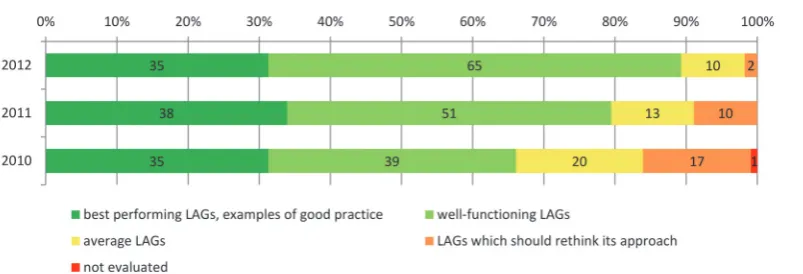
In 2012, the evaluation of LAGs was conducted and compared to previous years it sounds relatively positive. However, the evaluation was conducted by LAGs themselves, intended Committee then assigns the given criteria of a certain number of points – see Fig. 3.
This assessment, however, disclose whether LAGs really work according to the principle Leader. LEADER is a multidimensional process, which is searching for accessible linkage of economic, sociocultural, and environmental objectives (Macken-Walsh, 2011). Basic principles of LEADER
correspond to the neo-endogenous development model and are stated in the Regulation (EU) No. 1305/2013:
1. creation of integrated development strategy, 2. partnership between the public and private
sectors,
3. bottom-up approach,
4. multi-sectoral implementation of the strategy, 5. innovation,
6. cooperation, and
7. creation of local social networks (Pechrová, Boukalová, 2015).
Many LAGs in the Czech Republic do not apply the LEADER method correctly and implement projects that are not in compliance with Leader principles, which will be shown on the analysis of projects implemented by LAGs. Similar evaluation was made in the UK (Moseley in Woods 2005). This British evaluation presents the main concerns of LEADER I groups – the biggest number of LAGs are interested in promoting of tourism and in training and human development (these are “so projects”). On the contrary, Czech LAGs invest the most of money from the RDP into civic facilities and services, then into village renewal and development and restoration of cultural heritage (see Tab. III and Fig. 4). Focus of all of these projects can be considered for “hard infrastructural projects”. II: Diff erence between top-down and bottom-up approach
Traditional development policies Local and regional development
1. Top-down approach in which decisions about the areas where interventions is needed are taken in the national
centre.
1. Promotion of development in all territories with the initiative o en coming from below.
2. Managed by the national central administration.
2. Decentralized, vertical cooperation between diff erent tiers of government and horizontal cooperation between
public and private bodies.
3. Sectoral approach to development. 3. Territorial approach to development (locality, milieu).
4. Development of large industrial projects that will foster other economic activity.
4. Use of the development potential of each area, in order to stimulate a progressive adjustment of the local economic
system to the changing economic environment. 5. Financial support, incentives and subsidies as the main
factor of attraction of economic activity.
5. Provision of key conditions for the development of economic activity.
Source: Pike, Rodriguez-Pose, Tomaney, 2006: p. 17
A large amount of funding is also allocated to the modernization of agricultural production and food production. All this points to the fact that the Czech LAGs substitute by their activities insuffi cient infrastructure development, and for so activities, such as human resource development or tourism promotion (as shown in Moseley Woods in 2005) lacks. From this perspective, we can say that Czech LAGs still do not work on the Leader principle at all.
This statement is also confi rmed by the report of the European Court of Auditors (ECA), which
examined the functioning of the LEADER principle within all EU. The main conclusions of the ECA report are as follows (Budzich-Szukala, 2013: p. 127):
• The LEADER approach has potentially a very high value added for rural development, but due to the way it is implemented (mainly as a result of national legislation), this value added in many cases is not realised, and the implementation of the specifi c LEADER features is o en incomplete. • The LAG autonomy to set objectives of the strategy
and to select projects is too o en restricted. III: Number of realised projects and subsidy for axis IV. of Rural Development Programme of the Czech Republic for the period 2007–2013 (10. 7. 2014)
Measure 1111
Modernisation
of agricultural production 1121
Forestry
equipment 1123
Forest
infrastructure 1131
Support for
food production 1310
Vocational
training and information actions 2242
Non-productive
investments in forests 3110
Diversifi
cation
of agricultural production 3120
Support for
the creation of micro-enterprises 3130+3131+3132 Tourism 3211
Village renewal
and development (roads, water supply, sewerage, wastewater treatment) 3212
Civic facilities
and services 3220
Restoration of
cultural heritage 3310
Education and
information Total Number
of projects 984 52 19 148 3 18 67 813 598 1804 3949 1227 87 9769
Subsidy
(mil. CZK) 316.5 12.2 9.7 47.4 0.5 6.5 27.7 210.9 269.3 847.7 1656.4 524.0 20.6 3949.5 Source: State Agricultural and Interventional Fund, own elaboration.
• In many cases the types of measures in the strategy, types of benefi ciaries and eligible costs have been determined in a “top-down” way by the Managing Authorities; in addition, in some countries LAGs can only support projects falling within the standard measures of the national Operational Programmes.
• There are cases when LAGs are not allowed to decide e.g. on the level of aid intensity for individual projects in line with their strategic priorities, but are obliged to follow the guidelines of the Managing Authorities.
• LAGs lack of incentive for the LAG to undertake innovative projects.
• LAGs become simply an additional administrative layer and their functions simply duplicate those of regional and national administrations.
• LEADER funding was allocated to fi nance the normal activity of the local authorities (e. g. constructing a fence around a children’s playground, modernisation of sewage system or road surface), as well as to very large projects (over EUR 200.000) which could easily be eligible for funding from other EU programmes. From this perspective appears to be multi-funding, which should be possible in 2014+, as appropriate. • In many countries benefi ciaries of projects
fi nanced from LEADER had to fi ll long and elaborate forms; the extension of the process of analysis was o en the result of errors or incomplete applications which could indicate that the procedures are too complicated.
• Complex and lengthy procedures of decision making and payments.
• Too much focus on project monitoring and too little attention paid to achieving objectives of the strategy.
• Many local strategies are formulated in a very general way (in some cases they could apply to almost any rural area).
• Domination of the public sector in decision making of the LAG.
• Insufficient attention paid to properly documenting the way decisions are taken.
• “Deadweight eff ect” (fi nancing projects that would have been implemented anyway, with or without EU funding).
The European Court of Auditors stresses that the added value of the LEADER approach is created by the LAGs; the Managing Authorities should only provide guidance and support to the LAGs, ensure that the legislation, operating rules and management systems set the minimum standards, required, create the right incentives for the LAGs to add value, and avoid obstacles and disincentives.
Preparation of SCLLD for 2014–2020 The new programming period gives to LAGs new opportunity to receive subsidies also from other operational programmes than the RDP. The only conditions are to work out a Strategy of community led local development (SCLLD) and pass certifi cation of the LAG on national level.
As many of above mentioned facts could be applied for the Czech Republic, 180 of LAGs which should operate in 2014–2020 in the Czech Republic, have to pass the certifi cation. LAGs will be during 2014–2020 probably more in the spotlight than in the previous programming period. However, fi nances for LAGs remain at 5% of the allocation of RDP, but recently LAGs can also draw fi nances from other funds than EARFD, such as ERDF and ESF (operational programs employment; science, research, education; … – Fig. 5).
A new approach CLLD (Community led local development), which is a new approach for 2014+, was also done due to partial malfunction of the LEADER approach. Thus, the second objective of this paper is to show that some local groups were created purely for the purpose on the area of the association of municipalities, which are recently without fi nancial resources and gradually lose their meaning. LAGs are also o en circumventing the rules about the proportion of subjects of public administration, business and non-profi t organizations. These hypothesis will be confi rmed/
5: SCLLD subsidy scheme
rejected or on base of the results of a questionnaire survey with selected LAGs and associations of municipalities, which was realised in June 2014 in order to evaluate the new instruments of regional policy ITI (Integrated territorial investments), IPRÚ (Integrated urban development plans) and CLLD. Also approaches to developing SCLLD based on the experience of the authors will be presented.
Community Led Local Development from View of LAGs
Comparison between earlier survey with LAGs (Svobodová, 2010) and current knowledge delivers positive results. It turns out that the activity of LAGs from the previous programming period shi ed from mere redistributors of fi nances to a real entity that develops its region. In 2007–2013, it was clear that collaboration and synergies which specifi c cooperation can bring to rural development have not been fully utilized. At the beginning of 2015 the improvement of cooperation is evident (effi ciency, the number of contacts and synergies arising from it etc. even by adjusting the system of subsidies supporting cooperation of LAGs).
This knowledge was found out by questionnaire survey realised in 2014 with 23 LAGs. LAGs were selected according to diff erent size (with diff erent number of municipalities and population) and various natural and socio-economic conditions. The sample thus allows capturing diff erent views of various types of LAGs.
The main benefi t of LAG existence for their regions is primarily establishing of cooperation of diff erent types of actors and start of common development of the territory (answer of 7 LAGs). Five LAGs answered that the importance of LAG is in gaining funds for the implementation of development projects, four LAGs specifi ed these projects as cultural, sporting and social events. According to opinion of two LAGs important contribution is activation of inhabitants and the strengthening of relations between them. One LAG mentioned possibility of consulting in the grant applications, support of tourism and the rural economy.
Despite the opinion of LAGs that the main role of LAG is cooperation, in practise diff erent members of LAGs are involved in the activity with diff erent intensity. The most active members of LAGs are municipalities – in 8 LAGs is the activity of municipalities very intensive, in 2 LAGs average, none of LAGs stated that municipalities are involved weakly or not at all. Less active are non-profi t organisations (in 3 LAGs are involved intensively, in 5 average). At least active are entrepreneurs and citizens – mostly weakly.
The biggest problem for the involvement of stakeholders in the activities on the territory of LAG is an unwillingness to cooperate (opinion of 4 LAGs). Low involvement of entrepreneurs is o en caused by lack of time, sometimes entrepreneurs are not aware of the usefulness of LAG. According
to the opinion of LAGs better cooperation is with non-profi t organizations, as they are accustomed to devote time in various non-profi t activities.
Misunderstanding the benefi ts of LAG was noted in 3 LAGs as a problem. Two LAGs stated time demands cooperation, diffi culty in obtaining funding for applicants and mistrust entities.
According to one LAG a problem is that most associations of municipalities were established on purpose for obtaining subsidies and cannot comprehensively cooperate. Only two LAGs do not see any problems.
Only six of the respondents were supported in the 2007–2013 period from RDP, other LAGs arose relatively recently, so they have not drawn fi nances yet. Supported LAGs gained 32 million CZK in average for which they realized 77 projects in average. The amount of funding and number of projects among LAGs, however, is very diff erent – the amount of funding varies from 20–41 millions CZK, number of projects from 57 to 117. The projects were implemented mostly by public administration (47% of projects), fewer by entrepreneurs (33%) and even less non-profi t organizations (17 %).
The responded LAGs employ an average of 4 people, but mostly part-time – with the average work load 2.0. Also in employment are signifi cant diff erences among LAGs. Number of staff diff ers from 2 to 7, the work load diff ers from 0.6 to 4.5. Two LAGs hired new staff in connection with the possibility to fi nance their wage costs under a grant from the Operational Programme Technical Assistance, but only on a temporary basis.
All responded LAGs cooperate with others LAGs. Most of them have ties to neighbouring or nearby lying LAGs, cooperation with further LAGs appeared only 3times. The scope of cooperation are mostly projects co-fi nanced from the Rural Development Programme (6 LAGs), the exchange of experience and peer consulting (5 LAGs). LAGs are rarely involved in other projects of cooperation (international or national – only one LAG). Only one of the LAGs has been prepared projects for the programming period 2014–2020 in cooperation with other LAG.
DISCUSSION AND CONCLUSION
LAGs’ situation in the Czech Republic is gradually getting better with more and more experience and LAGs’ activity approaches to the Leader principle. While in the previous programming period mainly hard infrastructure projects were supported, it seems that in the period 2014–2020 the activity moves rather to promote education, employment and environmental care (“so ” projects). This is obviously given by setting of new operational programs and RDP from which the activity is mostly funded. In the future, LAGs would welcome certain changes in their operations that would help them better perform their activities. The most commonly cited change relates to fi nances; LAGs mentioned that they intend to adjust and stabilize fi nancial conditions for their operation so that they are not fully dependent on subsidies or membership fees. Next goal is to strengthen and professionalize the team (including training of employees). LAGs should widen their activities in terms of a “comprehensive development service” for whole territory of LAG. This would require strengthening the involvement of its members – especially entrepreneurs and non-profi t organizations and also increased promotion of LAGs’ activities, as well as improving relations around (with actors from the region and central authorities).
However, programming period 2014–2020 is still at the beginning and it is only a question of time what role in the rural development will LAGs play in this period. LAGs are becoming the main instrument of competitiveness in the world where the increasing importance is attributed to new knowledge. It is precisely this knowledge and continuous learning which represent the key inputs for the creation of innovations (Ročková, 2011).
REFERENCES
BINEK, J., OPRAVIL, Z., CHMELAŘ, R. and SVOBODOVÁ, H. 2015. Cooperation and Mutual Relationships of Cities and their Hinterland with Regard to Functioning of the EU Integrated Development Instruments. Quaestiones Geographicae, in print.
BUDZICH-SZUKAŁA, U. 2013. A new approach to local development in programming EU funds– experience from the past and challenges for the future. [Online]. In: New Paradigm in Action, 116– 138. Available at: http://www.mir.gov.pl/english/ Regional_Development/Regional_Policy/NSRD/ doc_str/Documents/MRD_NPA_on_successful_ partnerships.pdf#page=117/. [Accessed: 2015, January 10].
COFFEY, W. J. and POLÈSE, M. 1984. The Concept of Local Development: A Stages Model of Endogenous Regional Growth. Papers in Regional Science, 55: 1–12. doi: 10.1111/j.1435-5597.1984. tb00823.x.
COFFEY, W. J. and POLÈSE, M. 1985. Local development: Conceptual bases and policy implications. Regional Studies, 19(2): 85–93. doi: 10.1080/09595238500185101.
ČEPELKA, O. 2001. Iniciativa Evropské unie LEADER pro rozvoj venkova. Praha: Ministerstvo pro místní rozvoj ČR.
ČEPELKA, O. 2008. Místní akční skupiny v ČR v roce pět. Liberec: Tima Liberec.
ČEPELKA, O. et al. 2004. Místní partnerství a rozvoj venkova (příprava na iniciativu LEADER). Liberec: Omega
HERBERT-CHESHIRE, L. and HIGGINS, V. 2004. From risky to responsible: expert knowledge and the governing of community-led rural development. Journal of Rural Studies, 20: 289–302. KONEČNÝ, O. 2013. Multifunkcionalita: geografi e,
venkov, zemědělství. In: Výroční konference České
geografi cké společnosti: Nové výzvy pro geografi i. Brno: Masarykova univerzita, 182–189.
LOŠŤÁK, M. and HUDEČKOVÁ H. 2010. Preliminary impacts of the LEADER+ approach in the Czech Republic. Agricultural Economics – Czech, 56: 249–265.
MACKEN-WALSH, A. 2011. Partnership and subsidiarity? A casestudy of farmers’ participation in contemporary EU governance and rural development initiatives. Rural Society, 21: 43–53. MINISTRY OF AGRICULTURE OF THE CZECH
REPUBLIC. ©2014. Hodnocení místních akčních skupin. [Online]. Available at: http://eagri.cz/ public/web/mze/dotace/program-rozvoje- venkova-na-obdobi-2007/opatreni-osy-iv/mistni- akcni-skupina/hodnoceni-mistnich-akcnich-skupin-2012.html. [Accessed: 2015, March 14]. MOSELEY, J. M. (ed.). 2003. Local Partnerships for Rural
Development: The European Experience. Oxon: CABI Publishing.
MUELLER, R. 2003/2004. Community Development Process in a Low-income Country Like Nepal. IUC Journal of Social Work. Theory & Practice, 2003/2004(7). [Online]. Available at: https://www. bemidjistate.edu/academics/publications/social_ work_journal/issue07/articles/Comm_devel.htm. [Accessed: 2014, November 12].
NEVĚDĚL, L. and HORÁK, M. 2015. Operation of the Selected Local Action Group. Acta Universitatis Agriculturae et Silviculturae Mendelianae Brunensis, 63(1): 347–352.
OECD. 2006. The New Rural Paradigm – Policies and Governance. OECD Rural Policy Reviews, Organisation for Economic Cooperation and Development.
PECHROVÁ, M. and BOUKALOVÁ, K. 2015. Diff erences among Czech Local Action Groups in Using Selected Principles of LEADER. Scientia Agriculturae Bohemica, 46(1): 41–48.
PELCL, P., HAVRÁNEK, T., LEHMANNOVÁ, A. and MARTÍNEK, J. 2008. Metodika dobré praxe místních akčních skupin v České republice. Plzeň: CPKP.
PIKE, A., RODRIGUEZ-POSE, A. and TOMANEY, J. 2006. Local and Regional Development. London: Routledge.
EVROPSKÉ SPOLEČENSTVÍ. ©2006. Přístup Leader: Základní příručka. Lucemburk: Úřad pro úřední tisky evropských společenství.
EUROPEAN PARLIAMENT. 2013. Regulation (EU) No. 1305/2013 of the European Parliament and of the Council of 17 December 2013 on support for rural development by the European Agricultural Fund for Rural Development (EAFRD) and repealing Council Regulation (EC) No. 1698/2005. Offi cial Journal of the European Union, L347–L548. ROČKOVÁ, L. 2011. Existence učících se regionů v dimenzi
ČR. Unpublished Master’s Thesis. Pardubice: University of Pardubice.
SHUCKSMITH, M., THOMSON, J. K. and ROBERTS, D. 2005. The LEADER community iniciative. In: The CAP and the regions:the territorial impact of the common agricultural policy. Oxfordshire: CABI Publishing, 106–110.
SCHILLER, H. 2008. Networks of Local Action Groups in Rural Areas: The Example of the Eu Initiative Broads and Rivers Leader+. VDM Verlag Dr. Mueller e. K. STÁTNÍ ZEMĚDĚLSKÝ INTERVENČNÍ FOND.
©2014. Státní zemědělský intervenční fond. [Online]. Available at: www.szif.cz. [Accessed: 2015, January 12].
SVOBODOVÁ, H. 2010. Realita postavení místních akčních skupin v rozvoji venkova České republiky – cíle, aktivity, bariéry – pohledem geografa v praxi. In: Sborník XXII. sjezdu České geografi cké společnosti. Ostrava.
WOKOUN, R. 2008. Regionální rozvoj. Východiska regionálního rozvoje, regionální politika, teorie, strategie a programování. Praha: Linde.
WOODS, M. 2005. Rural Geography: Processes, Responses and Experiences in Rural Restructuring. London: Sage Publications Ltd.