2202
Reliable And Energy Efficient Scheduling Model
For Tsch Enabled Mobile Adhoc Network
B.Suresh babu, Dr.Mohammed Ali Hussain, Dr. Mahmood Ali MirzaAbstract: the future Industrial Internet of Things (IIOT’s) application is composed of wearable sensor for real-time monitoring human activity. These wearable sensor generate continuous stream of data at much high data rate and are powered by battery. Thus, they are limited to use wireless protocol such as Bluetooth Low Energy and IEEE 802.15.4. Time-Slotted Channel Hopping (TSCH) Medium Access Control (MAC) is a promising technology for provisioning IIOT’s application that are deployed in environment condition that are prone to interference. This work aims to overcome the issues and challenges in building Reliable and Energy Efficient Scheduling (REES) model for TSCH mobile adhoc network (MANET). The unpredictable nature of wireless link and data source locations makes scheduling challenging. Further, it waste to reserve resources for the worst-case scenario (i.e., high expected data rate). The REES model allows both dedicated slots and shared slots. Along with, allow each communicating device pair to adaptively activate their assigned slots. Thus, aid in increasing overall access fairness, packet delivery rate and reducing the idle listening overhead of unutilized slots. Further, for catering high traffic load a MANET device can dynamically activate additional slots, without the requirement of reorganizing new schedule. Experiment outcome shows REES model minimize energy consumption and maximize data transmission performance.
Keywords: 6TiSCH, Industrial internet of things, MANET, TSCH, Scheduling.
———————————————————
1
INTRODUCTION
Communications in modern application service generally requests low idleness, high dependability, adaptability, and scalable in nature. Customarily, wired communications provisioned the correspondence requirements of modern application uses. Nonetheless, such arrangements induces higher establishment cost and maintenance/support costs. As of late, wireless/remote advances, nonetheless, have developed to fulfill the performance guidelines by consolidating new mechanisms. One such model is the
standards [1], is the most recent prototype (i.e.,
modification) to the standards; a important empowering agent for low-powered (LP) remote personal are network (PAN) with node that are low-powered, low-bandwidth and short communication/correspondence frequency range [2], such as Mobile adhoc network (MANET) and sensor network ( ). The standard presents a TSCH mode, which is instrumental in accomplishing the strict correspondence prerequisites of numerous modern application services as it gives strength to multipath interference/obstruction and fading.
The rising over prototyping committee or organization [3] targets giving Internet Protocol (IP) organizing abilities for TSCH-based low-powered remote systems, in this manner connecting a significant gap among modern and data innovation/technology environments. In 6TiSCH remote systems, the accepted link layer (LL) would be founded on guidelines. In TSCH MAC, MANET device synchronizes on a frame organization and pursue a correspondence scheduling method. In any case,
the standard doesn't indicate how a
scheduling method is modelled. As of late, various procedures and algorithms are being modelled for packet schedule in
remote systems. Scheduling for remote
systems can be modelled either centralized or distributed (i.e., decentralized) manner. In the previous case, a main control channel/server is accountable for constructing scheduling mechanism. Then again, no centralized/main controller and global system topological information is accessible in the decentralized environment condition. MANET device in the system acknowledge to the scheduling mechanism via adjacent devices to device data exchange and schedule optimization. In centralized methods [4], [5] are just fit to genuinely static networks wherein the overhead of collecting the global network data is very minimal. The adaptability of centralized-based schedule design gets testing in systems with high MANET device size as the expense of introducing the scheduling mechanism becomes very important. In this manner, decentralized packet schedule methods are attractive from a real-world applicability viewpoint. Decentralized methodologies are especially appealing for huge scale systems working in condition that is dynamic in nature. Contrasted with centralized schedule design, decentralized design may bring about higher energy dissipation/utilization. Reducing energy overhead [6] are assumed to be energy efficient (EE) design for MANET routing [7]. The IoT application such as smart homes, smart cities and wearables requires robust (i.e., work reliably) and flexible (i.e., ease of use and satisfy applications dynamic requirements) and also should minimize energy overhead and support large scale operation. Thus, in this work we aim to enhance the reliability of data transmission and increase the energy efficiency of TSCH network. The TSCH is characterized by
————————————————
• Suresh babu . B, currently as Research Scholar in Dept of CSA, SCSVMV UNIVERSITY, Kanchipuram(Dist), TamilNadu, India.
Dr.Mohammed Ali Hussain, Currently working as Professore, Dept. of Computer Science and Engineering. KL University, Guntur(Dist), Andhra Pradesh, India.
Dr. Mahmood Ali Mirza, Currently working as Professore Dept. of Computer Science, Krishna University, Machilipatnam, Andhra Pradesh, India. Email:[email protected] Email: [email protected]
Suresh babu . B, currently as Research Scholar in Dept of CSA, SCSVMV UNIVERSITY, Kanchipuram(Dist), TamilNadu, India. [email protected]
Dr.Mohammed Ali Hussain, Currently working as Dept. of Computer Science and Engineering. KL University, Guntur(Dist), Andhra Pradesh, India.
2203 dynamic/unpredictable traffic and high data rate either due to
ever-changing wireless network channel condition. Thus, induce random amount of retransmission. In high bandwidth network the MANET sink’s device packet reception capability is considered to be utilized closest to its full potential (maximal). This is due several aspect follows. Firstly, it is hard to forecast location of source mobile device and data rate. Secondly, it is difficult to forecast dynamic nature of wireless link. Thirdly, it is hard to find or forecast routing path changes. The timescale of these changes is general in the order of milliseconds. In such condition, reactive scheduling does not perform well (i.e. it may not be practical to build and distribute new schedule in a reactive fashion. Instead, proactive resource over allocation of slot using static scheduling is required. However, it may substantially reduce the overall schedule capability and may cause many reserve TSCH slots to be left unutilized. Further, conservative over allocation may increase packet loss as scheduling capacity may not be enough to cater rapid high volume traffic. Subsequently, excessive over allocation of TSCH slots may induce energy overhead. Since each assigned slots not utilized by the transmitter induce idle listening overheads among the receiving device. For overcoming research problems, this paper models reliable and energy efficient scheduling (REES) model for TSCH enabled MANET. The REES is built by extending static scheduling by allowing transmitting and receiving device to adaptively select timeslots required based on slot utilization.
The contribution of work is as follows
Presented a novel reliable and energy efficient scheduling model for TSCH enabled mobile adhoc network.
The REES model bring a good tradeoff between energy minimization and packet transmission performance requirement of future IIOT’s application.
The REES model can provision high traffic application without affecting energy consumption of MANET device by dynamically activating additional slots, without the requirement of reorganizing new schedule.
Experiment outcome shows proposed REES model attain superior energy efficiency and packet transmission and access fairness performance than state-of-art model [8], [10], [11], [12], [13], and [14].The paper is articulated as follows: Section I gives brief introduction of scheduling mechanism using TSCH for wireless and mobile adhoc network. Further, highlights research problem, issues and challenges in designing reliable and energy efficient scheduling design. In section II the proposed reliable and energy efficient scheduling model for TSCH enabled mobile adhoc network is presented. Experiment result and analysis is discussed in section III. Lastly, the conclusion with future research direction of work is discussed.
2
RELIABLE
AND
ENERGY
EFFICIENT
SCHEDULING
MODEL
FOR
TSCH
ENABLED
MOBILE
ADHOC
NETWORK
This section present reliable and energy efficient scheduling mobile for TSCH enabled mobile adhoc network. This work
aims design an efficient scheduling mechanism that brings a good tradeoffs between minimize energy consumption of MANET device and maximizing packet transmission performance. Firstly, the system model is presented. Then, energy model to compute energy dissipation per packet is presented. Thirdly, energy minimization tradeoffs model is presented. Lastly, the reliable and energy efficient scheduling model is presented.
A. System model
Let us assume a high traffic network with high data rate composed of large number of MANET device operates under dense mobile adhoc environment. Under such environment TSCH based slotted aloha is expected to perform very badly. This is due to increase in collision likelihood. Further, dedicating separate number slots for performing packet retransmission restrict the maximum number of device to be catered. Let us assume a single-hop based TSCH network that composed two end device and , and a single sink device. The end devices and communicates with bandwidth (i.e., packets per slot) of and , respectively. For easiness, end devices toward sink described by data link layer packet reception rate (PRR), and , respectively. This work assumes the retransmission as a set of independent Bernoulli distribution with same likelihood of packet error rate (PER) for each distribution. Further, this work also considers infinite queues. Thus, the cumulative predictable number of transmission for device , , can be computed as follows
∑
(1)
Similarly, the cumulative predictable number of transmission for device , , can be computed as follows
∑
(2)
and can also be stated as packet per slot frame. depicts the number of slots in slot frame, where depicts the number slots shared within a slot frame. Along with, each MANET device posses dedicated contention-less slots.
Each MANET end device first utilizes its dedicated slots till packets considering in each slot frame. Then, it tries to transmit the remaining packet, if any through shared medium or slots. This excess packet load is described as follows
(3)
and
(4)
If there is no shared slots available , excess packet load is considered to be lost. Otherwise, it is communicated via shared medium, with a likelihood of collision and
respectively. Then, the cumulated packet collision in a slot frame as the cumulated likelihood of and choosing same slot is described as follows
(5)
2204
{
(6)
Similarly, the packet delivery rate of MANET device is computed as follows
{
(7)
The system performance is optimized at the number of shared timeslot that maximize the average packet delivery rate.
B. Energy consumption model
For modeling energy consumption this work focusses on contention-free schedules. Further, assumes unicast transmissions. Let us assume that each slot time is classified into sleeping slot, idle listening slot, and TxRx slot. In sleeping slot, both transmitter and receiver are in sleeping state with their radio being turned off. This slot in TCH scheduled is depicted as unused slots. The cumulated energy dissipation during sleeping stage is computed as follows
( ) (8)
where is the electric charge incurred in process of sleeping slot for a given voltage , is supply voltage of MANET system and factor depicts both transmitter and receiver. In Idle listening slot, a slot is dedicated for initialization communication among transmitter and the receiver. However, in this case there is no pending packets among sender (i.e., the queue is empty). Thus, induces energy wastage in idle listening. Similarly, the cumulated energy dissipation in idle listening slots phase is computed as follows
( ) (9)
where is the electric charge induced among receiver for idle listening slot phase. In TxRx slot, a slot is dedicated for initialization communication among transmitter and the receiver. Thus, the transmitter switched on with desire to perform transmission and the receiver listens to the channel for future incoming communications. Along with, the pending packet queues will possess at least one frame to perform transmission toward the sender. Lastly, the cumulated energy dissipation in process of TxRx slots is computed as follows
(10)
where is the electric charge induced among transmitter for performing transmission of data and obtaining an acknowledgement packet and is the electric charge induced among receiver, respectively. These parameter describes as an upper limit for failed transmission due to presence of interference or channel error. For easiness, in this work it is considered as successful transmission and increment them with . Thus, the average energy consumed per packet is computed as follows
(11)
where the incoming packet load described in packets per frame and is the total simulated frames.
C. Energy minimization tradeoff model
Here we shows a trade-off model among energy minimization and reliable packet transmission for TSCH enabled mobile adhoc network. Let us assume there is always 8 active slots always available for performing transmission. Reducing the active slots size aid in minimizing energy dissipation of radio (i.e. radio will be in sleep mode). Yet, if slot size is less than , it may not be enough to route/relay the packet load. Similarly, if slot size is more than , then energy is wasted (due to idle listening). To bring a good trade-off, this work define as the energy required per packet to efficiently perform packet delivery [21].
(12)
where regulates the tradeoff specification of reliability over energy dissipation. The lesser is, the more the energy efficient the scheduling of TSCH based MANET.
D. Reliable and energy efficient scheduling model A well-organized static scheduling mechanism would perform well (optimal) when network condition is static. However, considering a fixed number of active slots would not (sub-optimal) perform well (i.e., sub-(sub-optimal) when condition are dynamic (i.e., varying traffic and channel environment condition). For addressing this issues, this work present a Reliable and Energy Efficient Scheduling (REES) design for TSCH enabled MANET. The REES enhances the scheduling by inheriting the feature of static scheduling mechanism such as simplicity, efficiency and robustness. The REES model works as follows. Firstly, the scheduling model assigns dedicated (contention-less) slots for each frame to a set of associating pair of MANET device (transmitter and receiver). must be higher to assure worst cast packet load scenarios. On top of this schedule, the transmitter and the receiver agree on number of slots required, depicted as [ ]. The process of slot selection among transmitter and the receiver is adaptive in nature. That is, the preliminary slots will be active and remaining of their assigned slots will not be active. The transmitter updates the utilization status of the active slots with coefficient using Exponentially Weighted Moving Average. Prior to initializing the communication, the transmitter learns using (algorithm 1), policy (algorithm 2) and update the header of the data packet. However, this will introduce slight overhead of bits which is negligible. If the data communication is positive, the transmitter and receiver adapt the scheduling using present parameter.
Algorithm 1: Reliable and energy efficient scheduling for TSCH enable MANET
Step 1: Start
Step 2: Initialize
Step 3: For each active slots available using static scheduling do
Step 4: If then Step 5: ; Step 6: Else
Step 7: ; Step 8: learns by using Algorithm 2;
2205 Step10: If communication is acknowledged then
Step 11: Apply adaptive leaning ; Step 12: End
Step 13: End Step 14: End Step 15: Stop
Algorithm 2, describes the adaptive learning policy which feature both low threshold and high threshold . In our work we will not reduce the size of active slots unless the pending packet buffer/queue size is likely to be null post completion of communication of the present data packet, irrespective of the resource utilization capacity.
Algorithm 2: Adaptive learning policy
Input: , Output: Step 1: Start Step 2: If then
Step 3: ; Step 4: End
Step 5: If then Step 6: ;
Step 7: End Step 8: Stop
Further, our REES model can ensures access fairness among shared neighbouring contending devices by using Algorithm 3.
Algorithm 3: Access fairness assurance among neighboring contending device
Step 1: Start
Step 2: For do Step 3:
Step 4: If then (not the local device)
Step 5: If [ ] then (possess data packet)
Step 6: return
[ ]
Step 7: End if Step 8: End if Step 9: End for Step 10: return Step 11: Stop
In a communication slot, a MANET device can choose any its adjacent/neighboring devices with nonempty pending data packet buffers/queues as its receiving device. It is well known that using same neighbouring device for personal gain will lead to bandwidth starvation for less prioritized device (i.e., considering condition like where the data in the neighborhood queues are not transmitted out before its expires (timeout). This work carryout selection processes in a round robin manner, utilizing the present timeslots as its input. Let describe as the number of MANET device and with device info the local device’s channel offset. The algorithm gives equal selectivity (priority) to its neighbors as long as the and the slot frame length are co-prime numbers. Thus, the proposed REES model reduce packet drop rate when compared with existing model. Thus, ensures access fairness.
Further, the proposed REES model will minimize energy consumption of MANET device and at the same time attain superior packet transmission performance when compared with existing model which is experimentally shown below.
3
RESULT
AND
DISCUSSION
This section of the paper describes the experiment evaluation of REES method and existing scheduling model [8]. For carrying simulation study I-5 processor with 12 GB RAM is used. The 6TiSCH simulator is written in using python programing language by the associates of 6TiSCH WG [9] and it is open source. It composed of existing model [8] and proposed REES model is incorporated into 6TiSCH simulator. The simulation parameter used for experiment analysis is tabulated in TABLE I. The parameter considered are according to industrial environment condition where traffic are bursty in nature [10]. Experiment is carried out for evaluating outcome of proposed REES with respect to existing scheduling model in terms of energy overhead (EO) and packet routing performance.
E. Energy consumptio perforamcne evaluation
This section describes performance evaluation of REES over existing approach in terms of energy efficiency considering varied packets and transmission rate. Energy overhead or consumption incurred considering varied packets by both REES and existing model is shown in Figure 1. The packet is varied from 3600 to 7200 packets. The outcome shows REES reduces energy consumption by 15.52%, 22.83%, 27.99%, and 32.78% over existing approaches considering 3600, 4800, 6000, and 7200 packets, respectively. Average EO minimization of 24.77% is attained by REES with respect to existing approach considering varied packets. The result describes efficient outcome achieved by REES when compared with existing approach in terms of energy overhead minimization considering varied packets. Similarly, Energy overhead or consumption incurred considering varied transmission rate by both REES and existing model is shown in Figure 2. The transmission rate is varied from 1 to 20. The outcome shows REES reduces energy consumption by 26.62%, 18.026%, 27.99%, and 36.34% over existing approaches considering 1, 10, 15, and 20, respectively. Average EO minimization of 27.24% is attained by REES when compared with existing approach considering varied transmission rate. The outcome shows significant performance achieved by REES over existing approach in terms of energy overhead minimization considering varied transmission rate.
0 0.2 0.4 0.6 0.8 1
3600 4800 6000 7200
E
n
er
gy
Co
n
sum
pt
io
n
(J
)
Number of Packets
Energy consumption for
varied packets
2206
Figure 1: Energy consumption performance evaluation considering varied packets.
Figure 2: Energy consumption performance evaluation considering varied transmission rates.
F. Throughput and packet delivery rate perforamcne evaluation
This section describes performance evaluation of REES over existing approach in terms of packet routing performance such as throughput and packet delivery rate considering varied transmission rate. Figure 3 determines the throughput of the network for REES and existing model for different transmission rates in Mbps. It is clearly seen from figure that throughput of our REES model is much higher than the existing technique of packet transmission considering different transmission rates. It is clearly visible from the figure 3 that the conventional static algorithm perform satisfactory till the transmission rate of 6 Mbps. However, it underperforms for higher transmission rate and throughput remains almost similar for all the further transmission rates whereas the proposed scheduling algorithm perform satisfactory for all the transmission rates till 20 Mbps. Average enhancement of 47.83% is attained by proposed REES model with respect to existing model in terms of throughput. Figure 8 determines the packet delivery rate comparison between REES and existing for different transmission rates in Mbps. From the Figure 8 it is clearly visible that existing technique can perform satisfactory for lower transmission rate. However, for higher transmission rate, this technique is highly insufficient. On the other hand, the REES model performs far better for all the transmission rates. Average enhancement of 47.54% is attained by proposed REES model with respect to existing model in terms of packet delivery rate considering varied transmission rate.
Figure 3: Throughput performance achieved considering varied transmission rates.
Figure 4: Packet delivery rate performance evaluation considering varied transmission rates.
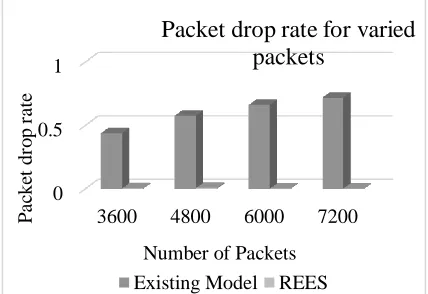
G. Access fairness performance perforamcne evaluation This section describes performance evaluation of REES over existing approach in terms of access fairness performance. The access fairness is evaluated in term of number of packet being dropped considering varied packets. Figure 5 determines the number of packets dropped out of total number of packets transmitted using REES and existing technique. Using the existing technique the number of dropped packets are very high in comparison with total transmitted packets and number of dropped packets increases as number of transmitted packets is increased. However, the number of dropped packets using the REES technique are minimum. The proposed REES model reduces packet drop by 99.7% over existing model. Thus, the proposed REES model attain significant access fairness performance when compared with existing model.
Figure 5: Packet drop rate performance evaluation considering varied packets.
H. Result and discussion
This section evaluates the outcome achieved by various existing model and comparison with proposed REES model is carried out. In [11] carried out extensive survey on existing algorithm developed to address the performance issues TSCH
0 2
1 10 15 20
E
n
er
gy
Co
n
sum
pt
io
n
(J
)
Transmisison Rate in Mbps
Energy consumption for varied
transmission rate
Existing Model REES
0 0.5 1
6 9 12 18
T
h
ro
ugh
p
ut
Transmission Rate in Mbps
Throughput achieved for varied
transmission rate
Existing Model REES
0 50 100
6 9 12 18
P
a
cke
t
S
uc
ce
ss
R
a
ti
o
Transmission Rate in Mbps
Packet delivery rate for varied
transmission rate
Existing Model REES
0 0.5 1
3600 4800 6000 7200
P
a
cke
t
dr
o
p
ra
te
Number of Packets
Packet drop rate for varied
packets
2207 network to provision future real-time dynamic applications
needs. The model [8] presented a scheduling model considering decentralized network and achieved a throughput improvement of 45.5%. However, energy overhead and other packet routing performance evaluation is not carried out. In [10], [12] carried out experiment analysis energy overhead performance. An energy overhead reduction of 27.08% and 25.6% is achieved respectively. Similarly, [13] achieved 22.38% reduction of energy overhead and [14] reduced packet drop rate by 25% over existing approaches. The REES model is compared with [8] since it is adopts decentralized network. REES model attain good tradeoff between energy overhead minimization and routing performance requirement. It is clearly seen from result outcome achieved, REES attain significant performance improvement over state-of art technique [8], [10], [11], [12], [13], and [14] in terms of energy overhead, packet drop rate reduction, throughput performance, packet delivery rate and access fairness.
4
CONCLUSION
This manuscript modelled reliable and energy efficient scheduling technique for TSCH enabled mobile adhoc network. From extensive analysis it can be seen the static scheduling algorithm incurs energy overhead due to over resource allocation. Further, it challenging to design an efficient scheduling mechanism due to unpredictable nature of wireless link and data source locations. Along with, the existing static scheduling waste to reserve resources for the worst-case scenario (i.e., high expected data rate). Thus, to bring a good tradeoffs the proposed REES model allow both dedicated slots and shared slots together. Along with, it allows each communicating device pair to adaptively activate their assigned slots. Thus, aid in increasing overall access fairness, packet delivery rate and reducing the idle listening overhead of unutilized slots. Further, for catering high traffic load a MANET device can dynamically activate additional slots, without the requirement of reorganizing new schedule. Experimental analysis is carried for estimating outcomes of proposed REES model over existing model. The outcome attained shows the proposed REES model improves energy efficiency performance by 24.77% and 27.24% over existing model considering varied packet and transmission rate, respectively. Then, the proposed REES model improves throughput and packet delivery rate performance over existing model by 47.83% and 47.54%, respectively considering varied transmission rate. Further, the proposed REES reduces packet drop rate by 99.7% over existing model. Thus, REES attain superior access fairness performance over state-of-art models. The overall result attained shows scalable performance. Future work would consider performance evaluation under multi-hop TSCH network and evaluate considering different network performance parameter.
5
REFERENCES
[1] IEEE Standard for Low-Rate Wireless Networks, IEEE Standard 802.15.4-2015, pp. 1–709, 2016. [2] "IEEE Standard for Local and metropolitan area
networks--Part 15.4: Low-Rate Wireless Personal Area Networks (LR-WPANs)," IEEE Std 802.15.4-2011 (Revision of IEEE Std 802.15.4-2006), pp. 1-314, 2011.
[3] D. Dujovne, T. Watteyne, X. Vilajosana, and P. Thubert, “6TiSCH: Deterministic IP-enabled industrial
Internet (of Things),” IEEE Commun. Mag., vol. 52, no. 12, pp. 36–41, Dec. 2014.
[4] Z. Shelby, K. Hartke, and C. Bormann, The Constrained Application Protocol (CoAP), IETF RFC 7252, 2014.
[5] S. Bandyopadhyay and E. J. Coyle, "Minimizing communication costs in hierarchically-clustered networks of wireless sensors," Elsvier Journal of Computer Networks, vol. 44, no. 1, pp. 1-16, 2004. [6] L. Karim and N. Nasser, "Energy efficient and fault
tolerant routing protocol for mobile sensor network," in IEEE International Conference on Communications (ICC), Japan, pp. 1-5, 2011.
[7] Municio, Esteban & Latré, Steven “Decentralized broadcast-based scheduling for dense multi-hop TSCH networks”, Proceedings of the Workshop on Mobility in the Evolving Internet Architecture, Pages 19-24, 2016.
[8] T. Watteyne, K. Muraoka, N. Accettura, and X. Vilajosana. The 6tisch simulator. https://bitbucket.org/6tisch/simulator/src, 2015. [9] Kralevska, Katina & Vergados, Dimitrios & Jiang,
Yuming & Michalas, Angelos. (2017). A Load Balancing Algorithm for Resource Allocation in IEEE 802.15.4e Networks, 2017.
[10]Rodrigo Teles Hermeto, Antoine Gallais, Fabrice Theoleyre “Scheduling for IEEE802.15.4-TSCH and slow channel hopping MAC in low power industrial wireless networks” Journal Computer Communications archive Volume 114 Issue C, Pages 84-105, 2017.
[11]Thang Phan Duy, Thanh Dinh, and Younghan Kim “A rapid joining scheme based on fuzzy logic for highly dynamic IEEE 802.15.4e time-slotted channel hopping networks”, International Journal of
Distributed Sensor Networks,
https://doi.org/10.1177/1550147716659424, 2016. [12]X. Fafoutis, A. Elsts, G. Oikonomou, R. Piechocki
and I. Craddock, "Adaptive static scheduling in IEEE 802.15.4 TSCH networks," 2018 IEEE 4th World Forum on Internet of Things (WF-IoT), Singapore, pp. 263-268, 2018.