Integration Facility Management: Human
Resources
Dimas Indra Laksmana, Maranatha Wijayaningtyas
Abstract: Buildings maintenance after construction is increasingly important as a factor of safety, security and comfort for building users. The basic about building maintenance are evaluated from management, building component, mechanical, electrical, cleanliness and spatial. Integrated facility management make management of controlling facilities and infrastructure based on working conditions and environment what that needs and can be utilized by all elements, such as for management administration of facilities and infrastructure, maintenance and repair of assets to support work. Facility management integrates the principles of science, business administration and human behavior in achieving for more optimal work productivity. As an integrated process management that considers human, processes and places in the context of the organization, includes an efficient physical environment, technology, safety, comfort and occupational health. The purpose of this study is to coordinate and integrates the interface between human, places, processes and technology. Everything is to better integrate existing organizational factors, simplify complicated processes to identify and schedule tasks, records, decisions maker and more. This research was conducted by structured model designing and stages for 3 (three) year (human, products, processes). Focus of this year's research is obtained integrated human resource system, and continued with following year which focuses on products and processes. Which step by step research, will be get a comprehensive system integration management facility.
Index Terms: Human Resources; Integration Facility Management; Userinterface.
—————————— ——————————
1.
INTRODUCTION
The development of the building is increasingly rapid followed by a more varied development process from the stages of planning, design, implementation and building maintenance. The role of building maintenance after construction is increasingly important because of safety, security and comfort factors for users. The basic things about building maintenance as building maintenance management, building component maintenance, mechanical maintenance, electrical maintenance, building cleanliness and spatial maintenance. Integrated facility management make management of controlling facilities and infrastructure based on working conditions and environment what that needs and can be utilized by all elements, such as for management administration of facilities and infrastructure, maintenance and repair of assets to support work. Facility management integrates the principles of science, business administration and human behavior. As an integrated process management that considers human, processes and places in the context of the organization, includes an efficient physical environment, technology, safety, comfort and occupational health in achieving for more optimal work productivity. Based on the description above that integration facilities management developed supportive more workplace productive process flow by adding value and reducing costs, various services, activities, responsibilities, skills, knowledge and management. Everything is to better integrate existing organizational factors, simplify complicated processes to identify and schedule tasks, records, decisions maker and more. Scope of the future integration of facility management is also considered, account the current conditions of the organization and impact of future innovations and changes. Integration facility management is a computer system platform, designed to enable management facilities to implement a comprehensive maintenance
management activities.
2 LITERATURE REVIEW
2.1 Life Cycle Development System
According to Raymond Mc Leod Jr system life cycle is a process of change that is followed by the application of the system or sub-system of computer-based information. This system life cycle consists of a series of tasks that follow the steps of the system approach. Because these tasks follow a regular and top-down way, this life cycle is often referred to as the waterfall approach to system development and use of the system. (Gaol, 2008).
2.2 Data Base Management System
Data Base Management System (DBMS) is a database system software to store, modify, delete, and extract the data to / from the database, the query language called Structured Query Language (SQL), and database maintenance such as archiving and backup & recovery. A DBMS can store more than one database. Examples of DBMS are Oracle, SQL Server, MySQL and Microsoft Access. (Hartono, 2004).
2.3 Delphi
Delphi is the first programming language to break the boundaries between high level programming languages, Delphi programming language called procedural language means to follow a certain sequence. In making application commands, Delphi uses a visual programming environment. Delphi is the next generation of Turbo Pascal. Delphi programming developer write and compile code within application developer or Integrated Development Environment (IDE). The IDE is an integrated display where you see separate but highly related menus and tools that are a unified whole in one coordination. Functioning as a control center starting from main menu, component pallet, form, code editor, object inspector and object treeview which are used to design, write program code and manage the appearance of applications in various models. (Madcoms, 2003).
2.4 Human Resources Information System
Every company has a system for collecting and maintaining ————————————————
Dimas Indra Laksmana, Industrial Engineering Program Study, Postgraduate, National Institute of Technology Malang, East Java, Indonesia. E-mail: [email protected]
data that explains human resources, converts data to information and reports that information to users. This system is called Human Resource Information System (HRIS). (McLeod dan Scheel, 2008). HRIS is a form of intersection between fields of human resource and information Technology. This system connects the human resources as a science discipline which mainly applied fields of information technology into the activities of human resource, like in planning and preparing data processing system in a series of steps standardized and summarized in application of enterprise resource planning enterprise resource planning. (McLeod dan Scheel, 2008). Enterprise resource planning system aims to integrate information from different applications into a single database system as universal. The linkage of financial calculation modules and human resource modules through the same database is very important which distinguishes from other application forms that have been made before, makes this application more flexible but also more rigid rules. (McLeod dan Scheel, 2008).
2.5 Facility Management
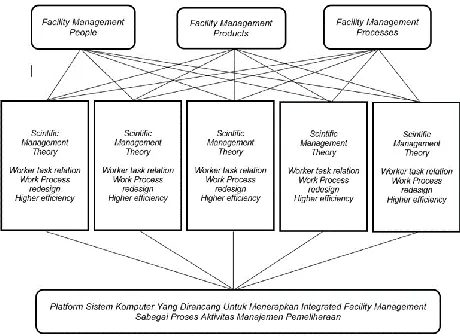
Jones dan George (2012), management theory has evolved from the theory of scientific management in 1880 and 1890 through development of five theory of management, administrative, behavioral, science and organization's environmental management of contemporary theoretical. In recent decades, revolution lifecycle management integrated on assets built facility management as one of profession of the fastest growing in the construction industry globally related to the diverse needs and demands of clients and establishment of the principles of facility management, the three essential elements (people, products and processes) as an integral elements linked to key aspects in the five management theory in terms of scope all general management issues. International Facility Management Association (IFMA), an international association in charge of facility management facility management defines as a job that includes a variety of disciplines to ensure functionality of the built environment by integrating people, place, processes and technology. From this definition, facility management be the coordination of the operation of the facility that is intended to make the whole organization more effective at what it does so that the operation runs smoothly. Facility management workplace leads to a more supportive flow of productive processes while adding value and reduce costs. The scope, services, activities, responsibilities, skills and knowledge of facility management are intended to integrate existing organizational factors. (PATANAPIRADEJ, 2006). Research in developed countries such as United Kingdom, United States and Asia Pacific region have analyzed measure and composition of facility management and establish its relevance. Other studies in the United States and the United Kingdom have concentrated on determining the strategic role of facility management in business organizations as competency requirements, cost control and performance measurement. (Oladokun, 2011). Concept of facility management adopted not only in practice, also inspire thinking on the management of three critical elements, as people, products and processes, to develop Facility Management Body of Knowledge (FMBOK). From the viewpoint of facility management profession, people is a client and facility management professionals and their organizations, products of various facility management services and process are various management measures to provide facility
management services. Further reviews focused on people, products and processes because it was carried out into the evolution of management theory to set a generic framework of management principles in facility management. (Chen, 2017).
Figure 1. Facility Management System
Source: British Institute of FM dalam Oladokun 2011
Sijtsemaa et al. (2009) the research reveals about knowledge work productivity in a distributed work teams, where the efficiency of information and communications technology support services interests. For shopping centers, more diverse dimensions, including three staff categories (staff, security and cleaning), public areas and public facilities. (Hui et al, 2013). The relationship between the characteristics of the work and results of the work has been applied to the facility management, which is an important step to connect the direct productivity. (Ling and Wong, 2016). Business service productivity, implies that integration of human resources such as inputs and outputs related to the integration of service facilities can be linked to another. (Nielsen et al., 2016).
3
METHODOLOGY
3.1.State of the Art
This research is expected to obtain designed a computer system platform to implement Integrated Facility Management as a comprehensive maintenance activity process, better integrate organizational factors, simplify complicated processes in identifying and scheduling tasks, records, making facility decisions and more.
3.2.Research Roadmap
To provide an overview of this research and direction of next developments, a research roadmap was show in figure 2.
3.3.Methodology
First activity is build a computer system platform as designed by integration facility management to implement comprehensive maintenance management activities of facility management principles. Three important elements (people, products and processes) as a integration with key aspects are built gradually every year to develop the integration of people, places, processes and technology simultaneously.
1. Data Collection and System Development Identification. To develop a computer system platform begins with the collection of data by interviews and literature study, given solutions and input on the benefits and conveniences.
2. Analysis and Formulate Model
Analyze problems to determine and determine by grouping the problems that have been identified, so that they can coordinate the interface between what people, places, processes and technology to effectively and efficiently.
3. Architecture System Design
Analysis results obtained, system design using architecture system design methods (structured design).
4. Coding
Coding based on the results of structured design to make modeling and database servers with table structures and attributes/fields or record stores tobe use.
5. Testing and Evaluating Model
Test a program that has been written to ensure the programs are in accordance with the expected.
6. Implementation and Documentation
Documentation and archiving of computer system platform projects as integrated facility management. Research activities are carried out within a period of three years. Implementation of this study is explained in the research roadmap.
4 RESULTS
AND
DISCUSSION
Based on the results of the design a structured system model that focuses on management system and human resource management that can be used as a basis for an integrated decision making process, and followed by system design that focuses on products and processes in the next year. Obtained a compatible system with mobile phones in the first year, consists of:
- Admin and Employee Panels
- Determination of workdays, holidays and events - Notification of upcoming birthdays
- Notification settings
- Position data, designation management - Management of employees, list of employees - Management of employee attendance - Monthly or annual reports in PDF, Excel - Attendance report
- Payroll management
- Determination of employee salaries - Payment
- Payslip
- Announcements management - Cost management
- Managing expenses management - Email management
- Database Backup
Admin is given access in the form as:
- General settings and company information - Setting working days
- Make events categories as needed - Make notification settings
- Make a list of holidays - Making position data
- Add, update or delete employees
- Management of employee attendance with a system - Print attendance or annual reports in PDF, Excel - Manage employee payroll
- Payments and employee salary reports - Manage company costs
- Make recapitulation of company expenses - Database Backup
Management system and human resource management has the following features:
1. General settings
General settings is to organize the company's basic information. In settings, can set company name, logo, and company contact details, user can arrange an active working day in accordance with the provisions of the company; arrangement of event categories; add, update list of holiday companies. A list of holidays will assist, monitor and understand easily about the presence of employee; enable or disable notifications for different criteria to be notified.
2. Position
Possible to add, update or delete position data and appointment of underlying company. In addition can add, update name of the position as needed. During the addition of position, can also make a designation that will be under that position. Make as many positions as needed and as many titles as you want; glance at all positions and assignments that underlie them at a glance from this menu.
3. Employee
Employee menu will allow to add, update, or delete employees and related information along with documents as required by the company. Add new employee menu in accordance with company employee ID and with employee's personal and professional information. In the menu can save all documents related to employee data; employee list menu can see all employees according to their position and appointment related to the employee; appreciation for the desired employee or they deserve an award. The gift items they will get and if needed the company can also determine the amount of money they deserve from their awards.
4. Presence
manage the attendance time of all your employees very easily which is a very useful requirement for every attendance management; in the attendance report can easily see all the attendance every month for a particular employee. You can easily select a report based on the month of the year you want to see. 5. Application List
In the application list, a list of all employees who sent the application to management will be displayed. Users can easily see application details and causes or categories of applications and can set status for any application. There are 2 types of status, accepted or rejected. When any application is accepted, a notification will appear on the admin page and from there it can easily get an overview from applicants. After taking action to accept or reject it, employees will be notified of information on employee access page. 6. Pay Roll
In the pay roll, companies can easily manage and pay the relative salaries of employees and get notifications about future salary payments and salaries already paid, and can also create and maintain salary slips for each employee. By using this menu, you can manage the salary structure together with the type of employee (temporary or permanent). Admins can also set benefits to be received by employees and can also specify various types and amounts of deductions to be deducted from the total salary. This tab is very important because the system will calculate employee salaries according to the data in the salary breakdown menu; from the employee payroll tab, you can easily monitor salaries based on the department each employee receives. You can also easily jump back to the salary details tab from here and can update whatever data is needed; From the tab make a payment can easily make payment for each employee needed, can see the record of previous payments during payment and will be notified if the payment has been made and try to pay it again. The system will automatically calculate the employee payment structure and will tell you the amount to be paid and will take the payment method and pay an employee; Payslip can be printed or downloaded as a PDF.
7. Company Costs
In the company cost, admin can easily configure categories of expenditure incurred on company. Admins can easily add new expenses generated by employees, and can track amount of monthly spent.
8. Notice
From notification board menu, admins can easily create and announce or cancel announcement for company employees. New notifications will be displayed at the top in notification panel and you can also view individual notifications to print them if needed. Display is provided easily so that it can format text and produce desired notifications as needed.
9. Database Backup
Admins can easily retrieve backups from the database by simply clicking on the database backup menu. Everything in the database will enter the database which will be exported as a zip file in the local directory of the company data.
10.Employee Account
Employee in the company will get a simple page in the system. Employees can perform the following tasks from their panel such as: submit a new application; see previously applied applications; get notifications about applications that are implemented; send or receive new emails; see inbox and sent items; see the latest notifications; see upcoming events; see personal information; see holiday list; see the list of awards; and employee's main page.
5 CONCLUSION
After designing a structured model system that focuses on management system and human resource management, the following conclusions are:
1. Management system and human resource management run effectively, minimize errors in and facilitate the search for existing data and records more quickly and accurately.
2. Management system and human resource management able to produce reports or administration according to wishes of the current user.
3. This system has been registered by Directorate General of Intellectual Property, Ministry of Law and Human Rights of Republic Indonesia. Copyrighted Number EC00201977057.
ACKNOWLEDGMENTS
The authors wish to thank to Directorate General of Research and Development, Ministry of Research, Technology and Higher Education of Republic Indonesia.
REFERENCES
[1] Brochner Jan 2016. Measuring The Productivity of Facilities Management. Journal of Facilities Management Vol. 15 No. 3. Emerald Publishing Limited.
[2] Gaol, Chr. Jimmy Lbn. 2008. Sistem Informasi Manajemen Pemahaman dan Aplikasi. Jakarta: Grasindo.
[3] Hartono, Mulia. 2004. Tujuh Langkah Membangun Sistem Informasi, Yogyakarta: Graha Ilmu.
[4] Madcoms. 2003. Pemrograman Borland Delphi 7. Yogyakarta: Andi.
[5] McLeod, Raymond, Jr & schell, George P. 2008, Sistem Informasi Manajemen, Edisi 10, Terjemahan oleh Ali Akbar Yulianto dan Afia R. Fitriati, Salemba Empat, Jakarta.
[6] Jones, G. and George, J. 2012. Essentials of Contemporary Management. 5th ed. USA: McGraw-Hill Education.
[7] Patanapiradej, Wanlaya. 2006. The Scope of Facility Management. Journal of Environmental Design and Planning, Vol 1 ISSN: 1905-7210. Chulalongkorn University. Bangkok 10330, Thailand.
[8] Oladokun, Timothy Tunde. 2011. An Examination Of The Practice Of Facilities Management In Nigeria. Journal of International Real Estate and Construction Studies. Vol 1 No 2. [9] Chen, Zhen. 2017. The principles of facilities management and
case studies. Proceedings of working papers from the Association of Researchers in Construction Management and The BEAM Research Centre on Building Asset Managemen, Glasgow Caledonian University.
[11]Hui, E.C., Zhang, P.H. and Zheng, X. 2013. Facilities Management Service and Customer Satisfaction in Shopping Mall Sector Facilities. Vol.31 Nos 5/6.
[12]Ling, F.Y.Y. and Wong, D.M.G. 2016. Redesigning Facility Management Operatives. Jobs to Increase Work Outcomes. Journal of Facilities Management, Vol.14 No.1.