• No results found

Download (6MB)

N/A
N/A
Protected

Academic year: 2020

Share "Download (6MB)"

Copied!
171
0
0

Loading.... (view fulltext now)

Full text

(1)

413

SOCIAL CLASS, PEDAGOGIC PRACTICE

AND ACHIEVEMENT IN SCIENCE:

A STUDY OF SECONDARY SCHOOLS IN PORTUGAL

VOLUME TWO

Ana Maria Roseta Morais Delgado Domingos

Thesis submitted for the degree of

Doctor of Philosophy

University of London Institute of Education

1984

(2)

414

(3)

415

APPENDIX I

CHARACTERISTICS OF SCHOOLS

INVOLVED IN THE EMPIRICAL STUDY

Characteristics of schools here presented include essentially

their past history and the conditions under which they

currently work.

They provide information on the

environ-ment in which children were taught and teachers did their

job.

We are mainly reporting features of each school which are

relevant to science education.

It is important to note

that the science curriculum for the middle school is part

of the common curriculum which all schools must provide.

The common curriculum includes guidelines for the teaching

of each subject.

It follows that the emphasis upon science

does not vary between schools.

There may be variation

within the upper schools according to the areas provided.

However, in the case of the upper schools in our sample

each upper school makes similar provision for the science

subjects under investigation.

We present the schools separated in two groups:

middle-class schools with a mixed social middle-class population and

working-class schools with a predominantly working-class

population.

At the end we present a short analysis of the

characteristics of the schools.

(4)

416

Eight.

All of them currently: official; comprehensive;

mixed sex; mixed ability.

MIDDLE-CLASS SCHOOLS

SECONDARY SCHOOL

X

A

(Teachers Xl and X

2

)

Sited in a large city (Lisbon).

One of the oldest schools in Lisbon, i t was opened in

1902 in an old building; in 1909 i t was moved to a new

building.

Built for 800 pupils i t has currently a

popula-tion of 3000 pupils divided into three shifts, one of them

in the evenings for adult education (about 1000 students).

A former 'liceu', i t gradually changed into a comprehensive

school in the late '70s.

It has always been a boys' school,

except in the beginning.

It first had girls' classes in

1971-72 but those were completely separated from boys'

classes, functioning in different periods of the day.

In

1974-75 i t became a true mixed sex school.

It has always

been a mixed ability and mixed social class school,

although until the comprehensivization of secondary education

i t tended to be mainly a middle-upper class school; i t

still maintains a high percentage of pupils from that

social status.

It has gathered some of the best teachers

in Lisbon because of its academic level.

It has been a

school for the initial training of teachers since 1969/70.

It has had evening classes for formal adult education since

1972/73.

It was the first 'liceu' to have an evening

school (before that, evening adult education only existed

in technical schools).

Its old building is being repaired and enlarged.

Although laboratories of Biology and related fields were

being rebuilt during the academic year in which data for

this study were collected, teachers had all the facilities

(5)

417

can count on a trained laboratory technician to help them.

SECONDARY SCHOOL

X

B

(Teachers X3 and X

4

)

Sited in a large city (Lisbon)

One of the oldest schools in Lisbon, i t was opened

in 1905 in a rented old building; in 1911 i t was moved to a

new building.

Built for 500 pupils i t has currently a

population of about 3000 pupils divided into three shifts,

one of them in the evenings for adult education (about

1000 students).

A former 'liceu', i t gradually changed into

a comprehensive school in the late '70s.

It has always

been a boys' school except in the beginning; i t had a few

girls in the last two years of schooling but the sexes

were segregated in some of the classes and during breaks.

In 1974/75 i t became a true mixed sex school.

It has

always been a mixed ability and mixed social class school

although until the comprehensivization of secondary

education i t tended to be mainly a middle-upper class

school; i t still maintains a high percentage of pupils from

that social status.

Because of its high academic level i t

has always had some of the best teachers and pupils in

Lisbon.

It functioned as a centre for teacher training for many

years.

Until 1947 i t was one of the two 'liceus' in the

country where teacher training was carried out (for that

reason i t was called 'Liceu Normal'),

Such a function

was interrupted from 1947 to 1956.

From 1957 onwards i t

was one of the three 'liceus' in the country for teacher

training.

Even in 1972/73 when teacher training was

expanded to many schools in Lisbon and throughout the

country, i t still centralized teacher training in the Lisbon

area (e.g. the crucial final examination teachers had to

sit was still carried out there during that year).

Also,

(6)

418

there, including one on Mathematics, one for the last two

years of secondary school on Natural Sciences, one in

Physics and Chemistry for the 8th and 9th years.

It has

had evening classes for formal adult education since 1973/74.

It was the second 'liceu' (after 'liceu'

X

A

)

to have an

evening school (before those evening classes, adult

education only existed in technical schools).

Its old building

have been repaired.

Good

labora-tories for the teaching of Biology and related fields.

Teachers have all the facilities and equipment needed

including audio-visual aids.

Teachers can count on a

trained laboratory technician to ·help them.

SECONDARY SCHOOL

Xc

(Teacher

X

6)

Sited in a large city (Lisbon)

Opened in 1950, i t was moved to a new building in

1961/62.

Built for 700 pupils i t has currently a

population of about 3500 pupils divided into three shifts,

one of them in the evenings for adult education (about

1200 students).

A former 'liceu', i t gradually changed

into a comprehensive school in the late '70s.

A girls'

school until 1974/75, when i t became a mixed sex school.

Until that date all teachers and members of clerical staff

were females.

It still keeps a high percentage of females

among its clerical staff and teachers.

It has always been

a mixed ability and mixed social class school although

until the comprehensivization of secondary education i t

tended to be mainly a middle-upper class school; i t still

maintains a high percentage of pupils from that social

status.

It has been a school for the initial training of

teachers since 1972/73.

It has been widely used for

carrying out courses for in-service teacher training

(7)

419

namely some of the GTEB - Gulbenkian Foundation courses

for Science Teachers.

It has had evening classes for

formal adult education since 1975/76.

It possesses new building with very good accommodations.

Many and excellent laboratories for the teaching of

Biology and related fields.

Teachers have all the

facilities and equipment needed, including audio-visual

aids.

Teachers cannot count on a trained laboratory

technician to help them, although a member of the clerical

staff gives them some kind of help.

WORKING-CLASS SCHOOLS

SECONDARY SCHOOL

X

D

(Teacher

X

5)

Sited in a large city (Lisbon)

Opened in 1980/81 i t is a school without previous

history.

It has a population of 600 pupils divided into

two shifts of 7th, 8th and 9th years, the only years

functioning there.

It opened as a comprehensive, mixed

sex school; i t is a mixed ability and mixed social class

school.

It does not have evening classes for adult

education.

The school population is constituted by pupils

for whom there was no place in other schools, mainly

children from the suburbs or children repeating the year.

Although a new building its accommodation is not very

good because i t is a ready-built construction created to

answer the urgent need for schools.

There are no true

laboratories, only one room-laboratory for all classes

of Biology and related fields.

Teachers have some

equip-ment and audio-visual aids; they cannot count on any help

from laboratory technicians or members of the clerical

(8)

SECONDARY SCHOOL

X

E

(Teacher

x?)

420

Sited in a large city (Porto)

Opened in 1955, i t was the first secondary school in

the area (working class area), built many years before the

'liceu'.

A former Technical School (Industrial and

Commer-cial) , i t gradually changed into a comprehensive school in

the late '70s.

Built for 2000 pupils (2 shifts, one in the

evening) i t has now 3000 divided into three shifts, one of

them in the evenings for adult education (about 1000

stu-dents).

It has always been a mixed sex school although

sexes were completely segregated in all classes and during

breaks.

In the early '70s i t began to have some mixed

classes.

In 1974/75 i t became a true mixed sex school.

As

is the case with all technical schools i t has always been a

working-class school although since the comprehensivization

of secondary education i t has changed to a somewhat more

mixed social class school.

It has always been a school for the initial training

of teachers.

It has always had evening classes for formal

adult education.

A relatively new building, i t has very good facilities

and equipment for the purpose i t was constructed: a

techni-cal school.

However, subjects like Biology and related

fields, which were not very relevant in the curriculum of

technical schools (before the comprehensivization of

secondary school), do not as yet have proper laboratories.

There is only a room-laboratory for all classes, and teachers

lack almost all kinds of equipment, from apparatus to

audio-visual aids.

Teachers of these subjects cannot count

on any help from laboratory technicians or members of

(9)

SECONDAEY SCHOOL

ZA

(Teachers

Z1

and Z4)

421

Sited in a town in the centre of Portugal.

Opened in an old building in 1955, i t was moved to a

new one in 1963.

It was the second secondary school in

the town, built many years after the 'liceu'.

Built for

600 pupils (two shifts one in the evening), i t has

currently a population of 2000 pupils divided into three

shifts, one of them in the evenings for adult education

(about 400 students, comparatively less than in the early

years of its functioning).

A former technical school

(Industrial and Commercial), i t gradually changed into a

comprehensive school in the late '70s.

It has always been

a mixed sex school although the sexes were completely

segregated in classes and during breaks.

In the early '70s

i t began to have some mixed classes and after 1975/76 i t

became a true mixed sex school.

As is the case with all

technical schools i t has always been a working-class

school; although since the comprehensivization of

secondary education i t was supposed to become a mixed

social class school, there has been little change in its

social composition.

It has been a school for the initial training of

teachers since 1974.

It has always had evening classes for

formal adult education.

A new building, i t has reasonable facilities and

equipment for the purpose i t was built (to be a technical

school).

However, subjects like Biology and related

fields, which were not relevant in the curriculum of

technical schools (before the comprehensivization of

secondary school), have not as yet proper laboratories.

There is only a room-laboratory for all classes; there is

some equipment and teachers can use audio-visual aids.

They cannot count on any help from laboratory technicians

or other members of the clerical staff.

(10)

SECONDARY SCHOOL

2B

(Teacher 2

2

)

422

Sited in a seaside town in the south of Portugal.

Opened in 1932/33 for the teaching of the first two

years of secondary school, i t was the first secondary school

in the town, preceding the technical school (1963/64) by

many years.

In 1960/61 the number of years i t taught started

to increase, until all years were taught.

It was

accommo-dated in an old building until 1964/65 when a new building

was built.

Built for 900 pupils i t has currently a

popula-tion of 2500 pupils divided into three shifts, one of them

in the evenings for adult education (300 students).

A

former 'liceu', i t gradually changed into a comprehensive

school in the late '70s.

It has always been a mixed sex

school although sexes were segregated in different classes

and during breaks.

In 1974/75 i t became a true mixed sex

school.

It has always been a mixed ability and mixed social

class school, although until the comprehensivization of

secondary education i t tended to be mainly a middle

class school; i t still maintains a high percentage of pupils

from that social status.

It has been a school for the initial training of

teachers since 1971/72.

It has been used to carry out

courses for in-service teacher training namely one of the

GTEB-Gulbenkian Foundation courses for Science teachers.

It has had evening classes for formal adult education since

1975/76.

New building.

It has reasonable accommodation and

reasonable laboratories for the teaching of Biology and

related fields.

Teachers have all the facilities and

equipment needed, including audio-visual aids.

Teachers

cannot count on a trained laboratory technician to help

them, although a member of the clerical staff gives some

(11)

SECONDARY SCHOOL

2C

(Teacher 2

3

)

423

Sited in a small town not very far from Lisbon.

Opened in 1975/76.

It is the only secondary school in

the town.

Accommodated in a building built for a private

school which had been closed.

The building which was

intended for 600 pupils is now occupied by 1500 pupils

divided into three shifts, one of them in the evenings for

adult education (about 200 students).

The school only admits

pupils from the 7th to the 9th years.

It opened already as

a comprehensive, mixed sex school.

It has been a school for the initial training of teachers

since 1980/81.

It has had evening classes for formal adult

education since 1977/78.

A new building, small in size, i t provides reasonable

accommodation.

Although there is only one laboratory for

the teaching of biology and related fields (obviously not

enough for all classes), that laboratory is quite good and

reasonably well equipped.

Teachers can make use of some

audio-visual aids and although they cannot count on a trained

laboratory technician to help them there is a member of the

clerical staff to help them.

Analysis of the Schools

From the analysis of the characteristics of the schools

we can see that our sample has three middle-class schools

and two working-class schools placed in large cities.

The

schools in the country are all working-class schools,

some-thing we did not expect when we selected the sample because,

at least, schools

ZB

and

Zc

given their characteristics of

being respectively a former 'liceu' and a new secondary

school were supposed to have a higher social class school

(12)

424

The analysis also shows that all our working-class

schools (except school

ZB)

are former technical schools

or new secondary schools with poor laboratories and

facili-ties for the teaching of the subjects which were the object

of our study.

The best equipped schools in our sample are

all middle-class schools (except school

ZB).

These factors

have certainly had an influence on the teaching children

receive, although they cannot per se be made accountable

for inferior or superior teaching and achievement.

As we

have seen (Chapter four) pupils in working-class schools

attained in some cases a better level than pupils in

middle-class schools.

As we have seen the crucial factor is the

teacher and not the building or the facilities i t possesses,

although these if inadequate have undoubtedly a depressing

effect on the work of the teacher.

This effect, as we have

seen, is felt when the teacher remains in this kind of

(13)

425

APPENDIX II

SUMMARY CURRICULUM VITAE OF TEACHERS

INVOLVED IN THE EMPIRICAL STUDY

The short history of each teacher here presented includes

her family background and her educational and professional

life.

It serves the main purpose of providing additional

data to characterise and understand each teacher's

pedagogi-cal practice.

The curriculum vitae refers to the time when the collection

of data for the empirical study was carried out (1980-1981).

We present the teachers ordered according to the final

scale we achieved in Chapter four,

i.e.

teachers follow a

decreasing

order

of competence according to our quantitative

and qualitative assessments of the teachers described in

that chapter.

This will allow the reader to relate the

teacher's characteristics with the competence they showed

in the study.

For

each teacher we included the description of family

background, studies and professional life.

Official and

extra-official qualifications and publications are referred.

At the end we present a short analysis of the characteristics

of teachers.

(14)

426

TEACHER

X

7

(7)

Female, 36 years old, she was born in a small town in

the country where she spent the first part of her

child-hood.

Later on her parents moved to a larger town where

she took her primary education in a state school and her

secondary education in a 'liceu'.

She was brought up in

a catholic family of traditionally quite well-off farm

owners, her father being a solicitor and her mother being

a housewife all of her life.

She is married to a former

bank employee with some years of a higher degree who became

a manager of a medium commercial enterprise, and she has

two small children.

She lived for many years in Lisbon but

has recently moved to a smaller city.

She has had no job

other than teaching.

She took her highest academic studies

in the Universities of Lisbon and Coimbra, where she

obtained a Licence in Biology in 1967.

Later on, in 1972,

she obtained a Diploma in Pedagogical Sciences (General

Psychology, Educational Psychology, History of Education,

Pedagogy, Health and Education) in the University of Lisbon.

She undertook her initial training for teaching in 'liceus'

(Natural Sciences) in Lisbon in 1972-1973, following the

traditional training scheme.

l

She has fourteen years of teaching practice in state

schools, including preparatory schools, technical schools,

'liceus' and comprehensive secondary schools.

Throughout her

professional life she has taught subjects like Mathematics,

Geology, Environmental Science, Biology, Human Biology,

Ecology.

She was head of department for one year and also

a member of the Pedagogical CouncilS of the school for one year.

She began to do educational research in 1973 in GTEB

3

of which she has been an active member.

Within that group,

and in collaboration with other members of it, she has

developed remarkable and outstanding work in teacher

training, curriculum development and in the improvement of

(15)

427

most crucial influence in the science teaching in Portugal.

To summarize her work one can, for example, pOint out:

(a) the numerous and unique courses for teachers and for

trainers of teachers

4

which she has organized and taught

and for which she has written many papers;

(b) the

develop-ment of a new course on Environdevelop-mental Science for Secondary

school which was a definite advance both in the scientific

content and in the methodological structure judqed by either

national or international standards;

(c) development of a

course for the training of teachers which was recently

pub-lished and is being widely used in centres for teacher

training throughout the country.

She has attended many

courses, conferences and seminars on educational subjects.

Her publications, whose number rises to over twenty, are

papers, books and audio-visual material on subjects ranging

from teacher training and curriculum development to various

materials for use in the classroom; most of these

publica-tions have been written in collaboration with other members

of GTEB.

She possesses a good knowledge of educational

psychology and a very good knowledge of both theory and

practice of science education.

She has an outstanding

mastery of the new methods of teaching Biology and related

fields.

TEACHER

X3 (3)

Female, 38 years old, she was born in a small village

in the country where she lived out her childhood and took

her primary education in a state school.

She was sent away

from home to take her secondary studies in a 'liceu' in

Lisbon.

She was brought up in a catholic family of

traditionally working owners of small farms, her parents

being primary school teachers who spent half of their lives

working in small villages and who settled later on in Lisbon.

She was married to a social welfare worker with a higher

degree and she has two children.

She has always lived in

(16)

428

nine years where she carried out work on documentation.

She took her higher academic studies in the University of

Lisbon where she obtained a Licence in Biology in 1962.

Later on, in 1973, she obtained a Diploma in Pedagogical

Sciences (General Psychology, Educational Psychology,

History of Education, Pedagogy, Health and Education) in

the University of Lisbon.

She undertook her initial

training for teaching in 'liceus' (Natural Sciences) in

Lisbon in 1973-1974, following the traditional training

scheme.

1

She has ten years of teaching practice in state schools,

all of them 'liceus' and now comprehensive secondary schools.

Throughout her professional life she has taught subjects

like Geology, Environmental Science, Biology, Human Biology,

Ecology, Human Physiology.

She was a teacher trainer at

school level for one year of the new training scheme.

2

She

was head of department also for one year; she was a member

of the Pedagogical CouncilS of the school for one year.

She began to do educational research in 1974 in GTEB

3

of which she has been an active member.

Within that group,

and in collaboration with other members of i t she has

developed remarkable and outstanding work in teacher

training, curriculum development and in the improvement of

the teaching-learning process, which has had the greatest

and most crucial influence on science teaching in Portugal.

To summarize her work one can, for example, point out:

(a) the numerous and unique courses for teachers and for

trainers of teachers

4

which she has organized and taught

and for which she has written many papers;

(b) the

develop-ment of a new course on Environdevelop-mental Science for Secondary

School which was a definite advance both in the scientific

content and in the methodological structure judged by either

national or international standards;

(c) the development

of a course for the training of teachers which was recently

published and is currently widely used in centres for

(17)

429

She has attended many courses, conferences and seminars

on educational subjects.

Her publications whose number

rises to over twenty, are papers, books and audio-visual

material on subjects ranging from teacher training and

curriculum development to various materials for use in the

classroom; most of these publications have been written in

collaboration with other members of GTEB.

She possesses a

good knowledge of educational psychology and a very good

knowledge of both theory and practice of science education.

She has an outstanding mastery of the new methods of teaching

Biology and related fields.

TEACHER

X

2

(2)

Female, 44 years old, she was born in a small village

in the country where she spent her childhood and where she

took her primary education in a state school.

She was sent

to Lisbon to a well known catholic private boarding school,

where she took most of her secondary education, the last

two years of i t having been taken at a state school, also

in Lisbon.

She was brought up in a catholic family of

traditionally working and non-working owners of small farms.

Her father is an office employee with supervisory functions

in a medium industrial enterprise and her mother a housewife

during all of her life.

She is a single woman who spent

seven years of her life teaching in Mozambique and Angola

when they were still Portuguese colonies.

She has also

lived in towns in the country and in Lisbon, where she is

now settled.

She has had no job other than teaching. She

took her higher academic studies in the University of Lisbon

where she obtained a Licence in Biology in 1966.

Later on,

in 1969 she obtained a Diploma in Pedagogical Sciences

(General Psychology, Educational Psychology, History of

Education, Pedagogy, Health and Education) in the University

of Lisbon.

She undertook her initial training for teaching

in 'Liceus' (Natural Sciences) in Angola in 1970-1971

(18)

430

She has twenty years of teaching practice, the first

six of them in private schools.

After that she has always

taught in state schools all of them 'liceus' and now

com-prehensive secondary schools.

Throughout her professional

life she has taught subjects like Geology, Biology, Human

Biology, Ecology, Environmental Science.

She was a teacher

trainer at school-level for two years of both training

schemes,

the traditional

l

and the new

2

ones.

She has also

been head of department for three years and a member of

the Pedagogical CouncilS of the school for four years.

From 1976 onwards, she has been a teacher's trainer in

the GTEB-Gulbenkian Foundation in-service teacher's training

4

courses.

To be prepared for such a task she attended the

GTEB's courses for teacher's trainers.

She is currently a

member of GTEB.

3

She also taught a few other courses for

teachers and she has attended many courses, conferences and

seminars on educational subjects, one of them a GTEB course

4

(which she attended before becoming one of the trainers of

such courses).

Her publications are a collection of inquiry

and discussion slides with teacher's guide, which she made

in collaboration with other members of GTEB.

She possesses

a good knowledge of educational psychology and a good

know-ledge of both theory and practice of science education.

She

has a very good mastery of the new methods of teaching

Biology and related fields.

TEACHER Z2

(9)

Female, 43 years old, she was born in a town in the

country, where she spent her childhood and where she took

her primary education and the two first years of secondary

education, always in state schools.

After that she was

sent away from home to continue her secondary studies

(always in a 'liceu') firstly in another town in the country

and finally in Lisbon.

She was brought up in a family who

(19)

431

influence.

Her father was a taxi driver initially employed

in a family enterprise and he maintained a close friendship

with his employers.

Later on he became self-employed.

Her

mother who started as a self-employed dressmaker became,

later on in her life, a housewife.

There is in the family

background of this teacher a discrepancy between the

socio-economic and cultural characteristics of the family.

This

teacher told the researcher that despite her father's

occupation (taxi driver which in Portugal is associated with

a low socio-cultural status) he maintained a strong interest

and concern for general cultural matters.

She is a single

woman who has lived for alternative periods of her life in

the town where she was born and brought up, and in Lisbon.

She has had no job other than teaching.

She took her higher

academic studies in the University of Lisbon where she

obtained a Licence in Biology in 1960.

Later on, in 1965,

she obtained a Diploma in Pedagogical Sciences (General

Psychology, Educational Psychology, History of Education,

Pedagogy, Health and Education) in the University of Lisbon.

She undertook her initial training for teaching in 'liceus '

(Natural Sciences) in Coimbra in 1969, following the

traditional training scheme.

l

She has nineteen years of teaching practice in state

schools all of them 'liceus ' and now comprehensive secondary

schools.

Throughout her professional life she has taught

subjects like Geology, Biology, Human Biology, Ecology,

Environmental Science.

She was head of department and

deputy head of department both for one year.

She was also

a member of the Pedagogical councilS of the school for five

years and a member of the Directory CouncilS of the school

for two years.

Her deep interest in the new methodologies of science

teaching began with her becoming involved in a pilot

experi-ment on Natural Sciences for the last two years of secondary

school.

She was one of the teachers who led that experiment

(20)

432

From 1976 onwards, she has been a teacher trainer of GTEB

-Gulbenkian Foundation in-service teacher's training courses. 4

To be prepared for such a task she attended the GTEB's

courses for teacher trainers.

She has attended many courses,

conferences and seminars on educational subjects

in

Portu-gal and abroad, one of them a GTEB course

4

(which she

attended before becoming one of the trainers of such courses) .

Her publications are two textbooks on Biology for the 10th

year of schooling, which she wrote in collaboration with

other teachers.

She possesses a good knowledge of

educa-tional psychology and a good knowledge of both theory and

practice of science education.

She has a very good mastery

of the new methods of teaching Biology and related fields.

TEACHER

X5 (5)

Female, 28 years of age, she was born in Lisbon where

she has spent all of her life.

She took her primary

education in a private school, she then entered a 'liceu'

to take her secondary education but she went back to a

private school for the last two years of her secondary

education.

She was brought up in a non-catholic family,

her father being a builder and her mother being a housewife

all of her life.

There was a discrepancy between a

reasonably high socio-economic level and a low cultural

level within her family.

She is a single young woman who

has always lived in her parents' home.

She has had no job

other than teaching.

She took her higher academic studies

in the University of Lisbon where she obtained a Licence in

Biology in 1979.

That degree already included the study of

a number of subjects on education and one-year teacher

training in a school, for i t corresponds to the new teacher

training scheme.

2

At school-level she was supervised by a

member of GTEB.

3

Her initial training was for teaching in

'liceus' (Natural Sciences).

She has three years of teaching practice, the first

(21)

433

of them in a private school and also for a short period of

time in a 'liceu' and the other two in state schools,

already comprehensive secondary schools.

She has taught

subjects like Biology, Human Biology, Ecology.

She has

been head of department for one year and a member of the

Pedagogical CouncilS of the school for one year too.

So

far she has attended only a few short courses on educational

subjects.

She possesses some knowledge of both theory and

practice of science education.

She has a reasonable mastery

of the new methods of teaching Biology and related fields.

TEACHER

Xl (1)

Female, 49 years of age, she was born in a town in

the country where she spent her childhood and adolescence.

She took her primary education in a private school; her

secondary education was also taken in a private school except

for the two last years which were taken in a 'liceu'.

She

was brought up in a non-practicing catholic family, her

father being a small entrepreneur in commerce and her mother

a housewife during all her life.

She is married to a commercial manager with secondary

education and she has six grown-up children, one of them

already married.

She has always lived in Lisbon.

She has

had no job other than teaching.

She took her higher academic

studies in the University of Lisbon where she obtained a

Licence in Biology in 1954.

Later on, in 1956 she obtained

a Diploma in Pedagogical Sciences (General Psychology,

Educational Psychology, History of Education, Pedagogy,

Health and Education) in the University of Lisbon.

She

undertook her initial training for teaching in 'liceus'

(Natural Sciences) in Lisbon in 1958-1960, following the

traditional training scheme.

l

She has 25 years of teaching practice, the first two

of them in a private school.

After that she has always

(22)

434

comprehensive secondary schools.

Throughout her professional

life she has taught subjects like Geology, Biology, Human

Biology, Ecology.

She was a teacher trainer at school level

for six years of the new training scheme.

2

She has also

been head of department for three years, a member of the

Pedagogic Council of the schoolS for three years and a

S

member of the Directory Council of the school for one year.

She was involved in a pilot experiment

of Natural Sciences

for the last two years of secondary school; she was actually

one of the teachers who led that experiment

in Lisbon for

the last two years of its existence.

She has attended

several courses, conferences and seminars on educational

4

subjects in Portugal and abroad, one of them a GTEB course.

Her publications are two textbooks on Biology for the 10th

year of schooling, which she wrote in collaboration with

other teachers.

She possesses a fair knowledge of both

theory and practice of science education and she has some

mastery of the new methods of teaching Biology and related

fields.

TEACHER

X

4

(4)

Female, 29 years of age, she was born in Lisbon where

she has spent all of her life.

She took her primary

education in a state school and her secondary education in

a 'liceu'.

She was brought up in a non-practicing catholic

family, her father being a shop assistant and her mother

being a housewife all of her life.

She is married to an

engineer who became a secondary school teacher; she has a

small child and so far has lived in Lisbon in her parents'

horne.

Before she started teaching she had another job for

four years in a state service, where she carried out a

kind of bureaucratic work.

She took her higher academic

studies in the University of Lisbon where she obtained a

Licence in Biology in 1978.

She took her initial training

for teaching in 'Liceus' (Natural Sciences) in Lisbon in

(23)

435

She has one year of teaching practice in state schools,

already comprehensive secondary schools.

She has taught

subjects like Biology, Human Biology, Ecology, Human

Physiology.

So far she has attended only a few short

courses on educational subjects.

She possesses some

know-ledge of both theory and practice of science education.

She does not as yet have a good mastery of the new methods

of the teaching of Biology and related fields.

TEACHER Z3 (10)

Female, 44 years old, she was born in a small town in

the country, where she spent her childhood and where she

took her primary education in a state school.

She was sent

to Lisbon to a well known catholic private boarding school,

where she took all of her secondary education.

She was

brought up in a well-off catholic family of traditionally

farm owners, her father being a veterinary surgeon with a

higher degree and her mother a housewife all of her life.

The economic and socio-cultural level of her family was

definitely high.

She is a single woman who has lived in

several towns in the country and also in Lisbon, where she

has been settled for many years.

She has had no job other

than teaching.

She took her higher academic studies in the

University of Lisbon and Coimbra where she obtained a Licence

in Biology in 1965.

Later on in 1972, she obtained a

Diploma in Pedagogical Sciences (General Psychology,

Ed~cational

Psychology, History of Education, Pedagogy,

Health and Education) in the University of Lisbon.

She

undertook her initial training for teaching in 'liceus'

(Natural Sciences) in Lisbon in 1972-1973, following the

traditional training scheme.

1

She has 15 years of teaching practice in state schools,

including preparatory schools, technical schools, 'liceus'

and comprehensive secondary schools.

Throughout her

(24)

436

Physics and Chemistry, Geography, Geology, Biology, Human

Biology, Ecology.

She was a director of laboratory for one

year.

She has attended a few courses on educational subjects,

one of them a GTEB course.

4

She possesses a fair knowledge

of both theory and practice of science education and has

some mastery of the new methods of teaching Biology and

related fields.

TEACHER X6 (6)

Female, 31 years of age, she was born in Angola but

has spent all of her life in Lisbon.

Her primary and

secondary education were both taken in a private school.

She was brought up in a catholic family.

Her father who

came from a low social class was educated and

self-made man who owned a large enterprise.

He died when she

was s t i l l a girl.

Her mother who was a housewife all of

her life came from a higher social class although she was

culturally inferior to her husband.

There was a discrepancy

between a very high socio-economic level and a somewhat

low cultural level within her family.

She is married to a

husband who is s t i l l a student of engineering employed in

a large enterprise, and she has two small children.

She

has always lived in Lisbon except for a small stay in Angola.

She has had no job other than teaching.

She took her higher

academic studies in the University of Lisbon where she

obtained a Licence in Biology in 1976.

That degree included

the study of a number of subjects on education and a

one-year teacher training in a school as i t corresponds to the

new teacher training scheme.

2

Her initial training was for

teaching in 'liceus' (Natural Sciences).

She has three years of teaching practice

in

state

(25)

437

Biology, Ecology, Environmental Science.

So far she has

attended only a few short courses on educational subjects.

She possesses some knowledge of both theory and practice

of science education.

She does not as yet have a good

mastery of the new methods of teaching Biology and related

fields.

TEACHER Z 4 (i1 )

Female, 52 years old, she was born in a town in the

country where she spent her childhood and where she took

her primary education in a state school.

Her secondary

education was taken in a 'liceu' in the same town.

She was

brought up in a catholic family of traditionally working

owners of small farms who raised their socio-economic level

by becoming medium sized entrepreneurs.

There was a

dis-crepancy between a reasonably high socio-economic level and

a low cultural level within her family.

She is a widow of

a country doctor with an adult daughter.

She lived for

some years in a small town and later on she moved to a

larger town also in the country, where she is now settled.

She spent, however, a short period of her life in two big

cities.

She has had no job other than teaching.

She took

her higher academic studies in the University of Lisbon

where she obtained a Licence in Biology in 1953.

Also in

1953, she obtained a Diploma in Pedagogical Sciences (General

Psychology, Educational Psychology, History of Education,

Pedagogy, Health and Education).

She took her initial

training for teaching in technical schools (Natural Sciences

and Physics and Chemistry) in Lisbon in 1969, following the

traditional training scheme.

l

She has twenty three years of teaching practice, the

first five of them in a private school.

After that she has

always taught in state schools all of them technical schools

and now comprehensive secondary schools.

Throughout her

professional life she has taught subjects like Mathematics,

(26)

438

Ecology.

She was a deputy head teacher for one year, and

she has been head of department for seven years and member

of the Pedagogical CouncilS of the school for seven years.

She has attended a number of short courses on educational

subjects, and also a one-year course on T.V.

She possesses

a fair knowledge of both theory and practice of science

education but she does not as yet have a good mastery of

the new methods of teaching Biology and related fields.

TEACHER Z1

(8)

Female, 25 years of age, she was born in a small town

in the country where she spent her childhood and where she

took a first period of her primary education in a state

school.

Later on her parents moved to a larger town where

she completed her primary education, firstly in a private

school and afterwards in a state school.

Her secondary

education took place in a 'liceu'.

She was brought up in

a middle class catholic family, her father being a country

doctor (who died when she was still a young girl) and her

mother a secondary school teacher, both of them having corne

from families of traditionally working owners of small farms

who, in some cases, raised their socio-economic level by

becoming medium-sized entrepreneurs.

She is a single

woman who, after obtaining her degree, carne back to live

in her parents' house in the town where she had lived before.

She has had no job other than teaching.

She took her higher

academic studies in the University of Porto where she obtained

a Licence in Biology in 1978.

That degree included the study

of a number of subjects on education and one-year teacher

training in a school, for i t corresponds to the new teacher

training scheme.

2

Her initial training was for teaching in

'liceus' (Natural Sciences).

She has three years of teaching practice in state

schools all of them comprehensive secondary schools.

She

has taught subjects like Biology, Human Biology, Ecology,

Environmental Science.

She has been deputy head of

(27)

439

So far she has attended only a few short courses on

educational subjects.

She possesses some knowledge of both

theory and practice of science education although she does

not as yet have a good mastery of the new methods of

teaching Biology and related fields.

NOTES:

1.

Traditional training scheme - traditional way of

training secondary school teachers still currently

existing in Portugal: i t is a school-based type of

training not linked to the university.

2.

New training scheme - a quite recent way of training

teachers with no more than ten years of existence.

The Licence in any scientific field itself includes the

study of a number of subjects on education and a

one-year training in a school; such a training scheme is

linked to the university.

3.

G.T.E.B. - Grupo de Trabalho para

0

Ensino da Biologia

(Working Group for the Teaching of Biology): a group

devoted to educational research which started in 1971

and which has been supported by the Gulbenkian

Founda-tion.

Its main field of work has been teacher training

and curriculum development.

Through its activities

G.T.E.B. has had the most crucial influence in changing

science education in Portugal.

An important number of

publications have been made by its members.

4.

G.T.E.B.'s Courses -

In-service teachers' courses on the

Philosophy and Methodology of Science and the Methodology

and Organization of Teaching.

These have included

courses for teachers and courses for trainers of teachers

and they have made an important contribution to the

introduction of new methods of teaching and new scientific

contents as well in science education in Portugal.

Their unique characteristics have made them an outstanding

innovation judged either by national or international

(28)

440

reading the paper: DOMINGOS, A.M., "Changing Science

Education through In-service Teacher's Courses" in

Associateship Report,

University of London Institute

of Education, London, 1979.

5.

After 1974 the administration of the school was

radically changed.

The Pedagogic Council consisting

of the elected heads of each department and the elected

president of the directory council is responsible for

all pedagogic practice.

The Directory Council is an

elected executive body which replaced the Head and

Deputy teachers.

Analys~of

teacher's characteristics

The analysis of differences and similarities between

teachers and their relation with the competence they showed

when we carried out the quantitative and qualitative

assessments in Chapter four, points to some main

character-istics of a teacher capable of producing a higher competence

with respect to the appropriate level of conceptual demand

and also with respect to assisting pupils to attain that

level.

The most important characteristics appear to be the

extra-official qualifications, their experience as teacher

trainers, their contribution in curriculum development,

their publications and the knowledge the teachers possess

of the sciences of education and their understanding of new

methods of science teaching.

The age of the teacher and the

type and area of the school where they teach appear to have

some relation.

Family background and years of practice

appear not to have a clear relation with the teacher's

competence.

This definitely points to efficient

teacher training

as

the important factor in the improvement of science education.

Such training should include the study of the sociology of

(29)

441

APPENDIX III

INSTRUMENTS

The instruments used

to

carry out the empirical study are

in this appendix and they are:

(aJ

Questionnaire

to

teachers

(bJ

Questionnaire

to

pupils

(cJ

Sheet

to

plan and correct the teachers' tests

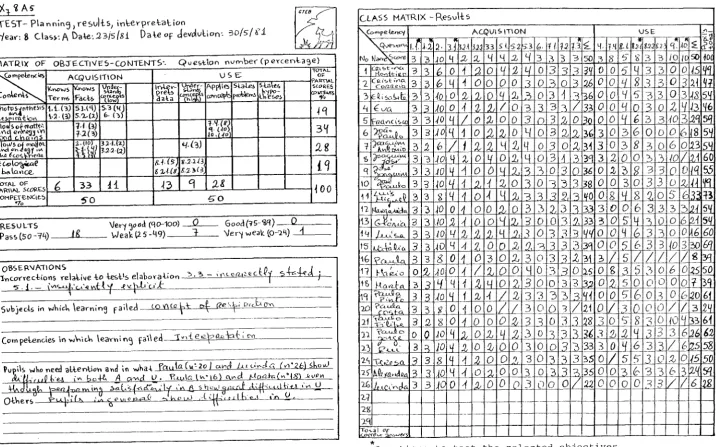
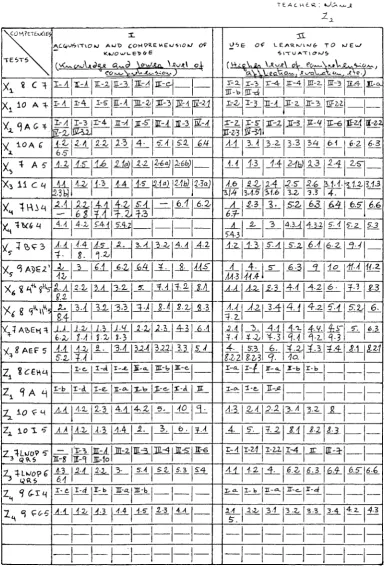
(dJ

Table

to

register the classification made by each

teacher of A/U competencies in different tests

(eJ

Table to register the classification made by different

teachers of A/U competencies in one test

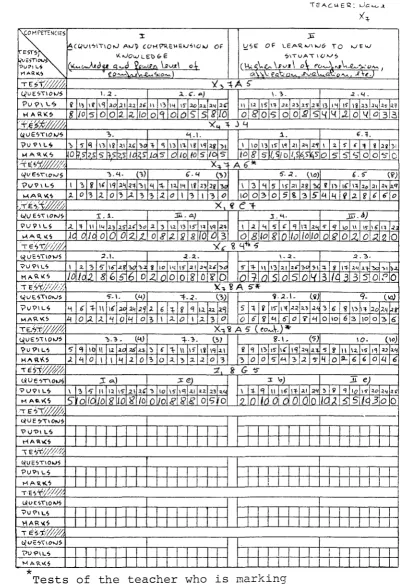
(fJ

Table to register marks given by one teacher

to

answers of different teachers' pupils

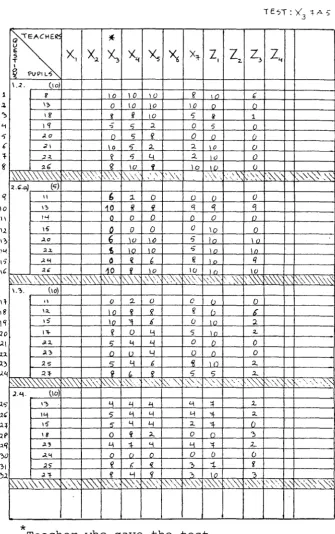
(gJ

Table to register marks given by different teachers

to

pupils' answers to questions of one test

(hJ

Table to register marks of pupils to answers to

questions testing selected objectives

A

filled-in example of each one of these instruments is

(30)

442

QUESTIONNAIRE TO TEACHERS

Code number of the pupil

Name

Number

Class

Year

Date of Birth

School

Address

Father:

Name

Address

Occupation ______________________________________________________ _

Educational Qualification

Mother:

Name

Address

Occupation

Educational Qualification

Person

Name

in charge

of

Address

education

Occupation ______________________________________________________ _

Educational Qualification

Is the pupil repeating this or another school year?

MARKS

CCMPEI'ENCIES

I - ACQUISITION AND

II -

USE

OF LEARNIN3

CCMPREHENSION OF

TO NEW SITUATIONS

KNJWLEDGE

{Higher level of

GIDBAL

TERMS

lower level of

(Knowledge and

comprehension,

app l ication,

comprehension)

evaluation, etc.)

2..Q/60 -

:1..'4/60

(L)

)'O/LiO - - 1:l./'10

(L) '-1,61/100 - ,q/lOo

1st

Term

2nd Term

'})'/60 -'1~/60

tAl

'5/'10 -- g/'-Io

(l)

"'>l/IOO - 5

4/

100

3rd

Term

"'>/50

---;'9/50

(A) J,.LI.!50 __ \ 5(/50

(L)

')9/100 - ')<;/100

OBSERVATIONS:

*

Marks are indicated in each cell according to order in

time of tests.

The level in

A

and

U

competencies and

global achievement assigned by the end of the term is

in brackets

(L -

low; A - average; H - high; 1 -

0%-24%;

2 -

25%-49%; 3 -

50%-74%; 4 -

75%-89%; 5 -

90%-100%) .

(2)

(2)

(31)

443

QUESTIONNAIRE TO PUPILS

l

(Translation)

(In questions accompanied by blank squares make a cross in front of the

appropriate answer; for each question use as many squares as approprate)

1.

Date of birth

2. Sex:

Male

0

Female

0

3.

Brothers and/or sisters:

Age

Studies possessed

4.

What type of primary school did you attend?

State school

0

Private school

0

5.

If you have repeated one or more years, say which (write the number

of years you repeated in the square) :

1st

0

6th

D

6.

Father:

2nd

0

7th

0

3rd

0

8th

0

4th

0

5th

0

9th

0

lOth

0

11th

0

6.1.

Do you live with your father? ____________________ Yes

0

No [ ]

If not: How long

ago _________________________________ _

Is he

deceased? ________________________________

yes[]

Is he an emmigrant? ___________________________ Yes

0

No

D

NoD

6.2.

Father's age:

up to 40 years

D

from 40-50 years

0

more than 50 years

0

6.3.

Father's qualifications (underline 'Liceu' or Technical School

as appropriate):

Cannot read or write

Did not go to Primary School, but can read & write ______ _

Completed Primary School (3rd or 4th year) ______________ _

Attended some years of a secondary school (5th-9th year)

('Liceu' or Technical School) ___________________________ _

Took the 9th year exams ('Liceu' or Technical School)

Took 11th year exams ('Liceu' or Technical School) ______ _

D

D

D

o

D

Figure

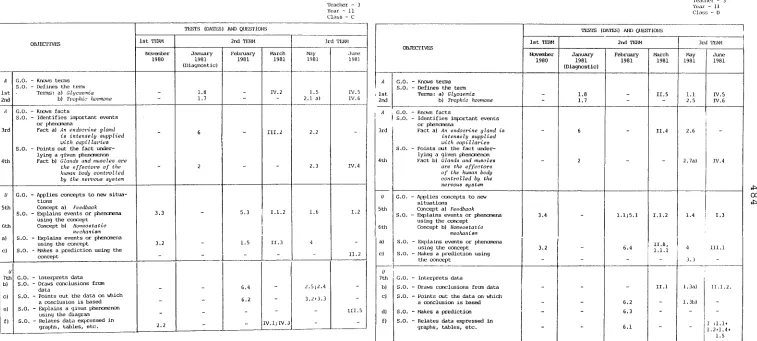
Figure 111.1 -
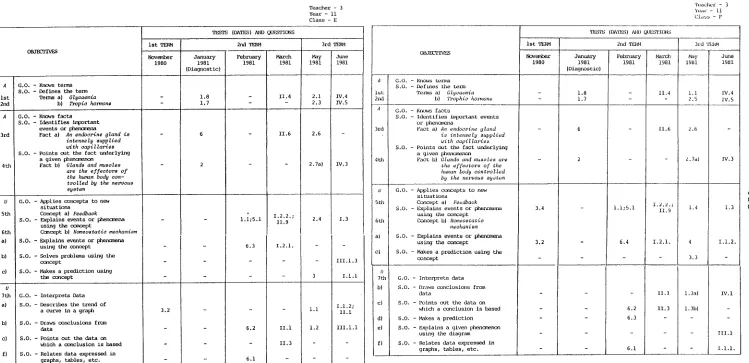
Figure III.2 -Categories of competencies required in tests administered by different teachers and classified by one teacher: a filled-in example of the table used by each teacher
Figure III.4 -
Figure III.5 -Teachers' marking of pupils' answers to some questions of one test administered by one teacher: filled-in example
+7

References

Related documents

Instead, the project promises Skopje a new image, one that will deliver Macedonia a properly “European” capital, at once attractive to outsiders and worthy of national pride«

Pada permainan bolabasket pada atlet PON Sul-Sel telah dilakukan tes kemampuan Physical Fitnes diantaranya adalah kekuatan, daya tahan otot, kelincahan, kelentukan,

The key to the successful treatment of OM in the diabetic foot is a combination of antibiotic therapy and surgical procedures.. The latter may include surgical debridement with

Most of the investigated possible sources of stress showed significant correlations with burnout. The most interesting findings were that women seems to experience more “Demands”

Our undergraduate programmes support learning across the School’s key research themes: o Sports performance, policy and education o Exercise medicine and health o Human

Based on configuration and contingency, manufacturing industry which applying prospector strategy operating in hostile environment, having organic export channel structure and

(a) That the IP Policy Working Group, consisting of the Chief Executive Officer of Warwick Ventures Ltd., the Director of Corporate Relations, the Director of Research Support

Only regular and honorary members of the Corporation in good standing who have demonstrated active participation in the Corporation and who meet the established qualifications