2558
Linprot: A Multimedia Courseware For
Optimization Methods With Integration Of
Augmented Reality
R. N. Farah, F. N. Hanani, R. L. Zuraida
Abstract: LinProT is a learning aid that combines the use of computer and mobile devices with educational materials. It is part of a learning approach that gives users the opportunity to learn with a self-directed learning approach. LinProT is an educational courseware for the Optimization Methods course. LinProT consists of a multimedia elements package including short video tutorials and scanned pictures by using QR Code and Augmented Reality applications. The main contents in LinProT are notes, exercises and tutorial videos. Users can enjoy a new experience of learning through courseware and reduce frustration from conventional learning and boring reading.
Index Terms: ADDIE model, Augmented Reality, Feasibility, Optimization Methods, QR Code, Self-Directed Learning approach —————————— ——————————
1.
INTRODUCTION
THE fourth Industrial Revolution (IR 4.0) has changed the prospect of educational innovation. IR 4.0 is the name for the current trend of automation and data exchange in manufacturing technologies that include cyber-physical systems, the internet of things and cloud computing [1]. Hence, Education 4.0 is the rapid revolution in innovation which has delivered another educational model for the future to prepare graduates for future life and work which is achieved by IR 4.0 [2]. In Malaysia, the Ministry of Higher Education introduced the Higher Education theme 4.0 (MyHE4.0) which includes the Teaching and Learning (T&L) 4.0 process at universities encompassing study space, pedagogy, organic curriculum and the use of latest technology. According to former Higher Education Minister (2015-2018), Dato 'Seri Idris Jusoh, learning methods such as heutagogy (self-determining learning), paragogy (cyber-oriented learning) and cybergogy (virtual-based learning) need to be adjusted in T&L 4.0 [3]. This was also carried out by the current Minister of Education, Dr. Maszlee Malik. He stated that instructors need to have high creativity and innovation and dare to make changes according to the latest technological developments to take on the IR 4.0 challenge. In the educational environment of Information and Communication Technology (ICT), instructors must also play a key role as agents of change. As stated in his speech in conjunction with the Malaysia Teacher 2019 Festival in Malaysia, integrating and cultivating ICT on every occasion in T&L in universities can influence the interest and ability to change existing T&L practices and bring the practice to a more quality level [4].
Therefore, the role of instructors in implicating the approach of learning using ICT in T&L is very important.
The Mathematics education system practiced in Malaysia has made continuous efforts for change towards the development of individual potential in a comprehensive and
integrated manner in the Mathematics field. With collaboration between instructors and students, they can bring a positive change in education. In Mathematics, the learning process should include a learning material or tool that emphasizes the mastery of learning objectives so that students can identify their potential to understand concepts and skills that have been learned. Education with ICT refers to computers and electronic facilities that facilitate instructors to deliver the whole part of the course content to achieve the objectives of the subject or course [5]. The use of ICT in T&L can make the T&L process more active and create an exciting and fun learning environment compared to traditional learning methods [5]. Besides that, implementing ICT in T&L can improve the efficiency and effectiveness of learning a course, especially by applying ICT tools as teaching aids. The T&L process with ICT usage can create a simpler, more concise, compact and attractive T&L environment. Hence, the use of ICT in the T&L process is one of the strategies and approaches of Computer Aided Learning (CAL). According to Endang Istikomah and Nor Sakinah Mohamad [6], through the analysis and exploration process with CAL, students will obtain information such as facts, procedures, concepts and principles [6].
2.
COURSEWARE
REQUIREMENTS
IN
EDUCATION
Nowadays, various forms of software have been created and used to help students be more focused and interested in self-learning through creative and exploratory activities. The T&L process using educational software is increasingly important especially in Mathematics. Among the Mathematical software used widely in T&L are MathCAD, AutoGraph, Geometer‘s Sketchpad, GeoGebra and Matlab. Courseware is a form of educational software that acts as a learning tool in CAL which incorporates multimedia elements. Courseware is more focused on disseminating information on specific topics, subjects or courses in the process of T&L. The use of courseware provides a diversified learning tool in T&L and provides an early introduction to students about the modernity of ICT. According to Noreliana Md Sharif [7], the implementation of courseware in T&L is effective and efficient to produce interactive learning materials that are expected to motivate students to continue exploring the contents of learning while enriching existing learning approaches [7]. According to Maslin Masrom et al. [8], the use of computer software or courseware in operational research which consists ————————————————
R. N. Farah is an associate professor at Faculty of Mathematics at Sultan Idris Education University, Malaysia. E-mail: [email protected]
F. N. Hanani is currently pursuing masters degree program in Mathematics Education in Sultan Idris Education University, Malaysia. E-mail: [email protected]
2559 IJSTR©2019
www.ijstr.org of optimization methods can improve students‘ understanding of the mathematical methods in Optimization Methods quickly and easily. Based on the preliminary study conducted by the researcher using an early questionnaire from the study, it was found that the need for courseware as a learning aid in T&L for the Optimization Methods course was appropriate to improve the learning process. Therefore, the researcher developed a courseware named LinProT as a learning tool for the Optimization Methods course. The name ‗LinProT‘ was from the combination of Linear Programming and Transportation Problems. The researcher developed LinProT in the form of an educational courseware so that the students can learn actively by conducting investigations, enhancing creativity and solving problems that integrate thinking skills and understanding concepts as well as improving understanding of their achievements in the Optimization Methods course.
3.
INSTRUCTIONAL
DESIGN
MODEL
Before the researcher developed the courseware, the choice of a systematic instructional design model is very important as it will be the framework for developers or designers to develop multimedia courseware systematically. The instructional design models that can be used as a guide in developing courseware are the Hanaffin and Peck model, ADDIE model, Watefall model, and Rapid Prototyping model. The development or production process of a courseware can use only one model or a combination of elements from various models as a guideline. In developing LinProT, a model known as the ADDIE model was selected as a guideline. This model was deemed suitable for this study because as it is one of the models of teaching design or systematic design in producing effective and user friendly teaching tools [9]. There are five main phases in the ADDIE model which are Analysis, Design, Development, Implementation and Evaluation. According to Edmonds, Branch and Mukherjee (1994) and Anderson and Goodson (1980) in Noraffandy Yahaya and Fatimah Hishamuddin [10], the ADDIE design model is an instructional design model that develops a concept for teachers and professional designers to produce and deliver one end product of learning. Based on the results of the study conducted by Johari Surif, Nor Hasniza Ibrahim and Mohamad Yusof Arshad [11], the software they developed using the ADDIE model made a positive impact as an additional learning tool. Abd. Wahid Mukhari and Mohammad Faizal Naharuddin [12] also applied the ADDIE design model in the software in their study. The results found that their software fulfilled the interactive multimedia feature and achieved their objectives.
4.
COURSEWARE
DEVELOPMENT
PROCEDURES
2.1 Analysis
Before designing and developing LinProT‘s courseware, user requirements and design aspects were necessary to ensure that the courseware development meets the curriculum of the Optimization Methods course, its learning objectives and consumer needs. A preliminary study was conducted to identify the elements required by the consumers in the design of the courseware. In addition, the aspects of the development of the courseware needed to be considered in terms of target groups, learning topics, objectives and learning outcomes, consumer needs and T&L methods. The findings of this requirement analysis study will be the main guide in the design
of the learning courseware. The instrument involved in the analysis phase was a questionnaire about the study of the needs of the students in the Optimization Methods course. This was done with the students of Diploma in Mathematics Science at Universiti Pendidikan Sultan Idris that had taken the Optimization Methods course. There were six main topics or chapters in the Optimization Methods course that were included in this courseware. The selection of the chapters was based on the guideline stated in the course plan and instructional plan provided by the instructors for the students approved by UPSI. This study aimed to develop a LinProT courseware as a learning tool in Optimization Methods to help students understand the subject and improve the quality of learning methods in this course. The objectives in developing LinProT were to produce courseware containing self-direct learning elements that were integrated to help the needs of students and evaluate the feasibility of LinProT in terms of relevance of content, achievement of lesson objectives, ability to attract users and its feasibility in T&L. A few aspects were emphasized in identifying the needs of students. They were the existing methods of T&L, the existing learning tools in T&L, the readiness of using the learning tools and the learning strategies needed in the LinProt‘s development.
2.2 Design
2560 be implemented [13]. The design of the organizational structure
of the content illustrates the overall conceptual design and the essential content contained in the interface of the courseware. The main menu consists in the courseware is Home, Introduction, Notes, Exercises and Tutorial videos. Furthermore, the process is to illustrate the appearance of the screens in the developed courseware. The use of buttons or navigation system should be illustrated. Additionally, visual and audio sketches, texts or messages that will be displayed on the screen are also sketched in a storyboard in a specific order. The storyboard for LinProT's courseware in this study is shown by displaying the main int
erface of the courseware as in Figure 1.
2.3 Development
In the development phase, the hardware and authoring software requirements, the use of multimedia elements and LinProT‘s development are emphasized. In order to develop this courseware, the designed storyboard was guided. For the authoring software, the researcher used Macromedia Director MX 2004 version 10.1 as the main software in the development process. Macromedia Director is complex and complicated multimedia authoring software with a comprehensive set of features to create interactive multimedia, animation and multimedia applications. Interestingly, there were two additional applications used in this courseware which were QR codes and HP Reveal. There were five main elements of multimedia that were applied: text, graphics, animation, audio and video as well as hypermedia and hypertext elements that were also considered in the development of this courseware. QR Code or Quick Response code is a two-dimensional bar code that can be read on a smartphone or computer that has a camera, which can be accessed after the code is scanned and allows the user to complete the action [14]. QR Codes are provided in the Exercise module for users to scan the code for additional information to get complete answers to each question in the module. HP Reveal is an Augmented Reality (AR) application. According to Razi [15], AR is a kind of visual impact generated by a computer where visual objects generated on the computer will be added to the reality scene that will appear on the display screen. As a result, users who view the real world through the computer screen will find that there are other
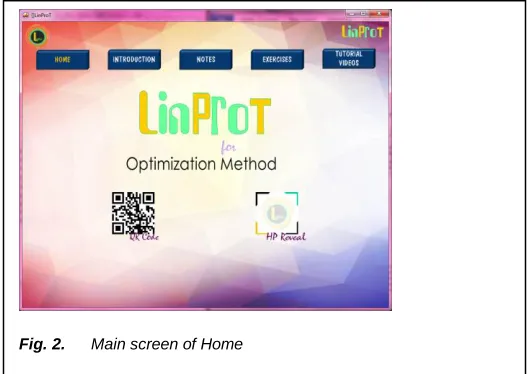
objects in existence other than the present reality. In LinProT, users can scan the image provided by using the HP Reveal application on their smartphone and display a video about the use of the courseware and the existing website to troubleshoot Optimization Methods problems. Additionally, users can scan certain images contained in the complete notes module to get additional information via text and related animations. In LinProT, there were five main menus involved whichwere Home, Introduction, Notes, Exercises and Tutorial videos. The Home‘s overall structure in LinProT was designed by involving text elements, animations and graphics. Figure 2 shows the main screen of the Home menu.
The entire structure of the Introduction menu in the designed courseware consisted of Abbreviation, Glossary and a description of the QR Code and HP Reveal usage guidelines. Figure 3 shows the main screen of the Introduction menu and Figure 4 shows the HP Reveal menu as a guideline to the user on how to use HP Reveal in this courseware.
Fig. 3. Main screen of Introduction menu Fig. 1. Storyboard screen for Notes and Exercises menu with B1
to B5 refers to Home, Introdcution, Notes, Exercies and Tutorial videos and B6 to B11 refers to each chapters in Optimization Methods. B12 and B13 are the navigation buttons.
2561 IJSTR©2019
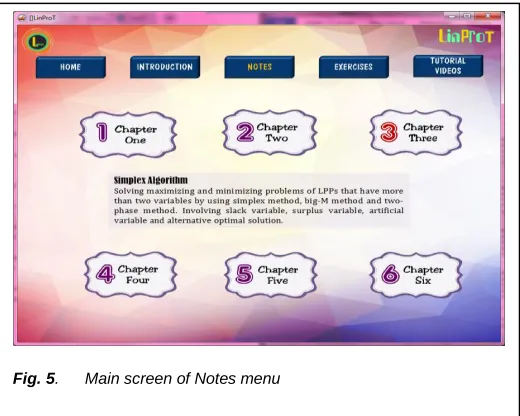
www.ijstr.org The entire structure of the Notes menu comprises of a Notes module for each chapter in the Optimization Methods course and a brief description of each chapter for the user‘s knowledge.
The overall structure of the Exercises is to include
questionnaire modules as well as complete answers to each topic for the Optimization Methods course as well as multiple lists of websites and related software to solve the problems in this course.
The overall structure of the Video Tutorials is as supplementary material to enhance knowledge of existing websites and software as appropriate to solve problems in Optimization Methods. The main overall design involves the use of video elements. However, users need to use the HP Reveal app to watch the videos.
The entire structure of the Notes menu comprises of the Notes module for each chapter in the Optimization Methods course and a brief description of each chapter for the user‘s knowledge.
2.4 Implementation
The implementation process of LinProT began with a pilot study of its validity and reliability. Based on the findings of the pilot study, it was found that the questionnaire instrument for the analysis of the need for the development of the courseware and LinProT‘s feasibility study on the 10 students of the Diploma in Mathematical Science at Universiti Pendidikan Sultan Idris (UPSI) was able to be used to collect data for actual study from the reliability aspect. From the validity aspect, LinProT was introduced and presented to two experts from UPSI. Based on the expert's comments and opinions through the LinProT's development evaluation questionnaire, the courseware was restored with improvements depending on the expert's comments and
Fig. 6. Main screen of Exercises menu
Fig. 4. Screen of HP Reveal menu
Fig. 5. Main screen of Notes menu
2562 IJSTR©2019
www.ijstr.org opinions. After being restored, the experts agreed for LinProT to be presented to the respondents for implementation and subsequently conduct a feasibility study review. After the improvement process, the researcher introduced the courseware to the respondents, who were 65 students of the Optimization Methods course. The instructor and students gathered in one lecture room. The introduction and explanation of the use of LinProT were presented by the researchers. Students were given the opportunity to explore the courseware before they answered the questionnaire about the feasibility of LinProT in Optimization Methods.
2.5 Evaluation
After the implementation phase, the courseware is assessed by students from the aspect of courseware design to meet the needs of the curriculum, learning objectives and the needs of the students and fulfill the learning theory and applied in T&L method. The assessment of the feasibility of the courseware was also carried out.
5.
RESULT
The assessment of feasibility of this courseware involved formative evaluation and summative evaluation. A formative assessment is a test that involves feedback from students who define which elements are needed in the courseware. A summative evaluation is a test that involves the application of courseware by assessing the extent to which the elements integrated in this courseware can help meet the needs of students in the T&L process. Both types of assessments were tested using a questionnaire. According to Norazah Mohd Nordin [16], the assessment of the learning tools was conducted to identify the extent to which the learning tool was applicable to its users. Hasnah Yusuf [17] stated that the content of courseware or website that meets the syllabus is important to ensure its relevance as a learning tool. Feasibility refers to the relevance of the content, the accessibility of learning objectives in the T&L process, the ability to attract students and the implementation of the T&L process, and the feasibility in the T&L process [18]. The feasibility of the courseware is assessed according to the needs of the Optimization Methods course for students to enhance understanding, consolidation and increase learning knowledge. Table 1 shows the results of the feasibility study in the Optimization Methods course which was assessed using the mean score.
Based on the interpretation value of the 4-point Likert scale scores adapted from[19], the score between 3.51 - 4.00 is the highest score. Therefore, the result of the feasibility of LinProT
courseware was high. The development and feasibility of LinProT courseware in Optimization Methods met the needs of users, especially students of Diploma in Mathematics Science in their learning process by applying basic concepts, training and guidance to enhance their knowledge in this course.
6. DISCUSSION
There are many advantages of using LinProT courseware in T&L process as students can learn by themselves as it is user-friendly because it can be installed on the computer and accessible anywhere offline. The courseware covers the entire topics in the Optimization Methods course. Students can have self- learning courseware because it can be installed and access offline due to the stand alone system and can be used to offer course in an independent study base. For instructors, it will improve their lecture. It makes the classroom lectures more informative and exciting by enhancing students‘ participation in classroom discussions. The intent is to have a more active learning environment rather than a passive one. This courseware consists of multimedia elements package; short video tutorials, scanned pictures by using HP Reveal application and QR Code and connection to other calculation software packages, it will produces dynamic learning atmosphere. But, it has a limited time use because it is only suitable for the Optimization Methods course for UPSI students as long as the faculty and administration do not make any changes to the learning plan for this course. However, other students may also use this courseware as a reference in the Operational Research course as long as it still covers the same aspects. LinProT is only useful if the faculty and the administration do not has change the Instructional Plan of Optimization Methods Course for UPSI students.
7.
CONCLUSION
The development and feasibility of LinProT shows positive implications for students. The use of new methods in the T&L process such as the self-directed learning approach through multimedia learning software is still not widely available as instructors are familiar with conventional methods. With the creation of this courseware, it will be a driving force for the production of more educational courseware in the future in order to address the problem of learning courseware and interactive courseware especially in Mathematics.Besides that, the use of AR to benefit education as appropriate content needs to be identified where it becomes more meaningful to education, especially in the T&L process in assisting instructors to attract students so that they focus on the learning process [20]. However, the use of computers in the T&L process is not meant to replace the instructors‘ role as they still need to be more competent, creative and professional in planning and compiling the contents of the lessons to integrate ICT in education [21].
ACKNOWLEDGMENT
The authors would like to thank the Sultan Idris Education University under the university teaching and learning research grant (2018-0180-107-01) for financial support.
R
EFERENCES[1] M. Hermann, T. Pentek, and B. Otto, ―Design Principles for Industrie 4.0 Scenarios,‖ 49th Hawaii Int. Conf. Syst. Sci., vol. 49, pp. 3928–3937, 2016.
[2] Aida Aryani Shahroom and Norhayati Hussin,
TABLE1
THE RESULTS OF THE FEASIBILITY OF LINPROT
No. Aspects of Feasibility of LinProT Mean Score I Interface design and presentatation 3.62 II The ability to attract user 3.56 III The relevance of the content 3.60 IV Accessibility of learning objectives in teaching
2563 IJSTR©2019
www.ijstr.org ―Industrial Revolution 4.0 and Education,‖ Int. J. Acad. Res. Bus. Soc. Sci., vol. 8, no. 9, pp. 314–319, 2018. [3] Nor Azma Laila, ―Pendidikan Tinggi 4.0,‖ Berita HArian,
18-Jan-2018.
[4] BERNAMA, ―Guru perlu bersedia tempuh cabaran revolusi industri,‖ BH Online, Georgetown, 13-May-2019.
[5] Vespanathan Supramaniyam, ―Penggunaan Teknologi Maklumat dan Komunikasi (TMK) dalam kalangan guru-guru Mata Pelajaran Kemahiran Hidup di Sekolah Rendah Luar Bandar Negeri Johor,‖ Universiti Tun Hussein Onn Malaysia, 2015.
[6] Endang Istikomah and Nor Sakinah Mohamad, ―Kesan Penggunaan Perisian Geometer ‘ S Sketchpad,‖ Pendidik. Mat., vol. 1, no. 2, pp. 1–13, 2013.
[7] Noreliana Md Sharif, ―Kesan Penggunaan Multimedia dalam Kalangan Pelajar Politeknik Yang Berbeza Gaya Kognitif,‖ Universiti Tun Hussien Onn Malaysia, 2012. [8] Maslin Masrom, Khairul Hasni Adam, Mercy Trinovianti
Mulyadi, Noraziah Abd. Wahab, Fadilah Ismail, and Shafie Md. Tarmudi, Pengaturcaraan dalam Penyelidikan Operasi. Selangor: Venton Publishing (M) Sdn Bhd, 2010.
[9] Baharuddin Aris, Rio Sumarni Shariffudin, and M. Subramaniam, Reka Bentuk Perisian Multimedia, 2nd ed. Skudai: Penerbit UTM, 2004.
[10] Noraffandy Yahaya and Fatimah Hishamuddin, ―Pembangunan perisian multimedia bagi subjek kimia, tingkatan 4, Electrochemical Series berdasarkan teori konstruktivisme,‖ pp. 1–8, 2010.
[11] Johari Surif, Nor Hasniza Ibrahim, and Mohamad Yusof Arshad, ―Pembangunan dan Keberkesanan Perisian Berdasarkan Teori Konstruktivisme dalam Mempelajari Konsep Traffic Sign, Pengajian Kejuruteraan Awam,‖ 2006.
[12] Abd. Wahid Mukhari and Mohammad Faizal
Naharuddin, ―Pembangunan Perisian Multimedia Interaktif Teknologi Automotif: Anti-Lock Brake System (ABS),‖ Skudai, 2010.
[13] Nor Musliza Mustafa, Mokmin Basri, and Marziana Abdul Majid, ―Reka bentuk perisian multimedia yang efektif berasaskan kesesuaian teori dan strategi pembelajaran,‖ Semin. Teknol. Mklm. dan Masy. 2014, 2014.
[14] Jae Hwa Chang, ―An introduction to using QR codes in scholarly journals,‖ Sci. Ed., vol. 1, no. 2, pp. 113–117, 2014.
[15] Razi, ―Apakah maksud Augmented Reality?,‖ Majalah
Isra‘, 2016. [Online]. Available:
https://majalah.isra.org.my/2016/07/apakah-maksud-augmented-reality.html. [Accessed: 26-Jun-2019]. [16] Norazah Mohd Nordin, ―Reka Bentuk Instruksi,‖ in
Panduan Amalan Pengajaran dan Pembelajaran Berkesan, Mohamed Amin Embi, Ed. Bangi, 2010, pp. 133–150.
[17] Hasnah Yusuf, ―embangunan dan penilaian
pengajaran dan pembelajaran pendidikan Al-Quran dan Al-Sunnah ‗Tokoh Mazhab,‘‖ Universiti Kebangsaan Malaysia, 2006.
[18] Zulkifli Osman, ―Kebolehlaksanaan dan
Kebolehgunaan Modul Pengajaran Bahasa
Berlandaskan Pendekatan Holistik,‖ J. Pendeta, vol. 4, pp. 202–230, 2013.
[19] Riduwan, Skala Pengukuran Variabel-Variabel Penelitian. Bandung: Alfabeta, 2012.
[20] Norabeerah Saforrudin, Halimah Badioze Zaman, and
Azlina Ahmad, ―Pengajaran Masa Depan
Menggunakan Teknologi Augmented Reality dalam Pendidikan Bahasa Melayu: Tahap Kesedaran Guru,‖ J. Pendidik. Bhs. Melayu, vol. 2, no. 2, pp. 1–10, 2012. [21] R. N. Farah, F. N. Hanani, R. . Zuraida, and N. A, ―The