50
Performance Evolution Of Various Models Of
Bio-Gas Technologies In Household Environment
Vivek Kumar Singh, Rajeev Kumar, P L Ravi Teja
Abstract: This paper investigates the research and development carried out with bio-gas energy technologies. Its describe the Bio-gas technologies that are commercially available technologies and performance evaluation in real in-situ term periodical gas pressure monitoring of gas holder and also carried out the experimental study of gas consumption in a Controlled cooking test (CCT). The World Cow Research Center (WCRC) cow generates about 10 to12 kg of dung per day, On the basis of these we also calculated the economics of a biogas plant involves the calculation of annual profit cost for the LPG equivalent of dung. The use of bio-gas technology has benefited the country in improving health, environment, economy and energy conservation.
Index Terms: Anaerobic digestion, Biogas, Cooking fuel, Designs, Dung
————————————————————
1
I
NTRODUCTIONBiomass is a major energy resource in rural areas of India. It plays a major role in domestic cooking and about 80 percent of domestic energy consumption in rural India is met by biomass fuel. About 90 percent of biomass using households of the country use wood, crop residue and animal dung as their primary cooking fuel [1]. Mostly women and children collect the firewood and this can take 3-5 hours per day [2]. Leaving this group with less time for education, employment and recreation. In efficient usage of biomass in traditional stove results in smoke that is a health hazard for the women and children who are exposed to it. [3]. Biogas is produced by anaerobic digestion of biological wastes such as cattle dung, vegetable wastes, sheep and poultry droppings, municipal solid waste, industrial waste water, landfill, etc. It is an environment friendly, clean, cheap and versatile fuel. Biogas is an appropriate cooking fuel in rural areas. Biogas is perhaps the best alternative to fuel wood which is becoming a scarce resource. Biogas technology can be sustainable and cost-effective in the long run. It is beneficial to the households for safe [4] and smoke-free combustion [5] for cooking in households. Rural India has vast potential of biogas generation and application for fulfilling the rural cooking energy demand [6]. During the past two decades, biogas has been promoted mostly as a cooking fuel in the rural areas.
Being a renewable source, biogas, when utilized appropriately can replace the commercial and nonrenewable energy sources to a considerable extent the technology is mature but operational issues have limited its uptake in rural areas. The various points have to be kept in mind during the selection of a suitable site for a digester. Adequate space, should be provided for plant construction (installation) near the staple where the animals are placed. Raw material availability, the gas production is proportional to the amount of raw material digested. Sufficient water availability, the usual materials fermented in a biogas plant normally contain a higher percentage of solids and they are therefore usually diluted with water. From experiments, it is found that a 1:1 (by volume) slurry of cow dung and water. Family size, the section of the household‘s family should be small, so easily fulfill the gas requirement cooking fuel for a full day. Historically, the biogas technology is over a hundred years old in India. The National Project on Biogas Development (NPBD) was launched by the Ministry of Agriculture with an outlay of US$10 million in late 1981. After a few months the project was transferred to the newly created Department of Non-conventional Energy Sources. The project focused initially on 100 selected districts, and a modest target of 400,000 biogas plants was set in the Sixth Five-Year Plan period. The average success rate of the plants was close to 85%.
NPBD LEARNING
• A total of about 3.4 million family size biogas plants had been installed all over India by Dec. 2002. Also, more than 3380 Community Biogas Plants (CBP), Institutional Biogas Plants (IBP) and Night-soil based Biogas Plants (NBP) have been installed all over the country [7]. • Feedback on operational problems related to running of
biogas plants was not adequately addressed with the result that the fixed–dome Deenbandhu model became the lone surviving designs. Interestingly, this model did not come from the research network of NPBD. Consequently; users did not have any design options to choose from
• Poor performance and slow progress of the biogas project has led to reduced interest in the technology among renewable energy specialists. Centralized bureaucratic control and poor performing State nodal agencies have brought the downfall of an environment friendly technology. While subsidies are being phased out, there is no reduction in the overhead expenses of the project.
____________________________
• Vivek Kumar Singh is currently pursuing PhD in Sustainable Energy System in University of Coimbra-MIT Portugal Program E-mail: [email protected] • Rajeev Kumar is currently working as Assistance
Professor in Galgotia College of Engineering and Technology, Greater Noida, India
Email: [email protected]
• P L Ravi Teja is currently pursuing Masters in University of Coimbra-MIT Portugal Program
Bio-gas technologies that are commercially available technologies and performance evaluation in real in-situ term periodical gas pressure monitoring of gas holder and also carried out the experimental study of gas consumption in a Controlled cooking test (CCT). Through this paper, we have tried to evaluate the maximum rate of biogas production. We also compare rate of cooking speed, Specific fuel consumptions with the other energy sources which we use for cooking purposes like LPG, Kerosene and Coal.
Objective:
− Evaluate the potential for biogas production with three types of Biogas Plant
− Test the functioning Digester reactors in real-field conditions and Economic of Biogas plant
2
D
ESIGNS(
MODELS)
OF BIOGAS PLANTThere are two basic designs of biogas plant that are popular in India
2.1 Floating drum type
In 1962 this model standardized design was developed and popularized by the Khadi &Village Industry Commission (KVIC) of India. Floating drum type plants have an underground well shaped digester having inlet and outlet connections through pipes located at its bottom on either side of a partition wall. A reversed drum (gas holder), made of mild steel, is placed in the digester, which rests on the wedge shaped support and the guidance frame at the level of the partition wall. This drum can move up and down along a guide pipe with the accumulation and disposal of gas, respectively. Adjustable weight of the drum applies for develops sufficient pressure on the gas to make it flow long into the pipeline to households for cooking or lighting
2.2 Fixed dome type
In 1962 this model standardized design was developed and popularized by the Khadi &Village Industry Commission (KVIC) of India. Floating drum type plants have an underground well shaped digester having inlet and outlet connections through pipes located at its bottom on either side of a partition wall. A reversed drum (gas holder), made of mild steel, is placed in the digester, which rests on the wedge shaped support and the guidance frame at the level of the partition wall. This drum can move up and down along a guide pipe with the accumulation and disposal of gas, respectively. Adjustable weight of the drum applies for develops sufficient pressure on the gas to make it flow long into the pipeline to households for cooking or lighting. Installation cost is very high for KVIC model, so it cannot reach the most of the rural people, thus need to think for an apparent need to have an alternative inexpensive design to bring it within the reach of the poor rural population.
3
E
XPERIMENTAL REVISIONS OF THREE TYPES OFBIOGAS PLANTS
3.1Study area
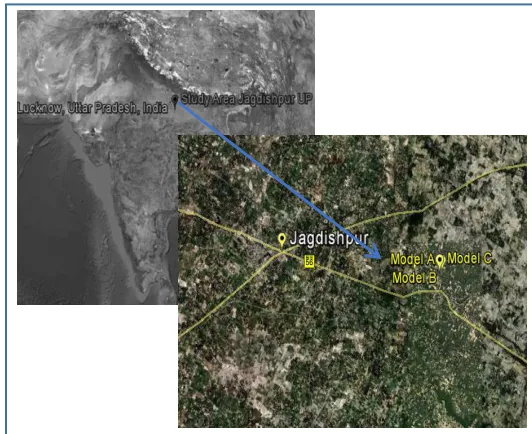
The study area was in the Jagadishpur block of Sultanpur district in Uttar Pradesh, India. The Climate of the study area Is generally subtropical. Temperature variations due to difference in Plane land topography are considerable. In the summer heat is often of high intensity, and winter is pleasant.
The study area has plenty of ground water, however, the surface water is scanty. The selected area represents a diverse section of people with a similar occupational pattern, commonly observed in other backward states in India. The testing was conducted in the Village of Ashrafpur and Mohabatpur, in Jagadishpur block of Sultanpur district in Uttar Pradesh, India.
Figure 1. Study area of biogas plant map from Google Earth
3.2 Site selection
The following points have to be kept in mind during the selection of a suitable site for a digester.
Adequate space should be provided for plant construction (installation) near the staple where the animals are placed
Raw material availability: The gas production is proportional to the amount of raw material digested. Sufficient water availability: The usual materials
fermented in a biogas plant normally contain a higher percentage of solids and they are therefore usually diluted with water. From experiments, it is found that a 1:1 (by volume) slurry of cow dung and water,
Family size: The section of the household‘s family should be small, so easily fulfill the gas requirement cooking fuel for a full day.
3.3 Biogas plant under study
52
3.31 Model A- Balloon Flexi,
A balloon plant digester gas holder conjoining, plastic or rubber bag (balloon). The gas is stored at the top of the balloon. Inlet and outlet are attached directly to the skin of the balloon. Balloon gas pressure on the skin can be enhanced by employing load. High digester temperatures in hot weather; uncomplicated cleaning, emptying and maintenance, low cost manufacturing sophistication, ease of transport, a high groundwater table suitable for use in areas with shallow water hyacinths on the establishment of standardized prefabrication for difficult substrates can be used. Major disadvantages as low gas pressure may require gas pumps; scum cannot be removed during operation; the plastic balloon has a relatively short useful lifespan and is susceptible to mechanical damage and usually not available locally.
3.32 Model B- Floating Drum (HPDE)
Floating-drum plants, potable and whole body of Biogas plant made up with High-density polyethylene and consist of an above ground digester and a moving holder. The gas-holder floats either directly to the fermentation slurry or in a water jacket on its own. The gas is collected in the gas drum, which rises or moves down, according to the amount of stored gas. Either directly in the fermenting slurry or a separate gas holder floats in the water jacket. Biogas which the drum that provides stability and keeps the drum upright an internal and / or external guide frame. If biogas is produced, the drum moves up, if gas is consumed, the gas-holder sinks back.
3.33 Model C-Bamboo Cement (Floating Drum)
Digester is insulated and made of bamboo, cement and concrete. Floating-drum plants consist of an underground digester and a moving High-density polyethylene drum gas-holder similar to the model –B. Model A and Model B were prefabricated and commercially available in Indian market. Both the plants have a life span of more than 5-10 year and their installation required no skilled person.
3.4: Pressure Measurement
The appearance of biogas plants pressure depends on high digester temperatures, Sludge quality opening of the inlet and outlet, and the gas pressure is achieved by through the added weights in place on the gas holder. In Balloon Flexi model having the extra pressure developed by the elasticity of the balloon. If the gas is required at constant pressure it is recommended to install a pressure regulator in the digester of choosing a different design of biogas plant to avoid the gas pressure fluctuates substantially. The gas pressure rises if gas consumption is lower the production if the gas storage is full. The volume of the plant remains constant, but the gas pressure varies [10]. In Table- 1 given that the monthly (Oct-10- June-11) variation of pressure in three types of plant in Situ condition. Model B having maximum pressure drop, it may be due to longer retention time of slurry and model A and Model C more or less similar in both plant performance.
TABLE 1.
MEASUREMENT OF MONTHLY (OCT-10- JUNE-11) VARIATIONS OF WITH THREE TYPES OF PLANTS
3.5 Gas Consumption in Controlled cooking test (CCT)
Controlled cooking test (CCT) provides a standardized comparison of stove performance for real cooking session involving use of local fuel, food, and cooking practices, this test has been designed to ―assess the performance of the improved stove in terms of time required and fuel consumption for cooking. CCTs were carried out as per international test protocol of CCT Version 2.0 [11]. Using the Controlled Cooking Test (CCT) a common standard meal was chosen for this study and a single cook was asked to prepare that meal as they normally would use biogas stoves three times each. The meal chosen was a typical meal consisting of pulse (skinned, green gram) and rice. 200gm of the pulse and 500gm of rice were taken for each time of cooking. Aluminum made Indian pots with lids which were easily available in the local market was chosen for the test purpose. The lids were used about 50% of the cooking time.
TABLE2.
GASCONSUMPTIONSINCONTROLLEDCOOKINGTEST
consumption traditional mud stove and average reduction in specific fuel consumption as 36-47 % and secondly reduction in time 18-28 %.
TABLE3
TESTRESULTSFROMCONTROLLEDCOOKINGTEST
4.
E
CONOMICB
ENEFITS FROMB
IOGASP
LANTCow-dung based biogas plant is doubly beneficial as Firstly, it provides clean combustion fuel for cooking.Secondly, and the residual slurry is a good source of bio-fertilizer [7]. Other indirect benefits of biogas plants as Reduction in fuel wood consumption, Reduction in the use of agricultural residues in stoves, Reduction in the use of dried cattle dung in inefficient stove and reduction in chemical fertilizer use. The calculation for modem biogas plant the economics of a biogas plant involves the calculation of annual profit, cost for the LPG equivalent of dung given in table – 4 are based on following assumptions and calculations:
Dung generation by one cow = 10-12 kg. Per day
Dung required by 1 cu.m. Plant = 25 kg.
Wd = Annual wet dung requirement (kg) = Plant capacity (m3) * 25 * 365
Fdd = Fraction of dry dung in wet dung = 0.30
EqLpg = Kg. of LPG Equivalent to 1 m3 of biogas = 0.43 kg.
Dpm3 = Dry Dung cakes required per m3 of biogas = 12.3 kg.
LPG Equivalent of dung = Wd * 0.30 * 0.43 * / 12.3
TABLE4.
MONTHLYSAVINGINREFERENCEWITHLPGEQUIVALENT TODUNG,
The economics of a biogas plant involves the calculation of annual profit and the payback period for the different models, Where
Annual profit = Annual income - Annual operational cost
Annual operational cost of a biogas plant involves the annual depreciation on civil construction work and other installations, annual maintenance charges and cost of dung required to run it per annum. The corresponding annual depreciation will be 4%, 10% and 5%. Further, the maintenance charges are taken to be 2% of the net installation cost. [12] As the cost of a 2 m3 capacity ―Fixed Dome Biogas Plant‖ works out to be about 18500 INR (TERI 2011) and 2 m3 capacity plant table 5 annual profit 5359 INR. Thus payback period 3.5years.
5.
C
ONCLUSIONWe all aware of how the cattle populations in rural areas are depleting because of various factors as a result of modernizations and urbanizations for rural people. Therefore, it is a very difficult task to select an appropriate model and size of biogas plant to meet the present requirements of the people in rural communities. Two types of digester models (fixed and floating dome) are the most commonly available designs. Both designs are having own specific feature and advantage or disadvantages. There is considerable scope in improving the performance of these models by making design changes such as eliminating the dead volume and sizing the plant appropriately. In addition, by using the locally available material such as bamboo or other alternatives such as HDPE, the biogas plant cost can be brought down. By reducing the cost of construction and bringing it at affordable level the technology can be used by more people in the rural areas.
Acknowledgment
The author sincerely thanks the Energy Resources Institute, New Delhi; as well as the field staff of TERI PMU Jagdishpur Utter Pradesh, India for their enthusiastic cooperation in the field level data collection.
R
EFERENCES[1]. Vinod, K. Mishra, V.K. Retherford, R. D. Smith, K.R. (1999) ‗Biomass Cooking Fuels and Prevalence of Tuberculosis in India‘ International Journal of Infectious Diseases / Volume 3, Number 3.
[2]. Ahmed, R.2002 Integration of Gender Perspectives in Water Aid‘s Bangladesh Program for improved Safe Water Supply, Environmental Sanitation and Hygiene
Promotion available
thttp://www.wateraid.org/documents/plugin_doc uments/bangladesh_gender_1.pdf (accessed on 13/06/11).
54 [4]. Han, j. Mol,A.P.J. Lu,YZhang.L. (2008)
‗Small-scale bioenergy projects in rural China: Lessons to be learnt‘ Energy Policy 36, pp2154–2162
[5]. Acharya,J.Bajgain,M.S. Subedi.,P. S.(2005) Scaling up biogas in Nepal: what else is needed? Boiling Point No 50.
[6]. Vijay,V.K. Prasad,R.Singh,J.P. and Sorayan,V.P.S.A Case For Biogas Energy Application For Rural Industries In India, Renewable Energy. Volume 9, Issues 1-4, September-December 1996, Pages 993-996 ,World Renewable Energy Congress Renewable Energy, Energy Efficiency and the Environment.
[7]. Kapdi, S.S. Vijay, V.K. Rajesh, S.K. Rajendra , Prasad. (2005) ‗Biogas scrubbing, compression and storage: perspective and prospectus in India context ‘(2005) Renewable Energy 30, pp-1195
[8]. Quadir, S.A. Mathur, S.S. Kandpal ,T .C.(1995) ‗ Barriers to the dissemination of renewable energy technologies for cooking.‘ Energy Conversation Management, 36(12):1129.
[9]. T E R I. (2009) ‗Sustainable Development through - Research, Customization Demonstration of Technology in Jagdishpur Block, district Sultanpur, Uttar Pradesh‘ The Energy and Resources Institute. New Delhi [Project Report No. 2008RA02. [
[10]. Singh , P.P. Ghuman, .S. Grewa, N.S.(1998) ‗ Computer model for performance prediction and optimization of unheated biogas plant ‘ Energy Conversation Management, 39 pp-51-68.
[11]. Bailis ,R..(2004) ‗Stove performance testing protocols. Controlled Cooking Test (CCT) Version2.0. Shell Foundation. University of California Berkeley