Developing A Prototype Of E-Incubator Based On
Triple Helix Business Model For Sustainable
Learning Of The Small And Medium Enterprises
(Smes): A Case Study In Developing Country
Satria Fadil Persada, Imam Baihaqi, Khoirrunnissa’ Nur’ AbidahAbstract: The use of information technology becomes a necessary existence in enhancing the business model of the organization. The present research seeks the improvement of incubation business pace through the development of the e-incubator system. The system is driven from the triple helix concept, where the government, big industries, and academic institutions cooperate in helping the sustainability of the small, and medium enterprises (SMEs) through the online incubation. Ensuring the continuity of SMEs will surely help the stability of the national economy, especially in developing countries. Thus, any improvement in the incubation process becomes essential, and the e-incubator system is proposed. The system is developed through focus group discussion as the user needs in the initial stage. Business model canvas (BMC), unified modeling language (UML), and business process model and notation (BPMN) are being used as the conceptual tools to depict the triple helix incubation system. This prototype system is adapted to a specific case study in Indonesia as a developing country, while the concept can be applied to any situation in other countries. Several triple helix implications are discussed, and the contribution can be used for helping the incubator business in providing the platform for SMEs.
Index Terms: Business Incubator, SMEs, Triple Helix Business Model, BMC, BPNM, Prototype, Developing Country
————————————————————
1. INTRODUCTION
Nowadays , the global economic fluctuation and the monetary policy forces the worldwide nation to think carefully in facing the global trade, indicated by the wavering of the money exchange rate. Indonesia, by natural as a developing country, needs to manage and create a good economic condition in order to maintain the sustainability of the economic level. Several approaches are conducted to stabilize such as on the real sector as it presented on the growth indicator of gross domestic products (GDP). In the practical situation, the most significant contribution of GDP is originated from small, medium enterprises (SMEs) with 60.6 percent. In order to maximize the growth of SMEs and its environment-friendly businesses, there is the organization such as business incubators to accelerate the development of SMEs. The incubators are one of the approaches that are frequently used by the developing countries as a media to incubate and nurturing the stability of SMEs‘ sustainability.From its term, a business incubator is an organization where it nurtures the business owner in terms of facilitating its product development, infrastructures, growth, technology, and the management coach. Recently, business incubator becomes the phenomena all over the world as it considered as media to promote the development of tech-based business [1]. Several reasons why the incubator exists are the inability of the startup to growth from the human resource perspectives, since not everyone
capable of performing the entrepreneurial in the competitive world. Further, startups need to get adequate skills and infrastructures as they compete with significant competitors. Thus, the incubator exists to help the startups in accelerating their businesses.The activities of the business incubator are explored firstly by Joseph Mancuso at New York 1957 [2]. At that time, the US government want the SME to growth as well as creating a new job and pushing the economic from the depression. The government giving the subsidize to the academician organization and individual in integrating the available resources for fulfilling the needs of startup SMEs [3]. Further, starting in the 1970s, the business incubator is spreading to all over the world [4]. Indonesia, as one of the largest populated and developing country, started to initiate in 1992 by the ministry of cooperative and academic institutions. Up to 2003, there were only 23 incubators, which they came from the academic institution (72%), private incubator (21%), and government (7%) [5]. The number increased as in 2016 into 94 incubators stated by the Association of Indonesia incubator [6]. Considering the vital role of business incubators in creating new energetic entrepreneurs, innovation in every aspect is necessary. Based on the decree of Indonesia President regarding business incubator [7], the implementation of incubation is supported through the cooperation of government, a private company, and academic institution. This regulation is suitable for the triple helix concept [8]. However, ensuring the business model to synchronize all of the stakeholders is another challenge. One way to effectively increase the realization of triple helix is by using the information technology platform. In align with the industrial revolution 4.0, the businesses are pushed to employ the Internet of Things (IOTs). The extensive use of the internet is connecting the millions of people in terms of business, both from product and services [9]. Thus, the terminologies of electronic business (E-Business), as well as electronic commercial (E-Commerce), become universal. These concepts empower the stakeholder in business to work through the internet, which one of it applies to a virtual incubator. The present research proposes the holistic ————————————————
Satria Fadil Persada is currently serve as Assistant Professor at Department of Business Management, Institut Teknologi Sepuluh Nopember. E-mail: [email protected]
Imam Baihaqi is currently serve as Department Head at Department of Business Management, Institut Teknologi Sepuluh Nopember. E-mail: [email protected]
794 approach in developing virtual incubator namely E-Incubator.
The approaches consist of defining the business model based on triple helix concept, followed by the use of unified modeling language (UML), and business process model and notation (BPMN) to develop the prototype. A case study of the incubator in a public campus at Surabaya is performed. Through this platform, the SMEs can get the incubator services systematically. The history of data recorded in the system can give the references to the coach as well as the interested parties in seeing the solution from different perspectives. The E-Incubator also provides some services that can be used by the government and big industries for collaboration. The rest of this article structured as follows. Chapter 2 describes the relevant theories regarding triple helix and the business model tool, some brief description of UML and BPMN are presented. Chapter 3 mentions the methodology, the way to improve the business model as well as the business process. Chapter 4 depicts the analysis and improvement of the business model as well as the prototyping result. Chapter 5 concludes the research by drawing the insight and potential improvement for future research development.
2
LITERATURE
REVIEW
2.1 Virtual Incubator
The virtual incubator is projected by many researchers as the advanced evolution of business incubation approach as it can be seen the progress in Figure 1 [10]. IdeaGist gives the friendly definition of the virtual incubator as an accelerator of socio-economic construction, which provides the process in early developing stage idea into stable and viable ventures [11]. The virtual incubator development aims to connect the technical talent in business aspects without the limitation of physical condition in order to meet the business opportunity [12]. The virtual incubator also serves as the network of innovation to link the industrial competitiveness with business management. The connectivity between the practitioner and institutions will facilitate a strong alliance for the startup. By using the paradigm of Component-Based Software Development (CBSD), it will help the developer application in developing the application to inject the best component of functional business in the incubation process. Thus, the virtual incubator will facilitate the marketers, technology experts, business practitioners, investors, and others to set up their alliance in facing the business opportunity.
Figure 1. The Incubator Evolution [10]
2.2 Triple Helix Business Incubator
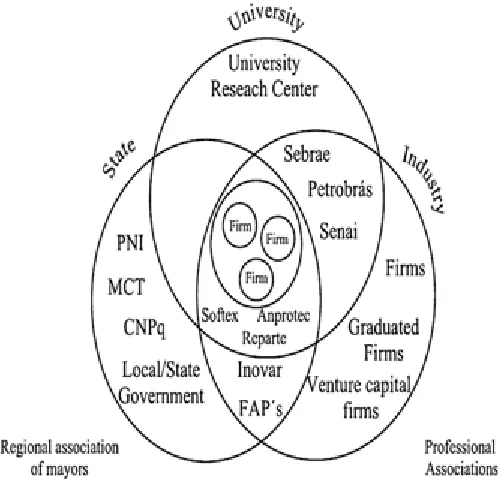
Business incubators, as it was seen on its trend, continue performing the innovation due to keep up in pace with the business competition in globalization era. In many developing countries, business stakeholders such as government, academic institutions, and big industries are working by themselves without a good synergy. However, if the entire stakeholders cooperate, it will create a competitive situation that is good for the economic development of SMEs. Academic stakeholders will create the breakthrough via the expert knowledge that they have. The big industries contribute to giving the real problem situation as well as the excellent illustration for SMEs in seeing the business from more critical dimensions. The government creates policies that will maintain the environment business for the SMEs. Thus, we can see the triple helix as the model of innovation to explain the excellent interaction between academic institutions, industries, and the government [13]. Yuwawutto et al. [14] depict how the triple helix strategy can give the benefit to an SME case study in Thailand significantly. Several kinds of research give real pieces of evidence on how to triple helix to SMEs support [15][16][17]. Moreover, Etzkowitz et al. [18] (see the illustrator on Figure 2) in their research mention the triple helix III as the evolution incubator or known as a technological incubator that serves as the catalyzer through technology. In this phase, the academic institutions serve as active users in creating cooperation with government and industries.
2.3 Business Model Canvas
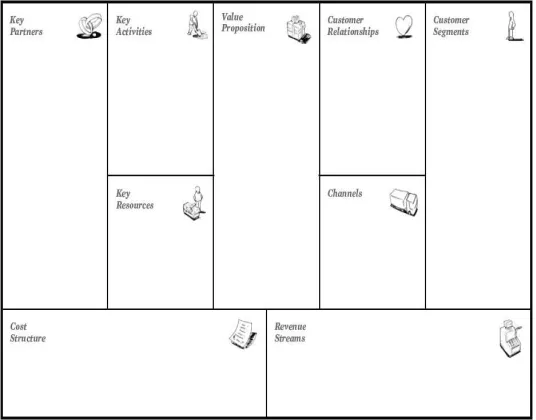
Every business must have its business model, where the complexity and the dimensions of their components depend on how the business operates. In this research, the Business Model Canvas (BMC) is being utilized to depict the e-incubator business model in facilitating all the stakeholders to support SMEs development. BMC is a handy canvas developed by Ostewalder and Pigneur [19] in depicting the business model with nine important consideration aspects. As it can be seen in Figure 3, the aspects consist of Value Proposition, Channels, Customer Segments, Customer Relationships, Key Resources, Key Activities, Key Partners, Revenue Streams, and Cost Structure. The value proposition is depicted as the value that the customer will take effort to attain it. Channels are the media or any instruments that will help the business owner in transferring the value to the segmented customer. Customer segments are the people that have similar characteristic based on the segmentation defined by the business owner. Customer relationships are the way of business in retaining the customer to stay loyal. The key resources are any assets and ownership to ensure the running of the business sustain. Key activities are any process the business will conduct to prolong the business application. Key partners are any third party that they directly influence the business activities. Revenue streams are any income owned by the business owner in the business. The cost structure is any spend performed by the business in regard to the business businesses process.
Figure 3. Business Model Canvas
2.4 Software Development Life Cycle
Software development lifecycle (SDLC) is interactive and iterative processes to combine the steps of developing an application. It is one perspective in the development of solution [20]. Many methods are available such as waterfall, iterative, spiral, and many more. In brief, there are essential
steps such as defining the problem, analyze, design the possible solution, implement the design, and maintaining the post-implementation. This research employs the waterfall method as it can be seen in Figure 4.
Figure 4. Waterfall SDLC
In the waterfall method, the prototype will be developed with sequential steps. Thus, this development surely takes time and effort to ensure every step fulfill the business process facilitated by the system and error prevention.
2.5 Business Process Model and Notation (BPMN)
796 Figure 5. Representation of BPMN
2.6 Unified Modeling Language (UML)
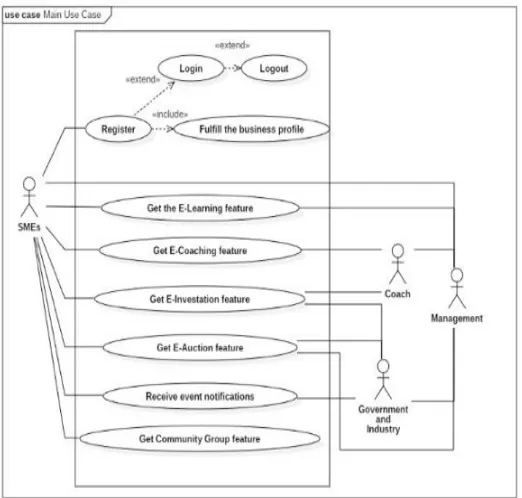
Unified modeling language (UML) is a standard specification protocol used to prepare documentation, specification, and developing software. It was created by Grady Booch, James Rumbaugh, and Ivar Jacobson under the Rational Software Corp [23]. UML is a structured entity that is used by many object-oriented programs (OOP). UML growth in the last 1980s and early 1990, which from the combination of a graphical object-oriented language. UML defines several diagrams such as use case diagram, class diagram, activity diagram, sequence diagram, collaboration diagram, and deployment diagram. This research, however, only shows the use case as it can be seen in Figure 6.
Figure 6. The example of Use Case Diagram in this research
3 M
ETHODOLOGY3.1 Analysis and Improvement of Business Model
In order to improve the business model, this research needs to capture every detail of the business model in the electronic incubator by using the triple helix concept. Thus, capturing the present business model is the opening step. We conduct several approaches as instrument development tools. The first tool is an interview to expert and the stakeholder of the business incubator. The stakeholder consists of academic institution people, the government, big industries, and the SMEs according to the triple helix concept. In this research, we focused on campus incubator namely Institut Teknologi Sepuluh Nopember (ITS) incubator. The second tool is observation, which non-formal situation is better captured in this approach. BMC is used as the platform for business model extraction data. The current business model exploration is conducted between August 2018.
3.2 The Development of Application
The development of application starts with the business process mapping. We use the map with BPMN approach. The business process map was conducted between August 2018. After the process was captured, the design language of UML is utilized. The process of waterfall development ranges from September 2018 to January 2019.
4 ANALYSIS
4.1 Current Business Model
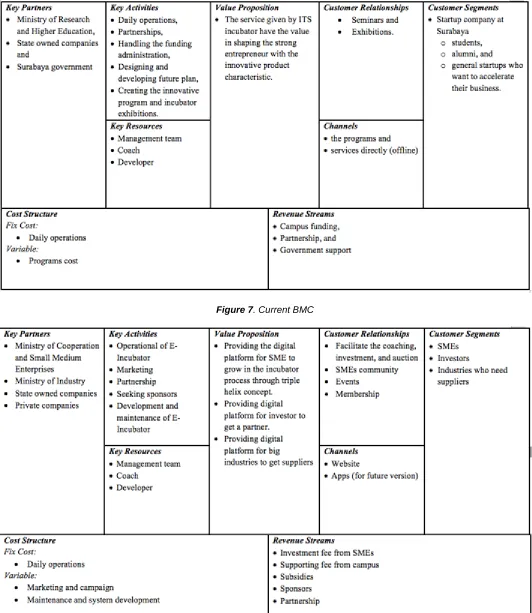
Based on the interviews and observations on ITS business incubator, the current business model is depicted into nine elements of BMC in Figure 7. Based on the current observation and interviews, most of the activities and media are conducted by offline and traditional. The customers and the partners are also limited by the geographical location, which is Surabaya. The revenue streams are also limited to campus and zoned funders, which are the investor and government from Surabaya.
4.2 Improvement Business Model
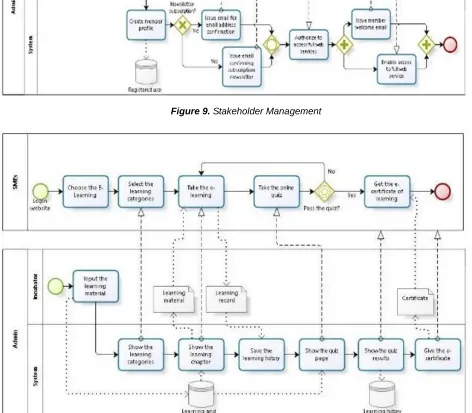
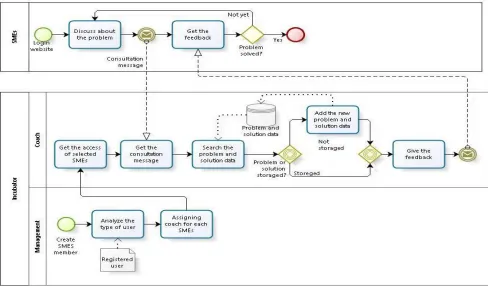
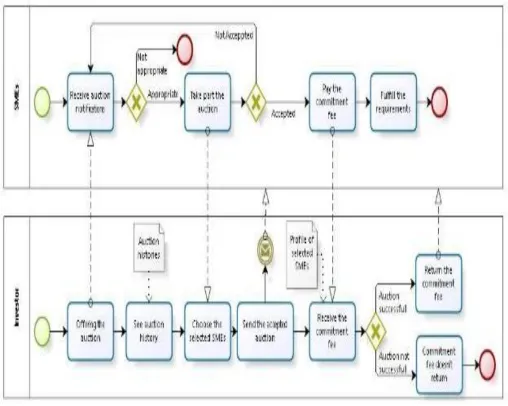
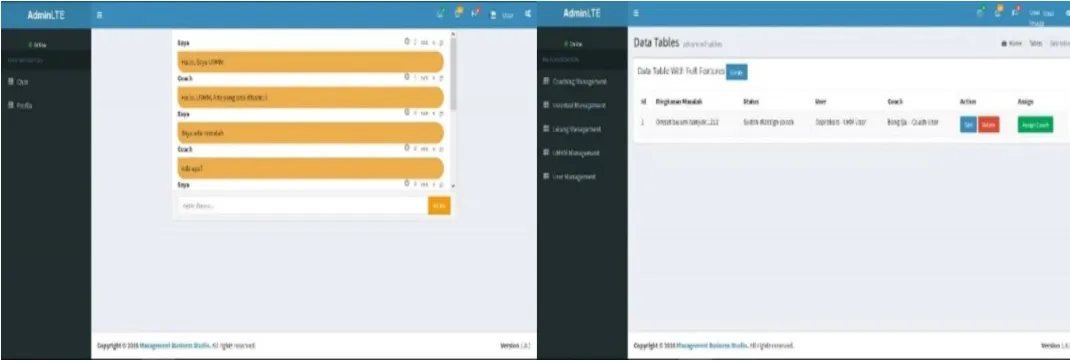
platform. It also applies for the key partners and revenue streams that will be broader. Every relationship and news related to SMEs environment will be informed by the E-incubator application. From the key activities, key resources, and cost structure will support the online perspective. The resources will be reduced and replaced by the system, while the activities are all based on online through E-incubator application. As for the cost structure, the spend majority came from online cost and daily operations.The next step after the BPMN maps are defined, the system is designed through the UML. Figure 5 shows how the use case and entity relationship diagram are developed. Finally, by using the waterfall methodology, the application was developed, and it can be seen from Figure 14-17. The stakeholder management (see Figure 14) will help all the system related to stakeholder, which include the profile and detail information. The E-Coaching and E-learning (see Figure 15) will be merged into a simple interactive menu that can facilitate the business coach and the SMEs individually to learn and solve the problem. E-Investment (see Figure 16) serve as the menu to help the investor to fund the potential SMEs with several agreements. E-Auction (see Figure 17) will help the big industries, governments, as well as peers SMEs to offer the auction in logistics. In summed up, the fundamental menus are developed by the triple helix concept, and it will be improved by adding more menu in the future version. The system is being tested and no fundamental problem has appeared. The stakeholders are being interviewed and they relatively satisfied with the application.
5 CONCLUSIONS
This research contributes to the idea of facilitating the triple helix concept for helping the SMEs through a holistic online platform namely E-Incubator. The development of E-incubator is tested through a case study of public campus business incubator in Surabaya, Indonesia. The development was conducted with a waterfall software development method and several tools such as BMC, BPMN, and UML was utilized. Through the interview and observation, this research explored five core functions. The core functions comprise of E-learning and coaching, Stakeholder Management, Auction, and E-Investment. The development and testing application were deployed in between 5 months, and the application shows a positive result. Through the application, the triple helix concept is well facilitated. Several limitations are appeared in this research, which the first is from the tester. Adding the tester from outside of Surabaya city will better validate the robustness of the application. The second limitation is related to the function menu. We realized this core functions only facilitate the minimum improvement to SMEs. Thus, adding more functions will accelerate SMEs growth, and this application can be better replicated to any other business incubators worldwide.
ACKNOWLEDGMENT
The authors wish to thank ITS for ―Penelitian Unggulan Dana Lokal ITS 2018‖ funding.
REFERENCES
[1] A. Bergek and C. Norrman, ―Incubator best practice : A framework,‖ Technovation, vol. 28, no. 1–2, pp. 20–28, 2008. [2] H. Leblebici and N. Shah, ―The birth, transformation and
regeneration of business incubators as new organisational
forms: understanding the interplay between organisational history and organisational theory,‖ Bus. Hist., vol. 46, no. 3, pp. 353–380, 2004.
[3] W.-B. Wang, Y.-C. Hung, and C.-C. Wang, ―University-industry research collaboration in Taiwan,‖ J. Inf. Optim. Sci., vol. 33, no. 6, pp. 665–683, 2012.
[4] P. Albert and L. Gaynor, ―National contexts, incubator families and trends in incubation–views from four countries,‖ in The 48th ICSB Conference Proceedings, Belfast, 2003.
[5] Biro Kredit Bank Indonesia, ―Kajian Inkubator Bisnis dalam Rangka Pengembangan UMKM,‖ Jakarta, 2006.
[6] AIBI, ―Member of AIBI.‖ [Online]. Available: http://aibinetwork.com/anggota-aibi/. [Accessed: 20-Dec-2018]. [7] P. of Indonesia, Decree of Indonesia President No 27/2013:
Development of Business Incubator. Indonesia, 2013.
[8] H. Etzkowitz and R. Viale, ―Polyvalent knowledge and the entrepreneurial university: A third academic revolution?,‖ Crit. Sociol., vol. 36, no. 4, pp. 595–609, 2010.
[9] S. Rosyadi, ―Revolusi Industri 4.0: Peluang dan Tantangan bagi Alumni Universitas Terbuka,‖ 2018. .
[10]D. Folinas, P. Pastos, V. Manthou, and M. Vlachopoulou, ―Virtual Pre-Incubator: a new entrepreneurship approach,‖ Int. J. Enterp. Netw. Manag., vol. 1, no. 1, pp. 29–40, 2006.
[11]H. Syed, ―Virtual Incubators.‖ [Online]. Available: https://ideagist.com/defining-virtual-business-incubator/.
[12]M. J. Nowak and C. E. Grantham, ―The virtual incubator: managing human capital in the software industry,‖ Res. Policy, vol. 29, no. 2, pp. 125–134, 2000.
[13]H. Etzkowitz and L. Leydesdorff, ―The dynamics of innovation: from National Systems and ‗Mode 2‘ to a Triple Helix of university–industry–government relations,‖ Res. Policy, vol. 29, no. 2, pp. 109–123, 2000.
[14]S. Yuwawutto, T. Smitinont, N. Charoenanong, N. Yokakul, S. Chatratana, and G. Zawdie, ―A Triple Helix strategy for promoting SME development: the case of a dried banana community enterprise in Thailand,‖ Ind. High. Educ., vol. 24, no. 3, pp. 177– 187, 2010.
[15]P. Ueasangkomsate and A. Jangkot, ―Enhancing the innovation of small and medium enterprises in food manufacturing through Triple Helix Agents,‖ Kasetsart J. Soc. Sci., 2017.
[16]T. Brink and S. O. Madsen, ―The triple helix frame for small-and medium-sized enterprises for innovation and development of offshore wind energy,‖ Triple Helix, vol. 3, no. 1, pp. 1–23, 2016. [17]S. Muljaningsih, M. Multifiah, and A. K. Galuh, ―Synergicity of
Triple Helix Creative Economy Model in Malang,‖ MIMBAR, J. Sos. dan Pembang., vol. 34, no. 1, pp. 185–194, 2018.
[18]H. Etzkowitz, J. M. C. de Mello, and M. Almeida, ―Towards ‗meta-innovation‘ in Brazil: The evolution of the incubator and the emergence of a triple helix,‖ Res. Policy, vol. 34, no. 4, pp. 411– 424, 2005.
[19]A. Osterwalder and Y. Pigneur, Business model generation: a handbook for visionaries, game changers, and challengers. John Wiley & Sons, 2010.
[20]J. A. O‘Brien and G. M. Marakas, Management information systems, vol. 6. McGraw-Hill Irwin, 2006.
[21]P. Briol, BPMN, the Business Process Modeling Notation Pocket Handbook. LuLu. com, 2008.
[22]M. Von Rosing, H. Von Scheel, and A.-W. Scheer, The Complete Business Process Handbook: Body of Knowledge from Process Modeling to BPM, vol. 1. Morgan Kaufmann, 2014.
798 Figure 7. Current BMC
Figure 9. Stakeholder Management
800 Figure 11. E-Coaching Management
Figure 13. E-Auction Management
802 Figure 15. E-Coaching in Chat, History of Problem, and List Solution
Figure 16. E-Investment in Investment History and New Investment