Original Research Article
Rural population at risk of development of diabetes mellitus: a cross
sectional study using Indian diabetic risk score in Bengaluru
Vidya K. R.
1, Lohit K.
2, Naveen Kumar P.
3*
INTRODUCTION
The recent WHO report says that number of people with diabetes has risen from 108 million in 1980 to 422 million in 2014.1 Diabetes prevalence in India is 8.8%.2 Though it varies with in the country, being highest reported from Kerala (19.5%) and lowest from Kashmir valley (6.1%).1
Even with growing concern on diabetes, many sophisticated techniques to early detection of diabetes and also medications to manage diabetes with very less or no side effects along with the management guidelines, 50% of adults with diabetes are undiagnosed (212
million) and most patients are diagnosed at the time of complication.2 A very high prevalence of complications at diagnosis has been reported from various studies across globe and from parts of India.2
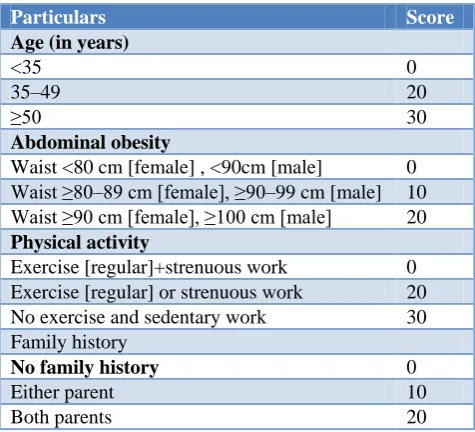
Indian Diabetic Risk Score (IDRS) was developed by Mohan et al based on multiple logistic regression model using four simple parameters namely age, waist circumference, physical activity and family history. It is the cost effective method to detect high risk individuals (Table 1).3 The IDRS has a sensitivity of 72.5% and specificity of 60.1% and is derived on the largest population based study on diabetes in India by CURES study by Mohan et al.4 This IDRS score is also validated
ABSTRACT
Background: Prevalence of diabetes mellitus is increasing in an alarming way throughout the world. More than 50% of the diabetic subjects in India remain unaware of their diabetes status and screening for risk factors of diabetes mellitus enable us to initiate appropriate control measures. This study was undertaken to identify the people who are at risk of diabetes mellitus in rural area of Bengaluru.
Methods: It was a community based cross sectional study in which 1750 study subjects were randomly selected using multi stage random sampling method. Selected individuals were examined and interviewed using a semi structured questionnaire. Indian diabetic risk score was used to assess risk of developing diabetes. Data entry and analysis was done using SPSS version 20.0.
Results: According to IDRS, 46.2% of respondents were in the moderate risk group and 33.1% were in the high risk group. Family history of diabetes, low physical activity and abdominal obesity were found to associate with high risk group.
Conclusions: The prevalence of high risk for diabetes according to IRDS was 33%. Primordial and primary preventive actions are very much necessary.
Keywords: IDRS, Prevalence, Diabetes, Rural, Screening
1
Department of Community Medicine, 2Department of Pharmacology Sri Sidhartha Institute of Medical Sciences, T. Begur, Karnataka, India
3Department of Community Medicine, Rajarajeswari Medical College, Bengaluru, Karnataka, India
Received: 29 June 2019
Revised: 02 August 2019
Accepted: 07 August 2019
*Correspondence:
Dr. Naveen Kumar P.,
E-mail: [email protected]
Copyright: © the author(s), publisher and licensee Medip Academy. This is an open-access article distributed under the terms of the Creative Commons Attribution Non-Commercial License, which permits unrestricted non-commercial use, distribution, and reproduction in any medium, provided the original work is properly cited.
by Stanley et al. in which the score of more than 60 has 100% sensitivity and 17.6% specificity.5
It is possible to identify the high risk group by simple parameters such as anthropometry, presence of family history of diabetes and assessment of the physical activity.6 Use of a simple diabetic risk score is more effective and less expensive than genotyping and makes it less costly than universal OGTT screening of the whole population to detect subjects without diagnosed T2DM in India.3 Screening for risk factors of diabetes mellitus will enable us to initiate appropriate control measures, and hence this study was undertaken to identify the people who are at risk of diabetes mellitus using IDRS.
METHODS
A community based cross sectional study was conducted in the rural field practice area of a tertiary care centre, Raja Rajeswari Medical college and Research Center in Bengaluru. In order to calculate sample size for this study, 18.66% of study subjects had high risk for diabetes mellitus (IDRS>60) in rural area of Tamil Nadu based on a study conducted by Gupta et al was considered, expecting similar prevalence and to get 95% confidence level and relative precision of 10%, 1750 subjects were considered for the study.7Study was conducted from July 2014 to April 2015.
All individuals aged more than 18 years of age, permanent residents, who were present on the day of survey were included in the study. Those individuals who were not willing to participate in the study were excluded. Multistage random sampling technique was done to select participants. Rural field practice area covering a population of 10,911(PHC record 2014) with 19 villages was selected. For the required sample size of 1750 people from entire population, the villages were divided into three different strata based on sub-center. Using stratified random sampling method, sample to be studied from each stratum was calculated.
Villages in each stratum were arranged according to alphabetical order. Using lottery method, one village was selected by random in each stratum. From the centre of the village using a currency note the street was selected. In that street by tossing a coin, side of the street was selected. Houses were numbered in that selected side of street. Then the first house was selected using a random number from currency note, then selected house in that particular street was visited and adults in that house were included in the study and the process was continued till the required sample from that particular stratum was reached.
Once the household was selected, study subject was explained about the purpose of the study, an informed written consent was obtained from each individual prior to administering the semi-structured questionnaire using interview method. Ethical clearance was obtained before
conducting the study from the Institutional Ethical Committee.
Table 1: Distribution of characteristics as per IDRS.
Particulars Score
Age (in years)
<35 0
35–49 20
≥50 30
Abdominal obesity
Waist <80 cm [female] , <90cm [male] 0 Waist ≥80–89 cm [female], ≥90–99 cm [male] 10 Waist ≥90 cm [female], ≥100 cm [male] 20
Physical activity
Exercise [regular]+strenuous work 0 Exercise [regular] or strenuous work 20 No exercise and sedentary work 30 Family history
No family history 0
Either parent 10
Both parents 20
Minimum score 0; Maximum score 100.
Data collected was entered in Microsoft excel sheet and analysed using statistical package for Social Sciences Software version 20.0.0.
RESULTS
Among 1750 study subjects 683 (39%) were aged more than 50 years followed by 556 (31.8%) and 511 (29.2%) less than 35 years and 35 to 49 years respectively. Around 50 % were males and 99.4% were Hindu by religion. Most of the study subjects, 412 (23.5%) had studied up to intermediate and 343 (19.6%) were not literate. Unemployment was seen in 603 (34.5%) and 353 (20.2%) were in clerical, shop owner or farmer by occupation. According to updated B G Prasad socio-economic classification for 2015, 707 (40.4%) belonged to middle social class, followed by 493 (28.2%) in upper middle social class (Table 2).
According to IDRS, 808 (46.2%) of respondents were in the moderate risk group and 579 (33.1%) were in the high risk group Figure 1.
Figure 1: Distribution of study subjects according to IDRS category: (n=1750).
20.7
46.2
33.1 Low risk (Score <30) Moderate risk (Score 30-50)
Table 2: Socio-demographic characteristics of study subjects: (n=1750).
Characteristics Frequency %
Gender Male 884 50.5
Female 866 49.5
Religion Hindu 1739 99.4
Muslim 11 00.6
Educational status
Not literate 343 19.6
Primary 245 14.0
Secondary 198 11.3
High school 323 18.5
Intermediate 412 23.5
Graduate 194 11.1
Profession 35 02.0
Occupational status
Profession 45 02.6
Semi- profession 200 11.4
Clerical, shop owner, farmer 353 20.2
Skilled worker 254 14.5
Semi-skilled worker 198 11.3
Unskilled worker 97 05.5
Unemployed 603 34.5
Socio economic status (per capita income per month in rupees)
Upper class [>5356 ] 119 06.8
Upper middle class [2652-5356] 493 28.2 Middle class [1570-2651] 707 40.4 Lower middle class [812-1569] 374 21.3
Lower class [<811] 57 03.3
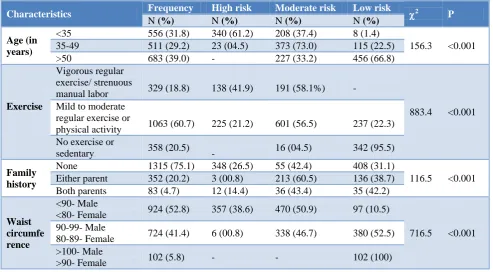
Table 3: Distribution of study subjects according to components of IDRS (n=1750).
Characteristics Frequency High risk Moderate risk Low risk 2 P
N (%) N (%) N (%) N (%)
Age (in years)
<35 556 (31.8) 340 (61.2) 208 (37.4) 8 (1.4)
156.3 <0.001 35-49 511 (29.2) 23 (04.5) 373 (73.0) 115 (22.5)
>50 683 (39.0) - 227 (33.2) 456 (66.8)
Exercise
Vigorous regular exercise/ strenuous
manual labor 329 (18.8) 138 (41.9) 191 (58.1%) -
883.4 <0.001 Mild to moderate
regular exercise or
physical activity 1063 (60.7) 225 (21.2) 601 (56.5) 237 (22.3) No exercise or
sedentary 358 (20.5) - 16 (04.5) 342 (95.5)
Family history
None 1315 (75.1) 348 (26.5) 55 (42.4) 408 (31.1)
116.5 <0.001 Either parent 352 (20.2) 3 (00.8) 213 (60.5) 136 (38.7)
Both parents 83 (4.7) 12 (14.4) 36 (43.4) 35 (42.2)
Waist circumfe rence
<90- Male
<80- Female 924 (52.8) 357 (38.6) 470 (50.9) 97 (10.5)
716.5 <0.001 90-99- Male
80-89- Female 724 (41.4) 6 (00.8) 338 (46.7) 380 (52.5) >100- Male
>90- Female 102 (5.8) - - 102 (100)
It was observed that 456 (66.8%) of >50 years subjects were in high risk category, whereas 340 (61.2%) of <35 year old study subjects were in low risk category. Most of the subjects 1063 (60.7%) were indulged in mild to
than 100 cms for male and more than 90 cms for female whereas in vigorous regular exercise or strenuous manual labor category 191 (58.1%) were in moderate risk group and is statistically significant (p<0.001) (Table 3).
Normal waist circumference was seen in 924 (52.8%) subjects. Among 724 (41.4%) subjects who had their waist circumference between 90-99 cm for males, 80-89 cm, 380 (52.5%) were in high risk group and it was found to be statistically significant (p<0.001) and all 102 (5.8%) subjects with waist circumferences of >100cm for males, >90 cm for females were in high risk group.
Majority of study subjects 1315(75.1%) had no family history of diabetes. Among them 559 (42.4%) were in moderate risk group. 36 (43.4%) subjects with family history of both parents having diabetes were in moderate risk group and it was found to be statistically significant (p<0.001) (Table 3).
DISCUSSION
Diabetes has become a global epidemic. In India the incidence rate is increasing in an alarming rate. We used simplified Indian diabetes risk score to identify high risk people in rural Bangalore. As this is a most cost effective method in our country as over half of diabetic people remain unaware of their condition. The subjects included in the study have fairly equal distribution among male and female subjects constituting 50.6% and 49.4% respectively. Most of the subjects (99.4%) were Hindu by religion. 61% of subjects are below 50 years old. This finding was comparable to a study conducted by Subramani et al where 55.2% were males and 44.8% were females. Whereas about 54.5% people belong to below 35 years age group.8
Various studies in the west used different diabetes risk scores, based on demographic, simple anthropometric, and behavioral factors to detect undiagnosed diabetes.9,10 We also used diabetes risk score suitable for detecting undiagnosed diabetes in South Asia. The risk score used in this study are those recommended by American Diabetes Association.11
In our study 31.3% of study population had high risk score (>60) for diabetes. A similar type of study conducted by Mohan et al.at Chennai found 43% of study population in the high risk group and another study by Gupta et al found 19% of study population in the rural Tamil Nadu to be in the high risk group.3,12 This risk difference may be due to variance in regional dietary habits, life-styles of the population.
Around 18.8% of subjects were involved in Vigorous regular exercise/ strenuous manual labour, 60.7% were involved in mild to moderate regular exercise or physical activity. Around 20% lead sedentary life style without exercise. This pattern is similar to that seen in a study done by Subramani et al 17.2% were involved in
vigorous regular exercise/strenuous manual labour, 72.7% were involved in mild to moderate regular exercise or physical activity and 9.5% lead sedentary life style without exercise.8 In another study done by Gupta et al showed that 90% were involved in mild to moderate category as this study was done in urban area.12
Majority of study subjects 1315 (75.1%) had no family history of diabetes among their parents. Only 4.7% were had family history of diabetes among both parents. Similar observations were found in study done by Gupta et al, 68.5% of the respondents had no family history of diabetes.12 The family history of diabetes could be important public health tool in predicting development of diabetes and useful in prevention of diabetes.
This study provides the use of simplified Indian diabetic risk score for identifying the subjects who are at high risk of diabetes in the community. Mass screening for high risk cases can be made cost effective with regular use of IDRS. Further confirmation with GTT is required among subjects with IDRS >60 to early detect the occurrence of diabetes. Besides this, and lifestyle modification are to be initiated to reverse the risk factors among high risk group.
CONCLUSION
The prevalence of high risk for diabetes according to IRDS was 33%, Family history of diabetes; physical activity and abdominal obesity were found to associate with high risk group. Primordial and primary level prevention measures are necessary to prevent early onset of diabetes.
Recommendations
Rural population in India can no longer be ignored as a traditionally low risk group, as non-communicable diseases like diabetes are almost as much prevalent in rural India as in their urban counterpart, because of the change in lifestyle. Under the National Non-Communicable Disease Control Program, the National Diabetes Control Program can further be strengthened by the government by promoting awareness among the general publics about the disease and also by improving the gross root level workers in screening for diabetes.
Funding: No funding sources Conflict of interest: None declared
Ethical approval: The study was approved by the Institutional Ethics Committee
REFERENCES
1. World health organisation. Key facts on diabetes. Available at: https://www.who.int/news-room/fact-sheets/detail/diabetes. Accessed on 30 October 2018.
report/view/704ee0e6475b4af885051bcec15f0e2c/I ND. Accessed on 28 April 2019.
3. Mohan V, Deepa R, Deepa M, Somannavar S, Datta M. A simplified Indian Diabetes Risk Score for screening for undiagnosed diabetic subjects. J Assoc Physicians India. 2005;53:759-63.
4. Deepa M, Pradeep R, Rema M, Anjana Mohan, Deepa R, Shanthirani S et al. The chennai urban rural epidemiology study (CURES). J Assoc Physicians India. 2003;5:863-70.
5. Stanley LJM, Elantamilan D, Mohanasundaram K, Kumaravel TS. Evaluation of Indian diabetic risk score for screening undiagnosed diabetes subjects in the community Indian J Sci Technol. 2012;5(6):2798-9.
6. Sosale A, Kumar PKM, Sadikot SM, Nigam A, Bajaj S, Zargar H, et al. Chronic complications in newly diagnosed patients with type 2 diabetes mellitus in India. Indian J Endocrinol Metab. 2014;18(3):355-60.
7. Gupta SK, Singh Z, Purty AJ, Kar M, Vedapriya D, Mahajan P, et al. Diabetes prevalence and its risk factors in rural area of Tamil Nadu. Indian J Community Med. 2010;35(3):396-9.
8. Subramani R, Devi U, Shankar U. Assessment of risk of type 2 diabetes mellitus among rural population in Tamil Nadu by using Indian Diabetic Risk Score. Middle-East J Sci Res. 2014;21(1):223-5.
9. Phillips LS, Ratner RE, Buse JB, Kahn SE. We can change the natural history of type 2 diabetes. Diabetes Care. 2014;37(10):2668-76.
10. Standards of medical care in diabetes-2012. Diabetes Care. Available at: http://care.diabetes journals.org/content/35/Supplement_1/S11.full. Accessed on 10 July 2015.
11. Standards of diabetes care-2015. Diabetes Care. 2015; S1-2.
12. Gupta SK, Singh Z, Purty AJ, Vishwanathan M. Diabetes prevalence and its risk factors in urban Pondicherry. Int J Diabetes Dev Ctries. 2009;29(4):166-9.