INTRODUCTION
Coconut and palm kernel oils are called lauric oils due to their high composition of lauric acid, which is about 50%. They are very rich in short and medium chain fatty acids. Due to their composition, these oils have been used for the management of diseases such as obesity, cancer and immunodisorders (Lim-sylianco, 1987; Karup and Rajmohan, 1995). They are also used as anti-aging and antioxidant agents (Fletcher et al. 1985; Sundran et al. 1994). Available reports also indicate that coconut oil is beneficial oil for prevention and treatment of some hear t diseases i.e. its consumption reduces the risk of coronary heart diseases (Blackburn et al., 1998; Kaunitz and Dayrit, 1992).
Biomedical & Pharmacology Journal Vol. 1(1),31-36 (2008)
Comparative effect of coconut oil and palm kernel oil
supplemented diets on Na
+/K
+-Atpase activity
in the liver, kidney and heart of rats
S.O. ASAGBA¹*, J.O.T. EMUDAINOHWO², D.E. EJEBE², M.S. SURU³ and C.C. OLISE
1Department of Biochemistry, Delta State Unjiversity, Abraka (Nigeria)
2Department of Pharmacology and Therapeutics, Delta State University, Abraka (Nigeria) 3Department of Biochemistry, University of Ibadan (Nigeria)
(Received: February 12, 2008; Accepted: April 04, 2008)
ABSTRACT
We investigated the comparative effects of coconut oil (10% w/w) and palm kernel oil (10% w/ w) supplemented diets on the activity of Na+/K+-ATPase in the liver, kidney and heart tissues. Control
group was fed growers mash, coconut oil group was fed growers mash and coconut oil (10% w/w) and palm kernel group was fed growers mash and palm kernel oil (10% w/w). Rats were fed for 6 weeks and then sacrificed. The mean body weight gain was significantly (p< 0.05) increased in both coconut oil and palm kernel oil fed rats relative to control rats. Changes in organ weight was only significant (p<0.05) for liver weight in animals fed oil supplemented diets. Coconut oil and palm kernel oil supplemented diet exerted a significant (p< 0.05) increase in the activity of Na+/K+-ATPase in the various tissues. The highest activity of this enzyme in these tissues was observed in rats fed palm kernel oil supplemented diet. The results show that both oil supplemented diets exerted a significant increase in Na+/K+-ATPase activity in these tissues. This alteration in Na+/K+-ATPase activity is expected
to exert a significant impact on the electrophysiological and metabolic functions of the heart, kidney and liver.
Key words: Coconut oil, Palm kernel oil, Na+/K+-ATPase Activity.
Most researches have focused on the effects of diet on plasma cholesterol levels, considered as the major cause of coronary heart disease. As a result, the hypercholesterolaemic effect of saturated fatty acids has been well established in human and animal models (Gil-Villarino et al. 1997; Gil-Villarino et al. 1998; Castillo et al. 1999). Other studies have examined the effect of saturated fatty acids on enzyme activity (Hexokinase, Citrate synthase, Desaturase,Elongase,3-Hydroxy-3-MethylGlutaryl-CoA Reductase), and production of cytokine, eicasanoids and reactive species (superoxide, hydrogen peroxide and nitric oxide) (Gil-Villarino et al. 1999; Oliveros et al. 2002).
chick diet caused a drastic increase in cytochrome oxidase activity in 24hour but lowered compared with the control values when dietary manipulations was prolonged for 5 to 14 days. On the other hand, ATPase activity showed an inverse profile. The study also showed that changes in cytochrome oxidase activity were parallel to changes in the cholesterol / phospholipid molar ratio, whereas changes in ATPase activity showed an inverse correlation with changes in this molar ratio. These investigations were basically carried out in the plasma and hepatic tissues and the source of saturated fatty acids was coconut oil. At present however, there is paucity of research information on the effect of saturated short and medium chain fatty acids on other tissues and from source other than coconut oil. With keen interest in Na+/K+-ATPase, we hypothesize similar
changes in the activity of this enzyme with palm kernel oil supplement (in comparism with coconut oil supplementation) from which functional benefits or pathological consequences may be correlated. Na+/K+-ATPase is a plasma membrane bound
enzyme that provides the necessar y electrochemical gradients of Na+ and K+ to maintain
the cell volume and thus it plays a crucial role in homeostasis (Crambert et al. 2000).It functions by expor ting intracellular Na+ and impor ting
extracellular K+ across the plasma membrane to
provide energy for membrane transport of various metabolites taking par t in special functions. Therefore changes in the activity of this enzyme may have a major impact on basic cellular functions leading to either functional benefits or pathological consequences.
In view of the foregoing, we studied the comparative effects of diet supplementation with 10% coconut oil and 10% palm kernel oil on the activity of Na+/K+-ATPase in the heart, liver and
kidney of male Wistar rats.
MATERIAL AND METHODS
Collection of Plant samples and extraction of oils
Coconut (Cocos nucifera) and Palm Kernel (Elaeis guineensis) were purchased from Abraka market, Abraka Delta State, Nigeria. The coconut and palm kernel were shelled and 500g of their
respective nuts were used for the extraction. The coconut was grated and boiled with water for 2 hours. The oil was decanted and heated to1000C to
remove any trace of water. The palm kernel oil was obtained by directly heating weighed amount of palm kernel nut in a crucible without the addition of water and the resulting oil collected.
Preparation of Diet
The control diet was prepared by mixing growers marsh and water only (10:1). Coconut oil diet was prepared by mixing growers marsh and coconut oil (10:1).Palm Kernel diet was prepared by mixing growers mash and palm kernel oil (10:1). The diets were prepared fresh daily by the addition of the appropriate amount of oil to the growers mash.
Animals
Fifteen male Wistar rats weighing between 120-160g were purchased from the animal house, college of Health sciences, Delta State University, Abraka, Nigeria. The animals were kept in well ventilated cages and allowed free access to water and growers mash (Guinea Feed Nigeria Ltd). The rats were acclimatized for two weeks and received humane care in compliance with the ethical guide for the care and use of Laboratory Animals approved by the College of Health Sciences, Delta State University, Abraka, Nigeria.
Experimental design
The animals were randomly allocated to three experimental groups of rats each:
1. Control group, which were fed on control diet (growers mash + water; 10:1)
2. Coconut oil group which were fed on coconut oil diet (growers mash +coconut oil: 10:1) 3. Palm kernel oil group, which were fed on palm
kernel oil diet (growers mash + palm kernel oil; 10:1).
homogenates were prepared from the frozen liver, kidney and heart using ice cold 1.15 % (w/w) KCl. The homogenates were centrifuged at 40C, and
aliquots of the supernatants obtained were used for biochemical assays.
Biochemical assays
Na+/K+-ATPase activity was determined
using the method Adam-Vizi and Seregi (1982). The Na+/K+-ATPase was taken as the difference between
total ATPase and Mg2+ ATPase activities. The
specific activity of the enzyme is expressed in standard units of microgram inorganic phosphate released per hour per mg protein. The inorganic phosphate released was estimated by the method Fiske and Subbarrow (1925). The protein content in the liver, kidney and heart homogenates were determined by the method of Lowry et al. (1951).
Statistical Analysis
Data was presented as Mean± SD from 6 animals in each group. Statistical significance was analysed by one way analysis of variance (ANOVA).A p-value less than 0.05 was considered significant.
RESULTS AND DISCUSION
The effect of coconut and Palm kernel oils supplementation on body weight and organ weight is presented in Table 1.During the experiment, there was a significant (p< 0.05) increase in the mean body weight gain of rats fed coconut and palm kernel oils relative to the control group. Rats fed palm kernel oil had the highest mean body weight gain. The significant increase in mean body weight may be due, in part to either enhanced food intake and / or accumulated body fats.
Table 1: Effect of Coconut oil and Palm kernel oil on organ and body weight of rats
Experimental groups
Parameters control coconut oil palm kernel oil
Initial Body weight 155.35±4.30a 154.10±5.60a 154.50±5.10a
Final Body weight 171.20±11.37 197.25±13.49 216.30±19.24
Body weight Grm% 10.20± 7.07a 28.00±7.89b 40.00±14.14 b
Liver weight (g) 3.94 ±0.30a 5.32± 0.70 b 4.30±0.50 b
Kidney weight (g) 0.72±0.08a 0.80±0.10 a 0.82±0.13 a
Heart weight (g) 0.40 ±0.01a 0.46±0.01 a 0.42±0.08 a
Values are mean ± SD, n = 6, Values in the same row with different superscript are significantly different (p< 0.05).
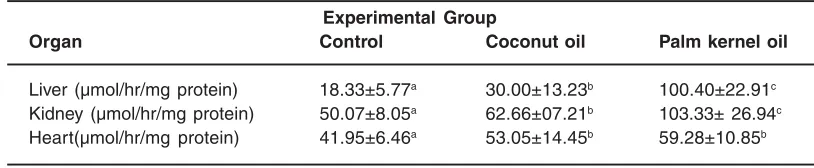
Table 2:The activity of Na+/K+-ATPase in the liver, kidneys and heart of rats fed with coconut oil and palm kernel oils
Experimental Group
Organ Control Coconut oil Palm kernel oil
Liver (µmol/hr/mg protein) 18.33±5.77a 30.00±13.23b 100.40±22.91c
Kidney (µmol/hr/mg protein) 50.07±8.05a 62.66±07.21b 103.33± 26.94c
Heart(µmol/hr/mg protein) 41.95±6.46a 53.05±14.45b 59.28±10.85b
Both the coconut and palm kernel oils supplementations exerted general increase in organ weight but this was only significant (p<0.05) in the liver weight relative to control. The significant increase in the weight of liver may be attributed to the liver’s ability to rapidly synthesize and take up cholesterol (Garg and Blake 1977).This is possible given that dietary supplementation with saturated fats is commonly associated with enhanced cholesterol biosynthesis (Hayes et al. 1991; Gil-Villarino et al. 1998).
The effects of coconut and palm kernel oils supplementation on Na+/K+-ATPase activity in
the liver, kidney and heart is presented in Table 2. coconut and palm kernel oils exerted a significant (p<0.05) increase in the activity of Na+/K+-ATPase
in these organs. Rats fed palm kernel oil had the highest activity of this enzyme in the tissues studied. Similar increase in Na+/K+-ATPase activity as a result
of coconut oil supplementation has been reported in other studies (Vajreswari and Narayanareddy, 1992; Srinivasarao et al. 1997)
The increased activity of Na+/K+-ATPase
in the organs of rats fed coconut and palm kernel oils is a likely indication that these oils may have a nutritional modulator y role in Na+/K+-ATPase
associated /related abnormalities.
The rational mechanism by which coconut oil and palm kernel oil supplementation result in the increase in Na+/K+-ATPase activity in these tissues
is at present not clear. However, plasma membranes are sites of several regulator y mechanisms and study of membrane bound enzyme activities are gaining importance for the elucidation of inter-relation between nutrition/diet and disease mechanisms and/or functional health benefits (Gil-Villarino et al. 1999; Oliveros et al. 2002).
The fatty acid composition of coconut oil and palm kernel oil and their specific impact / influence on membrane composition have been studied (Garcia –Fuentes et al. 2002).Both oils are known to be rich sources of medium chain saturated fatty acids which have been shown to influence
membrane composition, fluidity and functions. However there is evidence that different saturated fatty acids can exert specific and in some cases opposite effects on plasma cholesterol level (Fernandez et al. 1992). Observation made by Clamp et al. (1997) indicate that membrane fatty acid distribution ,membrane fluidity and functionality are complex and do not necessarily translate from or depend on the specific function of a single fatty acid.
Thus the observed increase in Na+/K+
-ATPase in tissue of rats may be due to changes in membrane composition and fluidity probably in the immediate Na+/K+-ATPase domain and/or by
hormonal changes initiated by the cells in response to any change in membrane composition or fluidity occasioned by the coconut and palm kernel oils supplemented diets.
It is well known that cellular and sub cellular membrane composition par ticularly that of phospholipids, may be altered in response to changes in dietar y fat. In vitro and in vivo modifications of membrane composition have been shown to modulate membrane functions including transport, receptors and enzyme activities.
In summary, the activity of Na+/K+-ATPase
in the liver, kidney and heart can be altered by feeding rats with dietary supplements of 10% w/
w
coconut and palm kernel oils with palm kernel oil having a greater effect. Diet-induced changes in membrane composition and fluidity may in concert with hormonal changes account for the increase in the activity of Na+/K+-ATPase in these tissues.
However, the role of enhanced Na+/K+-ATPase
activity in the functional benefits or pathological consequences of these oils remain to be determined.
ACKNOWLEDGMENTS
REFERENCES
1. Oliveros L.B, Videla A.M, Gimenez M.S.,
Effects of dietary fat saturation on lipid
metabolism, arachidonic acid turnover and
peritoneal macrophage oxidative stress in mice. Braz J Med. Biol. Res 37(3): 311-320 (2002).
2. Garcia-Fuentes E, Gil-Villarino A, Zafra M.F,
Garcia-Peregrin E, Differential changes in the
fatty acid composition of the main lipid
classes of chick plasma induced by dietary coconut oil. Comp Biochem. Physiol. Part B
133: 269-275 (2002).
3. Castillo M, Amalik F, Linares A,
Garcia-Peregrin E, Dietar y fish oil reduces
cholesterol and arachidonic acid levels in
chick plasma and very low density lipoprotein. Mol. Cell Biochem. 200: 59-67 (1999). 4. Gil-Villarino A, Garcia-Fuentes E, Zafra M.F,
Garcia-Peregrin E, Coconut oil induces short
term changes in lipid composition and
enzyme activity of chick hepatic
mitochondria. J Nutr. Biochem. 10: 325-330 (1999)
5. Gil Villarino A, Garcia- Fuentes E, Zafra M.F,
Garcia Peregrin E, Production of a rapid
hypercholesterolemia in young chick by
feeding coconut oil from two different sources
and fatty acid composition. Nutr. Res. 18: 1273-1285 (1998).
6. Gil-Villarino A, Torres M.I, Zafra M.F,
Garcia-Peregrin E, Supplementation of coconut oil
to the diet induces cellular damage and rapid
changes in fatty acid compositionof chick liver
and hepatic mithochondria. Comp. Biochem physiol. 117C: 243-250 (1997).
7. Crambert G, Hasler U, beggah A.T, Yn C,
Modynavov N.N, Harisberger J.D, Lelievres
L, Geering K, Transport and Pharmacological
properties of nine different human Na+/K+
-ATPase isozymes. J.Biol Chem 275: 1976- 1986 (2000).
8. Clamp A.G, Ladha S, Clark D.C, Grimble R.F,
Lund E.K, The influence of dietary lipids on
the composition and membrane fluidity of rat hepatocyte plasma membrane. Lipids 32(2): 179-184 (1997)
9. Hayes K.C, Pronczuk A, Lindsey D,
Diersen-Schade D, Dietary saturated fatty acids
(12:0,14:0,16:0) differ in their impact in
plasma cholesterol and lipoproteins in non-human primates. AM.J clin Nutr., 53: 491- 498 (1991)
10. Garg M.L and Blake R, Cholesterol dynamics
in rats fed diets containing either cariola
oil or sunflower oil. Nutr. Res. 3: 485-492 (1997).
11. Adam- Vizi and Seregi A. Receptor
independent stimulator y effect of
Noradrenalin on Na+/K+-ATPase in rat brain
homogenate. Role of lipid peroxidation.
Biochem Pharmacol. 31: 2231- 2236 (1982).
12. Lowry O.H, Rosebrough N.J, Farr A.L,
Randall R.J, Protein measurement with the Folin- phenol reagent. J. Biol chem. 193: 265-275 (1951)
14. Fernandez M.I, Lin E.C.K, McNamara D.J,
Differential effects of saturated fatty acids on
low density-lipoprotein metabolism in the
guinea pig. J Lipid Res. 33: 1833-1843 (1992).
15. Vajreswari A, and Narayanareddy K. Effects
of dietary fats on some membrane-bound
enzymes activities, membrane lipid
composition and fatty acid profiles of rat heart
sarcolemma. Lipids 27: 339-343 (1992). 16. Srinivasarao P, Narayanareddy K, vajreswari
Influence of dietary fat on the activities of
sub-cellular membrane-bound enzymes from different regions of rat brain. Neurochem. Int.
31:789-794 (1997).
17. Fiske C.H and Subbarrow Y., The calorimetric determination of Phosphorus. J Biol. Chem.