Original Research Article
Determination of prevalence, knowledge, attitude and practices
of contraceptive use in an urban population in South India:
a community based study
Yeshvanth Kumar
1, Pavan Mukherjee
2, Augustin Frankline
2,
Sajitha M. F. Rahman
1, Kirubah V. David
1, Ruby Angeline Pricilla
3*
INTRODUCTION
As early as 1952, India had introduced the family planning program and the Department of family planning was created in the Ministry of Health in 1961. Still the country’s birth rate continues to be as high as 21.6/1000 population.1 As of 2011 only 40% of the eligible couples practiced some method of family planning.1 According to the national family health survey (NFHS) done in 2015
-2016, a quarter of the women are married before 18 years of age, which is the legal age of marriage in India. Nearly 8% of the women aged 15-19 years of age are already mothers or pregnant. In the country only 53.5% women
aged 15-49 years practiced some method of
contraception.2 The most popular method of family planning practiced was female sterilisation for both the state and the country.2,3 There are no studies from the population we serve regarding contraceptive use. Such a
ABSTRACT
Background: Family planning influences mothers and infant’s health, population growth and regional and national development. Studying the knowledge, attitude and practice of contraceptive methods of a region aids in overcoming the barriers in the utilization of the services providing them.
Methods: A community based cross sectional study was done among 350 married women of an urban population by systematic random sampling using a structured questionnaire.
Results: From a total of 350 women enrolled, majority were of the Hindu religion (84.9%) and from the lower socio-economic status (68%). The prevalence of use of contraceptive methods was 75.4% and it was predominantly female sterilization. It was significantly higher (p<0.001) in women aged above 32 years, married for more than 10 years, having more than two children and last child birth of more than seven years. Only 142 (40.6%) of the participants had adequate knowledge of contraceptive methods. However, 299 (85.4%) had a positive attitude to contraception and 296 (84.6%) had good practice of family planning (FP) methods.
Conclusions: The knowledge and use of contraceptive methods especially temporary methods needs to be improved in our community. The utilization of media can be improved in addressing this shortfall. Health care providers being the bulk source of information on contraceptive methods must be pro-active in every interaction with women and men of reproductive age group by providing information on the various methods.
Keywords: Contraceptive methods, Urban community based, Knowledge attitude and practice
1
Department of Family Medicine, 2Department of Medical Social Works, 3Department of Community Medicine, Low
cost Effective Care unit, Christian Medical College, Vellore, Tamil Nadu, India
Received: 05 June 2019
Revised: 20 July 2019
Accepted: 30 July 2019
*Correspondence:
Dr. Ruby Angeline Pricilla, E-mail: [email protected]
Copyright: © the author(s), publisher and licensee Medip Academy. This is an open-access article distributed under the terms of the Creative Commons Attribution Non-Commercial License, which permits unrestricted non-commercial use, distribution, and reproduction in any medium, provided the original work is properly cited.
study would aid in directing our health education services as well as the contraception services. Appropriate interventions towards addressing the barriers women face in accessing and using appropriate contraception can be planned.
This study was conducted in the urban community we serve with the objectives,
To determine the prevalence of contraceptive use among married women aged 15-45 years in an urban population in Vellore, South India.
To determine the Knowledge Attitude and Practices regarding the common methods of contraception among these women.
METHODS
Study design and setting
This is a community based cross sectional study done among the married women of the urban population of Vellore town, South India. Health care services are provided to this urban community by the Low Cost Effective Care Unit (LCECU), which is the secondary level care provider of Christian Medical College, Vellore. We serve in five communities in this area covering a population of 10,000. The list of this population is available with the community health workers (CHW) who work among this population. From this list of eligible couples, married women in the age group 15 to 45 years were selected if they satisfied the eligibility criteria. The women were contacted at home with the help of the volunteers and community health workers in that area. After obtaining informed consent at home, they were enrolled in to the study. This study was carried out from May 2018 to February 2019.
Study participants
Married women in the age group 15 to 45 years were selected by systematic random sampling from the list of eligible couples living in the five communities served by the urban health centre. Every 4th women was selected from the list and only one woman was selected from each household. They were excluded if they were divorced or separated or widowed or having primary infertility.
Sample size and sampling technique
The study done in the slums of Delhi showed the prevalence of contraceptive use to be 25.8%.4 Based on these rates and taking an absolute precision of 5% and using the formula 4pq/d2, we arrived at a sample size of 320 and accounting for 10% missing, the final required sample size was 350 women. They were selected by systematic random sampling from the list of eligible participants.
Data source and measurement
For the first objective a structured questionnaire containing the socio-demographic details, current and past contraceptive use, number, type and place of abortions was used. For the second objective a structured questionnaire containing questions on knowledge, attitude and practice regarding contraceptive use was used. This questionnaire was adapted and modified from other studies done on this topic.5-8 There were 15 questions in the knowledge session and the right response to each question got a score of 1. So the maximum score was 15 and minimum was 0. Those who score more than 7 were considered to have adequate knowledge regarding contraception. There were 11 questions in the section on Attitude. The responses were in a Likert scale and the most positive answer was scored 1. The overall possible maximum score in the attitude section was 11 and minimum was 0. Those who score more than 5 were considered to have a positive attitude towards contraception. The section on practice had 5 questions on wanting to use contraception where a “yes” was scored as 1. The other 10 questions on not wanting to practice contraception, “No” was scored as 1. There was also a question on how to deal with unintentional pregnancy. So the maximum possible score was 16 and the minimum was 0. Those who scored 8 and more were considered to have good practice. The women were contacted at home at their convenient time and privacy was maintained during the administration of the questionnaire. The questionnaires were administered individually to the eligible women after obtaining informed consent in the local language by the Principal Investigator (PI) / Co-Investigator (CI). It was translated in to the local language and back translated to English and pilot tested for validation. Confidentiality of the data was maintained. Data was entered using the Epi-Data software.
Statistical methods
The data was analysed using SPSS version 23.
Descriptive statistics was calculated including
RESULTS
From the population served by our unit, there were a total of 1612 married women in the age group 15 to 45 years. After excluding women who were widowed, separated, divorced and with primary infertility, 1306 women were eligible for participation as shown in Figure 1. From the eligible women, 350 women were selected by systematic random sampling. There was no refusal of consent.
Figure 1: Flow chart describing the selection of the participants.
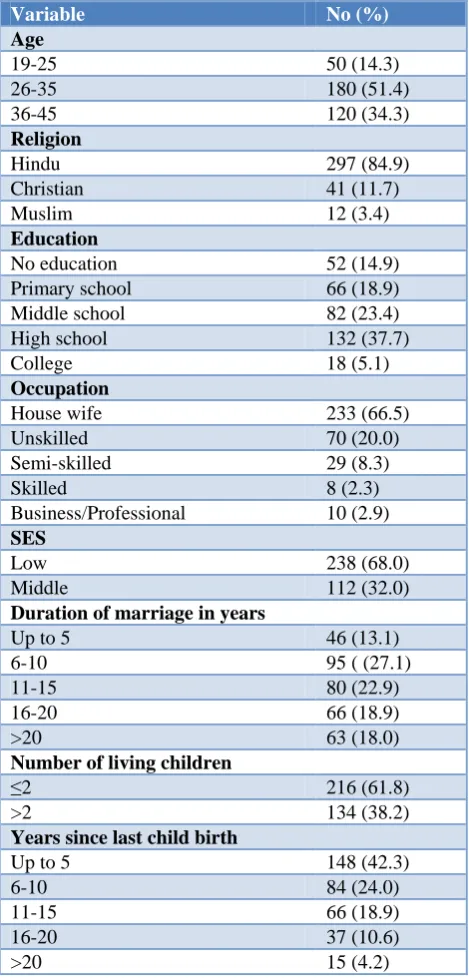
The socio–demographic description of the participants is given in Table1. About a half of the women were of the ages 26 to 35. The mean (SD) age of the women was 32.6 (6.3), with a median of 32 and age ranging from 19 to 45 years. They were mostly belonging to the Hindu religion and the lower socio-economic status. A third of them were home makers by profession. More than a third of them had high school education and nearly a quarter of the women had primary education. Only 5.2% of the women had any college education. The mean (SD) years of schooling was 7.2 (4.1), with a median of 8 years and a range of 0 to 19 years. The mean (SD) duration of marriage was 13.4 (6.8) years and the median was 13 years. Two thirds of the women had two or lesser number of children. The mean (SD) and median years since last child birth was 8.45 (6.4) and 7 respectively.
There were 264 (75.4%) participants who had ever used a method of contraception. Out of this 244 (92.4%) used permanent method, namely female sterilization and 36 (13.6%) of them used temporary method of contraception such as condoms (11) and intra uterine contraceptive device (IUCD) (25). Sixteen women who used temporary methods earlier went on to have sterilization later. Currently 244 (69.7%) women have had female sterilization and only five (1.4%) women were using temporary methods of contraception. There were nine women who were currently pregnant and 25 (7.1%) women who had induced abortions as they did not want to continue the pregnancy.
Table 1: Socio-demographic distribution of the participants (n=350).
Variable No (%)
Age
19-25 50 (14.3)
26-35 180 (51.4)
36-45 120 (34.3)
Religion
Hindu 297 (84.9)
Christian 41 (11.7)
Muslim 12 (3.4)
Education
No education 52 (14.9)
Primary school 66 (18.9)
Middle school 82 (23.4)
High school 132 (37.7)
College 18 (5.1)
Occupation
House wife 233 (66.5)
Unskilled 70 (20.0)
Semi-skilled 29 (8.3)
Skilled 8 (2.3)
Business/Professional 10 (2.9)
SES
Low 238 (68.0)
Middle 112 (32.0)
Duration of marriage in years
Up to 5 46 (13.1)
6-10 95 ( (27.1)
11-15 80 (22.9)
16-20 66 (18.9)
>20 63 (18.0)
Number of living children
≤2 216 (61.8)
>2 134 (38.2)
Years since last child birth
Up to 5 148 (42.3)
6-10 84 (24.0)
11-15 66 (18.9)
16-20 37 (10.6)
>20 15 (4.2)
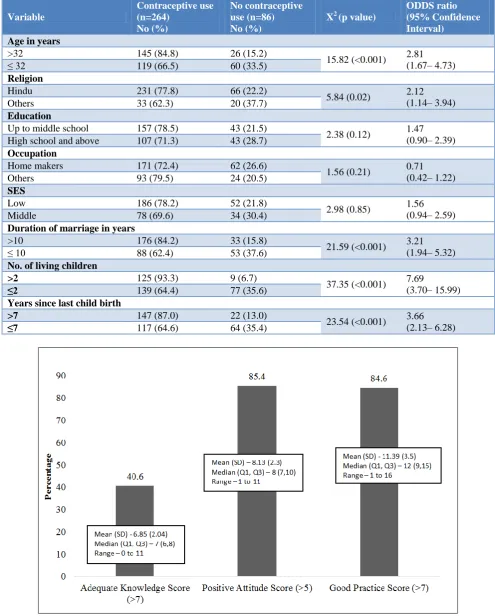
Women aged above 32 years (p <0.001), belonging to the Hindu religion (p=0.02), married for more than 10 years (p<0.001), having more than two living children (p<0.001) and in whom the last child birth was more than seven years (p<0.001) had a significantly higher contraceptive use ever. There was no significant association of contraceptive use with education, occupation and the SES of the women (Table 2).
The descriptive statistics for knowledge, attitude and practice scores are given in Figure 2.
Total married women aged 15 to 45 years- 1612
Women with primary infertility- 106
Total married women aged 15 to 45 years eligible for participation- 1306
350 eligible women were selected by systematic random sampling
Women widowed- 144
Table 2: Factors influencing the contraceptive use among the participants.
Variable
Contraceptive use (n=264)
No (%)
No contraceptive use (n=86) No (%)
X2 (p value)
ODDS ratio (95% Confidence Interval)
Age in years
>32 145 (84.8) 26 (15.2)
15.82 (<0.001) 2.81 (1.67– 4.73)
≤ 32 119 (66.5) 60 (33.5)
Religion
Hindu 231 (77.8) 66 (22.2)
5.84 (0.02) 2.12
(1.14– 3.94)
Others 33 (62.3) 20 (37.7)
Education
Up to middle school 157 (78.5) 43 (21.5)
2.38 (0.12) 1.47
(0.90– 2.39)
High school and above 107 (71.3) 43 (28.7)
Occupation
Home makers 171 (72.4) 62 (26.6)
1.56 (0.21) 0.71
(0.42– 1.22)
Others 93 (79.5) 24 (20.5)
SES
Low 186 (78.2) 52 (21.8)
2.98 (0.85) 1.56
(0.94– 2.59)
Middle 78 (69.6) 34 (30.4)
Duration of marriage in years
>10 176 (84.2) 33 (15.8)
21.59 (<0.001) 3.21 (1.94– 5.32)
≤ 10 88 (62.4) 53 (37.6)
No. of living children
>2 125 (93.3) 9 (6.7)
37.35 (<0.001) 7.69
(3.70– 15.99)
≤2 139 (64.4) 77 (35.6)
Years since last child birth
>7 147 (87.0) 22 (13.0)
23.54 (<0.001) 3.66 (2.13– 6.28)
≤7 117 (64.6) 64 (35.4)
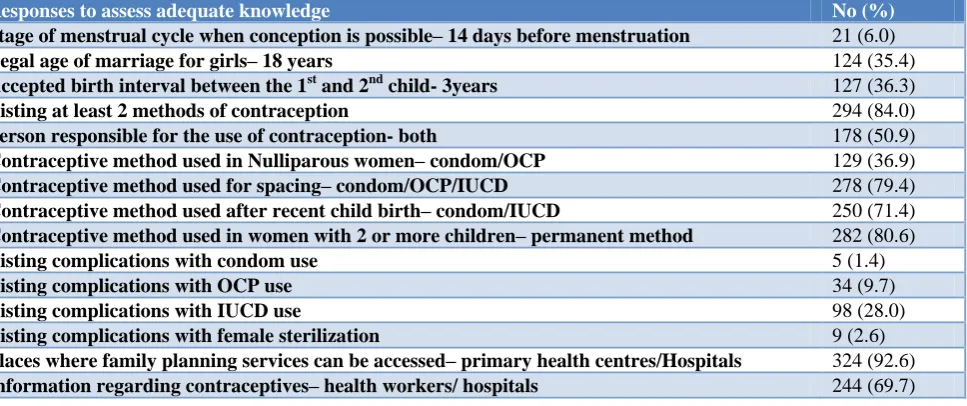
The overall knowledge was not adequate. Only 142 (40.6%) had adequate knowledge scores. The distribution of knowledge is described in Table 3. The knowledge regarding stage of menstrual cycle when conception takes place (6.0%), legal age of marriage (35.4%), birth interval (36.3%), nulliparous method (36.9%) and
complications associated with condom (1.4%), OCP (9.7%), IUCD (28%) and female sterilization (2.6%) was poor. Nearly 70% of the participants had received information regarding contraception from health care workers and hospitals. Rest of them had received information from friends and relatives (21.7%) and media (6.6%).
Table 3: Distribution of adequate knowledge regarding contraception (n=350).
Responses to assess adequate knowledge No (%)
Stage of menstrual cycle when conception is possible– 14 days before menstruation 21 (6.0)
Legal age of marriage for girls– 18 years 124 (35.4)
Accepted birth interval between the 1st and 2nd child- 3years 127 (36.3)
Listing at least 2 methods of contraception 294 (84.0)
Person responsible for the use of contraception- both 178 (50.9)
Contraceptive method used in Nulliparous women– condom/OCP 129 (36.9)
Contraceptive method used for spacing– condom/OCP/IUCD 278 (79.4)
Contraceptive method used after recent child birth– condom/IUCD 250 (71.4)
Contraceptive method used in women with 2 or more children– permanent method 282 (80.6)
Listing complications with condom use 5 (1.4)
Listing complications with OCP use 34 (9.7)
Listing complications with IUCD use 98 (28.0)
Listing complications with female sterilization 9 (2.6)
Places where family planning services can be accessed– primary health centres/Hospitals 324 (92.6)
Information regarding contraceptives– health workers/ hospitals 244 (69.7)
Table 4: Distribution of positive attitude regarding contraception (n=350).
Positive responses regarding attitude No (%)
Birth control methods limit family size or delay births- agree 285 (81.4)
Contraceptive methods are safe- agree 278 (79.4)
Can freely discuss selection of contraceptive method with husband- agree 274 (78.3)
Can freely discuss selection of contraceptive method with friend/close relative- agree 205 (58.6)
Use of contraception depends on the gender of the living children– don’t agree 231 (66.0)
Use of contraceptive methods conflicts with my moral, cultural or religious beliefs- don’t agree 284 (81.1)
Use of contraceptive methods leads to ill health and weakness of the body- don’t agree 169 (48.3)
Support family and friends who want to use any family planning methods– agree 292 (83.4)
Family planning methods should be selected appropriately to avoid side effects- agree 285 (81.4)
It is difficult to get information regarding available family planning methods- don’t agree 259 (74.0)
It is difficult to access family planning services- don’t agree 281 (80.3)
Table 5: Distribution of good practice regarding contraception (n=350).
Good practice responses No (%)
Improves health– yes 258 (73.7)
Prevents unwanted pregnancy- yes 313 (89.4)
Prevents sexually transmitted disease- yes 223 (63.7)
Spacing between children– yes 291 (83.1)
Recommended by health professionals- yes 271 (77.4)
Want more children– no 232 (66.3)
Don’t know any suitable method– no 228 (65.1)
Don’t know where to get suitable method– no 236 (67.4)
Husband disapproves of use– no 254 (72.6)
Family members disapprove of use– no 251 (71.7)
Has effect on future fertility– no 194 (55.4)
Good practice responses No (%)
Fear of side effects– no 185 (52.9)
It is expensive– no 292 (83.4)
Social or religious beliefs– no 294 (84.0)
Unintended pregnancy– will continue 214 (61.4)
Although the knowledge was poor, most of them (299, 85.4%) had a positive attitude with regard to contraception as shown in Table 4. The attitude was not so positive only with regard to contraceptive methods leading to ill health and weakness of the body.
Similarly the responses with regard to practice were good in majority (296, 84.6%) of the participants although only 75.4% used any method of contraception ever. The responses with regard to good practice of contraceptive use are given in Table 5.
Education of the participant was the only factor that influenced the knowledge regarding contraception. Women who had been to high school or above (75, 50.0%) had better knowledge than women who had been to middle school, primary school or no schooling at all (67,33.5%). This was statistically significant with a chi-square value (p value) of 9.68 (0.02) and odds ratio (95% Confidence interval) of 1.99 (1.29-3.07). Similarly with regard to practice, 152 (88.8%) women aged above 32 years had good practice responses as compared to 144 (80.4%) women aged 32 years and below. This was statistically significant with a chi-square value (p value) of 4.68 (0.03) and Odds ratio (95% confidence interval) of 1.93 (1.06-3.53). There were no other significant factors that influenced the knowledge or the practice scores. There was no significant association between age, education, occupation, religion, socio-economic status, duration of marriage, number of living children, and years since last child birth with the attitude score.
DISCUSSION
Family planning (FP) is stated to be crucial in ensuring good health among women. Successful implementation of FP methods enables prevention of unintended pregnancies, reducing need for unsafe abortions, slows down unsustainable population growth and thus in the long run contributes to healthy and economically productive population. In a study done in the urban slums of Delhi India, it was found that a quarter of the women surveyed had induced abortions and unsupervised medical termination of pregnancy was reported in 27.5% of the women. The prevalence of contraceptive use was only 25.8%.4 In another study done in a tertiary hospital among women attending the obstetrics and gynaecology outpatient reported 66% of the participants experienced at least one unwanted pregnancy and 44% of these pregnancies were aborted. They also reported that only 42% of the study population practiced some form of
contraception.9 In contrast, the prevalence of
contraceptive use in our population was found to be 75.4%. The percentage of women who reported aborting unwanted pregnancies was 7.1%.
In the same study the knowledge regarding at least one method of contraception was adequate.9 In another study done in Karnataka among 136 married women, nearly 2/3rds of them had adequate knowledge regarding contraception. The researchers also found a significant association between knowledge regarding contraception and educational status, occupation, family income and
duration of marriage.10 Surprisingly the NFHS-4
document claims that knowledge of contraceptive methods is universal (99%) in India in both urban and rural areas.2 However, adequate knowledge of different methods of contraception was only 40.6% in our study group and those with high school education or more seemed to have better knowledge scores. It has been noted that rural women in Udipi district of Karnataka and Karachi have moderate knowledge of contraceptive methods.10,11 Further studies are indicated on the factors behind the discordant figures of individual areas versus the NFHS data.
Though the knowledge of the women in our urban area was less than adequate, their perceptions regarding practice of contraception was good and attitude was positive. Majority of the participants practicing contraception (92.4%) were utilizing permanent method of contraception. Studies done in Ethiopia and Tanzania have indicated that the practice of contraception was significantly related to the participant’s age, education level, and distance to the nearest health facility, parity, women’s participation in decision making, side-effects and spouses’ permission and encouragement.12,13
CONCLUSION
In conclusion, our study done in an urban economically challenged community documents a prevalence of contraceptive use of 75.4% with less than adequate knowledge of various contraceptive methods among the married women. The practice and attitude towards contraceptive methods was good and positive. The knowledge and use of temporary contraceptive methods needs to be improved in our community. As most of the women knew about contraceptive methods form HCP, we have an important role in providing evidence-based counselling of methods, addressing concerns and being available to clarify doubts. Efforts need to be initiated in educating about newer methods by utilising media and other health education tools.
Limitation
As the data collected was by interviewer administered questionnaire, the women interviewed may not have been free to share all their thoughts and concerns. Thus the KAP may have been underestimated or overestimated.
ACKNOWLEDGEMENTS
The investigators want to thank all the participants who willingly participated in this study. We would also like to thank Dr. Lisa Stehno-Bittel and the Modale Fellowship program for all the encouragement and support.
Funding: The Institutional Research fund 22z440 Conflict of interest: None declared
Ethical approval: The study was approved by the Institutional Ethics Committee
REFERENCES
1. Park’s Text book of Preventive and Social Medicine
23rd Edition. Bhanot Publishers; 2015: 490-561.
2. National Family Health Survey– 4, 2015-16.
Ministry of Health and Family Welfare.
Government of India. Available at: http://rchiips. org/NFHS/factsheet_NFHS-4.shtml. Accessed on 17 August 2017.
3. National Family Health Survey– 4, 2015-16. State Fact Sheet– Tamil Nadu. Ministry of Health and Family Welfare. Government of India. Available at: http://rchiips.org/NFHS/pdf/NFHS4/TN_FactSheet. pdf. Accessed on 17 August 2017.
4. Meenakshi B, Panna L, Nandini S, Preena B, Ashok
K. Prevalence of induced abortions and
contraceptive use among married women in an urban slum of Delhi, India. Int J Gynecol Obstet. 2017;136:29–32.
5. Budi IS, Raymond S. Knowledge, Attitude and
practice of contraception among pregnant women in Ende District, East Nusa Tenggara, Indonesia. J
South Asian Federation Obstetr Gynaecol.
2017;9(2):110-8.
6. Abate M, Assefa N, Alemayehu T. Knowledge,
Attitude, Practice, and Determinants Emergency
Contraceptive Use among Women Seeking
Abortion Services in Dire Dawa, Ethiopia. PLoS ONE. 2014;9(10):e110008.
7. Nivedita K, Fatima SN. Knowledge, Attitude and Practice of Emergency Contraception on Nursing Personnel. J Clin Diagnos Res. 2014;8(9):OC20-2.
8. Te-Hsiung S, Chang MC, Lee ML, Lin HS.
Knowledge, Attitudes and Practice of contraception in Taiwan: Sixth province-wide fertility survey (KAP VI), 1986. ICPSR version. Taichung, Taiwan: Taiwan Provincial Institute of Family Planning [producer], 1986. Ann Arbor, MI: Inter-university Consortium for Political and Social Research [distributor], 2002.
9. Agarwal M, Samanta S, Bhusan D, Anant M.
Assessing knowledge, attitude, and practice of contraception: a cross- sectional study among patients in a semi-urban tertiary hospital. Int J Reprod Contracept Obstet Gynecol. 2017;6(2):720-4.
10. Sonam ZS, Melita S, Asha N. Knowledge, Attitude,
Practice and Preferences of contraceptive Methods in Udupi District, Karnataka. Journal of Family and Reproductive Health. 2013;7(3):115-20.
11. Mustafa R, Afreen U, Hashni HA. Contraceptive knowledge, attitude and practice among rural women. J Coll Physicians Surgeons Pakistan. 2008;18(9):542-5.
12. Kasa AS, Tarekegn M, Embial N. Knowledge,
attitude and practice towards family planning among reproductive age women in a resource limited settings of Northwest Ethiopia. BMC Res Notes. 2018;11:577.
13. Lwelamira J, Mnyamagola G, Msaki MM.
Knowledge, Attitude and Practice (KAP) Towards Modern Contraceptives Among Married Women of Reproductive Age in Mpwapwa District, Central Tanzania. Cur Res J Soc Sci. 2012;4(3):235-45.
14. Pricilla RA, David KV, Siva R, Vimala TJ, Rahman
SP, Angeline N. Quality of antenatal care provided by nurse midwives in an Urban health centre with regard to low-risk antenatal mothers. Indian J Community Med. 2017;42:37-42.
15. Pricilla RA, David KV, Siva R, Vimala TJ, Rahman
SM, Sankarapandian V. Satisfaction of antenatal mothers with the care provided by nurse-midwives in an urban secondary care unit. J Family Med Prim Care. 2016;5:420-3.