Original Research Article
An epidemiological study of chronic obstructive pulmonary disease
among 35 years and above rural population of Gurugram, Haryana
Navneet Aggarwal
1, Balbir S. Deswal
2*, Shalini Ray
2, Ved Pal
2INTRODUCTION
Chronic obstructive pulmonary diseases (COPD) is a global health concern and is a major cause of chronic morbidity & mortality. It is 4th leading cause of death worldwide and predicted to be third by 2030.WHO leads the global alliance against chronic respiratory diseases (GARD) towards a common goal of reducing global burden of Chronic respiratory diseases.1,2 In India, COPD accounts for 7% of deaths and 3% DALYs loss.3 Study
was conducted to delineate risk factors of COPD and estimate the economic burden on the community.
METHODS
The study was conducted among field practice area of PHC Garhi Harsaru of Gurugram for one year from January 2018 to December 2018. Presuming the prevalence of cases about 7% among 35 years & above form previous study, a sample size of population was
ABSTRACT
Background: COPD is 4th leading cause of death worldwide and predicted to be third by 2030. In India, COPD accounts for 7% of deaths and 3% DALYs loss. Study was conducted to Find the prevalence & determinants of COPD among 35 years & above rural population of Gurugram, Haryana and also determine health seeking behavior & economic burden of COPD cases.
Methods: The study was conducted among field practice area of PHC Garhi Harsaru for one year. A total of 1434 individuals 35 years and above of age found in 700 households among were selected by probability proportion to size (PPS) sampling methods. 115 cases detected as cases were matched with equal number of controls matching and Data analyzed.
Results: Prevalence of COPD was 8.02 % among 35 years & above age group. Smoking, passive smoking,biomass fuel smoke exposure, occupational exposure to dust/smoke/gas /chemical vapors at work, frequent respiratory infections, family history of COPD were found important determinants of COPD (P<0.05). Physical activity and body mass index were not found significant contributor on multivariate logistic regression analysis. Among all COPD patients 87.83% seeks immediate medical help in case of any breathing discomfort. Annual economic burden on COPD case was found to be Rs 14804/-.
Conclusions: Smoking, exposure to smoke/dusty /chemical vapors and family history of COPD are main determinant of COPD. Public health planners should concentrate to mitigate these causes.
Keywords: COPD, Spirometry, Risk factors, Health seeking behavior, Economic burden
Department of Community Medicine, 1HCMS, Civil Hospital, Hissar, 2SGT Medical College, Budhera, Gurugram, Haryana, India
Received: 02 March 2019
Revised: 17 April 2019
Accepted: 18 April 2019
*Correspondence:
Dr. Balbir S. Deswal,
E-mail: [email protected]
Copyright: © the author(s), publisher and licensee Medip Academy. This is an open-access article distributed under the terms of the Creative Commons Attribution Non-Commercial License, which permits unrestricted non-commercial use, distribution, and reproduction in any medium, provided the original work is properly cited.
calculated using formula n= (Z1-a/2)2p (1-p)/d2 where p is
prevalence and relative precision of 10% with anticipated non-response 10%.2 Population of all 14 villages consisting of 7700 household under PHC Garhi Harsaru was listed as per 2011 census and 7 villages were selected by simple random sampling. of these seven villages, 700 households were selected by probability proportion to size (PPS) sampling methods. All the 1434 individuals above 35 years of age found in these household were examined to detect chronic obstructive pulmonary diseases. Case definition was subject suffering from cough with expectoration for three or more months in a year for not less than 2 years and breathlessness. Spirometry was done to confirm the case & severity of condition (Gold criteria).4 A total of 137 cases were listed on screening, of which 115 were taken as confirmed case of COPD as per case definition, spirometry and pulmonary medicine consultant advice. All 115 cases detected were matched with equal number of controls matching the two for age (±2 yrs) and sex. Data were
collected on structured scheduled and analyzed using SPSS ver 22. Factors which were found statistically significantly associated were further analyzed using multivariate logistic regression analysis. Prior ethical
clearance was taken from Institutional Ethical
Committee.
RESULTS
Prevalence of COPD
Out of total population sampled 1434 individuals above 35 years & above, 115 had confirmed cases of COPD giving prevalence of 8.02% among 35 years and above age group.
Risk factors of COPD
Following factors were found significantly associated with COPD (p<0.05) as shown Table 1.
Table 1: Association of risk factors with COPD (n=115).
Factor Category COPD cases Controls Statistical value
Smoking Non smoker 27 66 OR 4.39 (2.49-7.75)
p≤0.0001
ever smoker 88 49
Smoking substance among smokers
Cigarette 06 06
ᵡ2=9.79, DF=4, p=0.0441
Bidi 55 19
Hooka 23 16
Mix 04 08
Average no. of bidi/cigarette/hooka per day among smokers
1-5 03 09
ᵡ2=17.6177, DF=4, p=0.0041
06-10 12 11
11-15 15 05
16-20 17 04
21+ 18 03
Passive smoking at home upto 18 years age (yrs of exposure)
0-4 02 02
ᵡ2=9.8569, DF=4, p=0.0429
5-9 03 08
10-14 23 14
15-18 76 67
Passive smoking at home after 18 years age (yrs of exposure)
0-4 08 15
ᵡ2=9.9495 DF=4, p=0.0413
5-9 17 13
10-19 09 08
20+ 52 34
Passive smoking at work place (yrs of exposure)
0-4 11 04
ᵡ2=9.9677 DF=4, p=0.0462
5-9 16 10
10-19 17 14
20+ 30 25
Biomass fuel smoke exposure Not exposed 08 24 OR=3.53, (CI
1.51-8.23); χ2=9.9677 DF=4, p=0.0462
Exposed 107 91
Type of biomass fuel used among exposed
Wood 10 18
χ2
=5.1974 DF=4, p=0.26
Agriculture- crop
residue 14 12
Animal dung 22 20
Mix 61 41
Factor Category COPD cases Controls Statistical value
Average exposure hours per day to biomass fuel among exposed
-1 hrs/day 5 16
χ2
=9.9772, DF=4, p=0.0444
1-2 hrs/day 7 4
2-3hrs/day 19 17
3-4 hrs/day 23 13
4 hrs+ 53 41
Occupational exposure job dusty conditions
Not exposed 41 59 OR=1.9, (CI 1.12-3.23)
ᵡ2=5.7323 DF=1, p=0.166
Exposed 74 56
Time spent in dusty job exposure among exposed
Upto 5 yrs 09 17
ᵡ2=10.4084 DF=4, p=0.0341
06-10 yrs 11 07
11-15yrs 08 03
16-20 yrs 14 15
20 yrs+ 32 14
Occupation where exposure to gas/smoke/chemical vapors
Not exposed 91 102 OR=2.07, (CI 1.0-4.3)
ᵡ2=3.8972 DF=1, p=0.0483
Exposed 24 13
Time spend on job exposure to gas/smoke/chemical vapors
Upto 5 yrs 01 03
ᵡ2=11.0197 DF=4, p=0.0263
6-10 yrs 02 05
11-15yrs 06 03
16-20yrs 05 01
20 yrs+ 10 01
Frequent respiratory infection
Negative 72 86 OR=1.77 (CI 1.01-3.12)
ᵡ2=3.9627 DF=1, p=0.0465
Positive 43 29
Family history of COPD
Negative 86 99 OR=2.09 (CI 1.01-4.10)
ᵡ2=4.6691 DF=1, p=0.0307
Positive 29 16
Physical activity
Light 44 27
ᵡ2=6.1505 DF=2, p=0.04617
Moderate 58 63
Heavy 13 25
Body mass index
Underweight 37 23
ᵡ2=6.3945, DF=2 p=0.0408
Normal range 48 66
Overweight 30 26
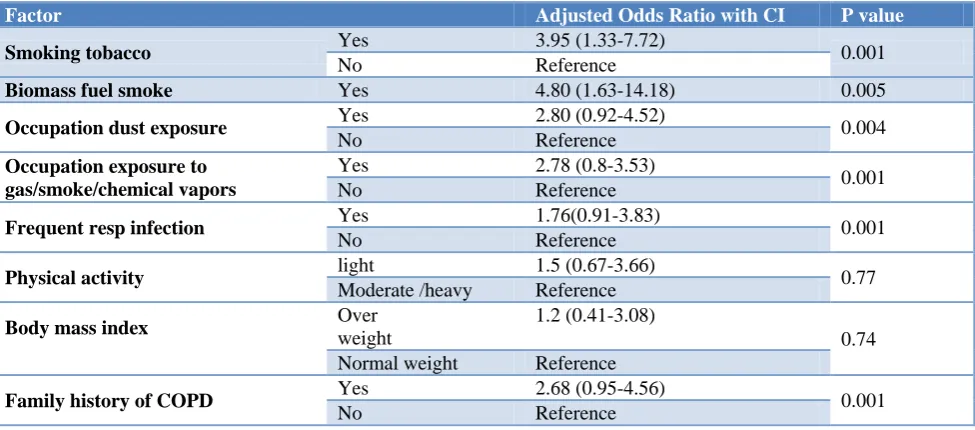
Table 2: Multivariate logistic regression analysis of risk factors associated with COPD.
Factor Adjusted Odds Ratio with CI P value
Smoking tobacco Yes 3.95 (1.33-7.72) 0.001
No Reference
Biomass fuel smoke Yes 4.80 (1.63-14.18) 0.005
Occupation dust exposure Yes 2.80 (0.92-4.52) 0.004
No Reference
Occupation exposure to gas/smoke/chemical vapors
Yes 2.78 (0.8-3.53)
0.001
No Reference
Frequent resp infection Yes 1.76(0.91-3.83) 0.001
No Reference
Physical activity light 1.5 (0.67-3.66) 0.77
Moderate /heavy Reference
Body mass index
Over weight
1.2 (0.41-3.08)
0.74
Normal weight Reference
Family history of COPD Yes 2.68 (0.95-4.56) 0.001
Table3: Economic cost burden of COPD case.
Total annual expenditure (INR) on COPD
COPD subjects
No. ( %) Mean expenditure/head
≤10000 31 (26.96) Annual direct cost = Rs. 13,477/-
Annual Indirect cost =Rs. 1,327/-
Annual total mean cost = Rs.14,804 /-
10001-20000 71 (61.74)
≥20000 13 (11.30)
Smoking
Smoking was found statistically associated with COPD. Data was analyzed regarding types of smoking, age of starting smoking and average consumption of smoking substance
Passive smoking
Passive smoking was analyzed regarding up to what age one stayed in same house with someone else smoked till he attained the age of 18 yrs, how many yrs he stayed in house after 18 yrs age and how many years subject worked at a place where someone else smoked. All three variables were significantly found associated with COPD.
Biomass fuel smoke exposure
Biomass fuel smoke exposure was found highly significantly associated with COPD including average exposure in terms of hours per day considering entire life of subject. Tobacco chewing was not found significantly associated with COPD.
Occupation exposure to dust/smoke/gas/chemical vapours
Occupation exposure to dust/smoke/gas /chemical vapors was found statistically associated with COPD including time or span of such exposure
Frequent respiratory infections
History of frequent respiratory infections was found to be significantly associated with COPD
Other factors found significantly associated with COPD were Family history of COPD. Alcohol consumption were not found significantly associated with COPD during univariate analysis. Physical activity and body mass index (BMI) were associated with COPD on univariate analysis but found insignificant determinants on multivariate logistic analysis (Table 2).
Heath seeking behavior
Among all COPD patients 87.83% seeks immediate medical help in case of any breathing discomfort while 12.7% neglected their ailment& did not seek any medical help. Of these 46.09% preferred allopathic, 42.61 % preferred Indian system of medicine & 11.30 % preferred
naturopathy. 36.52% utilized Government health system while 6.09% could go to private qualified doctor, 41.74 depended upon quacks & 15.65% chemist store.
Economic burden of COPD
In the study it was found that COPD hurt an individual economically both directly (cost of medication, investigations, diet etc.) & indirectly (loss of man-hours).Annual economic burden on individual was found to be Rs 14804/-as depicted in Table 3.
DISCUSSION
In the present study, prevalence of COPD among 35 year and above age was found as 8.02% which to concordant with other reports.2 Smoking had significant association with COPD more early the age starting smoking more chances to develop COPD. Number or quantity of smoking used by subjects on average per day was also found associated with smoking. Similar results were reported by Shahab et al and Thakkar at al in their separate studies.5,6 A study commissioned by ICMR estimated that smokers have three times more risk to develop COPD than their nonsmokers.3 In our study, it was observed that passive smoking both at home and at work place and the more time spent in such exposure more chances of developing COPD. Similar conclusions were drawn by study carried by Hagstad et al in North Sweden and Earnest et alin their separate studies.7,8
Exposure to biomass fuel smoke as well to occupational exposure of dusty environment, gases, chemical vapours; more the exposure per day more the chances of developing COPD. These findings were concordant with Agarwal et al in Indian study and a study done by Johnson et al.9,10 In present study, the subjects ever exposed to biological dust had three times more risk of COPD as reported by Matheson et al.11 Jaen et al reported that chronic cough & COPD was two times more prevalent in subjects with lifelong occupational exposure and those who were exposed for more than 15 years had lower lung functional values.12
subjects similar to findings of our study.15 Similar results were found by Gupta et al from their study carried out in Lucknow.16
Health seeking behavior in our study was supported by similar study carried out by Grover et alin Rural Haryana and urban Chandigarh.17 Direct medical cost was Rs. 12488/- and indirect Rs. 1641/- annually incurred by COPD case was assessed in their study done in South India by Kalluru et al that almost similar to our study with expected regional difference.18 Patel et al reported mean direct cost as Rs.2942/- per hospital event incurred by COPD case.19
CONCLUSION
COPD is an important public health problem likely to be increased further is effective interventions are not scaled up. Smoking, exposure to smoke/dusty / chemical vapors & family history of COPD are main determinants of COPD. Public health planners should concentrate to mitigate these causes.
Funding: No funding sources Conflict of interest: None declared
Ethical approval: The study was approved by the Institutional Ethics Committee
REFERENCES
1. Halbert RJ, Natoli JL, Gano A, Badamgarav E, Buist AS, Mannino DM. Global burden of COPD: systematic review and meta analysis. Euro Respri J. 2006;28:523-32.
2. McKay AJ, Mahesh PA, Fordham JZ, Majeed A.
Prevalence of COPD in India: a systematic review. Prim Care Respir J. 2012;21:313-21.
3. Jindal SK. Emergence of chronic obstructive disease as an epidemic in India. Indian J Med Res. 2006;124:619-30.
4. Global initiative of chronic obstructive lung diseases. Pocket guide to COPD diagnosis, management and prevention. A guide for health care professionals 2017. Report Global Initiative for Chronic Obstructive Lung Diseases; 2017: 2. 5. Shahab L, Jarvis M, Britton J, West R. Prevalence,
diagnosis and relation to tobacco dependence of chronic obstructive pulmonary diseases in a naturally representative population sample. Thorax. 2006;61:1043-7.
6. Thakkar M, Rohan K, Jain N, Jain N, Sharma M. Chronic obstructive pulmonary diseases. Does sex really matter? Lung India. 2011;28:258-62.
7. Hagstad S, Bjerg A, Ekerljung L, Backman H, Lindberg A, Ronmark E, et al. Passive smoking exposure is associated with increased risk of COPD in never smokers. Chest. 2014;145:1298-304. 8. Earnest G, San PM, Balemes JR, Eiser MD, Yelin
E, Kartz PP, et al. the occupational burder of
chronic obstructive pulmonary disease. Eur Respir J. 2003;22:462-9.
9. Agrawal A, Garg U, Madan C, Goel S. Association
of biomass fuel smoke exposure and COPD in women of rural India- Across sectional hospital based study. NJIRM. 2013;4:11-7.
10. Johnson P, Balkrishanan K, Ramaswamy P, Ghosh S, Sadhashivamm, Abirami O. Prevalence of chronic obstructive pulmonary disease in rural women of Tamilnadu implication for refining
disease burden assessments attributable to
household biomass combustion. Global Health Action. 2011;4:7226-7.
11. Matheson M, Benke G, Raven J, Sim M, Kromhout
H, Vermeulen R, et al. Biological dust exposure at work place is a risk factor for COPD. Thorax. 2005;60(12):645-51.
12. Jaen A, Zock J, Kogevinas M, Ferrer A, Martin A. Occupation, smoking and chronic obstructive pulmonary diseases: a cross sectional study in an industrial area of Catalonia, Spain. Environmental Health. 2006;5:52-7.
13. Mathew N, Xavier Z. the study of aetiology of chronic obstructive pulmonary disease (COPD in nonsmokers). J Pulmonary Respir Med. 2015;5:7-11.
14. Garg A, Singh M, Gupta V, Garg S, Daga M. An epidemiological study of chronic obstructive pulmonary diseases and associated factors in a resettlement colony of Delhi. University of Delhi, 2008.
15. Behrens G, Mathew C, Moore S, Hollenbeck A, Leitzmann M. body size and physical activity in relation to chronic obstructive pulmonary disease. Canadian Medical Association J. 2014;186:E457-69.
16. Gupta S, Gothi D, Narula G, Sircar J. Correlation of BMI and oxygen saturation in stable COPD in Northern India. Lung India. 2014;31(1):29-32.
17. Grover A, Kumar R, Jindal SK. Socio-demographic
determinants of treatment seeking behavior among chest symptomatic. IJCM. 2006;31:145-8.
18. Kallaru H, Nagasubramanian V, Balakrishnan H, Gopal K, Palani T. impact of severity of disease on cost of illness and quality of life of patients with COPD. J Young Pharmacists. 2015;7:106-12. 19. Patel K, Lalwani T, Shah K. Economic burden in
direct cost of chronic obstructive pulmonary disease at a tertiary care teaching hospital as prospective cohort study. Indian J Pharmacy Practice. 2014;7:61-8.
Cite this article as: Aggarwal N, Deswal BS, Ray S, Pal V.An epidemiological study of chronic