Original Research Article
A cross-sectional study on the factors influencing juvenile delinquency
in the government juvenile home, Hyderabad, Telangana
Jyothi Lakshmi Naga Vemuri, R. L. Lakshman Rao, Sara Roohen, G. Kiranmayee*
INTRODUCTION
Juvenile delinquency is a social problem which needs to be controlled before it deepens its roots. There were many studies done in various countries aiming to explore the factors leading to the delinquent behavior. The complexity of factors contributing and increasing trend of juvenile delinquency necessitates many more explorations for good policy.
Juvenile is a boy who has not attained 16 yrs and a girl who has not attained 18 yrs. Any offence thefts/robbery, attempt to murder/murder, rape, addictions and any
deviation from normal behavior like truancy, vandalism, immorality and ungovernability is termed as delinquency.1
India has signed the UN convention on the rights of the child and obligated itself to work towards ensuring all the rights enshrined therein to all its children.2 The incident in Delhi in December, 2012, in which a juvenile and five others were arrested by Delhi Police for brutally raping and assaulting a 23-year-old girl implicates the importance for taking corrective measures for juvenile delinquency.2 Delinquency itself is socially inadequate adjustment on the part of the individual to difficult
ABSTRACT
Background: Juvenile is a boy who has not attained 16 yrs and a girl who has not attained 18 yrs. Any offence thefts/robbery, attempt to murder/murder, rape, addictions and any deviation from normal behavior like truancy, vandalism, immorality and ungovernability is termed as delinquency. According to National Crime Records Bureau (NCRB) (2016), Telangana is holding 16th rank and among the metropolitan cities, Hyderabad is contributing to 11th rank based on percentage share in India on Juvenile crime. The objective of the study was to study the factors influencing the juvenile delinquency.
Methods: An institutional based cross-sectional study is carried out for a period of three months in the Government
Juvenile homes of Hyderabad, Telangana. All the inmates of the male and female juvenile homes (n=200) available at the time of study who were willing to participate were interviewed. Those who were sick and not cooperative were excluded. A semi-structured questionnaire completed through interviews and studying the subjects’ records and ISRD3 questionnaire were used. Institutional ethical clearance was taken before starting the study.
Results: 77.5% (155) were males and 22.5% (55) were females. 16.5% (33) were 6-10 yr age group and 83.5% (167)
were above 11 yrs. The mean age (yrs) is 14.02±2.96. 18% (36) didn’t attend school and 82% (164) attended school. Age, sex, school attending and the time spent with the parents have shown significance (p<0.05) in the delinquency.
Conclusions: The peer influence, smart phone usage, influence of movies and truancy from home also showed
significance (p<0.05) in the delinquency.
Keywords: Juvenile, Delinquency, Truancy, Peer influence, Movie influence, Smart phone usage
Department ofCommunity Medicine, Osmania Medical College, Hyderabad, Telangana, India
Received: 24 December 2018
Accepted: 29 January 2019
*Correspondence: Dr. G .Kiranmayee,
E-mail: [email protected]
Copyright: © the author(s), publisher and licensee Medip Academy. This is an open-access article distributed under
the terms of the Creative Commons Attribution Non-Commercial License, which permits unrestricted non-commercial use, distribution, and reproduction in any medium, provided the original work is properly cited.
situations. Each juvenile offense is the outcome of a complexity of causes.3 The rich family gives their children huge money for the expenditure and that influences them to activate any criminal activities indirectly. In many poor families, the family members are involving in quarrel because of poverty, which pays negative impacts on the children’s mind. As a result, children spend most of their time with their friends in outdoor to be relieved from family crisis, which gradually influences them to involve in many criminal activities.4 The National Agency for the Campaign against Drug Abuse (Nacada) in its October 2002 study recognizes the rampant drug abuse in learning institutions which is not limited to cannabis sativa.5 According to National Crime Records Bureau (NCRB) (2016), Telangana is holding 16th rank and among the metropolitan cities, Hyderabad is contributing to 11th rank based on percentage share in India on Juvenile crime.
The objective of the present study is to assess the factors influencing the juvenile delinquency.
METHODS
Study design
An institutional based cross-sectional study.
Study period and study population
3 months (March to May, 2018) in the Government Juvenile homes of Hyderabad, Telangana. Non probability sampling was done for this study. Purposive sampling technique was used.
Inclusion criteria
All the inmates of the male and female juvenile homes (n=200) available at the time of study who were willing to participate were interviewed. Those who were sick and not cooperative were excluded.
Study tool
A semi-structured questionnaire completed through interviews and studying the subjects’ records and ISRD3 questionnaire for assessing the delinquent behavior were used.6 Institutional ethical clearance was taken before starting the study.
Data analysis
Univariate and bi-variate analysis were performed to identify- what are the factors influencing the juvenile delinquency. In the univariate analysis, frequency, percentage, mean were observed. In bi-variate analysis, the significance of association between the independent variables (age, gender, family, peer, etc) and the
The data analysis was done using Excel and Epi Info 7.2.2.
RESULTS
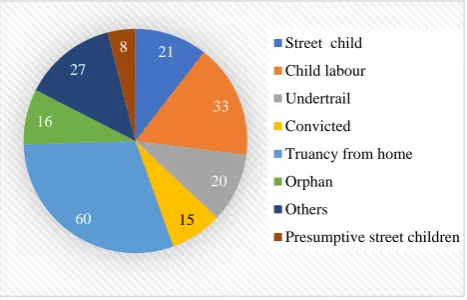
30% (60) in the juvenile home were due to truancy from home. 16% (32) were brought from child labour. 14% (28) were brought due to other reasons like missed children and minor marriages (Figure 1).
Figure 1: Pie diagram showing the reasons for being in the juvenile home.
Among 105 juveniles who have reported truancy from home, the main reasons for truancy include parent’s or guardian’s abusive behaviour towards them as 36% (38) and under the friends’ influence 30% (31). Among 45 females, 22 (49%) reported truancy from home and among them, 14 (64%) reported being in a love relationship as a reason for the truancy.
Figure 2: Bar diagram showing the peer activities.
36.5% (73) juveniles involved in more than two peer activities like smoking, drinking alcohol, inhaling whitener or ganja, street fights and thefts (Figure 2).
77.5% (155) were males and 22.5% (45) were females.
21
33
20
15 60
16 27
8 Street child
Child labour
Undertrail
Convicted
Truancy from home
Orphan
Others
Presumptive street children
2.5% 0.5% 0.5% 1.5%
3% 1.5%
36.5%
0 10 20 30 40
Thefts Smoking Drinking Inhaled whitener/ganja Street fights Truancy More than two activities
Table 1: Socio-demographic data.
Characteristics Frequency %
Religion
Hindu 120 60
Muslim 42 21
Christian 38 19
Sex
Male 155 77.5
Female 45 22.5
Age group (years)
6-10 33 16.5
≥11 167 83.5
Education
Not attended school anytime 36 18
Attended school 164 82
1) Lower primary (1-4) 46 23
2) Upper primary (5-7) 62 31
3) High school (8-10) 41 20.5
4) Intermediate 6 3
5) Religious school 9 4.5
SES (modified B.G. Prasad’s)
Upper class 9 4.5
Upper middle class 23 11.5
Middle class 64 32
Lower middle class 52 26
Lower class 52 26
The mean age (yrs) was 14.02±2.96. Socio-economic status according to modified B. G. Prasad’s classification showed 32% (64) belonged to middle class.
145 (72.5%) belonged to Telangana and the remaining belonged to other states. 60% (120) were Hindus, 21% (42) were Muslims and 19% (38) were Christians. 18% (36) didn’t attend school and 82% (164) attended school. Among them, 31% (62) studied upto upper primary (5th to 7th class).
Table 2: Socio-demographic data about family.
Variables No Frequency
Death of parents
Death of the father 37 18.5
Death of the mother 17 4.5
Death of both parents 31 15.5
Literacy status of parents
Father
Yes 69 34.5
No 131 65.5
Mother
Yes 41 20.5
No 159 78.5
Total No. of children in the family
≤2 86 43
≥2 114 57
Birth order
Eldest 55 27.5
Middle 49 24.5
Youngest 75 37.5
Only one 21 10.5
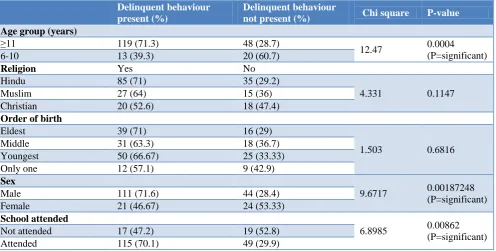
Table 3: Sociodemographic factors on delinquency.
Delinquent behaviour present (%)
Delinquent behaviour
not present (%) Chi square P-value
Age group (years)
≥11 119 (71.3) 48 (28.7)
12.47 0.0004
(P=significant)
6-10 13 (39.3) 20 (60.7)
Religion Yes No
Hindu 85 (71) 35 (29.2)
4.331 0.1147
Muslim 27 (64) 15 (36)
Christian 20 (52.6) 18 (47.4)
Order of birth
Eldest 39 (71) 16 (29)
1.503 0.6816
Middle 31 (63.3) 18 (36.7)
Youngest 50 (66.67) 25 (33.33)
Only one 12 (57.1) 9 (42.9)
Sex
9.6717 0.00187248 (P=significant)
Male 111 (71.6) 44 (28.4)
Female 21 (46.67) 24 (53.33)
School attended
6.8985 0.00862
(P=significant)
Not attended 17 (47.2) 19 (52.8)
Table 4: Parental factors influencing delinquency.
Variables Delinquent behaviour
Present
Delinquent behaviour
Not present Chi square P-value
Father literacy status
0.0288 0.8653
Literate 45 (65.2) 24 (34.7)
Illiterate 87 (66.4) 44 (33.6)
Mother literacy status
2.1224 0.1451
Literate 31 (75.6) 10 (24.3)
Illiterate 101 (63.5) 58 (36.5)
Father social habits
0.5309 0.46621
Alcohol+ 77 (68.1) 36 (31.9)
No alcohol 55 (63.2) 32 (36.8)
Mother social habits
0.3201 0.5715
Alcohol+ 40 (69) 18 (31)
No alcohol 92 (64.8) 50 (35.2)
Parents spending time with children
3.926 0.04754631
(P=significant)
No 101 (70.1) 43 (29.9)
Yes 31 (55.4) 25 (44.6)
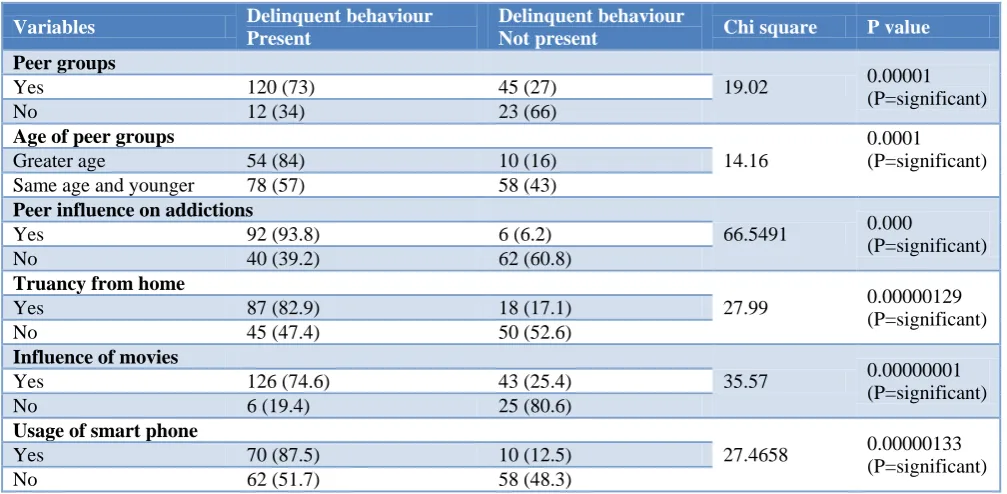
Table 5: Peer group and media influence on delinquency.
Variables Delinquent behaviour
Present
Delinquent behaviour
Not present Chi square P value
Peer groups
19.02 0.00001
(P=significant)
Yes 120 (73) 45 (27)
No 12 (34) 23 (66)
Age of peer groups
14.16
0.0001 (P=significant)
Greater age 54 (84) 10 (16)
Same age and younger 78 (57) 58 (43)
Peer influence on addictions
66.5491 0.000
(P=significant)
Yes 92 (93.8) 6 (6.2)
No 40 (39.2) 62 (60.8)
Truancy from home
27.99 0.00000129
(P=significant)
Yes 87 (82.9) 18 (17.1)
No 45 (47.4) 50 (52.6)
Influence of movies
35.57 0.00000001
(P=significant)
Yes 126 (74.6) 43 (25.4)
No 6 (19.4) 25 (80.6)
Usage of smart phone
27.4658 0.00000133 (P=significant)
Yes 70 (87.5) 10 (12.5)
No 62 (51.7) 58 (48.3)
34.5% (69) have literate fathers and 20.5% (41) have literate mothers (Table 2).
Death of single parent was seen in 23% (54) and the death of both parents in 15.5% (31).
Total number of children in the family were greater than two in 57% (114). 37.5% (75) were the youngest in the house and 27.5% (55) were the eldest.
132 (66%) showed delinquent behaviour and 68 (34%) were not having delinquent behaviour. The factors influencing the delinquent behaviour were studied.
The age group ≥11 yrs, the male sex, the juveniles who didn’t attend the school showed significant association (p<0.05) with delinquent behaviour.
The juveniles whose parents were not spending time with them had shown significance (p<0.05) in delinquency.
The peer groups, juveniles who had peer group greater than their age and the influence of peers on addictions showed significant association (p<0.05) with delinquency.
DISCUSSION
Findings of the studies by Chowdhury et aland of Nisar, Ullah and Alam revealed that the delinquents belonging to age group of 16-18 years were more probable to commit crimes as compare to those with adolescents ages.4,7 This study also found that the peer group has social influence on the child behaviour and that the type of family and unstable economic background was found significantly contributed towards the occurrence of juvenile delinquency.7
The present study also showed significant association in relation to the age of the juvenile (aged ≥11 yrs).
In the study by Mohideen et al, it was found that educational experience ranked as the most influential contributors towards juvenile misconduct, followed by family and socioeconomic class.8
The present study showed no significance in socioeconomic class in delinquency.
The study by Chowdhury et alstated that because of the family conflict, the juveniles were stayed most of the time in the outdoor, which led them to involve in many criminal activities gradually.4 Seperation from the family was also implicated as the influential factor in a study by Nourollah, Fatemeh and Farhad.9
The present study also is in accordance with this findings as the reasons for truancy from home were parental abusive behaviour and the peer influence. The truancy has shown significance with the delinquency.
The study by Nisar, Ullah and Alam also found that the peer group has social influence on the child behaviour and that the type of family and unstable economic background was found significantly contributed towards the occurrence of juvenile delinquency.7 The influence of peer was also emphasized in the study by Akhter et al.10 The present study also showed significance in the peer group influence on juvenile behaviour.
64% of the 22 females who reported truancy showed being in a love relation as the cause. The parents and teachers should spend time with the children explaining the false attraction towards opposite sex.
The influence of social media was proven in the study of Vigneswari and Thanappan.11 The present study is also in accordance with this finding.
Limitations of the study
The study findings cannot be generalised as they are institution based. A case-control study of the juveniles in the community and in the juvenile home would be more appropriate to find the causation.
The qualitative study design is more preferable.But as the electronic gadgets, tape-recorders, are not permitted, this couldn’t be done.
The respondents’ self-reports may be biased, the data collected could have hidden the actual information.
CONCLUSION
There should be continuous monitoring of the children on the usage of smart phones and internet. The children due to any reason of truancy are exposed to the environment which can favour delinquent behaviour in them. The importance of parental affection, close supervision of the peer groups and the importance of the family in moulding the child can never be neglected.
Free and compulsory formal and informal education is essential in all stages of juveniles’ development, particularly incorporating the ethical and moral values in the growing minds to protect from delinquency.
There should be bridge courses in the juvenile homes to continue with the level of education the juveniles have discontinued. The problems in language faced by the children from other states should be looked into. The training programmes can be expanded which will be beneficial for their livelihood.
ACKNOWLEDGEMENTS
The study would not be done without thanking the authorities of the Government Juvenile home, Hyderabad, for their valuable help and all the juveniles who had participated in the study.
Funding: No funding sources Conflict of interest: None declared
Ethical approval: The study was approved by the Institutional Ethics Committee
REFERENCES
1. Ahuja R. Social problems in India. Rawat publications; 3-Na-20; 2000.
2. Sahmey K, Patnaik B. A Study on Factors Underlying Juvenile Delinquency and Positive Youth Development Programs; Department of Humanities and Social Sciences National Institute of Technology Rourkela-769008, Odisha, India. 2013. 3. Bridges KMB. Factors Contributing to Juvenile
Delinquency, 17 Am. Inst. Crim. L. Criminol. 531 (1926-1927).
4. Chowdhury IA, Khan MM, Uddin I. Causes and Consequences of Juvenile Delinquency in Bangladesh: A Sociological Analysis. Int J Social Sci Tomorrow. 2012;1(4):1-8.
6. Questionnaire ISRD3 Standard Student Questionnaire; ISRD3 Working Group (2013); ISRD3 Technical Report Series #2; 2013.
7. Nisar M, Ullah S, Ali M, Alam S. Juvenile Delinquency: The Influence of Family, Peer and Economic Factors on Juvenile Delinquents. Scientia Agriculturae. 2015;9(1):37-48.
8. Mohideen RS, Anuar NKK, Latiff DIA, Ridzuan AR, Kamarudin FH. Social factors that contribute juvenile delinquency at Melaka. J Educ Social Sci. 2016;3:93-8.
9. Nourollah M, Fatemeh M, Farhad J. A Study of Factors Affecting Juvenile Delinquency. Biomed Pharmacol J. 2015;8:25-30.
10. Akhter N, Sabeen M, Nadeem M, Khan HU. Socio-economic factors affecting juvenile delinquency: a study in borstal jails, Punjab. Int J Agr Ext. 2015;3(1):57-61.
11. Vigneswari GG, Thanappan A. A research analysis on influencing factors of Juvenile delinquencies in Tamil Nadu. Indian J Economics Develop. 2016;4(3):1-6.
Cite this article as: Vemuri JLN, Rao RLL, Roohen