43
Technical sciences
2. Olympus NDT. Introduction to Phased Array Ultrasonic Technology Applications. USA, Waltham, 2007.
3. Gouva A.A., Shchelkanov A.I. Ultrasonic Thickness Gauge for automated production of parts //Actual problems of modern science. Proceedings of the III Regional Youth NPK
with international participation. – 2014. – Р. 109–111.
The work is submitted to the International Sci-entific Conference “Modern science technologies”, Spain (Tenerife), November 21–28, 2014, came to the editorial office оn 16.11.2014.
THE ACTUAL SCIENTIFIC AND EDUCATIONAL PROGRAM OF SMALL
SPACECRAFTS ENGINEERING Kovalev I.V.
Siberian State Aerospace University named after academician F. Reshetnev, Krasnoyarsk, e-mail: [email protected] The Siberian State Aerospace University and its strategic partners are described. Two satellites series are considered.
At the present time the Siberian State Aerospace University named after academician M.F. Reshet-nev (the SibSAU) in cooperation with the strategic partners – the Joint-stock Company “Information Satellite Systems” named after academician M.F. Reshetnev” (JSC “ISS”) and the Scientific Center of Krasnoyarsk under Siberian branch of Russian Academy of Sciences – implements the program of creation of the scientific and educational, techno -logical microsatellites series [1-3].
The SibSAU is one of the leading Russian Uni-versities in the aerospace technologies domain. The University develops on principles of the research university and implements the integrated system of preparation of specialists and scientific brainpower for the enterprises of space domain. The specialists preparation programs combine educational process, research activities and students work practice in the leading Russian space enterprises [4]. SibSAU implements the innovation educational programs [5–11] and performs scientific researches in close cooperation with the strategic partners – the base enterprise JSC “ISS” and the scientific institution – Scientific Center of Krasnoyarsk under Siberian branch of Russian Academy of Sciences, which have cooperatively created the subdepartments, scientific and educational laboratories and research centers [12, 13].
The JSC “ISS” is one of the leading enterprises of Russian space industry which possesses the tech-nologies of complete space complexes creation cy-cle starting by the design to the spacecrafts control in all types of orbit – from low circular to geosta-tionary. During its activities the enterprise has tak-en part in implemtak-entation of more than 30 Russian and international space programs in the domains of communication, retransmission, television, navi-gation, geodesy and scientific researches. The en -terprise has designed, manufactured and launched
about 1200 spacecrafts of 50 different types which distinguish by the high reliability and are intended for operation in low circular, circular, high-ellipti-cal and geostationary orbits.
The objectives and tasks of the program for cre-ation of the scientific and educcre-ational, technological microsatellites series being implemented [14, 15]:
● development of the integrated system of the engineering education (distance learning system, laboratory sessions performing using the ground stations of microsatellites control etc.);
● implementation of the design-oriented edu -cational technology during formation of the space domain specialists professional capacities (stu-dents’ participation in designing and manufacturing of satellites, service systems and scientific devices);
● scientific experiments in space (develop -ment of the Earth natural resources space monitor-ing methods, multifunctional nanomaterials, high-temperature superconductors and other intelligent materials use in space);
● technological development and obtaining of the flight qualification for the advanced service sys -tems, devices and elements of the satellites (of the attitude determination and control subsystem, elec-tric power subsystem, thermal control subsystem and other subsystems with the increased lifetime).
In 2007 the SibSAU in cooperation with the JSC “ISS” and the Scientific Center of Krasnoyarsk under Siberian branch of Russian Academy of Sci-ences have concluded the strategic partnership agreement on creation of students’ small satellites series according to which the program of techno-logical, scientific and educational satellites regular creation and following launch was adopted (smka. sibsau.ru). Due to this program the technological work-out in space and flight qualification obtain -ing will be provided for the new elements of satel-lites and space systems developed on the basis of the University. The SibSAU is the single Russian higher school which will perform the manufactur-ing of elements and the assembly of microsatellites, the mounting of technological and scientific instru -ments as well as the part of small satellites tests directly on the basis of the joint scientific and edu -cational center “Space systems and technologies” and the industrial resource center “Spacecrafts and space systems” which has the clean room and pro-duction facilities for these purposes.
44
Technical sciences
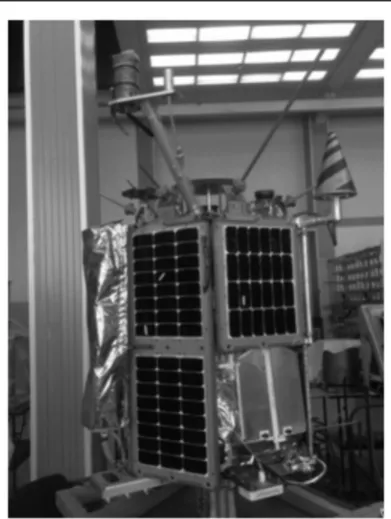
determination subsystem elements are located – magnetometer and transversal beams with balancers, receiving and transmitting antennas as well as the scientific equipment: three Earth sensors to receive
the data on the Earth radiation in the infrared range of wave lengths and to research the space-time radia-tion of the Earth day-time and night-time atmosphere in the apparent spectral range.
Fig. 1 Photo of the Small satellite “Yubileyniy”
On the middle panel the DОКА-B equipment is installed that includes on-board computer, receiving equipment operating in frequencies of 145 MHz, transmitting equipment operating in frequencies of 435 MHz and radionavigation on-board equipment.
On the bottom there are located: magnetic-gravitational attitude determination system pro-viding the satellite longitudinal axis orientation towards the Earth in nominal mode, navigational equipment antenna, experimental sun sensor and “Radek” equipment dedicated to check the efficien -cy of application of the nano-coatings developed in the SibSAU for radiation protection of satellites’ electronic components.
One of the purposes of the unified platform of this satellite developed in the JSC “ISS” is to cre-ate conditions to perform the educational and sci-entific and technical experiments in space. As the satellite attitude control subsystem elements the self-deploying mechanical micro systems based on composite materials are used. Such mechanical systems allow creating the transformable large-size spatial structures based on lightweight tubular rods in space. The rods extension mechanisms allow spatially allocating the objects with the mass about 10 kg at distances of tens of meters.
The solar arrays panels mounted on the frame are made based on the three-stage gallium arsenide and allow providing electric power to the satellite
on-board equipment in the sunlit part of orbit. The selected frame shape provides the required value of the solar array effective area, at different sat-ellite position relative to the Sun. In eclipse orbit the electric power is provided to the equipment by the nickel-metal-hydride battery. The battery is not the separate unit, its elements are included in the instrumentation power and control unit which ac-commodates all the automatics of the electric pow-er subsystem; all this is included in the DОКА-B equipment.
The peculiarity of this satellite is the passive thermal control subsystem: the required tempera-ture conditions are provided by unregulated ratio of optical factors on object structure elements sur-faces, heat-insulating elements, electric heaters and heat pipes which provide thermal conditions for the DОКА-B equipment.
In the frame of the project “Research of ra-diation shields efficiency at rara-diation effects of the Earth.
The telemetry data from the equipment are received, processed and stored in the SibSAU stu-dents’ Satellite Control Center.
The small satellite “Yubileyniy” ensured the performance of research, experimental and educa-tional tasks.
45
Technical sciences
stages of the space exploration (speech messages, slides in SSTV format, simulation of signals of the first satellite).
It created conditions for use of information from the small satellite by the leading Russian high-er schools in teaching and educational objectives.
Performance of scientific and technological ex -periments:
● Ensuring the flight qualification of promising Sun and Earth sensors;
● Acquisition of data on the Earth radiation in the infrared range of wave lengths;
● Research the space-time radiation of the Earth day-time and night-time atmosphere in the apparent spectral range;
● Working-out the satellite orientation assessment methods according to the information from the experi-mental Sun sensor and the compact magnetometer;
● Check of the efficiency of application of the nano-coatings developed in the SibSAU for radia-tion protecradia-tion of satellites’ electronic components; ● Ensuring the flight qualification of the prom -ising multifunctional unpressurized platform for satellites with the mass of 30–100 kg;
● Working-out the technology of small satellite concurrent injection into the operational orbit by the “Rokot” launcher.
All the organizations that have taken part in development and creation of the small satellite obtained the significant scientific and technical groundwork for the future and made their contribu-tion to the preparacontribu-tion of highly skilled specialists for the space industry of Russia.
The launch of the small satellite “Yubiley-niy” together with three nominal satellites was performed from the “Plesetsk” launch site on the 23/05/2008.
Besides the scientific-technical and experimen -tal tasks the small satellite was intended to perform one more function not less important. The creation of this satellite allowed performing preparation of young specialists on the basis of project-oriented educational technology for the first time. The stu -dents took part in all stages of satellite creation: from the design documentation development to the satellite in-orbit control.
Operation control of the satellite that has been successfully operating in space for four years is per-formed by the Satellite Control Center per-formed in the SibSAU with the JSC “ISS” participation. The students receive the telemetry information from the satellite in real-time mode there, learn to decode it and to control the satellite.
The Satellite Control Center main functions are control and coordination of interactions between technical means of satellite deployment, mainte-nance in nominal operation mode and replacement. The Center fulfills the following tasks:
● long-term and operational planning for the satellite and the ground control center technical fa-cilities operation;
● organization of technical facilities synchro -nous operation in real time;
● control of the checking information packets generation and transmission on-board the satellite;
● reception, processing, display and archiving the telemetry information from the satellite;
● analysis and prediction of the satellite techni -cal state;
● organization of the current navigational pa -rameters measurements and their processing;
● organization of preventive measures and con -tingencies recovery;
● performing the Satellite Control Center tech -nical facilities operability monitoring in accordance with the technical requirements;
● organization of information protocols, queues, priorities, flows, archives access;
● providing the automatic information ex -change with the ground control center facilities and interacting complexes.
The “Mikhail Reshetnev” satellites series On the second satellite “Mikhail Reshetnev” (MiR) has being launched in August 2012 and five new university developments will be approbated already. The students of SibSAU have developed and manufactured: on-board computer, remote data interface unit, Earth remote sensing camera and la-ser corner reflector intended to measure the distance from the satellite to the Earth. The function of the devices is the working-out the new control unit and the digital line of the Earth remote sensing informa-tion transmission in space.
The small satellite MiR is designed on the base platform of the “Yubileyniy” satellite with extended mass and power performances (Fig. 2).
46
Technical sciences
The tasks performed during creation and opera-tion of the small satellite “Mikhail Reshetnev”:
● Obtaining the scientific and technical ground -work in the field of competitive space technology and technologies of new generation for use in de-fense, scientific and commercial purposes;
● Creation and working-out in field conditions the experimental parts of small satellites and ad-vanced satellites of the JSC “ISS”;
● Obtaining the experience of creation and op -eration of the satellites for the Earth remote sensing; ● Improving the existing forms of project-and-team preparation of specialists for the JSC “ISS” with the participation of the SibSAU students on the basis of the joint scientific and educational center “Space systems and technologies” (SEC SST);
● Creation and launch of the satellite in honor of the fiftieth anniversary of the JSC “ISS” and the SibSAU.
● Working-out and acquisition of the contour heat pipes production technologies.
The opportunities for students
The students of technical specialities dur-ing studies have the unique possibility to directly control the Russian small satellites (“Yubiley-niy”, “Mozhaets”, “Chibis” and future “Mikhail Lomonosov” and “Baumanets 2”) and satellites of the Technical University of Berlin (DLRSAT, TUBSAT), receive and process the telemetry in-formation (sat.sibsau.ru). In the center there are also studies on the program simulator of modern telecommunication satellite “Express-АМ” that fully simulates operation of all satellite service subsystems and is used for test work-out of on-board control system and learning to operate the real satellite (joint development of SibSAU and JSC “ISS” specialists). The Students’ SCC of the SibSAU is an important ground segment of the orbit group of technological, scientific and educa -tional small satellites being created by the Univer-sity and the partners.
In 2010 in the frame of the international pro-ject “Reformation of the educational programs in the field of space technology in Russia, Ukraine and Kazakhstan” (CRIST) according to the Eu-ropean Commission program TEMPUS the inter-national distributed network of the University’s small satellites control stations was created for the successful and full-scale small satellites con-trol. This network included SibSAU, the Tech-nical University of Berlin, the State Aerospace University of Samara, the Moscow Aviation Uni-versity and several leading institutions of higher education of Russia, Ukraine and Kazakhstan. In 2011 in the frame of the project on the TEMPUS program SibSAU and the Technical University of Berlin were remotely united through the Internet. Thus the students of SibSAU obtained the unique possibility to receive the information from the Russian University’s satellites and satellites of the Technical University of Berlin.
Conclusion
The speciality of the program on students’ mi-crosatellites series creation being implemented is that the JSC “ISS” uses them as an experimental field for working-out new devices and systems. The most part of the payload on-board equipment mounted on these satellites is used for the first time. The new equipment gets the flight qualification in-orbit, after that it could be used in creation of big spacecrafts.
As a result of implementation of the pre-sented project in Krasnoyarsk due to the joint ef-forts of JSC “ISS”, SibSAU and SCK SB RAS the successful integrated system is created for the space industry manpower development using the unique technologies of project-and-team stu-dents’ work, balancing between innovations and traditions, education and scientific research and maintaining the flexibility in educational trajec -tory construction. It allowed organizing students’ and postgraduate students’ work on the real pro-jects directly in the SibSAU starting from the de-sign and the short-series manufacturing of space engineering devices and elements to the creation of small satellites.
References
1. Kovalev I.V., Loginov Y.Y. Innovative activity of the
University in the field of space systems and technologies. Higher education in Russia. – 2011. – № 6. – P. 16–21.
2. Kovalev I.V., Loginov Y.Y. The Development of re-gional technological platform “Information-telecommunication and space technologies for innovative development of Siberia”.
Vestnik SibGAU. – 2012. – № 2. – P. 168–173.
3. Kovalev I.V., Loginov Y.Y., Cybulski G.M. The Estab-lishment of a regional centre for receiving and processing remote sensing data of the earth on the territory of Krasnoyarsk region.
Resetdevice reading. – 2013. – So 1, № 17. – P. 256–257.
4. Kovalev I.V., Karaseva M.V. English-German-English frequency dictionary on system analysis in electronic engineer-ing and the aerospace industry. Siberian state aerospace
Univer-sity. Krasnoyarsk, 2013. – 216 р.
5. Kovalev I.V., Zelenkov P.V. Automation of formation of information and terminological basis multilinguistic learning
tech-nologies. Distance and virtual learning. – 2005. – № 3t. – P. 68–81.
6. Kovalev I.V., Agarunov S., Lomakov P.M. Algorithmic customization tools information-terminological basis in the
field of aerospace engineering. Aerospace instrument-making. – 2007. – № 9. – P. 67–71.
7. Kovalev I.V., Karaseva M.V., Leskov V.O. Information terminological basis as a set of lexically related components.
Vestnik SibGAU. – 2009. – № 1. – P. 54–56.
8. Kovalev I.V., Leskov O.V., Karaseva M.V. Intralingual
associative fields in multilinguistic adaptive-learning technol -ogy. System management and information technol-ogy. – 2008.
№ 3.1 (33). – P. 157–160.
9. Usachev V., Kovalev I.V. Adaptive Technology of the
Education Quality Control. В сборнике: 9th International Sci
-entific and Practical Conference of Students, Post-graduates and
Young Scientists – Modern Techniques and Technologies, MTT’
2003 Proceedings. – 2003. – Р. 251–253.
10. Kovalev I., Kovaleva T., Susdaleva E. Effective infor-mation training technology based on the learner’s memory state
model. Modelling, Measurement and Control D. – 2000. – Т. 21, № 3–4. – P. 11–26.
47
Technical sciences
Training Technology Organization and Usage: Proceedings of Modelling and Simulation, MS’2004 AMSE International Confer-ence on Modelling and Simulation, MS’2004. sponsors: Univer-sity Lyon 1, France, Assoc. for the Adv. Model. and Simul. Tech. Enterprises, AMSE, French Research Council, CNRS, Rhone-Alpes Region, Hospitals of Lyon. Lyon-Villeurbanne, 2004.
12. Kovalev I.V. Creating the question of improving the accuracy and reliability of the test system and simulation of
weightlessness in space. Vestnik SibGAU. – 2014. – № 2 (54). –
P. 106–109.
13. Kovalev I.V., Stupina A.A., Tsarev R.U. Planning the development of the cluster structure of the automated control system of satellite communication. Aerospace
instrument-mak-ing. – 2006. – № 12. – P. 26–30.
14. Kovalev I.V., Nurgalieva Y.A., Gritsenko S.,
Us-achev A.V. Tо the problem of selecting the structure of the au -tomated system of aircraft control. Vestnik SibGAU. – 2009. –
№ 3. – P. 105–110.
15. Kovalev I.V., Engel E.A., Tsarev R.Ju. Program-matic Support of the Analysis of Cluster Structures of Failure-Resistant Information Systems. Automatic Documentation and
Mathematical Linguistics. – 2007. – Т. 41, № 3. – Р. 89–93.
The work is submitted to the International Sci-entific Conference “Actual problems of science and education” Germany (Dusseldorf – Cologne), No-vember, 2–9, 2014 came to the editorial office оn 29.10.2014.
MEASUREMEN.T PHASE NOISE CRYSTAL OSCILLATOR Nikonova G.V., Novikov S.M., Petrov A.V.
Omsk State Technical University, Omsk, e-mail: [email protected]
One of the most important characteristics of high frequency oscillators (HFO) used in commu-nication devices, navigation equipment, digital de-vices, systems orientation autopilot aircraft, missile guidance systems, radar equipment – is the phase noise generated oscillations, in other words , the distortion of the generated signal [1].
The ideal signal generated by a crystal oscil-lator (CG) should not be distorted shape, and loca-tion of its edges should exactly repeat from period to period, that is, it must exactly match their math-ematical function, U = Uosin(t/T) for a sinusoidal signal where: T – the period of oscillation, t – cur-rent time.
Waveform distortion due to the nonlinear re-gime autogeneration, electrical frequency multipli-cation, and other factors, spectral analysis explains “admixing” to the basic ideal signal with frequency
ω of its harmonics with multiple frequencies (2ω, 3ω, 4ω ...) and amplitudes corresponding to that signal distortion [2].
In that case, if the waveform distortion is ran-dom chaotic can speak of a phase noise in the sig-nal . Phase noise in the reference oscillator leads to a deterioration of the radio systems: degradation of the radio communication, reduce the accuracy of location of objects in the GPS navigation data transmission losses, reduced sensitivity of radar and others. Today, phase noise is one of the main
pa-rameters of the CG, which reduce is of paramount importance .
Phase noise measurement is performed on spe-cial analyzers spectral analysis, determine how its power is distributed over the frequency range from zero to infinity. In practice, it is usually limited by the operating frequency detuning of the signal in the range from 0,1 Hz to 100 kHz (and sometimes from
0,01 Hz to 1 MHz) [3].
The measurement results are presented in the form of the curve L(Ω), where Ω – frequency analy-sis Hz; L(Ω) – logarithm of the spectral power den-sity of the “noise” of the signal S(Ω), measured in a 1 Hz bandwidth at a distance from the lasing fre-quency Ω: L(Ω),dBc = 10Log[S(Ω)/2].
The dependence of L(Ω) is divided into three zones differing slope L(Ω)/Ω: proximal zone oc-cupies a range of from 0Ω to 10 Hz has a slope
L (Ω)/Ω about 30 dBc per decade (a decade – the change Ω10 times ); middle zone , which occupies the frequency range Ω approximately 10 Hz to
10 kHz, is characterized by a slope L(Ω)/Ω from
10 to 20 dBc per decade; far zone (or noise-floor), starting from Ω = 10 kHz, has almost no slope of
L (Ω)/Ω.
In the formation of the CG noise involved vari-ous sources , concentrated in the oscillator circuit , temperature control system and a quartz resonator (CR). Their influence on the noise CG occurs by a complex interaction between them and the param-eters of the resonator. Despite the well-known con-vention, it is assumed that the phase noise L(Ω) at different detuning Ω generated by various sources of noise.
Far field (noise-floor) is formed mainly in -trinsic noise buffer amplifier. Thus , the higher the level of the generated signal at the input of the buf-fer amplifier , the lower the contribution of noise in the CG and the lower level L(Ω). Limit reduce noise-floor limited Johnson noise equal at room temperature – 174 dBm/Hz. Therefore, the lower levels of phase noise reduction required tempera-tures CG [4].
The middle zone L(Ω) is formed by noise am-plifier oscillator , closed through the CD positive feedback . At the level of phase noise in this area influences the loaded quality factor KR: the higher the QL, the lower the frequency of the upper middle zone and the middle zone of the transition frequen-cy in noise-floor.
In the formation of the near field dependence
L(Ω) involving the same sources as in the middle zone, but added to them related to the influence of noise on the resonator and the thermostat. Effect of noise on the thermostat due to fluctuations in its temperature , called through the thermodynamic ef-fect of the frequency fluctuations of the CD. Usu -ally this factor is concentrated in the range of 0,01Ω