Software Process Improvement in Small and Medium
Enterprises in Sudan
Mohammed Merghany Mohammed Abd
Elsalam
Faculty of Computer Sciences and Information Technology
Al Zaiem Alazhari University- Khartoum- Sudan
Sallam Osman Fageeri Khairy
Faculty of Computer Sciences and Information Technology
Al Zaiem Alazhari University-Khartoum- Sudan
ABSTRACT
Given the increasing development in the area of software process improvement and the great efforts made for development; many researchers expressed the importance of deploying software process improvement and developing its approaches. The small and medium enterprises play a prominent role in our planet economy (around the year 2008, inside the folks The Nation's Association of Software restore Publication rack small and medium enterprises). Researchers claimed how the standardization of the software process is required for the reason that the software capability maturity model presents some recommended practices in several key process areas that have been shown to enhance software process capabilities. A survey across sample of five Sudanese Software companies has been conducted; This paper presents proposed Small and Medium software Enterprises definition and problems facing them in adopting Software Process Improvement in Sudan in contrast of some of international studies.
Keywords
Medium and Small Enterprises; Process Improvement; Capability Maturity Model; Capability Maturity Model Integration; Software Process Improvement Knowledge
1.
INTRODUCTION
The software Medium and Small Enterprises (SMEs) has a prominent role in software production; either SMEs was standing alone or they were acting as subcontractors for big companies or projects [1]. The role which played with the medium and small enterprises in the global economy (by the year 2008, more than 85% of the members of The National Association of Software and Service Companies are small and medium enterprises). There are a considerable number of studies that have been devoted to overwhelm the SMEs problems in adoption of Software Process Improvement (SPI) methods in order to maintain competitiveness. Those studies have had various goals to achieve the institutionalization of SMEs [2]. These problems are involved in resources, effort, money and software process improvement professionals or software process improvement knowledge, in addition to the complexity of the SPI models like Capability Maturity Model Integration. In other side and due to the market ware to survive, software companies looking forward to improve their products, services and customer satisfaction. Software companies should improve their processes and activities that used to get products because the product enhancement depends on the practices and activities that compose the process. Smaller and Medium Enterprises settings agile enough and the SPI models like Capability Maturity Model Integration (CMMI) are applicable, if the obstacles are solved.
2.
SOFTWARE
PROCESS
DEFINITION
Process: A set of partially ordered steps, intending to reach a goal. While the term process is used in many different contexts, the context of this definition is software. For software development, the goal is production or enhancement of software products, or the provision of services. Other examples are the software maintenance process, the acceptance testing process, or the process development process [3].
A process is nothing more than a structured set of activities and decisions to do a certain job. Everything we do involves processes [4], Organizations have a way of accomplishing business whether it’s manual or automated. A process, in the context of Information Technology Process Improvement, is simply a means of documenting, organizing, and controlling the ways organizations accomplish business [5].
In general, a process is defined as:
Webster’s Dictionary: ‘‘A large or major undertaking, especially one involving considerable money, personnel, and equipment.’’
CMMI: ‘‘Consists of activities that can be recognized as implementations of practices in a CMMI_ model.’’
IEEE: ‘‘A sequence of steps performed for a given purpose.’’
SEI: ‘‘Set of activities, methods, practices, and transformations that people use to develop and maintain software and the associated products.’’
PMBOK: ‘‘A series of actions bringing about a result.’’
The key with processes is to remember that their primary purpose is to enable information technology staff to do their job more effectively by allowing them to concentrate on technical issues as opposed to administrative issues. If these primary goals are kept in mind throughout the development of processes, it is more likely that the processes will be accepted and used by organizations and project staff, which is the ultimate goal of any process improvement effort. In essence, processes give information technology staff the tools they need to benefit from lessons learned by others [5].
R. S. Pressman, the software process is a framework of tasks to build high quality software.
Somerville [7] stated that the software process is a structure of activities to develop software systems and pointed out that software process consists of the four activities: (1) Software Specification; (2) Software Design and Implementation; (3) Software Validation; (4) Software Evolution.
3.
SOFTWARE
PROCESS
IMPROVEMENT
(SPI)
Software process improvement is a deliberate, planned methodology following standardized documentation practices to capture on paper (and in practice) the activities, methods, practices, and transformations that people use to develop and maintain software and the associated product [8].
Any software process improvement plan requires a true and qualified statement about the current status of software development in the organizations and a description of strengths and weaknesses used to identify the areas of improvement. On the basis of previous studies, we have selected five SPI methodologies that have been already implemented in SMEs.
4.
SPI AND SMALL AND MEDIUM
ENTERPRISES (SMES)
Nevertheless, in educational and industrial environments, there is a widespread tendency to emphasize that the success of SPI is, in most cases, only possible for large companies which have enough resources to tackle this type of practice. This perception is based on the fact that often SPI programs are just not viable for SMEs, because of their organizational structure and the cost that is involved. This viewpoint also takes into account the reality that the models of improvement created by international organizations have not been considered for this type of companies, but rather for large-scale ones [9]
From the results obtained in the current review, the first observation from the study that was carried out is that, in the last 5 years, the Software Engineering community has shown an ever-increasing interest in tackling SPI in SMEs. Although at a global level, there is a general consensus that SEI and ISO models can be applied only with difficulty in small companies, these same companies do indeed adapt and use these models when undertaking their improvement efforts. Small companies are currently undertaking SPI efforts, but SEI or ISO models do not lead to these companies receiving their certification. The results show that it is indeed very difficult to successfully apply formal SPI programs which use models such as, for example CMM, of SMEs [9].
5.
CAPABILITY MATURITY MODEL
INTEGRATION (CMMI)
Capability Maturity Model Integration (CMMI) can be used to guide process improvement across a project, division, or an entire organization. Under this methodology, processes are rated according to their maturity levels, which are defined as initial, repeatable, defined, qualitatively managed and optimized. The model was created by the Software Engineering Institute by combining the CMM models (SW-CMM V2.0, Integrated Product Development (IPD), and System Engineering CMM (SE-CMM) [10].
The purpose of CMMI is that it helps to integrate the different organization functions. The disadvantages of CMMI or (1) may not be suitable for every organization; (2) it may add overhead in terms of documentation; (3) may require additional resources and knowledge required in smaller organizations to initiate CMMI-based process improvement;
(4) may require a considerable amount of time and effort for implementation and (5) require a major shift in organizational culture and attitude.
CMMI was developed by the Software Engineering Institute (SEI) at Carnegie Mellon University (CMU) based on some emerging CMM models and these models are Capability Maturity Model for Software (SW-CMM) v2. 0 drafts, Systems Engineering Capability Model (SECM), and Integrated Product Development Capability Maturity Model (IPD-CMM) v0. 98, and the first version of this model was released in 2000. The objective of the CMMI is to provide a guideline for improvement of the software process in the organizations, and it is written especially for the software industry to describe the software processes in details.
Furthermore, CMMI Product Team pointed out that the CMMI supports the organizations to manage the development, acquisition, and maintenance of products or services. CMMI also focuses on the supplier to improve the internal software process, where it has two representations; the first one is continuous representation that focuses on process areas capability and are measured by capability levels, and the second is staged representation; which focuses on organizational maturity and is measured by maturity levels.
CMMI model is the most widely used compared to other software process improvement models, where CMMI is supposedly applicable for all the size of firms. However, this model is not ready to be used by small software firms. Nevertheless, the continuous representation can be useful and is more applicable for small software firms compared to stage representation, as smaller software firms could allocate its’ limited resources on the most striking problems.
Based on this, the CMMI-DEV V1.2 continuous representation will be used as a baseline improvement model in developing the software development process improvement framework for several reasons such as: (1) CMMI have been used to guide the software development improvement such as CMMI-DEV V1.2 ; (2) CMMI is the comprehensive software improvement model of the SEI where this model mostly comply with relevant international standards such as ISO 9000 and ISO/IEC 15504; (3) CMMI model improves upon the best practices of other improvement models in many important ways; (4) CMMI gains the international acceptance in the software engineering community ; and (5) CMMI have been broadly used for assessing and improving the organizational maturity and process capability throughout the world, where customers have descriptions of how the various good practices fit together. [11]
6.
CMMI & SMES
have more software and computers in new products than in current products. Thus, there is a motivation for CMMI in SMEs and it is applicable if it can be linked to business performance. The solution should be tailored regarding the problems facing SMEs in adopting CMMI.
6.1
Importance of SMES
[15] Expressed the importance of deploying SPI and developing its approaches. Shows the importance of developing a new process meta-model illustrating that the current process models do not provide informational and behavioral aspects of software development process. The improved processes can’t be compared or identified because the focus is on process description only. Says the competitiveness of the companies depends on their product quality and also they show the necessity of SMEs in Brazil (70% of Brazilian software industry are SMEs). However [16] state that the Software production is one of the most important Indian Economy factors as reported by NASSCOM CEO Summit. [17] state that SPI standards like SW-CMM could promote productivity and competitiveness. The SW-CMM presents sets of recommended practices in a number of key process areas that enhance software process capability. SME’s are striving for standardization of their software development processes. They are carrying out some of SPI goals, but they are not using a proper method [18]. Fig II reflects the distinguish types of software products produced by Sudanese software companies.
6.2
The problems facing SMEs in SPI
Adoption
All the studies in [7, 16] [19] and mentioned above thought of the inhibitors of implementation standards like CMMI in SMEs concentrated in the terms of lack of money, lack of Software Process Improvement (SPI) knowledge and SMEs consider the Institutionalization is a time consuming process. Lack of experienced process engineers and activities which lead them to have a good CMM level is a big issue to be resolved [18]. The rest of the paper is organized as follows. Section III reviews Medium and Small software Enterprises. Section IV review Sudanese Medium and Small software Enterprises. Section V presents problems face the study. Section VI state study findings. Section VII conclusion.
7.
SMALL & MEDIUM ENTERPRISES
SMES OVERVIEW
Several definitions have been mentioned in the SMEs context. Some of them define SMEs as a business with fewer than 100 people by [14] and [13], Organizations within a larger organization with fewer than 50 people [14] and Project with fewer than 20 people [14]. Some other institutions identify SMEs base on a variety of regards as it illustrated below:
7.1
SME Definition
SMEs have a number of different definitions, these definitions vary according to environment, countries and the software product type, size and area of interest. For example the European Commission [20] define SMEs as in Table 2.
Normally a small setting is typically defined as businesses with fewer than 100 people, organizations, within a larger organization, with fewer than 50 people, projects with fewer than 20 people [21]
SMEs are companies whose personnel numbers fall below certain limits. SMEs is also said to be responsible for driving innovation and competition in many economic sectors. SMEs represent a high proportion of firms in most countries all over the world. They represent more than 85% of all firms in the
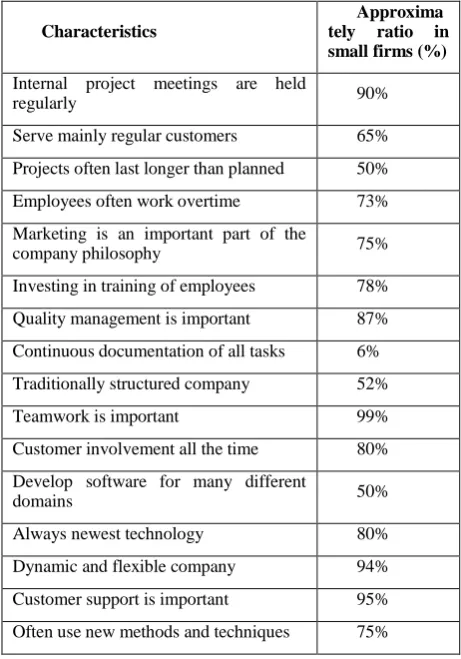
US, Canada, China, India, Finland, Ireland and many other countries [1]. Depending on the study conducted by Hofer in Australia [22], the size of small firms is between 10 to 50 employees. The characteristics of small and medium enterprises, according to Hofers [22] are given in Table 1.
Table 1. Characteristics of Small Software Firms by Hofer
Characteristics
Approxima
tely ratio in
small firms (%)
Internal project meetings are held
regularly 90%
Serve mainly regular customers 65%
Projects often last longer than planned 50%
Employees often work overtime 73%
Marketing is an important part of the
company philosophy 75%
Investing in training of employees 78%
Quality management is important 87%
Continuous documentation of all tasks 6%
Traditionally structured company 52%
Teamwork is important 99%
Customer involvement all the time 80%
Develop software for many different
domains 50%
Always newest technology 80%
Dynamic and flexible company 94%
Customer support is important 95%
Often use new methods and techniques 75%
Table 2. SMEs, European Commission Definition
Types Medium Small Micro
Maximum number
of employees 250 250 10 Maximum
turnover (in million ECU)
40 7 -
Maximum balance-sheet total (in million ECU)
27 5 -
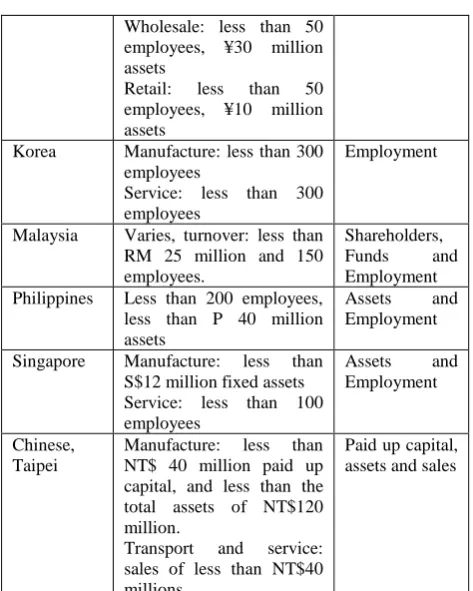
SME Definition by Asian countries: Different Asian countries introduced different definitions of SME. In general, SME classified by the number of employees and the amount of capitals or turnover as in Table 3.
Table 3. The Definition of SME in various Asian Countries
Country Definition of SME Measurement
People Republic of China
Varies with industries, less than 100 employees
Employment
Indonesia Less than 100 employees Employment Japan Less than 300 employees,
or ¥10 million assets.
Wholesale: less than 50 employees, ¥30 million assets
Retail: less than 50 employees, ¥10 million assets
Korea Manufacture: less than 300 employees
Service: less than 300 employees
Employment
Malaysia Varies, turnover: less than RM 25 million and 150 employees.
Shareholders, Funds and Employment Philippines Less than 200 employees,
less than P 40 million assets
Assets and Employment
Singapore Manufacture: less than S$12 million fixed assets Service: less than 100 employees
Assets and Employment
Chinese, Taipei
Manufacture: less than NT$ 40 million paid up capital, and less than the total assets of NT$120 million.
Transport and service: sales of less than NT$40 millions
Paid up capital, assets and sales
8.
APPLICABILITY OF CMMI IN SMES
There are many reasons why CMMI is difficult to implement in small organizations and small projects. Fixed costs of establishing the necessary infrastructure. The large number of roles which must be filled by a limited number of people Quantity of information that must be absorbed to properly interpret the model. Similar problems are experienced when applying the CMMI to short duration project challenges in applying CMMI in small settings and practical strategies for overcoming them will be outlined as follows [23]
SMEs with systems and software incorporated in their products do experience product delivery, quality and cost problems. There is a need for disciplined methods in the SME community. Given the technical and business situation described by the SMEs studied, it would appear that the CMMI™ in its current form is not feasible to implement in the SME environment. The data collected in this study indicates that small, quickly implemented improvements focused on identifiable SME problem areas is the preferred approach when working with SMEs.
CMMI SME implementation issues can be summarized in terms of size - CMMI is considered too large by Mislinkage to SME problems is not immediately evident Lack of SME implementation knowledge, infrastructure and resources translate process framework into value added operational processes. CMMI Alternative approaches like CMMI-SME Front-end provides a direct link of SME development problems to the appropriate practices in the model, CMMI-SME Back-end: Link of model components to off the shelf “whole” product solutions appropriate for SME implementation The optimum packaging for the CMMI-SME would provide “line of sight” connectivity from SME problem to model components to implement solutions.
[7] Recommended that SMEs want to know how they compare to others, but SMEs lack resources and expertise to benchmark.
Analyzes SME performance Identifies problem areas, relates them to the model, points to the associated solutions. Develop a library of SME appropriate “whole” product solutions mapped to the SME problem areas and the CMMI.
Most firms are ISO certified and believe that it is valuable. There appears to be a strong process orientation in almost all firms; UL, ISO most frequently mentioned. There is a motivation for CMMI, if it can be linked to business performance. Traditional, classroom training is the preferred method of learning.
9.
SUDANESE SMALL & MEDIUM
ENTERPRISES SMES OVERVIEW
The small and medium size software enterprises have a significant number in Sudan. SMEs play very important role in the country's economy internationally as mention in several studies. Unfortunately, there are very few studies devoted to this area in Sudan.
In order to promote the software Small and Medium Enterprises output in Sudan. This case study conducted to enrich researches in this area. The case study was across five software Sudanese companies. The study conducted in the period from March to July 2017. The contribute companies were; Nile Center Technology Research NCTR Khartoum - Sudan (http://www.nctr.sd), Financial & Banking System (FBS) is Sudanese Software Company (http://fbs-sd.com) 9th floor AL Baraka Tower Zubair Basha Street, Khartoum, Sudan, Brilliant Solutions Company is a small organization in the electronic parts and equipment companies industry located in Khartoum, Sudan +249 183243039 Block 7, House 184 Obaid Khatem Street Khartoum Sudan, Live Communication Technology LCT Khartoum Sudan Alsafa City, Software Company for Accounting and Business Systems SCABS Khartoum Sudan Amarat Street 15.
Table 4. The Five SMEs Summary
NCTR FBS Brilliant LCT SCABS
Employees >125 75 20 25 26 Life Span 10 10 10 4 7
10.
PROBLEMS FACING THE STUDY
During the beginning steps of the study, we face very hard hinders. The very weak cooperation and the wrong perception of such type of institutions (SMEs) about Software Process Improvement were the biggest barriers of studies in this area. The contradictory in answers of some surveyed companies members in second level of problems.
11.
STUDY FINDINGS
Do not know 50% Used
42%
Not Used 8%
Fig 1: SPI Usage
Fig 2: Software Products Type
12.
CONCLUSION
In spite of the fact that more and more researches and studies should be devoted to this area. Our study makes at least common sense about the situation of Sudanese software enterprises (medium and small). The results of the study ensure the absence of wariness about SPI approaches and benefit for the organization and the state of Sudan. The cooperation of the Sudanese organizations in research area missed clearly. This lack of cooperation, which comes from bad perception about researches, leads to poorer researches, which in turn slow countries' development. The researchers will continue to clarify such problems and overwhelming them. Our ongoing project is to establish a web-based system to help Sudanese SMEs to get the advantages of SPI by knowledge dissemination, shared database of best practices and provide initiative SPI self-assessment.
13.
REFERENCES
[1] Cater-Steel, "An evaluation of software development practice and assessment based process improvement in small software developmen firms," PhD, Sch.Com Info, Grifith, Australia, 2004.
[2] A. M. Deepti Mishra, "Software Process Improvement in SMEs: A Comparative View," ComSIS vol. Vol. 6, p. 30, June 2009 2009.
[3] F. Peter and H. Watts, "Software Process Development and Enactment: Concepts and Definitions," CMU/SEI-92-TR-004September 1992 1992.
[4] T. D. Tore Dybå, Nils Brede Moe PROCESS IMPROVEMENT INPRACTICE A Handbook for IT Companies. New York, Boston, Dordrecht, London, Moscow Kluwer Academic Publishers, 2004.
[5] D. Jacobs, Accelerating Process Improvement Using Agile Techniques: Auerbach Publications Taylor & Francis Group, 2006.
[6] V. M. Paula and R. d. S. Alberto, "PIT-ProcessM: A Software Process Improvement Meta-model," presented at the Seventh International Conference on the Quality of Information and Communications Technology, 2010.
[7] I.Sommerville, “Software Process”, in Software Engineering, 6th edn ed.: Addison-Wesley, 2001.
[8] S. M. Mamta Shelpar, "Software Process Improvement Model," International Journal of Advanced Research in Computer Science and Software Engineering, vol. 3, p. 5, June 2013 2013.
[9] F. G. Francisco J.Pino, Mario Piattini, "Software process improvement in small and medium software enterprises: a systematic review," Springer Science+Business Media, LLC 2007, 2007.
[10]CMMI Product Team, "CMMI® for Development, Version 1.3 CMMI-DEV, V1.3," ESC-TR-2010-033November 2010 2010.
[11]M. S. A. Mejhem Yousef Al Tarawneh, Abdul Bashah Mat Ali, "Software Process Improvement (SPI) In Small Software Firms," 2008.
[12]G. SuZ, "Thoughts on Applying CMMI in Small Settings," ed: CMU/SEI, 2005.
[13]NDIA CMMI Working Group, "CMMI for Small Business," ed: Natinal Defense Industrial Association NDIA, 2010.
[14]G. Maggie, G. SuZ, M. Gene, and H. Rick, "Applicability of CMMI for Small to Medium Enterprises," ed: Software Engineering Institute Northrop Grumman Corporation, 2010.
[15]S. Gleison, M. Mariano, J. Vasconcellos, F. Sávio, C. Reinaldo, C. Cristina, et al., "Implementing Software Process Improvement Initiatives in Small and Medium-Size Enterprises in Brazil," presented at the Sixth International Conference on the Quality of Information and Communications Technology, 2007.
[16]K. A.M. and E. A., Jeya Kumar, "Software Process Improvization Framework using Fuzzy Logic Based Approach for Indian Small scale Software Organizations," IJCSNS International Journal for Computer Science nad Network Security, vol. 10, p. 8, March 2010 2010.
[17]C. P. Mark, V. W. Charles, and B. C. Mary, "The Capability Maturity Model for Software," ed: Software Engineering Institute, USA, 1997.
[18]Ashima and A. Himanshu, "Essesnce of Software Process Reengineering in SME's: Towrds Process Customization and Automation," Global Journal of Enterprise Information System, vol. 2, p. 10, July-Dec 2010 2010.
[19]V. B. Gisele, R. C. d. R. Ana, and P. d. A. Marcio, "An approach to implement software process improvement in small and mid-sized organizations," presented at the Seventh International Conference on the Quality of Information and Communications Technology, 2010.
0 5 10 15 20
LCT NCTR Brilliant FBS SCABS
[20]European Commission. (1996). SME Definition by EC. Available:
http://europa.eu.int/ISPO/ecommerce/sme/definition.html
[21]S. E. I. International Process Research Consortium (IPRC), "Improving Processes in Small Settings (IPSS)," vol. A White Paper, 2006.
[22]C. Hofer, "Software development in Austria: results of an empirical study among small and very small enterprises," pp. pp. 361-366, 2002.