Original Research Article
A study on obstetric care in a primary health center of
South Assam district, India
Ajit Kumar Dey, Debojit Chutia*
INTRODUCTION
Every year more than 200 million women become pregnant. Most pregnancies end with the birth of a live baby to a healthy mother. But because of difficulties associated with human birth, women often require assistance during delivery.1 With the global phenomenon of increasing urbanisation many more women are delivering in obstetric facilities, whether they are having normal or complicated births. Generally, between 70 and 80% of all pregnant women may be considered as
low-risk at the start of labour.2 Around 15% of all pregnant women will develop a potentially life-threatening complication that calls for skilled care, and some will require a major obstetrical intervention to survive.3 The problems of maternal and neonatal mortality are complex, involving women’s status, education, employment opportunities and the availability to women of basic human rights and freedoms.1
In 1988, following an influential call for action,the Safe Motherhood movement was launched in Nairobi, Kenya.4
ABSTRACT
Background: Maternal and child health are critically important in a country that is experiencing high infant mortality
and maternal mortality. Research all over the world has suggested that one of the major solutions to this problem is availability of Emergency Obstetric Care services within the reach of people.Objectives of the study were to examine profile of mothers who have delivered in health facility during a year and the interplay of various factors in child birth and newborn outcome.
Methods: Retrospective cross sectional study conducted by collecting information in predesigned format from
medical records. Appropriate statistical methods and test of significance performed for qualitative and quantitative variables.
Results: Out of 539 women, the majority of 42.9% were in the age group 20-25 years, the mean age (SD) of mother
was 24.1 years (±4.09). Out of total 539 vaginal deliveries, 56.6% cases episiotomy was performed. 41.6% deliveries occurred from 8 AM to 4 PM. The mean birth weight was 2.830 kg SD 0.439 and low birth prevalence 16.0%. Parity with time to delivery after admission in different age groups revealed significant association (X2=66.456, p=0.000). Women aged less than 20 years are 12 times more at risk of episiotomy performed. The multivariate logistic regression analysis shows 60.67% specificity and 85.59% sensitivity in predicting episiotomy.
Conclusions: From study it is evident that women report to hospital late in labor hence there is urgent need to provide
quality antenatal care services at village and PHC level and augment awareness among the community for promotion of safe motherhood.
Keywords: Safe motherhood, PHC, Obstetric care
Department ofCommunity Medicine, Silchar Medical College, Silchar, Assam, India
Received: 06 June 2018
Accepted: 10 July 2018
*Correspondence:
Dr. Debojit Chutia,
E-mail: [email protected]
Copyright: © the author(s), publisher and licensee Medip Academy. This is an open-access article distributed under
the terms of the Creative Commons Attribution Non-Commercial License, which permits unrestricted non-commercial use, distribution, and reproduction in any medium, provided the original work is properly cited.
During the 1990s, there was a major reversal in policy, with WHO and other UN agencies strongly discouraging the use of traditional birth attendants and exclusively promoting facility births with skilled attendants.5 The basic 4 pillars of safe motherhood1 such as family planning, antenatal care, clean/safe delivery, essential obstetric care must be delivered through primary health care and rest on a foundation of greater equity for women (Figure 1).
Figure 1: The four pillars of safe motherhood.1
Maternal and child health are critically important in a country that is experiencing high infant mortality and maternal mortality. To improve the availability and access of quality health care, especially for those residing in rural areas, the government has launched the NRHM programme in 2005 for poor women and children.6 Research all over the world has suggested that one of the major solutions to this problem is availability of Emergency Obstetric Care services within the reach of people.7 Studies found that geographical access has a greater effect on utilization than socioeconomic factors, particularly in rural areas with limited service provision.
8-10
In line with this in India, under the National Rural Health Mission (NRHM), 24×7 Primary Health Centers (PHCs) have been operationalized.11 The need of the hour is intersectoral convergence and focus on PHC to ensure ―a world in which all people have the freedom to live and have reason to value‖.12
The Government of India gave high priority to promote institutional deliveries to improve maternal survival as part of national policy and also being a signatory for MDGs.13
The present retrospective study is performed in a 24×7 Primary Health Center (PHC) of a district of Assam with the objective to examine the profile of mothers who have delivered in health facility during a year and the interplay of various factors in child birth and newborn outcome.
METHODS
Study design
Cross sectional retrospective study.
Study setting
24×7 primary health center (PHC) of Hailakandi district of Assam, India. Out of four Block PHCs, one was selected conveniently. The PHC cover a population 46,000 is rendering 24×7 delivery services and having a functioning Newborn care Corner (NBCC), operational referral services, good record keeping and manpower posted in the labour room who are trained on Skill birth attendant (SBA), basic emergency obstestric care (BEmoC), Navajatak Shishu suraksha Karyakram (NSSK) training. There are 3 Medical Officers, 5 staff nurses, 3 Auxillary nurse midwifes (ANMs) who provides round the clock duties.
Study period
1 year (1st April 2016-31st March 2017).
Study sample
Consecutive 539 women delivered in the facility.
Exclusion criteria
Referred cases having obstetric complication were excluded.
Method of data collection
Data was collected in a predesigned format by referring to the delivery register and bed head tickets for all delivered cases occurred during the study period and whereby necessary by interacting with the attending MO and GNMs in labour room.
Statistical analysis
Data was then entered in excel sheet and analyzed by using SPSS statistical package 16.0 version. Results were presented in tables and graphs. Qualitative and Quantitative data was expressed as percentage, mean, standard deviation respectively, suitable test of significance performed like chi square test, ANOVA, logistic regression.
RESULTS
Mother characteristics
Out of 539 women, the majority of 42.9% were in the age group 20-25 years followed by 32.5% in 25-30 years age group. The mean age (SD) of mother was 24.1 years (±4.09) and median age was 24 years (Range 40-16 years). 67.7% of women multiparous, of whom 76.7% have children 1–2 nos. the maximum number of living children women having was 7. The mean age (SD) of multipara women 26 years (3.79) (Range- 20-40 years] whereas for primipara it is 21 years (2.80) [Range-16-32 years] The sex ratio among the living children was 844 males per 1000 females. Majority (59.8%) of study population belonged to Muslim religion(Table 1).
Table 1: Mother characteristics.
Number (n=539) %
Age group (yrs)
<20 57 10.57
20-25 231 42.86
25-30 175 32.47
30-35 61 11.32
≥35 15 2.78
Parity
Primipara 174 32.28
Multipara 365 67.72
Religion
Hindu 217 40.26
Muslim 322 59.74
No living children†
Nil 32 8.77
1-2 280 76.71
3 30 8.22
≥4 23 6.30
†Note: out of 365 multiparous women 32(8.77%) not having living children.
Table 2: Mode and time of delivery and deliver outcome.
Mode of delivery
SVD with epistiotomy 305 56.59
SVD 234 43.41
Time of delivery
8 AM-4 PM 224 41.56
4 PM-8 PM 86 15.96
8 PM-00 AM 82 15.21
00 AM-8 AM 147 27.27
Delivery outcome (n=540)
Sex: Male 256 48.30
Female 274 51.70
<2.5 kg 85 16.04
≥2.5kg 445 83.96
Total referred 21 3.90 Still births 10 1.85
As per availability of level 2 facility care all women had vaginal deliveries. In 56.6% cases episiotomy was performed. Majority (41.6%) deliveries occurred from 8 AM to 4 PM. The details of outcome of deliveries are given in Table 2.
Delivery outcome
Newborn birth weight
Of the total 530 live born babies 48.30% were boys and 51.70% females (Table 2). Overall mean birth weight was 2.830 kg SD 0.439 [Range 1.1 kg-4 kg]. The prevalence of low birth weight in the present study was found to be 16.04%.
Association of newborn birth weight with sex of baby
The mean birth weight for boys was 2.858 kg and SD 0.438 kg while for girls was 2.803 kg and SD 0.440 kg. The difference of mean birth weights between sex was found not significant (F=2.076; p=0.150). The LBW prevalence among boys and girl child was 18.06% and 19.65% respectively. However, the difference was not significant (p=0.723).
Association of Mean mother age, Parity, Birth weight, episiotomy in different age groups
From Table 3, mean age of mother and parity in different age groups was found to be statistically significant.
Association of time to delivery after admission in relation to age of mother and parity
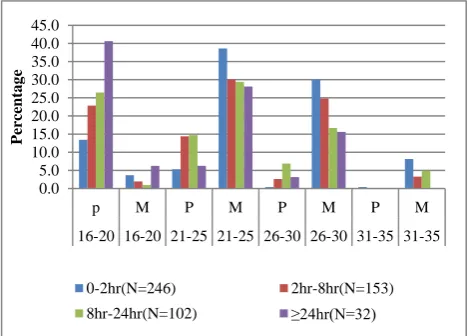
Analysis of parity with time to delivery after admission in different age groups revealed significant association (X2=66.456, p=0.000) (Figure 2).
Figure 2: Time to delivery percent distribution among the nullipara and multiparous mothers in different
age groups.
0.0 5.0 10.0 15.0 20.0 25.0 30.0 35.0 40.0 45.0
p M P M P M P M
16-20 16-20 21-25 21-25 26-30 26-30 31-35 31-35
Perc
entag
e
0-2hr(N=246) 2hr-8hr(N=153)
The time to delivery after admission was more than 24 hours in 40.6% of mothers who are primipara and in the age group less than 20 years while 68.7% of multiparous mothers in age group 21-30 years delivered within 2 hours of admission which signifies delay in reporting to hospital.
Association of episiotomy performed with age of women
The women less than 20 years was 12 times more at risk of performing episiotomy compared to more than 20 years age group (Odds ratio=12.09, 95% Confidence interval=4.30 to 33.93, p<0.0001).
Table 3: Mean mother age, parity and birth weight in different age groups.
Maternal age <20 20-24.9 25-29.9 30-34.9 >35 P*
n=57 n=231 n=175 n=61 n=15
Mother age in years Mean
(SD) 18.8 (0.6) 21.8 (1.4) 26.3 (1.3) 30.8 (1.3) 35.9 (1.6) (0.000)
Parity
Multi - 132 (57.1) 162 (92.6) 56 (91.8) 15 (100.0) 0.000
Nulli 57 (100.0) 99 (42.9) 13 (7.4) 5 (8.2) -
Baby birth weight mean (SD) 2.7 (0.4) 2.8 (0.4) 2.9 (0.4) 2.9 (0.4) 2.7 (0.5) 0.004
Episiotomy 53 (93.0) 159 (68.8) 72 (41.1) 18 (29.5) 3 (20) 0.000
Note:* for continuous variable ANOVA and categorical chi square test done.
Table 4: Predictors of SVD* with episiotomy.
Variable B S.E. Wald df Sig Exp (B) 95% CI for EXP(B)
Lower Upper
Age 0.115 0.030 14.368 1 0.000 1.122 1.057 1.190
Parity 2.600 0.351 54.819 1 0.000 13.460 6.763 26.787
B Wt -0.129 0.241 0.285 1 0.593 0.879 0.548 1.410
Constant -4.759 0.943 25.471 1 0.000 0.009
Note: Hosmer and Lemeshow test show significance at 0.518 hence the model is acceptable. Abbreviation-SVD- Spontaneous vaginal delivery.
Logistic regression analysis
Logistic regression analysis was done with the predictor variables age, parity of mother and newborn birth weight to predict spontaneous vaginal delivery (SVD) with episiotomy. The regression model with intercept only can predict 56.71 but inclusion with these variables helped to improve predictability up to 71.46%. Employing 0.5 criteria of statistical significance the result are tabulated in Table 4. By using the regression model there is 60.67% specificity and 85.59% sensitivity in predicting episiotomy.
DISCUSSION
The overall prevalence of institutional births in rural India has increased from 15% in 1989 to 25% in 1998 and presently 78.9% and in public health facilities 52.1% (NFHS 4, 2015-16) following launch of NRHM in 2005 and implementation of maternal health promotion schemes specially JSY Scheme.14 The present study reveals profile of mothers delivering at Primary health center of Assam, India and related associated factors.
Mother characteristics and newborn outcome
In the present study the mean age (SD) of mother was 24.1 years (±4.09) range 16-40 years, similar mean
maternal age of mother of 23.9±4.0 years (range: 18-40 years) reported from a hospital based study conducted in Madhya Pradesh.15 Comparatively, present study shows lower 10.6% and 2.8% women were below the age of 20 years and above 35 years of age (Table 1) while in the same study this was 17.5% and 5.1% respectively while higher 37.6% and 3.1% reported from Andhra Pradesh.15,17 However, a lower overall mean (SD) age of mother 21.7 years (3.44 years) was observed in a hospital based study conducted in Kolkata among the mothers who had normal delivery.16
In the present study 32.3% women were Primipara and 67.7% multipara (Table 1) which is similar to findings from Madhya Pradesh 37.9% and 62.1% respectively and Andhra Pradesh in contrast to this the study from Kolkata found 55.9% women were primipara and 44.1% multipara.15-17
and additional support in high priority districts and increasing awareness among the community.
A higher rate of episiotomy (56.6%) is observed in the present study compared to 26.1% as reported from Andhra Pradesh.17 40.4% from Nigeirahigher prevalence of episiotomy (62.1%) was observed among women at first birth in Nigeria.18,19
Similar to present finding mother age, parity was found as predictor of episiotomy with vaginal delivery in a study in Nigeria.18 However age of women was not found predictor for episiotomy in primigravida.19 Similar to present finding, birth weight was not a significant factor for episiotomy this could be because most macrosomic babies were delivery by women who were multiparous.20
The present study shows proportion of delivery during 4 PM-8 PM 16% is similar 17% to study conducted at Harare Maternity Hospital, Harare, Zimbabwe.21 However higher 41.6%, 34% and 27.3% is observed in the present study during time period 8 AM–4 PM, 8 PM – 12 AM and 12 AM–8 AM compared to 31%, 15.2% and 18% in the other study
CONCLUSION
The escalation in institutional births, referral and newborn care and provision of additional support in high priority district has invited more qualitative obstetric care at PHC level. From present study it is evident that women report to hospital late in labor and child birth less than 20 years of age results to higher morbidity to both mother and newborn. There is urgent need to provide quality antenatal care services at village and PHC level and augment awareness among the community for promotion of safe motherhood.
Limitation of study
The present study being a retrospective study could not elicit association of other variables such as socio-demographic, antenatal, previous pregnancy history and health seeking behavior of the population studied. Further prospective study is necessary to corroborate present findings
ACKNOWLEDGEMENTS
We acknowledge SDM&HO, Sarojini Nagar PHC, Hailakandi, Assam and staffs for their cooperation all throughout the study work.
Funding: No funding sources Conflict of interest: None declared
Ethical approval: The study was approved by the Institutional Ethics Committee
REFERENCES
1. World Health Organization. Maternal Health and Safe Motherhood Programme (1996). Mother-baby package: implementing safe motherhood in countries: practical guide, Geneva: WHO. Available at: http://www.who.int/iris/handle/10665/63268. Accessed 10 April 2018.
2. World Health Organization. Maternal Health and Safe Motherhood Programme. Care in normal birth: A practical guide: report of a technical working group. Geneva: WHO, 1996.
3. World Health Organization. Managing complications in pregnancy and childbirth: a guide for midwives and doctors – 2nd ed. Geneva: World Health Organization, 2017.
4. Rosenfield A, Maine D. Maternal mortality—a neglected tragedy. Where is the M in MCH? Lancet. 1985;2:83–5.
5. Koblinsky M, Matthews Z, Hussein J, Mavalankar D, Mridha MK, Anwar I, et al. Going to scale with professional skilled care. Lancet. 2006;368:1377– 86.
6. Srivastava RK, Kansal S, Tiwari VK, Piang L, Chand R, Nandan D. Assessment of Utilization of RCH Services and Client Satisfaction under Different Level of Health Facilities in Varanasi District. Indian J Public Health. 2009;53(3):183-9. 7. UNFPA, AMDD Program. Course 6: Reducing
Maternal Deaths: Selecting Priorities, Tracking Progress, 2001.
8. Sawhney N. Management of family welfare programmes in Uttar Pradesh: infrastructure utilisation, quality of services, supervision and MIS. In Family Planning and MCH in Uttar Pradesh (A Review of Studies) Edited by: Premi M. New Delhi: Indian Association for the Study of Population; 1993: 50-67.
9. Kumar RM, Singh M, Kaur M. Impact of health centre availability on utilisation of maternity care and pregnancy outcome in a rural area of Haryana. J Indian Med Assoc 1997, 95(8):448-50.
10. Chowdhury M, Ronsmans C, Killewo J, Anwar I, Gausia K, Das-Gupta S, et al. Equity in use of homebased or facility-based skilled obstetric care in rural Bangladesh: an observational study. The Lancet. 2006;367(9507):327-32.
11. Government of India, Ministry of Health and Family Welfare. National Rural Health Mission (2005- 2012), Mission Document. New Delhi; 2005. 12. WHO High-Level consultation to accelerate
progress towards achieving maternal and child health: Millenium Development Goals (MDGs 4 and 5) in South-East Asia; Ahmedabad, India, 14-17 October 2008.
13. India. Ministry of Health and Family Welfare. National Health Policy of 2002 (India). New Delhi: Ministry of Health and Family Welfare, Government of India, 2002: 41.
importance of accessibility and economic status. BMC Preg Child birth. 2010;10:30
15. Noor N, Kural M, Joshi T, Pandit D, Patil A. Study of maternal determinants influencing birth weight of newborn. Arch Med Health Sci. 2015;3:239-43. 16. Bisai S, Sen A, Mahalanabis D, Datta N, Bose K.
The Effect of Maternal Age and Parity on Birth Weight Among Bengalees of Kolkata, India. Human Ecol (Special Issue). 2006;14:139-43.
17. Devyani D, Sandro S, Swarna Lata N, Paola B. A retrospective observational study of obstetric care in rural Andhra Pradesh by Dangoria Charitable Trust (1979 to 2009): Indian J Med Res. 2013;138:928-34.
18. Onah HE, Akani Cl. Rates and predictors of episiotomy in Nigerian women. Trop J Obstet Gynaecol. 2004;21:44-5.
19. Izuka EO, Dim CC, Chigbu CO, Obiora-Izuka CE. Prevalence and predictors of episiotomy among women at first birth in Enugu, South East Nigeria. Ann Med and Health Sci Res. 2014;4(6):928-32. 20. Owa OO, Eniowo AR, Ilesanmi OS. Factors
associated with episiotomy among parturients delivering in a tertiayry Centre in Nigeria. Int J Res Med Sci. 2015;3:836-40.
21. Mahomed K, Zvadasara P, Chikodzore R. Time of delivery - effect on obstetric outcome: A retrospective study. Central Africa J Med. 1991;37(8):234-7.
Cite this article as: Dey AK, Chutia D.A study on