Original Research Article
Outbreak investigation and control measures following dengue fever
cases in Vadodara, July-August 2017
Raman D. Damor
1, Jyotsna F. Maliwad
2*, Kalpita S. Shringarpure
1, Bansari L. Chawda
1,
Neelam N. Pandya
3, Varoon J. Vadodariya
4INTRODUCTION
Dengue viruses, single-stranded ribonucleic acid (RNA) viruses of the Flaviviridae family, are the most common cause of arboviral disease in the world.1Dengue fever is one of the most serious vector borne disease’s spread by
Aedes aegypti and Aedes albopictus mosquitoes. Dengue
is self-limiting and out of the four serotypes DENV-1, DENV-2, DENV-3 and DENV-4, type 1 is commonly responsible for outbreak of dengue fever.2,3 A dramatic global increase has been reported in the frequency of
dengue fever, dengue haemorrhagic fever, dengue shock syndrome and their epidemics. Spectrum of disease is variable which ranges from dengue fever (DF), dengue hemorrhagic fever (DHF) to dengue shock syndrome (DSS).The paradigm shift in transmission of vector borne diseases shows rapidly increases in dengue fever cases throughout the India.4The mortality is as high as 15-20% with exact nature of the disease still being unknown.5
Annually approximate 50 million dengue infections occur worldwide, of whom 5,00,000 people with DHF require
ABSTRACT
Background: Dengue fever is one of the major public health problems among all the vector born diseases. It is an
emerging disease of tropical and sub-tropical regions, affecting urban, peri-urban and rural areas. Twenty five cases of dengue fever were reported in our hospital and other private hospitals from Undera village, which is in the peri urban area of Vadodara, so an investigation was carried out. The objective of this study is to find out the incidence and demographic details of people affected by fever during the outbreak and to find the environmental factors responsible for the outbreak.
Methods: Community based, cross-sectional, direct interviewing of community members of Undera village in
Vadodara district was carried out on 21st August 2017 and 23rd August 2017.
Results: In this outbreak investigation, 219 fever cases were reported from 2930 population residing in 645 houses.
There were 25 confirmed cases of dengue fever, out of which three deaths were reported. This included one pregnant woman during this outbreak. Seventy percent of fever cases were in the age group 0-30 years. Daily wagers were affected more than other occupations. At least one fever case was reported from 109 houses. Breeding places for mosquitoes were observed surrounding the houses from were fever cases reported.
Conclusions: The dengue fever outbreak was confirmed through laboratory as well as clinico-epidemiological
correlation with confirmed clinical picture and presence of breading places of Aedes mosquitoes. The fatality rate was 12% and there were three complicated deaths.
Keywords: Dengue haemorrhagic fever, Rapid response team, Aedes mosquitoes
1
Department of Community Medicine, 2Department of Anaesthesiology, 3Department of Microbiology, 4Department of Medicine, Medical College, Baroda, Gujarat, India
Received: 03 November 2019
Accepted: 19 November 2019
*Correspondence:
Dr. Jyotsna F. Maliwad, E-mail: [email protected]
Copyright: © the author(s), publisher and licensee Medip Academy. This is an open-access article distributed under
the terms of the Creative Commons Attribution Non-Commercial License, which permits unrestricted non-commercial use, distribution, and reproduction in any medium, provided the original work is properly cited.
hospitalization every year and about 2.5% of those affected die.
As per WHO out of 390 million dengue infection per year of which 96 million manifest clinically, 3.9 billion people are at risk of infection dengue virus. Dengue risk is in 128 countries, 70% burden is in Asia.6
There have been an estimated 9221 dengue deaths per year between 1990 and 2013, increasing from a low of 8277 in 1992, to a peak of 11,302 in 2010.7 This yielded a total of 576 900 years of life lost to premature mortality for which dengue is responsible in 2013.8
If we count fatal and non-fatal outcomes together, dengue was responsible for 1∙14 million (0∙73 million–1∙98 million) disability-adjusted life-years in 2013.9
The incidence of dengue increased greatly between 1990 and 2013, with the number of cases more than doubling every decade, from 8∙3 million apparent cases in 1990, to 58∙4 million apparent cases in 2013.8
Changes in environment, industrialization, life style changes and deficient water management including improper water storage practices in urban, peri-urban and rural areas the number of dengue cases increases in the last decade all over India.1
Disease burden in Gujarat is also high with 8028 cases and 14 deaths in 2016 and 4565 cases including four deaths in 2017.7
Objective
Diagnosis of outbreak of fever is always a challenging task. Therefore we carried out this study evaluating several epidemiological, clinical and pathological diagnoses to come to a final diagnosis. Understanding the differential diagnosis and coming to a confirmatory diagnosis of fever cases in peri-urban area of Vadodara city.
The study identifies the factors responsible for the outbreak and to provide recommendations to prevent future outbreaks. The study report shares experiences of outbreak investigation carried out by RRT for fever in peri urban area of city.
METHODS
Outbreak alert for increased fever cases was received on 20th august 2017 from District Heath Office regarding 25 fever cases with three deaths from peri urban area, village under of Vadodara district. After receiving alert a rapid response team (RRT) consisting of consultant from community medicine, medicine and microbiology department from Medical College was formed.
Pre-planning meeting was done with concerned Head of Departments and RRT Members for investigating fever outbreak, rapid preventive measures to control spread of disease and treat affected patients accordingly.
The team visited affected area on 21st August 2017. First clinical examination was done of admitted cases at health facility followed by Epidemiological surveillance including house to house survey for active case finding. Follow up visit was done 23rd August 2017.
Outbreak case definition was defined “as any person identified with acute febrile illness of 2-7 days duration with two or more of the following signs and symptoms (headache, retro-orbital pain, myalgia, arthralgia and/or rash) from 10th July to till 23rd August 2017 and residing in Undera village of Vadodara district.10
Total 219 cases of fever were reported during period of 10th July to 23rd August 2017 and out of 44 suspected for cases of dengue. Serum sample for laboratory investigation was taken and sent to laboratory. All other necessary demographic information was also collected for further communication and to take action. Epidemiological surveillance including house to house survey for active case finding was done in localities from dengue cases was confirmed. Figure 1 shows the epidemic investigation of fever.
Figure 1: Flow chart for epidemic investigation of fever.
Entomological investigation
index (CI) and Breteau index (BI) to estimate the prevalence and density of vectors in the affected community. Each of them was calculated as follow.13,14
HI = Number of house positive for 𝐴𝑒𝑑𝑒𝑠 larvaTotal house inspected × 100
CI = Number of container positive for 𝐴𝑒𝑑𝑒𝑠 larva
Total container inspected × 100
BI = Number of container positive for 𝐴𝑒𝑑𝑒𝑠 larva
Total house inspected × 100
Data analysis
The data on clinical, epidemiological, entomological and laboratory results were collected and analyzed using
Microsoft Excel 2007 and Epi Info 7.0.2.3. For data presentation descriptive statistics like percentage, mean, median, standard deviation (SD) and graphs were used to explain observations and finding from outbreak investigation.
RESULTS
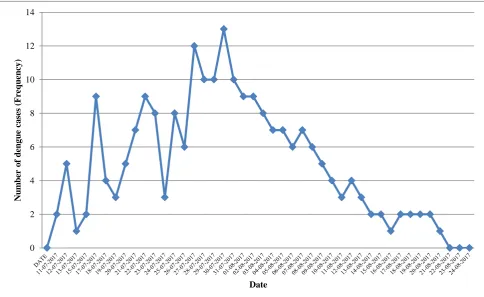
Epidemiological investigation and reporting showed 219 fever cases during the period of outbreak over 45 days (Figure 2). These cases included 106 (48.40%) males with 70% of patients in the age group of 0-30 years age group (Table 1).
Most common symptoms were fever, chills, headache, body ache and weakness (Figure 3).
Figure 2: Epidemic curve of fever cases.
Table 1: Demographic characteristics of total fever cases (n=219).
Age group (years) Male Female Total
N (%) N (%) N (%)
0-15 41 (58.57) 29 (41.43) 70 (31.96)
16-30 36 (42.35) 49 (57.65) 85 (38.81)
31-45 17 (39.53) 26 (60.47) 43 (19.64)
>45 12 (57.15) 9 (42.95) 21 (09.59)
Total 106 (48.40) 113 (51.60) 219
χ2=1.22 P=0.27
0 2 4 6 8 10 12 14
N
u
m
b
er
o
f
d
en
g
u
e
ca
se
s
(Fr
eq
u
en
cy
)
Figure 3: Common symptoms of all fever cases (multiple responses, n=219).
Table 2: Distribution of laboratory confirmed dengue fever cases (n=44).
Age group (years) Male female Total Laboratory confirmed (%)
0-15 9 6 15 13 (86.66)
16-30 6 14 20 9 (45)
31-45 2 4 6 2(33.33)
>45 1 2 3 1 (33.33)
Total 18 26 44 25 (56.19)
Table 3: Entomological indices for the surveyed geographical area (n=137).
Locality Total HH inspected
Positive houses
Container inspected
Container with larvae
HI (%)
CI (%)
BI (%)
A 31 6 109 13 19.3 11.9 41.9
B 29 9 119 10 31.1 08.4 34.4
C 20 2 73 03 10 04.1 15.0
D 09 1 37 07 11.1 18.9 77.7
E 24 4 56 17 16.6 30.3 70.8
F 17 2 24 3 11.7 12.5 17.6
G 07 2 21 2 28.5 9.52 28.5
Total 137 26 438 55
HH: House-to-house; HI: House index; CI: Container index; and BI: Breteau index. Mean: HI-18.32, SD-7.89; CI-13.66, SD-7.97; BI-40.84, SD-22.86.
Serum sample for laboratory investigation were sent for 44 of the patients suspected for dengue. Of 44 suspected fever cases tested in laboratory, 25 (56.81%) were confirmed positive for NS1 (nonstructural antigen) and/or IgG, IgM antibodies for dengue virus, with most of them being confirmed from the age group of 0-15 years (86.7%). There were three deaths out of confirmed 25
cases, with case fatality rate being (12%) one antenatal mother (Table 2).
The entomological indices were calculated after inspection of houses. Out of 137 houses inspected, 26 (18.97%) houses showed presence of larvae inside or outside the houses. Of the 438 container inspected 55
0 50 100 150 200 250
Fever Hedache Chills Bodyache Arthralgia Myalgia Retro orbital pain Diarrhoea Weakness Giddiness Cough Abdominal pain Vomiting Petechie Hemetemesis Drowsiness Unconscious
Number of cases
S
y
m
p
to
m
these houses was 18.32%, 13.66%, 40.84% respectively between 10th July to 25th of August 2017 (Table 3).
DISCUSSION
There are various methods for epidemic investigations; with some tailor made changes for each. We present here the investigation of epidemic for fever cases and the measures thereof to contain at and steps taken to prevent further outbreak.
We confirmed Dengue outbreak in Undera village which is a peri-urban area of Vadodara district. Dengue is seasonal and increase in incidence is seen during raining season. Dengue outbreak in Undera village may have been due to heavy rainfall, unplanned urbanization, sanitation practices in peri urban area and substandard housing condition which led to accumulation of rain and other water in various containers (drums, drains, tyres, flower pots and on terrace) and high temperature after the rain, which is conducive for breeding of larva.11,12,15,16 Dengue incidence increases with an interval of three to four weeks lag time between the rainfall stop which is observed in this outbreak.2
Current dengue outbreak shows some severe and complicated dengue cases, includes three deaths (one pregnant woman and two paediatric patients). Thus mortality risk was high in vulnerable groups, although dengue is totally preventable and self-limiting disease. Males are more affected than females, due to outdoor activities and day time bites habit of Aedes mosquitoes; however in this study almost equal number of males and females were affected
DENV-1 virus prototype has been predominant as compared to other three virus serotype (DENV-1,2,3 and 4) in past three years and also during dengue surveillance conducted in India 2017.2,8,17 In this outbreak also DENV-1 is predominant.
Among containers, tyres, drums and flower pots and terrace were found to be the breeding of Aedes in large numbers. Natural containers, tree holes and accumulated water around the household premises were also found positive for larva. The high entomological index is an alert for increasing number of vector control and other intervention measures. The high number of larva found in different containers in different places necessitated immediate control measures to be implemented to contain dengue outbreak. Aedes aegypti and albopictus were found in surrounding area from where the dengue positive cases were reported with preponderance of the earlier one. Similar findings were observed in other studies.18,19
Control and preventive measures taken
All Patients admitted at Community Health Centre were examined and treatment given as per NVBDCP guidelines.11
On initial day of visit and in follow up visits, house to house survey was done for active case finding in presence of District health officials. Entomological survey was done with the help of paramedical staff for case detection, identification of breeding places and creating awareness in people of affected locality.
Anti-larval and anti-adult measures for mosquitoes were taken; fogging was carried out in all affected locality of Undera village.
We also ensured referral linkages for diagnosis and treatment of cases between local government health facility and Medical College, which is tertiary care hospital of Vadodara city.
Follow-up measures
Active case finding increased the number of cases initially; as evident from the propagated epidemic curve.
Physician and Medical officers from Community Health Centre and Primary Health centre of affected area were trained and immediate referral of patients requiring further management to tertiary care hospital was managed and streamlined.
Active surveillance for fever cases and vector control measures were continued for timely management and preventing spread of the disease.
Community participation in terms of good sanitation practices and use of ITBNs as well as person protective measures was identified and advocated through health talk and school education.
Rapid communication network was developed to keep on updating the District and State health officials for implementing control activities in the affected village
Recommendations
Active searching of new fever cases for early diagnosis, management and timely referral to prevent complication and spread of disease.
Surveillance should be continued for early detection of new case and breading places for mosquito.
Integrated vector control measures required in all the society of Undera village- source reduction, anti-larval activity, anti-adult measures (fogging) and personal protective measures especially use of ITBNs for high risk peoples.
Distribution of IEC material and Health education during house to house visit for creating awareness.
Proper engineering measures (role of panchayat) required for treatment of sewage and waste water for prevention of water borne disease and vector born disease in future.
Funding: No funding sources Conflict of interest: None declared
REFERENCES
1. Ahmed NH, Broor S. Dengue Fever Outbreak in Delhi, North India: A Clinico-Epidemiological Study. Indian J Community Med. 2015;40(2):135–8. 2. WHO. Dengue guidelines for diagnosis, treatment,
prevention and control. 2009. Available at: www.who.int/tdr. Accsssed on 29th October 2019. 3. Sam SS, Omar SFS, Teoh BT, Abd-Jamil J,
AbuBakar S. Review of Dengue Hemorrhagic Fever Fatal Cases Seen Among Adults: A Retrospective Study. Volume 7. PLoS Neglected Tropical Diseases. Public Library of Science; 2013.
4. Murhekar MV, Kamaraj P, Kumar MS, Khan SA, Allam RR, Barde P, et al. Burden of dengue infection in India, 2017: a cross-sectional population based serosurvey. Lancet Glob Heal. 2019;7(8):e1065–73.
5. Sarkar S. Flavivirus in India :A major threat for public health and mortality. Asian J Bio Sci. 2017;12(1):48–50.
6. WHO. Dengue and severe dengue; 2019.
7. NVBDCP. Dengue Cases and Deaths in the Country since 2010; 2017.
8. Stanaway JD, Shepard DS, Undurraga EA, Halasa YA, Coffeng LE, Brady OJ, et al. The global burden of dengue: an analysis from the Global Burden of Disease Study 2013. Lancet Infect Dis. 2016;16(6):712–23.
9. Hung TM, Clapham HE, Bettis AA, Cuong HQ, Thwaites GE, Wills BA, et al. The Estimates of the Health and Economic Burden of Dengue in Vietnam. Trends Parasitol. 2018;34(10):904–18. 10. Wangchuk S. Report on Outbreak Investigation of
Dengue Fever in Phuntsholing; 2016.
11. WHO. National guideline for clinical management of dengue; 2014: 1–55.
12. Operational guideline for urban VBD Scheme-2016; 2016: 1–68.
13. WHO. National guidelines for clinical management of Dengue-2014; 2014: 1–55.
14. NVBDCP _ National Vector Borne Disease Control Programme; 2019.
15. WHO. Dengue Changing epidemiology; 2019: p. 1–4.
16. Chandran R, Azeez PA. Outbreak of dengue in Tamil Nadu, India. Volume 109. Current Science; 2015.
17. Anand AM, Sistla S, Dhodapkar R, Hamide A, Biswal N, Srinivasan B. Evaluation of NS1 antigen detection for early diagnosis of dengue in a tertiary hospital in Southern India. J Clin Diagnostic Res. 2016;10(4):DC01-DC04.
18. An Investigation of the Risk Factors of a Dengue Fever Outbreak in Sanmin District, Kaohsiung City; 1998.
19. Jain S, Mittal A, Sharma SK, Upadhyay AD, Pandey RM, Sinha S, et al. Predictors of dengue-related mortality and disease severity in a tertiary care center in north India. Open Forum Infect Dis. 2017;4(2) ofx056.
Cite this article as: Damor RD, Maliwad JF,