Original Research Article
A study on disability in terms of activities of daily living among elderly
in Palam village of west Delhi
Devendra Kumar*, S. K. Rasania, Ranjan Das
INTRODUCTION
Elderly or old age consists of ages nearing or surpassing the average life span of human beings. In India persons of age 60 years or aboveare considered as senior citizen or elderly.1
Low birth rates coupled with long life expectancies push the population to an ageing humanity. The phenomenon of population ageing is becoming a major concern for the policy makers all over the world, for both developed and developing countries during last two decades.2
Aging, an integral part of living, typically is accompanied by gradual but progressive physiological changes and an increased prevalence of acute and chronic illness.
Although neither a disease nor disability per se, aging nonetheless is associated with a high incidence of physical impairment as well.3
International classification of functioning, disability and health (ICF) has used functioning as an umbrella term encompassing all body functions, activities and participation. Similarly disability serves as an umbrella term for impairment, activity limitation and participation restriction.4
Very old people, due to their reduced mobility and debilitating disabilities, need other people to do things for them. With the increasing trend of nuclear families in the society and with fewer children in the family, the care of older persons in the families gets increasingly difficult. Maintaining health of the elderly is very significant for ABSTRACT
Background: Aging, an integral part of living, typically is accompanied by gradual but progressive physiological changes and an increased prevalence of acute and chronic illness. Although neither a disease nor disability per se, aging nonetheless is associated with a high incidence of physical impairment as well.The objective of the present study was to assess the prevalence of activities of daily living (ADL) disability in elderly living in Palam village of Delhi.
Methods: A community based cross-sectional study was carried out to assess the prevalence of ADL disability in elderly living in Palam village of Delhi using Barthel ADL index. It uses ten variables describing ADL and mobility. The sample size was estimated to be 350 and systematic random sampling was used to choose the study subjects. Results: The prevalence of ADL disability was found to be 20.3% in the study population. This was found to be 16.3% in males and 23.9% in females.
Conclusions: After obtaining adequate data on elderly having difficulty in performing their routine activities of daily living, appropriate steps needs to be taken to mitigate its ill effects which should also address their health care needs and help them to live a healthy and good quality life.
Keywords: Elderly, Activities of daily living, Disability
Department of Community Medicine, Lady Hardinge Medical College, New Delhi, India
Received: 19 August 2019 Accepted: 13 September 2019
*Correspondence: Dr. Devendra Kumar,
E-mail: [email protected]
Copyright: © the author(s), publisher and licensee Medip Academy. This is an open-access article distributed under the terms of the Creative Commons Attribution Non-Commercial License, which permits unrestricted non-commercial use, distribution, and reproduction in any medium, provided the original work is properly cited.
any country and it holds special importance in India as many of them have to continue to work even when they becomes senior citizens, so good health is what can keep them and their families going on.
METHODS
Study type
An observational study.
Study design
A community based cross-sectional study.
Study area and period
The community based cross-sectional study was carried out in Palam village in West Delhi from January to December 2016 which is one of the field practice area of Community Medicine Department, Lady Hardinge Medical College, New Delhi.
Study methodology
A semi-structured interview schedule was administered to all the study subjects for obtaining socio-demographic details. Sample size was calculated using the prevalence of 19% (at least one ADL restriction), absolute error of 5%, (confidence interval=95%, power=80%).5 Taking design effect of 1.25 and response rate of 90%, the effective total sample size was 350.
According to population census 2011, >60 years population constitutes around 9% of total population. In Palam village, elderly population is around 960 of the total population of Palam village which is around 10700, (2015). 1st house was selected randomly and subsequent houses were selected by systematic random sampling (every 2nd house was taken to choose the study subjects). To get the total sample size of 350 elderly, we had to screen 418 households. People aged more than 60 years of both sexes in the study area and willing to participate were included in the study while those who are known case of psychiatric illness or refuse to give informed
consent were excluded from the study.
The Barthel ADL index, an ordinal scale, freely available was used for assessment of activities of daily living disability (ADL Disability) in the study.6,7 It uses ten
variables describing ADL and mobility. Each
performance item is rated on this scale with a given number of points assigned to each level or ranking yielded a score of 0-20. The ten variables addressed in the Barthel scale are as presence or absence of fecal incontinence, presence or absence of urinary incontinence, help needed with grooming, help needed with toilet use, help needed with feeding, help needed with transfers , help needed with walking, Help needed with dressing, help needed with climbing stairs and help needed with bathing. ADL disability is defined in the study subject if the total score in Barthel ADL index is <20. 6,7
Data entry and statistical analysis
Data entered in proforma subsequent to interview was checked for correctness manually before entering them into a spreadsheet database created and analysis which was done using Statistical Package for Social Sciences (SPSS version 19).
RESULTS
The study population consisted of 166 (47.4%) males and 184 (52.6%) females. Mean age of the study subjects was 67.40±6.63 years, range is 60-93 years. Majority of the study subjects (94.9%) were Hindu while 3.7% were Muslims and 1.4% was Sikhs. On the basis of educational status it was seen that majority of the study subjects (47.1%) were illiterate. Among males, 22.3% were illiterate and 22.9% had education up to primary school and 8.4% were having graduate or post graduate degree. Among females 69.6% were illiterate, only 9.2% had education up to primary school and 5.1% were having graduate or post graduate degree. There were 80.7% of currently married males compared to 57.6% of currently married females and 42.4% of females were widows compared to 18.7% males who were widowers. However there were 0.6% of never married males compared to none amongst females.
Table 1: Socio-demographic characteristics of the study population.
Characteristics
Sex of the subject
Total (n=350)
Male (n=166) Female (n=184)
N (%) N (%) N (%)
Age (in years)
60-69 107 (64.5) 124 (67.4) 231 (66.0)
70-79 44 (26.5) 44 (23.9) 88 (25.1)
80 and above 15 (9.0) 16 (8.7) 31 (8.9)
Religion
Hindu 158 (95.2) 174 (94.6) 332 (94.9)
Muslim 5 (3.0) 8 (4.3) 13 (3.7)
Characteristics
Sex of the subject Total (n=350)
Male (n=166) Female (n=184)
N (%) N (%) N (%)
Educational status
Illiterate 37 (22.3) 128 (69.6) 165 (47.1)
Primary school 38 (22.9) 17 (9.2) 55 (15.7)
Middle school 15 (9.0) 7 (3.8) 22 (6.3)
High school certificate 44 (26.5) 20 (10.9) 64 (18.3)
Intermediate or post high school diploma 16 (9.6) 7 (3.8) 23 (6.6)
Graduate or post graduate 14 (8.4) 4 (2.2) 18 (5.1)
Professional 2 (1.2) 1 (0.5) 3 (0.9)
Marital status
Married 134 (80.7) 106 (57.6) 240 (68.6)
Unmarried 1 (0.6) 0 (0.0) 1 (0.3)
Widow or widower 31 (18.7) 78 (42.4) 109 (31.1)
*Figures in bracket represent column percentage.
Among males, 57.8% reported their spouse as their primary care givers, daughter in law by 22.3% and 1.2% of males reported no primary caregivers for them.
Whereas 23.9% of females reported their spouse, 50.5% reported daughter in law as their primary care givers and 5.9% reported no primary care givers for them.
Table 2: Primary caregivers of the study population.
Care giver (relationship)
Sex of the subject
Total (n=350)
Male (n=166) Female (n=184)
N (%) N (%) N (%)
Spouse 96 (57.8) 44 (23.9) 140 (40.0)
Daughter in law 37 (22.3) 93 (50.5) 130 (37.1)
Children 24 (14.5) 24 (13.0) 48 (13.7)
Other relatives 7 (4.2) 12 (6.5) 19 (5.4)
None 2 (1.2) 11 (5.9) 13 (3.7)
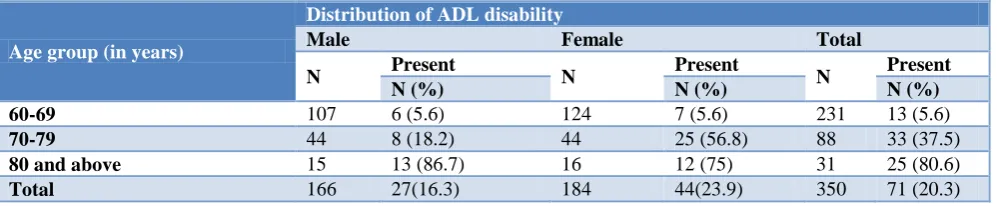
The prevalence of ADL disability was found to be 20.3% in the study population. This was found to be 16.3% in
males and 23.9% in females. An increasing trend in the prevalence was noted with increase in age of study subjects.
Table 3: Prevalence and distribution of ADL disability in study population.
Age group (in years)
Distribution of ADL disability
Male Female Total
N Present N Present N Present
N (%) N (%) N (%)
60-69 107 6 (5.6) 124 7 (5.6) 231 13 (5.6)
70-79 44 8 (18.2) 44 25 (56.8) 88 33 (37.5)
80 and above 15 13 (86.7) 16 12 (75) 31 25 (80.6)
Total 166 27(16.3) 184 44(23.9) 350 71 (20.3)
DISCUSSION
The study population consisted of 350 elderly out of which 166 (47.4%) were males and 184 (52.6%) were females giving a sex ratio of 1108, in favour of females matching with the population census 2011 data in which the sex ratio among elderly people was found to be 1033. The age and sex distribution of the study subjects in our study (Table 1) was similar to the studies conducted by Gupta et al among elderly persons in a rural area of Haryana, Singh et al in rural area of Patiala District,
Goswami et al in Ballabhgarh district of Faridabad, Haryana as majority of the elderly population was in the 60-69 year age group and females were more than males.8-10
In the present study, spouse was elicited as the primary caregiver by majority of the elderly followed by daughter in law (Table 2). Similar findings were seen in the studies done by Mandal et al in Delhiand Bisht et al in Nepal.12,13
Using the 10 items Barthel scale, prevalence of ADL disability in the present study was found to be 20.3% (Table 3). It was found to be 22% in study done by Venkatarao et aland 16% in study done by Chakrabarty et al.14,15 Day et al reported prevalence of ADL disability only 6.9% as it was a hospital based and included the elderly who attended the geriatric clinic only.16
The prevalence of ADL disability in the present study was similar to some studies done in countries like Japan (20%), Malaysia (19.8%).17,18 However lesser prevalence was noticed in studies carried out in USA (15%) done by Chaudhry et al, which can be due to better health care facilities and health seeking behaviour of the study population in that geographical portion.19 The prevalence was reported to be higher in studies done in other developing countries like Nigeria (28%) and Brazil (40%).20, 21
Konjengbam et al conducted a cross sectional study in Imphal and found 12.2% of elders to be disabled in ADL, and it was reported to be 15.5% by Pereira et al in their study done in Porto Alegre, Brazil.11,22 However both the studies used Katz index to evaluate basic activities of daily living.
CONCLUSION
Maintaining health of the elderly is very significant for any country and it holds special importance in India as many of them have to continue to work even when they becomes senior citizens, so good health is what can keep them and their families going on. Appropriate social and economic policies need to be made specially focussing on elderly with disability to mitigate its ill effects which should also address their health care needs also and help them to live a healthy and good quality life.
Recommendations
The health policies and programmes running for the welfare of the elderly must adopt a life cycle approach which tackle health problems from the beginning and enable people to grow older with minimum of disabilities. Elderly living without families or under difficult conditions should be identified in the community and proper care should be provided to them with the help of health workers. Social security schemes and medical benefits for the elderly should be strengthened up and made available to larger sections of the elderly. Elderly needing supportive items like walking sticks or calipers, walker (ordinary) etc., should be identified and should be provided with them starting from the sub centre level only.
Funding: No funding sources Conflict of interest: None declared
Ethical approval: The study was approved by the Institutional Ethics Committee
REFERENCES
1. National policy for older persons, 1999. Available at: http://socialjustice.gov.in/writereaddata/Upload File/National%20Policy%20for%20Older%20 Persons%20Year%201999.pdf. Accessed on 2 April 2017.
2. Situation analysis of the elderly in India, 2011. Available at: http://mospi.nic.in/sites/default/files/ publication_reports/elderly_in_india.pdf. Accessed on 5 April 2017.
3. Konjengbam S, Bimol N, Singh AJ, Singh AB, Devi EB, Singh YM. Disability in ADL among the ederly in an urban area of Manipur. Indian J Pharm Med Res. 2007;18(2):41-3.
4. WHO. ICF- International Classification of Functioning, Disability and Health. Geneva: WHO Library; 2001.
5. Venkatarao T, Ezhil R, Jabbar S, Ramkrishnam R. Prevalence of disability and handicaps in geriatric population in rural south India. Indian J Public Health. 2005;49(1):11-7.
6. Collin C, Wade DT, Davies S, Horne V. The Barthel ADL index: a reliability study. Int Disabil Stud. 1988;10(2):61-3.
7. Wade DT, Collin C. The Barthel ADL index: a standard measure of physical disability?. Int Disabil Stud. 1988;10(2):64-7.
8. Gupta P, Mani K, Rai SK, Nongkynrih B, Gupta SK. Functional Disability Among Elderly Persons in a Rural Area of Haryana. Indian J Public Health. 2014;58(1):11-6.
9. Singh N, Kumar S, Muzammil K, Raghav SK, Singh JV. Assessment of functional status in the elderly persons in the rural area of Punjab. Indian J Community Health. 2014;26(1):25-9.
10. Goswami A, Reddiah VP, Kapoor SK, Singh B, Singh U, Dey AB, et al. Prevalence and determinants of disability in the rural elderly population in Northern India. Indian J Phys Med Rehabil. 2005;16:39-44.
11. Konjengbam S, Bimol N, Singh AJ, Singh AB, Devi EV, Singh YM. Disability in ADL among the Ederly in an Urban Area of Manipur. Indian J Pharm Med Res. 2007;18(2):41-3.
12. Mandal A. A clinicosocial study of psychiatric disorders and related health care needs of the elderly in Delhi [MD thesis]. New Delhi: University of Delhi; 2002.
13. Bisht PS. Population ageing: global and Nepalese perspectives. Population and Development in Nepal. 2000;7:167-82.
population in rural south India. Indian J Public Health. 2005;49(1):11-7.
15. Chakrabarty D, Mandal PK, Manna N, Mallik S, Ghosh P, Chatterjee C, et al. Functional disability and associated chronic conditions among geriatric populations in a rural community of India. Ghana Med J. 2010;44(4):150-4.
16. Dey AB, Soneja S, Nagarkar KM, Jhingan HP. Evaluation of the health and functional status of older Indians as a prelude to the development of a health programme. Natl Med J India. 2000;14(3):135-8.
17. Woo J, Ho SC, Yuen YK, Yu LM, Lau J. An estimation of the functional disability burden in elderly Chinese age 70 years and over. Disabil Rehabil. 1996;18(12):609-12.
18. Aris M, Aznan M, Draman S, Ab Rahman J, Samsuddin N. Functional disabilities and its associated factors among elderly patients in primary care clinics. Int Med J Malaysia. 2009;16(4):251-6. 19. Chaudhry SI, McAvay G, Ning Y, Allore HG,
Newman AB, Gill TM. Geriatric impairments and
disability: the cardiovascular health study. J Am Geriatr Soc. 2010;58(9):1686-92.
20. Abdulraheem IS, Oladipo AR, Amodu MO. Prevalence and correlates of physical disability and functional limitation among elderly rural population in Nigeria. J Aging Res. 2011;2011:369894. 21. Fillenbaum GG, Blay SL, Andreoli SB, Gastal FL.
Prevalence and correlates of functional status in an older community- representative sample in Brazil. J Aging Health. 2010;22(3):362-83.
22. Pereira GN, Bastos GA, Del Duca GF, Bos AJ. Socioeconomic and demographic indicators associated with functional disability in the elderly. Cad Saude Publica. 2012;28(11):2035-42.